Credit: Angewandte Chemie International Edition (2024). DOI: 10.1002/anie.202419869
Detection of nitric oxide (NO) is important for monitoring air quality because the NO released in the combustion of fossil fuels contributes to acid rain and smog. In medicine, NO is an important messenger molecule and serves as a biomarker for asthma.
An international research team now reports a material that can detect NO reversibly, with low power, and with high sensitivity and selectivity: a copper-containing, electrically conducting, two-dimensional metal–organic framework. The findings are published in the journal Angewandte Chemie International Edition.
Metal–organic frameworks (MOFs) are latticelike structures consisting of metal “nodes” connected by organic bridges (ligands). An emerging class of MOFs are electrically conducting structures consisting of layers.
These 2D-cMOFs have demonstrated great potential as chemiresistive sensors that react to the presence of specific molecules with a change to their electrical resistance, which may allow for particularly sensitive and low-power detection of toxic gases.
Problems with such systems have included cross-reactivity with a variety of gases and limited reusability due to irreversible binding of the analytes.
Katherine A. Mirica, Christopher H. Hendon, and their team at Dartmouth College (Hanover, NH, U.S.), the University of Oregon (Eugene, OR/U.S.), and Ulsan National Institute of Science and Technology (South Korea), have now developed a reusable 2D-cMOF for the highly selective detection of NO. They chose to use a 2D-cMOF based on copper and hexaiminobenzene, Cu3(HIB)2.
Thanks to their different synthetic strategy (the linker was added as an undissolved powder to a solution of Cu2+ ions and potassium acetate), the team produced a material with significantly higher crystallinity (rod-shaped crystallites about 500 nm in length) than has previously been attained.
The crystallites consist of stacked layers of a weblike structure of six-membered rings linked together by copper ions bound to their nitrogen atoms. Spectrometric analyses and computations revealed that the binding sites for NO were Cu-bis(iminobenzosemiquinone) units of the copper-2D-cMOFs. An analogous compound made with nickel instead of copper demonstrated no significant absorption of NO.
Evidently, copper ions with a single positive charge, which are present in small amounts in the structure besides those with a twofold positive charge, play an important role in binding NO. Computational studies suggest that the adsorbed NO significantly distorts the structure, destabilizing the bound state, which is the primary cause for the desirable reversibility of the NO adsorption.
This new sensor material detects NO at room temperature and low voltage (0.1 V) with high sensitivity (detection limit about 1.8 ppb) and could be reused for at least seven cycles without regeneration. Quantitative measurements of NO were also successful in the presence of moisture, and showed high enhancement of sensor signal towards NO in comparison to other gases, such as nitrogen dioxide, hydrogen sulfide, sulfur dioxide, ammonia, and carbon monoxide and dioxide.
More information:
Hyuk‐Jun Noh et al, Reversible and Ultrasensitive Detection of Nitric Oxide Using a Conductive Two‐Dimensional Metal–Organic Framework, Angewandte Chemie International Edition (2024). DOI: 10.1002/anie.202419869
Provided by
Dartmouth College
Citation:
Ultrasensitive detection of nitric oxide using a conductive 2D metal–organic framework (2024, December 12)
retrieved 12 December 2024
from https://phys.org/news/2024-12-ultrasensitive-nitric-oxide-2d-metalorganic.html
This document is subject to copyright. Apart from any fair dealing for the purpose of private study or research, no
part may be reproduced without the written permission. The content is provided for information purposes only.
Understanding how plants reproduce is critical to understanding ecosystem dynamics, and pollination plays a vital role in these processes. Most flowering plants, or angiosperms, rely on animals for pollination, while about 10% depend on the wind to spread their pollen.
But here is where things get even more intriguing: some plants use both animals and the wind to reproduce, a strategy called ambophily. Despite how fascinating this sounds, ambophily has been largely overlooked in pollination research, with less than 1% of studies evaluating ambophilous species. This lack of studies has left scientists with a dilemma: is ambophily truly rare, or we haven’t been paying enough attention to it?
Ambophily might actually be a clever evolutionary strategy that helps plants thrive in challenging environments, especially where animal pollinators are scarce. For example, open habitats like tropical highland grasslands create the perfect conditions for both animal and wind pollination, which could explain why we find more ambophilous species there than previously thought. However, past research in these ecosystems has often focused on primarily wind-pollinated species, leaving a big part of the plant community unexplored.
With this gap in mind, Amanda Pacheco and her team from the Instituto de Pesquisas Jardim Botânico do Rio de Janeiro examined 63 plant species in the campos de altitude at Itatiaia National Park, an incredible location in southeastern Brazil at about 2,300 meters above sea level. The researchers wanted to evaluate how both wind and animal pollination contributed to seed production in these plants. To do this, they conducted controlled pollination experiments, where some flowers were bagged to either exclude or allow wind or animal pollination. By the end of their experiments, they considered a species to be ambophilous if both animal and wind-pollinated flowers produced viable seeds.
Bagging flowers for the controlled pollination experiment. Photo by Amanda Pacheco.
The researchers found that 7 of the 63 plant species (11%) were pollinated by both animals and wind, meaning they are ambophilous. While this number might sound rather low, it increases the number of known ambophilous species by around 5% and all these records come from a single plant community.
The high frequency of ambophily in the campo de altitude can be explained by a combination of environmental factors, including adequate wind speeds, open vegetation, and low animal visitation rates. Moreover, most ambophilous species in this ecosystem had small and pale flowers that can be pollinated by many small insects, such as beetles, flies and wasps. The flower morphology doesn’t prevent wind from transporting pollen, suggesting that wind could act as a complementary source of pollination. One could say that this dual strategy allows plants to embrace the best of both worlds: wind ensures pollination even when animals are scarce, while insects provide targeted pollen delivery.
The seven ambophilous species found in this study. (A) Achyrocline satureioides. (B) Actinocephalus polyanthus. (C) Austroeupatorium petrophilum. (D) Baccharis uncinella. E. Grazielia intermedia. (F) Esterhazya eitenorum. (G) Symphyopappus cuneatus. Photos from Pacheco et al. (2024).
The authors also highlight that ambophily may be more common than previously thought, mainly because wind’s contribution to pollination is rarely addressed in plant families that are typically animal-pollinated. Still, Esterhazya eitenorum, one of the ambophilous species described in this study, has large tubular flowers that are pollinated by hummingbirds and large bees. Thus, they call attention to a more comprehensive evaluation of different pollination vectors regardless of flower morphology.
These findings underscore the importance of thorough pollination studies in plant communities. Particularly, the study by Pacheco and her team opens the door to exploring how ambophily shapes plant survival and diversity in other ecosystems, offering exciting opportunities for future research on this fascinating yet understudied pollination system.
READ THE ARTICLE:
Pacheco, A., Bergamo, P. J., & Freitas, L. (2024). High frequency of ambophily in a Brazilian campos de altitude. Annals of Botany, mcae176. https://doi.org/10.1093/aob/mcae176
Victor H. D. Silva is a biologist passionate about the processes that shape interactions between plants and pollinators. He is currently focused on understanding how plant-pollinator interactions are influenced by urbanisation and how to make urban green areas more pollinator-friendly. For more information, follow him on ResearchGate as Victor H. D. Silva.
The US Environmental Protection Agency (EPA) has finalised rules banning two common solvents used for purposes like dry cleaning, stain removal and automotive repair that have been linked to cancer. The EPA’s action, announced on 9 December,prohibits all uses of trichloroethylene (TCE) as well as all consumer uses and many commercial uses of tetrachloroethylene (PCE). The agency had first proposed a ban on all uses of TCE in October last year.
The EPA notes that even at very small concentrations, TCE can cause various cancers as well as damage to the central nervous system, immune system, and other organs. The agency will now prohibit all uses of the chemical, most of which will be banned within one year. Under the agency’s new regulations, all TCE uses with longer phaseout timeframes will have worker safety requirements, including an inhalation exposure limit. The EPA states that safer alternatives are readily available for the majority of uses.
Meanwhile, the EPA says that PCE is also linked to several cancers and can cause damage to the kidney, liver and immune system. The chemical is also a known neurotoxin and can cause adverse effects on fertility.
The EPA notes that PCE can biodegrade into TCE, and it may contain trace amounts of TCE as an impurity or a contaminant. However, for many uses of TCE that will be now totally prohibited, the agency suggests that PCE can be used as a substitute as long as appropriate safety measures are taken. Such applications include asphalt testing, the manufacture of refrigerants and vapour degreasing.
Jonathan Kalmuss-Katz, an attorney for US-based environmental nonprofit Earthjustice, estimates that the new rule will ban less than 20% of the current production volume of PCE, allowing the largest PCE uses to continue indefinitely. While the new regulations establish occupational exposure limits to protect workers who will remain exposed to PCE, they do not limit environmental releases of PCE or include protections for fenceline communities, he noted.
‘The last thing we want is for industry to replace prohibited uses of TCE with PCE, swapping one toxic threat for another,’ Kalmuss-Katz warned. ‘But the narrower scope of the PCE ban opens the door to that very substitution, leaving workers and impacted communities at risk.’
The Alliance for Chemical Distribution(ACD), which represents US chemical distributors, is disappointed with the EPA’s decision to completely ban TCE, arguing that certain uses should be allowed.
‘For example, TCE is a critical component in the manufacturing process of lithium and lead–acid battery separators,’ states ACD’s senior vice president of regulatory affairs, Jennifer Gibson. ‘Lead–acid batteries and lithium batteries power our daily lives, and a reduction in this sector will have cascading impacts on the transportation, defense, and energy sectors.’
TCE has been widely used in many industries, from metal degreasing, refrigerants, paints, lubricants, and sealants, explains Lynn Kornfeld, a partner at the Denver, Colorado-headquartered law firm Holland & Hart. Due to historic uses, it is a contaminant of concern at many cleanup sites, she adds.
‘Going forward, companies will have to identify those products or manufacturing processes that utilise TCE and identify and source alternatives,’ Kornfeld advises. She says there are potential replacements already on the market, but companies will have to determine which of those are most suitable for their operations or products.
Several companies are currently selling proprietary brand name products that purport to be suitable replacements for TCE as fast-drying degreasers or cleaners, Kornfeld notes.
Porous substrate with a small water contact angle: The surface absorbs a lot of liquid. Right: The new material features a large water contact angle and is thus nearly completely hydrophobic. Credit: KIT
Scientists from Karlsruhe Institute of Technology (KIT) and the Indian Institute of Technology Guwahati (IITG) have developed a surface material that repels water droplets almost completely. Using an entirely innovative process, they changed metal-organic frameworks (MOFs)—artificially designed materials with novel properties—by grafting hydrocarbon chains.
The resulting superhydrophobic (extremely water-repellent) properties are interesting for use as self-cleaning surfaces that need to be robust against environmental influences, such as on automobiles or in architecture. The study was published in the journal Materials Horizons.
MOFs (metal-organic frameworks) are composed of metals and organic linkers that form a network with empty pores resembling a sponge. Their volumetric properties—unfolding two grams of this material would yield the area of a football pitch—make them an interesting material in applications such as gas storage, carbon dioxide separation, or novel medical technologies.
The outer surfaces exposed by these crystalline materials also offer unique characteristics, which the research team took advantage of by grafting hydrocarbon chains onto thin MOF films. They observed a water contact angle of more than 160 degrees—the larger the angle formed by the surface of a water drop with the substrate, the better the hydrophobic properties of the material.
“With our method, we are able to achieve superhydrophobic surfaces with contact angles that are significantly higher than those of other smooth surfaces and coatings,” states Professor Christof Wöll from KIT’s Institute of Functional Interfaces. “Although the wetting properties of MOF powder particles have been explored before, the use of monolithic MOF thin films for this purpose is a groundbreaking concept.”
Next-generation ‘superhydrophobic’ materials
The team attributes these results to the brush-like arrangement (polymer brushes) of the hydrocarbon chains on the MOFs. After being grafted to the MOF materials, they tend to form “coils”—a state of disorder that scientists call “high-entropy state,” which is essential for its hydrophobic properties. The scientists asserted that this state of the grafted hydrocarbon chains could not be observed on other materials.
It is remarkable that the water contact angle did not increase even when they used perfluorinated hydrocarbon chains for grafting, i.e., substituting hydrogen atoms with fluorine. In materials such as Teflon, perfluorination brings about superhydrophobic properties. In the newly developed material, however, it decreased the water contact angle significantly, as the team found out.
Further analyses in computer simulations confirmed that the perfluorinated molecules—in contrast to hydrocarbon chains—could not assume the energetically favorable high-entropy state.
In addition, the scientists varied the surface roughness of their SAM@SURMOF systems in the nanometer range, thereby further reducing the water adhesion strength. Even with extremely small inclination angles, water droplets started rolling off, and their hydrophobic and self-cleaning properties were significantly improved.
“Our work also includes a detailed theoretical analysis, which links the unexpected behavior shown in experiments to the high-entropy state of the molecules grafted to the MOF films,” says Professor Uttam Manna from IITG’s Chemistry department. “This study will change the design and production of next-generation materials with optimum hydrophobic properties.”
More information:
Evgenia Bogdanova et al, Functionalization of monolithic MOF thin films with hydrocarbon chains to achieve superhydrophobic surfaces with tunable water adhesion strength, Materials Horizons (2024). DOI: 10.1039/D4MH00899E
Provided by
Karlsruhe Institute of Technology
Citation:
Scientists develop material with almost perfect water repellency (2024, December 12)
retrieved 12 December 2024
from https://phys.org/news/2024-12-scientists-material-repellency.html
This document is subject to copyright. Apart from any fair dealing for the purpose of private study or research, no
part may be reproduced without the written permission. The content is provided for information purposes only.
The Athabasca Basin, located in northern Saskatchewan, Canada, is unique by providing 25% of the world’s uranium supply. Its unique geology made some of the largest and richest uranium deposits in the world and counted uranium production since the 1950s.
The Lorado, Gulch, Black Bay, and Smitty Projects are historical mines that contributed to producing over 70 million pounds of uranium from 1950 to 1982 in the district. The historical production targeted shallow-depth low-hanging fruit mineralisation.
With today’s basin geological understanding, the larger deposits were discovered at much lower horizons (around 350-90m vertical versus the 10-70m vertical of historical production). In addition, the Don Lake and Beaver River projects are also in the Beaverlodge district but have never produced uranium despite mineralisation evidence at the surface and through drilling.
When all these key features of uranium past production, favourable geology, and uranium surface showings align, the context is right for a potential major discovery.
This reinforces the adage that the best place to find a mine is right next to a mine, and Xcite has four of them in the district.
The Beaver River Project
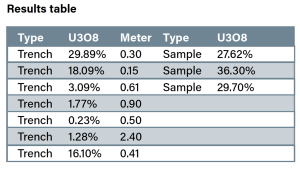
The VIC showing returned some stellar uranium surface results, returning tranche and samples above 30% U3O8 over an area of 200 meters long, which caught the attention of Xcite’s management when they purchased the property. The project generated multiple high-grade uranium results, and previous owners never followed up on the discovery with further work. This creates a unique discovery opportunity in the near future.
The VIC Zone
In addition, the geology is uranium prospective, counting multi-pathfinder elements like copper, nickel, and boron in clay, which is associated with the unconformity prospective geology hosting the major uranium deposits.
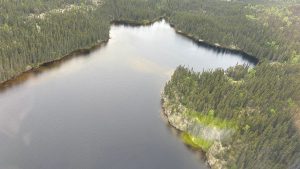
Panoramic view of the western Beaver River’s claim cluster Vic Zone towards northwest, taken in June of 2024. It illustrates the typical physiography and vegetation of the Project area. The norther settlement of Uranium City is located 40 km away
On the map below, the presence of major cross-cutting faults is also a compelling feature of the Beaver River Project. They create weakness in the underground, enabling uranium to precipitate in rich pockets of mineralisation.
The additional ingredient for success is the graphitic conductors because uranium loves graphite. On the above map, the purple spaghetti is the graphitic conductor mapped on the property.
The company is preparing the next round of work to refine the drilling target and maximise discovery success. This will include geophysics, fieldwork, and detailed mapping of the prospective areas.
The Black Bay Uranium Project
The Black Bay project demonstrated economic uranium mining in the 1950s, mining 1,375 tonnes at 0.17% U3O8. The property is uranium-rich at the surface and depth, with significant results.
The fact that historical mining happened on the project is significant, showing that at a near-surface economic concentration from the 1950s mining perspective and available technologies. The fact that limited modern-day exploration methods have been invested in the Black Bay Project leaves the door open for a uranium discovery.
On the ground, the presence of the Martin Group formation is an important geological feature and is the signature of the Athabasca Basin unconformity signature. The A and B Zones are characterised by radioactive quartzose stringer hosted within a well-banded, hematitic, pyritic quartzite that contains diopside interbands. The fracture hosts yellow uranium oxide, and minor tremolite was altered to talc.
Scintillometer readings of up to 10,000 cps are localised in two areas of intense orange hematite-stained badinage amphibole-quartz-biotite schist interlayered within the quartzite.
Again, the exploration programme will include geophysics, mapping, and sampling before drilling.
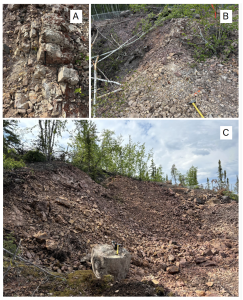
A) and B) Historic Black Bay Uranium Mine with yellow secondary U mineralization in quartzite fractured along 120°/045° with 0.456% U and 288 ppm Th; C) A blast pit in pinkish quartzites
The Don Lake Project
The geology of the Don Lake Project is divided into two separate opportunities. Uranium is hosted in structurally associated vein, shear, and breccia-hosted uranium particular to the Beaverlodge uranium model, with additional consideration for sub-Athabasca-basin, basement-hosted unconformity-style uranium mineralisation.
The structurally controlled nature of the U mineralisation indicates the importance of faulting on the tenure.
The most significant drilling campaign on the project was for 1,200 metres. This was a shallow drilling campaign that averaged less than 40 metres per hole for a total of 37 holes. Even if the drilling was limited, the project generated excellent results despite the lack of a geophysics survey, mapping and modern targeting.
The Don Lake Project sits right at the contact point of the Black Bay fault system and the Beaverlodge rock package. The fault separates the Beaverlodge and the Martin Group Sediments rocks, which are targets for Athabasca unconformity uranium-hosted deposits.
The property is also crossed by the Townsend Fault, adding more complexity to the geology but also adding more potential for a world-class uranium discovery.
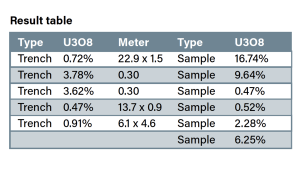
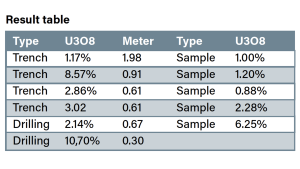
The geology is favourable, and multiple evidence of uranium-rich mineralisation is demonstrated right at the surface. High-grade uranium samples and trenches reported grades up to 10% U3O8.
Key location and geology
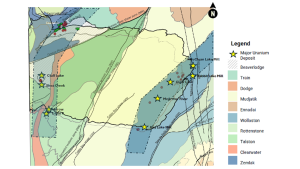
Xcite’s uranium projects are also aligned on the proven major Clearwater geological trend and the Black Bay fault, which has produced world-class uranium discoveries. The Trend is hosting the Tripple R deposit from Fission Uranium Corp. (around $1bn market cap) and the Arrow deposit from Nexgen Energy Ltd. (around $5bn market cap).
This trend generated the most exciting discoveries since the Cameco Cigar Lake and McArthur River deposits.
All Xcite projects are served by road infrastructure and are located near Uranium City, where contractors, lodging facilities, and an airport are available to support exploration logistics.
Uranium prices are firming up once again
After uranium prices reached over $100 per pound a year ago, prices are firming up again, triggering sector momentum and M&A transaction activity.
Uranium M&A activities
On 24 June, Paladin Energy announced the acquisition of Fission Uranium for $1.14bn in a court-approved plan of arrangement under the Canada Business Corporation Act. Critical uranium supply may block or at least slow down the transaction.
In October, the Minister of Innovation, Science and Industry ordered a national security review of the arrangement. Fission stated in a press release that: ‘‘In light of the national security review of the arrangement, there can be no certainty that Fission will be able to obtain ICA clearance in a timely manner or at all.
“Failure to obtain ICA clearance would prevent the arrangement from being completed.’’
On 2 October, IsoEnergy announced a definitive agreement for the acquisition of Anfield Energy in an all-share deal.
Xcite’s management view on the commodity price is to remain robust for the next 15 years with normal, timely pullbacks. The number of new nuclear plants committed in the next ten years will fuel demand. The other energy consumption driving force is the power requirement for the new AI tech solution being developed.
Why did Microsoft enter a deal with the Three Mile Island Nuclear Plant?
Even if the details of the deal were not disclosed, the agreement is for an electricity purchase for a 20-year period.
Constellation Energy is betting billions on the restart of the Pennsylvania Plant, which is still without permits and approvals. The estimated investment is $1.6bn, and the plant should come online by 2028.
Since all big tech companies are making a move into AI, the following data explains the move.
On average, a ChatGPT query needs nearly ten times as much electricity to process as a Google search. That difference lies in a coming sea change in how the US, Europe, and the world at large will consume power and at what cost.
For years, data centres displayed a remarkably stable appetite for power, even as their workloads mounted. Now, as the pace of efficiency gains in electricity use slows and the AI revolution gathers steam, Goldman Sachs Research estimates that data centre power demand will grow 160% by 2030, and consumption is estimated at about 200 terawatt-hours per year.
Data centre overall power demand is set to double in the next decade, and yet infrastructures aren’t capable of supplying that coming demand. Microsoft’s smart move is to secure a 20-year power contract before energy prices inflation, coming ahead of the curve by securing this contract.
Stars are born, live and die in spectacular ways, with their deaths marked by one of the biggest known explosions in the Universe. Like a campfire needs wood to keep burning, a star relies on nuclear fusion — primarily using hydrogen as fuel — to generate energy and counteract the crushing force of its own gravity.
But when the fuel runs out, the outward pressure vanishes, and the star collapses under its own weight, falling at nearly the speed of light, crashing into the core and rebounding outward. Within seconds, the star is violently blown apart, hurling stellar debris into space at speeds thousands of times faster than the most powerful rocket ever built. This is a supernova explosion.
Astronomers aim to understand what types of stars produce different kinds of explosions. Do more massive stars result in brighter explosions? What happens if a star is surrounded by dust and gas when it explodes?
While we have simulations modelling a star’s death, they are difficult to validate. Observing a star’s behaviour in real-time before the explosion could help answer these questions — but finding such a star is no easy task.
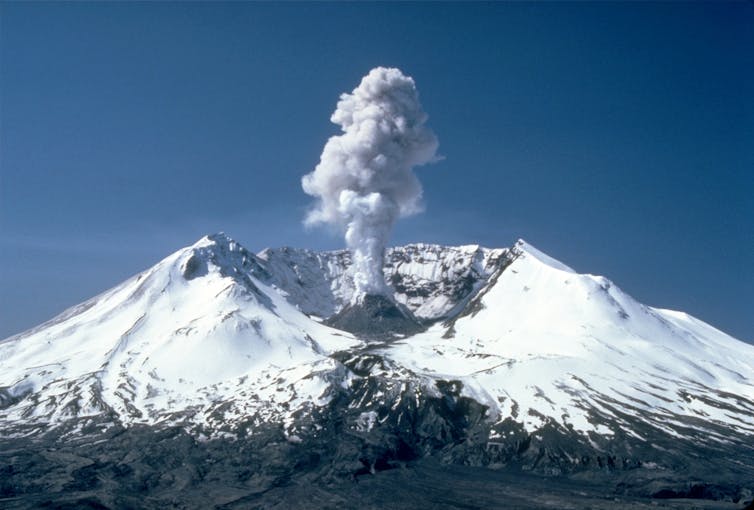
Scientists already do this with eruptions on Earth. Volcanologists monitor volcanoes, measuring changes in activity to predict an upcoming eruption. For example, in March 1980, Mount St. Helens in the US began to show some precursor events, such as seismic activity, and dozens of steam eruptions ejecting ash and gas into the atmosphere.
Plumes of steam, gas, and ash often occurred at Mount St. Helens in the early 1980s. wikipedia
Two months later, an earthquake triggered the largest landslide ever recorded, releasing built up pressure in the magma chamber, resulting in a catastrophic eruption that devastated an area of almost 232 square miles (600 square kilometres).
Pre-supernova eruptions
Massive stars – larger than around 10 times the mass of the Sun – can do the same thing, albeit at much larger scales. In 2009, astronomers observed a bright event 65 million light years away that on first impressions resembled a supernova explosion.
Dubbed SN 2009ip, the explosion did not brighten as expected and was reclassified shortly after discovery as a “supernova impostor” – a giant eruption which ultimately does not destroy the star.
Over the next three years, the star underwent many rapid “flickering” events, a bit like quickly turning on and off a light bulb. Finally, in 2012, an unexpected supernova occurred. The evolution of the supernova explosion is still being studied to this day, and what exactly happened from 2009 to 2012 remains a mystery.
In a recent paper, published in Astronomy and Astrophysics, our team found a peculiar star in the Virgo Cluster, coincidentally also 65 million light years away. Unlike SN 2009ip, the star lacked hydrogen and was composed primarily of helium. The star was observed very slowly increasing its brightness for over five years – akin to slowly turning on a bulb using a dimmer switch – before a supernova was observed.
The supernova, labelled as SN 2023fyq, provided astronomers with a rare opportunity to capture the first light from the supernova explosion, known as shock breakout, from observatories worldwide and in space, largely due to the daily monitoring of the precursor activity.
Clash with current theory
This precursor activity offers an exciting chance to uncover the mysteries of supernova explosions, shedding light on both the conditions leading up to and following these cosmic events.
The underlying cause of this pre-supernova activity remains unclear. It is thought that an isolated massive star does not experience such rapid fluctuations in brightness. In the final moments of a star’s life, its core undergoes rapid evolution, desperately attempting to counteract the crushing force of gravity with its dwindling fuel reserves.
However, the star is so large at this stage that any activity in the core doesn’t have enough time to reach the surface. Observing these dramatic changes, occurring so close to the star’s demise, present a significant challenge to current theories.
One compelling hypothesis points to the interaction of multiple stars. Stars are born in dense clouds of gas and dust where multiple stars can form in close proximity. Neighbouring stars may interact gravitationally with one another – exchanging material as they orbit each other.
This mass transfer could account for the changes in brightness observed in SN 2009ip before its explosion and the hydrogen deficiency seen in SN 2023fyq. The companion involved might be another massive star – or perhaps a more exotic object, such as a black hole.
We know not all eruptions will not end in a supernova explosion. For example, in the 1840s, Eta Carinae – a star 100 times larger than the Sun – experienced the “Great Eruption” launching 30 times the Sun’s mass into space. Although this was an extremely energetic explosion, the massive star was not destroyed.
Do all stars announce their departure? We aren’t sure. Seemingly normal supernovas have been observed with precursor eruptions, thanks in part to deep observations catching the faint precursor activity.
In 2025, the Vera C. Rubin Observatory, equipped with the world’s largest camera, will begin to study these events. At 3,200-megapixels, it is over 40 times more sensitive than cameras we have available on Earth, providing the opportunity to search for fainter precursor activity.
At Stockholm University, our team is currently using telescopes from the European Southern Observatory and the Zwicky Transient Facility, including the Nordic Optical Telescope in La Palma, Spain and the Very Large Telescope at Cerro Paranal in the Atacama Desert of northern Chile, to identify the signs that indicate a star is nearing the end of its life.
By recognising these signals, we can alert the scientific community and be ready to watch as a star experiences its final, dramatic moments.
Mannen kunnen soms tegen problemen aanlopen die invloed hebben op hun intieme leven, wat hen kan frustreren en onzeker kan maken. Deze uitdagingen zijn niet ongebruikelijk en kunnen voortkomen uit verschillende oorzaken, zoals stress, angst of fysieke aandoeningen. Gelukkig zijn er oplossingen en middelen beschikbaar die hen kunnen helpen om hun zelfvertrouwen en welzijn te herstellen. Een nuttige stap is om betrouwbare informatie te zoeken en producten te bekijken op websites zoals. Het is belangrijk dat mannen zich realiseren dat ze niet alleen zijn en dat er ondersteuning en opties zijn om hun seksuele gezondheid te verbeteren.
Lauren Goode: Yeah.
Mannen kunnen soms tegen problemen aanlopen die invloed hebben op hun intieme leven, wat hen kan frustreren en onzeker kan maken. Deze uitdagingen zijn niet ongebruikelijk en kunnen voortkomen uit verschillende oorzaken, zoals stress, angst of fysieke aandoeningen. Gelukkig zijn er oplossingen en middelen beschikbaar die hen kunnen helpen om hun zelfvertrouwen en welzijn te herstellen. Een nuttige stap is om betrouwbare informatie te zoeken en producten te bekijken op websites zoals. Het is belangrijk dat mannen zich realiseren dat ze niet alleen zijn en dat er ondersteuning en opties zijn om hun seksuele gezondheid te verbeteren.
Michael Calore: What about you, Zoë?
Zoë Schiffer: My total screen time. I actually looked it up before and I think it’s like three hours and 40 minutes on my phone, which honestly seems impressive to me. You’re raising your eyebrows, Mike, why are you doing that? Only a couple minutes of that is actually on social media apps. I feel like I deserve a Medal of Honor.
Michael Calore: You do actually deserve Medal of Honor. I have a timer on my phone that goes off after I’ve been on Instagram for any more than 20 minutes. I hit that timer every single day.
Lauren Goode: This is not a joke. He follows this. I’ve sent Mike memes before and then won’t get a response, and because we work across the newsroom from each other, I’ll literally sometimes go to his desk and, “Did just see that thing I sent you?”
Zoë Schiffer: It’s the thirsty.
Lauren Goode: No, I know. He’ll say, “No, I ran out of time,” and I’m like, “You’re adhering to that? Check the meme.”
Michael Calore: Do you ever think about getting off of the apps?
Lauren Goode: All the time.
Michael Calore: All the time?
Lauren Goode: I fantasize about it at this point. What would it be like to not constantly feel like you have to broadcast something?
Michael Calore: Yeah. What about you, Zoë?
Zoë Schiffer: Honestly, I’m not on them that much, but I’ve been on parental leave for a few months, so the answer is I think about getting off my phone all the time and I’m honestly amazed how much time I can spend on my phone even not using social media apps. What about you?
Michael Calore: I often get the urge to just throw the phone across the room and never look at it again, but then I always end up picking it up and getting back on.
Lauren Goode: That’s usually after I send him some terrible meme.
Michael Calore: Yeah, or I think of a joke.
Lauren Goode: Right.
Michael Calore: Must skeet now. Yeah. Well, today we’re talking about just that: Is it time to get off of social media? And because there are so many kinds of social apps and platforms out there, we’re going to focus on the platforms that we use the most, the text-based social sites, because we’re words people. This is WIRED’s Uncanny Valley, a show about the people, power, and influence of Silicon Valley. I’m Michael Calore, director of consumer tech and culture here at WIRED.
It’s something we all do multiple times a week: We manually add things to our calendar while copying details over from an email. What if a bot could do that work for you?
That’s the idea behind Fwd2cal, a currently free project by Moe Adham that can parse any email with an appointment in it and automatically add it to your calendar. If you get an email with a potential calendar appointment in it—a party invitation, a meeting, a coworker casually mentioning you can join them for drinks after work today—you can forward it to the free bot. The service uses ChatGPT to parse the email and find the relevant bits of information, then turn that information into a calendar appointment, then add that calendar appointment to your Google Calendar.
“I wrote it because I was really frustrated managing many different email addresses on different platforms into a single calendar,” Adham writes on the project’s website. “It also seemed like a task that machine learning could maybe do reliably.”
I’ve been testing this for a couple weeks, and so far I agree: This is something machine learning can do reliably. The service couldn’t be easier to use, and the setup process isn’t too difficult. All you need to do is send an email to [email protected]. You’ll get a message back, with a link, asking you to authorize your Google Calendar. You can add more email addresses by sending another email to the service—just put “add” followed by your second email address in the subject line and you’re done.
After connecting Fwd2cal to your Google Calendar, you can start using the service. You can forward any email mentioning an event happening—the bot will parse the email, turn it into a calendar appointment, then add it to your Google Calendar. If something goes wrong, you’ll get an email explaining that. If not, the service will quietly keep adding appointments to your calendar. You can even include instructions in the email, if you want, using the same phrasing you would use to talk to any AI chatbot. I’ve found the bot is pretty good at figuring out what you want.
This all requires putting a lot of trust in Adham, which he acknowledges on the website. The good news is that the project is distributed with an open source license, meaning the code is available online if you want to review it. The privacy policy also makes it clear that the only information the bot collects is what’s necessary to provide the service and that no personal information is stored long term or used to train the AI model. The service runs on a combination of tools from Google Cloud, OpenAI, and SendGrid.
Fwd2cal is free, though that might change. “If this ever gets too popular and it costs too much to run, I’ll maybe start charging for it,” Adham writes on the website. In the meantime, it’s a service that offers some great convenience.
TikTok is officially on the chopping block, friends.
Last Friday, a federal appeals court upheld a law that could result in the app being banned from operating within the United States next month. Even if President Joe Biden decides to extend that deadline an additional 90 days, TikTok is still on a pretty tight timeline to find a way out of this mess.
Earlier this year, I spoke with Frank McCourt for this newsletter about his bid to buy TikTok. After last week’s events, I figured it was a good time to check back in with him. Plus, I got some insight on how creators are preparing for a post-TikTok future.
Let’s talk about it.
This is an edition of the WIRED Politics Lab newsletter. Read previous newsletters here.
There are three options left for TikTok at this point. The company could win an appeal, forget about all of this, and go back to business as normal (eventually). Come next year, the app could be banned. Or, someone with a lot of money could buy TikTok’s US business off of ByteDance. Wednesday afternoon, my colleague Zeyi Yang and I spoke to Frank McCourt, the billionaire former owner of the Los Angeles Dodgers who wants to do just that.
McCourt’s motivation isn’t just to save TikTok but to bolster a personal project of his. Through his Project Liberty initiative, he has made what he’s called a “people’s bid,” bringing together a variety of investors and groups that share in his vision of a more open web. To achieve this, he’d apply Project Liberty’s Decentralized Social Networking Protocol, or DSNP, to TikTok. The protocol would allow for users to export over their friends and followers to a new TikTok. And after Friday’s court decision, McCourt is more confident than ever that his team will soon be running and possibly rebuilding the app.
In our conversation, McCourt argued that a sale would make everyone happy, including ByteDance, users, and the US government. McCourt has offered $20 billion for the app’s brand, its user base, and the existing content in order to scale his vision of an interoperable, more privacy-friendly internet that competes with companies like Meta and Google. He doesn’t “need or want” the algorithm running TikTok’s For You page, he says.
When asked if Project Liberty could maintain TikTok’s existing userbase without the beloved algorithm, McCourt said, “People don’t know what they don’t have until you show them.”
The detection of nitric oxide (NO) is important for monitoring air quality because the NO released in the combustion of fossil fuels contributes to acid rain and smog. In medicine, NO is an important messenger molecule and serves as a biomarker for asthma. Christopher H. Hendon, University of Oregon, OR, USA, Katherine A. Mirica, Dartmouth College, Hanover, NH, USA, and colleagues have found a material that can detect NO reversibly, with low power, and with high sensitivity and selectivity: a copper-containing, electrically conducting, two-dimensional metal–organic framework.
MOFs for Sensors
Metal–organic frameworks (MOFs) are latticelike structures consisting of metal “nodes” connected by organic ligands. An emerging class of MOFs have electrically conducting structures consisting of layers. These 2D-cMOFs have demonstrated great potential as chemiresistive sensors that react to the presence of specific molecules with a change to their electrical resistance.
This may allow for particularly sensitive and low-power detection of toxic gases. Problems with such systems have included cross-reactivity with a variety of gases and limited reusability due to irreversible binding of the analytes.
Highly Crystalline 2D Framework
The team developed a reusable 2D-cMOF for the highly selective detection of NO. They chose to use a 2D-cMOF based on copper and hexaiminobenzene, Cu3(HIB)2. Thanks to their different synthetic strategy (the linker was added as an undissolved powder to a solution of Cu2+ ions and potassium acetate), the team produced a material with significantly higher crystallinity (rod-shaped crystallites about 500 nm in length) than has previously been attained.
The crystallites consist of stacked layers of a web-like structure of six-membered rings linked together by copper ions bound to their nitrogen atoms. Spectrometric analyses and computations revealed that the binding sites for NO were Cu-bis(iminobenzosemiquinone) units of the copper-2D-cMOFs.
An analogous compound made with nickel instead of copper demonstrated no significant absorption of NO. Evidently, copper ions with a single positive charge, which are present in small amounts in the structure besides those with a twofold positive charge, play an important role in binding NO. Computational studies suggest that the adsorbed NO significantly distorts the structure, destabilizing the bound state, which is the primary cause for the desirable reversibility of the NO adsorption.
Ultrasensitive Detection of NO
This new sensor material detects NO at room temperature and low voltage (0.1 V) with high sensitivity (detection limit about 1.8 ppb). It could be reused for at least seven cycles without regeneration.
Quantitative measurements of NO were also successful in the presence of moisture, and showed high enhancement of the sensor signal towards NO in comparison to other gases, such as nitrogen dioxide, hydrogen sulfide, sulfur dioxide, ammonia, and carbon monoxide and dioxide.







 The most significant drilling campaign on the project was for 1,200 metres. This was a shallow drilling campaign that averaged less than 40 metres per hole for a total of 37 holes. Even if the drilling was limited, the project generated excellent results despite the lack of a geophysics survey, mapping and modern targeting.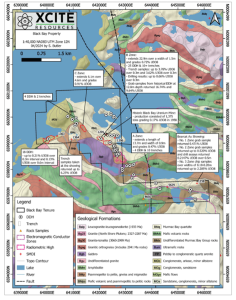







.jpg)


