IN 1770, inventor Wolfgang von Kempelen claimed to have created a machine that could skilfully play chess against human opponents. Known as the Mechanical Turk, his contraption defeated many challengers, including Napoleon Bonaparte and Benjamin Franklin, and caused much amazement and debate about how it worked. It was eventually exposed as a hoax, however, with a human chess master hiding inside.
The Mechanical Turk raises intriguing questions about how humans perceive technology,…
Generative AI can rewrite political adverts on social media to target users with different personality types, making it easier to manipulate elections using personal data on a large scale
Minecraft is a game for humans, but it could help AI too
Minecraft
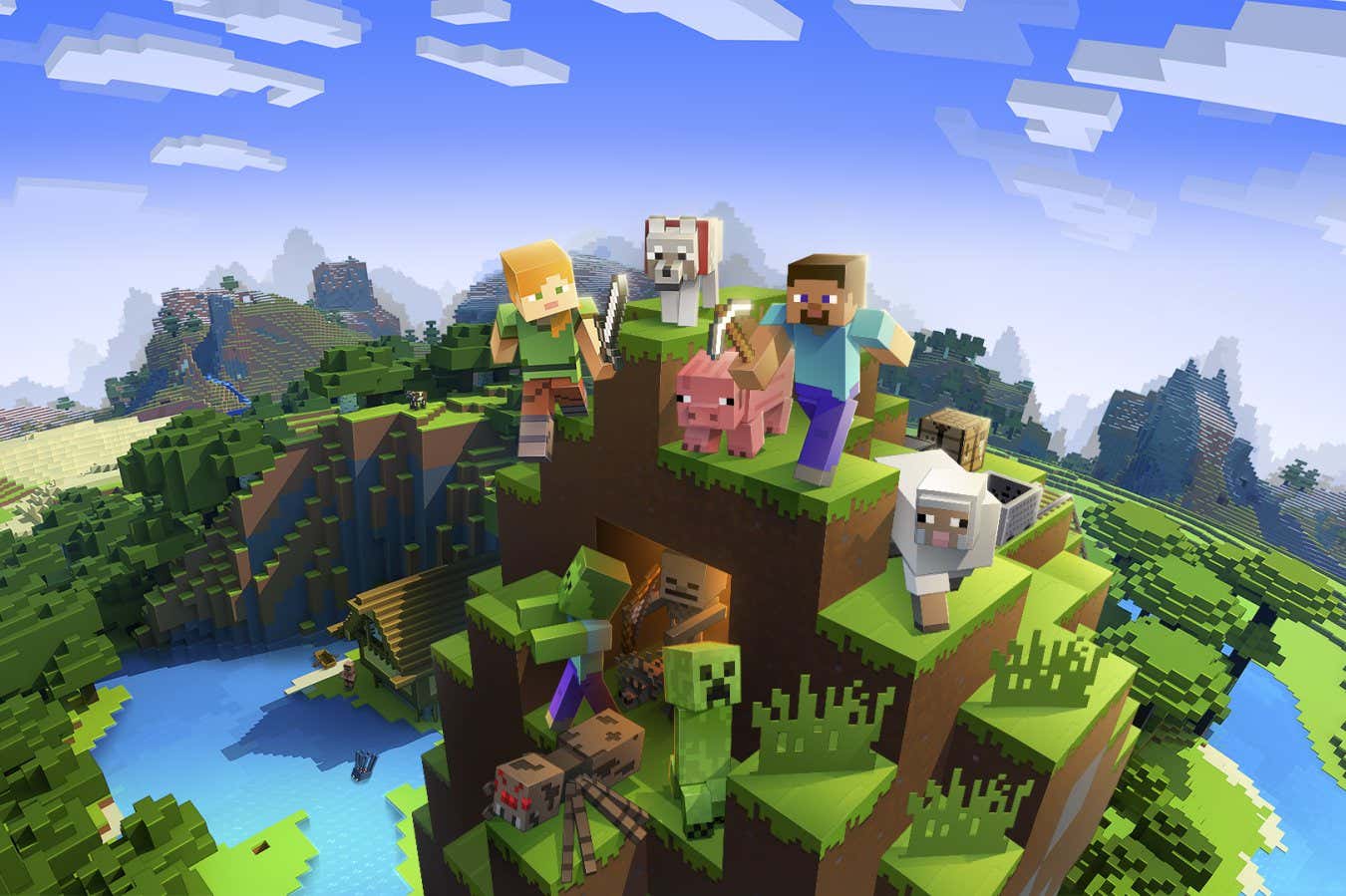
Minecraft is not only the best-selling video game in history, it could also be key to creating adaptable artificial intelligence models that can pick up a variety of tasks the way humans do.
Steven James at the University of the Witwatersrand in South Africa and his colleagues developed a benchmark test within Minecraft to measure the general intelligence of AI models. MinePlanner assesses an AI’s ability to ignore unimportant details while solving a complex problem with multiple steps.
Lots of AI training “cheats” by giving a model all the data it needs to learn how to do a job and nothing extraneous, says James. That is a fruitful approach if you want create software to accomplish a specific task – such as predicting the weather or folding proteins – but not if you are attempting to create artificial general intelligence, or AGI.
James says that future AI models will need to tackle messy problems, and he hopes that MinePlanner will guide that research. AI working to solve a problem in the game will see the landscape, extraneous objects and other detail that isn’t necessarily needed to solve a problem and must be ignored. It will have to survey its surroundings and work out by itself what is and is not needed.
MinePlanner consists of 15 construction problems, each with an easy, medium and hard setting, for a total of 45 tasks. To complete each task, the AI may need to take intermediate steps – building a set of stairs in order to place blocks at a certain height, for instance. That demands that the AI can zoom out of the problem and plan ahead in order to achieve a goal.
In experiments with state-of-the-art planning AI models ENHSP and Fast Downward, open-source programs designed to handle sequential operations in pursuit of an overall goal, neither model was able to complete any of the hard problems. Fast Downward was only able to solve one of the medium problems, and five of the easy problems, while ENHSP performed slightly better by completing all but one of the easy problems and all but two of the medium problems.
“We can’t require a human designer to come in and tell the AI exactly what it should and shouldn’t care about for each and every task it might have to solve,” says James. “That’s the problem we’re trying to address.”
Tech giants are gearing up for a series of potentially bitter legal battles over claims they used copyrighted material in training the latest generation of artificial intelligence
AS WE close out 2023, what awaits us in 2024? As any sensible New Scientist reader knows, the division of time into years is a fairly arbitrary business, marking only that Earth has completed a full orbit around the sun (yes, OK, give or take 0.256363004 days, pipe down there at the back please). As such, many of the big stories of this year, such as the rise of artificial intelligence and the growing danger of climate change, will remain the big stories of the next.
Yet it is hard not to imbue a new year with new significance.…
FROM the very beginnings of recorded history, there has been a desire to create a single language that could unite humankind. Allegorised in the biblical story of the Tower of Babel, as well as in origin myths from cultures around the world, the belief has always been that the diversity of languages – there are over 7000 spoken today – is a problem for which we need to find a solution. This has led, down through the centuries, to many a scheme trying to craft some form of truly universal communication.
To date, however, none of these have properly succeeded. But with…