Boiling and filtering tap water rich in calcium can remove nearly 90% of nano- and microplastics, offering a simple, cost-effective solution to reduce plastic consumption and mitigate environmental pollution. This approach is effective in both hard and soft water, highlighting its potential as a widespread method for purifying drinking water from plastic contaminants. Credit: Eddy Zeng
Nano- and microplastics are seemingly everywhere — water, soil, and the air. While many creative strategies have been attempted to get rid of these plastic bits, one unexpectedly effective solution for cleaning up drinking water, specifically, might be as simple as brewing a cup of tea or coffee.
As reported in ACS’ Environmental Science & Technology Letters, boiling and filtering calcium-containing tap water could help remove nearly 90% of the nano- and microplastics present.
Contamination of water supplies with nano- and microplastics (NMPs), which can be as small as one-thousandth of a millimeter in diameter or as large as 5 millimeters, has become increasingly common. The effects of these particles on human health are still under investigation, though current studies suggest that ingesting them could affect the gut microbiome.
Some advanced drinking water filtration systems capture NMPs, but simple, inexpensive methods are needed to substantially help reduce human plastic consumption. So, Zhanjun Li, Eddy Zeng, and colleagues wanted to see whether boiling could be an effective method to help remove NMPs from both hard and soft tap water.
Research Findings on Boiling Water to Remove Plastics
The researchers collected samples of hard tap water from Guangzhou, China, and spiked them with different amounts of NMPs. Samples were boiled for five minutes and allowed to cool.
Then, the team measured the free-floating plastic content. Boiling hard water, which is rich in minerals, will naturally form a chalky substance known as limescale, or calcium carbonate (CaCO3). Results from these experiments indicated that as the water temperature increased, CaCO3 formed incrustants, or crystalline structures, which encapsulated the plastic particles.
Zeng says that over time, these incrustants would build up like typical limescale, at which point they could be scrubbed away to remove the NMPs. He suggests any remaining incrustants floating in the water could be removed by pouring it through a simple filter such as a coffee filter.
Efficacy in Different Water Types
In the tests, the encapsulation effect was more pronounced in harder water — in a sample containing 300 milligrams of CaCO3 per liter of water, up to 90% of free-floating MNPs were removed after boiling.
However, even in soft water samples (less than 60 milligrams CaCO3 per liter), boiling still removed around 25% of NMPs. The researchers say that this work could provide a simple, yet effective, method to reduce NMP consumption.
Reference: “Drinking Boiled Tap Water Reduces Human Intake of Nanoplastics and Microplastics” by Zimin Yu, Jia-Jia Wang, Liang-Ying Liu, Zhanjun Li and Eddy Y. Zeng, 28 February 2024, Environmental Science & Technology Letters. DOI: 10.1021/acs.estlett.4c00081
The authors acknowledge funding from the National Natural Science Foundation of China.
Glutenin, a wheat protein, shows promise for lab-grown meat production by supporting the cultivation of muscle and fat layers that mimic real meat’s texture and composition, offering a sustainable alternative to traditional meat as the global population increases.
As the global population grows, lab-grown meat, which consists of animal muscle and fat cells cultivated in lab settings, presents a promising solution to meet the rising demand for protein. Additionally, affordable plant proteins could serve as a foundation for these cell cultures. Recent findings published in ACS Biomaterials Science & Engineering demonstrate that the non-allergenic wheat protein glutenin successfully grew striated muscle layers and flat fat layers, which could be combined to produce meat-like textures.
Development of Plant-based Scaffolds for Cultured Meat
Cultured cells need a base or scaffold to adhere to produce lab-grown meat. Plant proteins are appealing candidates for the scaffolds because they are edible, abundant, and inexpensive. Previous researchers showed that a plant-based film made of glutenin was a successful base to cultivate cow skeletal muscle cells.
But for this technique to produce a promising meat-like alternative, the muscle cells need to form aligned fibers, similar to the texture in real tissues. Additionally, fat needs to be included in the 3D structure to replicate the composition of traditional meat products. To take advantage of using glutenin, a protein in gluten that people with celiac disease or a gluten sensitivity don’t typically react to, Ya Yao, John Yuen, Jr., Chunmei Li, David Kaplan, and colleagues wanted to develop plant-based films with it to grow textured muscle cells and fatty layers.
Experimental Results and Future Directions
The researchers isolated glutenin from wheat gluten and formed flat and ridge-patterned films. Then they deposited mouse cells that develop into skeletal muscle onto the protein bases and incubated the cell-covered films for two weeks. Cells grew and proliferated on both flat and ridged films. As expected, compared to cells grown on control films made of gelatin, the performance of the glutenin-based films was inferior but sufficient. The researchers say further work needs to be done to improve how cells attach to the plant-based film to get closer to the growth on the animal-derived biomaterial. During the second week of the culture, the cells on the patterned film formed long parallel bundles, recreating the fiber structure of animal muscles.
By putting ridges in a plant protein base, cultured muscle cells grew in a pattern that mimics the alignment of muscle fibers in animals. Credit: Adapted from ACS Biomaterials Science & Engineering 2024, DOI: 10.1021/acsbiomaterials.3c01500
In another test, mouse cells that produce fat tissues were deposited onto flat glutenin films. During the incubation period, as cells proliferated and differentiated, they produced visible lipid and collagen deposits.
The cultured meat and fat layers attached to the edible glutenin films could be stacked to form a 3D meat-like alternative protein. Because the glutenin material base supported the growth of both textured animal muscle and fat layers, the researchers say it could be used in an approach for more realistic cultivated meat products.
Reference: “Cultivated Meat from Aligned Muscle Layers and Adipose Layers Formed from Glutenin Films” by Ya Yao, John S. K. Yuen, Jr., Ryan Sylvia, Colin Fennelly, Luca Cera, Kevin Lin Zhang, Chunmei Li and David L. Kaplan, 16 January 2024, ACS Biomaterials Science & Engineering. DOI: 10.1021/acsbiomaterials.3c01500
The authors acknowledge funding from MilliporeSigma and the U.S. Department of Agriculture. Some authors are employees of MilliporeSigma, Inc.
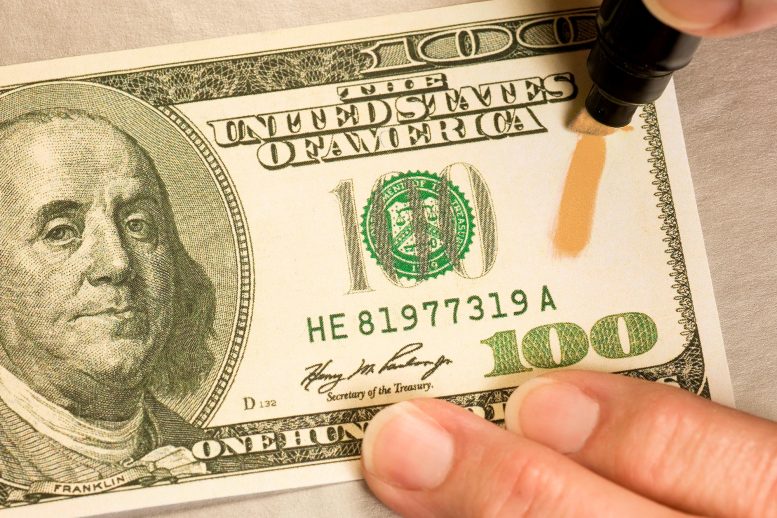
Delving into the chemistry of counterfeit detection pens, this video covers various experimental attempts to modify their reaction with starch. It also discusses the broader context of counterfeit money detection, underscoring the intricacies involved.
Counterfeit detector pens use a starch-iodine reaction to identify fake bills. But could you fool them with chemistry? In today’s episode, we dive into the chemistry of iodine, its color and its clock reactions, all while making a little extra cash on the side.
Video Transcript:
Let’s say that we wanted to fool these counterfeit detection pens for science, how could we make this reaction not happen on normal paper?
Y’all, my search history is a mess.
(subtle groovy music)
I’m telling you, someone’s gonna look at my online purchase history and be like, she’s printing bills and like, I mean, technically I did.
Making counterfeit money is bad and wrong and illegal and hard to do, and if you are looking for a how-to video, this is not it.
Does that work, ACS Legal?
Can we make the video now?
These pens are filled with an iodine solution, usually something like potassium iodine to help the non-polar iodine dissolve in water. If you swipe them on a piece of regular non-currency paper, which contains starch, it leaves behind a dark mark, and that is it.
These pens are just a simple reaction between iodine and starch.
Now, most regular paper like printer paper contains starch.
If you recall our soft bread episode, some of the starches arranged into long strands of glucose molecules called amylose, which can fold into helices.
Inside the pen, iodine and iodide ions come together to form a triiodide complex.
I know, I know, let’s go to the whiteboard.
Okay, I got you.
So iodine is the element, iodide is the ion, and the triiodide complex is three of ’em all together.
Got it?
Great.
I think I got it.
Equilibrium.
This is important because when you run the pen over the paper, these triiodide complexes slip inside the amylose helix and cause a dark purple or brown color.
This is why you can get the same reaction on a starchy food like a potato chip.
So iodine plus starch equals a brown mark on regular paper, but currency paper isn’t regular paper.
It’s actually a mix of fabric fibers and contains no starch.
So when you run the pen over a real bill, there’s no color change because there’s no starch.
Iodine’s color change depends on what it is dissolved in.
As a solid, iodine is kind of a grayish metal with a purple vapor.
If you add a bit of iodine solution into oil, you can see that really pretty kind of violet color.
There’s a world in which that’s purple.
The color we see, of course, is light reflecting off of the molecules.
Some light gets absorbed, moving electrons around in their molecular orbitals, and some light bounces off, and what we see is the light that bounces off.
So if the wavelengths of light that get absorbed change,
the color we see can change as well.
And iodine’s color changes based on its solvent.
For example, when added to water, iodine solutions turn from that sort of purple color into more of a yellow brown color.
This is due in part to the interaction of electrons between the iodine and the water molecules.
Weakly-bound donor acceptor complexes can form between the iodine and the water, and this changes how the electrons respond to incoming light, changing the wavelengths of light that are absorbed, changing the color that we see.
Now, when the iodine solution in the pens reacts with starch molecules on paper, you get this kind of purple-brown color.
And remember how I said that it was likely because of the triiodide complexes slipping into the starch helices?
There’s actually a bit more than just that going on here, and the research into the specifics is still ongoing, because it’s really cool.
So the pens contain a really dilute iodide-iodine solution, which has little to no color.
Now, there are I2 molecules floating around, triiodide complexes and potassium iodide.
And if anything, this whole thing is just like, slightly pale yellow.
But when the triiodide molecules slip inside the amylose helices in starch, I2 molecules tag along with them.
Electrons that absorb incoming light can now easily move back and forth between the I2 and I3 molecules, because they’re right next to each other, changing not just the color of the iodine, but also the intensity.
So now you can get these bright blues and dark browns that we see when we mix starch and iodine.
Various lengths of polyiodine chains inside the amylose helices have been proposed from three to four, like we just talked about, to as high as 160.
So, lots of variability.
A 2022 team investigated and suggested that the short chains might enter the helix and then rearrange, causing longer chains, and also potentially causing changes to the structure of the helix itself.
The interaction also changes based on the length and the structure of the amylose helices, how much water is around, how the starch itself was purified.
There are a lot of things here that might impact exactly what color happens when you run that pen over the paper.
Anyways, this is all cool, but what if we wanna actually stop this interaction from happening?
We can’t pull the iodine outta the pens, so instead, let’s see if we can take a stab at getting the starch out of the paper.
First up, starch is a polymer of sugar molecules, so we could try heat to break that down.
Starch breaks down starting at around 280 degrees Celsius, which is about 536 degrees Fahrenheit.
But my oven only goes to 500, and the ignition temperature paper is around 233 Celsius or 451 Fahrenheit, so I’m gonna try and set my oven to 425 and see if maybe we can break it down a little bit, but without catching it on fire.
(pan bangs)
Don’t try this at home.
I also have a fire professional on hand, just in case.
(container rustling)
(incorrect buzzer dings)
But here’s why biochemistry is my favorite.
Fight me, George.
Enzymes catalyze reactions by lowering their activation energy, and there is an enzyme that catalyzes the breakdown of starch.
Amylase.
Amylase takes that reaction that happens at 233 degrees Celsius and makes it happen closer to about 65 to 75 Celsius, which is way more reasonable.
Now, your spit actually contains a lot of amylase to break down the starches in food.
So what I’m gonna do is I’m gonna take this piece of paper and I’m gonna lick it, no, I’m not.
I’m not gonna do that.
Instead, I’m gonna take this amylase that I ordered from the internet and add 1/2 a teaspoon per gallon of water and simmer our paper in it at about 70 Celsius or 158 Fahrenheit.
Amylase breaks down starch chains into smaller sugars like maltose and glucose.
There’s bubbles forming at the top, and I actually am wondering if those bubbles are like, little, sugary, I mean for sure it’s ’cause the water is heating up, but like maybe we’re actually breaking down some starch into some sugars there.
Eh, no.
Maybe it worked a little.
No.
(incorrect buzzer dings)
Now, yeast also creates and uses amylase, so if you’d like to do this a much smellier way, you could try that too.
(incorrect buzzer dings)
Alternatively, we could try blocking the iodine from interacting with a starch rather than breaking it down.
Now, we could try and do this physically
with something hydrophobic, like hairspray.
(hairspray whooshes)
Oh-ho-ho-ho, that did not work at all.
It almost made the reaction faster.
Hairspray is a no.
(incorrect buzzer dings)
Or you could try vitamin C.
Vitamin C, AKA, ascorbic acid, reduces iodine into iodide ions, which are basically colorless in solution.
So you get I2, 2I minus.
These hydrogens pop on over here.
Reduction, chemistry.
So we can spray our bill with a little bit of vitamin C dissolved in water, let it dry, and then try out the pen.
Woo.
The vitamin C worked.
(correct buzzer dings)
Can’t catch me now, government mint.
Now, this is how the classic iodine clock reaction works, and I’ve actually never done this experiment before, and it looks really cool, so we’re gonna do it.
I did not come up with this version of the iodine clock reaction, I’m following Nile Red’s version of it, because I haven’t done it before, and I thought this one looked good.
So thanks, Nigel.
Credit where credit is due.
In one beaker, we have water, iodine, and vitamin C.
It’s colorless because that vitamin C means that we have iodide ions.
In the other beaker we have water, hydrogen peroxide, and our old friend, starch.
If we mix the two colorless liquids together, they initially remain colorless, but then bam.
I think my iodine concentration is a little too low.
(bright tone beeps)
(bright subtle music)
Oh, the other one, the one off camera just turned.
There’s hope, there’s hope, there’s hope.
(instructor chuckles)
Bam, they turn into a dark liquid.
This is because there are multiple reactions happening here.
The hydrogen peroxide turns the iodide ions back into I2 or iodine, but as long as there’s vitamin C around, the iodine keeps being reduced back to iodide.
But eventually, the vitamin C runs out, the I2 forms up, comes together with some other I-minus ions to form those triiodide complexes we talked about before.
Those hang out with starch, and bam, color.
So freaking cool.
What was this video about again?
Right, counterfeit money.
Because none of this happens in real currency paper, because there’s no starch in it.
US currency paper is made by Crane & Co.
They were handpicked, no lie, by Paul Revere, to make the first US currency,
and they’ve just stuck ever since.
The paper also has red and blue colored filaments running through it, making it hard to duplicate, and Crane & Co won’t sell it to you.
But this stuff is some paper that I bought off of Amazon, so you can buy a paper that might already fool a tired, underpaid cashier just trying to finish their shift and check your bill.
Right, it’s definitely a different color from the printer paper.
So there’s printer paper and then Amazon paper.
There’s the real bill, and I don’t think it’s fooling anybody.
I bet they spray it with a little starch for this purpose.
And most real counterfeiters aren’t buying stuff like this.
They’re bleaching small denomination bills to get the right paper, and then printing larger denominations on it.
So these pens are one of the weakest methods of counterfeit detection for a number of reasons.
So was all of this for naught?
I mean, no, the chemistry was worth it.
You learned something, didn’t you?
I did.
I actually haven’t tried this pen on this paper yet.
Also, fun fact, this paper has red and blue filaments running through it.
Like, you can just buy with red and blue fibers in it.
A new study reveals an efficient method for extracting uranium ions from seawater using a specially designed electrode material. This approach offers a sustainable alternative to traditional uranium mining, potentially turning the oceans into vast sources of nuclear fuel.
Most of the Earth’s surface is covered by oceans, which are teeming with a wide variety of life. Interestingly, these vast bodies of water also contain a dilute distribution of uranium ions. Extracting these ions could potentially offer a renewable source of fuel for nuclear power generation. A recent study in ACS Central Science introduces a new material designed for electrochemical extraction. This innovation is more effective at capturing the elusive uranium ions from seawater compared to previous techniques.
Nuclear power reactors release the energy naturally stored inside of an atom and turn it into heat and electricity by literally breaking the atom apart — a process known as fission. Uranium has become the favored element for this process as all its forms are unstable and radioactive, making it easy to split.
Currently, this metal is extracted from rocks, but uranium ore deposits are finite. Yet, the Nuclear Energy Agency estimates that 4.5 billion tons of uranium are floating around in our oceans as dissolved uranyl ions. This reserve is over 1,000 times more than what’s on land. Extracting these ions has proven to be challenging, though, as the materials for doing so don’t have enough surface area to trap ions effectively. So, Rui Zhao, Guangshan Zhu, and colleagues wanted to develop an electrode material with lots of microscopic nooks and crannies that could be used in the electrochemical capture of uranium ions from seawater.
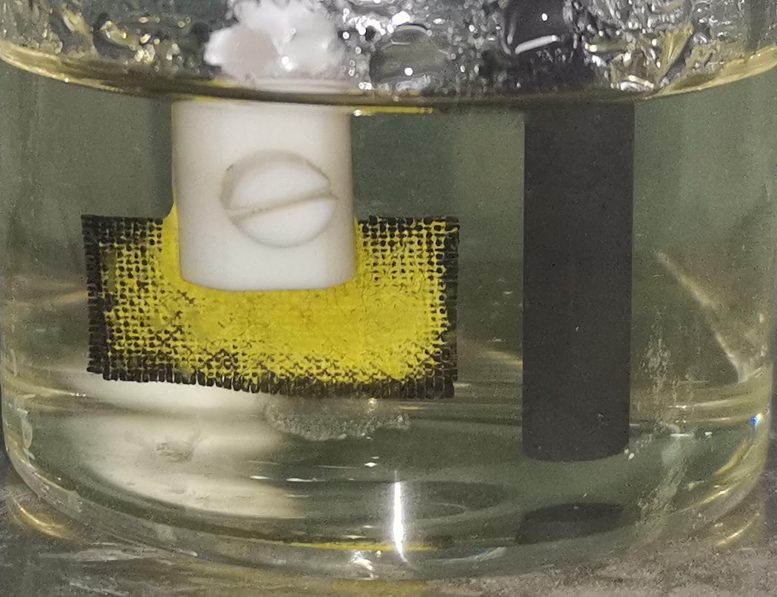
This new coated cloth effectively accumulated uranium (in yellow) on its surface from uranium-spiked seawater. Credit: Adapted from ACS Central Science, 2023, DOI: 10.1021/acscentsci.3c01291
Innovative Electrode Material Development
To create their electrodes, the team began with flexible cloth woven from carbon fibers. They coated the cloth with two specialized monomers that were then polymerized. Next, they treated the cloth with hydroxylamine hydrochloride to add amidoxime groups to the polymers. The natural, porous structure of the cloth created many tiny pockets for the amidoxime to nestle in and easily trap the uranyl ions.
In experiments, the researchers placed the coated cloth as a cathode in either naturally sourced or uranium-spiked seawater, added a graphite anode, and ran a cyclic current between the electrodes. Over time, bright yellow, uranium-based precipitates accumulated on the cathode cloth.
In the tests using seawater collected from the Bohai Sea, the electrodes extracted 12.6 milligrams of uranium per gram of coated, active material over 24 days. The coated material’s capacity was higher than most of the other uranium-extracting materials tested by the team. Additionally, using electrochemistry to trap the ions was around three times faster than simply allowing them to naturally accumulate on the cloths. The researchers say that this work offers an effective method to capture uranium from seawater, which could open up the oceans as new suppliers of nuclear fuel.
Reference: “Self-Standing Porous Aromatic Framework Electrodes for Efficient Electrochemical Uranium Extraction” by Dingyang Chen, Yue Li, Xinyue Zhao, Minsi Shi, Xiaoyuan Shi, Rui Zhao and Guangshan Zhu, 13 December 2023, ACS Central Science. DOI: 10.1021/acscentsci.3c01291
The authors acknowledge funding from the National Key R&D Program of China, the National Natural Science Foundation of China, the Project of Education Department of Jilin Province, the Natural Science Foundation of Department of Science and Technology of Jilin Province, the Fundamental Research Funds for the Central Universities, and the “111” project.
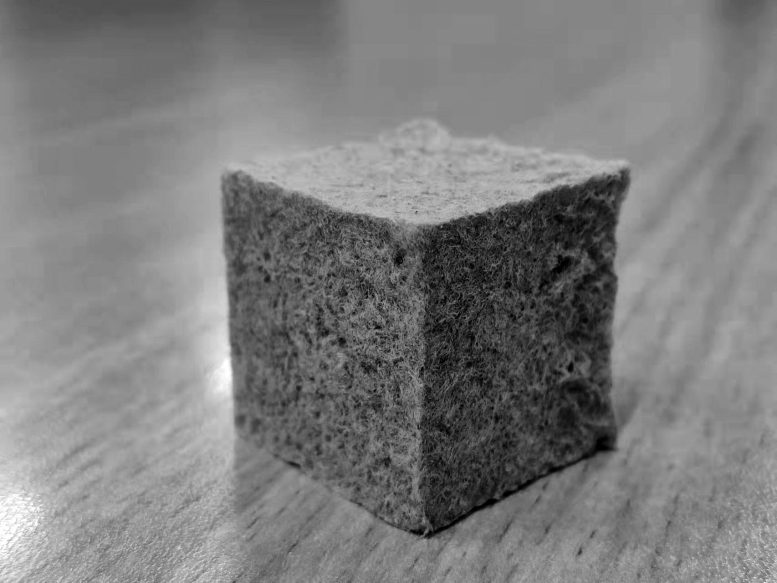
This cardboard-based foam reinforced with gelatin could make packaging materials more sustainable. Credit: Jinsheng Gou
Eco-friendly cushioning foam made from recycled cardboard offers a stronger, more insulating alternative to traditional packaging materials, presenting a sustainable solution for the shipping industry.
With the holiday season in full swing, gifts of all shapes and sizes are being shipped around the world. But all that packaging generates lots of waste, including cardboard boxes and plastic-based foam cushioning, such as Styrofoam™. Rather than discard those boxes, researchers publishing in ACS Sustainable Chemistry & Engineering developed a cushioning foam from cardboard waste. Their upcycled material was stronger and more insulating than traditional, plastic foam-based cushioning.
Transforming Common Household Waste Into Eco-Friendly Materials
Among the many kinds of trash that accumulate within a home, wastepaper is one of the most common. Everything from newspapers and junk mail to paperboard envelopes and cardboard boxes can pile up, especially as internet shopping has exploded in popularity. Researchers are interested in turning these containers and paper waste into something else that’s useful — sturdy but light mailing materials.
Currently, to keep electronics and toys nestled tightly inside of a box, molded cushioning materials, such as Styrofoam, are typically used. A sustainable alternative could be lightweight, cellulose aerogels, but current methods to produce them from wastepaper require several chemical pretreatment steps. So, Jinsheng Gou and colleagues wanted to find a simpler way to make a wastepaper-based foam material that could withstand the roughest of deliveries.
Innovating Cardboard-Based Foam for Enhanced Protection
To create their foam, the team broke down cardboard scraps in a blender to create a pulp, then mixed it with either gelatin or polyvinyl acetate (PVA) glue. The mixtures were poured into molds, refrigerated, then freeze-dried to form cushioning foams. Both paper-based foams served as good thermal insulators and strong energy absorbers — even better than some plastic foams.
The team then created a heavy-duty version of their wastepaper foam by combining the pulp, gelatin, PVA glue, and a silica-based fluid that hardens as force is applied. This version of the cardboard-based foam withstood hits from a hammer without falling apart, and that result suggests the foam could be used in force-intensive deliveries, such as parachute-free airdrops.
The researchers say their work offers a simple yet efficient method to upcycle cardboard to create more environmentally friendly packaging materials.
Reference: “Biodegradable Wastepaper-Based Foam with Ultrahigh Energy-Absorbing, Excellent Thermal Insulation, and Outstanding Cushioning Properties” by Bin Zhang, Wenxuan Tao, Ziming Ren, Shiqi Yue and Jinsheng Gou, 28 November 2023, ACS Sustainable Chemistry & Engineering. DOI: 10.1021/acssuschemeng.3c06230
The authors acknowledge funding from the Beijing Key Laboratory of Wood Science and Engineering.
Recent research reveals that fermenting alliums like onions with fungi can naturally mimic meat flavors, offering a promising solution for enhancing plant-based meat alternatives without synthetic additives.
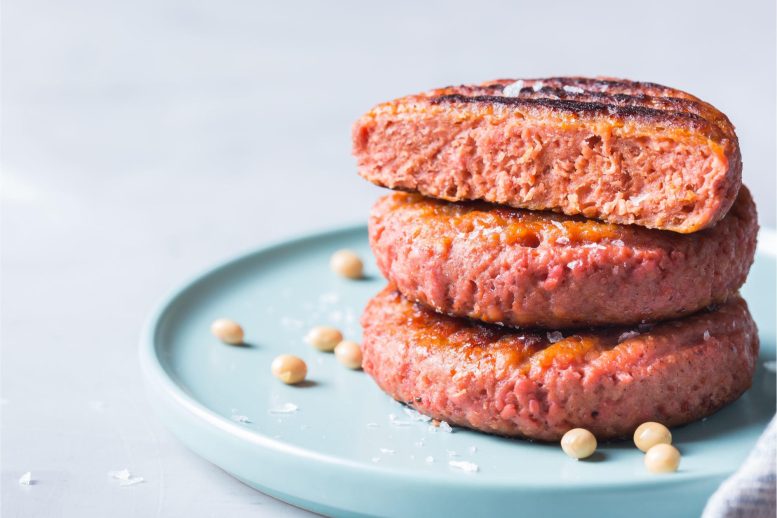
Plant-based substitutes like tempeh and bean burgers offer protein-packed choices for individuals looking to cut down on meat. However, mimicking the taste and smell of meat is difficult, and many companies use artificial additives for this purpose. A recent study in ACS’ Journal of Agricultural and Food Chemistry has revealed a promising solution: onions, chives, and leeks can generate natural compounds similar to meat’s savory flavors when fermented with typical fungi.
Innovative Approaches to Natural Meat Flavoring
When food producers want to make plant-based meat alternatives taste meatier, they often add precursor ingredients found in meats that transform into flavor agents during cooking. Or, the flavoring is prepared first by heating flavor precursors, or by other chemical manipulations, and then added to products.
Because these flavorings are made through synthetic processes, many countries won’t allow food makers to label them as “natural.” Accessing a plant-based, “natural” meat flavoring would require the flavoring chemicals to be physically extracted from plants or generated biochemically with enzymes, bacteria or fungi. So, YanYan Zhang and colleagues wanted to see if fungi known to produce meaty flavors and odors from synthetic sources could be used to create the same chemicals from vegetables or spices.
Alliums Unlock Meaty Aromas
The team fermented various fungal species with a range of foods and found that meaty aromas were only generated from foods in the Allium family, such as onions and leeks. The most strongly scented sample came from an 18-hour-long fermentation of onion using the fungus Polyporus umbellatus, which produced a fatty and meaty scent similar to liver sausage.
With gas chromatography-mass spectrometry, the researchers analyzed the onion ferments to identify flavor and odor chemicals, and found many that are known to be responsible for different flavors in meats. One chemical they identified was bis(2-methyl-3-furyl) disulfide, a potent odorant in meaty and savory foods.
The team says that alliums’ high sulfur content contributes to their ability to yield meat-flavored compounds, which also often contain sulfur. These onion ferments could someday be used as a natural flavoring in various plant-based meat alternatives, the researchers say.
Reference: “Sensoproteomic Discovery of Taste-Modulating Peptides and Taste Re-engineering of Soy Sauce” by Manon Jünger, Verena Karolin Mittermeier-Kleßinger, Anastasia Farrenkopf, Andreas Dunkel, Timo Stark, Sonja Fröhlich, Veronika Somoza, Corinna Dawid and Thomas Hofmann, 20 May 2022, Journal of Agricultural and Food Chemistry. DOI: 10.1021/acs.jafc.2c01688
The authors acknowledge funding from the Adalbert-Raps-Stiftung.
Recent research in ACS Central Science reveals that carbamic acid, a simple amino acid, might have formed in interstellar ices near forming stars or planets, much earlier than life on Earth. This suggests that essential life components could have originated from outer space and been brought to Earth via meteorites or comets.
New research suggests that carbamic acid, a basic amino acid, could have originated in interstellar ices, indicating that life’s building blocks predate Earth and were possibly delivered via meteorites.
While life on Earth is relatively new, geologically speaking, the ingredients that combined to form it might be much older than once thought. According to research published on November 29 in the journal ACS Central Science, the simplest amino acid, carbamic acid, could have formed alongside stars or planets within interstellar ices. The findings could be used to train deep space instruments like the James Webb Space Telescope to search for prebiotic molecules in distant, star-forming regions of the universe.
Theories of Amino Acid Formation
It has long been hypothesized that one of the building blocks for life, amino acids, could have formed during reactions in the “primordial soup” of the early, prebiotic Earth. However, another theory suggests that amino acids could have been carried to the Earth’s surface by meteorites. These space rocks might have picked up the molecules from dust or interstellar ices — water and other gases frozen solid by the cold temperatures of outer space. But because meteorites came from far away in the universe, scientists are left wondering, where did these molecules form, and when? To help answer these questions, Ralf Kaiser, Agnes Chang and colleagues wanted to investigate the chemical reactions that might have taken place in interstellar ices that once existed near newly forming stars and planets.
The team created model interstellar ices containing ammonia and carbon dioxide, which were deposited onto a silver substrate and slowly heated. Using Fourier transform infrared spectroscopy, they found that carbamic acid and ammonium carbamate started to form at -348 °F and -389 °F (62 and 39 Kelvin), respectively. These low temperatures demonstrate that these molecules — which can turn into more complex amino acids — could have formed during the earliest, coldest stages of star formation.
In addition, the researchers found that at warmer temperatures, similar to those produced by a newly formed star, two carbamic acid molecules could link together, making a stable gas. The team hypothesized that these molecules could have been incorporated into the raw materials of solar systems including our own and then delivered to the early Earth by comets or meteorites once the planet formed. They hope this work will inform future studies that use powerful telescopes to look for evidence of prebiotic molecules in the far reaches of space.
Reference: “Thermal Synthesis of Carbamic Acid and Its Dimer in Interstellar Ices: A Reservoir of Interstellar Amino Acids” by Joshua H. Marks, Jia Wang, Bing-Jian Sun, Mason McAnally, Andrew M. Turner, Agnes H.-H. Chang and Ralf I. Kaiser, 29 November 2023, ACS Central Science. DOI: 10.1021/acscentsci.3c01108
The authors acknowledge funding from the Division for Astronomy of the U.S. National Science Foundation, the W.M. Keck Foundation, and the University of Hawaii at Manoa.



![Outsmarting Counterfeit Detector Pens With Clever Chemistry [Video]](https://carbonchemist.com/wp-content/uploads/2024/02/Testing-Counterfeir-Money.jpg)