Male mice have a technique for escaping aggressive encounters
Edward Berthelot/Getty Images
In male-on-male mouse squabbles, the victims of aggression often hide behind a female mouse to divert their attacker’s attention.
“Think back to a time when you were confronted by a bully or found yourself in another challenging situation – you either confronted the issue directly or looked for ways to escape it,” says Joshua Neunuebel at the University of Delaware. “Animals often deal with similar struggles.”
Fights between male mice can be vicious, often involving biting, wrestling…
Boophis pikei, a newly named species of Madagascan frog
Miguel Vences (CC-BY-SA 4.0)
Deep in the forests of Madagascar, researchers have discovered seven new species of frogs and named them after characters from Star Trek.
“The calls of the frogs remind us strongly of iconic futuristic sound effects from the franchise,” says Mark D. Scherz at the Natural History Museum of Denmark.
Boophis marojezensis is a small, brownish frog found in Madagascar’s humid forests. It was first described in 1994, but, over time, researchers started to wonder whether this puppy-eyed amphibian was actually more than one species.
To find out, Scherz and his colleagues gathered as much data as possible from different individuals of B. marojezensis collected over three decades. They recorded and analysed the frogs’ calls, compared their physical characteristics and sequenced their DNA.
Their results showed that what was previously thought to be only one frog species is actually eight different ones. Physically, they look almost identical, says Scherz. “The key differences are in the sounds that they make. Their ear-splitting, high-pitched, whistling calls differ both in pitch and in timing of the whistles.” The DNA sequencing also showed genetic differences, confirming they are different species.
Male frogs use their bird-like calls to attract females, and as these newly named species live close to streams, Scherz thinks they evolved their high-pitched whistles to help their songs stand out from the din of flowing water. However, much about these frogs’ lives remains a mystery.
One of the species is named Boophis kirki, in honour of James T. Kirk. The others are named after Jean-Luc Picard, Benjamin Sisko, Kathryn Janeway, Jonathan Archer, Michael Burnham and Christopher Pike.
“We wanted to honour the captains that lead their teams on missions of exploration and discovery,” says Scherz. “It may serve also as a reminder of how much discovery there still is to do here on Earth, before we turn our eyes to the stars.”
The late, great evolutionary biologist William Hamilton apparently used to correspond on second-hand postcards, writing over the original script in different-coloured ink, sometimes at right angles. In The Genetic Book of the Dead: A Darwinian reverie, his colleague Richard Dawkins describes this as a kind of palimpsest – “a manuscript in which later writing has been superimposed on earlier (effaced) writing”. This, he says, is a…
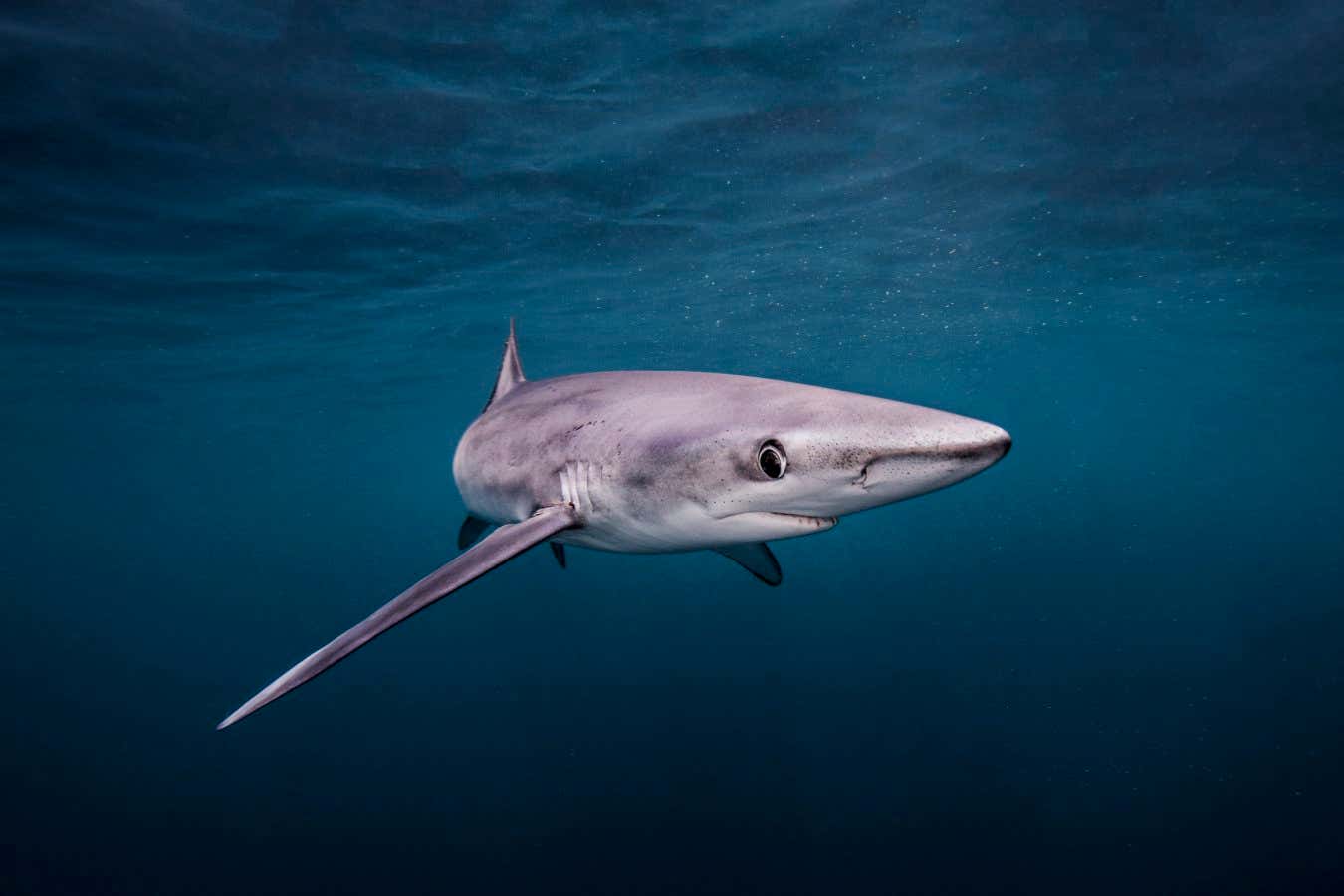
A blue shark was skewered through the head by a swordfish, but lived to tell the tale in the first known instance of a shark surviving this type of impalement.
When the shark was caught by fishers in Vlorë, southern Albania, it had no fresh puncture wounds and it had bait in its stomach, indicating it was feeding normally. An autopsy later revealed an 18.6-centimetre fragment of swordfish bill embedded in its skull.
“When I realised that there was a swordfish bill inside the shark’s head, I was astonished,” says Andrej Gajić at Sharklab ADRIA Research Centre in Vlorë.
Gajić has conducted tens of thousands of shark autopsies. “I’ve never encountered anything like this before, nor have I read about it in the literature,” he says. His team tries to revive and release sharks caught as bycatch if possible, but this shark died before it arrived in port.
There have been eight previously documented incidences of blue sharks (Prionace glauca) being impaled by swordfish (Xiphias gladius) with the swordfish’s rostrum found in or near the shark’s head. A bigeye thresher shark (Alopias superciliosus) and a shortfin mako shark (Isurus oxyrinchus) have also been found gored by billfish, the group that includes swordfish.
This is the first verified shark survival of such an encounter. As it was impaled, the young swordfish probably reacted instinctively by elevating its head, snapping off its bill without damaging any of the shark’s vital structures, says Gajić.
The adult shark measured 275 centimetres and weighed 44 kilograms. Swordfish can grow up to around 455 centimetres and weigh as much as 650 kilograms. There are some reports of blue sharks feeding on swordfish, and both animals use aggressive hunting tactics to feed on dense schools of fish or squid.
Such impalements could occur when swordfish try to defend themselves from a blue shark’s attack, or due to an accidental collision when both predators are feeding on the same prey. Gajić says more observations are needed to determine the cause.
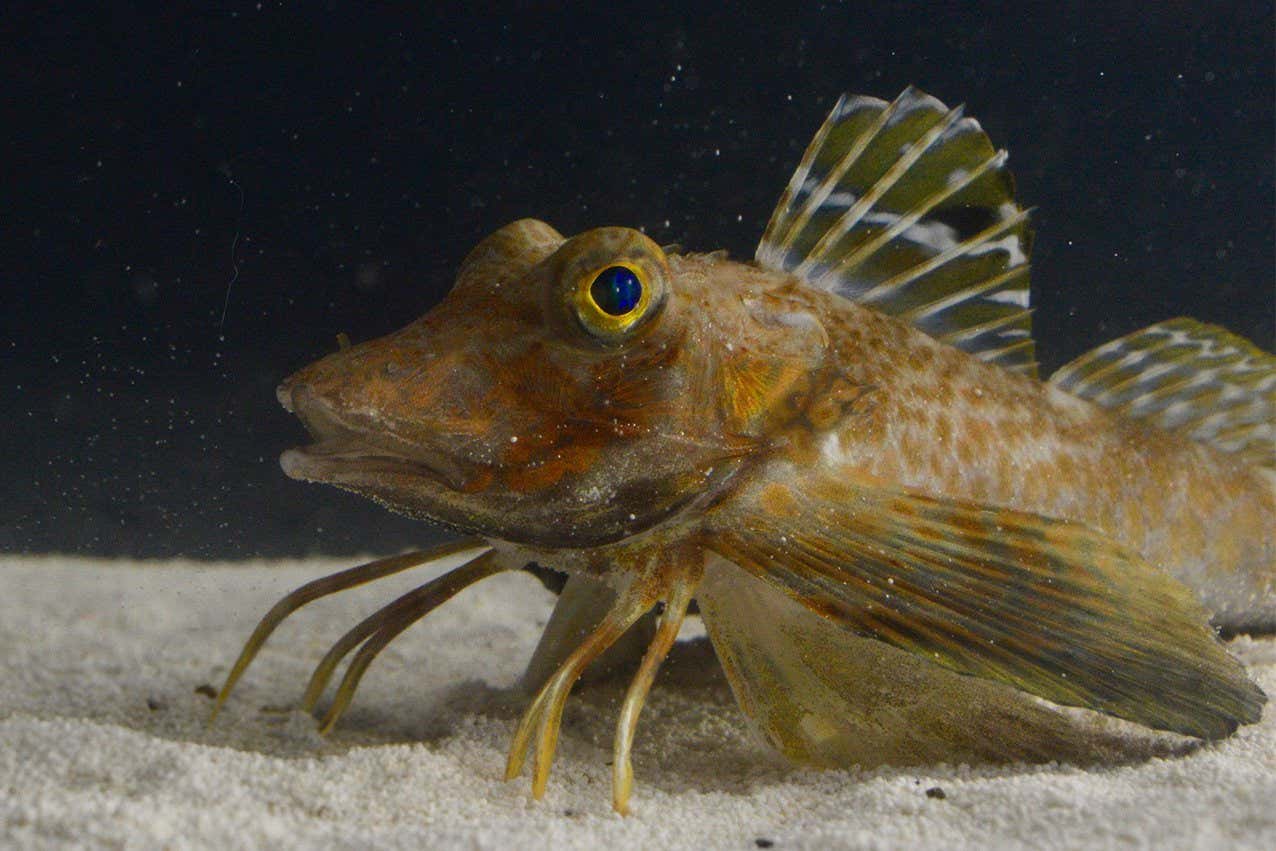
The northern sea robin uses its legs to find food in the seabed
Anik Grearson
A striking fish that lives at the bottom of the Atlantic Ocean has evolved legs – but not just for walking. These appendages are a novel sensory organ like a tongue, which they use to find prey buried in the seabed.
Northern sea robins (Prionotus carolinus) have three legs on each side of their body, protruding from the base of their pectoral fins. The legs are derived from structures within the pectoral fins, called fin rays.
On a research trip to Woods Hole, Massachusetts, Nicholas Bellono at Harvard University and his colleagues heard stories of the hunting prowess of the sea robins and decided to bring several live specimens back to their lab.
The team wanted to find out if the fish were as good at finding prey as their reputation suggested. “To our surprise, they were very, very good at it and could even uncover capsules filled with ground-up and filtered mussel extract, and single amino acids,” says Bellono.
The researchers then collected more of the fish, only to discover that the second batch were good at walking but not at sensing prey buried in the sand.
“This time the new sea robins didn’t find anything, despite readily eating prey on the surface,” says Bellono. “We thought we were maybe doing something wrong, but it turned out that we accidentally got a different species.”
The team had inadvertently collected the striped sea robin (Prionotus evolans), which walks but specialises in hunting unburied prey.
“When we looked at the digging versus non-digging animals, the legs were so obviously different and the sensory papillae on the digging legs were even clear by eye,” says Bellono.
These papillae are bumps containing taste receptors and touch-sensitive neurons, similar to the papillae made up of taste buds on the human tongue.
Various other fish have evolved modified pectoral and pelvic fins that allow them to walk or perch, says team member Amy Herbert at Stanford University, California. “However, a unique feature about the sea robin is that while other fish typically use the entire pectoral or pelvic fin for this purpose, the legs of the sea robin can move independently – and quite quickly – making them particularly adept at both walking and digging,” she says.
The team also looked into the genes that drove the evolution of the sea robin’s unique legs, and found that their development is controlled by an ancient regulatory gene called tbx3a.
“It’s normally expressed in a particular local domain of fin and limb buds in a whole range of animals from fish to mammals,” says team member David Kingsley, also at Stanford University. “This is an excellent example of making new body parts by modifying old, shared tools.”
Axolotls appear to age very little over their lifetimes
SeaTops / Alamy
Ever wished you could hit the pause button on ageing? At least one creature may do just that. Axolotls seem to halt one of the hallmarks of the process part way through their lives, a finding that could shed new light on ageing and regeneration.
Axolotls (Ambystoma mexicanum) belong to a group of amphibians called salamanders, which are famed for their astonishing powers of regeneration, such as regrowing amputated limbs. They also appear to age very little, a feature called negligible senescence.
Ancient DNA unearthed from a European rock shelter suggests that local herders tended goats and sheep more than 5000 years ago, but switched to primarily pigs 2000 years later – right about when the surrounding forests became much less biodiverse.
Although further research is needed, the findings hint that keeping pigs – which root the ground and are far less picky eaters than goats and sheep – might have played a role in how modern forests took shape. The discovery provides strong evidence that analysing ancient sedimentary DNA can…
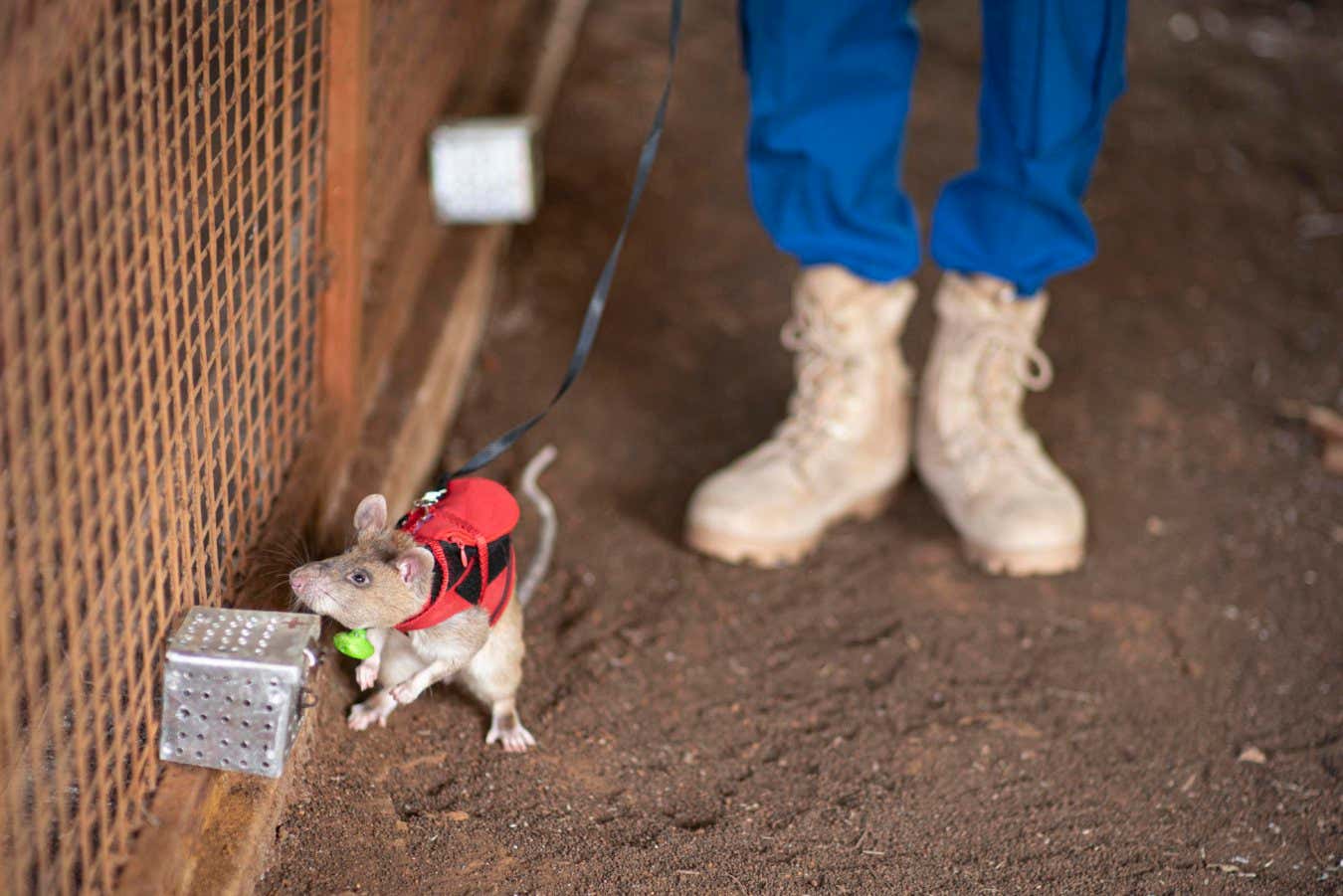
African giant pouched rats proved adept at detecting four commonly trafficked products derived from endangered species including rhino horn and elephant ivory
Some lizards can stay underwater for longer by blowing out and then rebreathing bubbles of air. This has been suspected since the behaviour was first observed, and now experiments have confirmed it.
While doing fieldwork in Costa Rica in 2015, Lindsey Swierk at Binghamton University in New York State noticed that some lizards (Anolis aquaticus) dived into streams as people approached and stayed underwater for long periods. When her team filmed the lizards underwater, they noticed they blew out large bubbles from their nostrils that remained attached to their heads, and then breathed them in again.
Swierk wrote a short paper describing the behaviour in 2018. In 2021, she and her colleagues reported that at least 18 species of Anolis lizards rebreathe bubbles while underwater, and that they can stay underwater for up to 18 minutes.
These species all have water-repellent skin that remains covered by a thin layer of air when they are underwater, giving them a silvery appearance. This is also why the larger bubbles they blow out remain attached.
Now Swierk has done a further study in which she applied a kind of moisturiser known as an emollient to the heads of newly caught lizards with a paintbrush, to temporarily stop the skin repelling water.
These lizards could only blow out tiny bubbles. “They were able to rebreathe a little because I did not apply the emollient over the nostrils, for obvious reasons,” says Swierk.
The lizards were then put in a clear plastic tank filled with stream water to see how long they could stay underwater, before being released. Those painted with plain water stayed underwater 32 per cent longer on average than lizards painted with the emollient.
Swierk thinks simply rebreathing the same air allows the lizards to get more oxygen out of it. In addition, as the blown-out bubble joins up with the thin layer of fresh air on the skin of the lizard, more oxygen will enter the bubble. In other words, the thin layer of air on the skin might act as a scuba tank.
What’s more, it is also possible that the large bubble acts as a gill, allowing carbon dioxide to dissolve out into the water and oxygen to diffuse in. It is known that many insects, spiders and plants can survive underwater thanks to layers of air that act as gills.
The star-nosed mole and the water shrew also blow out and rebreathe bubbles underwater, but they are thought to do this as a way of smelling while submerged.
A leaf chameleon from the newly named species Brookesia nofy, found in Madagascar
Andolalao Rakotoarison
A species of leaf chameleon new to science, measuring less than half the length of a human forefinger, has been discovered in a tiny patch of Madagascar’s highly threatened coastal rainforests.
Miguel Vences at the Technical University of Braunschweig in Germany and his colleagues were alerted to its presence by tourists posting photos of the tiny reptiles on the internet.
Vences’s Malagasy collaborators, Andolalao Rakotoarison and Alida Frankline Hasiniaina, went looking for it and collected the first sample.
Leaf chameleons, from the genus Brookesia, are miniature chameleons the colour of fallen leaves that have been breaking records for their small body sizes in recent years.
The new species, named Brookesia nofy after the Ankanin’ny Nofy tourist site where it was found on Madagascar’s eastern coastline, is only slightly bigger at around 33 millimetres long. It is the first leaf chameleon to be found living in coastal or littoral, rainforests – arguably the island’s most threatened habitat. Once extensive, only around 10 per cent remains.
It is possible B. nofy has only survived because the forest patch where it is found is part of a private reserve run by a hotel whose owners have allowed trees to regenerate over the past 20 years. The species was also photographed by a local journalist five years ago in a bigger patch of forest nearby, but when Vences and his colleagues visited two years ago, they witnessed a large part of that forest being destroyed by bushfires.
Supporting ecotourism ventures that give international tourists a chance to view Madagascar’s rare chameleons alongside lemurs probably outweighs the heavy carbon footprint needed to travel there, says Vences.
“If people don’t see an economic value in the little patches of [surviving littoral] forest, the forest will be gone,” he says.