Nature, Published online: 06 November 2024; doi:10.1038/d41586-024-03465-4
Powerful bursts of radio waves from distant galaxies are typically linked to young celestial objects. But observations reveal that they are more likely to occur in rarer, more massive galaxies, offering clues to their enigmatic origins.
The nearby star Gliese 229 harbours a ‘brown dwarf’ companion: an object less massive than a star but more massive than a planet. High-resolution observations reveal that it is two objects, each about 30 times the mass of Jupiter, that circle one another every 12 days as they orbit their sun every few hundred years.
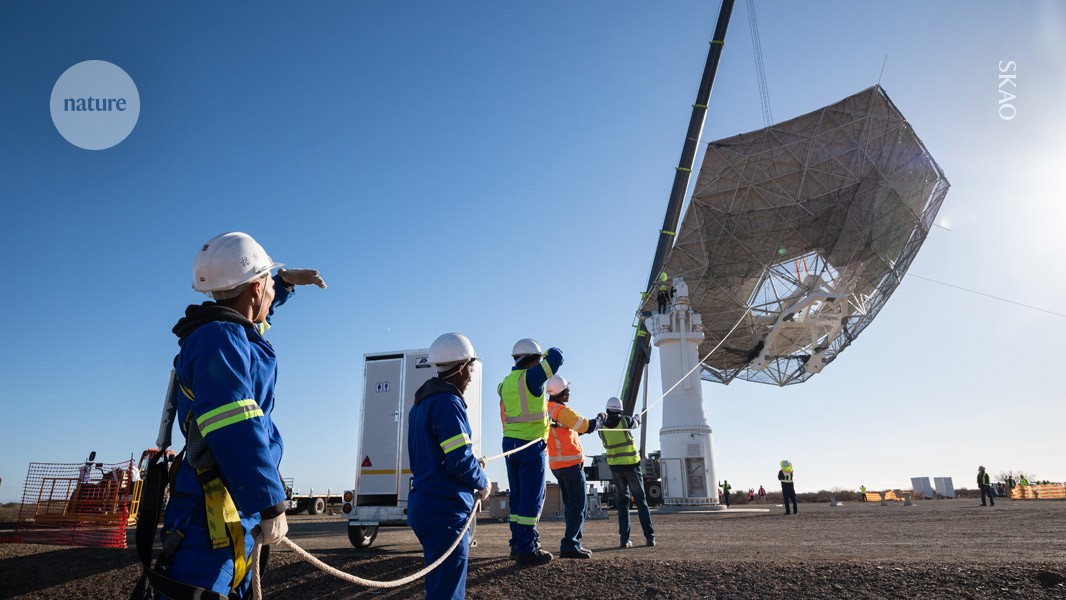
The world’s largest telescope, the Square Kilometre Array (SKA), which is based in Australia and South Africa, is changing its plans and will not be expanding into eight African countries on its original timetable.
In August, SKA director-general Philip Diamond said in a briefing at the International Astronomical Union’s general assembly in Cape Town, that the observatory’s plans had “evolved”. The project will be unable to fund a large expansion into other countries on the original timescale that had been agreed on when the project’s main sites were selected in 2012.
Diamond told Nature that “the ability to go from the current funding to another large monolithic phase of the project is probably just impractical. What we’re looking at now is much more of a phased, continual deployment.”
Pontsho Maruping, managing director of the South African Radio Astronomy Observatory (SARAO) in Cape Town, says that this will not affect the scientific scope of the project, but that the timing of its goals will depend on the availability of funding. “As soon as more funding is committed, more infrastructure will be deployed, including remote stations,” she says.
Nature’s news team contacted the African Astronomical Society, based in Cape Town, and the Ghana Space Science and Technology Institute in Accra, to ask whether the changes would lead to a loss in research capacity in some African nations. They referred enquiries to the SARAO and the SKA Observatory global headquarters (SKAO), near Manchester, UK.
Whether the telescope will ever reach its target ‘square kilometre’ is not clear. Diamond said that it will not happen during his tenure as director-general. “It’s for future leaders to take us there.”
First images
SKA telescopes are interferometers, in which multiple dishes or antennas act as a single telescope. Together, they collect radio signals emitted by celestial objects. Astronomers hope that the array will shed light on some of the most enigmatic problems in astronomy, such as how galaxies form, the nature of dark matter and whether there is life on other planets.
So far, the SKAO has secured €2.1 billion (US$2.3 billion) from its ten official members: Australia, Canada, China, Italy, the Netherlands, Portugal, South Africa, Spain, Switzerland and the United Kingdom.
This funding covers the first ten years of the telescope’s construction and operation (2021–30), accounting for roughly 10% of the planned dishes and antennas. This includes 197 three-storey mid-frequency dishes in South Africa and 131,072 low-frequency antennas in western Australia, grouped into smaller arrays. Both telescopes — called SKA-Mid and SKA-Low — have produced their first images.
A second phase, with a starting date of 2020, was meant to comprise around 2,000 radio dishes in Botswana, Ghana, Kenya, Madagascar, Mauritius, Mozambique, Namibia and Zambia, along with South Africa, and a total of one million antennas in Australia. The total collecting area would be around one square kilometre, hence the name.
Enter Botswana
Maruping says that the SKAO’s decision to delay the second phase “does not stop us partnering with African partner countries and SKA members to deliver astronomy infrastructure as appropriate”.
For example, next year, Botswana, one of the eight partner countries, will get its first SKA dish through a collaboration with South Africa and Germany, with a funding arrangement outside of the initial SKA plan.
“It’s a game-changer for the science in Botswana,” says Kgomotso Thelo, a project manager at the Botswana International University of Science and Technology (BIUST) in Palapye. “We’ll begin to have those astronomers working on the data that’s generated from their own telescope.”
The Max Planck Institute for Radio Astronomy in Bonn, Germany, and the German Center for Astrophysics in Görlitz are contributing the dish hardware, costing about €6 million. Meanwhile, Botswana is providing local support and covering infrastructure costs and South Africa is supplying other components, says Michael Kramer, an astronomer and director of the Max Planck Institute for Radio Astronomy.
The Max Planck Society, along with South Africa’s government and the Astronomical Observatory of Capodimonte in Naples, Italy, are currently funding the addition of 14 dishes to South Africa’s 64-dish MeerKAT telescope, which will ultimately be incorporated into the SKA.
Similarly, the Botswana dish will also be incorporated into SKA. “The construction and operation of the dish will be the first significant astronomical facility to be sited in Botswana,” says Michael Bode, an emeritus professor of astrophysics at Liverpool John Moores University, UK.
Botswana has just a handful of professional astronomers, Thelo says. “It’s going to be a tough road ahead, but if you’ve got partners who have done it before, it makes it much easier for us,” he adds.
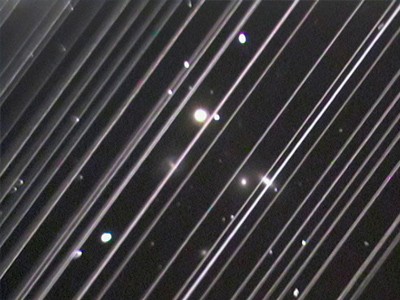
The movement of satellites causes bright stripes in astronomical images.Credit: Caltech Optical Observatories/IPAC
Astronomers have developed a machine-learning algorithm that can detect satellite streaks in images of the night sky with high accuracy. The model makes data easier to interpret and could allow removal of the streaks, which are causing increasing problems in astronomy.
The technology won’t solve the issue of Internet-communications satellites ‘photobombing’ observations, but it could help to reduce their impact on some telescope images. Researchers presented the work at the International Astronomical Union (IAU) general assembly last month in Cape Town.
“Machine learning and artificial intelligence can help because if you have enough data, you can classify that, okay, this is what a satellite looks like,” says Siegfried Eggl, an astrophysicist at the University of Illinois Urbana-Champaign. But satellite launches and developments are moving at “breakneck speed”, he adds, and researchers are “doing our best to catch up”.
Growing threat
Over the past five years, companies including SpaceX in Hawthorne, California, Eutelsat OneWeb in London and Amazon’s Project Kuiper in Redmond, Washington, have launched thousands of communications satellites into low Earth orbit. Many more are planned, including a 12,000-satellite megaconstellation called G60 Starlink, set to be launched by Shanghai Spacecom Satellite Technology in China. “There are now approximately a million satellites in the registry of ambitions for the future,” said Richard Green, director of the IAU’s Centre for the Protection of the Dark and Quiet Sky from Satellite Constellation Interference, in a session at the IAU general assembly.
Astronomers push for global debate on giant satellite swarms
These satellites provide fast broadband Internet access to people worldwide, but are increasingly disruptive for astronomers — they appear as bright streaks in images of the sky and can affect observations across the electromagnetic spectrum. Sensitive telescopes with wide fields of view bear the brunt of this satellite contamination. The upcoming Vera Rubin telescope, for example, could see more than one-third of its images compromised, according to an estimate presented at the assembly.
“Astronomy today is big-data science and there is no person who can look at all of the images that are being recorded every night and detect the streaks,” says Eggl. “This is where machine learning can help.”
To develop a program to identify satellite trails in telescope images, María Romero-Colmenares, a data scientist at the University of Atacama in Chile, trained a supervised machine-learning algorithm on tens of thousands of images taken by a network of telescopes across Chile, Spain, Mexico, Vietnam and South Korea. “We knew what time and position [in the sky] to observe the satellite, and we made one observation with a satellite and one without,” says Romero-Colmenares, generating an equal number of clear and contaminated images. When she and her colleagues applied the model to publicly available data from the WASP (Wide Angle Search for Planets) and Hungarian Automated Telescope Network projects, the algorithm was able to identify 96% of satellite streaks.
‘Unsustainable’: how satellite swarms pose a rising threat to astronomy
Detecting the streaks is an important step towards eliminating them from images and data, says Jeremy Tregloan-Reed, an astrophysicist at the University of Atacama who worked with Romero-Colmenares on the project. The next challenge will be to develop tools that can actually remove the satellite trails while preserving the data underneath. That is possible only in cases where the satellite is not so bright that it saturates an image’s pixels and bleeds into surrounding pixels, Tregloan-Reed says. If bleeding happens, the underlying data cannot be saved.
By the end of next year, the researchers hope to develop an open-source app and program that will enable observatories and amateur astronomers to identify contaminated images and data, and clean them up. Such measures are most likely to succeed for small telescopes that have cameras with low sensitivities.
Star-like flashes
Other forms of satellite contamination are proving even harder to tackle. When solar panels and other flat surfaces on satellites catch the light, they produce flashes resembling short-lived astronomical transients, bursts of energy that can last from milliseconds to years.
“As these flashes are very short, down to a millisecond sometimes, the satellite motion is negligible during it, and we get a perfectly stellar-like flash,” says Sergey Karpov, an astronomer at the Central European Institute for Cosmology and Fundamental Physics in Prague. There is “no real way to distinguish these flashes from astrophysical transients we would like to detect — apart from directly comparing its position to catalogues of satellite orbits”, he adds.
SpaceX tests black satellite to reduce ‘megaconstellation’ threat to astronomy
The electronic equipment inside satellites can also emit unintended radiation that interferes with observations of the Big Bang’s afterglow, says Eggl. Astronomers hope that studying this radiation, known as the cosmic microwave background, will answer questions about the Universe’s expansion. SpaceX’s next-generation satellites, which the company began launching last year, emit around 30 times more radiation than the previous generation. This type of radiation is not regulated and could compromise entire observing bandwidths1.
Eggl points out that AI tools cannot truly recreate lost data, and the problem will get worse as more satellites are launched. “If you brush white paint over the Mona Lisa, at some point, there’s nothing you can do, even if you train a machine learning algorithm on all of da Vinci’s paintings,” Eggl says. “They may guess at what the painting could look like, but they can never reconstruct the data that you lose.”
Nature, Published online: 23 September 2024; doi:10.1038/d41586-024-02804-9
JWST has opened a window on exoplanet imaging by observing the planet ε Indi Ab directly. The planet’s existence had been inferred, but its age and temperature made the discovery difficult to confirm — until now.
Scientists and science-fiction writers have long asked whether a nuclear explosion could change the course of an asteroid headed for Earth (artist’s impression).Credit: Detlev Van Ravenswaay/Science Photo Library
A blast of X-rays from a nuclear explosion should be enough to save Earth from an incoming asteroid, according to the results of a first-of-its-kind experiment.
The findings, published1 on 23 September in Nature Physics, “showed some really amazing direct experimental evidence for how effective this technique can be”, says Dawn Graninger, a physicist at Johns Hopkins University Applied Physics Laboratory in Laurel, Maryland. “It’s very impressive work.”
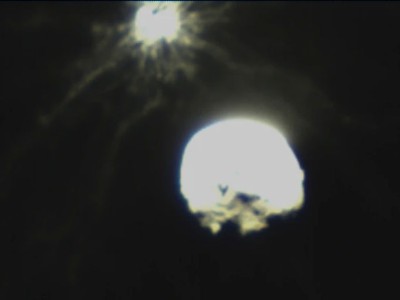
This spacecraft just smashed into an asteroid in an attempt to change its path
Nathan Moore, a physicist at Sandia National Laboratories in Albuquerque, New Mexico, and his colleagues designed the experiment to simulate what might happen if a nuclear bomb was detonated near an asteroid. Previously, scientists have studied the momentum of a bomb’s shock wave — which results from the expansion of gas — pushing against an asteroid. However, Moore’s team says that the huge amount of X-rays produced in the explosion would have a bigger effect in changing an asteroid’s trajectory.
The team used Sandia’s vast Z machine, which uses magnetic fields to produce high temperatures and powerful X-rays, to fire X-rays at two mock asteroids about the size of coffee beans. “About 80 trillion watts of electricity flow through the machine at about 100 billionths of a second,” says Moore. “That intense electrical surge compresses argon gas into a very hot plasma millions of degrees in temperature, and that emits a bubble of X-rays.”
Fresh images reveal fireworks when NASA spacecraft ploughed into asteroid
Cut and thrust
The two mock asteroids were about 12 millimetres and made of quartz and silica, to reflect different compositions of asteroids in the Solar System. Each was hung by a thin piece of foil inside a vacuum. When the X-ray bubble hit, it cut the foil like a pair of X-ray scissors and put the asteroids into free fall. That allowed the true impact of the X-rays in conditions simulating the vacuum of space to be observed. “That is completely novel,” says Graninger. “I’ve never heard of that being done before.”
The results of the experiment, which lasted just 20 millionths of a second, showed that the quartz and silica samples were accelerated to 69.5 metres per second and 70.3 metres per second, respectively, before being vaporized. The cause of the acceleration was the X-rays vaporizing the surface of the asteroids, creating thrust as gas expanded away from their surfaces.
The asteroid Dimorphos was nudged by the NASA DART mission in a deflection test.Credit: NASA/Johns Hopkins APL via Alamy
Moore says the results show that the technique could be scaled up to much larger asteroids, as big as around 4 kilometres in diameter, to push them away from a collision course with Earth. “In particular, we’re interested in the largest asteroids with a short warning time,” he says. Where these are concerned, other approaches, such as ramming a spacecraft into an asteroid — as NASA’s Double Asteroid Redirection Test, or DART, did in 2022 — “might not have enough energy to knock it off course”.
Mary Burkey, a physicist at Lawrence Livermore National Laboratory in Livermore, California, says the paper is “one of the first big blockbuster publications of trying to figure out on Earth how we can recreate how a nuclear deflection of an asteroid might go”. She notes that other experiments are investigating the possibility, including those using samples of meteorite to more closely mimic the composition of asteroids. “Planetary defence is having a lot more time in the Sun,” she says.
Moore hopes to perform more experimental tests of the X-ray-deflection technique to refine its effectiveness. One day, there might also be a test in space, similar to the DART mission, to see the effect on a real asteroid. “There’s nothing preventing us other than the desire to do that,” he says.
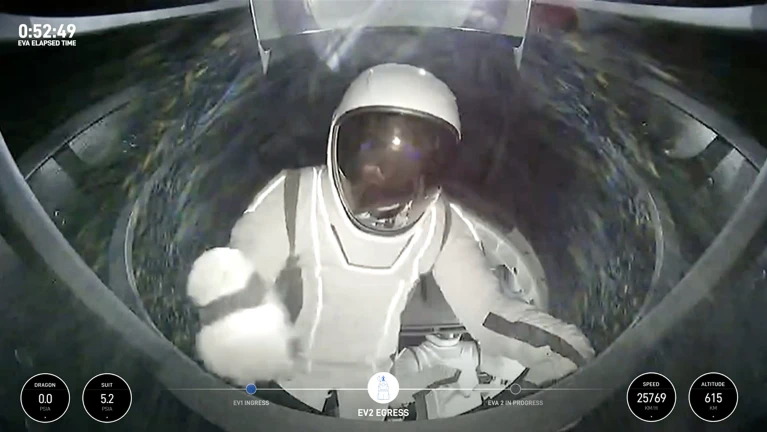
Entrepreneur Jared Isaacman, shown here climbing from the spacecraft’s hatch, made history today as the first private citizen to complete a spacewalk.Credit: SpaceX
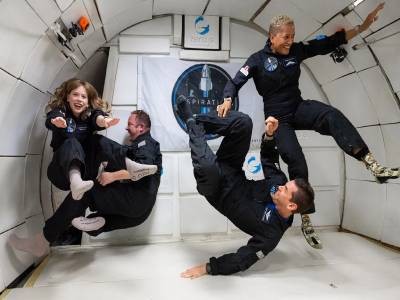
Polaris Dawn, the private SpaceX mission currently orbiting Earth, has already set several records since its launch on 10 September. Hours after taking off, the mission’s Crew Dragon spacecraft reached an altitude of 1,400 kilometres, the highest orbit above Earth achieved by a crewed spacecraft and the farthest humans have travelled from Earth since NASA’s Apollo missions of the late 1960s and early 1970s. And earlier today, two of its crew, US entrepreneur Jared Isaacman and SpaceX engineer Sarah Gillis, completed the first-ever commercial spacewalk at a peak altitude of more than 700 kilometres.
SpaceX to launch astronauts — and a new era of private human spaceflight
“Back at home, we all have a lot of work to do, but from here, Earth sure looks like a perfect world,” said Isaacman, as he stood with his head and torso poking out of the hatch of the spacecraft, preparing for his spacewalk manoeuvres.
Although these milestones are impressive, what is even more intriguing to researchers who spoke to Nature is what the mission could mean for the future of space science. With private citizens and flights going to space more frequently, there will be more opportunities to run experiments in microgravity and probe the bounds of human space travel.
“It’s probably the most exciting time in spaceflight since the 1960s,” says Christopher Mason, a geneticist at Weill Cornell Medical College in New York City, who leads the Space Omics and Medical Atlas (SOMA), a major repository for astronaut biomedical data. “Now we have spacesuits, spacecraft and a mission [that] are all from a private company, SpaceX, which is really the first time we’re having all of this independent organization of spaceflight.”
Space mechanics
Civilians being able to complete a spacewalk might even mean more options for fixing scientific equipment in space. In 2022, Isaacman proposed that NASA should use a crewed SpaceX mission to reboost the agency’s Hubble Space Telescope into a higher orbit to extend its lifetime. The telescope has been in space for 34 years and will gradually descend until it burns up in Earth’s atmosphere. NASA has turned down the proposal for now, citing the potentially catastrophic risks to both Hubble and the crew.
But with the success of today’s spacewalk — also known as an extravehicular activity, or EVA — the idea of a private company performing such difficult space operations has become that much more plausible. “If Polaris Dawn is completely successful with their commercial EVA, that will be one step forwards, and it might be that that’s enough to convince NASA,” says Laura Forczyk, executive director of the space-consulting firm Astralytical in Atlanta, Georgia.
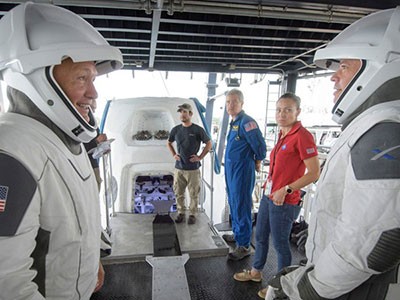
The crew of Polaris Dawn are (from left) SpaceX engineer Anna Menon, former US Air Force pilot Scott Poteet, Isaacman and SpaceX engineer Sarah Gillis.Credit: EPN/Newscom/Avalon
In the meantime, Polaris Dawn will deliver scientific results after it splashes down in the coming days in either the Gulf of Mexico or the Atlantic Ocean. The mission’s Crew Dragon spacecraft, named Resilience, is carrying 36 experiments contributed by 31 different institutions across Canada, Saudi Arabia and the United States, many of them focused on the health of space travellers. “We stand to learn quite a bit,” said Isaacman during a press conference on 19 August. “If we get to Mars someday, we’d love to be able to come back and be healthy enough to tell people about it.”
More crews, more data
Polaris Dawn is the first of three planned Polaris missions funded and led by Isaacman, the chief executive of payment-processing firm Shift4, based in Center Valley, Pennsylvania. One of the goals of the Polaris programme is to help advance the human-spaceflight ambitions of Hawthorne, California-based firm SpaceX. The third Polaris mission will be the first crewed flight of SpaceX’s Starship, a fully reusable mega-rocket that NASA has enlisted to transport astronauts in several years to the Moon’s surface, as part of its ambitious Artemis programme.
How a few days in space can disrupt a person’s biology
Before any of that, Polaris Dawn is testing some basics. For one, it debuted SpaceX’s EVA suit, the company’s first suit designed to protect humans from the vacuum of space. Gillis and Isaacman wore the suits during their spacewalk. “It’s not lost on us,” said Isaacman at the 19 August press conference, that “someday someone could be wearing a version” of the suit while walking on Mars.
For another, the mission is studying the health of the crew members on board. “Spaceflight is just a huge stressor,” says Jimmy Wu, the deputy director of the Baylor College of Medicine’s Translational Research Institute for Space Health (TRISH) in Houston, Texas, which collects medical data on commercial space travellers, including the Polaris Dawn crew.
Researchers think that private crewed spaceflights will help to get answers faster about how spaceflight affects health than government-led missions with trained astronauts, because they are lifting off more often. “It is really hard to study astronauts because it takes so long to get even 10 or 12 of them through six-month missions,” says Leigh Gabel, a kinesiologist at the University of Calgary in Canada, who studies the effects of microgravity on bone health. “Private space travel could give us a real leg up.”
How the body handles space
Gabel’s team will take high-resolution X-rays of the wrists and ankles of Polaris Dawn’s crew once they return to Earth, to measure the effects of several days’ worth of microgravity on bone structure. Her previous work on astronauts who have spent time on the International Space Station has shown that months of microgravity can cause the inner structure of load-bearing bones, such as those in the legs, to weaken in ways that don’t fully heal even one year after returning to Earth1.
Exclusive: How NASA astronauts are training to walk on the Moon in 2026
Several researchers are also using Polaris Dawn to better understand spaceflight-associated neuro-ocular syndrome (SANS), a condition in which astronauts experience permanent changes — and even damage — to their vision. Scientists suspect that SANS stems from built-up fluid in the eye that would normally drain away in Earth’s gravity. Working with ophthalmologist Prem Subramanian and space-health researcher Allie Hayman at the University of Colorado Boulder, the Polaris Dawn crewmembers are each wearing a ‘smart’ contact lens that can record the fluid pressure in the eye.
Other researchers will be studying the effects of exposure to space radiation — high-energy charged particles — on the body by analysing DNA, RNA and other biosamples taken from the Polaris Dawn crew. Importantly, Polaris Dawn represents the first time that many of these analyses will be run on the same space traveller across two different missions: Isaacman also participated in SOMA and TRISH’s research when he commanded Inspiration4, an all-civilian orbital mission operated by SpaceX in 2021.
Isaacman is “one of the most well-characterized human beings that’s ever existed, actually”, Mason says. “He is the best chance we have to understand what happens to the body before you go to space, and then what happens every time you go to space.”
Nature, Published online: 11 September 2024; doi:10.1038/d41586-024-02663-4
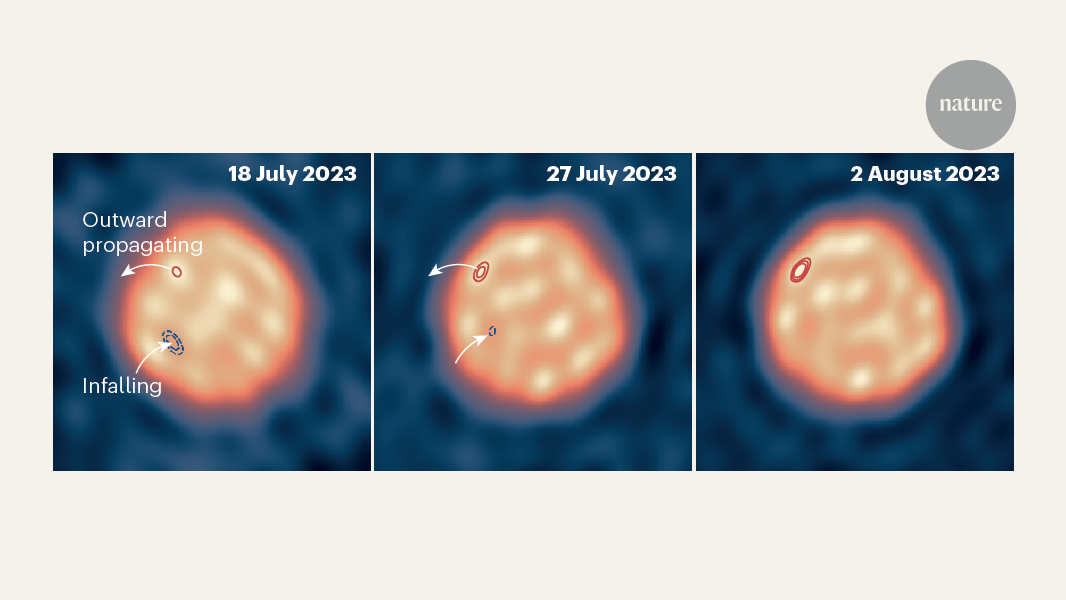
A powerful telescope array has imaged the surface of a star called R Doradus. The observations will help astronomers to understand the fluid dynamics of evolved giant stars — a type of star that the Sun will eventually become.
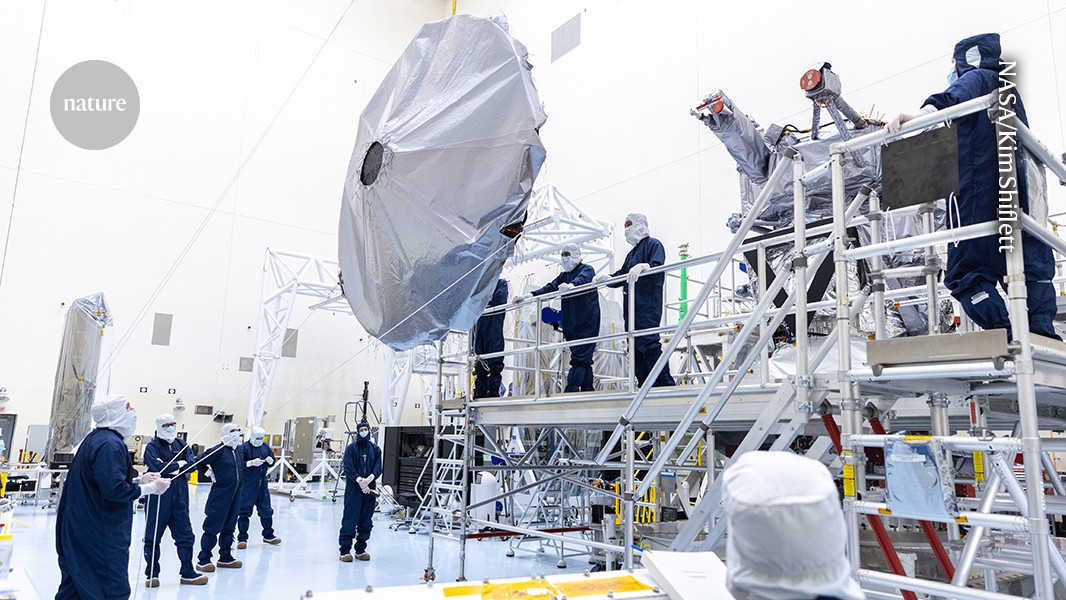
Technicians prepare to install Europa Clipper’s 3-metre-wide antenna on the spacecraft on 17 June at the Kennedy Space Center in Cape Canaveral, Florida.Credit: NASA/Kim Shiflett
After decades of dreaming of Jupiter’s moon Europa — and the vast ocean that probably lies beneath its icy surface — scientists are now weeks away from sending a spacecraft there. NASA confirmed yesterday that its Europa Clipper mission will launch on schedule, following a scare that it might have to be significantly delayed owing to possibly faulty transistors installed on the US$5-billion spacecraft.
“We are confident that our beautiful spacecraft and capable team are ready for launch operations and our full science mission at Europa,” Laurie Leshin, the director of NASA’s Jet Propulsion Laboratory (JPL) in Pasadena, California, said at a 9 September press conference.
With a mass of more than 3.2 tonnes, a height of roughly 5 metres, and a width of more than 30 metres with its solar panels fully unfurled, Europa Clipper is the largest spacecraft that NASA has ever built for a planetary mission. Yesterday, the mission passed what’s known in NASA parlance as ‘key decision point E’ — the final review hurdle that needs to be cleared before proceeding towards launch. The spacecraft’s launch window opens on 10 October.
Jupiter’s moon Europa has an icy surface and few craters.Credit: NASA/JPL-Caltech/SETI Institute
If it takes off successfully next month, the orbiter will arrive at Jupiter in April 2030. Its nine instruments will then investigate both Europa’s icy crust and the ocean that scientists suspect lies beneath it, to determine whether the moon could support life as we know it. Previous missions have suggested1 that Europa’s icy surface hides a subterranean ocean of brine with more than twice the volume of water in Earth’s oceans. The moon’s fissured, seemingly young surface also implies that the satellite has active geology — hinting that Europa’s interior could be warm and dynamic enough for the complex chemistry of life.
There’s no such thing as a tricorder — a fictional instrument from the Star Trek universe — that we can aim at something to reveal whether it is alive, said Curt Niebur, the Europa Clipper programme scientist at NASA’s headquarters in Washington DC, during the press conference. “It is extremely difficult to be able to detect life, especially from orbit,” he said. “First, we’re going to ask the straightforward question: Are the proper ingredients there for life to exist?”
Choppy waters en route to an ocean world
Before the transistor scare, Europa Clipper had endured its share of setbacks. In 2019, NASA angered scientists by cutting a sophisticated magnetometer from the spacecraft, citing budget concerns. The mission also endured uncertainty for years over how it would get to space. That’s because the US Congress had long mandated that the spacecraft fly aboard NASA’s long-delayed Space Launch System rocket. Finally, in 2020, US lawmakers allowed the programme to select the reliable Falcon Heavy rocket from private firm SpaceX in Brownsville, Texas, for the launch.
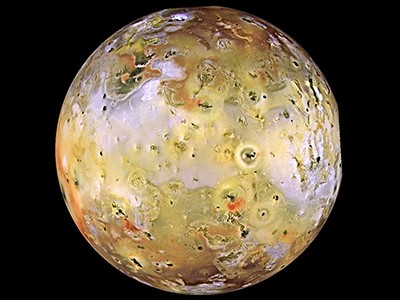
Violent volcanoes have wracked Jupiter’s moon Io for billions of years
The possible transistor problem reared its head in May this year when NASA engineers learnt that batches of a certain kind of transistor already installed on the Europa Clipper spacecraft were misbehaving. The components, called MOSFETS (metal-oxide-semiconductor field-effect transistors), act like switches in electrical circuits. They came from a NASA supplier, the company Infineon, based in Neubiberg, Germany.
Because Europa Clipper is set to fly past Europa 49 times, at distances as close as 25 kilometres, the spacecraft will also need to fly through a fusillade of charged particles accelerated by Jupiter’s magnetic field, which is roughly 20,000 times as strong as Earth’s. This means that the electronics housed in the orbiter must resist radiation damage.
But in May NASA said it was examining whether the mission’s transistors risked malfunctioning. The agency launched into four months of 24-hour intensive testing at three different facilities: JPL; the Johns Hopkins Applied Physics Laboratory in Laurel, Maryland; and the NASA Goddard Space Flight Center in Greenbelt, Maryland. “This was a huge lift, and I think ‘huge lift’ is a huge understatement,” Leshin said.
After evaluating spare MOSFETs from the same batches that were installed on Europa Clipper, NASA found that the spacecraft’s circuits would perform as expected. This conclusion partially rests on the fact that during the first half of its four-year baseline mission orbiting Jupiter, the spacecraft will be in the worst of Jupiter’s radiation only one out of every 21 days. The rest of the time, the orbiter’s transistors can partially self-heal from radiation damage when gently heated, via a process called annealing.
“While Europa Clipper does dip into the radiation environment, once it comes out, it comes out long enough for those transistors the opportunity to heal and partially recover between flybys,” said Jordan Evans, the Europa Clipper project manager at JPL during the conference. “We can — I have high confidence, and the data bears it out — complete the original mission.”