Tag: Astronomy and astrophysics

  • Two giant US telescopes threatened by funding cap

    Two giant US telescopes threatened by funding cap

    [ad_1]

    A render of the completed Thirty Meter Telescope at night with its facility lights on.

    An artist rendering of the Thirty Meter Telescope, planned for construction on Maunakea in Hawaii.Credit: TMT International Observatory/Courtesy of NAOJ with the cooperation of Mitsubishi Electric (CC BY 4.0)

    US astronomers might have only one huge ground-based telescope in their future, rather than the two that many had hoped for.

    They have been planning for years to build the Giant Magellan Telescope on a mountaintop in Chile, and the Thirty Meter Telescope on the Hawaiian mountain Maunakea. Construction has started in Chile, while the Thirty Meter project has been building telescope components and doing other off-site work owing to concerns from Native Hawaiians over Maunakea, which they consider sacred. Both projects are backed by international groups of funders, but neither has the estimated US$3 billion needed to fully fund its telescope.
    Many astronomers had hoped that the US National Science Foundation (NSF) would contribute money to cover the funding shortfall. But last week the National Science Board, which oversees the NSF, recommended that the agency cap its giant-telescope contributions at $1.6 billion. The board also signalled that it was reluctant for the NSF to spend even that much, citing the need to build other facilities “across a wide range of science and engineering fields”.

    Taken together, the board’s actions suggest that the NSF will probably have to choose which of the two telescopes to fund — there might not be enough money for both. The agency is supposed to draw up a plan by May on how to decide which of the two to support.

    Both projects could move ahead if they find additional private or other funding. But having the NSF involved would ensure that US astronomers would be allotted a percentage of observing time on the telescopes, rather than it being reserved for scientists who work with other funding partners. The US Congress could also allocate additional funds to the NSF for the telescopes, but many see that as unlikely in this time of tight budgets. US lawmakers still haven’t agreed on a budget for the current fiscal year, and policy watchers have predicted that science budgets will remain flat or even drop.

    Falling behind

    Looming over both telescope projects is the fact that the European Southern Observatory is ahead of them, quickly building the 39-metre-wide Extremely Large Telescope in Chile.

    To some US researchers, the idea of losing access to one of the two planned telescopes could represent a major blow to US leadership in astronomy. “Great vision should drive great budgets, not vice versa,” says John O’Meara, chief scientist at the W. M. Keck Observatory in Kamuela, Hawaii.

    Daytime exterior rendering of the telescope site summit at Las Campanas Peak.

    The Giant Magellan Telescope is intended to sit atop a mountain in Chile’s Atacama Desert, as shown in this artist rendering.Credit: Giant Magellan Telescope – GMTO Corporation (CC BY 4.0)

    To other scientists, the announcement is a long-needed push, given that it’s been six years since the projects joined forces to ask the NSF for funding. “This is incredibly good news,” says Michael Turner, an astronomer at the University of Chicago in Illinois who penned an editorial in Science in November arguing that the NSF should fund just one of the projects. “It was going nowhere, and these two projects were withering on the vine.”

    After the National Science Board publicly announced the funding cap on 27 February, a spokesperson for the two projects released a joint statement saying that they read the board’s recommendations “with great interest”. They noted that a 2021 survey of US astronomers’ priorities for the next decade ranked building the two giant telescopes at the top of the list for ground-based astronomy. In recent years, representatives for the two telescopes have been pitching the projects — once bitter rivals — as a partnership of one northern and one southern observatory that could together study most of the night sky. Now they might have to compete for survival.
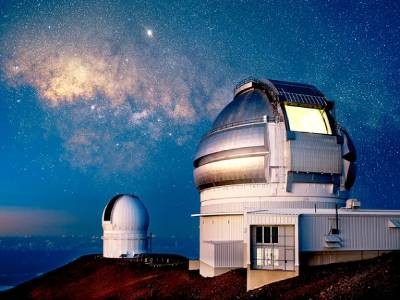
    Today’s largest ground-based telescopes, such as the Keck telescopes on Maunakea, have mirrors in the range of 8 to 10 metres wide that gather light from the night sky. Going up in scale would enable big leaps forward in astronomical discovery of exoplanets, supermassive black holes, star formation and other celestial objects.

    The Giant Magellan Telescope is meant to combine seven mirrors to form a light-gathering surface that is 25 metres wide. The Thirty Meter Telescope is designed to use 492 hexagonal segments to create a mirror that, as its name suggests, is 30 metres across. The plan to build atop Maunakea has been on hold as the state of Hawaii stands up a new stewardship authority for the mountain, which incorporates more Native Hawaiian representation than in the past.

    “These giant telescopes are becoming more expensive than philanthropy can afford,” Turner says. “We need to build an [extremely large telescope], and we need to get going.”

    [ad_2]

    Source link
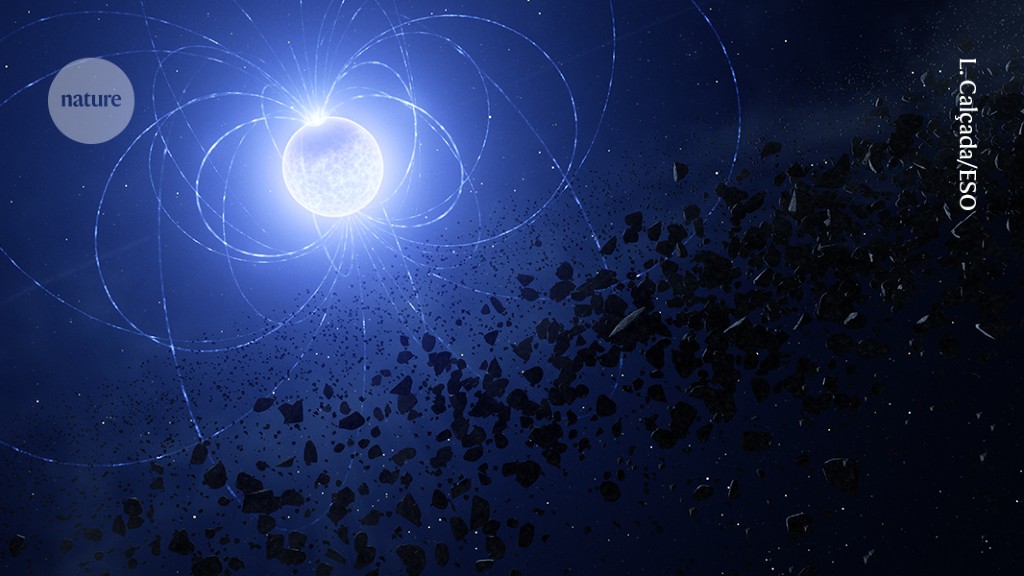
  • This dying star bears a jagged metal scar

    This dying star bears a jagged metal scar

    [ad_1]

    Nature, Published online: 29 February 2024; doi:10.1038/d41586-024-00564-0

    The surface of a white dwarf is marked with metallic patches — souvenirs of its encounter with an asteroid or planet.

    [ad_2]

    Source link

  • Could this one-time ‘epigenetic’ treatment control cholesterol?

    Could this one-time ‘epigenetic’ treatment control cholesterol?

    [ad_1]


    Download the

    Nature Podcast
    28 February 2024


    In this episode:

    00:49 What caused the Universe to become fully transparent?

    Around 13 billion years ago, the Universe was filled with a dense ‘fog’ of neutral hydrogen that blocked certain wavelengths of light. This fog was lifted when the hydrogen was hit by radiation in a process known as reionisation, but the source of this radiation has been debated. Now, researchers have used the JWST to peer deep into the Universe’s past and found that charged particles pouring out from dwarf galaxies appear to be the the main driver for reionization. This finding could help researchers understand how some of the structures we now see in the Universe were formed.


    Research article:


    Atek et al.

    08:46 Research Highlights

    Ancient inscriptions could be the earliest example of the language that became Basque, and how researchers etched a groove… onto soap film.


    Research Highlight:


    Ancient bronze hand’s inscription points to origins of Basque language


    Research Highlight:


    Laser pulses engrave an unlikely surface: soap films

    11:05 Controlling cholesterol with epigenetics

    To combat high cholesterol, many people take statins, but because these drugs have to be taken every day researchers have been searching for alternatives. Controlling cholesterol by editing the epigenome has shown promise in lab-grown cells, but its efficacy in animals was unclear. Now, researchers have shown the approach can work in mice, and have used it to silence a gene linked to high cholesterol for a year. The mice show markedly lowered cholesterol, a result the team hope could pave the way for epigenetic therapeutics for humans.


    Research Article:


    Cappelluti et al.

    18:52 The gene mutation explaining why humans don’t have tails

    Why don’t humans and other apes have a tail? It was assumed that a change must have happened in our genomes around 25 million years ago that resulted in the loss of this flexible appendage. Now researchers believe they have pinned down a good candidate for what caused this: an insertion into a particular gene known as TBXT. The team showed the key role this gene plays by engineering mice genomes to contain a similar change, leading to animals that were tail-less. This finding could help paint a picture of the important genetic mutations that led to the evolution of humans and other apes.


    Nature News:


    How humans lost their tails — and why the discovery took 2.5 years to publish


    Research Article:


    Xia et al.


    News and Views:


    A mobile DNA sequence could explain tail loss in humans and apes


    Subscribe to Nature Briefing, an unmissable daily round-up of science news, opinion and analysis free in your inbox every weekday.


    Never miss an episode. Subscribe to the Nature Podcast on


    Apple Podcasts


    ,


    Google Podcasts


    ,


    Spotify


    or your favourite podcast app.


    An RSS feed for the Nature Podcast


    is available too.

    [ad_2]

    Source link

  • How dwarf galaxies lit up the Universe after the Big Bang

    How dwarf galaxies lit up the Universe after the Big Bang

    [ad_1]

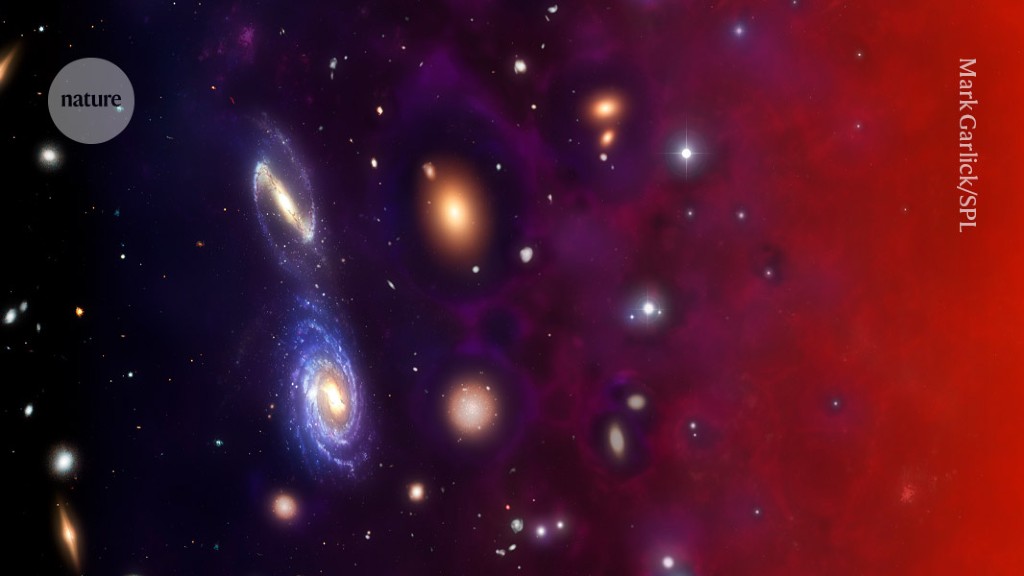
    Illustration showing the reionization of the Universe.


    An illustration of the reionization of the Universe, which transitioned from a cauldron (red, right) of subatomic particles to a sea of neutral hydrogen gas dotted with early stars (middle) to its current transparent state (left).


    Credit: Mark Garlick/SPL

    Astronomers have used the

    James Webb Space Telescope
    (JWST) to show that faint miniature galaxies cleared the early Universe of its

    obfuscating fog of atomic hydrogen
    — allowing starlight to shine through the cosmos for the first time.

    The research, published today in

    Nature


    1

    , provides evidence that

    dwarf galaxies
    roughly 100 times smaller than the

    Milky Way
    triggered the process known as reionization, which changed the course of cosmic history. “The Universe became transparent,” says Hakim Atek, an astrophysicist at the Paris Institute of Astrophysics and lead author of the study. “It’s because of reionization that we are able to see distant galaxies.”

    Emerging from a cosmic dark age

    For around 380,000 years after the Big Bang, the Universe was a hot, dense furnace of subatomic particles. As the cosmos cooled, the free electrons and protons combined to form a gas of neutral hydrogen atoms.

    What followed was a dreary period of darkness. This lasted until the gas collapsed in places to fuse and form the first stars, which produced ultraviolet (UV) light. However, the remaining gas permeating the Universe either absorbed or scattered this light. As a result, the Universe resembled a foggy forest speckled with dim, flickering fireflies, and light sources were visible only for short distances.

    To render space transparent, something needed to bombard this gas with powerful ‘ionizing’ radiation, which could transform the neutral hydrogen atoms into charged particles, or ions, of hydrogen. The three candidates were energetic light jets called quasars, which are powered by supermassive black holes; massive galaxies roughly the same size as the Milky Way; and, finally, the minnows — dwarf galaxies.

    Massive galaxies would have absorbed much of their own UV light, says Claudia Scarlata, an astrophysicist at the University of Minnesota in Minneapolis. And there might have been too few quasars to orchestrate the whole process. Dwarf galaxies, however, were small enough to allow easy escape of the UV light that they generated.

    Observations of

    younger dwarf galaxies,
    closer to Earth, suggest that they can emit ionizing radiation. All the same, “there’s nothing like actually having the data from the early galaxies to confirm that”, says James Rhoads, an astrophysicist at NASA Goddard Space Flight Center in Greenbelt, Maryland. But dwarf galaxies from the epoch of reionization are too tiny and too dim to detect — even for the JWST.

    Tale of two telescopes

    To overcome this, the authors took advantage of a ‘natural telescope’: a cluster of galaxies located about 1.2 million parsecs from Earth. This cluster is so enormous that it warps light passing through it, thereby magnifying any light source located behind the lens, as observed from Earth.

    The authors harnessed this lens to observe eight dwarf galaxies from the era of reionization, when the Universe was less than one billion years old. The galaxies are the faintest objects ever observed from that time.

    Using data gathered by the JWST, the astronomers analysed the wavelengths of UV light from these galaxies. This allowed the team to estimate that even these faint, small galaxies could have expunged hydrogen gas around them easily. The researchers also estimate that dwarf galaxies were abundant enough up to one billion years after the Big Bang to have ionized the entire Universe, even if 5% of their ionizing radiation escaped into intergalactic space.

    Small galaxies were the first to form in the Universe, which “probably makes it easier to start the [reionization] process early” in the history of the cosmos, Rhoads says. As each galaxy emitted radiation, it effectively blew a bubble of transparency that expanded into neutral gas. Eventually, all the bubbles from all the galaxies overlapped to complete the transformation.

    Dwarf galaxies would have blown bubbles smaller than those produced by quasars and massive galaxies, and such small bubbles might have ensured that reionization proceeded homogeneously across the Universe. This, in turn, had implications for the architecture of the present-day Universe, Atek says.

    [ad_2]

    Source link

  • Private Moon lander is dying — it scored some wins for science

    Private Moon lander is dying — it scored some wins for science

    [ad_1]

    Leaning on its side in the fading sunlight near the Moon’s south pole,

    the first commercial spacecraft to soft-land on the Moon
    is about to die. Mission controllers expect the Odysseus lander to lose power sometime on 28 February, six days after it touched down.

    They will try to wake Odysseus again in about three weeks, when the Sun is overhead and shining light onto its solar panels. Chances are low that it will survive the freezing lunar night, although a Japanese lander

    unexpectedly did so, waking up earlier this week
    .

    Space experts say that Odysseus, built by Intuitive Machines of Houston, Texas, counts as a success in the fledgling business of commercial lunar exploration. It is also the first US spacecraft to land on the Moon in more than half a century. All 12 of its payloads made it to the lunar surface, including six from NASA. Five of those NASA instruments have gathered scientific data, including measurements of radiofrequency interference leaking from Earth. The sixth, a retroreflector array that can be pinged to measure the distance between the lunar surface and other objects, will be tested in the coming months.

    “What we’re seeing here is at least the beginnings of validating this concept, where NASA can trust commercial companies with this lunar landing service,” says Laura Forczyk, executive director of the space consulting firm Astralytical in Atlanta, Georgia. Odysseus

    is the second spacecraft to launch
    in NASA’s Commercial Lunar Payload Services (CLPS) programme; the first, from the Pittsburgh, Pennsylvania-based company Astrobotic,

    did not make it to the lunar surface
    because of a propellant leak. NASA paid Intuitive Machines US$118 million to help develop Odysseus.

    Even though it was mostly successful, Odysseus encountered numerous challenges that underscore just how difficult it is to get to the Moon and operate on its surface. “When you’re trying things in a new way, with new technology, you’re going to expect bumps in the road,” Forczyk says.

    A bumpy landing

    Odysseus launched on 15 February but ran into several problems, including an issue with its navigational star-tracking equipment that had to be fixed as it flew towards the Moon. As mission controllers prepared for its landing, they also realized that the spacecraft’s laser rangefinders, which help it to navigate down to the lunar surface, were not working. Engineers had to upload new software that would command Odysseus to use a separate laser instrument onboard, provided by NASA as a test, to help it land.

    But during that last-minute manoeuvre, mission controllers forgot to update part of an algorithm — so Odysseus touched down around 1.5 kilometres from its planned landing site and pitched onto its side. The landscape where it ended up was much rougher than anticipated, so “we hit harder and sort of skidded along the way”, says Steve Altemus, chief executive for Intuitive Machines. Odysseus broke at least one of its six legs, causing it to slowly tip over at a resting angle of about 30 degrees to the lunar surface.

    That meant that some of its solar panels were not seeing as much sunlight as expected, and that its high-gain antenna could not be used to communicate with Earth. Mission controllers in Houston have been working overtime to get as much data from the lander as possible before it dies.

    Mixed performance

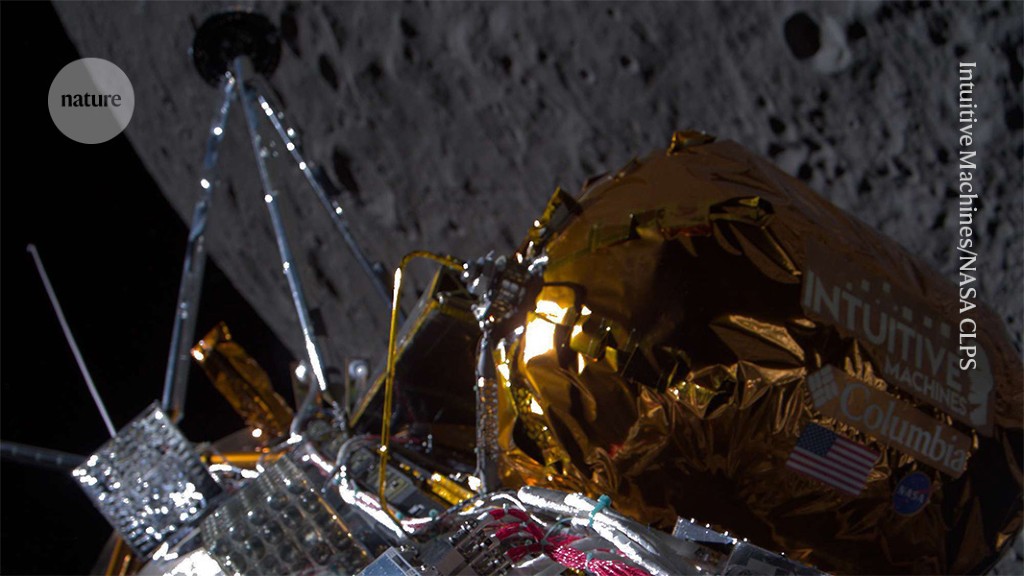
    As of 28 February, the company has released only one image of Odysseus on the lunar surface, taken by a narrow-field-of-view camera on the side of the lander. A student-built camera named EagleCam, which was supposed to eject off the lander and photograph its descent, was switched off because of the problems with the rangefinders.

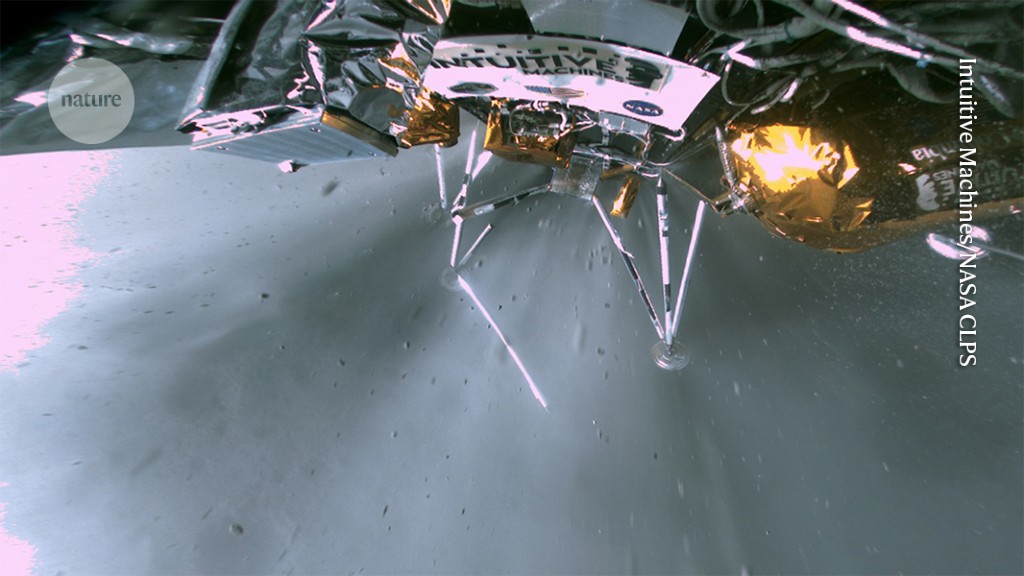
    Odysseus’ landing strut during landing on February 22nd performing its primary task, absorbing first contact with the lunar surface.


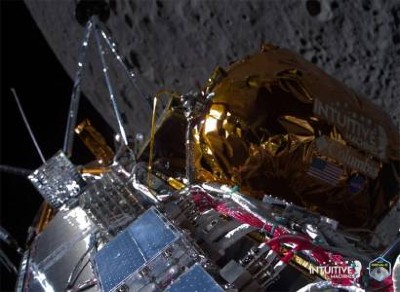
    Odysseus took this image of itself lying tilted on the Moon’s surface with a camera on the side of the lander.


    Credit: Intuitive Machines/NASA CLPS

    The problems during landing also meant that one of NASA’s main payloads, a set of four cameras meant to measure how rocket exhaust interacts with the lunar surface, also did not gather observations during landing. They were switched on during the last days of the lander, however. A separate, non-NASA astronomical imaging system reported collecting pictures of the lunar landscape and of Odysseus itself, but those photos won’t be released until 29 February.

    Other instruments in the NASA collection were more successful, including the radioantennas that measured radiofrequency interference from Earth.

    Odysseus’s mixed performance has sharpened attention on upcoming CLPS launches. Future NASA payloads include valuable instruments such as an ice drill and a rover that need to land successfully — and right-side-up — so that they can operate, says Carolyn van der Bogert, a planetary scientist at the University of Muenster in Germany. NASA wants the CLPS missions to help support its long-term goal of sending astronauts to the lunar south pole in the years ahead.

    Intuitive Machines’ next launch is slated to carry that ice drill to the Moon sometime later this year. Astrobotic is supposed to fly the rover to the lunar surface, but its launch might be delayed until at least next year, while the company works to incorporate lessons from its failed mission last month.

    [ad_2]

    Source link

  • From the archive: Stephen Hawking’s explosive idea, and scientific spirit

    From the archive: Stephen Hawking’s explosive idea, and scientific spirit

    [ad_1]

    Nature, Published online: 27 February 2024; doi:10.1038/d41586-024-00429-6

    Snippets from Nature’s past.

    [ad_2]

    Source link

  • First private Moon lander touches down on lunar surface to make history

    First private Moon lander touches down on lunar surface to make history

    [ad_1]

    Odysseus passes over the near side of the Earth's Moon following lunar orbit insertion on February 21, 2024.

    The spacecraft Odysseus passes over the Moon on 21 February on its way a successful landing on 22 February.Credit: Intuitive Machines/NASA CLPS

    In a historic lunar accomplishment, the first private spacecraft to land successfully on the Moon touched down on 22 February. The spacecraft, named Odysseus and built by Intuitive Machines in Houston, Texas, also became the first US lunar lander since 1972, when the last crew of Apollo astronauts visited the Moon.

    Odysseus offered up some nail-biting moments in the hours before landing, such as the malfunction of the laser rangefinders that were supposed to help guide its autonomous journey down to the lunar surface. Mission engineers had to upload a software patch to jury-rig it to use a secondary laser provided by NASA instead.

    The exact state of the spacecraft remained unclear immediately after its landing, which occurred at 5:23 p.m. Houston time. But it was sending a faint signal back to mission control in Houston, indicating that at least some portion of it had survived the touchdown. “Odysseus has found its new home,” said mission director Tim Crain as the control room burst into cheers.

    Lunar return

    Regardless of how operational the spacecraft might be going forward, the landing is a major shot in the arm for US and commercial efforts to return to the Moon. NASA paid for much of the private mission and is counting on companies such as Intuitive Machines to help ferry equipment and scientific instruments to the Moon in preparation for returning astronauts there.

    “The US has returned to the Moon,” said NASA administrator Bill Nelson. “Today is a day that shows the power and promise of NASA’s commercial partnerships.”

    The first images from the lunar surface are expected within a few hours of the landing, depending on how communications with the spacecraft go. If Odysseus’s scientific payloads check out successfully, they could collect data for up to seven days, until night falls at the landing site and there is no more solar power left for operations.

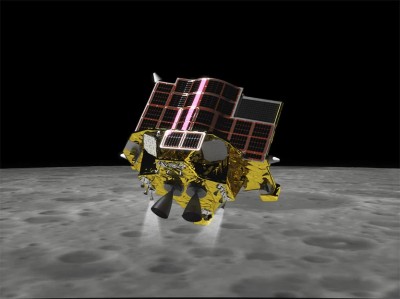
    Five of the last nine Moon landing attempts have failed. Among the failures is a mission launched last month by Astrobotic in Pittsburgh, Pennsylvania, which ran out of fuel within hours of launch due to a valve malfunction. But also last month, the Japanese space agency succeeded in putting its SLIM lander near Shioli crater near the Moon’s equator, although the spacecraft landed upside down.

    Speedy traveller

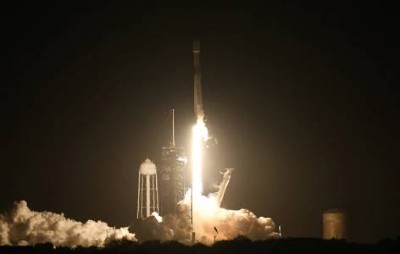
    Odysseus launched on 15 February from Cape Canaveral in Florida, and headed directly for the Moon. Along the way, it fired its engine several times to set itself on the correct trajectory and transmitted images of the Earth and the Moon. It entered lunar orbit on 21 February, initially circling 92 kilometres above the surface before making its landing attempt.

    The spacecraft fired its engines to descend to a lower altitude, then moved into an autonomous series of maneouvres in which it re-oriented itself and began assessing the craters and boulders beneath. It navigated towards its intended landing site and fired its engines again to slow its descent, ultimately touching down on the surface.

    The six-legged, phone-booth-sized spacecraft landed near the Malapert A crater, around 300 kilometres from the lunar south pole. NASA is interested in the Moon’s south pole because the region’s dirt and shadowy craters might contain ice that could provide fuel and other resources for future lunar explorers. Most lunar landers have visited the Moon’s equatorial regions; the only mission that has landed near the south pole is India’s Chandrayaan-3, which touched down last August.

    Bargain missions

    Odysseus is the second launch, after Astrobotic’s attempt, in NASA’s Commercial Lunar Payload Services (CLPS) programme, which aims to incentivize small aerospace companies to fly payloads for NASA and others to the Moon at low cost. NASA paid Intuitive Machines $118 million to develop Odysseus, which is a fraction of the cost of a typical interplanetary mission.

    NASA has six payloads on board Odysseus, including a set of cameras to study how rocket exhaust interacts with the lunar surface. The space agency wants to use CLPS flights to test technologies for its own return to the Moon, including plans to send astronauts to the lunar south pole as soon as 2026. A second Intuitive Machines Moon mission is slated to carry an ice drill to the south polar region, perhaps by the end of this year.

    Odysseus is the first craft to burn a methane-based rocket fuel in space. Methane-based propellants are more efficient and environmentally friendlier than conventional rocket propellants such as those including kerosene. But they can also be more difficult to work with because they need to remain at ultra-cold temperatures. Several other aerospace companies are planning to use methane fuels in the future.

    [ad_2]

    Source link

  • Arno A. Penzias (1933–2024), co-discoverer of the cosmic microwave background

    Arno A. Penzias (1933–2024), co-discoverer of the cosmic microwave background

    [ad_1]

    Black and white portrait of Dr. Arno Penzias

    Credit: Keystone Press/Alamy

    Arno Penzias and Robert Wilson made a pivotal discovery that altered humanity’s understanding of the Universe. In 1964, they detected the radio-frequency glow from the sky that became known as the cosmic microwave background. This observation confirmed the Big Bang model of the Universe and ushered in a new era of precision cosmology. For their discovery, Penzias and Wilson shared half of the 1978 Nobel prize for physics. Penzias has died aged 90.

    He and Wilson went on to detect radio waves in the millimetre wavelength range that enabled them to identify molecules such as carbon monoxide (CO) and the hydrogen isotope deuterium in interstellar clouds of gas and dust, shedding light on the origins of stars and galaxies.

    Penzias was born in 1933 in Munich, Germany, to Jewish parents of Polish descent. In 1938, the family was arrested by the Nazis and sent to Poland. Fortunately, the train was returned because Poland had stopped accepting Jews. Instead, in 1939, Arno and his four-year-old brother, Günther, were brought to England by a British children’s rescue group. His parents soon followed, and the family moved to New York City in 1940.

    After attending Brooklyn Technical High School, Penzias entered the City College of New York in 1951. He graduated with a physics degree in 1954. Following two years in the Army Signal Corps working on radar, he earned a PhD in physics at Columbia University, under the guidance of Charles Townes, inventor of the maser. In 1961, Penzias joined Bell Laboratories’ Radio Physics Research Department on Crawford Hill in Holmdel, New Jersey.

    At the time, Bell Laboratories were conducting telecommunications experiments in space using Echo satellites — 30-metre-diameter Mylar balloons bouncing microwave signals from one point on Earth to another. A horn antenna with an aperture measuring 6 metres across was built on Crawford Hill to measure these microwave beams, and Penzias and Wilson used it to study emissions from the Milky Way. In 1964, the pair discovered a uniform field of excess radiation coming from all over the sky — even where the Milky Way was dim. It was a bath of radiation with a temperature of about 3 kelvin. This signal turned out to originate from the early Universe, when it was just 380,000 years old.

    By the middle of the twentieth century, the idea that the Universe might be expanding was the subject of spirited debate. British astronomer Fred Hoyle coined the term Big Bang for the theory, and the phrase stuck. In 1948, astrophysicists George Gamow, Ralph Alpher and Robert Herman pointed out that the Universe must have been much smaller, denser and hotter in the distant past. As ancient cosmic light propagated to Earth, the Big Bang expansion would stretch the wavelength of this heat signature by a factor of about 1,000, such that photons emitted in the early Universe would reach Earth with a wavelength of about one millimetre. Alpher and Herman predicted that this signal should be detectable, with a temperature of several to ten kelvin, although most cosmologists remained sceptical.

    In the 1960s, Robert Dicke’s astrophysics group at Princeton University in New Jersey started to search for the predicted microwave signal. Penzias and Wilson did not know of the prediction, and did not find out that Dicke’s group was searching for the radiation until after their own discovery. They contacted Dicke’s group, and in 1965, the Astrophysical Journal published back-to-back papers, one by Dicke’s group and one by Penzias and Wilson. Today’s more detailed maps of the cosmic microwave background, made with space-based telescopes, provide us with a picture of the baby Universe.

    Penzias and Wilson also took Bell Labs’ state-of-the-art millimetre-wave receivers to a larger, 11-metre antenna at Kitt Peak in Arizona to search for interstellar molecules. In 1970, they and Keith Jefferts announced the discovery of the 2.6-millimetre emission line of CO in the region of the Orion nebula. CO and the other molecules discovered by the group have become the main tracers of interstellar molecular clouds and star formation. During the 1980s, Penzias continued to use the Crawford Hill antenna to look for rare isotopes of common elements found in interstellar molecules.

    Penzias was the director of the Radio Physics Research Laboratory from 1976 to 1979. While he served as vice-president of research at AT&T Bell Laboratories from 1981 to 1995 and chief scientist from 1995 to 1998, his management responsibilities took him away from his own research. During this period, he embraced information technology and wrote two books on the subject. He moved to California in 1995 as chief scientist of the Bell Laboratories spin-off company Lucent Technologies. After retiring at the age of 65, he joined New Enterprise Associates, a Silicon Valley venture capital firm, where he advised emerging companies in the fields of information technology and alternative energy sources.

    Arno was a humane and thoughtful scientist whose life and career were coloured by his early experience of oppression. He spoke out against US President Ronald Reagan’s Strategic Defense Initiative and thought it too risky to send humans into space, although he was an enthusiastic supporter of space science. Well into old age he retained an informed interest in the interactions of technology and society, and numerous individuals and organizations have benefited from his advice.

    Competing Interests

    The author declares no competing interests.

    [ad_2]

    Source link

  • JWST reveals the fate of an iconic stellar explosion

    JWST reveals the fate of an iconic stellar explosion

    [ad_1]

    The James Webb Space Telescope (JWST) has solved a decades-old mystery about one of the most famous explosions of a star in history.

    Astronomers used the observatory to finally spot signs of an ultradense ‘neutron star’ lurking in the explosion’s core in a galaxy that orbits the Milky Way. Light from the explosion reached Earth 37 years ago this week, in a supernova that revolutionized modern astrophysics by providing an up-close look at how stars die.

    But despite years of studying this blast, known as supernova (SN) 1987A, astronomers had not been able to detect what was left behind: maybe a black hole, which can sometimes be formed, or perhaps a neutron star, as many predicted?

    “It’s something that’s been searched for ever since the explosion,” says Patrick Kavanagh, an astrophysicist at Maynooth University in Ireland, and a member of the team reporting the discovery today in Science1. “And now we’ve found it.”

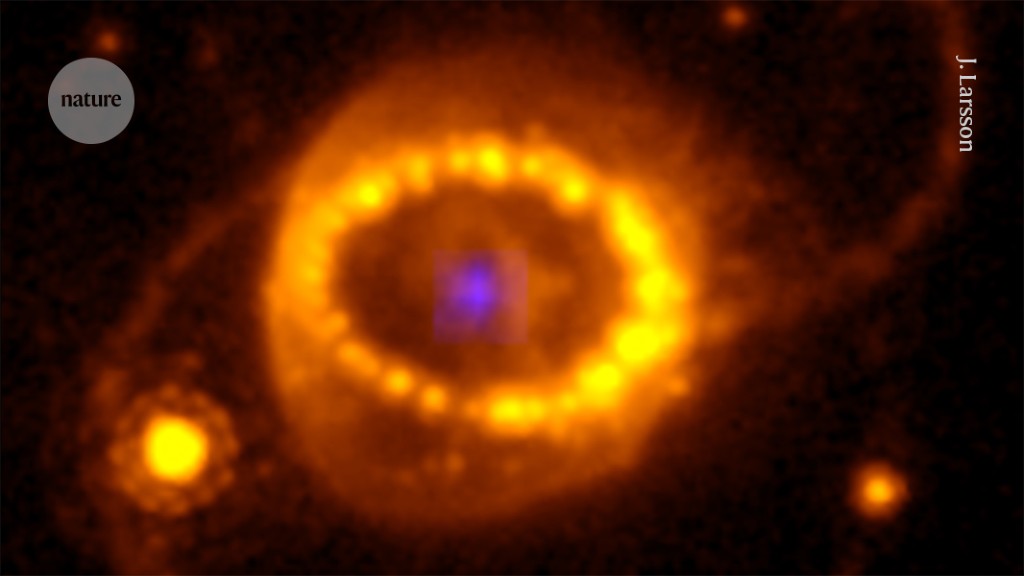
    JWST did not observe the neutron star directly, because it remains obscured behind a veil of dust from the explosion. But the telescope detected light coming from argon and sulfur atoms that had been ionized, or electrically charged, by radiation blazing from the long-sought neutron star.

    “This is a very plausible case for seeing the effects of the neutron star we all expected,” says Robert Kirshner, an astronomer and executive director of the TMT International Observatory in Pasadena, California, who has studied the supernova for decades. “There have been hints and allegations [before], but nothing as direct as this.”

    An ‘elusive nugget’

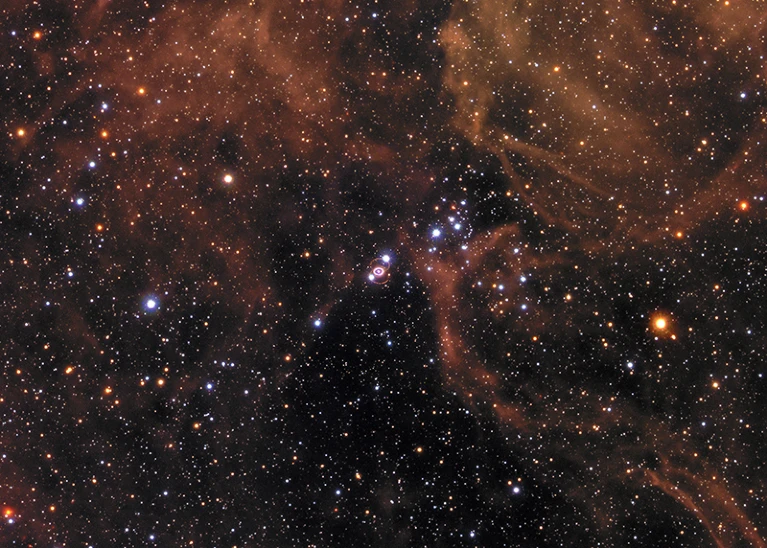
    The supernova astonished scientists when it appeared in February 1987 in the Large Magellanic Cloud galaxy, which is around 50,000 parsecs (160,000 light years) from Earth. The first sign that something had happened was a wave of the ghostly particles known as neutrinos, which washed over Earth and triggered neutrino detectors around the world. Within hours, a ‘new’ star blazed bright enough to be visible to the naked eye. It was the closest and brightest supernova observed since 1604, at the dawn of the age of the telescope.

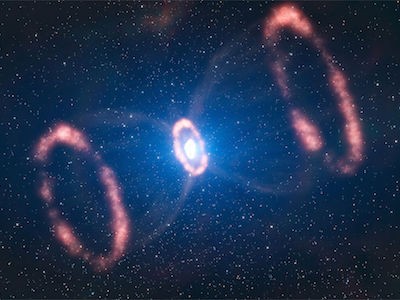
    Over the years, astronomers watched as rings of gas and dust expanded outwards from the site of the explosion, usually growing dimmer but sometimes brightening when various ejected materials collided. The world’s most powerful telescopes — including JWST’s predecessor, the Hubble Space Telescope — tracked the evolution of the explosion. Studies of SN 1987A ultimately led to many discoveries about stellar evolution, such as how dying stars expel the chemical elements forged in their hearts into space.

    This Hubble Space Telescope image shows Supernova 1987A within the Large Magellanic Cloud, a neighboring galaxy to our Milky Way.

    Supernova 1987A (at centre of image) is located in the Large Magellanic Cloud, a neighbouring galaxy.Credit: NASA, ESA, Robert P. Kirshner (CfA, Moore Foundation), Max Mutchler (STScI), Roberto Avila (STScI)

    But nobody had ever been able to spot the ember that was left behind — an “elusive nugget”, Kirshner calls it — when the original star blew up. Theory suggests that the original star exploded in the most common type of supernova, in which a large star (one that’s at least eight times the mass of the Sun) runs out of hydrogen, helium and other elements to sustain its nuclear fusion, and thus collapses and explodes.

    One outcome of such a supernova is to leave behind a black hole. But early observations of SN 1987A, such as the wave of neutrinos, suggested that it should have given rise to a neutron star, which can be just 20 kilometres across but is so dense that a teaspoonful weighs millions of tonnes. Astronomers have found several tantalizing hints of this outcome using other telescopes, but none have yielded a solid conclusion, meaning that other possibilities were still on the table2,3.

    Enter JWST, which launched in late 2021 and can observe celestial bodies at different wavelengths and higher resolution than can many other telescopes. In July 2022, in some of its first scientific observations, the powerful space telescope observed SN 1987A for nine hours. Two of its cutting-edge instruments provided unprecedented insights into what was happening at the heart of the exploded star. “The data were really superb quality, much better than I had imagined,” says team member Josefin Larsson, an astrophysicist at the KTH Royal Institute of Technology in Stockholm.

    The strongest evidence so far

    The JWST observations revealed the fingerprint of ionized argon and sulfur gas triggered by the central neutron star. The finding is “the strongest observational evidence so far” for the presence of a neutron star in SN 1987A, says Mikako Matsuura, an astrophysicist at Cardiff University, UK. She won’t go so far as to call it conclusive, but says that “JWST is really an amazing telescope to deliver such a discovery”.

    Now astronomers will shift their focus to better understanding the neutron star and how it evolves over time. Lead author Claes Fransson, an astrophysicist at Stockholm University, and his colleagues have new observations from JWST, including some taken just this week, and plan to look for more details, such as whether the neutron star is enveloped by powerful magnetic fields.

    As for actually seeing the neutron star through a telescope, the dust will have to clear out more. “As the supernova expands,” Fransson says, “the dust and gas blocking the light to the centre will get thinner and thinner, so that we will be able to see the central region easier.”

    [ad_2]

    Source link
  • Rare isotopes formed in prelude to γ-ray burst

    Rare isotopes formed in prelude to γ-ray burst

    [ad_1]

    Nature, Published online: 21 February 2024; doi:10.1038/d41586-024-00310-6

    The afterglow of a long burst of γ-rays suggests that the events leading to these explosions can be sizeable sources of some of the Universe’s rare isotopes — and that classifications of γ-ray bursts are too simplistic.

    [ad_2]

    Source link