Tag: Bispecific antibody

  • Research unveils bispecific antibodies for B-cell lymphoma treatment

    Research unveils bispecific antibodies for B-cell lymphoma treatment

    [ad_1]

    A new research paper was published in Oncotarget’s Volume 15 on April 12, 2024, entitled, “Novel therapeutic bispecific antibodies for B-cell lymphoma targeting IgM and other antigens on the B-cell surface.”

    The B-cell receptor regulates B-cell proliferation and apoptosis. Aberrations in BCR signaling are associated with the development and progression of B-cell malignancies, such as mantle cell lymphoma, diffuse large B-cell lymphoma, and chronic lymphocytic leukemia, many of which express the IgM type of BCR on their cellular surface. 

    Therefore, IgM is an attractive target for therapeutic antibodies against B-cell malignancies. However, soluble IgM competitively binds to anti-IgM antibodies in the serum, and these antibodies show insufficient cytotoxic activity. Thus, antibody therapy targeting IgM is hindered by the presence of soluble IgM in the blood. In this new study, researchers Takahiro Ohashi, Sayuri Terada, Shinsuke Hiramoto, Yuko Nagata, Hirokazu Suzuki, Hitoshi Miyashita, Tetsuo Sasaki, Yasukatsu Tsukada, and Keiko Fukushima from ZENOAQ (Zenyaku Kogyo Co., Ltd.) used a bispecific antibody to address this problem. 

    “In this study, we aimed to produce IgM-dependent bispecific antibodies targeting IgM and the other B-cell antigens such as CD20, CD32b (FcγRIIB), CD79b, and human leukocyte antigen (HLA)-DR using the Cys1m technology [10, 43–45]. Additionally, the correct IgG-like bispecific antibody structures were confirmed and their efficacies in the presence of soluble IgM were analyzed.”

    The researchers generated bispecific antibodies bound to IgM and other B-cell antigens such as CD20 and HLA-DR using their own bispecific antibody-producing technology, Cys1m. These bispecific antibodies directly inhibited cell proliferation via cell-cycle arrest and apoptosis in vitro, although large amounts of soluble IgM were present. Additionally, a bispecific antibody bound to IgM and HLA-DR (BTA106) depleted B-cells in cynomolgus monkeys. 

    “These data suggest that anti-IgM/B-cell surface antigen-binding specific antibodies are promising therapeutic agents for B-cell malignancies. Moreover, the bispecific antibody modality can potentially overcome problems caused by soluble antigens.”

    Source:

    Journal reference:

    Ohashi, T., et al. (2024). Novel therapeutic bispecific antibodies for B-cell lymphoma targeting IgM and other antigens on the B-cell surface. Oncotarget. doi.org/10.18632/oncotarget.28578.

    [ad_2]

    Source link

  • Therapeutic potential of CD20 x CD3 bispecific antibodies

    Therapeutic potential of CD20 x CD3 bispecific antibodies

    [ad_1]

    On Monday, March 25th, 2024, the U.S. FDA declined approval for Regeneron’s Odronextamab for two forms of lymphoma due to concerns over the progress of ongoing confirmatory trials. Cancer immunotherapy with CD3 bispecific antibodies (BsAbs) is a fast-developing field. As of March 2024, the FDA has approved three CD20 × CD3 BsAbs: mosunetuzumab (Lunsumio) for relapsed or refractory follicular lymphoma (R/R FL), glofitamab (Columvi) for relapsed or refractory diffuse B cell lymphoma (R/R DLBCL) or large B cell lymphoma (LBCL) with two or more prior therapies, and Epcoritamab (DuoBody®) for adult patients with relapsed or refractory diffuse large B-cell lymphoma (R/R DLBCL) after two or more systemic therapies. Progress in CD20 × CD3 bispecific antibody therapy underscores the need for ongoing research and advancement.

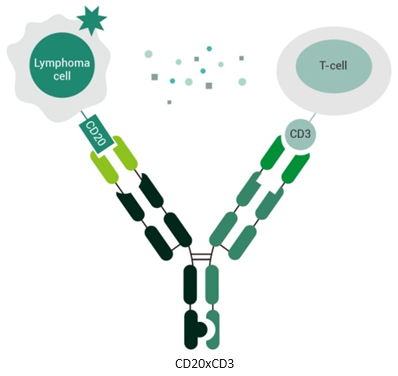
    Bispecific antibody. Image Credit: Sino Biological

    Bispecific antibodies mechanism of action

    CD20 × CD3 bispecific antibodies bind to both CD20 on malignant B cells and CD3 on T cells, bringing them into close proximity, which triggers T cell-mediated killing of the targeted B cells.

    • CD20 × CD3: Bridging T cells to CD20+ B-cell lymphomas

    CD20 × CD3 bispecific antibodies (bsAbs) have shown effectiveness in treating various lymphomas including non-Hodgkin lymphoma (NHL), by activating T cells to attack CD20-positive B-cell lymphomas. CD20, highly expressed in B-cell lymphomas but absent in normal tissues, makes anti-CD20 drugs the main treatment for these conditions. These drugs work through various mechanisms like antibody-dependent cytotoxicity (ADCC), complement-dependent cytotoxicity (CDC), and direct CD20 binding. The CD3/TCR complex facilitates the infiltration of cytotoxic T lymphocytes into cancerous cells, leading to cell death. Bispecific antibodies, targeting CD3, activate T cells to eliminate lymphoma cells by recognizing CD20. CD20 × CD3 bsAbs, engineered extensively, offer advantages like high specificity, moderate affinity, and minimal side effects. Their unique binding site allows them to effectively target CD20-positive cells, including those resistant to rituximab. 

    Sino Biological’s offering to support CD20 × CD3 bispecific antibody research

    Sino Biological partners with customers to accelerate drug discovery and development. As an international reagent supplier and service provider, Sino Biological is proud to provide a comprehensive suite of recombinant bispecific antibody production services and best-in class drug target reagents, with the ultimate goal of facilitating bispecific antibody development and screening.

    [ad_2]

    Source link