Tag: Central Nervous System

  • Study links Agent Orange exposure to neurodegenerative diseases

    Study links Agent Orange exposure to neurodegenerative diseases

    [ad_1]

    Agent Orange, an herbicide used during the Vietnam War, is a known toxin with wide-ranging health effects. Even though Agent Orange has not been used for decades, there is increasing interest in its effects on the brain health of aging veterans. A new study by scientists at Brown University reveals the mechanisms by which Agent Orange affects the brain and how those processes can lead to neurodegenerative diseases.

    The research shows that exposures to Agent Orange herbicidal chemicals damage frontal lobe brain tissue of laboratory rats with molecular and biochemical abnormalities that are similar to those found in early-stage Alzheimer’s disease. An early online version of this paper detailing the findings was published on Feb. 13 and is scheduled for publication in the Journal of Alzheimer’s Disease.

    The findings could have important implications for military veterans who were exposed to Agent Orange during the Vietnam War, said study author Dr. Suzanne M. De La Monte, a Brown University physician-scientist.

    If we can show that prior exposure to Agent Orange leads to subsequent neurodegenerative disease, then that gives veterans a chance to get help.”


    Dr. Suzanne M. De La Monte, Brown University physician-scientist

    But the study’s findings have much broader significance, she added, because the toxins in Agent Orange are also present in lawn fertilizers.

    “These chemicals don’t just affect veterans; they affect our entire population,” said De La Monte, who is a professor of pathology and laboratory medicine and neurosurgery at Brown’s Warren Alpert Medical School.

    Agent Orange is a synthetic defoliating herbicide that was widely used between 1965 and 1970 during the Vietnam War. Members of the U.S. military were exposed to the chemical when stationed close to enemy territory that had been sprayed by aircraft. Government reports show that exposure to Agent Orange also caused birth defects and developmental disabilities in babies born to Vietnamese women residing in the affected areas. Over time, studies showed that exposure to Agent Orange was associated with an increased risk of some cancers as well as cardiovascular disease and diabetes.

    Research also revealed associations between Agent Orange exposures and later development of nervous system degenerative diseases, and significantly higher rates and earlier onsets of dementia. However, in the absence of a proven causal link between Agent Orange and aging-associated diseases, there has been a need for studies that improve understanding of the process by which the herbicide affects the brain.

    “Scientists realized that Agent Orange was a neurotoxin with potential long-term effects, but those weren’t shown in a clear way,” De La Monte said. “That’s what we were able to show with this study.”

    The analysis was conducted by De La Monte and Dr. Ming Tong, a research associate in medicine at Brown; both are also associated with Rhode Island Hospital, an affiliate of the Warren Alpert Medical School. Their research builds upon their recent studies of exposure to Agent Orange chemicals on immature human cells from the central nervous system showing that short-term exposure to Agent Orange has neurotoxic and early degenerative effects related to Alzheimer’s.

    The researchers investigated the effects of the two main constituents of Agent Orange (2,4-dichlorophenoxyacetic acid and 2,4,5-trichlorophenoxyacetic acid) on markers of Alzheimer’s neurodegeneration using the samples from the frontal lobes of laboratory rats. The mature, intact brain tissue samples included a full complex array of cell types and tissue structures.

    The scientists treated the samples to cumulative exposure to Agent Orange, as well as to its separate chemical constituents, and observed the underlying mechanisms and molecular changes.

    They found that treatment with Agent Orange and its constituents caused changes in the brain tissue corresponding to brain cell degeneration, and molecular and biochemical abnormalities indicative of cytotoxic injury, DNA damage and other issues.

    The approach used by the researchers helped them better characterize the neuropathological, neurotoxic and neurodegenerative consequences of Agent Orange toxin exposures in young, otherwise healthy brains, as would have been the case for Vietnam War-era military personnel and many local residents in Vietnam.

    “Looking for the early effects tells us that there is a problem that is going to cause trouble later on and also gives us a grip on the mechanism by which the agent is causing trouble,” De La Monte said. “So if you were going to intervene, you would know to focus on that early effect, monitor it and try to reverse it.”

    Del La Monte hopes to be involved in additional research on human brain tissue to evaluate the long-term effects of Agent Orange exposures in relation to aging and progressive neurodegeneration in Vietnam War veterans.

    The use of Agent Orange was prohibited by the U.S. government in 1971. However, the chemicals remain in the environment for decades, De La Monte said. According to the study authors, the widespread, uncontrolled use of Agent Orange in herbicide and pesticide products is such that one in three Americans has biomarker evidence of prior exposure.

    Despite growing recognition of the broad toxic and carcinogenic effects of 2,4-dichlorophenoxyacetic acid, the researchers noted that concern has not achieved a level sufficient for federal agencies to ban its use. The researchers conclude that the results of this study and another recent publication support the notion that Agent Orange as well as its independent constituents (2,4-dichlorophenoxyacetic acid and 2,4,5-trichlorophenoxyacetic acid) exert alarming adverse effects on the mature brain and central nervous system.

    “That’s why it’s so important to look into the effects of these chemicals,” De La Monte said. “They are in the water; they are everywhere. We’ve all been exposed.”

    This research was supported by the National Institute on Alcohol Abuse and Alcoholism at the National Institutes of Health (R01AA011431, R01AA028408).

    Source:

    Journal reference:

    de la Monte, S. M., & Tong, M. (2024). Agent Orange Herbicidal Toxin-Initiation of Alzheimer-Type Neurodegeneration. Journal of Alzheimer’s Disease. doi.org/10.3233/JAD-230881.

    [ad_2]

    Source link

  • Enzyme released by immune cells may play role in depression

    Enzyme released by immune cells may play role in depression

    [ad_1]

    Mount Sinai researchers have shown for the first time that immune cells called monocytes, derived in the bone marrow and released into the bloodstream, can be drawn during stress into sites in the brain that control emotional behaviors. There, they release an enzyme called matrix metalloproteinase 8 (MMP8) that breaks down proteins and restructures the brain to alter the function of neurons and, ultimately, impair social behavior and reward.

    These data establish a novel mechanism by which the immune system can affect central nervous system function and behavior in the context of stress, potentially opening the door to novel therapeutic targets for stress-related disorders. The study appears in the February 7 issue of Nature.

    Psychosocial stress is a major factor for developing major depressive disorder and post-traumatic stress disorder (PTSD) and has been shown to have profound effects on the body, including the immune system and the brain. These data are the first to show that immune cells derived in the bone marrow-;and not the brain-;can be recruited during stressful circumstances to the brain, setting off a cascade of other mechanisms that alter brain function and behavior.”


    Flurin Cathomas, MD, lead author, Instructor of Neuroscience and member of the Brain-Body Research Center at Mount Sinai

    To explore these mechanisms, the research team performed comparative cross-species analyses in mice and humans and found that MMP8 is elevated in the serum of study subjects with major depressive disorder, as well as in stress-susceptible mice following chronic social defeat stress, a model of social trauma. Studies in mice confirmed that peripheral MMP8 enters the brain through damaged blood vessels to restructure the brain’s extracellular tissue matrix, which leads to altered function of neurons that ultimately impairs social behavior and reward.

    Prior to this work, most hypotheses about the role of the immune system in stress disorders such as depression have centered on mechanisms related to the brain’s resident immune cells, called microglia, and their ability to release pro-inflammatory molecules such as interleukins to control neural function and behavior.

    Using single-cell RNA sequencing to look at gene expression profiles in circulating monocytes as compared to microglia, the team found that, contrary to popular belief, the microglia did not exhibit a pro-inflammatory gene signature. The team found no evidence that they upregulate genes that code for interleukins. This is in stark contrast to circulating monocytes found within the blood vessel lining of brain regions that control mood and emotion.

    “There are no existing medications to target MMP8, and while it’s not yet clear if such treatments will ultimately be effective in treating depression, my hope is that this study will lead to renewed effort in developing such drugs,” said Scott Russo, PhD, Mount Sinai Professor in Affective Neuroscience, Leon Levy Director of the Brain-Body Research Center, and Center for Affective Neuroscience at Mount Sinai. “It’s also possible that non-pharmacological ‘lifestyle’ strategies to promote positive immune health might be helpful in treating these stress-related disorders.”

    The disturbances in the immune system identified in this study were only found in a subset of patients, which highlights the heterogeneous nature of such illnesses in terms of etiology. Additionally, the studies performed in human subjects were purely correlative, so the team does not yet know if treatments targeting monocytes or MMP8 directly will be effective for human stress disorders. Importantly, there are several additional MMPs that can be derived directly in the brain and it remains unclear whether they play complementary or opposing roles.

    “The brain and the body are unequivocally connected and we are really at the precipice of a markedly deeper understanding of how the connections between the brain and peripheral organ systems like the immune system, cardiovascular system, and others can affect a person’s health,” said Dr. Russo. “Our work suggests that strategies to promote immune health can benefit one’s emotional well-being and possibly prevent stress-related illnesses like depression and PTSD. Additional research for continued understanding and potential treatment development is warranted.”

    The Mount Sinai research team is currently testing therapeutic strategies to inhibit MMP8 as novel antidepressants. They are also investigating MMP8 as a novel immune biomarker for depression patients.

    Source:

    Journal reference:

    Cathomas, F., et al. (2024). Circulating myeloid-derived MMP8 in stress susceptibility and depression. Nature. doi.org/10.1038/s41586-023-07015-2.

    [ad_2]

    Source link

  • Small-molecule A485 mobilizes white blood cells on demand

    Small-molecule A485 mobilizes white blood cells on demand

    [ad_1]

    White blood cells, or leukocytes, are the body’s first and second lines of defense against foreign organisms and particles. However, few drugs target these cells’ production and movement for clinically useful purposes. A new study published in the journal Immunity explores the signaling molecule landscape to identify potentially druggable targets for leukocyte migration into the bloodstream.

    Study: Small-molecule CBP/p300 histone acetyltransferase inhibition mobilizes leukocytes from the bone marrow via the endocrine stress response. Image Credit: Rost9 / ShutterstockStudy: Small-molecule CBP/p300 histone acetyltransferase inhibition mobilizes leukocytes from the bone marrow via the endocrine stress response. Image Credit: Rost9 / Shutterstock

    Leukocytes, including neutrophils, monocytes, and B lymphocytes, are formed in the bone marrow from blood-forming precursor cells and in a few other specialized organs. They are held in the bone marrow until they are released into the circulation. 

    There are two leukocyte compartments in the blood and peripheral tissues, which show changes in size with varying bodily states. For instance, when the body is injured, stressed, or infected, the number of leukocytes in the affected tissue alters and returns to normal once the threat is contained.

    Multiple regulatory steps take part in leukocyte breakdown as well as movement to different sites where they are needed. These originate in the central nervous system (CNS) in response to peripheral signals, being regulated by neural circuits in which both the sympathetic nervous system and the hypothalamo-pituitary-adrenal (HPA) axis participate.

    These signals work to increase bone marrow hemopoiesis, recruit leukocytes into the blood and other tissues where they are required, and ensure they return to normal levels once the challenge has been surmounted.

    In some disease conditions, this homeostatic control is lost, thus leading to abnormal counts, such as bone marrow failure on the one hand or acute leukemia on the other. As yet, though, few medications can help correct such dysregulation by modifying the rate of production, breakdown, or migration of leukocytes, whether in blood cancer, chronic inflammation, or acute hyperinflammatory states.

    Among available medications are the granulocyte colony-stimulating factor (G-CSF) family, CXC-motif chemokine receptor 4 (CXCR4) antagonists such as plerixafor/AMD3100), or inhibitors of the integrin very late antigen 4 (VLA4). G-CSF is, for instance, used to correct neutropenia in patients on chemotherapy but is less useful in patients with acute febrile conditions involving low neutrophil counts. Moreover, G-CSF can cause adverse effects in some patients.

    The need to know more about this field of pharmacology motivated the current study. It focuses on a small molecule called E1A-associated protein p300 (EP300 or p300), which is seen to be newly acquired during the leukemic phase of a condition called severe congenital neutropenia (SCN).

    The loss of function of this gene has led to reduced blood cell production if deleted before birth but high or leukemic leukocyte counts in later life. This has an ortholog, cyclic-adenosine-monophosphate-response-element-binding protein (CREBBP, also known as “CBP,” with 90% homology of sequence. One of the 8 domains in this gene is responsible for histone acetyltransferase (HAT) activity and contains a mutation in SCN that causes leukemic transformation.

    In this case, this domain might be druggable to produce “leukocytosis on demand” by altering the sizes of different leukocyte compartments.

    What did the study show?

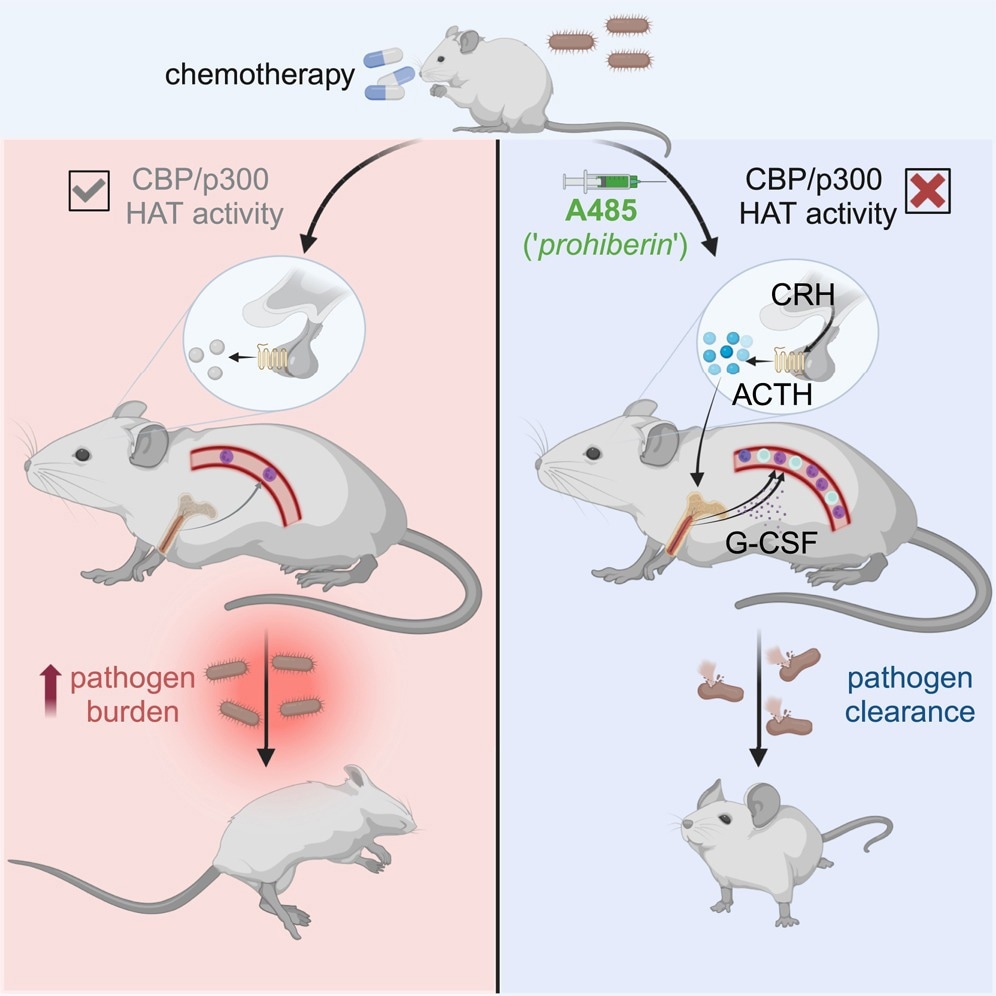
    The scientists found that inhibiting the CBP/p300 domain with its HAT activity by the small molecule inhibitor A485 led to a reversible competitive inhibition of HAT enzyme activity, especially for CBP and p300 compared to other HATs. As expected, this led to a rapid rise in the levels of acetyl CoA within bone marrow macrophages in mouse models. The result was rapid leukocytosis.

    This was found to be a dose-dependent action and did not wane with repeated administration. When another type of CBP/p300 HAT inhibitor (C646) was used, the same effect was observed, confirming the mechanism of action. Conversely, inhibitors of DNA binding by the protein or of another HAT found in mammals failed to cause leukocytosis.

    A485 levels in the blood rapidly rose when injected into the mice, accumulating in bone marrow, adipose tissues, liver, spleen, and kidney, but not the brain. Leukocyte counts rose in parallel, including neutrophils, lymphocytes, and monocytes. A week later, no evidence of drug administration was observable, suggesting a transient effect.

    The rise in leukocyte counts was comparable with that achieved by G-CSF, though somewhat faster for neutrophils. When both were given, significantly higher neutrophil counts resulted. However, after 24 hours, all three blood cell types were raised with G-CSF vs A485.

    This indicates a shorter and different action of A485 compared to G-CSF.

    To extend the observations to human subjects, the researchers looked at data from a cohort of patients with a rare disease called Rubinstein-Taybi syndrome (RSTS), where CREBBP and EP300 mutations occur. About two-thirds had high leukocyte counts, with 70% showing mutations in the HAT domain. As expected, this group was more likely to show leukocytosis than the other group, where HAT was spared.

    Does this observation have clinical utility? To find out, they tested the effect of A485 in a cohort of mice with myelodysplastic syndrome (MDS), finding that the small molecule kept the leukocyte count normal. Secondly, they induced severe neutropenia by a course of chemotherapy in a mouse model, showing that A485 led to acute recovery of leukocyte counts.

    Then, they introduced the organism Listeria monocytogenes in a sepsis-inducing dose in mice with chemotherapy-induced pancytopenia. Neutrophils are vital to the immune defense against this microbe. After infection set in, they injected A485 vs. vehicle in controls.

    While those treated with the vehicle became sick and died of sepsis, A485 in a single dose led to improved survival, with fewer bacteria being recovered from treated animals. A485 mobilizes leukocytes from the bone marrow, which is the mechanism of leukocytosis. In contrast, there was no emergency hematopoiesis in the bone marrow.

    Different subsets of leukocytes responded to distinct pathways triggered by A485. These involve both G-CSF-dependent and –independent pathways of neutrophilia, but other pathways for lymphocytosis.

    Moreover, A485 uses neurohumoral pathways, specifically the HPA axis, to induce leukocytosis, as seen by the increased levels of glucocorticoids in the blood after A485 administration. The leukocytosis response triggered by the HPA activation does not rely on glucocorticoids, however, but occurs in response to CRHR1-regulated signals, including the adrenocorticotropic hormone (ACTH), that occurs with the loss of HPA feedback signals.

    While neutrophils increase with ACTH administration, lymphocyte counts increase only with glucocorticoid blockade, indicating that both are regulated differently.

    What are the implications?

    Competitive, reversible, small-molecule-mediated inhibition of the CBP/p300 HAT domain triggers acute and transient leukocyte mobilization from the bone marrow.” Further research is required to identify which clinical contexts are ideal for this drug. A485 may be better if only a rapid short increase in neutrophils is required, while long-term recovery of blood cell production in the bone marrow may call for G-CSF.

    The timing of administration for good results also needs to be defined since patients with neutropenic sepsis present at various time points and stages. Moreover, the value of such drugs in bacterial or viral, rather than listerial, sepsis remains unexplored.

    However, as reported by earlier researchers, it has anti-tumor effects, which could make it valuable in adjuvant therapy for cancer patients. The current study also sheds light on the role of ACTH, rather than its downstream products, glucocorticoids, on leukocyte homeostasis and G-CSF activity.

    [ad_2]

    Source link