Tag: Chemical synthesis

  • Abolhasani, M. & Kumacheva, E. The rise of self-driving labs in chemical and materials sciences. Nat. Synth. 2, 483–492 (2023).

    Article 
    ADS 

    Google Scholar
     

  • Seifrid, M. et al. Autonomous chemical experiments: challenges and perspectives on establishing a self-driving lab. Acc. Chem. Res. 55, 2454–2466 (2022).

    Article 
    CAS 
    PubMed 
    PubMed Central 

    Google Scholar
     

  • Angelone, D. et al. Convergence of multiple synthetic paradigms in a universally programmable chemical synthesis machine. Nat. Chem. 13, 63–69 (2021).

    Article 
    CAS 
    PubMed 

    Google Scholar
     

  • Steiner, S. et al. Organic synthesis in a modular robotic system driven by a chemical programming language. Science 363, eaav2211 (2019).

    Article 
    CAS 
    PubMed 

    Google Scholar
     

  • Coley, C. W. et al. A robotic platform for flow synthesis of organic compounds informed by AI planning. Science 365, eaax1566 (2019).

    Article 
    CAS 
    PubMed 

    Google Scholar
     

  • Chatterjee, S., Guidi, M., Seeberger, P. H. & Gilmore, K. Automated radial synthesis of organic molecules. Nature 579, 379–384 (2020).

    Article 
    ADS 
    CAS 
    PubMed 

    Google Scholar
     

  • Bennett, J. A. et al. Autonomous reaction Pareto-front mapping with a self-driving catalysis laboratory. Nat. Chem. Eng. 1, 240–250 (2024).

    Article 

    Google Scholar
     

  • Wang, J. Y. et al. Identifying general reaction conditions by bandit optimization. Nature 626, 1025–1033 (2024).

    Article 
    ADS 
    CAS 
    PubMed 

    Google Scholar
     

  • Szymanski, N. J. et al. An autonomous laboratory for the accelerated synthesis of novel materials. Nature 624, 86–91 (2023).

    Article 
    ADS 
    CAS 
    PubMed 
    PubMed Central 

    Google Scholar
     

  • Ha, T. et al. AI-driven robotic chemist for autonomous synthesis of organic molecules. Sci. Adv. 9, eadj0461 (2023).

    Article 
    CAS 
    PubMed 
    PubMed Central 

    Google Scholar
     

  • Burger, B. et al. A mobile robotic chemist. Nature 583, 237–241 (2020).

    Article 
    ADS 
    CAS 
    PubMed 

    Google Scholar
     

  • Zhu, Q. et al. An all-round AI-Chemist with a scientific mind. Natl Sci. Rev. 9, nwac190 (2022).

    Article 
    CAS 
    PubMed 
    PubMed Central 

    Google Scholar
     

  • Zhu, Q. et al. Automated synthesis of oxygen-producing catalysts from Martian meteorites by a robotic AI chemist. Nat. Synth. 3, 319–328 (2023).

    Article 
    ADS 

    Google Scholar
     

  • Koscher, B. A. et al. Autonomous, multiproperty-driven molecular discovery: from predictions to measurements and back. Science 382, eadi1407 (2023).

    Article 
    CAS 
    PubMed 

    Google Scholar
     

  • Bayley, O., Savino, E., Slattery, A. & Noël, T. Autonomous chemistry: navigating self-driving labs in chemical and material sciences. Matter 7, 2382–2398 (2024).

    Article 
    CAS 

    Google Scholar
     

  • Caramelli, D. et al. Discovering new chemistry with an autonomous robotic platform driven by a reactivity-seeking neural network. ACS Cent. Sci. 7, 1821–1830 (2021).

    Article 
    CAS 
    PubMed 
    PubMed Central 

    Google Scholar
     

  • Porwol, L. et al. An autonomous chemical robot discovers the rules of inorganic coordination chemistry without prior knowledge. Angew. Chem. Int. Ed. 59, 11256–11261 (2020).

    Article 
    CAS 

    Google Scholar
     

  • Leeman, J. et al. Challenges in high-throughput inorganic materials prediction and autonomous synthesis. PRX Energy 3, 011002 (2024).

    Article 

    Google Scholar
     

  • Blair, D. J. et al. Automated iterative Csp3–C bond formation. Nature 604, 92–97 (2022).

    Article 
    ADS 
    CAS 
    PubMed 
    PubMed Central 

    Google Scholar
     

  • Angello, N. H. et al. Closed-loop optimization of general reaction conditions for heteroaryl Suzuki–Miyaura coupling. Science 378, 399–405 (2022).

    Article 
    ADS 
    MathSciNet 
    CAS 
    PubMed 

    Google Scholar
     

  • MacLeod, B. P. et al. Self-driving laboratory for accelerated discovery of thin-film materials. Sci. Adv. 6, eaaz8867 (2020).

    Article 
    ADS 
    CAS 
    PubMed 
    PubMed Central 

    Google Scholar
     

  • Jiang, Y. et al. An artificial intelligence enabled chemical synthesis robot for exploration and optimization of nanomaterials. Sci. Adv. 8, eabo2626 (2022).

    Article 
    CAS 
    PubMed 
    PubMed Central 

    Google Scholar
     

  • Slattery, A. et al. Automated self-optimization, intensification, and scale-up of photocatalysis in flow. Science 383, eadj1817 (2024).

    Article 
    CAS 
    PubMed 

    Google Scholar
     

  • Christensen, M. et al. Data-science driven autonomous process optimization. Commun. Chem. 4, 112 (2021).

    Article 
    PubMed 
    PubMed Central 

    Google Scholar
     

  • Basford, A. R. et al. Streamlining the automated discovery of porous organic cages. Chem. Sci. 15, 6331–6348 (2024).

    Article 
    CAS 
    PubMed 
    PubMed Central 

    Google Scholar
     

  • Mennen, S. M. et al. The evolution of high-throughput experimentation in pharmaceutical development and perspectives on the future. Org. Process Res. Dev. 23, 1213–1242 (2019).

    Article 
    CAS 

    Google Scholar
     

  • Ronchetti, R., Moroni, G., Carotti, A., Gioiello, A. & Camaioni, E. Recent advances in urea- and thiourea-containing compounds: focus on innovative approaches in medicinal chemistry and organic synthesis. RSC Med. Chem. 12, 1046–1064 (2021).

    Article 
    CAS 
    PubMed 
    PubMed Central 

    Google Scholar
     

  • Brown, D. G. & Boström, J. Analysis of past and present synthetic methodologies on medicinal chemistry: where have all the new reactions gone?: Miniperspective. J. Med. Chem. 59, 4443–4458 (2016).

    Article 
    CAS 
    PubMed 

    Google Scholar
     

  • Zhang, D., Ronson, T. K., Zou, Y.-Q. & Nitschke, J. R. Metal–organic cages for molecular separations. Nat. Rev. Chem. 5, 168–182 (2021).

    Article 
    CAS 
    PubMed 

    Google Scholar
     

  • Bilbeisi, R. A. et al. Subcomponent self-assembly and guest-binding properties of face-capped Fe4L48+ capsules. J. Am. Chem. Soc. 134, 5110–5119 (2012).

    Article 
    CAS 
    PubMed 

    Google Scholar
     

  • Jiménez, A. et al. Selective encapsulation and sequential release of guests within a self-sorting mixture of three tetrahedral cages. Angew. Chem. Int. Ed. 53, 4556–4560 (2014).

    Article 

    Google Scholar
     

  • Yoshida, N. & Ichikawa, K. Synthesis and structure of a dinuclear zinc(II) triple helix of an N,N-bis-bidentate Schiff base: new building blocks for the construction of helical structures. Chem. Commun. https://doi.org/10.1039/a701669g (1997).

  • Chu, L., Ohta, C., Zuo, Z. & MacMillan, D. W. C. Carboxylic acids as a traceless activation group for conjugate additions: a three-step synthesis of (±)-pregabalin. J. Am. Chem. Soc. 136, 10886–10889 (2014).

    Article 
    CAS 
    PubMed 
    PubMed Central 

    Google Scholar
     

  • Vijayakrishnan, S., Ward, J. W. & Cooper, A. I. Discovery of a covalent triazine framework photocatalyst for visible-light-driven chemical synthesis using high-throughput screening. ACS Catal. 12, 10057–10064 (2022).

    Article 
    CAS 

    Google Scholar
     

  • Thurow, K. et al. Multi-floor laboratory transportation technologies based on intelligent mobile robots. Transp. Saf. Environ. 1, 37–53 (2019).

    Article 

    Google Scholar
     

  • Grau, A., Indri, M., Lo Bello, L. & Sauter, T. Robots in industry: the past, present, and future of a growing collaboration with humans. IEEE Ind. Electron. Mag. 15, 50–61 (2021).

    Article 

    Google Scholar
     

  • Laveille, P. et al. Swiss CAT+, a data-driven infrastructure for accelerated catalysts discovery and optimization. CHIMIA 77, 154 (2023).

    Article 
    CAS 
    PubMed 

    Google Scholar
     

  • Boiko, D. A., MacKnight, R., Kline, B. & Gomes, G. Autonomous chemical research with large language models. Nature 624, 570–578 (2023).

    Article 
    ADS 
    CAS 
    PubMed 
    PubMed Central 

    Google Scholar
     

  • Darvish, K. et al. ORGANA: a robotic assistant for automated chemistry experimentation and characterization. Preprint at https://arxiv.org/abs/2401.06949 (2024).

  • Giorgino, T. Computing and visualizing dynamic time warping alignments in R: the dtw package. J. Stat. Softw. 31, 1–24 (2009).

  • Dolomanov, O. V., Bourhis, L. J., Gildea, R. J., Howard, J. A. K. & Puschmann, H. OLEX2: a complete structure solution, refinement and analysis program. J. Appl. Crystallogr. 42, 339–341 (2009).

    Article 
    ADS 
    CAS 

    Google Scholar
     

  • Sheldrick, G. M. SHELXT—integrated space-group and crystal-structure determination. Acta Crystallogr. 71, 3–8 (2015).


    Google Scholar
     

  • Sheldrick, G. M. Crystal structure refinement with SHELXL. Acta Crystallogr. C 71, 3–8 (2015).

    Article 
    ADS 

    Google Scholar
     

  • Ayme, J.-F., Cooper, A. I., Szczypiński, F. T. & Vijayakrishnan, S. Data and code examples for: Twin cooperative mobile robots for autonomous synthetic chemistry. Zenodo https://doi.org/10.5281/zenodo.11209807 (2024).

[ad_2]

Source link
  • Regioselective hydroformylation of propene catalysed by rhodium-zeolite

    [ad_1]

  • Pospech, J., Fleischer, I., Franke, R., Buchholz, S. & Beller, M. Alternative metals for homogeneous catalyzed hydroformylation reactions. Angew. Chem. Int. Edn 52, 2852–2872 (2013).

    Article 
    CAS 

    Google Scholar
     

  • Arnoldy, P. in Rhodium Catalyzed Hydroformylation (Van Leeuwen, P. W. N. M. & Claver, C.) 203–231 (Springer, 2000).

  • Franke, R., Selent, D. & Borner, A. Applied hydroformylation. Chem. Rev. 112, 5675–5732 (2012).

    Article 
    CAS 
    PubMed 

    Google Scholar
     

  • Liu, B. et al. Heterogeneous hydroformylation of alkenes by Rh-based catalysts. Chem 8, 2630–2658 (2022).

    Article 
    CAS 

    Google Scholar
     

  • Shylesh, S. et al. In situ formation of Wilkinson-type hydroformylation catalysts: insights into the structure, stability, and kinetics of triphenylphosphine- and xantphos-modified Rh/SiO2. ACS Catal. 3, 348–357 (2013).

    Article 
    CAS 

    Google Scholar
     

  • Li, C. et al. Single atom dispersed Rh-biphephos&PPh3@porous organic copolymers: highly efficient catalysts for continuous fixed-bed hydroformylation of propene. Green Chem. 18, 2995–3005 (2016).

    Article 
    ADS 
    CAS 

    Google Scholar
     

  • Riisager, A. et al. Very stable and highly regioselective supported ionic‐liquid‐phase (SILP) catalysis: continuous‐flow fixed‐bed hydroformylation of propene. Angew. Chem. Int. Edn 44, 815–819 (2005).

    Article 
    CAS 

    Google Scholar
     

  • Srinivas, G. & Chuang, S. S. C. An in-situ infrared study of the formation of n– and iso-butyraldehyde from propylene hydroformylation on Rh/SiO2 and sulfided Rh/SiO2. J. Catal. 144, 131–147 (1993).

    Article 
    CAS 

    Google Scholar
     

  • Smit, B. & Maesen, T. L. Towards a molecular understanding of shape selectivity. Nature 451, 671–678 (2008).

    Article 
    ADS 
    CAS 
    PubMed 

    Google Scholar
     

  • Ren, L. et al. Designed copper-amine complex as an efficient template for one-pot synthesis of Cu-SSZ-13 zeolite with excellent activity for selective catalytic reduction of NOx by NH3. Chem. Commun. 47, 9789–9791 (2011).

    Article 
    CAS 

    Google Scholar
     

  • McClure, S. M., Lundwall, M. J. & Goodman, D. W. Planar oxide supported rhodium nanoparticles as model catalysts. Proc. Natl Acad. Sci. USA 108, 931–936 (2011).

    Article 
    ADS 
    CAS 
    PubMed 

    Google Scholar
     

  • Ro, I. et al. Bifunctional hydroformylation on heterogeneous Rh-WOx pair site catalysts. Nature 609, 287–292 (2022).

    Article 
    ADS 
    CAS 
    PubMed 

    Google Scholar
     

  • Yates, D. J. C., Murrell, L. L. & Prestridge, E. B. Ultradispersed rhodium rafts: their existence and topology. J. Catal. 57, 41–63 (1979).

    Article 
    CAS 

    Google Scholar
     

  • Qi, L. et al. Ethene hydroformylation catalyzed by rhodium dispersed with zinc or cobalt in silanol nests of dealuminated zeolite beta. J. Am. Chem. Soc. 145, 2911–2929 (2023).

    Article 
    CAS 
    PubMed 

    Google Scholar
     

  • Matsubu, J. C., Yang, V. N. & Christopher, P. Isolated metal active site concentration and stability control catalytic CO2 reduction selectivity. J. Am. Chem. Soc. 137, 3076–3084 (2015).

    Article 
    CAS 
    PubMed 

    Google Scholar
     

  • Goellner, J. F., Gates, B. C., Vayssilov, G. N. & Rösch, N. Structure and bonding of a site-isolated transition metal complex: rhodium dicarbonyl in highly dealuminated zeolite Y. J. Am. Chem. Soc. 122, 8056–8066 (2000).

    Article 
    CAS 

    Google Scholar
     

  • Choi, M., Wu, Z. & Iglesia, E. Mercaptosilane-assisted synthesis of metal clusters within zeolites and catalytic consequences of encapsulation. J. Am. Chem. Soc. 132, 9129–9137 (2010).

    Article 
    CAS 
    PubMed 

    Google Scholar
     

  • Goel, S., Wu, Z., Zones, S. I. & Iglesia, E. Synthesis and catalytic properties of metal clusters encapsulated within small-pore (SOD, GIS, ANA) zeolites. J. Am. Chem. Soc. 134, 17688–17695 (2012).

    Article 
    CAS 
    PubMed 

    Google Scholar
     

  • Li, C. et al. Xantphos doped Rh/POPs-PPh3 catalyst for highly selective long-chain olefins hydroformylation: chemical and DFT insights into Rh location and the roles of Xantphos and PPh3. J. Catal. 353, 123–132 (2017).

    Article 
    CAS 

    Google Scholar
     

  • Pruett, R. L. & Smith, J. A. Low-pressure system for producing normal aldehydes by hydroformylation of α-olefins. J. Org. Chem. 34, 327–330 (1969).

    Article 
    CAS 

    Google Scholar
     

  • Zheng, Y. et al. Boosting the hydroformylation activity of a Rh/CeO2 single-atom catalyst by tuning surface deficiencies. ACS Catal. 13, 7243–7255 (2023).

    Article 
    CAS 

    Google Scholar
     

  • Farpón, M. G. et al. Rhodium single-atom catalyst design through oxide support modulation for selective gas-phase ethylene hydroformylation. Angew. Chem. Int. Edn 135, e202214048 (2022).

    Article 

    Google Scholar
     

  • Aireddy, D. R. & Ding, K. Heterolytic dissociation of H2 in heterogeneous catalysis. ACS Catal. 12, 4707–4723 (2022).

    Article 
    CAS 

    Google Scholar
     

  • Lu, J., Aydin, C., Browning, N. D. & Gates, B. C. Hydrogen activation and metal hydride formation trigger cluster formation from supported iridium complexes. J. Am. Chem. Soc. 134, 5022–5025 (2012).

    Article 
    CAS 
    PubMed 

    Google Scholar
     

  • Torrent, M., Sola, M. & Frenking, G. Theoretical studies of some transition-metal-mediated reactions of industrial and synthetic importance. Chem. Rev. 100, 439–494 (2000).

    Article 
    CAS 
    PubMed 

    Google Scholar
     

  • Liu, L. et al. Regioselective generation and reactivity control of subnanometric platinum clusters in zeolites for high-temperature catalysis. Nat. Mater. 18, 866–873 (2019).

    Article 
    ADS 
    CAS 
    PubMed 

    Google Scholar
     

  • Sun, Q. et al. Zeolite‐encaged single‐atom rhodium catalysts: highly‐efficient hydrogen generation and shape‐selective tandem hydrogenation of nitroarenes. Angew. Chem. Int. Edn 58, 18570–18576 (2019).

    Article 
    CAS 

    Google Scholar
     

  • Kaftan, A. et al. Supported homogeneous catalyst makes its own liquid phase. J. Catal. 321, 32–38 (2015).

    Article 
    CAS 

    Google Scholar
     

  • Ravel, B. & Newville, M. ATHENA, ARTEMIS, HEPHAESTUS: data analysis for X-ray absorption spectroscopy using IFEFFIT. J. Synchrotron Radiat. 12, 537–541 (2005).

    Article 
    CAS 
    PubMed 

    Google Scholar
     

  • Rice, C. A., Worley, S. D., Curtis, C. W., Guin, J. A. & Tarrer, A. R. The oxidation state of dispersed Rh on Al2O3. J. Chem. Phys. 74, 6487–6497 (1981).

    Article 
    ADS 
    CAS 

    Google Scholar
     

  • Marinkovic, N. S., Sasaki, K. & Adzic, R. R. Determination of single- and multi-component nanoparticle sizes by X-ray absorption spectroscopy. J. Electrochem. Soc. 165, J3222–J3230 (2018).

    Article 
    CAS 

    Google Scholar
     

  • Jentys, A. Estimation of mean size and shape of small metal particles by EXAFS. Phys. Chem. Chem. Phys. 1, 4059–4063 (1999).

    Article 
    CAS 

    Google Scholar
     

  • Cao, L. et al. Atomically dispersed iron hydroxide anchored on Pt for preferential oxidation of CO in H2. Nature 565, 631–635 (2019).

    Article 
    ADS 
    CAS 
    PubMed 

    Google Scholar
     

  • Cho, H. J., Kim, D., Li, J., Su, D. & Xu, B. Zeolite-encapsulated Pt nanoparticles for tandem catalysis. J. Am. Chem. Soc. 140, 13514–13520 (2018).

    Article 
    CAS 
    PubMed 

    Google Scholar
     

  • Kresse, G. & Hafner, J. Ab initio molecular dynamics for liquid metals. Phys. Rev. B 47, 558–561 (1993).

    Article 
    ADS 
    CAS 

    Google Scholar
     

  • Kresse, G. & Furthmüller, J. Efficiency of ab-initio total energy calculations for metals and semiconductors using a plane-wave basis set. Comput. Mater. Sci. 6, 15–50 (1996).

    Article 
    CAS 

    Google Scholar
     

  • Perdew, J. P., Burke, K. & Ernzerhof, M. Generalized gradient approximation made simple. Phys. Rev. Lett. 77, 3865–3868 (1996).

    Article 
    ADS 
    CAS 
    PubMed 

    Google Scholar
     

  • Grimme, S., Antony, J., Ehrlich, S. & Krieg, H. A consistent and accurate ab initio parametrization of density functional dispersion correction (DFT-D) for the 94 elements H-Pu. J. Chem. Phys. 132, 154104–154123 (2010).

    Article 
    ADS 
    PubMed 

    Google Scholar
     

  • Grimme, S., Ehrlich, S. & Goerigk, L. Effect of the damping function in dispersion corrected density functional theory. J. Comp. Chem. 32, 1456–1465 (2011).

    Article 
    CAS 

    Google Scholar
     

  • Blochl, P. E. Projector augmented-wave method. Phys. Rev. B 50, 17953–17979 (1994).

    Article 
    ADS 
    CAS 

    Google Scholar
     

  • Kresse, G. From ultrasoft pseudopotentials to the projector augmented-wave method. Phys. Rev. B 59, 1758–1775 (1999).

    Article 
    ADS 
    CAS 

    Google Scholar
     

  • Teter, M. P., Payne, M. C. & Allan, D. C. Solution of Schrödinger’s equation for large systems. Phys. Rev. B 40, 12255–12263 (1989).

    Article 
    ADS 
    CAS 

    Google Scholar
     

  • Bylander, D. M., Kleinman, L. & Lee, S. Self-consistent calculations of the energy bands and bonding properties of B12C3. Phys. Rev. B 42, 1394–1403 (1990).

    Article 
    ADS 
    CAS 

    Google Scholar
     

  • Methfessel, M. & Paxton, A. T. High-precision sampling for Brillouin-zone integration in metals. Phys. Rev. B 40, 3616–3621 (1989).

    Article 
    ADS 
    CAS 

    Google Scholar
     

  • Henkelman, G. & Jónsson, H. A dimer method for finding saddle points on high dimensional potential surfaces using only first derivatives. J. Chem. Phys. 111, 7010–7022 (1999).

    Article 
    ADS 
    CAS 

    Google Scholar
     

  • Heyden, A., Bell, A. T. & Keil, F. J. Efficient methods for finding transition states in chemical reactions: comparison of improved dimer method and partitioned rational function optimization method. J. Chem. Phys. 123, 224101–224115 (2005).

    Article 
    ADS 
    PubMed 

    Google Scholar
     

  • Henkelman, G., Uberuaga, B. P. & Jónsson, H. A climbing image nudged elastic band method for finding saddle points and minimum energy paths. J. Chem. Phys. 113, 9901–9904 (2000).

    Article 
    ADS 
    CAS 

    Google Scholar
     

  • Henkelman, G. & Jónsson, H. Improved tangent estimate in the nudged elastic band method for finding minimum energy paths and saddle points. J. Chem. Phys. 113, 9978–9985 (2000).

    Article 
    ADS 
    CAS 

    Google Scholar
     

  • Szécsényi, Á. et al. Breaking linear scaling relationships with secondary interactions in confined space: A case study of methane oxidation by Fe/ZSM-5 zeolite. ACS Catal. 9, 9276–9284 (2019).

    Article 

    Google Scholar
     

  • Jacobs, I., de Bruin, B. & Reek, J. N. Comparison of the full catalytic cycle of hydroformylation mediated by mono‐ and bis‐ligated triphenylphosphine–rhodium complexes by using DFT calculations. ChemCatChem 7, 1708–1718 (2015).

    Article 
    CAS 

    Google Scholar
     

  • Kozuch, S. & Shaik, S. How to conceptualize catalytic cycles? The energetic span model. Acc. Chem. Res. 44, 101–110 (2011).

    Article 
    CAS 
    PubMed 

    Google Scholar
     

  • Farkas, A., Hess, F. & Over, H. Experiment-based kinetic Monte Carlo simulations: CO oxidation over RuO2(110). J. Phys. Chem. C 116, 581–591 (2012).

    Article 
    CAS 

    Google Scholar
     

  • Lu, T. & Chen, F. Multiwfn: a multifunctional wavefunction analyzer. J. Comput. Chem. 33, 580–592 (2012).

    Article 
    PubMed 

    Google Scholar
     

  • Frisch, M. J. et al. Gaussian 16, Revision A.03 (Gaussian, Inc., 2016).

  • Becke, A. D. Density-functional exchange-energy approximation with correct asymptotic behavior. Phys. Rev. 38, 3098–3010 (1988).

    Article 
    ADS 
    CAS 

    Google Scholar
     

  • Lee, C., Yang, W. & Parr, R. G. Development of the Colle-Salvetti correlation-energy formula into a functional of the electron density. Phys. Rev. B 37, 785–789 (1988).

    Article 
    ADS 
    CAS 

    Google Scholar
     

  • Becke, A. D. Density-functional thermochemistry. III. The role of exact exchange. J. Chem. Phys. 98, 5648–5652 (1993).

    Article 
    ADS 
    CAS 

    Google Scholar
     

  • Mehio, N., Dai, S. & Jiang, D. Quantum mechanical basis for kinetic diameters of small gaseous molecules. J. Phys. Chem. A 118, 1150–1154 (2014).

    Article 
    CAS 
    PubMed 

    Google Scholar
     

  • [ad_2]

    Source link

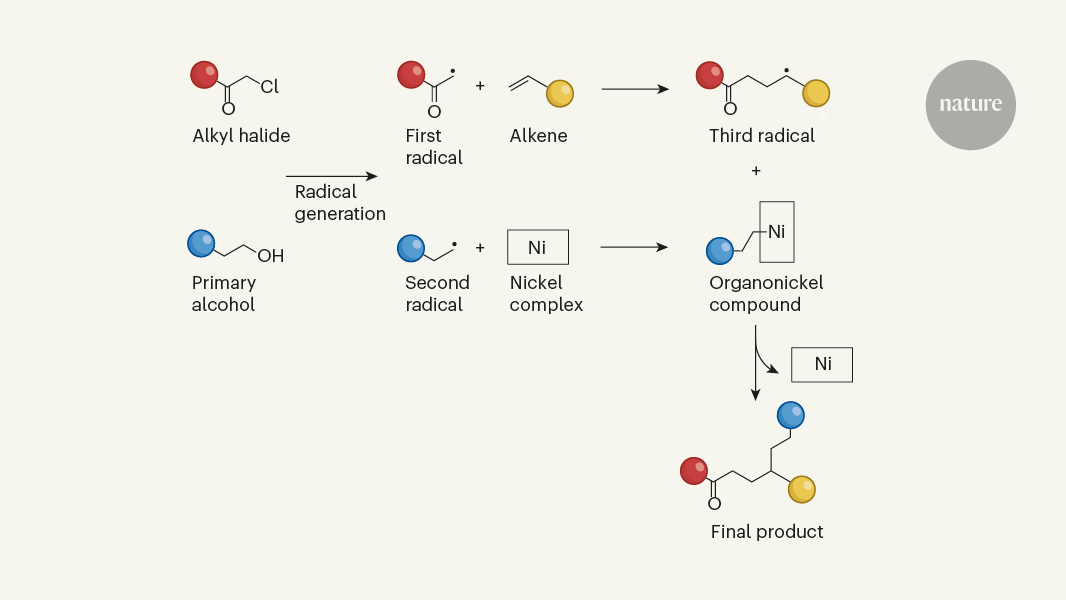
  • Trio of radicals choreographed for versatile chemical reaction

    Trio of radicals choreographed for versatile chemical reaction

    [ad_1]

  • Wang, J. Z., Lyon, W. L. & MacMillan, D. W. C. Nature 628, 104–109 (2024).

    Article 

    Google Scholar
     

  • Chatgilialoglu, C. & Studer, A. Encyclopedia of Radicals in Chemistry, Biology and Materials (Wiley, 2012).


    Google Scholar
     

  • Dong, Z. & MacMillan, D. W. C. Nature 598, 451–456 (2021).

    Article 
    PubMed 

    Google Scholar
     

  • Liu, W., Lavagnino, M. N., Gould, C. A., Alcázar, J. & MacMillan, D. W. C. Science 374, 1258–1263 (2021).

    Article 
    PubMed 

    Google Scholar
     

  • Sakai, H. & MacMillan, D. W. C. J. Am. Chem. Soc. 144, 6185–6192 (2022).

    Article 
    PubMed 

    Google Scholar
     

  • Tsymbal, A. V., Bizzoni, L. D. & MacMillan, D. W. C. J. Am. Chem. Soc. 144, 21278–21286 (2022).

    Article 
    PubMed 

    Google Scholar
     

  • Mao, E. & MacMillan, D. W. C. J. Am. Chem. Soc. 145, 2787–2793 (2023).

    Article 
    PubMed 

    Google Scholar
     

  • Gould, C. A., Pace, A. L. & MacMillan, D. W. C. J. Am. Chem. Soc. 145, 16330–16336 (2023).

    Article 
    PubMed 

    Google Scholar
     

  • Bour, J. R., Ferguson, D. M., McClain, E. J., Kampf, J. W. & Sanford, M. S. J. Am. Chem. Soc. 141, 8914–8920 (2019).

    Article 
    PubMed 

    Google Scholar
     

  • Wang, Y., Wen, X., Cui, X. & Zhang, X. P. J. Am. Chem. Soc. 140, 4792–4796 (2018).

    Article 
    PubMed 

    Google Scholar
     

  • Hu, Y. et al. Angew. Chem. Int. Edn 58, 2670–2674 (2019).

    Article 

    Google Scholar
     

  • Zhou, M., Lankelma, M., van der Vlugt, J. I. & de Bruin, B. Angew. Chem. Int. Edn 59, 11073–11079 (2020).

    Article 

    Google Scholar
     

  • Wang, X. et al. J. Am. Chem. Soc. 143, 11121–11129 (2021).

    Article 
    PubMed 

    Google Scholar
     

  • Wang, S. et al. Nature Commun. 13, 2432 (2022).

    Article 
    PubMed 

    Google Scholar
     

  • Gan, X.-c. et al. J. Am. Chem. Soc. 145, 15714–15720 (2023).

    Article 
    PubMed 

    Google Scholar
     

  • [ad_2]

    Source link

  • ‘Bandit’ algorithms help chemists to discover generally applicable conditions for reactions

    ‘Bandit’ algorithms help chemists to discover generally applicable conditions for reactions

    [ad_1]

    • RESEARCH BRIEFINGS

    In organic chemistry, finding conditions that enable a broad range of compounds to undergo a particular type of reaction is highly desirable. However, conventional methods for doing so consume a lot of time and reagents. A machine-learning method has been developed that overcomes these problems.

    [ad_2]

    Source link