Tag: climate desk

  • All That Rain Is Driving Up Cases of a Deadly Fungal Disease in California

    All That Rain Is Driving Up Cases of a Deadly Fungal Disease in California

    [ad_1]

    This story originally appeared on Grist and is part of the Climate Desk collaboration.

    Last week, a long, narrow section of the Earth’s atmosphere funneled trillions of gallons of water eastward from the Pacific tropics and unleashed it on California. This weather event, known as an atmospheric river, broke rainfall records, dumped more than a foot of rain on parts of the state, and knocked out power for 800,000 residents. At least nine people died in car crashes or were killed by falling trees. But the full brunt of the storm’s health impacts may not be felt for months.

    The flooding caused by intensifying winter rainstorms in California is helping to spread a deadly fungal disease called coccidioidomycosis, or valley fever. “Hydroclimate whiplash is increasingly wide swings between extremely wet and extremely dry conditions,” said Daniel Swain, a climate scientist at the University of California, Los Angeles. Humans are finding it difficult to adapt to this new pattern. But fungi are thriving, Swain said. Valley fever, he added, “is going to become an increasingly big story.”

    Cases of valley fever in California broke records last year after nine back-to-back atmospheric rivers slammed the state and caused widespread, record-breaking flooding. Last month, the California Department of Public Health put out an advisory to health care providers that said it recorded 9,280 new cases of valley fever with onset dates in 2023—the highest number the department has ever documented. In a statement provided to Grist, the California Department of Public Health said that last year’s climate and disease pattern indicate that there could be “an increased risk of valley fever in California in 2024.”

    “If you look at the numbers, it’s astonishing,” said Shangxin Yang, a clinical microbiologist at the University of California, Los Angeles. “About 15 years ago in our lab, we only saw maybe one or two cases a month. Now, it’s two or three cases a week.”

    Valley fever—named for California’s San Joaquin Valley, where the disease was discovered in a farmworker in the late 1800s—is caused by the spores of a fungus called Coccidioides. When inhaled, the spores can cause severe illness in humans and some animal species, including dogs. The fungus is particularly sensitive to climate extremes. Coccidioides doesn’t thrive in regions of the US that get year-round rain, nor can it withstand persistent drought.

    people in hospital with valley fever

    Patients in California undergo treatment for valley fever.

    Photograph: Brian Vander Brug/Los Angeles Times/Getty Images

    [ad_2]

    Source link

  • Countries Are Building Giant ‘Sand Motors’ to Protect Their Coasts From Erosion

    Countries Are Building Giant ‘Sand Motors’ to Protect Their Coasts From Erosion

    [ad_1]

    This story originally appeared on Grist and is part of the Climate Desk collaboration.

    When governments find themselves fighting the threat of coastal erosion, their default response tends to be pretty simple: If sand is disappearing from a beach, they pump in more sand to replace it. This strategy, known as “beach nourishment,” has become a cornerstone of coastal defenses around the world, complementing hard structures like sea walls. North Carolina, for instance, has dumped more than 100 million tons of sand onto its beaches over the past 30 years, at a cost of more than $1 billion.

    The problem with beach nourishment is obvious. If you dump sand on an eroding beach, it’s only a matter of time before that new sand erodes. Then you have to do it all over again.

    Beach nourishment projects are supposed to last for around five years, but they often disappear faster than expected. Moreover, a big coastal storm can wipe them out in a single night. And the costs are staggering: Dragging in new sand requires leasing and operating huge diesel dredge boats. Only the wealthiest areas can afford to do it year after year.

    Now, after decades of reliance on repeated beach nourishment, a new strategy for managing erosion is showing up on coastlines around the world. It’s called the “sand motor,” and it comes from the Netherlands, a low-lying nation with centuries of experience in coastal protection.

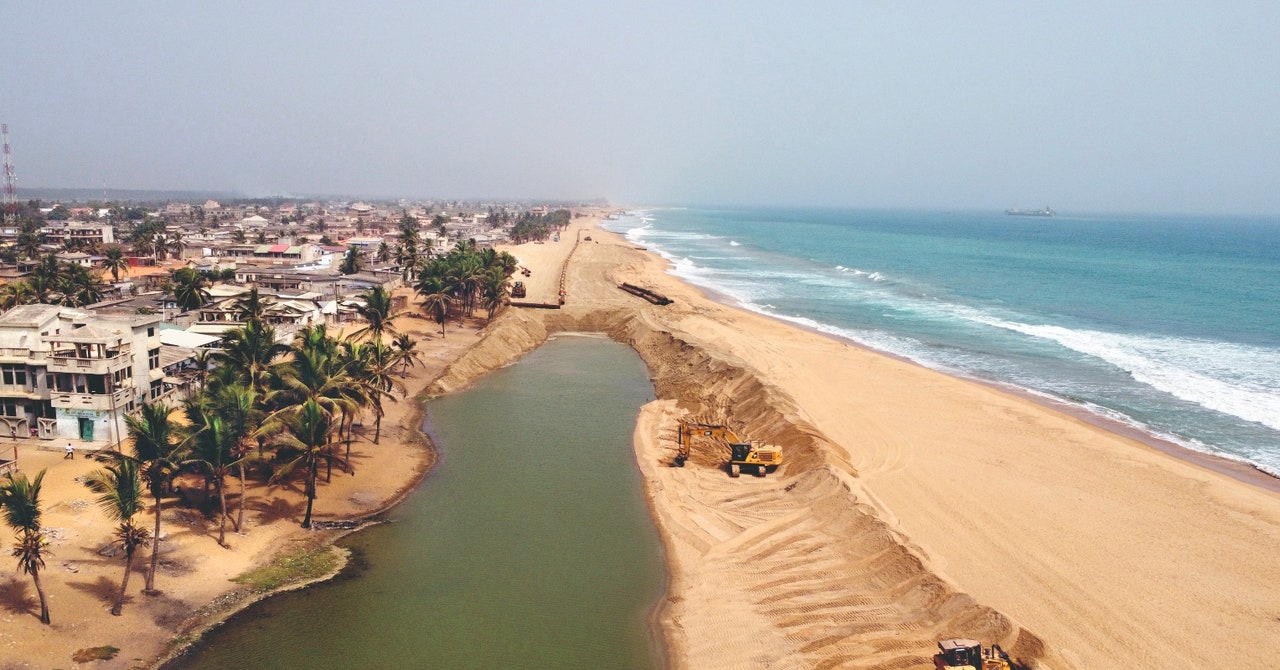
    A “sand motor” isn’t an actual motor—it’s a sculpted landscape that works with nature rather than against it. Instead of rebuilding a beach with an even line of new sand, engineers extend one section of the shoreline out into the sea at an angle.. Over time, the natural wave action of the ocean acts as a “motor” that pushes the sand from this protruding landmass out along the rest of the natural shoreline, spreading it down the coastline for miles.

    While sand motors require much more upfront investment than normal beach nourishment—and many times more sand—they also protect more land and last much longer. Developed countries such as the Netherlands and the United Kingdom are turning to these megaprojects as an alternative to repeated nourishment, and the World Bank is financing a sand motor in West Africa as part of a billion-dollar adaptation program meant to fight sea-level rise. But these massive projects only work in areas where erosion is not yet at a critical stage. That means they’re unlikely to show up in the United States, where many coastal areas are already on the point of disappearing altogether.

    The idea for the project came from a Dutch professor named Marcel Stive, who had watched with frustration as his country’s government spent billions to nourish the same coastal areas over and over again as sea levels kept rising. Stive presented the idea to the government, which hired a large dredging company called Boskalis to build a prototype on the shoreline south of The Hague.

    Even this experimental project, which the Dutch call “de Zandmotor,” was an unprecedented undertaking. Boskalis dredged up around 28 million cubic yards of sand from the ocean floor—more than the Netherlands uses on nourishment projects nationwide in a given year. Engineers then sculpted the sand into a hook that curved eastward along the shore, ensuring that waves would push the sand northeast toward beaches near The Hague. They also created a lagoon in the middle of the sand structure so that locals wouldn’t have to walk for almost a mile to get to the water. In the years since Boskalis finished construction on the $50 million project, the hook of sand has flattened out, almost the way a wave breaks as it reaches the shore.

    [ad_2]

    Source link

  • The US Has Big Plans for Wind Energy—but an Obscure 1920s Law Is Getting in the Way

    The US Has Big Plans for Wind Energy—but an Obscure 1920s Law Is Getting in the Way

    [ad_1]

    The reason for the Jones Act’s longevity, says Colin Grabow, a research fellow at the Cato Institute, a libertarian think tank, is that while it tends to benefit only a few people and businesses, the act goes unnoticed because there are many payers sharing the increased costs.

    The Jones Act is one in a string of protectionist laws—dating back to the Tariff Act of 1789—designed to bolster US marine industries. The Jones Act’s existence was meant to ensure a ready supply of ships and mariners in case of war. Its authors reasoned that protection from foreign competition would foster that.

    “Your average American has no idea that the Jones Act even exists,” Grabow says. “It’s not life-changing for very many people,” he adds. But “all Americans are hurt by the Jones Act.” In this case, that’s by slowing down the United States’ ability to hit its own wind power targets.

    Grabow says those most vocal about the law—the people who build, operate, or serve on compliant ships—usually want to keep it in place.

    Of course, there’s more going on with the country’s slow rollout of offshore wind power than just a century-old shipping law. It took a slew of factors to sink New Jersey’s planned Ocean Wind installations, says Abraham Silverman, an expert on renewable energy at Columbia University in New York.

    Ultimately, says Silverman, rising interest rates, inflation, and other macroeconomic factors caught New Jersey’s projects at their most vulnerable stage, inflating the construction costs after Ørsted had already locked in its financing.

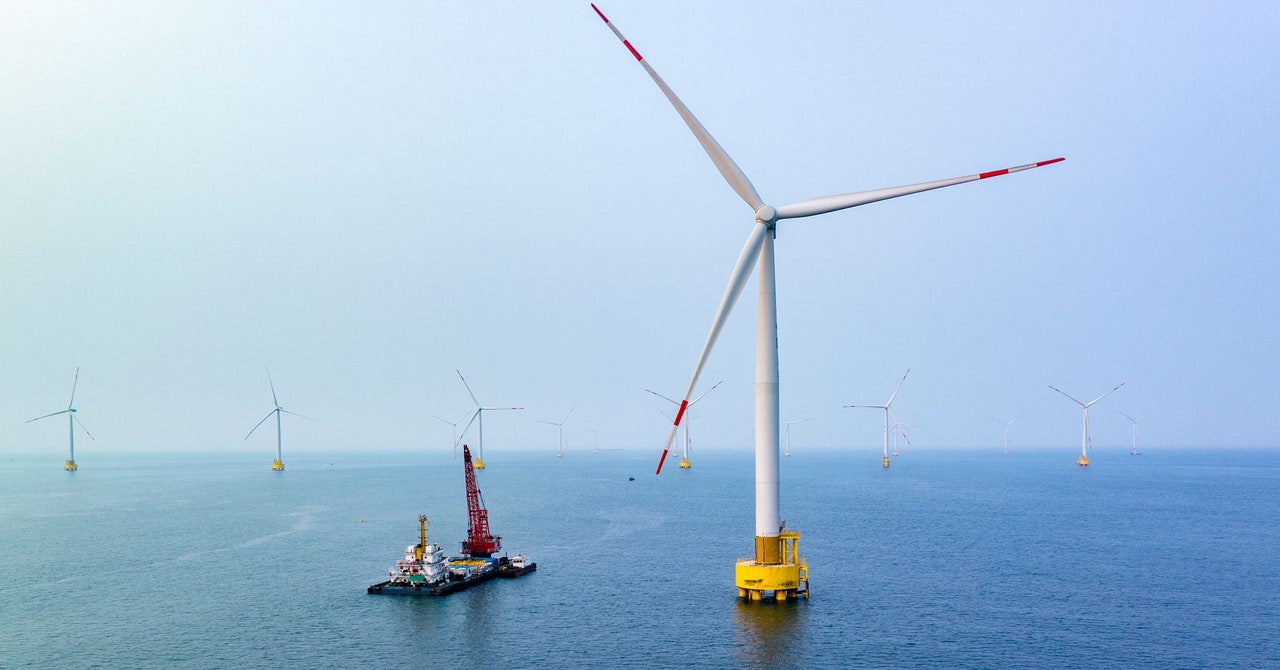
    Despite the setbacks, the potential for offshore wind power generation in the United States is massive. The NREL estimates that fixed-bottom offshore wind farms in the country could theoretically generate some 1,500 gigawatts of power—more than the United States is capable of generating today.

    There’s a lot the United States can do to make its expansion into offshore wind more efficient. And that’s where the focus needs to be right now, says Matthew Shields, an engineer at NREL specializing in the economics and technology of wind energy.

    “Whether we build 15 or 20 or 25 gigawatts of offshore wind by 2030, that probably doesn’t move the needle that much from a climate perspective,” says Shields. But if building those first few turbines sets the country up to then build 100 or 200 gigawatts of offshore wind capacity by 2050, he says, then that makes a difference. “If we have ironed out all these issues and we feel good about our sustainable development moving forward, to me, I think that’s a real win.”

    But today, some of the offshore wind industry’s issues stem, inescapably, from the Jones Act. Those inefficiencies mean lost dollars and, perhaps more importantly in the rush toward carbon neutrality, lost time.

    [ad_2]

    Source link