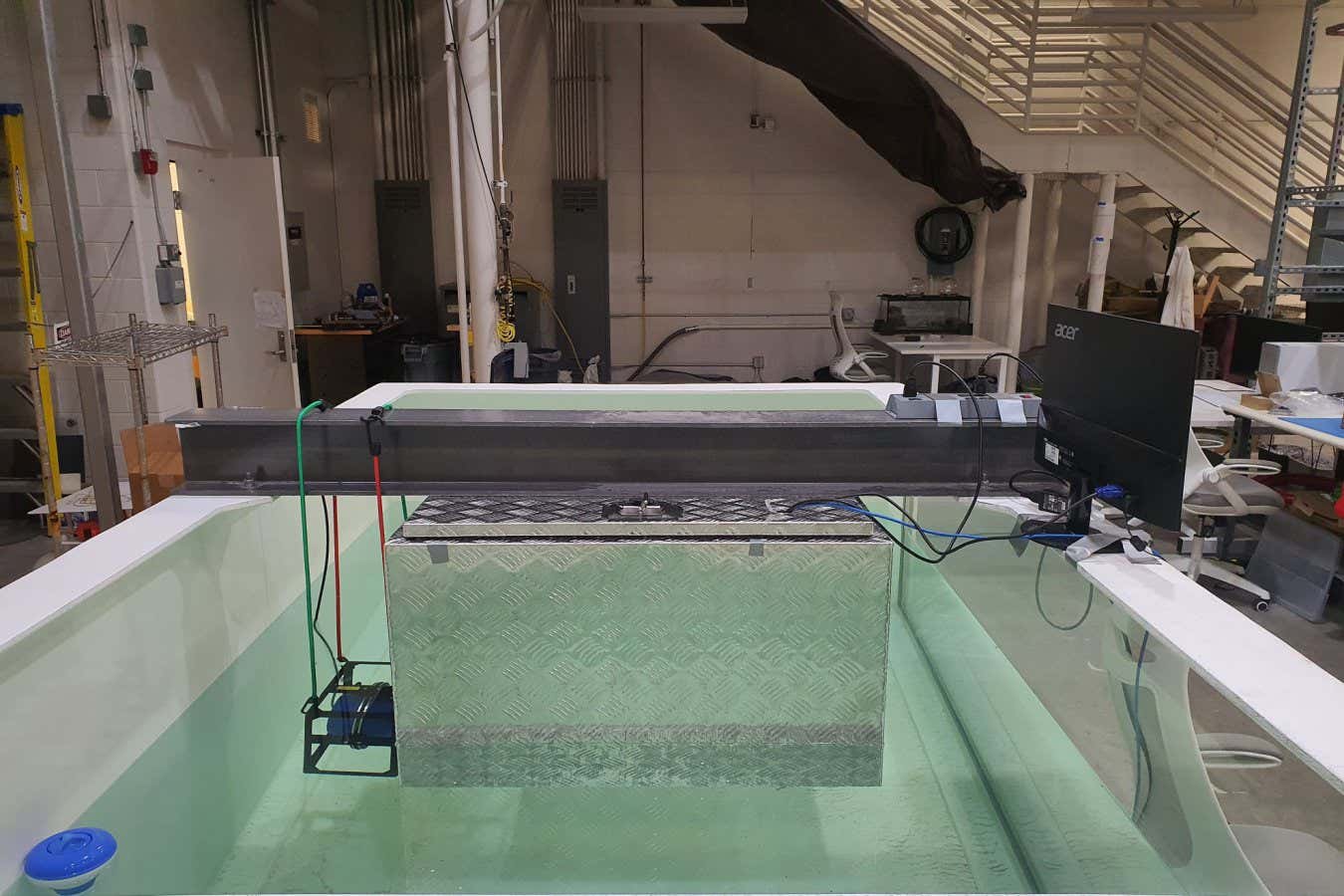
Researchers tested how sound affects computer hard drives in a metal enclosure submerged in a water tank
Adnan Abdullah
Some underwater data centres could be vulnerable to acoustic attacks as simple as a swimming pool speaker broadcasting a high musical note beneath the waves.
Companies have only recently begun deploying underwater data centres that can harness the ocean’s natural cooling to reduce electricity usage and carbon emissions. But experiments show computer hard drives placed within submerged metal containers can experience destructive vibrations when sounds are played underwater. Pressure amplifies these noises to…
India currently has a fairly small chip-manufacturing industry, but prime minister Narendra Modi wants the country to become a dominant player in the sector in just a few years
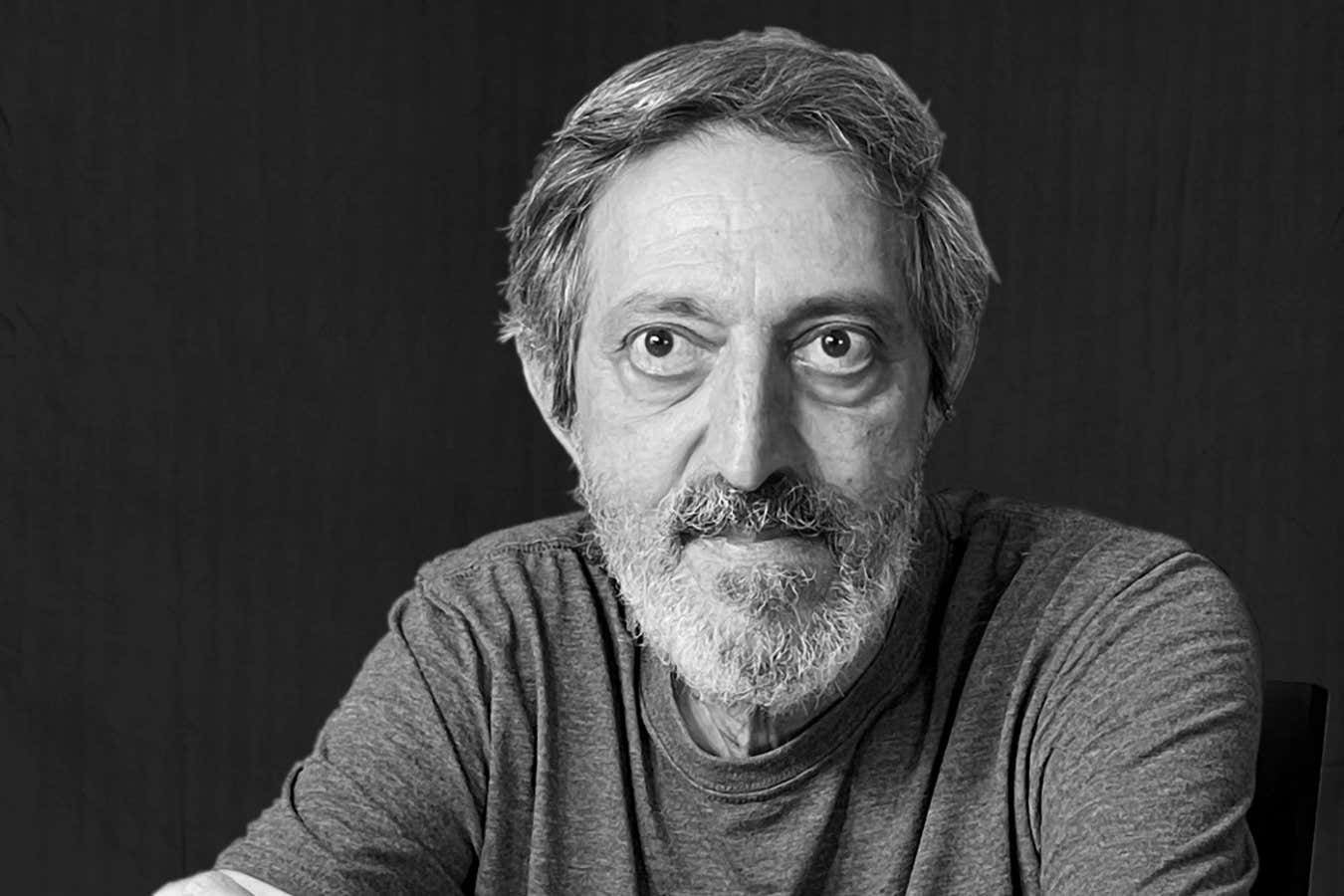
The mathematician Avi Wigderson has won the 2023 Turing award, often referred to as the Nobel prize for computing, for his work on understanding how randomness can shape and improve computer algorithms.
Wigderson, who also won the prestigious Abel prize in 2021 for his mathematical contributions to computer science, was taken aback by the award. “The [Turing] committee fooled me into believing that we were going to have some conversation about collaborating,” he says. “When I zoomed in, the whole committee was there and they told me. I was excited, surprised and happy.”
Computers work in a predictable way at the hardware level, but this can make it difficult for them to model real-world problems, which often have elements of randomness and unpredictability. Wigderson, at the Institute for Advanced Study in Princeton, New Jersey, has shown over a decades-long career that computers can also harness randomness in the algorithms that they run.
In the 1980s, Wigderson and his colleagues discovered that by inserting randomness into some algorithms, they could make them easier and faster to solve, but it was unclear how general this technique was. “We were wondering whether this randomness is essential, or maybe you can always get rid of it somehow if you’re clever enough,” he says.
One of Wigderson’s most important discoveries was making clear the relationship between types of problems, in terms of their difficulty to solve, and randomness. He also showed that certain algorithms that contained randomness and were hard to run could be made deterministic, or non-random, and easier to run.
These findings helped computer scientists better understand one of the most famous unproven conjectures in computer science, called “P ≠ NP”, which proposes that easy and hard problems for a computer to solve are fundamentally different. Using randomness, Wigderson discovered special cases where the two classes of problem were the same.
Wigderson first started exploring the relationship between randomness and computers in the 1980s, before the internet existed, and was attracted to the ideas he worked on by intellectual curiosity, rather than how they might be used. “I’m a very impractical person,” he says. “I’m not really motivated by applications.”
However, his ideas have become important for a wide swath of modern computing applications, from cryptography to cloud computing. “Avi’s impact on the theory of computation in the last 40 years is second to none,” says Oded Goldreich at the Weizmann Institute of Science in Israel. “The diversity of the areas to which he has contributed is stunning.”
One of the unexpected ways in which Wigderson’s ideas are now widely used was his work, with Goldreich and others, on zero-knowledge proofs, which detail ways of verifying information without revealing the information itself. These methods are fundamental for cryptocurrencies and blockchains today as a way to establish trust between different users.
Although great strides in the theory of computation have been made over Wigderson’s career, he says that the field is still full of interesting and unsolved problems. “You can’t imagine how happy I am that I am where I am, in the field that I’m in,” he says. “It’s bursting with intellectual questions.”
Wigderson will receive a $1 million prize as part of the Turing award.
Article amended on 10 April 2024
The year associated with the prize announcement was corrected.
The large language models behind AI chatbots are developing so rapidly that after eight months, a model only needs half the computing power to hit the same benchmark score – which is much faster than the rate at which computer chips improve
This extreme fragility might make quantum computing sound hopeless. But in 1995, the applied mathematician Peter Shor discovered a clever way to store quantum information. His encoding had two key properties. First, it could tolerate errors that only affected individual qubits. Second, it came with a procedure for correcting errors as they occurred, preventing them from piling up and derailing a computation. Shor’s discovery was the first example of a quantum error-correcting code, and its two key properties are the defining features of all such codes.
The first property stems from a simple principle: Secret information is less vulnerable when it’s divided up. Spy networks employ a similar strategy. Each spy knows very little about the network as a whole, so the organization remains safe even if any individual is captured. But quantum error-correcting codes take this logic to the extreme. In a quantum spy network, no single spy would know anything at all, yet together they’d know a lot.
Each quantum error-correcting code is a specific recipe for distributing quantum information across many qubits in a collective superposition state. This procedure effectively transforms a cluster of physical qubits into a single virtual qubit. Repeat the process many times with a large array of qubits, and you’ll get many virtual qubits that you can use to perform computations.
The physical qubits that make up each virtual qubit are like those oblivious quantum spies. Measure any one of them and you’ll learn nothing about the state of the virtual qubit it’s a part of—a property called local indistinguishability. Since each physical qubit encodes no information, errors in single qubits won’t ruin a computation. The information that matters is somehow everywhere, yet nowhere in particular.
“You can’t pin it down to any individual qubit,” Cubitt said.
All quantum error-correcting codes can absorb at least one error without any effect on the encoded information, but they will all eventually succumb as errors accumulate. That’s where the second property of quantum error-correcting codes kicks in—the actual error correction. This is closely related to local indistinguishability: Because errors in individual qubits don’t destroy any information, it’s always possible to reverse any error using established procedures specific to each code.
Taken for a Ride
Zhi Li, a postdoc at the Perimeter Institute for Theoretical Physics in Waterloo, Canada, was well versed in the theory of quantum error correction. But the subject was far from his mind when he struck up a conversation with his colleague Latham Boyle. It was the fall of 2022, and the two physicists were on an evening shuttle from Waterloo to Toronto. Boyle, an expert in aperiodic tilings who lived in Toronto at the time and is now at the University of Edinburgh, was a familiar face on those shuttle rides, which often got stuck in heavy traffic.
“Normally they could be very miserable,” Boyle said. “This was like the greatest one of all time.”
Before that fateful evening, Li and Boyle knew of each other’s work, but their research areas didn’t directly overlap, and they’d never had a one-on-one conversation. But like countless researchers in unrelated fields, Li was curious about aperiodic tilings. “It’s very hard to be not interested,” he said.
Altermagnetism works differently from standard magnetism
Libor Šmejkal and Anna Birk Hellenes
A new kind of magnetism has been measured for the first time. Altermagnets, which contain a blend of properties from different classes of existing magnets, could be used to make high capacity and fast memory devices or new kinds of magnetic computers.
Until the 20th century, there was thought to be only one kind of permanent magnet, a ferromagnet, the effects of which can be seen in objects with relatively strong external magnetic fields like fridge magnets or compass needles.
These fields are caused by the magnetic spins of the magnets’ electrons lining up in one direction.
But, in the 1930s, French physicist Louis Néel discovered another kind of magnetism, called antiferromagnetism, where the electrons’ spins are alternately up and down. Although antiferromagnets lack the external fields of ferromagnets, they do show interesting internal magnetic properties because of the alternating spins.
It seemed, when looking at a crystal in terms of sheets of spins, that a third kind of permanent magnetism might be responsible, which has been called altermagnetism. Altermagnets would look like antiferromagnets, but the sheets of spins would look the same when rotated from any angle. This would explain the Hall effect, but no one had seen the electronic signature of this structure itself, so scientists were unsure whether it was definitely a new kind of magnetism.
Now, Juraj Krempasky at the Paul Scherrer Institute in Villigen, Switzerland, and his colleagues have confirmed the existence of an altermagnet by measuring the electron structure in a crystal, magnesium telluride, that was previously thought to be antiferromagnetic.
To do this, they gauged how light bounced off magnesium telluride to find the energies and speeds of the electrons inside the crystal. After mapping out these electrons, they were found to almost exactly match the predictions given by simulations for an altermagnetic material.
The electrons seemed to be split into two groups, which allows them more movement inside the crystal and is the source of the unusual altermagnetic properties. “This gave direct evidence that we can talk about altermagnets and that they behave exactly as predicted by theory,” says Krempasky.
This electron grouping seems to come from the atoms of tellurium, which is non-magnetic, in the crystal structure, which separate the magnetic charges of the magnesium into their own planes and allow the unusual rotational symmetry.
“It’s really nice verification that these materials do exist,” says Richard Evans at the University of York, UK. As well as the electrons in altermagnets being freer to move than those in antiferromagnets, this new type of magnet also doesn’t have external magnetic fields like in ferromagnets, says Evans, so you can use them to make magnetic devices that don’t interfere with each other.
The property could boost the storage on computer hard drives, because commercial devices contain ferromagnetic material that is so tightly packed that the material’s external magnetic fields start to see interference – altermagnets could be packed more densely.
The magnets could even lead to spintronic computers that use magnetic spin instead of current to perform their measurements and calculations, says Joseph Barker at the University of Leeds, UK, combining memory and computer chips into one device. “It maybe gives more hope to the idea that we could make spintronic devices become a reality,” says Barker.
This is a job for LLL: Give it (or its brethren) a basis of a multidimensional lattice, and it’ll spit out a better one. This process is known as lattice basis reduction.
What does this all have to do with cryptography? It turns out that the task of breaking a cryptographic system can, in some cases, be recast as another problem: finding a relatively short vector in a lattice. And sometimes, that vector can be plucked from the reduced basis generated by an LLL-style algorithm. This strategy has helped researchers topple systems that, on the surface, appear to have little to do with lattices.
In a theoretical sense, the original LLL algorithm runs quickly: The time it takes to run doesn’t scale exponentially with the size of the input—that is, the dimension of the lattice and the size (in bits) of the numbers in the basis vectors. But it does increase as a polynomial function, and “if you actually want to do it, polynomial time is not always so feasible,” said Léo Ducas, a cryptographer at the national research institute CWI in the Netherlands.
In practice, this means that the original LLL algorithm can’t handle inputs that are too large. “Mathematicians and cryptographers wanted the ability to do more,” said Keegan Ryan, a doctoral student at the University of California, San Diego. Researchers worked to optimize LLL-style algorithms to accommodate bigger inputs, often achieving good performance. Still, some tasks have remained stubbornly out of reach.
The new paper, authored by Ryan and his adviser, Nadia Heninger, combines multiple strategies to improve the efficiency of its LLL-style algorithm. For one thing, the technique uses a recursive structure that breaks the task down into smaller chunks. For another, the algorithm carefully manages the precision of the numbers involved, finding a balance between speed and a correct result. The new work makes it feasible for researchers to reduce the bases of lattices with thousands of dimensions.
Past work has followed a similar approach: A 2021 paper also combines recursion and precision management to make quick work of large lattices, but it worked only for specific kinds of lattices, and not all the ones that are important in cryptography. The new algorithm behaves well on a much broader range. “I’m really happy someone did it,” said Thomas Espitau, a cryptography researcher at the company PQShield and an author of the 2021 version. His team’s work offered a “proof of concept,” he said; the new result shows that “you can do very fast lattice reduction in a sound way.”
The new technique has already started to prove useful. Aurel Page, a mathematician with the French national research institute Inria, said that he and his team have put an adaptation of the algorithm to work on some computational number theory tasks.
LLL-style algorithms can also play a role in research related to lattice-based cryptography systems designed to remain secure even in a future with powerful quantum computers. They don’t pose a threat to such systems, since taking them down requires finding shorter vectors than these algorithms can achieve. But the best attacks researchers know of use an LLL-style algorithm as a “basic building block,” said Wessel van Woerden, a cryptographer at the University of Bordeaux. In practical experiments to study these attacks, that building block can slow everything down. Using the new tool, researchers may be able to expand the range of experiments they can run on the attack algorithms, offering a clearer picture of how they perform.
Original storyreprinted with permission fromQuanta Magazine, an editorially independent publication of theSimons Foundationwhose mission is to enhance public understanding of science by covering research developments and trends in mathematics and the physical and life sciences.
The exascale supercomputer JUPITER will be hosted at the Jülich Supercomputing Centre in Germany
Forschungszentrum Jülich/Sascha Kreklau
The first exascale computer in Europe, called JUPITER, should be completed next year, and it may even become the most powerful computer in the world. It will allow experiments and simulations currently only possible on a tiny number of machines in the US and China.
Exascale machines can carry out a billion billion operations per second, an exaflop. Currently, there are – officially – only two supercomputers in the world capable of those sorts of calculations: the Frontier…