Dead Planets Society is a podcast that takes outlandish ideas about how to tinker with the cosmos – from snapping the moon in half to causing a gravitational wave apocalypse – and subjects them to the laws of physics to see how they fare. Listen on Apple, Spotify or on our podcast page.
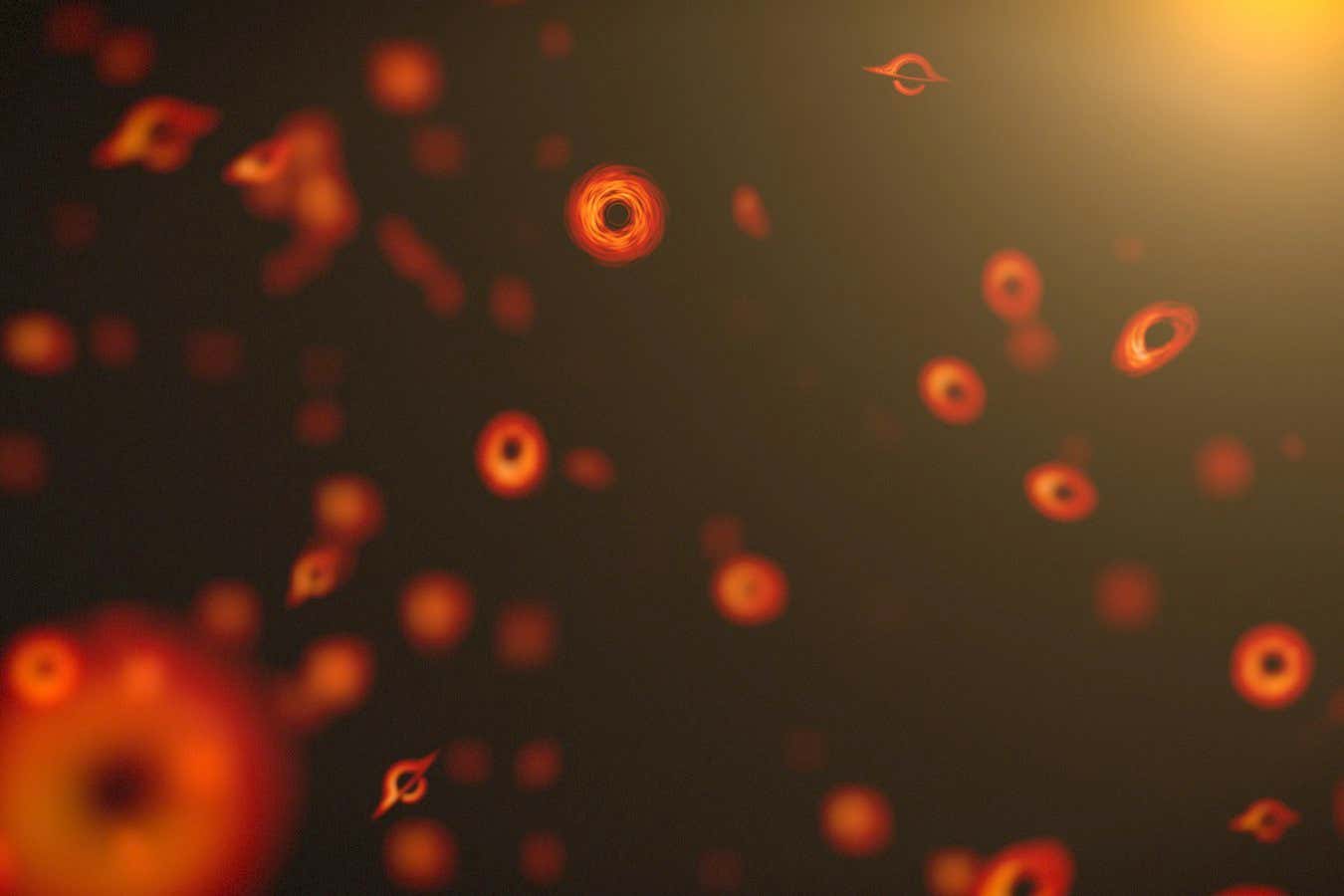
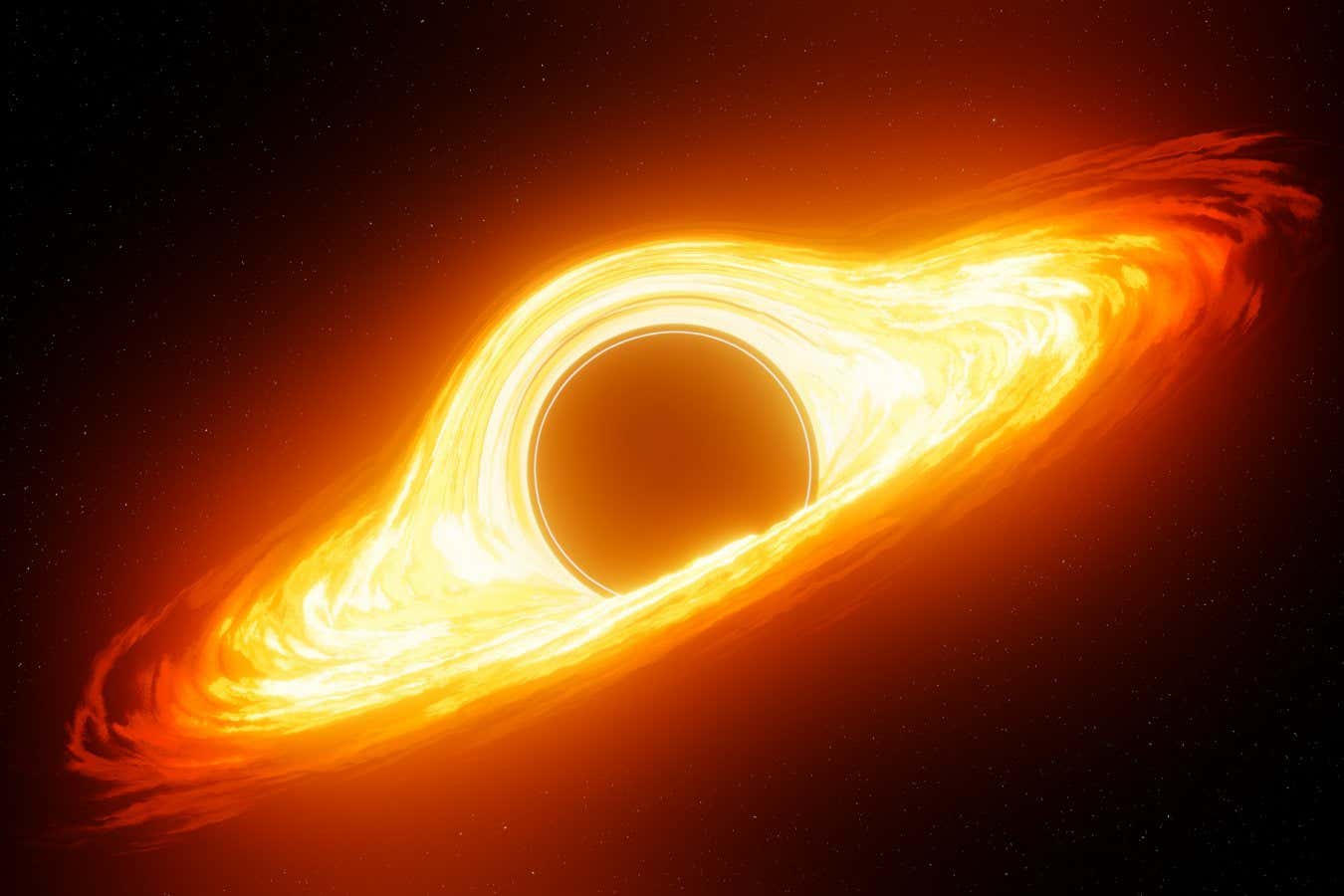
The early universe may have been littered with black holes smaller than an atom but as heavy as a mountain. If these primordial black holes do exist, they would solve several of the biggest problems in cosmology – and create endless opportunities for the Dead Planets Society to make mischief.
In this episode, our hosts Chelsea Whyte and Leah Crane are joined by black hole astronomer Allison Kirkpatrick at the University of Kansas as they explore what would happen if a primordial black hole was placed inside various objects, from the sun to Earth to the human body. The consequences aren’t quite as simple as one might expect.
For a really tiny black hole, placing it inside a star or planet wouldn’t have much of an effect – it would either pass straight through or stick around in the centre, depending on the mass of the object. But once they get a little bigger, perhaps the mass of Earth but the radius of a grape, things start to get interesting. Such a black hole would dramatically decrease the sun’s lifetime, or swallow up a planet from the inside out.
On the plus side, black holes in this size range could be used to reorganise the cosmos through their gravitational pull. A tiny black hole near the surface of the moon could stop its inexorable retreat from Earth, for example.
For a human being, standing several metres away from a tiny black hole would be reasonably safe, according to Kirkpatrick – but the closer you get, the more its gravity will affect whatever part of your body is closest, and if you get too close it will rip you apart. If you somehow managed to teleport the black hole inside your body, it would also not go well for you.
Kirkpatrick says under no circumstances should a primordial black hole be placed inside a human being, because of the havoc it would immediately wreak upon their body. The American Medical Association did not respond to a request for comment on the effects of a black hole on the human body.
Dead Planets Society is a podcast that takes outlandish ideas about how to tinker with the cosmos – from snapping the moon in half to causing a gravitational wave apocalypse – and subjects them to the laws of physics to see how they fare. Listen on Apple, Spotify or on our podcast page.
By the end of the 16th century, pretty much everyone knew that Earth revolved around the sun, and not the other way around. This was a major blow to those who thought Earth was the centre of the universe, but the Dead Planets Society is here to relieve their dismay. That’s right, we’re bringing back geocentrism.
Truly making Earth the centre of our solar system is going to take more than just fudging the maths. The sun is so much more massive than our puny planet that it is nearly impossible to force the former to orbit the latter, so our hosts Chelsea Whyte and Leah Crane are going to have to make some major changes to the solar system as we know it.
They are joined for this episode by Andy Rivkin at Johns Hopkins University in Maryland, who says that the only way to create a geocentric solar system is to make Earth the most massive thing around. Assuming that doesn’t force the planet to collapse into a black hole, this would lead to some strange effects.
For one, the moon is going to have to speed up to remain in orbit, circling Earth every hour or so until it simply shatters. The rest of the planets would speed up, too, or else they will all smash into the new enormous Earth within a decade or two. All that extra mass in our planet could even disturb other nearby stars and start to pull them towards us. The triumphant geocentric solar system might not last long, but it would certainly have a dramatic end.
Dead Planets Society is a podcast that takes outlandish ideas about how to tinker with the cosmos – from snapping the moon in half to causing a gravitational wave apocalypse – and subjects them to the laws of physics to see how they fare. Listen on Apple, Spotify or on our podcast page.
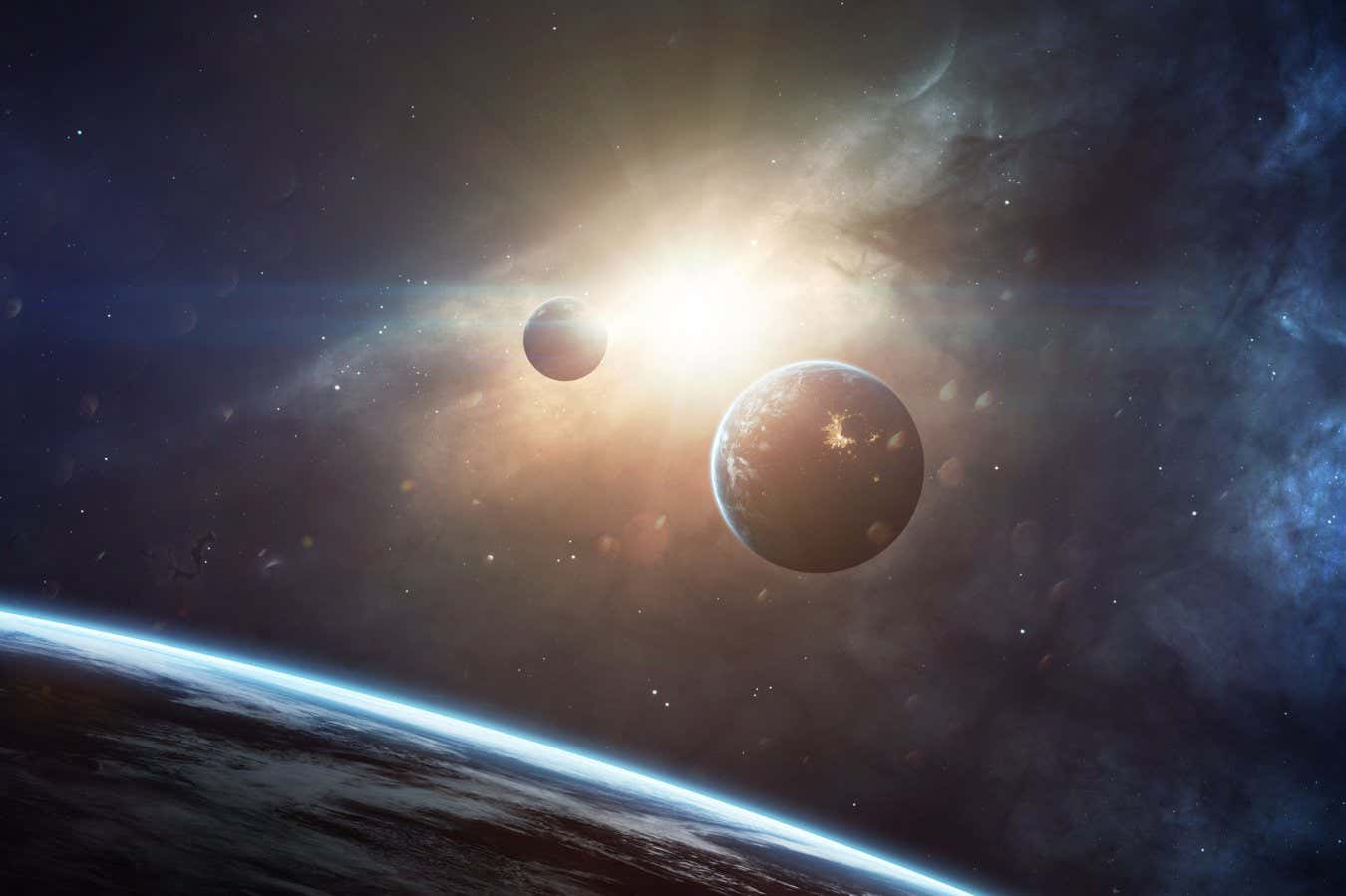
One moon simply isn’t enough. Earth only has one, while some other planets have many – Jupiter has 95 moons, putting our single shining cosmic partner to shame. In this episode of Dead Planets Society, it’s time to light up the night sky with as many moons as possible.
But it isn’t as easy as just chucking a bunch of rocks into orbit, so our hosts Leah Crane and Chelsea Whyte are joined this episode by Sean Raymond at the University of Bordeaux in France for help with the particulars. He suggests we could construct a ring of 10 moons orbiting Earth, each in a different phase, causing strange little eclipses as they march around the planet.
And it isn’t just moons: in 2018, Raymond and Juna Kollmeier at Carnegie Observatories in California found it is theoretically possible for Earth’s moon to have its own orbiting satellite, dubbed a moonmoon. Such a thing might not be stable because of gravitational anomalies present in our moon, so our hosts are adding a gargantuan immersion blender to their cosmic toolbelt to smooth things out. Once things are sorted, there could be moonmoons and even moonmoonmoons lighting up the night sky.
The moon is bright because it reflects sunlight, and these new moons could be the perfect places to put a series of huge solar panels – unobstructed by the atmosphere and clouds that plague Earth’s surface. They would also be so bright it would probably be impossible to ever see the stars from Earth’s surface, but that’s a relatively small detail.
The bigger problem: the more complex and crowded the orbits get, the greater the risk of these moons and moonmoons smashing together. This could give our planet beautiful rings like Saturn’s, but it could also destroy life on Earth.
Dead Planets Society is a podcast that takes outlandish ideas about how to tinker with the cosmos – from snapping the moon in half to causing a gravitational wave apocalypse – and subjects them to the laws of physics to see how they fare. Listen on Apple, Spotify or on our podcast page.
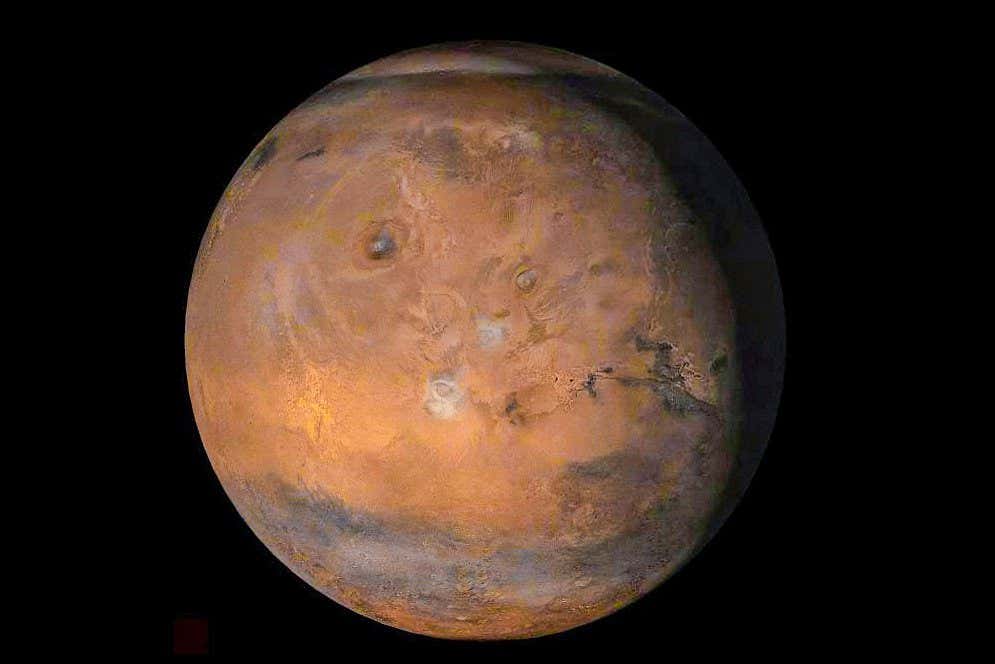
Feelings about Mars run strong in the planetary science community – many love it because of how much we know about it, while others resent the overwhelming attention it has received at the expense of other worlds in our solar system. But in this episode of Dead Planets Society, sentiment does not get in the way of the central goal: absolutely wrecking the Red Planet.
In this episode, Mars’s very redness may prove its demise. The red hue of Martian soil comes from iron oxide, and iron’s magnetic properties inspired our hosts, Chelsea Whyte and Leah Crane, to explore the possibility of destroying Mars with huge orbiting magnets.
Iron oxide itself is not magnetic, but Mars does have a core of liquid iron. Our hosts are joined this episode by volcanologist Robin George Andrews to consider how a giant magnet would affect this core.
Depending on the orbit of the huge magnet, the core could be simply disturbed so much that it would slosh around, causing fissures and volcanism and maybe eventually the complete disintegration of the planet. Or it could be pulled from deep underground through pre-existing vents, like those at the top of the huge Martian volcano Olympus Mons.
When it reaches space, the liquid iron would freeze into a glittering metallic statue. Much of it might accumulate on the magnet itself, turning it into a sort of enormous iron-shielded bullet hurtling through the solar system.
In the process, Mars would be left hollow. This alone would be a serious problem for the planet, leading to the outer layers crunching and grinding together to fill the empty space. Or the space could be filled with something else – the possibilities are endless and potentially truly disturbing.
Dead Planets Society is a podcast that takes outlandish ideas about how to tinker with the cosmos – from snapping the moon in half to causing a gravitational wave apocalypse – and subjects them to the laws of physics to see how they fare. Listen on Apple, Spotify or on our podcast page.
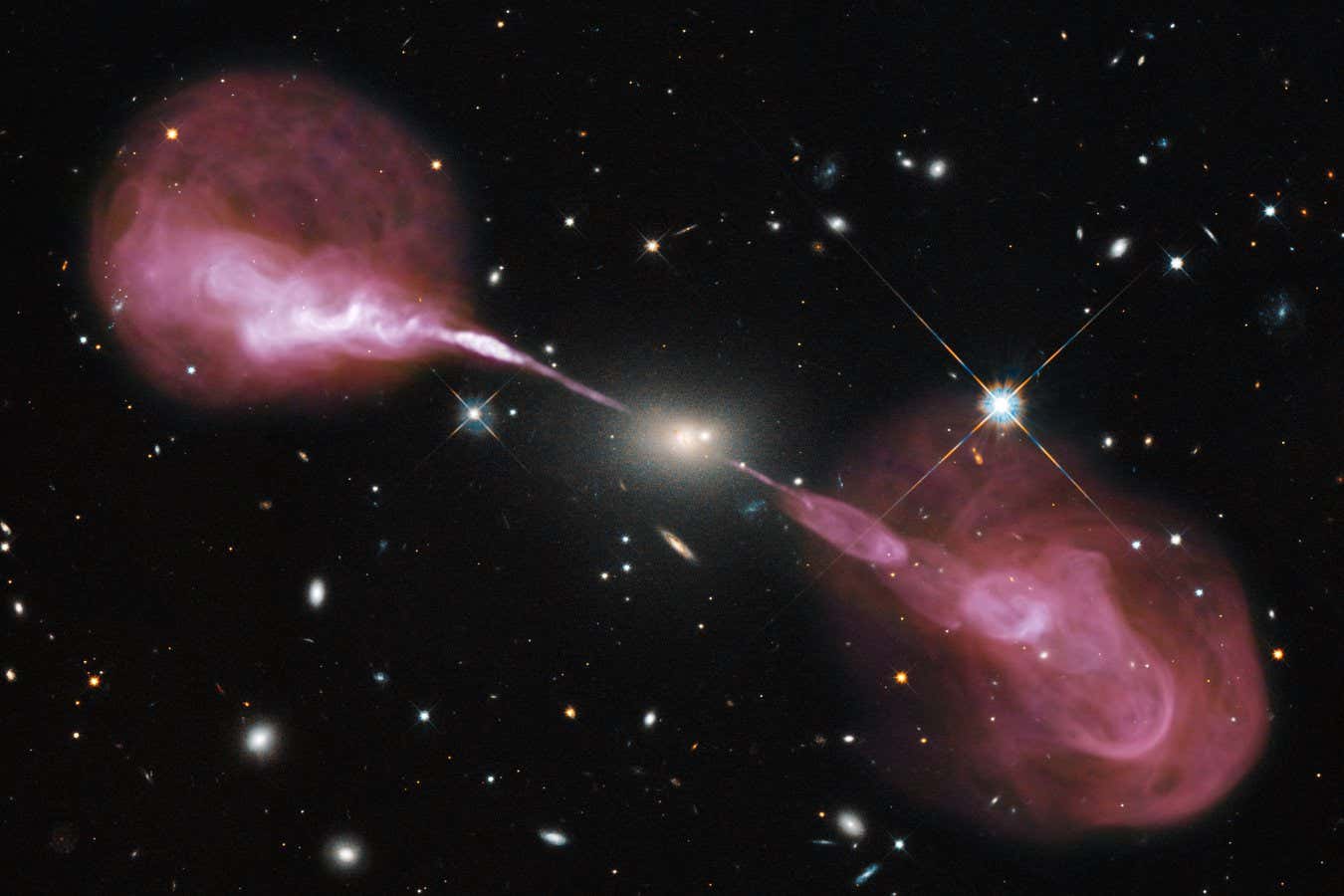
For the most part, galaxies only come in two shapes: spirals and blobs. While spirals can be majestic viewed from the right angles, the lack of variety can get boring over the cosmic eons. So in this episode of Dead Planets Society, it’s time to spice things up, galactically.
Our hosts Leah Crane and Chelsea Whyte are joined by Vivian U at the University of California, Irvine, an astronomer who studies how galaxies evolve when they smash together and warp one another. In the real world, galactic collisions can create strange swirls and many-armed behemoths, but over time the chaos from the smash-up results in just another blob. To make a lasting change, we’ll need tools with a bit more precision.
That’s where the supermassive black holes come in. They might be able to carve gaps through the dust and gas of a galaxy, creating more detailed images. But gravity tends to complicate things, and eventually even those black holes would devour too much matter and merge together, resulting in yet another blob. Perhaps dark matter could be used instead to create an invisible scaffold that shapes the distribution of the regular matter that we can see.
Building such a strange-shaped galaxy – especially one unlike anything that a natural galactic collision would create, such as a galaxy with sharp corners or one in a recognisable image like a giraffe – might be a way to signal to aliens or future astronomers that we are here and we have incredible cosmic powers.
In fact, perhaps this has already been done to the Milky Way by some strange alien force – after all, we can’t see our home galaxy from outside of it. We only know its shape by counting the stars that we can see in each direction and building theoretical models, so we can rule out that our galaxy is in the shape of a giraffe or something else wildly out of the ordinary. But if it were, say, a square instead of a spiral, it might be difficult for astronomers to tell the difference.
Listen, it’s not that I actually want to kill the sun – I just want to figure out how. But when I told my colleagues at New Scientist that I was recruiting scientists to do just this, I was met with baffled looks. I write about space every single day, and I find it endlessly fascinating. I feel at home with the mysteries of the cosmos, so why would I want to ruin any part of it, let alone kill our beloved and essential star?
Despite their confusion, my colleagues indulged me and my partner in destruction, our US editor Chelsea Whyte. We started reaching out to free-thinking astrophysicists and planetary scientists, asking them to join us on our podcast, Dead Planets Society. With them we began tinkering with the universe – in our minds, at least – not only killing the sun but imagining a gravitational wave apocalypse, what would happen if sliced the moon in half or chiseled the Earth into a cube.
As we thought about questions to ask the guests we had on the show, who are all university professors and proper scientists, we found ourselves looking up tidbits about gravity and planetary science, doing calculations of escape velocities and Roche limits. As much as the podcast was a flight of fancy – a fun game to play – it also started to feel a bit like we were doing science. We realised that seemingly absurd thought experiments have always been at heart of the scientific method.
Science began with thought experiments rather than empirical experiments that are carried out with lab benches or telescopes, says philosopher H. Peter Steeves at DePaul University. Galileo Galilei, one of the founders of the modern scientific method in the 16th century, is remembered for dropping a feather and a hammer from the Leaning Tower of Pisa. By demonstrating they fell at the same rate, the story goes, Galileo overturned a 2000-year-old idea of how gravity worked. “[It] is as fanciful a story as Newton getting hit on the head with an apple,” says Steeves. “But there is evidence that he engaged in a thought experiment to demonstrate how Aristotle’s conception of gravity was incorrect.”
Over the course of history, we have become far better at performing practical experiments, but thought experiments remain important. For example, Albert Einstein, who also transformed our view of the universe by grappling with gravity, is renowned for conjuring absurd scenarios in his head. One evening as he was riding in a streetcar, he imagined what the world would look like if he were travelling at the speed of light. After years of frustration trying to explain the behaviour of light, this was the seed that grew into special relativity in 1905. “Imagining things on this grand scale presents the familiar in a different way,” says philosopher Guy Kahane at the University of Oxford.
At Dead Planets Society, we like to imagine what would happen if Earth were cube-shaped
Vitaga/Adobe Stock
This is no less true today. Indulging in thought experiments is common practice among theorists trying to understand black holes and what these extreme objects reveal about the nature of reality. For instance, the intense gravity of a black holes mean that you can’t place any scientific instruments right next to one or inside one in order transmit data back out. So theorists spend a whole lot of time thinking about and calculating what might happen to an observer in one of those positions – leading to all kinds of surprising insights about concepts like time and causality. “Once you’re thinking in this playful way, you start to see things that you wouldn’t see otherwise,” says Kahane.
In the first episode of season two of Dead Planets Society, we carry out our own black hole thought experiment. Black holes are often thought of as massive voids that swallow everything that comes near them – they are the ultimate destroyers. So what would we learn by trying to demolish one? Searching for the black hole’s weak spot, we considered using infinitely fast spacecraft to escape a black hole with some of its mass, or unrealistically powerful magnets to rip it apart. We can’t actually build these cosmic tools, but imagining them reframed how we thought about black holes.
Over the course of recording the episode, this led us to think of black holes in new ways. Using quantum mechanics, we can picture them as incredibly massive objects that happen to have escape velocities higher than the speed of light, or according to general relativity, they are infinitely deep divots in space-time itself. The latter, for the record, is much harder to destroy.
Freedom from seriousness is an opportunity that Chelsea and I run wild with in the podcast. Cosmologists can benefit from thinking like this too, says Wendy Freedman at the University of Chicago. As we observe more and more astronomical anomalies, jarring with the standard model of cosmology, it is becoming evident that our best empirical theory of the universe is due an overhaul. “As the data get better and better and the theories get more and more creative, something will fit,” says Freedman. “We need wacky ideas right now, because there are so many things that we don’t understand.”
Nobel prizewinning cosmologist Jim Peebles, one of the architects of the standard model, agrees that this sort of playful thinking “is an important part of science”, so long as you get the balance right. “I indulge in blue-sky thinking; it’s… a time sink if overdone and a loss if suppressed,” he says.
Mike Myers as Dr Evil
FlixPix / Alamy
Now, I am not claiming that Chelsea and I are going to solve the problems with the standard model of cosmology by considering how to give the Milky Way more arms. But I do think that something is lost when scientists take themselves too seriously. Sure, the conversations we had while making Dead Planets Society are a little goofy, but they are also some of the most thought-provoking exchanges I have ever had.
“If you cut the moon in half, blew up the sun or suddenly turned the Earth into a cube, well, this is all interesting – and not just to Dr Evil, a Bond villain or the Borg,” says Steeves. “It pushes us both to think about limit cases given our current understanding of science and to have fun while doing it. Both of these are important: the pushing and the fun.”
If we weren’t having fun, we never would have realised that if the sun were to disappear, whales would outlive humans. It turns out this is true for most other types of apocalypses too, so underwater life may have a better chance out there in the universe than land-based organisms. We certainly would never have thought of using aerogel as a sort of cosmic fly strip to catch asteroids.
Steeves quotes Rob Reiner’s cult movie This Is Spinal Tap, which he describes as a font of scientific truths: “It’s such a fine line between stupid and clever.” In other words, turning our silliness up to 11 doesn’t mean we won’t end up with clever or interesting ideas.
This Is Spinal Tap holds surprising scientific truths
Pictorial Press Ltd / Alamy
The universe is big and messy and sometimes it feels like anything that can happen, cosmically, probably is happening somewhere out there. That is the beauty of it. So idle speculation, no matter how outlandish, is not necessarily useless. It can help reveal the secrets of the universe – even if it does mean thinking like a cartoon villain and, sometimes, trying to kill the sun.
And as for my colleagues’ bafflement, I will let Steeves respond to that: “The sanity question is hard. Are you a maniac, Leah? Perhaps. But in the very best way.” I’ll carry that compliment with me as I continue to imagine exploring and occasionally ruining the cosmos.
Dead Planets Society is a hilariously destructive podcast about the cosmos from New Scientist. In each episode, hosts Leah Crane and Chelsea Whyte explore what would happen if they were given cosmic powers to rearrange the universe. They speak with astronomers, cosmologists and geologists to find out what the consequences would be if we punched a hole in a planet, unified the asteroid belt or destroyed the sun. Season two of Dead Planets Society is available to listen to here.
Dead Planets Society is a podcast that takes outlandish ideas about how to tinker with the cosmos – from snapping the moon in half to causing a gravitational wave apocalypse – and subjects them to the laws of physics to see how they fare. Listen on Apple, Spotify or on our podcast page.
A total solar eclipse is one of the most incredible cosmic events we can witness from Earth – but they can also beinconvenient. Any particular location only experiences a solar eclipse about once every few hundred years or so, and travelling to the path of totality isn’t always feasible.
In this episode of Dead Planets Society, hosts Leah Crane and Chelsea Whyte are joined by astronomer Bruce Macintosh at the University of California, Santa Cruz, in their attempts to fix this problem and conjure up a total solar eclipse that is accessible to all.
Natural solar eclipses occur when the moon passes in front of the sun, casting a shadow on Earth’s surface. To create an artificial eclipse, our hosts will have to put something else between Earth and the sun. A relatively small sunshade could work, but it would have to be fairly close to Earth’ssurface to block out the entire sun – and to stay that close, it would need to orbit at extraordinary speeds. The eclipse from such a small, fast-moving shade would only last a few seconds.
Instead, our hosts are taking on the challenge of parking something much larger in front of the sun to block it. A planet might work, but none in our solar system are quite the correct size – plus it would be difficult to move a whole world, and the consequences for Earth might be dire. In fact, changing how much sunlight reaches the ground at all could be a problem…
The solution may be a series of small panels, blasted into space individually and flown in formation to block the sun. There would need to be a whole lot of them, but changing their orientation in flight could providesolar eclipses on demand – without necessarily destroying all life on Earth.
Dead Planets Society is a podcast that takes outlandish ideas about how to tinker with the cosmos – from snapping the moon in half to causing a gravitational wave apocalypse – and subjects them to the laws of physics to see how they fare. Listen on Apple, Spotify or on our podcast page.
Dead Planets Society is back for season two, and our intrepid hosts Chelsea Whyte and Leah Crane are going after the toughest adversaries in the universe: black holes. These cosmic behemoths are so big and so sturdy that they can devour pretty much anything that is thrown at them without so much as flinching – so is it even possible to destroy one?
Black holes are expected to evaporate on their own thanks to Hawking radiation, a process by which they emit a slow leak of particles, but this would take much longer than the age of the universe to happen naturally. Just waiting isn’t really an option, so our hosts are joined by black hole astronomer Allison Kirkpatrick at the University of Kansas in an attempt to find a faster way.
Throwing anything at the black hole won’t really help either, whether it is a planet made of TNT or clumps of antimatter – the black hole will just swallow it up and get even more massive.
That doesn’t mean it is impossible to dream up something that would destroy a black hole by falling in. The escape velocity of a black hole – the speed at which one would have to fly away from its centre to escape its gravitational influence – is faster than the speed of light, so a ship that could travel beyond that physical limitation might be able to escape, or a bomb that could explode faster than the speed of light might be able to make a dent.
That is only the beginning of the outlandish ways to potentially wreck a black hole. Theoretical objects called white holes might work, but that could mean sending the black holes back in time, which wouldn’t be great for the past or the future.
A black hole could perhaps be stretched out, but whether that works depends on the question of how quantum mechanics and general relativity mesh together, which may be the biggest unsolved question in physics. Our hosts find that giant magnets could help, with potentially horrifying results.