Tag: depression

  • Do we simply not care about old people?

    Do we simply not care about old people?

    [ad_1]

    The covid-19 pandemic would be a wake-up call for America, advocates for the elderly predicted: incontrovertible proof that the nation wasn’t doing enough to care for vulnerable older adults.

    The death toll was shocking, as were reports of chaos in nursing homes and seniors suffering from isolation, depression, untreated illness, and neglect. Around 900,000 older adults have died of covid-19 to date, accounting for 3 of every 4 Americans who have perished in the pandemic.

    But decisive actions that advocates had hoped for haven’t materialized. Today, most people — and government officials — appear to accept covid as a part of ordinary life. Many seniors at high risk aren’t getting antiviral therapies for covid, and most older adults in nursing homes aren’t getting updated vaccines. Efforts to strengthen care quality in nursing homes and assisted living centers have stalled amid debate over costs and the availability of staff. And only a small percentage of people are masking or taking other precautions in public despite a new wave of covid, flu, and respiratory syncytial virus infections hospitalizing and killing seniors.

    In the last week of 2023 and the first two weeks of 2024 alone, 4,810 people 65 and older lost their lives to covid — a group that would fill more than 10 large airliners — according to data provided by the CDC. But the alarm that would attend plane crashes is notably absent. (During the same period, the flu killed an additional 1,201 seniors, and RSV killed 126.)

    “It boggles my mind that there isn’t more outrage,” said Alice Bonner, 66, senior adviser for aging at the Institute for Healthcare Improvement. “I’m at the point where I want to say, ‘What the heck? Why aren’t people responding and doing more for older adults?’”

    It’s a good question. Do we simply not care?

    I put this big-picture question, which rarely gets asked amid debates over budgets and policies, to health care professionals, researchers, and policymakers who are older themselves and have spent many years working in the aging field. Here are some of their responses.

    The pandemic made things worse. Prejudice against older adults is nothing new, but “it feels more intense, more hostile” now than previously, said Karl Pillemer, 69, a professor of psychology and gerontology at Cornell University.

    “I think the pandemic helped reinforce images of older people as sick, frail, and isolated — as people who aren’t like the rest of us,” he said. “And human nature being what it is, we tend to like people who are similar to us and be less well disposed to ‘the others.’”

    “A lot of us felt isolated and threatened during the pandemic. It made us sit there and think, ‘What I really care about is protecting myself, my wife, my brother, my kids, and screw everybody else,’” said W. Andrew Achenbaum, 76, the author of nine books on aging and a professor emeritus at Texas Medical Center in Houston.

    In an environment of “us against them,” where everybody wants to blame somebody, Achenbaum continued, “who’s expendable? Older people who aren’t seen as productive, who consume resources believed to be in short supply. It’s really hard to give old people their due when you’re terrified about your own existence.”

    Although covid continues to circulate, disproportionately affecting older adults, “people now think the crisis is over, and we have a deep desire to return to normal,” said Edwin Walker, 67, who leads the Administration on Aging at the Department of Health and Human Services. He spoke as an individual, not a government representative.

    The upshot is “we didn’t learn the lessons we should have,” and the ageism that surfaced during the pandemic hasn’t abated, he observed.

    Ageism is pervasive. “Everyone loves their own parents. But as a society, we don’t value older adults or the people who care for them,” said Robert Kramer, 74, co-founder and strategic adviser at the National Investment Center for Seniors Housing & Care.

    Kramer thinks boomers are reaping what they have sown. “We have chased youth and glorified youth. When you spend billions of dollars trying to stay young, look young, act young, you build in an automatic fear and prejudice of the opposite.”

    Combine the fear of diminishment, decline, and death that can accompany growing older with the trauma and fear that arose during the pandemic, and “I think covid has pushed us back in whatever progress we were making in addressing the needs of our rapidly aging society. It has further stigmatized aging,” said John Rowe, 79, professor of health policy and aging at Columbia University’s Mailman School of Public Health.

    “The message to older adults is: ‘Your time has passed, give up your seat at the table, stop consuming resources, fall in line,’” said Anne Montgomery, 65, a health policy expert at the National Committee to Preserve Social Security and Medicare. She believes, however, that baby boomers can “rewrite and flip that script if we want to and if we work to change systems that embody the values of a deeply ageist society.”

    Integration, not separation, is needed. The best way to overcome stigma is “to get to know the people you are stigmatizing,” said G. Allen Power, 70, a geriatrician and the chair in aging and dementia innovation at the Schlegel-University of Waterloo Research Institute for Aging in Canada. “But we separate ourselves from older people so we don’t have to think about our own aging and our own mortality.”

    The solution: “We have to find ways to better integrate older adults in the community as opposed to moving them to campuses where they are apart from the rest of us,” Power said. “We need to stop seeing older people only through the lens of what services they might need and think instead of all they have to offer society.”

    That point is a core precept of the National Academy of Medicine’s 2022 report Global Roadmap for Healthy Longevity. Older people are a “natural resource” who “make substantial contributions to their families and communities,” the report’s authors write in introducing their findings.

    Those contributions include financial support to families, caregiving assistance, volunteering, and ongoing participation in the workforce, among other things.

    “When older people thrive, all people thrive,” the report concludes.

    Future generations will get their turn. That’s a message Kramer conveys in classes he teaches at the University of Southern California, Cornell, and other institutions. “You have far more at stake in changing the way we approach aging than I do,” he tells his students. “You are far more likely, statistically, to live past 100 than I am. If you don’t change society’s attitudes about aging, you will be condemned to lead the last third of your life in social, economic, and cultural irrelevance.”

    As for himself and the baby boom generation, Kramer thinks it’s “too late” to effect the meaningful changes he hopes the future will bring.

    “I suspect things for people in my generation could get a lot worse in the years ahead,” Pillemer said. “People are greatly underestimating what the cost of caring for the older population is going to be over the next 10 to 20 years, and I think that’s going to cause increased conflict.”

    Kaiser Health NewsThis article was reprinted from khn.org, a national newsroom that produces in-depth journalism about health issues and is one of the core operating programs at KFF – the independent source for health policy research, polling, and journalism.

    [ad_2]

    Source link

  • Enzyme released by immune cells may play role in depression

    Enzyme released by immune cells may play role in depression

    [ad_1]

    Mount Sinai researchers have shown for the first time that immune cells called monocytes, derived in the bone marrow and released into the bloodstream, can be drawn during stress into sites in the brain that control emotional behaviors. There, they release an enzyme called matrix metalloproteinase 8 (MMP8) that breaks down proteins and restructures the brain to alter the function of neurons and, ultimately, impair social behavior and reward.

    These data establish a novel mechanism by which the immune system can affect central nervous system function and behavior in the context of stress, potentially opening the door to novel therapeutic targets for stress-related disorders. The study appears in the February 7 issue of Nature.

    Psychosocial stress is a major factor for developing major depressive disorder and post-traumatic stress disorder (PTSD) and has been shown to have profound effects on the body, including the immune system and the brain. These data are the first to show that immune cells derived in the bone marrow-;and not the brain-;can be recruited during stressful circumstances to the brain, setting off a cascade of other mechanisms that alter brain function and behavior.”


    Flurin Cathomas, MD, lead author, Instructor of Neuroscience and member of the Brain-Body Research Center at Mount Sinai

    To explore these mechanisms, the research team performed comparative cross-species analyses in mice and humans and found that MMP8 is elevated in the serum of study subjects with major depressive disorder, as well as in stress-susceptible mice following chronic social defeat stress, a model of social trauma. Studies in mice confirmed that peripheral MMP8 enters the brain through damaged blood vessels to restructure the brain’s extracellular tissue matrix, which leads to altered function of neurons that ultimately impairs social behavior and reward.

    Prior to this work, most hypotheses about the role of the immune system in stress disorders such as depression have centered on mechanisms related to the brain’s resident immune cells, called microglia, and their ability to release pro-inflammatory molecules such as interleukins to control neural function and behavior.

    Using single-cell RNA sequencing to look at gene expression profiles in circulating monocytes as compared to microglia, the team found that, contrary to popular belief, the microglia did not exhibit a pro-inflammatory gene signature. The team found no evidence that they upregulate genes that code for interleukins. This is in stark contrast to circulating monocytes found within the blood vessel lining of brain regions that control mood and emotion.

    “There are no existing medications to target MMP8, and while it’s not yet clear if such treatments will ultimately be effective in treating depression, my hope is that this study will lead to renewed effort in developing such drugs,” said Scott Russo, PhD, Mount Sinai Professor in Affective Neuroscience, Leon Levy Director of the Brain-Body Research Center, and Center for Affective Neuroscience at Mount Sinai. “It’s also possible that non-pharmacological ‘lifestyle’ strategies to promote positive immune health might be helpful in treating these stress-related disorders.”

    The disturbances in the immune system identified in this study were only found in a subset of patients, which highlights the heterogeneous nature of such illnesses in terms of etiology. Additionally, the studies performed in human subjects were purely correlative, so the team does not yet know if treatments targeting monocytes or MMP8 directly will be effective for human stress disorders. Importantly, there are several additional MMPs that can be derived directly in the brain and it remains unclear whether they play complementary or opposing roles.

    “The brain and the body are unequivocally connected and we are really at the precipice of a markedly deeper understanding of how the connections between the brain and peripheral organ systems like the immune system, cardiovascular system, and others can affect a person’s health,” said Dr. Russo. “Our work suggests that strategies to promote immune health can benefit one’s emotional well-being and possibly prevent stress-related illnesses like depression and PTSD. Additional research for continued understanding and potential treatment development is warranted.”

    The Mount Sinai research team is currently testing therapeutic strategies to inhibit MMP8 as novel antidepressants. They are also investigating MMP8 as a novel immune biomarker for depression patients.

    Source:

    Journal reference:

    Cathomas, F., et al. (2024). Circulating myeloid-derived MMP8 in stress susceptibility and depression. Nature. doi.org/10.1038/s41586-023-07015-2.

    [ad_2]

    Source link

  • The impact of drinking water quality on mental health and the modifying role of diet

    The impact of drinking water quality on mental health and the modifying role of diet

    [ad_1]

    In a recent study published in BMC Medicine, researchers estimate how exposure to various trace elements in drinking water increases the risk of depression and anxiety.

    Study: Association between drinking water quality and mental health and the modifying role of diet: a prospective cohort study. Image Credit: New Africa / Shutterstock.com

    Background

    Mental health disorders, particularly depression and anxiety, remain a leading cause of both disability and premature death throughout the world. Following the coronavirus disease 2019 (COVID-19) pandemic, the prevalence of both anxiety and depression throughout the world rose by about 25%, thus exemplifying the widespread prevalence of these mental diseases.

    Several factors may increase an individual’s risk of depression or anxiety, including genetics, social environment, and physical environment. Within the physical environment, exposure to heavy metals like cadmium has been shown to increase the risk of depression and anxiety, whereas other elements like manganese, copper, and selenium, all of which combat oxidative stress, have the potential to reduce the risk of depression.

    To date, most studies investigating the impact of environmental risk factors on the incidence of depression and anxiety have been cross-sectional. Within China, few longitudinal studies have examined how exposure to metal and nonmetal elements in drinking water may impact the risk of depression and anxiety.

    About the study

    In the present study, researchers identified people diagnosed with depression and anxiety from the Yinzhou district using International Classification of Disease codes F32 and F41, respectively, in data retrieved from the Yinzhou Health Information System (YHIS). Atomic absorption spectrophotometry (AAS) was used to measure manganese, zinc, copper, iron, aluminum, cadmium, selenium, and fluorine levels in tap water samples collected from 37 sites in the Yinzhou district. 

    Water samples were collected four times each year, with at least one sample collected each season. Exposures were assigned to participants based on their residential addresses and the location of tap water collection sites. Daily exposure to all trace elements in drinking water was calculated and adjusted based on the daily drinking water intake of participants, as well as their age and gender.

    A baseline survey was administered to collect data on participants’ frequency of consuming leafy vegetables, meat, fruits, and fish, with their intake of these dietary components categorized as low, moderate, or high. Data on sociodemographic status, lifestyle, and medical history were also acquired.

    Study findings

    The final analysis included 24,285 individuals between 2016 and 2021 without a history of depression or anxiety. From these individuals, 765 and 1,316 depression and anxiety cases, respectively, were reported during a median follow-up period of 4.72 and 4.68 years, respectively.

    Females, as well as those who never smoked or drank, were more likely to have depression, in addition to a greater risk of hypertension, dyslipidemia, cancer, and stroke. Comparatively, females, less educated individuals, older individuals, never drinkers, non-smokers, and those with a lower income were more likely to have anxiety, diabetes, dyslipidemia, cancer, and stroke, in addition to lower levels of seafood and meat consumption.

    Exposure to aluminum in drinking water was more commonly reported in individuals diagnosed with depression, whereas exposure to manganese, iron, and aluminum in drinking water was higher in individuals with anxiety. Individuals with anxiety were also exposed to lower levels of zinc as compared to healthy participants.

    Long-term exposure to zinc, iron, aluminum, selenium, and fluorine did not impact the risk of depression. Likewise, long-term exposure to zinc, copper, aluminum, cadmium, and fluorine did not increase the risk of anxiety.

    Diet did not have a significant effect on the relationship between the risk of depression and manganese, copper, and cadmium exposure in drinking water. However, the risk of anxiety was greater in individuals who consumed less fruits, more seafood, and meat and who were also exposed to manganese and iron in drinking water. Long-term exposure to copper, selenium, and fluorine was also associated with a greater risk of anxiety in individuals who consumed less leafy vegetables and fruits.

    Lower socioeconomic level was associated with increased exposure to heavy metals, particularly copper, in drinking water. Additionally, older, low-income, and less educated individuals who were exposed to cadmium in drinking water were also at a greater risk of depression.

    Higher education levels were more commonly observed in anxious individuals who were exposed to manganese and selenium in drinking water. Comparatively, exposure to iron in drinking water was also more common in older and less educated individuals with anxiety.

    Conclusions

    The present study findings underscore the need to improve the quality of drinking water and adopt healthy dietary habits to reduce the burden of depression and anxiety, as these measures may contribute to the pathophysiology of depression and anxiety. Public health policies should also address the inequitable effect of exposure to various trace elements in drinking water in relation to the increased risk of mental diseases among people in low socioeconomic strata. 

    Journal reference:

    • Zhou, S., Su, M., Shen, P. et al. (2024). Association between drinking water quality and mental health and the modifying role of diet: a prospective cohort study. BMC Medicine 22(53). doi:10.1186/s12916-024-03269-3

    [ad_2]

    Source link

  • Body temperature fluctuations tied to depression severity

    Body temperature fluctuations tied to depression severity

    [ad_1]

    In a recent study published in the journal Scientific Reports, researchers used self-reports and wearable sensors to investigate the relationship between body temperature and depression, examining minor variations between awake and sleeping body temperature and reduced diurnal body temperature amplitude.

    Depression is an important health issue in the United States, with significant expenses for teenagers and young adults. Antidepressant usage has expanded in Western countries, yet existing pharmacologic medicines have limited effectiveness. It is critical to understand the processes that cause depression symptoms and recognize modifiable ones to create innovative therapies. Identifying anomalies related to depression may lead to a biologically homogenous subgroup that responds better to therapies targeting particular abnormalities.

    Study: Elevated body temperature is associated with depressive symptoms: results from the TemPredict Study. Image Credit: DimaBerlin / ShutterstockStudy: Elevated body temperature is associated with depressive symptoms: results from the TemPredict Study. Image Credit: DimaBerlin / Shutterstock

    About the study

    In the present study, researchers explored the association between body temperature and depression using data from the TemPredict Study, which included over 20,000 individuals in seven months. Eligible participants were adults who could converse in English and had mobiles that could link with the wearable sensor.

    The researchers investigated whether higher self-measured body temperature, lower daytime distal-region body temperature amplitudes, and minor differences between awake-time and asleep-time distal temperatures were associated with increased severity of depression. The team collected data on self-measured body temperatures, wearable sensor-recorded minute-level distal-region body temperatures, and self-reported depressive symptoms. The participants measured body temperature once a day with standard thermometers, and wearable sensors measured minute-level distal temperatures recorded using negative temperature coefficient (NTC) thermistors.

    The team sent the participants monthly surveys via email containing the Patient Reported Outcomes Medical Information System (PROMIS) Profile instrument for depressive symptoms experienced in the previous month. They converted the raw PROMIS depression summary scores into T-scores. In baseline surveys, participants self-reported demographic information such as age and sex.

    The researchers used linear regression models to construct odds ratios (ORs) to investigate the association between the mean daily self-documented body temperatures and the PROMIS T-scores. They calculated E-values for sensitivity analyses. The team computed the difference between the daily maximal and minimal distal body temperatures for all individuals to determine the amplitudes for daytime distal body temperatures.

    Results

    The mean age of the research participants who self-reported their body temperature was 47 years, with 53% being male. Participating individuals completed 3.60 of the seven available PROMIS depression tests. The sensor-recorded body temperatures sample consisted of 21,064 participants, with a mean age of 47 years and 56% men. In both unadjusted and adjusted models, the researchers discovered a positive connection between body temperature and depression T-scores. Linear models had E-values higher than the effects of age, sex, and body temperature on depression.

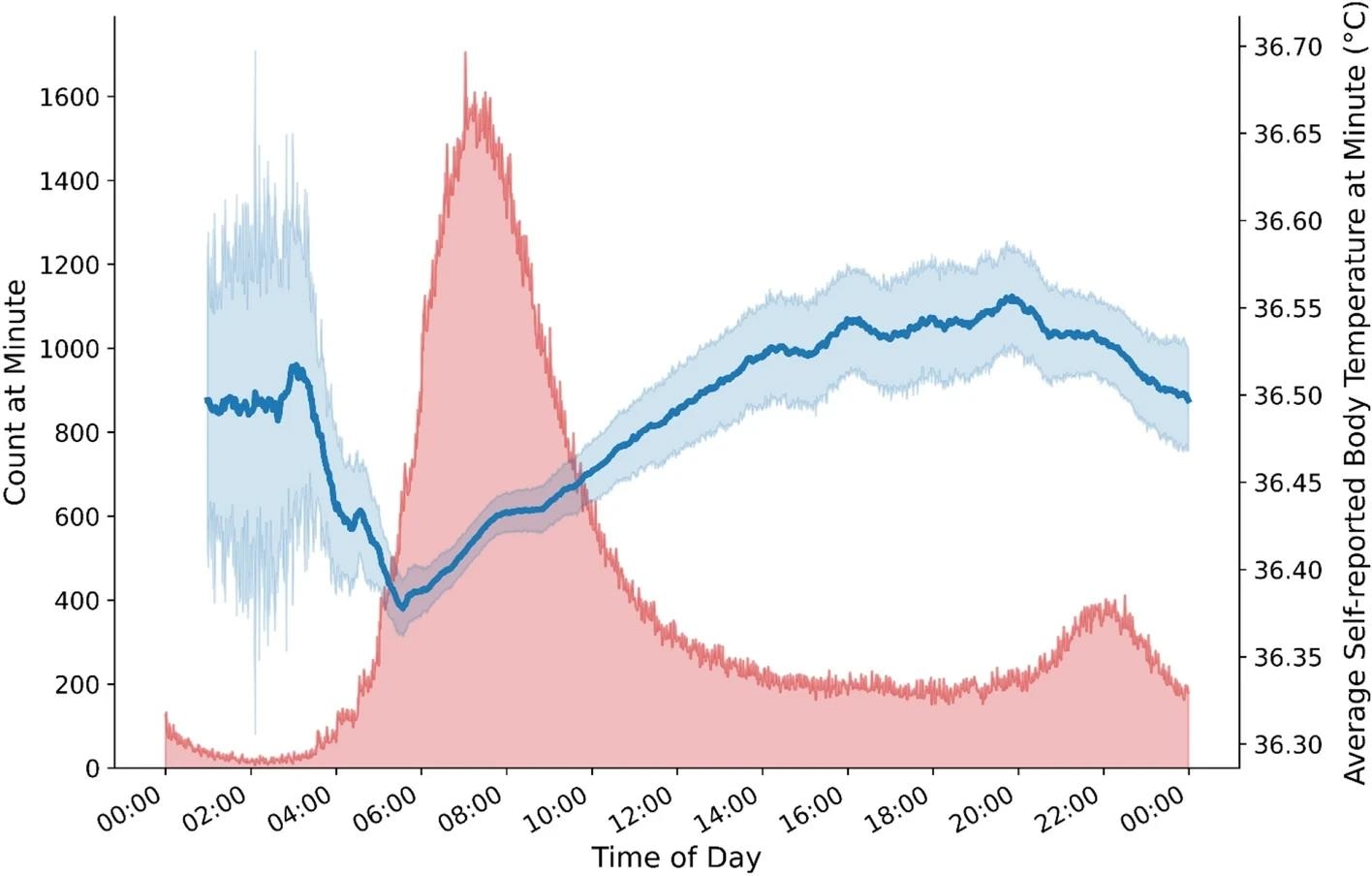
    Average self-reported body temperature by time-of-day. Figure depicts expected diurnal pattern of lowest self-reported body temperatures reported in the early morning hours and higher self-reported body temperatures during daytime hours. Note. Blue line depicts average self-reported body temperature (right Y axis) by time of day; blue shading indicates standard error of the mean. Red shading indicates number of responses (left Y axis) provided at each minute (X axis).Average self-reported body temperature by time-of-day. Figure depicts expected diurnal pattern of lowest self-reported body temperatures reported in the early morning hours and higher self-reported body temperatures during daytime hours. Note. Blue line depicts average self-reported body temperature (right Y axis) by time of day; blue shading indicates standard error of the mean. Red shading indicates number of responses (left Y axis) provided at each minute (X axis).

    The adjusted regressions revealed that body temperatures accounted for unique variances in PROMIS T-scores, while known variances were accounted for by age and gender. The OR value for having mean PROMIS T-scores in the moderate versus normal range increased significantly with every 0.10°C rise in the mean body temperature (OR, 1.0). PROMIS T-scores in moderate and severe ranges (OR, 1.1) were more likely present than within the normal range.

    The team used the receiver-operating characteristic (ROC) curves to analyze PROMIS T-scores, revealing improved differentiation between severe, moderate, and mild depression severity levels, with ROC curve values of 0.8, 0.7, and 0.6, respectively. Based on the corrected model, Youden’s Index has 86% sensitivity in detecting PROMIS T-scores for depression in the severe range but only 34% specificity. The unadjusted model performed best, with 97% sensitivity to identify PROMIS T-scores in the moderate range (with 63% specificity).

    The awake-time distal body temperatures changed slightly higher from the normal range to mild to moderate, with the most marked shift occurring from WNL to severe depression symptoms. Associated statistical tests revealed significant differences in awake-time distal body temperatures, asleep-awake differences in the distal body temperatures, and amplitudes for daytime distal body temperatures, comparing these metrics among participants with severe symptoms and within the normal range. Individuals with severe depression symptoms showed the highest difference in distal body temperatures compared to those with depression symptoms within the normal range.

    Overall, the study findings showed depressive symptoms associated with higher awake-time body temperatures. The collection of thermometer-measured and wearable sensor-recorded body temperatures corroborated the association. Asleep-time distal temperatures were comparable across the different categories of depression and greater than awake-time distal body temperatures, resulting in decreased asleep-awake disparities as depressed symptom severity increased. Individuals who directly target thermoregulatory systems have reported antidepressant effects.

    Journal reference:

    • Mason, A.E., Kasl, P., Soltani, S., et al. Elevated body temperature is associated with depressive symptoms: results from the TemPredict Study. Sci Rep 14, 1884 (2024), DOI: 10.1038/s41598-024-51567-w, https://www.nature.com/articles/s41598-024-51567-w

    [ad_2]

    Source link

  • Study reveals high insomnia rates in non-hospitalized COVID-19 survivors

    Study reveals high insomnia rates in non-hospitalized COVID-19 survivors

    [ad_1]

    In a recent study published in Frontiers in Public Health, researchers investigated insomnia prevalence and its association with anxiety and depression in the non-hospitalized coronavirus disease 2019 (COVID-19)-recovered community.

    Study: Sleep quality among non-hospitalized COVID-19 survivors: a national cross-sectional study. Image Credit: Stock-Asso/Shutterstock.com
    Study: Sleep quality among non-hospitalized COVID-19 survivors: a national cross-sectional study. Image Credit: Stock-Asso/Shutterstock.com

    Background

    The severe acute respiratory syndrome coronavirus 2 (SARS-CoV-2) pandemic has afflicted millions globally since late 2019, with most cases resolved by mid-2023. Common symptoms include coughing, weariness, fever, dyspnea, musculoskeletal issues, gastrointestinal complaints, anosmia, dysgeusia, and vertigo. Post-infection and long-term physical and psychological difficulties are serious public health concerns.

    Insomnia is a prevalent complaint, particularly among hospitalized COVID-19 patients. High-risk variables include being female, younger, and more educated, as well as having anxiety, depression, or post-traumatic stress disorder. Poor mental health is associated with insufficient sleep, and chronic disorders such as obstructive sleep apnea (OSA) can affect glycemic control, neurocognitive impairment, and aberrant functional pulmonary alterations.

    About the study

    In the current nationwide cross-sectional study, researchers investigated insomnia prevalence among COVID-19 survivors with no or moderate symptoms who did not require hospitalization throughout the recovery period (six months) and discovered relevant variables.

    Between June and September 2022, the team conducted a web-based survey among 1,056 COVID-19-recovered individuals who recovered within six months of acute SARS-CoV-2 infection and did not need hospitalization. They used the Depression Anxiety and Stress Scale-14 (DASS-14) and the Insomnia Severity Index (ISI). They obtained data on demographics such as age, marital status, sex, educational attainment, occupation, employment status, and comorbidities.

    The team asked the respondents to rate their SARS-CoV-2 infection severity and duration (days from the initial SARS-CoV-2-positive to the initial SARS-CoV-2-negative report). In addition, the respondents compared their sleep quality, sleep initiation, and total sleep duration in the previous two weeks with the time before confirming the SARS-CoV-2 infection.

    The team used multivariate logistic regressions to determine odds ratios (OR) for the relationships between anxiety and depression scores and insomnia levels among the survey respondents. They included adult COVID-19 survivors (who recovered as confirmed using polymerase chain reaction (PCR) within six months and did not require COVID-19-associated hospitalization) in Vietnam’s general population. They excluded individuals diagnosed with insomnia or psychological disorders before the study.

    Results

    The study included 1,056 individuals, with the majority being married (64%), female (69%), and having attended university (69%). After the SARS-CoV-2 infection, almost a third of respondents reported shorter sleep duration, worsened sleep quality, and more difficulties falling asleep, and half of them reported more nocturnal awakenings. Insomnia prevalence was 76%, with 23% of patients reporting severe insomnia.

    Individuals with anxiety (OR, 3.9) or depression (OR, 3.5) had a significantly increased risk of having insomnia. Other characteristics that increased the likelihood of sleeplessness included higher educational attainment and pre-existing medical conditions, but COVID-19 duration and symptoms had no significant relationship.

    Individuals who were divorced or widowed, female, had postgraduate education, were not actively employed, or suffered from chronic medical conditions had higher mean ISI ratings than their peers. Concerning COVID-19, 92% of infected individuals experienced symptoms (mean, 11 weeks). Although these symptomatic individuals showed higher ISI scores (15.2), there was no significant difference compared to individuals without symptoms.

    The mean scores for anxiety and depression were 7.6 and 6.4, respectively, with 439 (42%) and 291 (28%) individuals reporting relevant symptoms, respectively. Individuals with symptoms of anxiety (18.7) and depression (19.1) scored significantly higher on the ISI compared to those without (12.4 and 13.5, respectively). Participants experiencing insomnia scored higher on anxiety (9.2) and depression (7.8) than the overall group mean.

    In univariate analysis, those who were wedded and had a university degree were significantly less likely to experience insomnia than single and formally-educated individuals. Students were significantly more likely to experience insomnia compared to healthcare workers. Individuals with a history of chronic medical conditions were significantly more likely to suffer from insomnia following COVID-19 compared to healthy individuals. After controlling for variables, healthcare professionals had a significantly increased likelihood of insomnia (OR, 1.6) than workers in other professions; however, there were no differences compared to those who did not work or were students.

    Conclusion

    Overall, the study findings highlighted insomnia prevalence among COVID-19 survivors, with more than 75% reporting it. This percentage is much higher than that of the general population (10% to 20%) and hospitalized survivors (12% to 47%). Individuals with chronic medical conditions are more likely to suffer from insomnia, which is underreported. Public health researchers should anticipate a greater frequency of insomnia and sleep disorders in this group, which can last for one-third of healed patients up to one year after infection.

    [ad_2]

    Source link

  • Circulating myeloid-derived MMP8 in stress susceptibility and depression

    [ad_1]

    Mice

    The following mouse strains were used: For standard CSDS experiments, 7-week-old C57BL/6 J (stock no. 000664) mice were purchased from The Jackson Laboratory. For bone marrow transplantation experiments, 4 week-old B6.SJL-Ptprca Pepcb/BoyJ (stock no. 002014, B6 CD45.1) mice were obtained from The Jackson Laboratory. B6.129(Cg)-Ccr2tm2.1Ifc/J (stock no. 017586, Ccr2rfp) and B6.129×1-Mmp8tm1Otin/J (stock no. 005514, Mmp8−/−) were bred inhouse. Four- to six-month-old male retired CD-1 breeders (Charles River Laboratories, Crl:CD1[ICR]) were used as aggressors for male CSDS. For the female CSDS experiment, male B6N.129S6(Cg)-Esr1tm1.1(cre)And/J (stock no. 017911, ERacre (ERa is also known as Esr1)) mice were purchased from The Jackson Laboratory and were crossed with CD-1 females to obtain F1 males, which were used as aggressors. Mice purchased from external vendors were allowed to habituate to the animal facility for at least one week. Mice were maintained on a 12 h light:dark cycle (lights on at 07:00, lights off at 19:00) with ad libitum access to food and water. For all behavioural tests, mice were allowed to acclimate to the testing room for at least 1 h. All procedures were performed in accordance with the National Institutes of Health Guide for Care and Use of Laboratory Animals and the Icahn School of Medicine at Mount Sinai (ISMMS) Institutional Animal Care and Use Committee.

    CSDS and SI test

    For male CSDS19, retired male CD-1 breeders (age: 4–6 months) were used as aggressors. Before each defeat, aggressors were screened for aggressive behaviour for three consecutive days based on previously described criteria19. Two days before the start of the defeat, CD-1 mice were housed on one side of a perforated Plexiglass partition. During 10 consecutive days of CSDS, experimental mice (7–8 weeks old) were subjected to direct physical interaction with a CD-1 for 10 min per day (5 min for bone marrow chimera cohorts), and the rest of the day placed on the other side of the Plexiglass divider, allowing for sensory but not direct physical contact. Male aggressors for female CSDS61,62 were generated as follows: Heterozygous ERa-cre mice were bilaterally injected with a Cre-dependent AAV-DIO-hM3D(Gq)-DREADD (Addgene, 44361-AAV2) into the ventrolateral subdivision of the ventromedial hypothalamus. To activate ERα+ cells, intraperitoneal injections of 1.0 mg kg−1 clozapine-N-oxide (Tocris, 4936) were administered 30 min before each defeat bout. Unstressed control mice were pair-housed across a Plexiglass partition. After the last day of defeat, stressed and unstressed control mice were singly housed (males) or kept in pairs (females). All stressed mice were carefully examined for wounding during the CSDS experiments and mice with excessive wounding were excluded.

    Subthreshold stress

    Subthreshold stress is a variation of the CSDS paradigm that is used to unravel pro-susceptible factors32 without eliciting behavioural alterations in unmanipulated mice. Experimental mice were exposed to 3× 5 min periods of direct physical interactions with an aggressive CD-1 mouse with a 15 min interval between defeats. 24 h after the last defeat bout, the SI test was conducted as described below.

    SI test

    The SI test was performed 24 h after the last defeat session under red-light conditions. After a 1 h habituation period to the behavioural suite, mice were placed into a Plexiglass arena (42 cm × 42 cm × 42 cm, Nationwide Plastics) with a small meshed enclosure on one end. For the first 2.5 min, the experimental mouse freely explored the arena. The mouse was then removed from the arena which was subsequently cleaned with 70 % ethanol, then, a novel social target (CD-1 for males and ERacre for female CSDS) was placed into the enclosure and the experimental mouse was placed back into the arena for another 2.5 min. Locomotor activity was tracked and recorded using a Noldus Ethovision System (Noldus Information Technology, version 11.0). SI ratio was calculated as the ratio between the time the experimental mouse spent in the vicinity of the enclosure (SI zone) when a target mouse was present versus absent. Mice with an SI ratio of ≥1 show a behavioural profile similar to unstressed control mice and were termed resilient, while mice with an SI ratio <1 were termed susceptible. To test social avoidance behaviour towards a juvenile mouse, SI test was performed as described above with a four- to six-week-old male juvenile mouse as a social target. Additional parameters that were measured were total locomotion and time spent in corners, calculated as the sum between the two corners opposite the wire enclosure.

    Chronic variable stress

    Chronic variable stress was conducted in female mice as previously described63. For 21 days, mice were exposed to daily 1 h long stressors, consisting of either 100 mild foot shocks (0.45 mA), restraint stress in a 50 ml Falcon tube, or tail suspension. For the duration of the stress, mice were group housed.

    Intraperitoneal injection of rMMP8

    Before injection, rMMP8 (Bio-techne, 2904-MP-010) was activated ex vivo for 1 h at 37 °C with 1 mM 4-aminophenylmercuric acetate (APMA) in mercury-containing assay buffer (Anaspec, AS-71154) and then diluted in 0.9% sterile saline solution (VWR, 101448-952). For the dose–response experiment, we injected three different doses 50, 100 and 200 µg kg−1, and blood was drawn 20 min after the injection via submandibular bleeding and 18 h post-injection using trunk blood. MMP8 was measured as described below. For the behavioural experiments, mice were injected with 100 µg kg−1 rMMP8 or APMA 20 min before the defeat bout.

    Stereotaxic surgeries, viral gene transfer or chronic hyaluronidase infusions

    Surgeries were performed as described previously23. In brief, 6 week-old C57BL/6 J mice were injected intraperitoneally with a mixture of ketamine hydrochloride (100 mg kg−1 body weight) and xylazine (10 mg kg−1 body weigh). After anaesthesia was confirmed, mice were placed on a stereotaxic instrument (David Kopf Instruments). For the Cldn5 knockdown experiment, we bilaterally injected 0.5 μl of virus (1.0 × 1011 infectious units per ml) expressing either AAV2/9-shRNA or AAV2/9-shRNA-Cldn5 into the NAc (coordinates from bregma: AP + 1.5 mm; ML ± 0.5 mm; DV − 4.4 mm). After 2 weeks of recovery, mice received doxycycline (2 mg ml−1 in drinking water) for another 2 weeks. For the hyaluronidase infusion experiment, 27 G guide cannulae were inserted bilaterally into the NAc (from bregma: AP + 1.5 mm; ML ± 0.5 mm; DV − 4.4 mm) and fixed onto the skull using dental cement (Grip cement; Dentsply). After two weeks of recovery, daily infusions of 5 U of hyaluronidase (Sigma-Aldrich, H1136) or saline were completed once daily for 10 consecutive days. All compounds and viruses were infused at a rate of 0.1 μl min−1 and allowed to passively diffuse for 5 min before removing the needles.

    Generation of bone marrow chimeras

    Bone marrow chimeras were generated as described10,28. To ablate the peripheral immune system of the host mouse, 5-week-old male B6 CD45.1 mice were irradiated with a total of 11 Gy, delivered in two doses of 5.5 Gy, 3–4 h apart (X-rad 320 Irradiator (Precision X-Ray)). Haematopoietic progenitor cells were isolated from the femur/tibia of either Mmp8−/− or Mmp8+/+ male donor mice (12 weeks old). One hour after the second dose of irradiation, 1 × 106 cells were injected retro-orbitally in mice anaesthetized with isoflurane. Host mice were then allowed to recover for a total of six weeks. Mice received antibiotic treatment (0.2% in drinking water) (Neomycin trisulfate, N1876, Sigma) during the first three weeks of recovery. The level of chimerism was assessed using flow cytometry, comparing CD45.1 (host) (mouse anti-CD45.1-PE-Cyanine7, clone A20, Invitrogen, 25-0453-81) and CD45.2 (donor) (mouse anti-CD45.2-BV421, clone 104, BD Bioscience, 562895) leukocytes, and measuring MMP8 in plasma (Abcam, ab206982).

    sCPP

    sCPP was performed as described64. The experiment was done under red-light conditions after mice were habituated to the CPP room for 1 h. The CPP chamber (Med Associates) consisted of 3 different compartments: a neutral middle part, and two adjacent chambers, each with distinct floors (grid pattern) and walls. On the pre-test day, mice were allowed to explore all three chambers for 20 min and the time spent in each chamber was recorded. Based on these durations, mice were balanced to account for pre-test preferences. During the four consecutive conditioning days, mice were conditioned twice per day: In the morning, mice were placed in one chamber for 15 min with a novel, same-sex juvenile (4 to 5 weeks old) C57BL/6 J mouse (paired chamber). In the afternoon, the experimental mouse was put in the empty opposite chamber for the same amount of time (unpaired chamber). On the testing day, mice were again allowed to freely explore all chambers for 20 min and the time spent in each chamber was automatically recorded (Med Associates).

    Sucrose preference test

    Sucrose preference test was performed to assess hedonic behaviour towards a sweet gustatory stimulus11. Mice were given access to two water bottles (50 ml conical tubes with sipper tops) for 24 h for habituation. Then, one water bottle was exchanged with a bottle containing 1% sucrose (Sigma, S0389) in drinking water. After 24 h, the bottle positions were swapped to prevent position bias. After another 24 h, sucrose preference was assessed as follows (based on weight of bottles): (sucrose (g)/total fluid (g)) × 100%.

    Splash test

    The splash test, a test performed to assess self-care behaviour, was conducted under red-light conditions as described previously11. In brief, after 1 h of habituation to the testing room, a 10% sucrose solution was gently sprayed onto the lower back of the mouse. Behaviour was recorded for 5 min, and time spent grooming was scored.

    EPM test

    The EPM was conducted to assess anxiety-like behaviours11. After 1 h of habituation to the testing room, mice were placed on an elevated cross-shaped maze for 5 min under red-light conditions. The four arms (two arms without and two arms with walls, each arm of the maze measuring 12 × 50 cm) were elevated 1 m above the floor. Behaviour was tracked using a Noldus Ethovision System (Noldus Information Technology, version 11.0). Parameters assessed included time spent in closed arms, open arms and in the centre.

    Mass cytometry

    Blood was collected directly into fluorescence-activated cell sorting (FACS) buffer (DPBS (Thermo Fisher Scientific, 14190144) containing 0.5% bovine serum albumin (Sigma-Aldrich, A9647) and 2 mM EDTA (Invitrogen, AM9260G)). Cells were pelleted and red blood cells (RBCs) were lysed using RBC lysis buffers (BD, 555899). Immune cells of the brain were isolated as previously described25. In brief, mice were anaesthetized with 10% chloral hydrate and transcardially perfused with ice-cold PBS (0.1 M). Brains were extracted, leptomeninges carefully removed and the brains then cut into small pieces using scissors in a total of 3 ml digestion buffer (RPMI (Thermo Fisher Scientific, 11875093) with 2% fetal bovine serum (Thermo Fisher Scientific, A3840001), 2 mM HEPES (Corning, 25-060-CI) and 0.4 mg ml−1 collagenase D (Roche, 12352200)). The cell suspension was then incubated for 30 min at 37 °C. Digestion was stopped by adding EDTA (Invitrogen, AM9260G) to a final concentration of 5 mM. Using blunt 18 G needles (BD, 303129), the cell suspension was gently homogenized, and the homogenate was passed through a 70 μm strainer (pre-wet with PBS) (Miltenyi Biotec, 130-095-823). Cells were pelleted, resuspended in 30% Percoll (Millipore Sigma, GE17-0891-01) and centrifuged for 30 min at 23,500g without brakes at 4 °C. The myelin layer was aspirated and the middle layer containing leukocytes was transferred into a conical tube. Cells were then washed and stained for 30 min on ice with a mix of metal-conjugated antibodies (Supplementary Table 1). After antibody staining, cells were incubated with cisplatin for 5 min at room temperature as a viability dye to enable exclusion of dead cells. Cells were then fixed in PBS containing 1.6% formaldehyde and a 1:4,000 dilution of Ir nucleic acid intercalator to label all nucleated cells. Immediately prior to acquisition, cells were washed in PBS, then in distilled water, and finally resuspended in distilled water containing a 1/10 dilution of Equation 4 Element Calibration beads (Fluidigm, SKU 201078). After routine instrument tuning and optimization, the samples were acquired on a CyTOF2 Mass Cytometer equipped with a Super Sampler fluidics system (Victorian Airships). The acquisition rate was <500 events per second. The resulting FCS files were concatenated and normalized using a bead-based normalization algorithm in the CyTOF acquisition software and uploaded to Cytobank (https://mtsinai.cytobank.org/cytobank/; Cytobank, Menlo Park, CA, v7.0). FCS files were manually pre-gated for CD45+ events, excluding dead cells, doublets and DNA-negative debris (Extended Data Fig. 1a). Data analysis was performed with Clustergrammer, a web-based tool for visualizing and analysing high-dimensional data (https://github.com/ismms-himc/LegendScreen_CyTOF).

    Fluorescence-activated cell sorting and bulk RNA sequencing of leukocyte subpopulations

    For the mouse leukocyte subpopulation sequencing experiment, trunk blood was collected directly into FACS buffer. Samples were centrifuged and RBC lysis was performed (BD, 555899). After washing the cell pellet with ice-cold DPBS, Fc receptor blocking (rat anti-CD16/CD32, clone 2.4G2, BD Biosciences, 553141) was performed on ice for 30 min. Cells were pelleted and washed once. Leukocytes were then stained with the following antibodies (all at 1:400): rat anti-CD11b-PE-Cyanine7 (clone M1/70, BioLegend, 101215), rat anti-Ly6C-PerCP–Cy5.5 (clone HK1.4, BioLegend, 128027), rat anti-Ly6G-PE (clone 1A8, BioLegend, 127607), rat anti-B220-FITC (clone RA3-6B2, BioLegend, 103205) and rat anti-CD90.2-APC (clone 53-2.1, BioLegend, 140312) for 30 min on ice protected from light. After an additional wash, cells were sorted directly into Trizol (Themo Fisher Scientific, 15596026) by a BD FACSAria II cell sorter. Raw flow cytometry data were analysed using FlowJo software (FlowJo LLC, version 10.6.2). Samples were flash frozen on dry ice and stored at −80 °C. RNA was extracted using the RNeasy Micro Kit according to the manufacturer’s instructions (Qiagen, 74004). RNA quality, RNA integrity number (RIN) and RNA concentrations were assessed using Nanodrop (Thermo Fischer Scientific) and Bionalyzer (Agilent, 5067-1513). 500 pg of purified RNA was used for library preparation, which was performed using the SMARTer Stranded Total RNASeq Kit –2 – Pico Input Mammalian (Takara, 634413). Libraries were barcoded for multiplexing. Before sequencing, library quality and concentration were measured using Qubit Fluorometric Quantitation (Thermo Fisher). Libraries were sequenced (2 × 150 bp, paired-end reads configuration, v4 chemistry) on an Illumina HiSeq machine at a minimum of 30 million reads per sample. Sequencing was performed at Genewiz. Raw sequencing reads from the samples were mapped to mm10 using HISAT2 v2.1.065. Counts of reads mapping to genes were obtained using htseq-count v0.12.4 against Ensembl v90 annotation66. Differential expression analysis was done using DESeq2 v1.26.0 package67. The fold change threshold was set at 2 (that is, log2(fold change) > |1|). GO terms were determined using DAVID, version 6.868. Only GO terms with an adjusted P value < 0.05 (FDR) and an overall of > 5% (involved genes/total genes) were considered.

    Fluorescence-activated cell sorting and flow cytometry of immune cells in leptomeninges, dura and choroid plexus

    Leukocyte subpopulation frequencies from brain border regions were isolated as previously described69. Mice were anaesthetized with 10% chloral hydrate and transcardially perfused with ice-cold PBS (0.1 M). Leptomeninges, dura and choroid plexus were carefully dissected on ice. Meninges were digested in RPMI (Thermo Fisher Scientific, 11875093) with 1.4 U ml−1 Collagenase VIII (Sigma-Aldrich, C2139) and 1 mg ml−1 DNAse 1 (Thermo Fisher Scientific, EN0521) for 15 min at 37 °C. Digested dura and leptomeninges and undigested choroid plexus were passed through a 70 μm cell strainer (pre-wet with PBS) (Miltenyi Biotec, 130-095-823) into a 15 ml conical tube. Cells were pelleted (300g for 10 min at 4 °C) and washed once with ice-cold PBS. Cells were then resuspended in FACS buffer, Fc receptor binding was blocked (rat anti-CD16/CD32, clone 2.4G2, BD Biosciences, 553141) and cells were stained with a viability dye (Thermo Fisher Scientific, 65-0865-14) for 30 min. Cells were washed and stained with the following fluorophore-conjugated primary antibodies for 30 min on ice (all dilutions: 1:400): rat anti-CD11b–FITC (clone: M1/70, Invitrogen 11-0112-81), Armenian hamster anti-TCRβ-PerCP–Cy5.5 (clone: H57-597, Invitrogen, 45-5961-80), rat anti-Ly6C–APC (clone: HK1.4, Invitrogen, 17-5932-82), rat anti-Ly6G–eFluor 450 (clone: 1A8-Ly6g, Invitrogen, 48-9668-82), rat anti-CD19–PE (clone: IDE, BD Pharmingen, 553786), rat anti-CD45–PE–Cy7 (clone: 30-F11, BD Pharmingen, 552848). After an additional wash, cells were resuspended in FACS buffer and sorted by a BD FACSAria II using the 70 μm nozzle to sort cells into 1.5 ml Eppendorf tubes containing TRIzol LS with a sort speed of approximately 10,000 events per second. Raw flow cytometry data were analysed using FlowJo software (FlowJo, version 10.8.1).

    FACS and single-cell RNA sequencing

    Brain-trafficking monocytes and brain-resident myeloid cells were isolated based on previous published protocols70. Twenty-four hours after the SI test, mice were euthanized by injecting 10% chloral hydrate and perfused transcardially with ice-cold 0.1 M PBS (pH 7.4). Brains were rapidly dissected, leptomeninges carefully removed, and brains put in ice-cold PBS (for brain-trafficking monocyte RNA-sequencing experiment) or bilateral NAc tissue punches were obtained from 1 mm thick coronal slices using 1.2 mm punches (for resident myeloid cell RNA-sequencing experiment) (GE Healthcare Life Sciences, 1205×41). All the following steps were performed strictly on ice. For whole brains, tissue was cut into small pieces, for punches no shredding was needed. Tissue was then transferred to DPBS and homogenized with pestles (Sigma, D8938-1) in ice-cold PBS (20 stokes with pestle A, 20 stokes with pestle B). The cell suspension was then passed through a 70 μm cell strainer (pre-wet with PBS) (Miltenyi Biotec, 130-095-823) into a 15 ml conical tube. Cells were pelleted (300g for 5 min at 4 °C), resuspended in 10 ml of ice-cold 40% isotonic Percoll (Millipore Sigma, GE17-0891-01) (diluted in PBS) and centrifuged for 30 min at 500g at 4 °C with full acceleration and braking. The myelin layer was aspirated, then the cell pellet was washed with 10 ml of ice-cold PBS by centrifuging at 300g for 5 min at 4 °C. Cells were then resuspended in FACS buffer, Fc receptor binding was blocked (rat anti-CD16/CD32, clone 2.4G2, BD Biosciences, 553141) and then cells were stained with a viability dye (Thermo Fisher Scientific, 65-0865-14) for 30 min. Cells were washed and stained with a combination of the following fluorophore-conjugated primary antibodies: rat anti-CD45–BV510 (clone 30-F11, BioLegend, 103137), rat anti-CD11b–PerCP-Cyanine5.5 (clone M1/70, BioLegend, 101227), rat anti-Ly6C–APC-Cyanine7 (clone HK1.4, BioLegend, 128025), and rat anti-Ly6G–eFluor 450 (clone 1A8-Ly6g, Thermo Fisher Scientific, 48-9668-82) at a 1:400 dilution for 30 min on ice. After an additional wash, cells were sorted by a BD FACSAria II using the 70 μm nozzle to sort single cells into 96-well plates containing master mix (see below) with a sort speed of approximately 10,000 s−1. Raw flow cytometry data were analysed using FlowJo software (FlowJo LLC, version 10.6.2). All single-cell RNA-sequencing experiments were performed at the Single Cell Core Facility of the Sulzberger Columbia Genome Center, New York. Library preparation and RNA sequencing was performed as described previously71. In brief, cells were directly sorted into master mix, containing 1× Maxima Reverse Transcriptase Buffer (Thermo Fisher Scientific, EP0742), 40 U Maxima H Minus Reverse Transcriptase (Thermo Fisher Scientific, EP0751), 4 U SuperaseIN (Thermo Fisher Scientific, AM2694), 15% PEG (VWR, 97061-102), 1 μM TSO (Integrated DNA Technologies), and nuclease-free water. Template-switching reverse transcription was performed with adapter-linked oligo primers containing both cell- and molecule-specific barcodes (Supplementary Table 6). Excess primers were removed by adding 2 μl of Exonuclease I (Thermo Fisher Scientific, EN0581) mix to each well and incubated at 37 °C for 30 min, 85 °C for 15 min, 75 °C for 30 s. All wells were then pooled into a single 15 ml conical tube and cDNA was purified and concentrated with Dynabeads MyOne Silane beads (Thermo Fisher Scientific, 37002D). The cDNA was split into duplicate reactions of 25 μl cDNA, 25 μl of 2× HIFI HotStart Ready Mix (Kapa Biosystems, 07958927001), and 0.2 M SMART PCR Primer (Supplementary Table 6). PCR was performed as described above. cDNA was purified with AMPure XP beads (Beckman Coulter, A63880), visualized on an Agilent TapeStation and quantified with a Qubit II fluorometer (Thermo Fisher Scientific). Library preparation was performed using a modified protocol of the Nextera XT kit (Illumina, FC-131-1024), purified twice with AMPure XP beads (Beckman Coulter, A63880), and visualized and quantified as described above. Pooled, 3’-end libraries were sequenced on an Illumina NextSeq 500/550 apparatus. Reads were aligned to the mouse genome reference GRCm38 using STAR (version 2.5)72. Reads were assigned to cells and unique molecular identifiers73. The expression matrix for single-cell data was processed using the package Seurat v3.1.5 in R74. Features for which fewer than 3 cells were detected were removed, effectively excluding unexpressed features. Cells having at least 1,000 and at most 4,000 features were retained. Cells with more than 5% of reads mapping to mitochondrial genes were discarded. The NormalizeData function was used to log-normalize the dataset with a scale factor of 10,000. The top 2,000 most variable features across cells were found using the function FindVariableFeatures. The ScaleData function was applied to scale the dataset. The variable features were used to carry out dimensional reduction using principal components analysis. The optimal number of principal components to be used for dimensional reduction using UMAP was determined using ElbowPlot. FindNeighbors and FindClusters functions were utilized to construct a nearest neighbour graph and cluster cells in the dataset. UMAP was generated using the function DimPlot. The FindAllMarkers function was applied to determine markers for clusters in the UMAP plot. The FindMarkers function was used to carry out differential expression analysis for the three experimental groups.

    iDISCO+ staining, imaging and ClearMap analysis

    Twenty-four hours after the SI test, Ccr2rfp+/− mice were injected with 10% chloral hydrate and transcardially perfused with ice-cold 0.1 M PBS followed by 4% paraformaldehyde (PFA) (Electron Microscopy Sciences, 15713 S). Intact brains were dissected out of the skull and post-fixed in 4% PFA in PBS at 4 °C for 18 h. Brains were then cleared and stained according to the iDISCO+ staining protocol (http://www.idisco.info). The primary rabbit anti-RFP antibody (Rockland, 600-401-379, 1:1,000) and the corresponding secondary antibody (donkey anti-rabbit IgG, Alexa Fluor 647, Thermo Fisher Scientific, A-31573, 1:1,000) were incubated with the brains for 7 days each at 37 °C. A LaVision light-sheet microscope with zoom body was used for sagittal half brain scanning with dynamic focus and a step size of 4 µm. Brain images were processed as previously described using ClearMap (version 1)31. RFP+ cells were quantified using the cell detection module, with cell detection parameters optimized and validated based on the intensity and shape parameters of the signal. The autofluorescence channel was aligned to the Allen Institute’s Common Coordinate Framework using the Elastix toolbox. Brain areas were collapsed into their parent regions prior to analyses.

    Western blot

    Bilateral NAc tissue punches were briefly thawed on ice and digested for 60 min at 37 °C in 20 U ml−1 chondroitinase ABC (Sigma-Aldrich, C3667) in 25 mM Tris-buffered saline (Thermo Fisher Scientific, BP2471) with protease inhibitors (Thermo Fisher Scientific, 1861281). Samples were immediately cooled on ice, centrifuged for 20 min at 21,000g at 4 °C and the supernatant was transferred to a new tube. Protein concentration was determined using the Pierce BCA Protein Assay Kit (Thermo Fisher Scientific, 23227). Samples were flash frozen and stored at −80 °C. Total protein (20 μg) was separated by electrophoresis with a SDS–PAGE polyacrylamide gel (Bio-Rad, 4561034) and transferred to a PVDF membrane (Bio-Rad, 1704157). The membrane was blocked with 5 % non-fat dry milk (Bio-Rad, 1706404) in 0.1% Tween-20 (Sigma-Aldrich, P7949) in Tris-buffered saline (Thermo Fisher Scientific, BP2471, TBS-T) and incubated overnight with primary antibodies against aggrecan (1:1,000, Sigma-Aldrich, AB1031) or horseradish peroxidase (HRP) conjugated β-actin (1:2,000, Cell Signaling, 12262) in 5% non-fat dried milk (Sigma-Aldrich, A9647) in TBS-T. Membranes were then washed for 1 h with TBS-T and then incubated with secondary antibodies (1:10,000, anti-rabbit IgG HRP-linked, Cell Signaling, 7074) for 3 h at room temperature. After washing the membrane, visualization was performed using Pierce ECL Western Blotting Substrate (Thermo Fisher Scientific, 32209) with an iBright CL1500 Imaging System (Thermo Fisher Scientific, A44114). Quantification was done with ImageJ (NIH, v1.53f51)75. Uncropped blots are available in Supplementary File 1.

    Quantitative real-time PCR

    RNA from fluorescence-activated cell-sorted monocytes was isolated using the RNeasy Micro Kit according to the manufacturer’s instructions (Qiagen, 74004). RNA quality and RNA concentrations were assessed using Nanodrop (Thermo Fischer Scientific). RNA was reversed transcribed to cDNA using qScript (QuantaBio, 95048-100) and the PCR reaction was performed using the SYBR Fast Advanced Master Mix system (Thermo Fisher Scientific, A46012) with the following primers (Integrated DNA Technologies): Mmp8 (Mm.PT.58.6942600, primer 1: AGGATCAGTGGAGTGAGAGAG; primer 2: CAAGGTATTGGAGGAGATGCTC); Gapdh (Mm.PT.39a.1, primer 1: GTGGAGTCATACTGGAACATGTAG; primer 2: AATGGTGAAGGTCGGTGTG). Gene expression analysis was done using the 2(–ΔΔCT) method76 and samples were normalized to the housekeeping gene Gapdh.

    Ex vivo electrophysiology

    Brains were rapidly extracted from isoflurane-anaesthetized mice, and coronal sections (250 µm) were sliced using a Compresstome (VF-210-0Z, Precisionary Instruments) in cold (0–4 °C) sucrose-based artificial cerebrospinal fluid (aCSF) containing: 87 mM NaCl (Sigma-Aldrich, S7653), 2.5 mM KCl (Sigma-Aldrich, P9333), 1.25 mM NaH2PO4 (Sigma-Aldrich, 71507), 4 mM MgCl2 (Sigma-Aldrich, M2670), 0.5 mM CaCl2 (Sigma-Aldrich, C8106), 23 mM NaHCO3 (Sigma-Aldrich, S6297), 75 mM sucrose (Sigma-Aldrich, S7903), 25 mM glucose (Sigma-Aldrich, G7021). After 60 min in aCSF at 32 °C for recovery, slices were kept in oxygenated (95% O2, 5% CO2) aCSF containing 130 mM NaCl (Sigma-Aldrich, S7653), 2.5 mM KCl (Sigma-Aldrich, P9333), 1.2 mM NaH2PO4 (Sigma-Aldrich, 71507), 2.4 mM CaCl2 (Sigma-Aldrich, C8106), 1.2 mM MgCl2 (Sigma-Aldrich, M2670), 23 mM NaHCO3 (Sigma-Aldrich, S6297), 11 mM glucose (Sigma-Aldrich, G7021) at room temperature for the rest of the day and individually transferred to a recording chamber continuously perfused at 2 to 3 ml min−1 with oxygenated aCSF. Patch pipettes (4–6 MΩ) were pulled from thin wall borosilicate glass using a micropipette puller (P-97, Sutter Instruments) and filled with a potassium gluconate-based intra-pipette solution containing: 116 mM KGlu (Sigma-Aldrich, P1847), 20 mM HEPES (Sigma-Aldrich, H3375), 0.5 mM EGTA (Sigma-Aldrich, E0396), 6 mM KCl (Sigma-Aldrich, P9333), 2 mM NaCl (Sigma-Aldrich, S7653), 4 mM ATP (Sigma-Aldrich, A9187), 0.3 mM GTP (Sigma-Aldrich, 51120) (pH adjusted to 7.2 and osmolarity to 290 mOsm). Cells were visualized using an upright microscope with an IR-DIC lens and illuminated with a white light source (Scientifica). Excitability was measured in current-clamp mode by injecting incremental steps of current (0–300 pA, +20 pA at each step). For recording of sEPSCs, NAc MSNs were recorded from in voltage-clamp mode at −70 mV. Whole-cell recordings were performed using a patch clamp amplifier (Axoclamp 200B, Molecular Devices) connected to a Digidata 1550 LowNoise acquisition system (Molecular Devices). Signals were low pass filtered (Bessel, 2 kHz) and collected at 10 kHz using the data acquisition software pClamp 11 (Molecular Devices). Electrophysiological recordings were extracted using Clampfit 11 (Molecular Devices) and analysed with R (version: 3.6.1, http://www.R-project.org). All groups were counterbalanced by days after CSDS. All recordings were performed while blinded to the experimental conditions.

    Human participants and processing of biospecimen

    Study participants with MDD and healthy controls, as assessed according to SCID-577, were recruited through the Depression and Anxiety Center for Discovery and Treatment at the ISMMS. The ISMMS review board approved the study, and written informed consent was obtained from all participants prior to any study procedure. Participants were compensated for their time and effort. They provided demographic information and underwent a psychiatric evaluation using the SCID-5 conducted by trained study staff. Participants completed the Quick Inventory of Depressive Symptomatology-SR (QIDS-SR) to measure depressive symptom severity78. The Perceived Stress Scale27, a 10-item self-rating scale, was used to determine perceived stress levels. All participants underwent biochemistry and haematological laboratory testing, urine toxicology and pregnancy (if applicable) testing. At the time of enrolment, all participants were free of medications known to affect the immune system for at least two weeks. Participants were free of active infections or systemic illness. Subjects with concomitant unstable medical illnesses were excluded. Participants were free of current substances of abuse. On the day of blood draw, patients were fasted for at least 6 h. Blood was drawn into Vacutainer Gold Top 5 ml Silica Gel tubes (BD, 365968) for serum isolation, EDTA tubes (BD, 365975) to assess complete blood count and differential count (Sysmex XN-9100 Automated Hematology System) and into BD Vacutainer CPT tubes (BD, 362761) for the isolation of peripheral blood mononuclear cells (PBMCs). For serum, blood was allowed to clot for >30 min, then centrifuged at 1,300g for 15 min at 4 °C, then aliquoted and stored at −80 °C. PBMCs were isolated according to the manufacturer’s instructions and cryopreserved in liquid nitrogen. On the day of analysis, all PBMCs were carefully thawed in a water bath at 37 °C. Cells were pelleted (300g for 10 min at 4 °C) and washed once with ice-cold PBS. Cells were then resuspended in FACS buffer. Fc receptor binding was blocked using anti-CD16/32 (clone 2.4G2, Bio X Cell, BE0307) and cells were stained with a viability dye (Thermo Fisher Scientific, 65-0865-14) for 30 min. Cells were washed and stained with the following fluorophore-conjugated primary antibodies for 30 min on ice (all dilutions: 1:400): mouse anti-CD45–V500 (clone HI30, Fisher Scientific, BDB560779), mouse anti-CD19–PE–Cy7 (clone SJ25C1, Fisher Scientific, BDB560911), mouse anti-CD24–PE (clone ML5, Fisher Scientific, BDB560991), mouse anti-CD27–APC (clone L128), mouse anti-CD38 PerCP–Cy5.5 (clone HIT2, Fisher Scientific, BDB551400) and mouse anti-IgD–V450 (clone IA6-2, Fisher Scientific, BDB561309). Cells were washed, then resuspended in FACS buffer before acquisition on a BD LSRFortessa cell analyser (BD Biosciences). Flow cytometry data were acquired using FACS Diva software (BD, v.9). Data were analysed using FlowJo software (FlowJo LLC, version 10.8.1). Gating of B cell subtypes was performed as described79.

    Enzyme-linked immunosorbent assay

    Enzyme-linked immunosorbent assays were performed according to the manufacturer’s instructions (mouse MMP8: Abcam, ab206982; human MMP8: R&D Systems, DMP800B). For brain lysates, total protein was measured with the Pierce BCA Protein Assay Kit (Thermo Fisher Scientific, 23225). Plates were read on a SpectraMax 340PC384 microplate reader (Molecular Devices) and MMP8 or total protein levels were calculated from a serial dilution curve using SoftMax Pro 5 software (Molecular Devices).

    Multiplex assays

    Mouse plasma cytokines and chemokines were determined with the Milliplex MAP mouse cytokine/chemokine magnetic bead panel multiplex assay according to the manufacturer’s instructions (Millipore Sigma, MCYTOMAG-70K), and mouse MMP2, MMP3, proMMP9 and MMP12 were measured with Milliplex MAP Mouse MMP Magnetic Bead Panels 1 and 2 (Millipore Sigma, MMMP1MAG-79K, MMMP2MAG-79K).

    Transmission electron microscopy and image analysis

    Mice were injected with 10% chloral hydrate and transcardially perfused with 0.1 M sodium cacodylate buffer followed by ice-cold 2% PFA and post-fixed with 0.5% PFA at 4 °C. Tissue was sectioned on a vibratome, and freeze substitution and low temperature embedding of the specimens was performed as described80,81,82. Slices were cryoprotected by immersion in increasing concentrations of glycerol (from 10% to 30% in PBS) (v/v). Sections were plunged rapidly into liquid propane cooled by liquid nitrogen (−190 °C) in a Universal Cryofixation System KF80 (Reichert-Jung). The samples were immersed in 1.5% uranyl acetate dissolved in anhydrous methanol (−90 °C, 24 h) in a cryosubstitution AFS unit (Leica). The temperature was raised from −90 °C to −45 °C in steps of 4 °C/h. After washing with anhydrous methanol, the samples were infiltrated with Lowicryl HM20 resin (Electron Microscopy Sciences) at −45 °C. Polymerization with ultraviolet light (360 nm) was performed for 48 h at −45 °C, followed by 24 h at 0 °C. Ultrathin sections (80 nm) were cut with a diamond knife on a Leica UC7 ultramicrotome and mounted on 300 mesh copper grids using a Coat-Quick adhesive pen (Electron Microscopy Sciences). Images (n = 10 per mouse) were taken using a Hitachi 7700 electron microscope (Hitachi High-Technologies Corporation America) equipped with a XR81-B-M1-BT-FX, 8 Megapixel digital camera (Advanced Microscopy Techniques). Images were then imported into Adobe Photoshop (Adobe, 2022) and the ECS was manually scored using a computer tablet. Scoring was done by two independent investigators blinded to experimental conditions. Images were then imported into ImageJ (v1.53f51)75 and the percentage of marked area/total area was calculated.

    Immunohistochemistry and confocal microscopy

    Mice were injected with 10% chloral hydrate and transcardially perfused with ice-cold 0.1 M PBS (pH 7.4) followed by ice-cold 4% PFA (Electron Microscopy Sciences, 15713 S). Intact brains were dissected out of the skull and post-fixed in 4 % PFA at 4 °C for 18 h. Brains were then cryoprotected in 30% sucrose (Sigma, S0389), frozen and sliced on a cryostat at 35 μm thickness. Sections were washed with PBS three times and incubated in blocking solution (3% normal donkey serum (Jackson Immuno Research, 017-000-121), 0.3% Triton X-100 (Sigma, T9284) in PBS) for 2 h. Sections were then incubated in primary antibodies (rat anti-CD31, 1:300, Biolegend, 102501; rabbit anti-RFP, 1:300, Rockland, 600-401-379; goat anti-RFP, 1:200, Rockland, 200-101-379; rabbit; rabbit anti-AQP4, 1:400, Thermo Fisher Scientific, PA5-85767) overnight at 4 °C. The next day, sections were washed in PBS with 0.3% Tween-20 (PBST (Sigma, P7949)) three times for 15 min each, then incubated with anti-rabbit-Cy2 and anti-rat-Cy5 secondary antibodies for 2 h (1:400, Jackson Immuno Research, 711-225-152 and 712-175-153, respectively). Sections were washed again three times with PBST. Slices were then mounted on slides, air-dried overnight, dehydrated, and coverslipped with DPX (Electron Microscopy Sciences, 13510). All slices were imaged using a Zeiss LSM 780 confocal microscope. 3D reconstruction was performed with the IMARIS software (Oxford Instruments, v9.9).

    Biotinylation

    Biotinylation of mouse rMMP8 (Bio-techne, 2904-MP-010) was performed using the EZ-Link Sulfo-NHS-Biotin kit according to the manufacturer’s instructions (Thermo Fisher Scientific, A39256). Biotinylated rMMP8 was separated from unbound biotin using Pierce C18 Spin Columns, 7 K MWCO, (Thermo Fisher Scientific, 89882), which recovers proteins and macromolecules larger than 7 kDa. Biotinylated rMMP8 was injected retro-orbitally into anaesthetized mice. After 2 h of circulation, mice were euthanized and perfused with ice-cold PBS followed by 4% PFA. Brain tissue processing and imaging was performed as described in the Immunohistochemistry and confocal microscopy section, with the following antibodies: Biotin was visualized using the Oregon Green 488 conjugate of NeutrAvidin biotin-binding protein (Thermo Fisher Scientific, A6374). Counterstaining was performed using rabbit anti-NeuN (1:500, Abcam, ab177487) and rat anti-CD31 (1:300, Biolegend, 102501).

    Statistical analysis

    Detailed statistical information for each experiment can be found in Supplementary Table 2. Unless described otherwise, statistical analyses were performed with GraphPad Prism software (GraphPad Software, version 9) or SPSS version 24 (IBM, SPSS). Outliers were identified using the Grubbs’ test and excluded from statistical analyses. Level of statistical significance was set at P < 0.05.

    Reporting summary

    Further information on research design is available in the Nature Portfolio Reporting Summary linked to this article.

    [ad_2]

    Source link

  • U.S. adults face distress, unequal mental health care access during the COVID-19 era

    U.S. adults face distress, unequal mental health care access during the COVID-19 era

    [ad_1]

    U.S. adults experienced considerable psychological distress and adverse mental health effects as a result of the COVID-19 pandemic according to a study at Columbia University Mailman School of Public Health and Columbia University Irving Medical Center. Based on insurance claims, mental health care provider surveys, and electronic health records the research further revealed a decline in in-person outpatient mental health visits during the acute phase of the pandemic. Findings are reported in the Annals of Internal Medicine.

    The trends and patterns we observed in the United States align with reports globally concluding that several mental health problems, including depression, and generalized anxiety disorder, have become more prevalent during than before the pandemic.”


    Mark Olfson, MD, MPH, Professor of Epidemiology at Columbia Mailman School of Public Health, and Dollard Professor of Psychiatry, Medicine & Law at Columbia University Irving Medical Center 

    To characterize the psychological distress experienced, determine the level of outpatient mental health care, and describe patterns of in-person versus telemental health care, the researchers studied the responses of adults from the Medical Expenditure Panel Surveys by the Agency for Healthcare Research and Quality Component, a nationally representative survey of over 85,000 people. Psychological distress was measured with a 6-point scale range and outpatient mental health care use was determined via computer-assisted personal interviews.

    The rate of serious psychological distress among adults increased from 3.5 percent to 4.2 percent from 2018 to 2021. While outpatient mental health care increased overall as well — from 11.2 percent to 12.4 percent, the rate among adults with serious psychological distress decreased from 46.5 percent to 40.4 percent. Young adults (aged 18 to 44 years significantly increased outpatient mental health care but this pattern was not observed for the middle-aged (aged 45 to 64 years) and older adults (aged >65 years). Similarly, more employed adults reported outpatient mental health treatment care compared to the unemployed. 

    In 2021, 33 percent of mental health outpatients received at least one video visit. The likelihood of receiving in-person, telephone, or video mental health care varied across sociodemographic groups; percentages of video care were higher for younger adults than for middle-aged or older adults, women compared with men, college graduates compared with adults with less education, the seriously distressed, lower-income, unemployed, and rural patients.

    “Thanks to a rapid pivot to telemental health care, there was an overall increase during the pandemic of adults receiving outpatient mental health care in the United States. However, the percentage of adults with serious psychological distress who received outpatient mental health treatment significantly declined. Several groups also had difficulty accessing telemental health care including older individuals and those with lower incomes and less education,” observed Olfson. “These patterns underscore critical challenges to extend the reach and access of telemental health services via easy-to-use and affordable service options.” 

    “Increasing our understanding of the patterns we observed in terms of access to outpatient mental health care including in-person, telephone-administered, and internet-administered outpatient mental health services could inform ongoing public policy discussions and clinical interventions,” noted Olfson. “Identifying low-cost means of connecting lower-income patients to telemental health should be a priority, as well as increasing public investment to make access to high-speed broadband universal.”

    “The national profile of adults who receive outpatient mental health care via telemental health – the younger adult, the employed, higher-income, and privately insured adults, raises concerns about disparities in access to virtual mental health care,” said Olfson. “Unless progress is made in reducing these barriers, primary care clinicians will continue to encounter challenges in connecting their older, unemployed, and lower income patients to video-delivered outpatient mental health care.”

    Co-authors are Chandler McClellan and Samuel H. Zuvekas, Agency for Healthcare Research and Quality; Melanie Wall, Columbia Mailman School of Public Health; and Carlos Blanco, National Institute on Drug Abuse.

    Source:

    Journal reference:

    Olfson, M., et al. (2024). Trends in Psychological Distress and Outpatient Mental Health Care of Adults During the COVID-19 Era. Annals of Internal Medicine. doi.org/10.7326/m23-2824.

    [ad_2]

    Source link

  • Maternal happiness in pregnancy boosts child brain development, study finds

    Maternal happiness in pregnancy boosts child brain development, study finds

    [ad_1]

    A new study in the journal Nature Mental Health explores how a mother’s positive state of mind during pregnancy affects the structure and function of the developing fetal brain by measuring these parameters by 7.5 years of age.

    Study: Maternal positive mental health during pregnancy impacts the hippocampus and functional brain networks in children. Image Credit: Dean Drobot / Shutterstock.com Study: Maternal positive mental health during pregnancy impacts the hippocampus and functional brain networks in children. Image Credit: Dean Drobot / Shutterstock.com

    How does the maternal emotional state affect fetal development?

    During pregnancy, which is a time of significant physical, mental, and social change, anxiety, depression, and other stress-related mental health disorders are frequently reported. These mental health issues have been associated with a durable and adverse effect on fetal brain development.

    For example, previous research has shown that these mental disorders can lead to changes in the growth rate of the fetal hippocampus and a lower density of gray matter in the prefrontal and medial temporal lobes in early childhood. These children may also exhibit altered structure and function of emotion-regulating cortico-limbic networks, which are important for stress management.

    At certain stages, these changes appear to be more significant in girls than boys. Notably, it is not necessary that the mother be clinically anxious or depressed for these alterations to manifest.

    As a key component of mental health, positive maternal emotions like happiness can affect multiple outcomes, including maternal-infant bonding, parenting approaches, and child development. Furthermore, maternal happiness during pregnancy also impacts the long-term health of both the mother and child; however, it remains unclear how positive maternal emotions affect prenatal development.

    About the study

    The current study used data from the Growing Up in Singapore Towards Health Outcomes (GUSTO) cohort. Both structural and functional magnetic resonance imaging (MRI) were performed on children to explore the association of maternal happiness during pregnancy with brain development.

    The researchers developed their own tool to measure positive maternal mental health during pregnancy. This was based on a mental health questionnaire given to pregnant women at 26-28 weeks.

    What did the study show?

    At 7.5 years of age, children are experiencing a vital phase of development during which the brain shifts towards different patterns of activity and cognitive processes develop in new ways. As a result, this period was chosen as the focus of the study.

    Brain areas involved in perceiving and regulating emotions include the hippocampus and amygdala, as well as various functional networks like the visual networks, default mode network (DMN), and functional network. These regions of the brain have also been directly correlated with how the mother cares for the child.

    A composite measure from multiple mental health scales was used for assessing positive maternal emotions during pregnancy. Other potential contributing factors such as socioeconomic status, stress levels, family and friend relationships, and death of close relatives in the two years before and after pregnancy were also recorded to determine a socio-environmental adversity factor. Maternal parenting stress was also assessed when the child was six years of age.

    Interestingly, girls born to mothers who reported feeling happy during pregnancy had larger hippocampus volumes, whereas both boys and girls born to happy mothers exhibited altered functional connectivity of multiple networks.

    When categorized by task-negative and task-positive networks, reduced connectivity between task-negative networks was observed among girls born to mothers with increased positive emotions during pregnancy. Conversely, increased connectivity between task-positive networks was associated with greater maternal happiness during pregnancy.

    Since these findings were absent when explored in relation to depression or anxiety in the mother during pregnancy, the observed changes in functional connectivity may occur specifically with greater maternal positive emotion in pregnancy. This may indicate that maternal happiness transmits to the developing child’s brain through neural changes.

    What are the implications?

    The study findings suggest that feeling happy during pregnancy not only reduces the risk of psychiatric illness in the mother but also potentially acts as a protective factor for fetal brain development.

    Previous studies have shown that anxious and stressed mothers are more likely to have children with hippocampal changes, which may affect the developing brain and lead to impaired stress responses in the future. By encouraging mothers to have positive emotions during pregnancy, hippocampal development in the offspring may be promoted, with better structure and functional networks during the time when children typically begin to attend school.

    Importantly, better hippocampal development is associated with greater childhood resilience, thus serving as an early marker for psychological vulnerability and greater potential for behavioral and emotional problems when encountering stressful circumstances. However, the period of fetal development at which maternal positive emotions occur may modify the impact.

    Future studies are needed to establish and extend these findings, especially to understand the neural basis of prenatal-maternal interactions during psychoneurological development. These studies could support the development of preventive strategies to help mothers feel happy during pregnancy and ultimately promote the mental health of their children.

    Journal reference:

    • Qiu, A., Shen, C., Lopez-Vicente, M., et al. (2024). Maternal positive mental health during pregnancy impacts the hippocampus and functional brain networks in children. Nature Mental Health. doi:10.1038/s44220-024-00202-8.

    [ad_2]

    Source link

  • Exercise shapes our gut health, study finds

    Exercise shapes our gut health, study finds

    [ad_1]

    In a recent study published in the journal EBioMedicine,  a team of scientists investigated the association between physical activity levels and gut microbiota using accelerometer-based assessments of sedentary, moderate, and vigorous physical activity levels.

    Study: Accelerometer-based physical activity is associated with the gut microbiota in 8416 individuals in SCAPIS. Image Credit: Zhanna Mendel / ShutterstockStudy: Accelerometer-based physical activity is associated with the gut microbiota in 8416 individuals in SCAPIS. Image Credit: Zhanna Mendel / Shutterstock

    Background

    A growing body of evidence shows that optimal levels of physical activity lower the risk of type 2 diabetes, cardiovascular disease, and mental health conditions such as depression. Furthermore, sedentary habits involving activities that include extensive periods of sitting or lying down have been known to increase the risk of cardiovascular mortality and type 2 diabetes, and these risks can be lowered through high-intensity exercise. Recent studies have also shown that the positive effects of exercise on health might be mediated through gut microbiome changes.

    Substantial research also indicates that the gut microbiome plays a significant role in developing various diseases and mental health problems. Apart from the interactions with the host in the gastrointestinal tract, the gut microbiota is also thought to produce neurotransmitters that can influence the immune system, central nervous system, and brain homeostasis through various neuronal pathways and the microbiota-gut-brain axis. Physical activity and resulting changes in circulation, enterohepatic movement of bile acids, intestinal permeability, and gut immunity can influence the gut microbiota.

    About the study

    In the present study, the researchers used data from a cardiopulmonary bioimage study from Sweden to determine if sedentary, moderate, and vigorous levels of physical activity were associated with gut microbiome changes. While quite a few previous studies have examined this association, most of them have used self-reported levels of physical activity, which is subject to bias. Furthermore, the authors believe that the taxonomic resolution of the gut microbes had been limited in these studies.

    This study used data from a hip-worn accelerometer to obtain a more reliable and accurate measure of physical activity levels. Additionally, the use of deep shotgun metagenomics was thought to provide high-resolution taxonomic information about the gut microbial communities.

    The participants in the study were required to answer a detailed questionnaire about health and medical history, diet, and lifestyle habits. They underwent a series of physical and clinical examinations such as lungs, coronary artery, and abdominal computed tomography (CT). Participants also provided fecal samples that were used for the gut microbiome analysis. An accelerometer was worn on the hip by all the participants for one week, at all hours except while involved in water-based activities or sleeping.

    The data from the accelerometer was converted to counts per minute, which was then used to define sedentary, low, moderate, and vigorous levels of physical activity according to cut-offs validated from previous studies. Deoxyribonucleic acid (DNA) extraction was carried out for all the fecal samples, and the extracted DNA was then used to identify the metagenomic species.

    Various indices of species diversity, such as the inverse Simpson index, Shannon diversity index, and species richness, were calculated to determine the alpha diversity. Additionally, the dissimilarity in the microbe composition between the samples was determined by calculating the beta diversity.

    Results

    The results showed that the association between sedentary habits or very low levels of physical activity and the abundance of various gut microbe species was converse to the association between moderate or vigorous physical activity levels and the abundance of gut microbiome species.

    The abundance of Escherichia coli was found to be high in association with sedentary physical activity levels, while moderate physical activity levels were linked to a lower abundance of E. coli. The abundance of butyrate-producing bacteria such as those belonging to the Roseburia genus, and Faecalibacterium prausnitzii was high in individuals with moderate and vigorous physical activity levels.

    Furthermore, differences were also observed in the abundance of species, such as Prevotella copri, between individuals with moderate physical activity levels and those in the vigorous physical activity group. The abundance of P. copri was higher in association with moderate levels of exercise, but vigorous exercise showed no association with P. copri abundance.

    The functional potential of the gut microbiome was also found to differ in association with differing physical activity levels. Moderate levels of physical activity were found to be associated with higher acetate and butyrate synthesis. Vigorous exercise was found to be linked to higher propionate synthesis, and sedentary activity levels were associated with a lower capacity for carbohydrate degradation by the gut microbiota.

    Conclusions

    Overall, the findings suggested that physical activity levels were strongly linked to the abundance of specific gut microbes. Furthermore, the diversity and abundance of the gut microbiota, and subsequently its functional potential, changed according to different levels of physical activity. Sedentary habits and higher levels of physical activity exhibited converse associations with gut microbiome abundance and diversity.

    Journal reference:

    • Baldanzi, G., Sayols-Baixeras, S., Ekblom-Bak, E., Ekblom, Ö., Dekkers, K. F., Hammar, U., Nguyen, D., Ahmad, S., Ericson, U., Arvidsson, D., Börjesson, M., Johanson, P. J., Gustav, S. J., Bergström, G., Lind, L., Engström, G., Ärnlöv, J., Kennedy, B., Orho-Melander, M., & Fall, T. (2024). Accelerometer-based physical activity is associated with the gut microbiota in 8416 individuals in SCAPIS. EBioMedicine, 100. DOI: 10.1016/j.ebiom.2024.104989, https://www.thelancet.com/journals/ebiom/article/PIIS2352-3964(24)00024-0/fulltext

    [ad_2]

    Source link

  • High maternal cortisol levels linked to unexpected birth problems

    High maternal cortisol levels linked to unexpected birth problems

    [ad_1]

    A snippet of hair can reveal a pregnant person’s stress level and may one day help warn of unexpected birth problems, a study indicates.

    Washington State University researchers measured the stress hormone cortisol in hair samples of 53 women in their third trimester. Of that group, 13 women who had elevated cortisol levels later experienced unpredicted birth complications, such as an early birth or hemorrhaging.

    While more research is needed with larger groups, this preliminary finding could eventually lead to a non-invasive way to identify those at risk for such complications. The researchers reported their findings in the journal Psychoneuroendocrinology.

    There was otherwise nothing about these women that would suggest a disease or anything else complicating the pregnancy. This confirmed some hypotheses that levels of stress, related specifically to cortisol levels, might be associated with adverse birth outcomes.”


    Erica Crespi, a WSU developmental biologist and study’s corresponding author

    As part of the study, the participants all answered survey questions about their levels of psychological distress in addition to having cortisol measurements taken in the third trimester of pregnancy and after they gave birth. The women who experienced unexpected birth complications had elevated cortisol concentrations in their hair, a measure that indicates the stress hormone’s circulating levels in the body during the three months prior to collection. These women also reported feelings of stress, anxiety and depression, but on average, only high cortisol levels during pregnancy showed a strong link to adverse birth outcomes.

    Cortisol, a steroid hormone, rises in humans and many animals to help regulate the body’s response to stress, but prolonged high cortisol is associated with major health problems including high blood pressure and diabetes. Throughout pregnancy, cortisol levels naturally rise two to four times and peak during the third trimester, but the measurements in this study showed even more pronounced elevated cortisol levels among the women who had unexpected birth complications.

    “If this finding holds up, it could be a non-invasive way to get greater insight into who might be at risk because it is information we didn’t get from the survey,” said co-author Sara Waters, a WSU human development researcher. “This was not something we could find out just from asking people about their stress.”

    Two months after giving birth, the group that experienced birth complications continued to show elevated cortisol and gave survey answers indicating continued stress, anxiety and depression. At six months, their cortisol remained elevated, but they started to report lower psychological distress on the survey, which the authors noted might be a sign of recovery.

    Finding ways to reduce stress around birth could help improve outcomes for both infants and mothers, the researchers said. They point out that adverse birth outcomes are rising in the country. The U.S. also notoriously has one of the highest maternal mortality rates among developed countries, with deaths disproportionately impacting Black women and other people of color.

    More needs to be done to improve healthcare and support systems for pregnant people and new parents, Waters said. This study is also a reminder to expectant and new mothers to prioritize their health.

    “It’s very easy to sacrifice our own health and well-being to prioritize our children’s, especially when it feels like resources are scarce,” said Waters. “But our ability to show up as parents comes from a foundation of getting our needs met too – like the saying, ‘you can’t pour from an empty cup.’”

    This study involved an interdisciplinary research team at WSU. In addition to Crespi and Waters, co-authors include first author Jennifer Madigan, a Ph.D. candidate in stress physiology research; Maria Gartstein, a psychology professor; Jennifer Mattera, a psychology Ph.D. student; and Chris Connelly, an associate professor of kinesiology. This research received support from a WSU Grand Challenges Grant as well as interdisciplinary grants from the WSU College of Arts and Sciences, and the WSU Office of Research.

    Source:

    Journal reference:

    Madigan, J. A., et al. (2023). Perinatal hair cortisol concentrations linked to psychological distress and unpredicted birth complications. Psychoneuroendocrinology. doi.org/10.1016/j.psyneuen.2023.106921.

    [ad_2]

    Source link