Tag: Diabetes

  • Breakthrough obesity treatments on the horizon, rivaling surgery’s success

    Breakthrough obesity treatments on the horizon, rivaling surgery’s success

    [ad_1]

    In a recent study published in the International Journal of Obesity, researchers discussed the pipeline of obesity pharmacotherapies.

    Obesity is a chronic disease affecting about 650 million individuals worldwide. It increases the risk of several metabolic complications, including cardiovascular disease and type 2 diabetes (T2D). Lifestyle interventions form the core of obesity management. Still, the average weight loss (WL) is ≤ 10%, even with the most intensive interventions.

    Moreover, weight maintenance is challenging as weight regain occurs over time. While 5% to 10% WL is clinically beneficial, higher WL is required to improve or attain remission of obesity complications. Furthermore, bariatric surgery can offer up to 30% WL and longer-term weight maintenance; nevertheless, people may not opt for bariatric surgery due to perceived postoperative risks.

    Understanding the role of entero-pancreatic hormones resulted in the development of glucagon-like peptide (GLP)-1 receptor agonists (RAs) for obesity and T2D treatment. Semaglutide is the latest GLP-1 RA approved for obesity, which can result in 15% to 17% mean WL. Nonetheless, a significant difference exists between WL achieved through obesity pharmacotherapies and bariatric surgery.

    Further, current GLP-1 RAs for obesity are injectables, which some people may not consider. However, oral RAs are being developed to increase acceptance and adherence. Besides, a pipeline of pharmacotherapies based on entero-pancreatic hormones is being developed to enhance or complement GLP-1 RAs. In the present study, the authors discussed the pipeline of obesity pharmacotherapies.
    Study: What is the pipeline for future medications for obesity? Image Credit: Suzanne Tucker / ShutterstockStudy: What is the pipeline for future medications for obesity? Image Credit: Suzanne Tucker / Shutterstock

    GLP-1 RAs

    Subcutaneous semaglutide (2.4 mg) and liraglutide (3 mg) have been approved for obesity management. A higher semaglutide dose (7.2 mg) is being evaluated in a phase 3 trial. Because people may be reluctant to use injectables, oral semaglutide has been introduced and approved for T2D, with the 14 mg dose improving hemoglobin A1c (HbA1c) levels and WL.

    A phase 3 trial evaluated the efficacy and safety of a 50 mg oral dose of semaglutide in non-T2D obese subjects over 68 weeks. The trial revealed that semaglutide recipients achieved over 17% WL while placebo subjects attained < 2% WL. In a different trial on T2D subjects, the 50 mg semaglutide dose resulted in approximately 10% WL compared to 5.4% WL with the 14 mg dose.

    Danuglipron is a non-peptide, G protein-based, oral GLP-1 RA. A phase 2b investigation among obese subjects showed that 40 mg to 200 mg doses of danuglipron resulted in over 11% WL after 32 weeks. Orforglipron is another non-peptide, oral GLP-1 RA, which is being evaluated for T2D and obesity management.

    In obese subjects, 36-week orforglipron treatment led to WL of ≤ 14.7% and improvements in cardiometabolic risk factors. Likewise, in T2D patients, nearly half of the participants attained 10% or higher WL after a 26-week orforglipron treatment in a phase 2 trial. Currently, several phase 3 trials on orforglipron and oral semaglutide are underway for different populations.
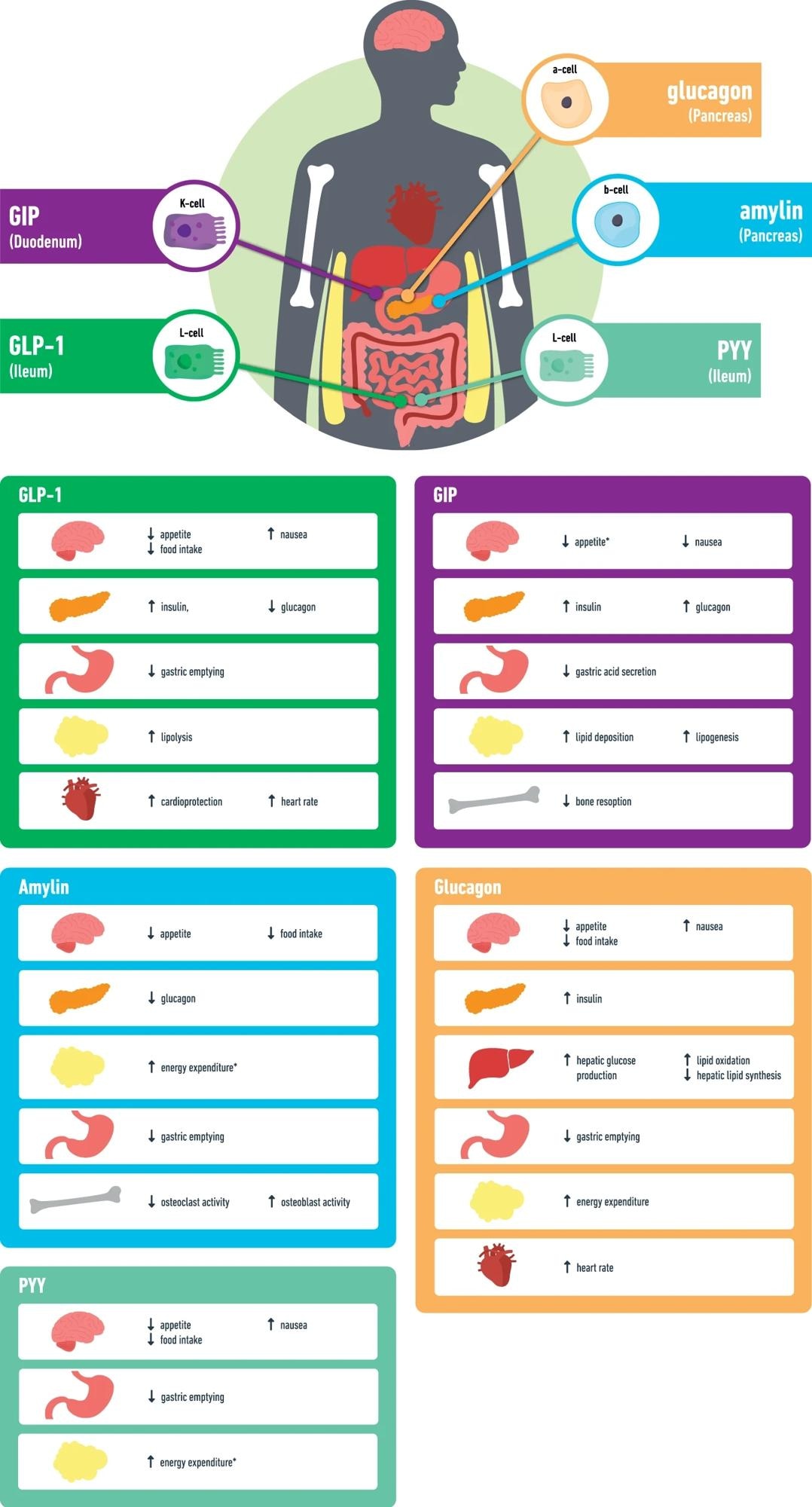
    GLP-1 glucagon like peptide-1, GIP glucose-dependent insulinotropic polypeptide, PYY peptide YY, *data mainly from animal studies.

    GLP-1 glucagon like peptide-1, GIP glucose-dependent insulinotropic polypeptide, PYY peptide YY, *data mainly from animal studies.

    Entero-pancreatic hormones and their combinations for obesity management

    Multiple entero-pancreatic hormones are currently evaluated alone or in combination with GLP-1 RAs to augment or complement the effects of GLP-1 agonism on weight and metabolism. Jejunal K-cells secrete glucose-dependent insulinotropic peptide (GIP) in response to food intake. GIP stimulates insulin release and increases lipogenesis, glucagon secretion, and lipid buffering capacity.

    Animal studies suggest an anorexigenic action of GIP receptor agonism. A phase 1 trial recently showed that repeated doses of long-acting GIP RA caused a modest WL in T2D subjects. Tirzepatide is an unimolecular subcutaneous dual (GIP and GLP-1) RA with comparable affinity to the GIP receptor but lower GLP-1 receptor affinity.

    A phase 3 study investigated the efficacy and safety of tirzepatide for obesity, and it has now been approved for chronic weight management. Various trials are evaluating the effectiveness and safety of tirzepatide in ameliorating cardiometabolic complications. Further, several injectable or oral GIP/GLP-1 RAs are in the early phases of development.

    Preliminary findings from rodent studies indicated a synergistic role of dual glucagon and GLP-1 agonism in reducing food intake. As such, numerous glucagon/GLP-1 co-agonists have been developed. Notwithstanding the promising results of glucagon/GLP-1 co-agonism in experimental studies, the efficacy and tolerability of the co-agonists have been heterogeneous in obese subjects.

    A triple agonist targeting glucagon, GIP, and GLP-1 could result in superior WL and glycemic control than dual agonists. For instance, retatrutide is a triple agonist and has been shown to improve WL and glucose profile in preclinical models relative to tirzepatide through reduced calorie intake and elevated energy expenditure. A phase 2 study in non-T2D obese individuals reported dose-dependent WL following 48-week treatment with varying doses of retatrutide.

    Concluding remarks

    Taken together, a new era has commenced for obesity treatment where combinations of entero-pancreatic hormones can reach the WL efficacy of bariatric surgery. Besides tirzepatide, the dual agonist approved for chronic management, various dual and triple agonists are evaluated in phase 3 trials.

    The multitude of obesity treatment options will enable tailored therapies based on individuals’ preferences, treatment responses, and comorbidities. Overall, obesity pharmacotherapies represent a rapidly growing field, and research on efficacy, safety, and cost-effectiveness will inform their place in therapeutic options for obesity and related complications.

    [ad_2]

    Source link

  • Exercise shapes our gut health, study finds

    Exercise shapes our gut health, study finds

    [ad_1]

    In a recent study published in the journal EBioMedicine,  a team of scientists investigated the association between physical activity levels and gut microbiota using accelerometer-based assessments of sedentary, moderate, and vigorous physical activity levels.

    Study: Accelerometer-based physical activity is associated with the gut microbiota in 8416 individuals in SCAPIS. Image Credit: Zhanna Mendel / ShutterstockStudy: Accelerometer-based physical activity is associated with the gut microbiota in 8416 individuals in SCAPIS. Image Credit: Zhanna Mendel / Shutterstock

    Background

    A growing body of evidence shows that optimal levels of physical activity lower the risk of type 2 diabetes, cardiovascular disease, and mental health conditions such as depression. Furthermore, sedentary habits involving activities that include extensive periods of sitting or lying down have been known to increase the risk of cardiovascular mortality and type 2 diabetes, and these risks can be lowered through high-intensity exercise. Recent studies have also shown that the positive effects of exercise on health might be mediated through gut microbiome changes.

    Substantial research also indicates that the gut microbiome plays a significant role in developing various diseases and mental health problems. Apart from the interactions with the host in the gastrointestinal tract, the gut microbiota is also thought to produce neurotransmitters that can influence the immune system, central nervous system, and brain homeostasis through various neuronal pathways and the microbiota-gut-brain axis. Physical activity and resulting changes in circulation, enterohepatic movement of bile acids, intestinal permeability, and gut immunity can influence the gut microbiota.

    About the study

    In the present study, the researchers used data from a cardiopulmonary bioimage study from Sweden to determine if sedentary, moderate, and vigorous levels of physical activity were associated with gut microbiome changes. While quite a few previous studies have examined this association, most of them have used self-reported levels of physical activity, which is subject to bias. Furthermore, the authors believe that the taxonomic resolution of the gut microbes had been limited in these studies.

    This study used data from a hip-worn accelerometer to obtain a more reliable and accurate measure of physical activity levels. Additionally, the use of deep shotgun metagenomics was thought to provide high-resolution taxonomic information about the gut microbial communities.

    The participants in the study were required to answer a detailed questionnaire about health and medical history, diet, and lifestyle habits. They underwent a series of physical and clinical examinations such as lungs, coronary artery, and abdominal computed tomography (CT). Participants also provided fecal samples that were used for the gut microbiome analysis. An accelerometer was worn on the hip by all the participants for one week, at all hours except while involved in water-based activities or sleeping.

    The data from the accelerometer was converted to counts per minute, which was then used to define sedentary, low, moderate, and vigorous levels of physical activity according to cut-offs validated from previous studies. Deoxyribonucleic acid (DNA) extraction was carried out for all the fecal samples, and the extracted DNA was then used to identify the metagenomic species.

    Various indices of species diversity, such as the inverse Simpson index, Shannon diversity index, and species richness, were calculated to determine the alpha diversity. Additionally, the dissimilarity in the microbe composition between the samples was determined by calculating the beta diversity.

    Results

    The results showed that the association between sedentary habits or very low levels of physical activity and the abundance of various gut microbe species was converse to the association between moderate or vigorous physical activity levels and the abundance of gut microbiome species.

    The abundance of Escherichia coli was found to be high in association with sedentary physical activity levels, while moderate physical activity levels were linked to a lower abundance of E. coli. The abundance of butyrate-producing bacteria such as those belonging to the Roseburia genus, and Faecalibacterium prausnitzii was high in individuals with moderate and vigorous physical activity levels.

    Furthermore, differences were also observed in the abundance of species, such as Prevotella copri, between individuals with moderate physical activity levels and those in the vigorous physical activity group. The abundance of P. copri was higher in association with moderate levels of exercise, but vigorous exercise showed no association with P. copri abundance.

    The functional potential of the gut microbiome was also found to differ in association with differing physical activity levels. Moderate levels of physical activity were found to be associated with higher acetate and butyrate synthesis. Vigorous exercise was found to be linked to higher propionate synthesis, and sedentary activity levels were associated with a lower capacity for carbohydrate degradation by the gut microbiota.

    Conclusions

    Overall, the findings suggested that physical activity levels were strongly linked to the abundance of specific gut microbes. Furthermore, the diversity and abundance of the gut microbiota, and subsequently its functional potential, changed according to different levels of physical activity. Sedentary habits and higher levels of physical activity exhibited converse associations with gut microbiome abundance and diversity.

    Journal reference:

    • Baldanzi, G., Sayols-Baixeras, S., Ekblom-Bak, E., Ekblom, Ö., Dekkers, K. F., Hammar, U., Nguyen, D., Ahmad, S., Ericson, U., Arvidsson, D., Börjesson, M., Johanson, P. J., Gustav, S. J., Bergström, G., Lind, L., Engström, G., Ärnlöv, J., Kennedy, B., Orho-Melander, M., & Fall, T. (2024). Accelerometer-based physical activity is associated with the gut microbiota in 8416 individuals in SCAPIS. EBioMedicine, 100. DOI: 10.1016/j.ebiom.2024.104989, https://www.thelancet.com/journals/ebiom/article/PIIS2352-3964(24)00024-0/fulltext

    [ad_2]

    Source link

  • New inhibitor drug shows promise in preventing diabetic eye and kidney disease

    New inhibitor drug shows promise in preventing diabetic eye and kidney disease

    [ad_1]

    New research has shown a new type of inhibitor drug could prevent microvascular diabetic complications, such as diabetic eye and kidney disease. The University of Bristol-led research is published in Cardiovascular Diabetology.

    Diabetes, a disease which results in uncontrolled blood glucose levels, is estimated to affect one in 11 adults worldwide. Even when managed, this common disease can result in life-altering complications, impacting the small blood vessels of the body, known as the microvasculature.

    While treatments are available for patients who develop microvascular complications, such as diabetic eye and kidney disease, these treatments do not fully delay progression. Eventually they may result in blindness and kidney failure in patients.

    The research team was interested in the protective lining of all blood vessels, called the glycocalyx. This lining is known to be damaged in diabetes. The researchers showed in two mouse models that by preventing damage to this protective layer, the development of diabetic eye and kidney disease could be stopped.

    This is achieved using a ‘heparanase inhibitor’. Heparanase acts likes a pair of scissors, damaging the glycocalyx lining. Heparanase inhibitors stop this damage from happening. The research team has developed a novel class of these drugs, which could be successfully developed as a medication to treat patients.

    Dr Rebecca Foster, Associate Professor of Microvascular Medicine in the Bristol Medical School: Translational Health Sciences (THS), and senior author of the study, said: “Our findings are exciting as we have shown that one type of medication might be able to prevent different diabetic complications, which is a global health problem for adults living with diabetes.”

    We are currently conducting research to advance our novel class of inhibitors to clinical use. With over 8% of the global adult population currently living with diabetes, we hope patients could benefit from our findings in the future.”

    Dr Monica Gamez, Research Associate in the Bristol Medical School (THS) and corresponding author

    The study was funded by the Medical Research Council [MRC].

    Source:

    Journal reference:

    Gamez, M., et al. (2024) Heparanase inhibition as a systemic approach to protect the endothelial glycocalyx and prevent microvascular complications in diabetes. Cardiovascular Diabetology. doi.org/10.1186/s12933-024-02133-1.

    [ad_2]

    Source link

  • How self-monitoring and motivation fuel online weight loss success

    How self-monitoring and motivation fuel online weight loss success

    [ad_1]

    A recent BMC Public Health study analyzes self-monitoring data from Chinese adults who participated in a group weight loss intervention using a mixed-methods approach.

    Study: Why more successful? An analysis of participants’ self-monitoring data in an online weight loss intervention. Image Credit: Ground Picture / Shutterstock.com Study: Why more successful? An analysis of participants’ self-monitoring data in an online weight loss intervention. Image Credit: Ground Picture / Shutterstock.com

    Background

    According to the World Health Organization (WHO), over 1.9 billion adults were overweight in 2016. This global public health problem has reached alarming proportions in China, which significantly increases the risks of several diseases, including cancer, diabetes, and cardiovascular diseases. 

    Self-monitoring, which enhances self-awareness, promotes desired behaviors, and reduces unwarranted behaviors, can be achieved through setting specific targets and logging progress. Changes in body weight, exercise, and dietary intake are regularly monitored by participants of weight loss interventions. In fact, obese individuals who periodically monitor their diet and body weight have experienced more beneficial responses to interventions.

    Researchers have both quantitatively and qualitatively analyzed the self-monitoring behaviors of dieters; however, few have utilized a mixed-methods approach for this purpose. Notable advantages of the mixed-methods approach include its ability to elucidate the association between weight loss and different self-monitoring indicators and reduce bias to ultimately develop reliable insights into self-monitoring.

    About the study

    Self-monitoring data from 61 Chinese adults who participated in a five-week online weight loss intervention group were analyzed in the current study. In addition to providing information on their weight loss motivation and body mass index (BMI) values, the study participants also engaged in daily quantitative monitoring, which included parameters like caloric intake and sedentary behavior, as well as qualitative self-monitoring, which involved a daily log of weight loss progress. 

    A scoring rule assessed the timeliness of the data. A one-way repeated measurement ANOVA was used to analyze the dynamics of self-monitoring indicators.

    Regression and correlation analyses were performed to explore the relationship between weight change, self-monitoring indicators, and baseline data. Participants were grouped into three categories based on their weight loss outcomes, and their qualitative data was assessed using content analysis. 

    Key findings

    Some fluctuation in self-monitoring data was observed throughout the intervention. Furthermore, some baseline characteristics of participants and self-monitoring behaviors were positively associated with their final weight loss outcomes. Across the weight loss categories, heterogeneity in qualitative self-monitoring data was observed. 

    During the weight loss process, a gradual decrease in caloric intake was observed, thus suggesting the learning behavior among participants. During the last week, participants exhibited some variation in commitment levels, which led to concerns about a rebound in caloric intake.

    Weight loss satisfaction was highest in the first week and gradually declined. This decline in satisfaction was consistent with their weight loss, highlighting the link between effort and outcome. 

    Weight loss motivation, baseline BMI, and timeliness of daily self-monitoring data completion predicted final weight loss. The relationship between weight loss, daily physical activity expenditure, and daily caloric intake was insignificant. Furthermore, no significant relationship was observed between weight loss and daily mood. 

    The qualitative analysis of participants’ daily logs revealed four categories: eating behavior, weight loss awareness, physical activity, and perception of change, the latter of which was most frequently mentioned. This was followed by the mention of weight loss awareness, eating behavior, and physical activity.

    Inconsistencies were noted in the probability distribution of participants’ daily log frequencies. Poor and moderate weight loss groups reported lower observed frequencies across all four categories than the excellent group. The excellent group reported a higher frequency of adjustments in eating habits, self-awareness, disadvantages, and demonstrating greater patience.

    Conclusions

    An inconsistent pattern in the self-monitoring behavior among individuals undergoing a group weight loss intervention was observed. More specifically, a higher level of self-monitoring was identified during the initial weeks of weight loss, followed by a slow decline.

    More significant weight loss was attained by individuals with higher levels of motivation, higher baseline BMI, and those who regularly self-monitored. Furthermore, more detailed and frequent content was reported in the texts submitted by successful participants.

    These findings imply that weight loss motivation and adherence to self-monitoring should be emphasized. The use of digital technologies could be beneficial, as they could facilitate greater weight loss awareness and promote healthy dietary habits.

    In the future, more studies with larger sample sizes and precise measurement tools are needed to evaluate daily calorie expenditure and intake. 

    [ad_2]

    Source link

  • Dementia risk can be the highest in the first year after stroke

    Dementia risk can be the highest in the first year after stroke

    [ad_1]

    Having a stroke may significantly increase the risk of developing dementia. The risk of dementia was the highest in the first year after a stroke and remained elevated over a period of twenty years, according to preliminary research to be presented at the American Stroke Association’s International Stroke Conference 2024. The meeting will be held in Phoenix, Feb. 7-9, and is a world premier meeting for researchers and clinicians dedicated to the science of stroke and brain health.

    Our findings show that stroke survivors are uniquely susceptible to dementia, and the risk can be up to 3 times higher in the first year after a stroke. While the risk decreases over time, it remains elevated over the long-term.”


    Raed Joundi, M.D., D.Phil., lead study author, assistant professor at McMaster University in Hamilton, Ontario, Canada, and investigator at the Population Health Research Institute, a joint institute of McMaster University and Hamilton Health Sciences

    To evaluate dementia risk after stroke, the researchers used databases at the Institute for Clinical Evaluative Sciences (University of Toronto, Canada), which includes more than 15 million people in the Canadian province of Ontario. They identified 180,940 people who had suffered a recent stroke -; either an ischemic stroke (clot-caused) or intracerebral hemorrhage (bleeding within the brain) -; and matched those stroke survivors to two control groups -; people in the general population (who had not had a heart attack or stroke) and those who had had a heart attack and not a stroke. Researchers evaluated the rate of new cases of dementia starting at 90 days after stroke over an average follow-up of 5.5 years. In addition, they analyzed the risk of developing dementia in the first year after the stroke and over time, up to 20 years.

    The study found:

    • The risk of dementia was highest in the first year after stroke, with a nearly 3-fold increased risk, then decreasing to a 1.5-fold increased risk by the 5-year mark and remaining elevated 20 years later.
    • Dementia occurred in nearly 19% of stroke survivors over an average follow-up of 5.5 years.
    • The risk of dementia was 80% higher in stroke survivors than in the matched group from the general population. The risk of dementia was also nearly 80% higher in stroke survivors than in the matched control group who had experienced a heart attack.
    • The risk of dementia in people who had an intracerebral hemorrhage (bleeding in the brain) was nearly 150% higher than those in the general population.

    “We found that the rate of post-stroke dementia was higher than the rate of recurrent stroke over the same time period,” Joundi said. “Stroke injures the brain including areas critical for cognitive function, which can impact day-to-day functioning. Some people go on to have a recurrent stroke, which increases the risk of dementia even further, and others may experience a progressive cognitive decline similar to a neurodegenerative condition.”

    Each year, about 795,000 people experience a new or recurrent stroke. Approximately 610,000 of these are first attacks, and 185,000 are recurrent attacks, according to the American Heart Association’s Heart Disease and Stroke Statistics 2024 Update. According to the CDC, of those at least 65 years of age, there is an estimated 7 million adults with dementia in 2014 and projected to be nearly 14 million by 2060.

    “Our study shows there is a large burden of dementia after acute stroke in Canada and identifies it is a common problem that needs to be addressed. Our findings reinforce the importance of monitoring people with stroke for cognitive decline, instituting appropriate treatments to address vascular risk factors and prevent recurrent stroke, and encouraging lifestyle changes, such as smoking cessation and increased physical activity, which have many benefits and may reduce the risk of dementia,” Joundi said. “More research is needed to clarify why some people who have a stroke develop dementia and others do not.”

    A 2023 American Heart Association scientific statement, Cognitive Impairment After Ischemic and Hemorrhagic Stroke suggests post-stroke screenings and comprehensive interdisciplinary care to support stroke survivors with cognitive impairment.

    A limitation of the study is that administrative data, hospital records and medication dispensary data were used for the analysis. Researchers were not able to perform cognitive assessments or neuroimaging (noninvasive images of the brain) on stroke survivors, therefore, there is no way to confirm the dementia diagnosis or type of dementia. However, the dementia definition was previously validated and shown to be accurate when compared to medical charts.

    Study background and details:

    • The study examined data from 2002 to 2022 on a total population of 15 million adults in Ontario, Canada.
    • Data was mined from all hospital admissions, pharmacies prescribing medications for dementia and emergency departments across the province of Ontario.
    • The analysis included 180,940 stroke survivors (mean age of 69, and 45% women) who had either an ischemic stroke or intracerebral hemorrhage and survived without dementia for at least 90 days.
    • The study population was matched 1 to 1 on age, sex, rural residence, neighborhood marginalization, hypertension, diabetes (including Type 1 and Type 2 together), high cholesterol, atrial fibrillation, heart failure and peripheral artery disease -; factors known to increase the risk of dementia.

    [ad_2]

    Source link

  • Berry consumption shown to lower stress-related disease risk in US adults

    Berry consumption shown to lower stress-related disease risk in US adults

    [ad_1]

    In a recent study published in the Journal Nutrientsresearchers investigated the association between berry consumption and physiological dysregulation from stress responses measured by allostatic load (AL) scores using publicly available data from the National Health and Nutrition Examination Survey (NHANES) conducted among adult population in the United States (US) during 2003–2010.

    Study: Berry Consumption in Relation to Allostatic Load in US Adults: The National Health and Nutrition Examination Survey, 2003–2010. Image Credit: Bojsha/Shutterstock.comStudy: Berry Consumption in Relation to Allostatic Load in US Adults: The National Health and Nutrition Examination Survey, 2003–2010. Image Credit: Bojsha/Shutterstock.com

    Background

    AL multisystem measurement framework uses 14 biomarkers of multiple physiological systems, including the cardiovascular, autonomic, metabolic, and immune systems, to measure the severity of physiological dysregulation due to incremental effects of stress overall and in specific systems.

    A higher AL score, calculated by summing the risk indicators for each biomarker within each domain, indicates more dysregulation due to stress, which may manifest as debilitating stress-related health conditions, such as physical and cognitive decline, mental disorders (e.g., depression), diabetes, cardiovascular diseases (CVDs), cancer, and even mortality.

    The high levels of specific polyphenols and other nutrients in berry fruits have garnered the attention of researchers because they protect against inflammation and cardiometabolic diseases due to their potent antioxidant properties.

    Raspberries and blackberries have the highest levels of polyphenol ellagic acid, whereas strawberries have high levels of anthocyanins. 

    Study methodology

    In this study, researchers hypothesized that more berry consumption would lower AL scores.

    They collected data from US adults enrolled in the 2003–2010 NHANES, including their demographic, dietary, and medical information via at-home interviews, mobile examination center (MEC) visits, and phone interviews.

    Trained staff then measured their total berry intake using two 24-hour dietary recalls.

    People consume berries often as mixed and processed foods. So, the team used an algorithm to identify berry intake from food records, and those consuming at least one cup of equivalent berry or berry subtype fruits (strawberries and blueberries) in a food recall were considered berry consumers. 

    The researchers used population weight-adjusted multivariable linear regression models to evaluate the effect of berry intake on AL composite scores and biomarkers.

    These models adjusted for potential confounders, such as age, dietary and sociodemographic, and lifestyle factors.

    Results

    Of 15,620 US adults who completed two 24-hour recalls, only 7,684 individuals attended a morning examination and provided complete information on the AL biomarkers.

    From these, ~19.3% of adults (n=1485), of which 61.9% were females, were berry consumers.

    Berry consumers, i.e., those who ate strawberries, blueberries, or any berries, had significantly lower mean AL composite scores than non-consumers.

    The relationship between greater berry intake and lower average AL composite scores was dose-dependent (p-trend< 0.05) and remained robust after adjusting for all confounders.

    Compared to non-users, berry consumers had lower levels of biomarkers in each AL domain. Accordingly, the mean cardiovascular and metabolic domain scores for total berry consumers were 4.73 and 2.97 vs. 4.97 and 3.1 for non-consumers.

    Compared to non-users, cardiovascular and metabolic domain scores for strawberry and blueberry consumers were 4.73 vs. 4.95; 2.99 vs. 3.1; 4.6 vs. 4.95; 2.92 vs. 3.11, respectively.

    Berry consumers also had markedly lower average AL immune and autonomic scores (1.52 vs. 1.56) and (2.49 vs. 2.57), respectively, relative to non-consumers.

    However, this slightly varied with the berry type consumed. So, while Blackberry consumers had markedly lower mean autonomic scores than non-consumers, no difference was noted for total berry consumers.

    Additionally, blackberry consumers had lower triglycerides and C-reactive protein (CRP) levels, while cranberry juice consumers had lower pulse rates and fewer white blood cells.

    Furthermore, consumers of blueberries, strawberries, and raspberries had lower fasting glucose, fasting insulin, triglycerides, and homeostatic model assessment for insulin resistance (HOMA-IR) than non-consumers. 

    Conclusions

    The present study findings suggest that consumption of berries is associated with lower AL composite and domain scores and may potentially reduce stress-related physiological dysregulations and prevent cardiovascular and metabolic disorders in the US adult population. 

    Consistent with previous studies, these findings may be attributable to the protective effects of flavonoids, polyphenols, and other components in berries that act against multisystemic dysregulations.

    In particular, polyphenols interact with gut microbiota through the gut–brain–axis signaling pathway fostering resilience to stress-induced physiological dysregulation.

    Likewise, anthocyanins, a type of flavonoid, have a beneficial effect on cardiometabolic factors. Furthermore, whole berries have abundant dietary fibers that decrease glucose absorption.

    Future research should further validate these results using different assessment methods in different population cohorts.

    Journal reference:

    [ad_2]

    Source link

  • New study recommends 2000 IU daily vitamin D supplementation

    New study recommends 2000 IU daily vitamin D supplementation

    [ad_1]

    In a recent narrative review published in Nutrientsresearchers discuss the evidence arguing for the efficiency and safety of 2000 international units (IU), i.e., 50 micrograms (µg) of vitamin D supplementation per day to prevent and treat vitamin D deficiency in the general adult population.

    Study: Vitamin D Supplementation: A Review of the Evidence Arguing for a Daily Dose of 2000 International Units (50 µg) of Vitamin D for Adults in the General Population. Image Credit: FotoHelin/Shutterstock.comStudy: Vitamin D Supplementation: A Review of the Evidence Arguing for a Daily Dose of 2000 International Units (50 µg) of Vitamin D for Adults in the General Population. Image Credit: FotoHelin/Shutterstock.com

    Background

    Vitamin D deficiency has many adverse clinical consequences, including poor musculoskeletal health, manifesting as diseases like rickets and osteomalacia.

    Moreover, vitamin D may be crucial for preventing extra skeletal diseases like cancer and diabetes.

    Vitamin D is biologically inactive in the human body; thus, in laboratory detection of vitamin D deficiency, they measure serum concentrations of 25-hydroxyvitamin D (25(OH)D), a vitamin D metabolite utilized by the body and that reflects the overall supply from different sources, including ultraviolet-B (sunlight) and food sources, such as fish or mushrooms.

    Worldwide, the prevalence of low serum levels of 25(OH)D, i.e., below 25-30 nmol/L and 50 nmol/L, occurs in ~5-18% and 24-49% of people, respectively, underscoring the need for prompt action to reduce vitamin D deficiency burden globally.

    At a dosage of 50µg per day, the whole 25(OH)D distribution of a given population could rise to higher levels; however, there are safety concerns with such dosage as it may also increase the risk of vitamin D overdosing for those at the higher end of the distribution.

    Moreover, given the extra skeletal health effects of vitamin D, it is crucial to focus on the attainment of 25(OH)D levels needed to prevent them rather than safety concerns for targeting 75 nmol/L (30 ng/mL), which are optimal target serum 25(OH)D concentrations for skeletal health.

    So, researchers additionally investigated whether attaining serum 25(OH)D levels ≥50 nmol/L should be the target.

    Current Vitamin D supplementation guidelines

    Guidelines for vitamin D intake establish target serum 25(OH)D concentrations and recommend the required doses to achieve those levels, assuming adequate intake of other nutrients and seasons (winters or summers).

    Accordingly, current guidelines recommend a daily vitamin D intake of 400-800 IU; however, individuals from different ethnicities or regions may require even higher intakes of 2008-2672 IUs for attaining 25(OH)D serum levels of ≥50 nmol/L.

    What should be the target serum 25(OH)D levels: 75 nmol/L (30 ng/mL) or 2000 IU (50 µg)?

    Many observational studies have suggested that while ≥50 nmol/L serum 25(OH)D levels can prevent rickets and osteomalacia, concentrations ≥75 nmol/L are needed for improved health outcomes in diabetes and cancer.

    The optimal concentration needed may also vary depending on the study population and outcome of interest.

    Further, the authors noted that randomized controlled trials (RCTs) testing 25(OH)D needs may be biased towards healthy people who may not accurately represent the general population, especially those with obesity.

    In fact, optimal serum 25(OH)D concentrations for most chronic diseases are slightly above 75 nmol/L (30 ng/mL).

    Thus, obese individuals, individuals with higher body mass index (BMI), and patients with malabsorption syndromes may require higher doses of vitamin D to increase their serum 25(OH)D levels. 

    Some may not meet the threshold even after supplementing with daily 2000 IUs of vitamin D, like patients with inflammatory bowel disease during episodes of high disease activity.

    Even medications, like antiepileptic drugs, can affect lower serum 25(OH)D concentrations by modulating its metabolism.

    When serum 25(OH)D concentrations exceed 150 ng/mL, vitamin D toxicity may lead to hypercalcemia; thus, clinicians advise caution for those on vitamin D supplements.

    Recent RCTs like the Vitamin D and OmegA-3 Trial (VITAL) gathered safety data on using 2000 IU of vitamin D/day in general adult populations who showed no signs of vitamin D toxicity for 5.3 years, indicating the safety of this daily dosage.

    Further, a meta-analysis of 15 vitamin D RCTs found no increase in kidney stones when supplementing with ≥70 µg of vitamin D for at least one year.

    Another meta-analysis found that daily vitamin D supplementation of 3200-4000 IUs for six months increased the risk of hypercalcemia, hospitalizations, and falls; however, this did not occur in chronic kidney disease patients.

    Conclusions

    Adherence to conservative dosing regimens not exceeding 800 IU (20 µg) of vitamin D per day may not sufficiently treat vitamin D deficiency, considering the heterogeneity in inter-individual dose-response and accounting for the multiple clinical factors involved, such as obesity, malabsorption syndromes, and medications that impair vitamin D metabolism.

    This review revealed that daily vitamin D supplementation was more effective than intermittent bolus dosing in adults. However, precaution is needed for older and diseased individuals, who are more prone to adverse effects of vitamin D overdosing. 

    In real-world settings, clinicians should consider tailoring the vitamin D dosage according to the patient’s needs and characteristics.

    Instead of following the ‘one-size fits all’ approach, they may adopt a personalized treatment approach and prescribe a dosing range from 800-2000 IUs (20-50 µg). 

    It is a narrative review lacking a pre-registered systematic review. Yet, based on the evidence outlined in this review, the authors argue in favor of a daily vitamin D supplement dose of 2000 IU (50 µg) to raise and maintain serum 25(OH)D concentrations >50 nmol/L (20 ng/mL) and >75 nmol/L (30 ng/mL) in >99% and >90% of the general adult population, respectively.

    Furthermore, they found no significant safety concerns in supplementing such a dose for several years, even in individuals with a sufficient vitamin D status at baseline. 

    This could be the perfect remedy for addressing the vitamin D pandemic in the general adult population.

    Journal reference:

    [ad_2]

    Source link

  • Study reveals key mechanism behind obesity-related metabolic dysfunction

    Study reveals key mechanism behind obesity-related metabolic dysfunction

    [ad_1]

    In a recent study published in Nature Metabolism, researchers found that feeding a high-fat diet (HFD) causes mitochondrial dysfunction and fragmentation in white adipocytes in mice.

    Study: Obesity causes mitochondrial fragmentation and dysfunction in white adipocytes due to RalA activation. Image Credit: Kateryna Kon/Shutterstock.com
    Study: Obesity causes mitochondrial fragmentation and dysfunction in white adipocytes due to RalA activation. Image Credit: Kateryna Kon/Shutterstock.com

    Background

    Obesity has become a global epidemic, increasing the incidence of non-alcoholic steatohepatitis, diabetes, and other cardiometabolic disorders. White adipose tissue (WAT) expands chronically during the development of obesity, with metabolic changes characterized by fibrosis, inflammation, hormone insensitivity, and apoptosis. Obese individuals have impaired mitochondrial function, and the underlying mechanisms and their contribution to obesity remain unclear.

    The study and findings

    In the present study, researchers demonstrated increased expression and activity of Ras-like proto-oncogene A (RalA) in adipocytes from obese mice and attenuation of HFD-induced obesity upon targeted Rala deletion in white adipocytes. First, they noted upregulation of Rala expression in epididymal (eWAT) and inguinal WAT (iWAT) adipocytes during obesity development in HFD-fed mice relative to controls.

    Further, RalA protein levels were elevated in iWAT adipocytes from obese mice. No changes in RalA were observed in brown adipose tissue (BAT) after HFD feeding. Next, RalA-floxed (Ralaf/f) mice and adiponectin-promoter-driven Cre transgenic mice were crossed to generate adipocyte-specific Rala knockout (KO) mice (RalaAKO). RalaAKO mice showed over 90% reduced RalA protein in primary adipocytes from BAT and WAT compared to Ralaf/f littermates.

    RalA depletion reduced insulin-stimulated glucose uptake in BAT and iWAT. Additionally, brown adipocyte-specific KO mice (RalaBKO) were produced by crossing Ralaf/f mice and uncoupling protein 1 (Ucp1)-promoter-driven Cre transgenic mice. This reduced glucose uptake in the BAT of RalaBKO mice, and insulin-stimulated glucose uptake was mainly limited to brown fat.

    Adipocyte-specific Rala deletion did not affect the body weight of chow-diet (CD)-fed mice, albeit they had reduced fat mass and depot weight. RalaAKO mice had smaller iWAT adipocytes than CD-fed controls. RalaAKO mice gained less weight than controls when fed 60% HFD. HFD-fed RalaAKO mice had smaller adipocytes in iWAT but not in BAT or eWAT compared to controls.

    HFD-fed RalaAKO mice also showed improved glucose tolerance, without changes in insulin tolerance; they also had reduced insulin levels and improved homeostasis model assessment of insulin resistance (HOMA-IR) than controls. RalaAKO mice showed lower glucose excursions in a pyruvate tolerance test than controls, with downregulation of hepatic gluconeogenic genes.

    HFD-fed RalaAKO mice had lower triglyceride levels and liver weight and less lipid accumulation in the liver than controls. Moreover, the expression of lipogenic, fibrosis-related, and inflammatory genes was reduced in the livers of RalaAKO mice. The team found that adipocyte Rala ablation did not affect food intake and energy metabolism in CD-fed mice.

    However, HFD-fed RalaAKO mice had increased energy expenditure. In contrast, energy expenditure and food intake were identical in HFD-fed RalaBKO mice and controls, suggesting that WAT-specific Rala deficiency increased energy expenditure. Further, oxidative phosphorylation proteins were upregulated in the iWAT of RalaAKO mice but not in eWAT.

    Next, the team explored mechanisms underlying increased energy metabolism in RalaAKO mice and mitochondrial activity in adipocytes. They observed an elevated oxygen consumption rate in iWAT mitochondria from KO mice relative to controls. Moreover, fatty acid oxidation was higher in KO adipocytes. The expression of mitochondrial biogenesis-related genes in WAT was comparable between HFD-fed RalaAKO and Ralaf/f mice.

    Electron microscopy showed that HFD feeding of wild-type mice induced smaller, spherical iWAT mitochondria. iWAT mitochondria in CD-fed mice had an elongated shape, while those in HFD-fed mice had smaller mitochondria. Besides, adipocyte Rala ablation did not grossly impact mitochondrial morphology in the iWAT of CD-fed mice; in contrast, the HFD-induced morphological change in mitochondria was prevented in Rala KO iWAT.

    Mitochondrial morphology in BAT was unaltered upon Rala deletion in HFD- or CD-fed mice. HFD feeding downregulated protein levels of long and short forms of optic atrophy 1 (Opa1), a mitochondrial fusion regulator, in iWAT. However, only the short form (S-Opa1) was downregulated in eWAT. Further, they focused on dynamin-related protein 1 (Drp1), which regulates mitochondrial fission, and found increased phosphorylation at the anti-fission site (S637) in Rala KO iWAT.

    The researchers analyzed microarray data of WAT from non-obese and obese females to examine the relevance of Drp1 in human obesity. They found that the human Drp1 homolog, dynamin 1 like (DNM1L), was positively correlated with HOMA-IR and body mass index. DNM1L expression was upregulated in obese subjects.

    Conclusions

    Taken together, the study demonstrated that RalA was induced and activated in white adipocytes of HFD-fed mice. Targeted RalA deletion in white adipocytes prevented obesity-related mitochondrial fragmentation and resulted in resistance to HFD-induced weight gain through heightened energy expenditure.

    HFD-fed RalaAKO mice showed improved liver function and pyruvate tolerance and reduced gluconeogenesis and hepatic lipids. Overall, chronically increased RalA activity plays a role in repressing energy expenditure in obese adipose tissue by shifting mitochondrial dynamics towards excessive fission and contributing to weight gain and metabolic dysfunction.

    [ad_2]

    Source link