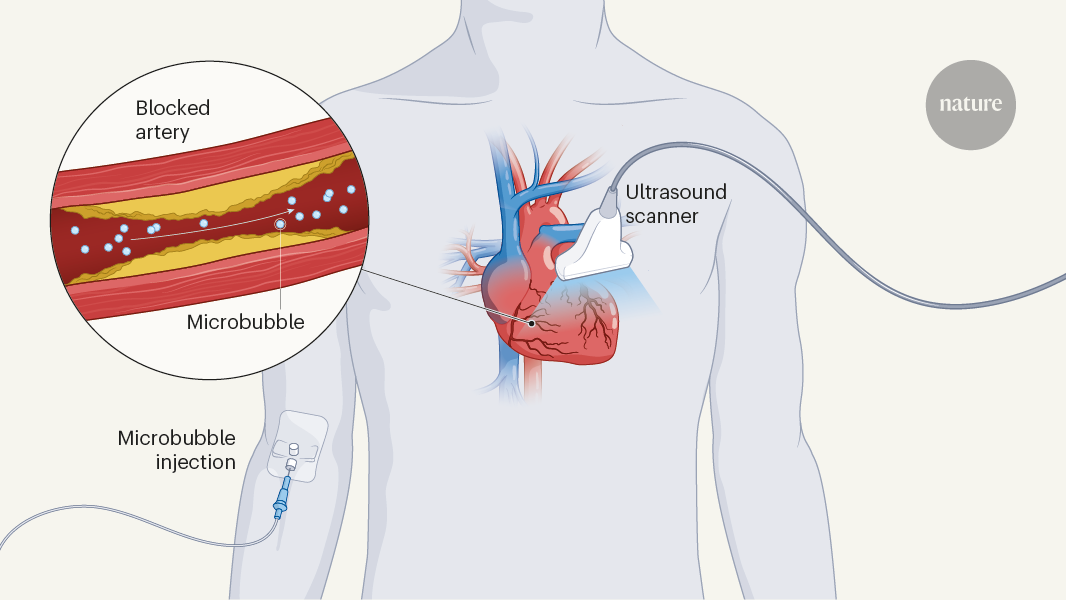
Cardiovascular disease claims more lives each year than do the two next-deadliest diseases combined. An ultrasound technique that tracks tiny gas-filled bubbles could pave the way towards improved early detection.
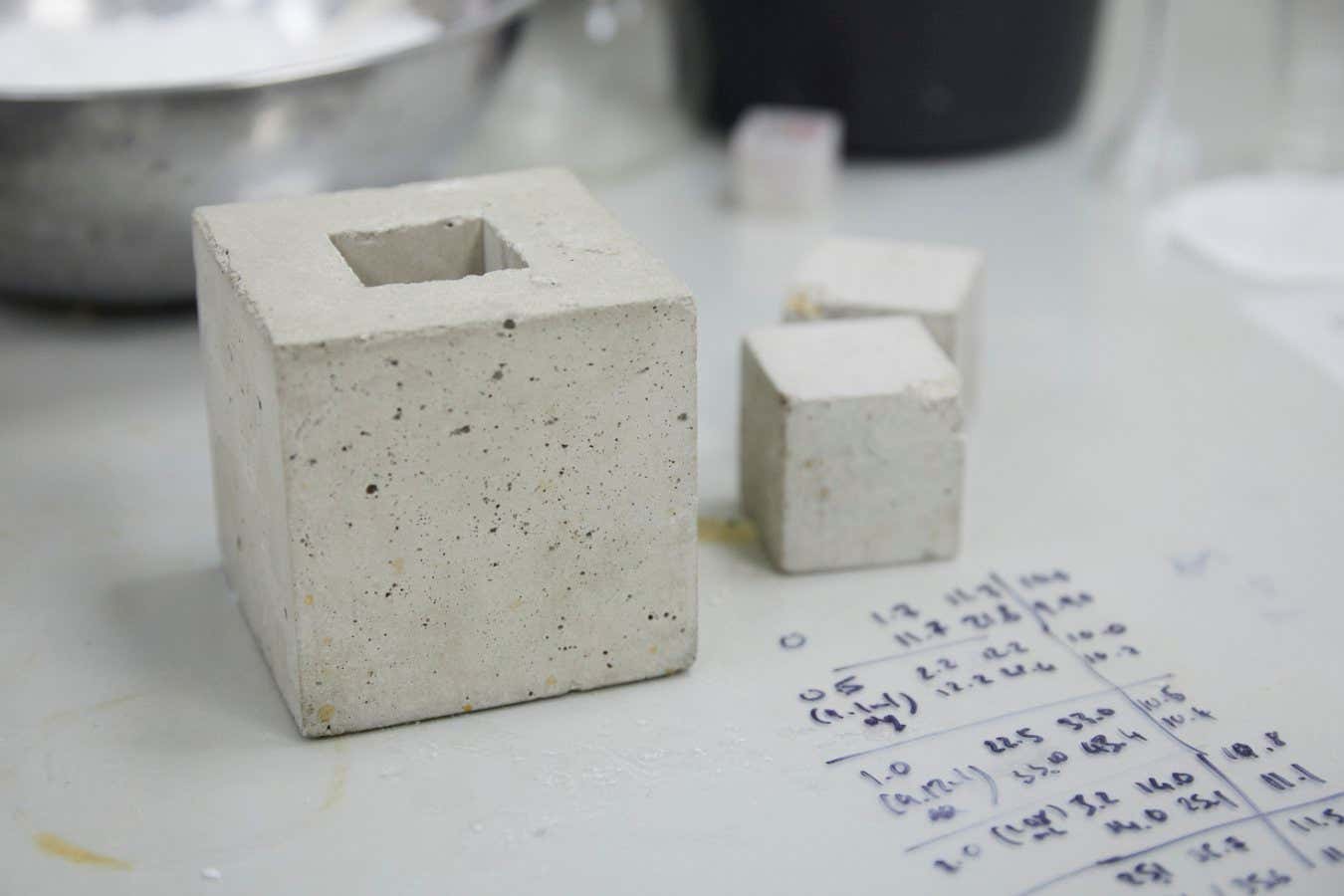
A sample of cement made from the mineral olivine, which can help sequester carbon during production
Helene Sandberg/Seratech
An abundant mineral called olivine can help make carbon-negative cement. This process could help tackle cement’s large carbon footprint – the material contributes about 8 per cent of global CO2 emissions.
Olivine is one of the main components of Earth’s mantle and reserves sit on every continent. “It’s one of the few minerals that is available at the gigatonne scale,” says Sam Draper at Seratech, a UK-based company that has patented a process to turn olivine into cement.
Dozens of start-ups like Seratech are developing low-carbon methods to produce cement, such as supplementing with steel by-products or recycling the CO2 released in cement production. Most emissions occur when heating limestone to produce clinker, a binder in cement, along with burning fossil fuels to generate the heat.
Draper and his colleagues looked to the more abundant olivine to find a replacement for some of the usual clinker. Olivine contains silica, which makes cement stronger and more durable. Magnesium sulphate can also be extracted from it, and this salt reacts with CO2 to form minerals that sequester the gas.
The researchers extracted these compounds by dissolving powdered olivine in sulphuric acid. After separating the silica and magnesium sulphate, they bubbled CO2 through the magnesium slurry to form a mineral called nesquehonite. To scale up the process, Draper says a cement plant would use CO2 captured from an emissions source or from the air, rendering the entire process carbon negative. The leftover nesquehonite could be recycled into new construction materials like bricks.
Replacing 35 per cent of the regular cement in a concrete mix with silica from this process would produce a carbon-neutral cement, the researchers estimated, while subbing 40 per cent or more would make it carbon negative. Draper says current building standards allow this type of material to replace up to 55 per cent of cement, although he says they haven’t yet made enough of it for robust testing.
The process utilises well-known reactions, says Rafael Santos at the University of Guelph in Canada, but offers a novel and “reasonable” way to combine them. However, some of the chemicals involved may prove tricky to recycle, he says.
Royal Society Open Science
DOI: https://doi.org/10.1098/rsos.231645
Later this week, China will embark on the world’s second-only trip to the Moon’s far side. The goal is to collect the first rocks from inside the South Pole-Aitken (SPA) basin, the largest and oldest impact crater on the lunar surface, and bring them back to Earth for analysis.
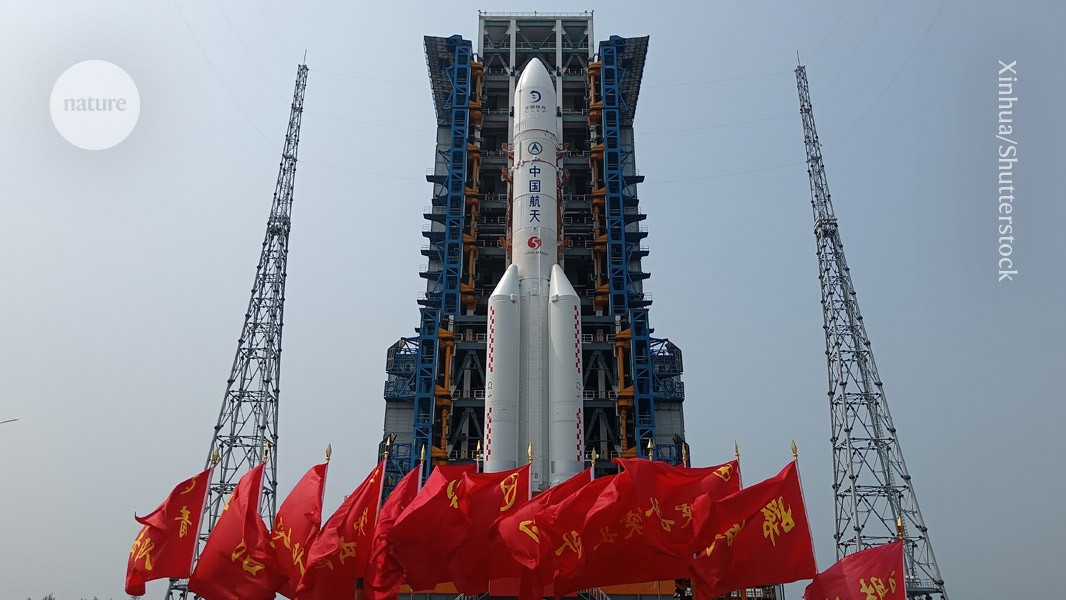
A stack of four spacecraft needed to complete this unprecedented and highly challenging mission, known as Chang’e-6, is now tucked into the nose of a 57-metre-tall Long March 5 rocket, waiting to lift off from the Wenchang Satellite Launch Centre on southern China’s Hainan Island.
“The whole process is very complex and risky,” says Jonathan McDowell, an astronomer at the Harvard-Smithsonian Center for Astrophysics in Cambridge, Massachusetts.
But he says it’s a risk worth taking: “Samples from the SPA basin would be very interesting scientifically and tell us a lot about the history of the Moon and of the early Solar System.”
Far side science
Because the Moon is tidally locked to Earth, humans were only able to see its near side for thousands of years. In 1959, the first lunar far-side images returned by the Soviet probe Luna 3 revealed a face pocked with mountains and impact craters, in contrast to the relatively smooth near side. Scientists have since been collecting data from satellites orbiting the Moon to understand its little-known other half. In 2019, China’s Chang’e-4 became the first spacecraft to soft land and conduct surveys on the Moon’s far side.
The upcoming Chang’e-6 mission, with its landing site carefully chosen by Chinese scientists and international colleagues, aims to give the first accurate measurements of the age and composition of the geology of the Moon’s far side. It might provide key clues to why the two sides of the Moon are so different — the so-called lunar dichotomy mystery — and help test theories about the early history of the Solar System.
The SPA Basin is a vast indentation on the lower half of the far side some 2,500 kilometres wide and 8 kilometres deep. Inside the northeastern part, Li’s team has identified three potential landing areas. They believe the sites could have a variety of materials formed during repeated asteroid impacts and volcanic eruptions over two billion years, and therefore could be scientifically rich.
The South Pole-Aitken Basin is the blue area in the centre of this false-colour image. The indentation is 2,500 kilometres wide.Credit: NASA/GSFC/University Of Arizona
The most likely rock to be collected is basalt — dark-coloured cooled lava — which has previously been brought back to Earth for analysis from the Moon’s near side. With the first far-side basalt samples, scientists will be able to date them and assess their chemical composition, giving clues to their formation. “Then we can make comparative studies to understand why volcanic activities happened on a much smaller scale and ended much earlier on the far side of the Moon,” says Long Xiao, a planetary scientist at the China University of Geosciences in Wuhan.
Being able to pin down the SPA Basin’s age would also be a major achievement, says planetary geologist Carolyn van der Bogert from the University of Münster, Germany. It will help settle the long-standing debate about whether the Moon and the inner Solar System was battered by a massive cluster of asteroids between 4.0 and 3.8 billion years ago. If the SPA Basin is older, then it would cast doubt on the heavy bombardment theory.
Besides basalts, scientists hope that Chang’e-6 will also pick up fragments of other rocks that have been scattered during impact events. If the Chinese mission strikes ejecta the from the deeper lunar crust or mantle, it will be scientific gold.
Engineering challenges
Chang’e-6 was originally built as a backup for the Chang’e-5 mission, which successfully returned 1.73 kilograms of samples from the Moon’s near side in 2020. Because the two craft are identical, site selection for Chang’e-6’s landing was constrained to similar latitudes as Chang’e-5’s and needed a relatively flat surface, says Chunlai Li, the mission’s deputy chief designer from the National Astronomical Observatories in Beijing.
Like its predecessor, Chang’e-6 does not pre-determine its landing site but will use its instrumentation during the descent process to find the safest and most favourable spot. “The landing of Chang’e-6 would be more challenging than Chang’e-5 simply because the far side landing site is more rugged,” says Xiao.
Chang’e-6, like its twin, consists of an orbiter, a lander, an ascender and a re-entry module. When the spacecraft arrives at the Moon, it will separate into two parts, with the lander and ascender headed for the lunar surface while the orbiter and re-entry module remain in orbit.
If it pulls off the difficult soft landing, the lander will drill and scoop up two kilograms of soil and rocks. The sampling process needs to be completed within 48 hours, after which the ascender is intended to blast off from the lander and return to the lunar orbiter. There it is supposed to dock and transfer the precious samples to the re-entry module for the trip home.
During the sample collection and lunar surface liftoff, the Chang’e-6 lander would be unable to directly communicate with Earth. Every command will need to go through a relay satellite named Queqiao-2. Launched last month and now operating in a highly elliptical orbit around the Moon, Queqiao-2 is more powerful than the Queqiao satellite which served the Chang’e-4 mission. Its 4.2-metre umbrella-shaped antenna has the ability to simultaneously serve up to ten spacecraft working on the Moon’s far side.
International collaboration
Chang’e-6 is also carrying scientific payloads from France, Sweden, Italy and Pakistan. The Detection of Outgassing RadoN (DORN), which will be the first French instrument on the Moon, plans to use radon released from the lunar surface as a tracer to study the origin and dynamics of the Moon’s faint atmosphere. Pierre-Yves Meslin, a planetary scientist at the Research Institute in Astrophysics and Planetology in Toulouse, France, says previous spacecraft have measured radon gas movement from orbit, but surface-level radon information is the missing piece of the puzzle.
The Negative Ions at the Lunar Surface, a payload developed in Sweden with funding from the European Space Agency, will seek to answer the question of why no negative ions have yet been detected on the lunar surface. Negative particles could be short-lived, formed either by atoms at the surface snatching electrons from the solar wind, or by molecules breaking apart from the high-energy solar radiation. The biggest challenge for this instrument is overheating, since it needs to face the Sun, says ESA project manager Neil Melville. But he says one hour of operation should be enough to gather the data.
Italy’s National Institute of Nuclear Physics is sending a laser retroreflector for distance measurements. And Pakistan has piggy-backed its first lunar satellite to the Chang’e 6 orbiter, which will deploy after entering the lunar orbit.
Both surface instruments need to complete their work and send data back to Earth within the 48-hour window. “As soon as the samples lift off, the ascender will bring with it the communications and control system it shares with the lander. Even if the instruments on the lander continue to take data, there is no way to receive them here on Earth,” Li says
He says that like Chang’e-5 samples, the returned Chang’e-6 samples will be shared with the international community.
“When those samples come back to Earth, they will be like a Christmas present — whoever opens it will be happily surprised,” Bogert says.
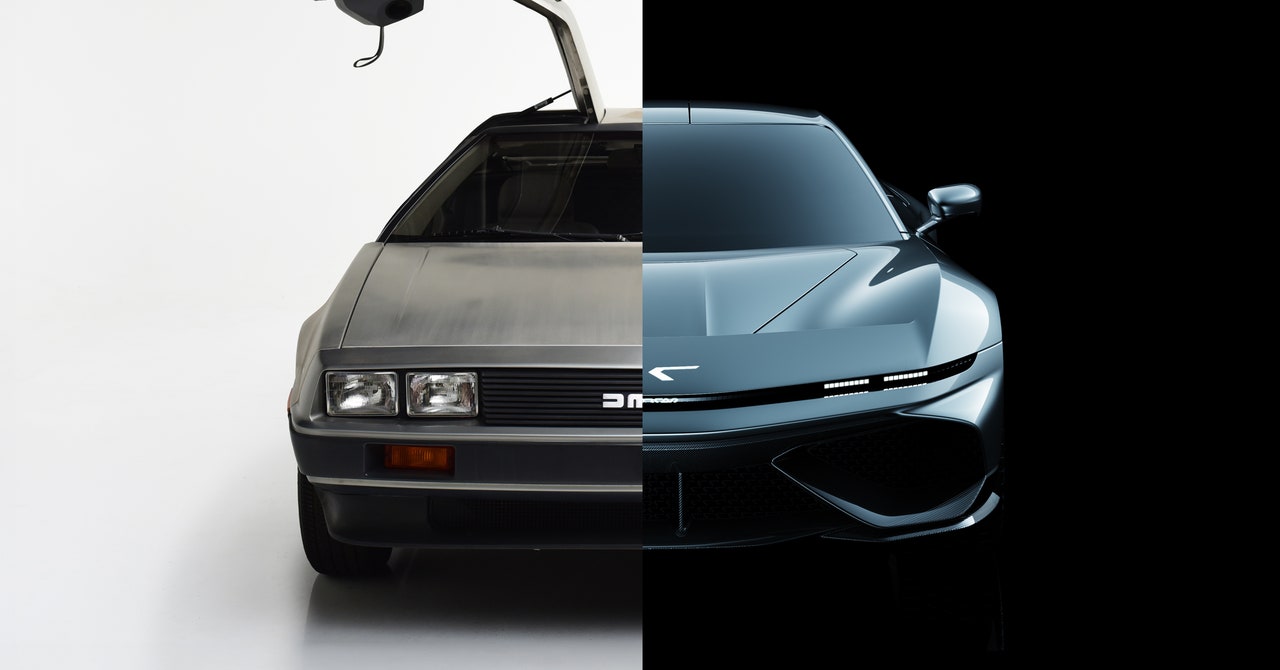
The news spread, first with an item on Fox News and then in outlets all over the world. Jason was so high on enthusiasm for the new company, and pride in his wife’s ambition, that he dashed off a public promise on the DNG Motors Instagram account. “UNVEILED SEPTEMBER 13, 2023,” read an image of white text on a black background, with Jason’s caption: “DeLorean is back in the Motor City.” He’d just committed them to building a car for the Detroit Auto Show. When Kat saw the post, she flipped out.
Soon afterward, the DeLorean Motor Company in Texas sent Kat a cease-and-desist, demanding she stop using the DeLorean name for her planned car. She and Jason had their lawyer send a reply asserting their rights and expressing their willingness to litigate, and kept going.
DeLorean Motor Company sits in a squat building off a tangle of highways in suburban Houston—you drive past some shabby lots and fields, and then the 1980s spring up around a curve in the road, where a retro-looking DMC logo looms over a row of DMC-12s in the parking lot. You might even spot a JIGAWAT license plate there. Inside the garage/warehouse is an array of disembodied gull-wing doors that evoke a flock of injured birds. Old covers of Deloreans magazines stare out from frames in the showroom.
This is the realm of Stephen Wynne, a Liverpool-born mechanic who has devoted his life to DeLorean the car—to the point of driving his son Cameron to kindergarten in DMC-12s that appeared in Back to the Future. Wynne is less impressed with DeLorean the man, however. “I have more respect for the team that he put together,” he says. “All you hear about is John DeLorean and not the team, and that, to me, is not right.” John was, Wynne said, ahead of his time as an engineer. But: “He made the company, and he also, you know, killed the company in the end.”
It was Wynne who picked up the pieces, effectively securing a monopoly on the small, strange market for DeLorean parts. This was not a decision about preserving someone else’s legacy; it was about securing his own future. “It felt to me like, to control my destiny, going forward, it was to have control of the parts,” he told me in the shop as tools clanked against cars behind us. “If someone was going to get it, I wanted it to be me.” He founded the new DeLorean Motor Company in 1995.
Wynne considers the original buyers of the 1980s DeLorean to have been “entrepreneurial, outside-of-the-box-thinking type people,” with something a “little bit different about them”—less interested in owning a really fast sports car than a piece of cultural history. (The original DeLorean did 0 to 60 in about 10.5 seconds, something my used Hyundai can easily beat.) “We believe that there’s much more wealth in that market these days,” Wynne says.
Over the years, Wynne and team made various plans to serve this market of “modern nerds” with new cars built mostly from original parts. But federal regulators were slow to relax the rules that said these historic replicas had to meet current safety standards, so the revival of the DMC-12—with its lack of airbags, a third brake light, and antilock brakes, for instance—never happened. Still, the company did a thriving business in parts sales and car service. It also made a good buck from the DeLorean brand, which it alternately licensed for apparel, video games, and the like, or zealously protected via cease-and-desists and lawsuits.
Fan, X. et al. Opportunities of flexible and portable electrochemical devices for energy storage: expanding the spotlight onto semi-solid/solid Electrolytes. Chem. Rev.122, 17155–17239 (2022).
Sumboja, A. et al. Electrochemical energy storage devices for wearable technology: a rationale for materials selection and cell design. Chem. Soc. Rev.47, 5919–5945 (2018).
Vijayakumar, V., Anothumakkool, B., Kurungot, S., Winter, M. & Nair, J. R. In situ polymerization process: an essential design tool for lithium polymer batteries. Energy Environ. Sci.14, 2708–2788 (2021).
Chen, S. et al. Carbon-Based Fibers for Advanced Electrochemical Energy Storage Devices. Chem. Rev.120, 2811–2878 (2020).
Zhao, Q., Liu, X., Stalin, S., Khan, K. & Archer, L. A. Solid-state polymer electrolytes with in-built fast interfacial transport for secondary lithium batteries. Nat. Energy4, 365–373 (2019).
Ling, S. et al. Densifiable ink extrusion for roll-to-roll fiber lithium-ion batteries with ultra-high linear and volumetric energy densities. Adv. Mater.35, 2211201 (2023).
Rao, J. et al. All-fiber-based quasi-solid-state lithium-ion battery towards wearable electronic devices with outstanding flexibility and self-healing ability. Nano Energy51, 425–433 (2018).
Zapata-Benabithe, Z., Carrasco-Marín, F. & Moreno-Castilla, C. Preparation, surface characteristics, and electrochemical double-layer capacitance of KOH-activated carbon aerogels and their O- and N-doped derivatives. J. Power Sources219, 80–88 (2012).
El-Kady, M. F. et al. Engineering three-dimensional hybrid supercapacitors and microsupercapacitors for high-performance integrated energy storage. Proc. Natl Acad. Sci. USA112, 4233–4238 (2015).
Nishi, T., Nakai, H. & Kita, A. Visualization of the state-of-charge distribution in a LiCoO2 cathode by in situ Raman imaging. J. Electrochem. Soc.160, A1785 (2013).
Chong, W. G. et al. Lithium–sulfur battery cable made from ultralight, flexible graphene/carbon nanotube/sulfur composite fibers. Adv. Funct. Mater.27, 1604815 (2017).
Xia, Z. et al. Manipulating hierarchical orientation of wet-spun hybrid fibers via rheological engineering for Zn-ion fiber batteries. Adv. Mater.34, 2203905 (2022).
Zeng, Y. et al. An ultrastable and high-performance flexible fiber-shaped Ni–Zn battery based on a Ni–NiO heterostructured nanosheet cathode. Adv. Mater.29, 1702698 (2017).
Zhang, Y. et al. Flexible and stretchable lithium-ion batteries and supercapacitors based on electrically conducting carbon nanotube fiber springs. Angew. Chem. Int. Ed.53, 14564–14568 (2014).
Hoshide, T. et al. Flexible lithium-ion fiber battery by the regular stacking of two-dimensional titanium oxide nanosheets hybridized with reduced graphene oxide. Nano Lett.17, 3543–3549 (2017).
Weng, W. et al. Winding aligned carbon nanotube composite yarns into coaxial fiber full batteries with high performances. Nano Lett.14, 3432–3438 (2014).
Artist’s impression of the Brightline West high-speed rail line
Brightline West
Construction began today on the first true high-speed rail line in the US, which will connect Los Angeles suburbanites to the bright lights of Las Vegas, Nevada. Not only should the project enable people in the US to finally experience European and Asian standards of speedy passenger trains, it could also offer a commercial model for building high-speed rail lines elsewhere in the US.
A groundbreaking ceremony today in Las Vegas, attended by US Secretary of Transportation Pete Buttigieg alongside Nevada and California state officials, marked the official start of construction for the Brightline West project. With a targeted completion in four years – just in time for the 2028 Summer Olympics in Los Angeles – Brightline West is expected to whisk passengers at speeds of up to 320 kilometres per hour down the median of the Interstate 15 highway, bypassing lines of cars stuck in weekend traffic jams.
The $12 billion project may seem like a bold gamble for Brightline and its owner, Fortress Investment Group, even with a $3 billion federal grant announced by President Joe Biden back in December 2023. But there are several reasons why Brightline West may succeed where other US high-speed rail projects have fallen behind.
Brightline is focused on connecting major markets separated by about 400 to 550 kilometres, according to a report by the infrastructure consultancy AECOM. That represents a sweet spot where high-speed rail is very competitive with driving and flying. The 350-kilometre Brightline West trip from Las Vegas to the Los Angeles suburbs is supposed to take just over 2 hours – representing an attractive alternative to the 4-hour drive that 50 million people travelling between the cities make each year.
“High-speed rail has been proven to be a very efficient way to move a high volume of passengers within a median distance,” says Junfeng Jiao at the University of Texas at Austin. “There’s a market there with many successful examples in European countries and Asian countries that have proven you can make a profit in high-speed rail operations.”
Another factor in Brightline’s favour is that it leased access from Nevada and California to build Brightline West through the existing Interstate 15 corridor. That bypasses the typical costs and delays involved in obtaining rights of way and acquiring land.
A reduced risk of delay can also keep overall project costs down over time. California’s own high-speed rail project, which was first approved by voters in 2008 to link San Francisco to Los Angeles, has seen estimated project costs skyrocket from $33 billion to $128 billion. Other high-speed rail projects are currently being considered for Texas and the Pacific Northwest.
“Time is not your friend if you’re talking about preparing for or going through with construction [because of] inflation,” says Jan Whittington at the University of Washington in Seattle. “These projects are so large that they are like implementing multiple mega projects that are all dependent on each other for successful completion.”
One lesson that US state rail authorities could learn from Brightline is to “value the cost of delay and indecision” by avoiding a lengthy planning phase, says Russell Jackson, global transit director at AECOM. And although Brightline’s approach focuses only on the most potentially profitable routes, he suggests that government funding can fill the gap for other cases.
“The public purse can be used for those projects that are still needed to connect city pairs that are a little bit too close together for airline travel and too far apart for cars,” says Jackson.
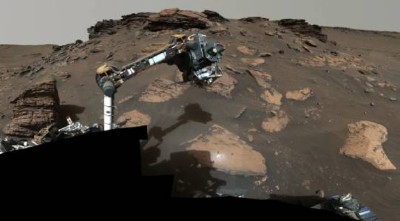
NASA’s Perseverance rover collects a sample from a Martian rock using a bit on the end of its robotic arm.Credit: NASA/JPL-Caltech
NASA announced today that it is abandoning its longstanding plan for ferrying rock and soil samples from Mars to Earth. Instead the agency will seek proposals for quicker and cheaper ways to deliver the samples to Earth.
An independent review board concluded last year that NASA’s Mars sample return mission could cost as much as US$11 billion, more than what it cost to launch the James Webb Space Telescope. In a report released today, a separate NASA review team concluded that even if the agency spent that much money, the dropoff of the samples on Earth would be delayed until 2040. The agency had originally sought to land the samples on Earth in the early 2030s.
The $11 billion price tag is “too expensive,” said NASA administrator Bill Nelson at a press briefing, and “not returning the samples until 2040 is unacceptable.” Nelson said the agency “is committed to bringing at least some of the samples back” and later said NASA would return “more than 30” of the 43 planned samples.
Scaling back
NASA’s Perseverance rover has already collected more than 20 rock samples from Jezero Crater, where the rover landed in 2020. Scientists think that the crater was once filled with a lake of water, and samples from the crater and its surroundings could provide a window into the planet’s history and, perhaps, evidence of past life on the red planet.
In the agency’s original vision, a NASA spacecraft would have flown to Mars carrying a two-part retrieval system: a half-ton lander — which would have been the most massive vehicle to ever land on Mars — and a rocket to fly the lander and samples into Martian orbit. There they were to meet a spacecraft launched by the European Space Agency that would fly the samples to Earth.
Now NASA plans to solicit proposals — from companies as well as NASA centres — for a streamlined system, perhaps one that uses a lighter lander, Nicky Fox, the associate administrator for NASA’s Science Mission Directorate, said at the briefing. The deadline for proposals is 17 May, and the revised mission will be chosen later this year. Fox did not respond directly to reporters’ questions about when the samples will reach Earth under the new scheme.
NASA recommends spending $200 million of its planetary-science budget in 2025 on assessing alternative architectures for Mars sample return, Fox said. Dedicating any more money to the mission threatened to “cannibalize” other planetary science missions, Nelson said.
Back to the drawing board
Vicky Hamilton, a planetary scientist at the Southwest Research Institute in Boulder, Colorado, expressed disappointment that eight months after the independent review board released its report, the agency still lacks a solid plan for “a very valuable science goal.”
Returning these samples would also demonstrate capability for two-way trip to Mars before we can send astronauts, says Bethany Ehlmann, a planetary scientist at the California Institute of Technology in Pasadena, California. “The sample return technology is here, it exists,” she says. “It’s a matter of putting the pieces together.”
But scientists were relieved by one announcement: Fox said the revised timeline for sample return will not affect the science goals for Perseverance, including plans for it to explore terrain beyond Jezero Crater.
NASA’s Mars rover makes ‘fantastic’ find in search for past life
Among samples collected outside the crater will be “some of the ancient crust of Mars, representing rocks older than we have seen yet in Jezero Crater, some of which may have been altered by near-surface water,” says Meenakshi Wadhwa, a planetary scientist at Arizona State University in Tempe and principal scientist for the Mars Sample Return program.
So far, the only Mars samples that scientists have been able to study on Earth are bits and pieces ejected from the red planet that made it to Earth as meteorites. All known Martian meteorites are “igneous” rocks, meaning that they solidified from lava, and all are very old. As a result, they provide valuable timestamps for Mars’ geological evolution, but carry little information about how the planet’s surface was shaped by the water that once flowed across it.
To achieve the mission’s main goal of searching for signs of past life, the real treasures are layered sedimentary rocks formed by minerals and organic matter deposited over the aeons by water. Perseverance’s instruments have already detected organic molecules in Martian samples, but whether those molecules are a marker of past life can only be determined by closer scrutiny in laboratories on Earth.
Nature, Published online: 09 April 2024; doi:10.1038/d41586-024-00919-7
What every biologist should know about electronics, plus a disturbing outbreak of volcanism in North Carolina, in the weekly dip into Nature’s archive.
The complexity of fitting brakes to all four wheels of a car and the simplicity of John Maynard Smith’s ecological models, in the weekly dip into Nature’s archive.