Tag: Fluoride

  • As bans spread, fluoride in drinking water divides communities across the US

    As bans spread, fluoride in drinking water divides communities across the US

    [ad_1]

    “Our water has been cloudy and bubbly and looks milky,” said Barrett, who blames fluoride, a mineral that communities across the nation have for decades added to the water supply to help prevent cavities and improve dental health.

    “I don’t want fluoride in my nothing!” said Barrett, echoing a growing number of people who not only doubt the mineral’s effectiveness but also believe it may be harmful despite decades of data pointing to public health and economic benefits.

    In February, the Board of County Commissioners in Union County, whose seat is Monroe, voted 3-2 to stop adding fluoride to drinking water at the Yadkin River Water Treatment Plant, the only water source wholly owned and operated by the county. But the decision came after heated discussions among residents and county officials.

    “My children had the blessing of growing up with fluoride in their water and … they have very little dental issues,” said Commissioner Richard Helms ahead of the vote. A fellow commissioner saw it differently: “Let’s stop putting something in the water that’s meant to treat us, and give people the freedom to choose,” said David Williams.

    Barrett’s water comes from the city of Monroe, not the Yadkin facility. So, for now, she will continue to drink water enhanced with fluoride. “I’m suspicious as to why they add that to our water,” she told KFF Health News.

    It is a scenario playing out nationwide. From Oregon to Pennsylvania, hundreds of communities have in recent years either stopped adding fluoride to their water supplies or voted to prevent its addition. Supporters of such bans argue that people should be given the freedom of choice. The broad availability of over-the-counter dental products containing the mineral makes it no longer necessary to add to public water supplies, they say. The Centers for Disease Control and Prevention says that while store-bought products reduce tooth decay, the greatest protection comes when they are used in combination with water fluoridation.

    The outcome of an ongoing federal case in California could force the Environmental Protection Agency to create a rule regulating or banning the use of fluoride in drinking water nationwide. In the meantime, the trend is raising alarm bells for public health researchers who worry that, much like vaccines, fluoride may have become a victim of its own success.

    The CDC maintains that community water fluoridation is not only safe and effective but also yields significant cost savings in dental treatment. Public health officials say removing fluoride could be particularly harmful to low-income families — for whom drinking water may be the only source of preventive dental care.

    “If you have to go out and get care on your own, it’s a whole different ballgame,” said Myron Allukian Jr., a dentist and past president of the American Public Health Association. Millions of people have lived with fluoridated water for years, “and we’ve had no major health problems,” he said. “It’s much easier to prevent a disease than to treat it.”

    According to the anti-fluoride group Fluoride Action Network, since 2010, over 240 communities around the world have removed fluoride from their drinking water or decided not to add it.

    One needs only to look to Union County to see just how intense discussions can be. Usually when the commissioners meet on the first floor of the Government Center in downtown Monroe, there are more vacant seats than attendees. But sessions about the prohibition of fluoride in public water supplies were packed, and residents who signed up to speak were divided.

    One person who came to the microphone on Feb. 5 compared water fluoridation to a seat belt. It does not “prevent the car crash, but it limits the harm done,” he said. Another argued that there is no proof fluoride is safe or effective. “It’s a significant potential milestone to reverse 60-plus years of poisoning the public,” he said, using an unproven claim often made by opponents of fluoridation.

    Fluoride opponents claim the mineral is responsible for everything from acne to high blood pressure and thyroid dysfunction to bone cancer.

    The National Institutes of Health acknowledges that, when ingested in extremely large amounts, fluoride from dental products or dietary supplements can cause nausea, vomiting, abdominal pain, diarrhea, bone pain, and even death in extremely rare cases.

    Infants and children who receive too much fluoride can develop discoloration or small dents in their teeth. In adults, consumption of excessive fluoride for extended periods can lead to skeletal fluorosis, a very rare condition that causes joint pain and stiffness, weak bones, muscle loss, and nerve problems.

    However, the recommended dosage in drinking water has always been small. In 2015, the Department of Health and Human Services lowered the optimal fluoride concentration from 1.2 milligrams per liter to 0.7 mg/L.

    Juneau, Alaska, voted to remove fluoride from its drinking water in 2007. A study published in the journal BMC Oral Health in 2018 compared the dental records of children and adolescents who received dental care for decaying teeth four years before and five years after the city stopped adding fluoride to the water. Cavity-related procedures and treatment costs were significantly higher in the latter group, the study found.

    Portland, Oregon, is the largest city in the nation that has consistently refused to fluoridate its drinking water. Voters have repeatedly rejected measures to add it, first in 1956 and the latest time in 2013.

    Despite the strong recommendation of local doctors and dentists, voters in Wichita, Kansas, have rejected adding fluoride to the water several times, most recently in 2012.

    The Brushy Creek Municipal Utility District in Williamson County, Texas, had been adding fluoride to its water system since 2007 but ended the practice in December.

    In 2016, Collier County, Florida, commissioners opted not to remove fluoride from the water system. But they unanimously reversed that decision following a 2023 Health Freedom Bill of Rights county ordinance in response to covid-19 “to safeguard the healthcare rights and freedoms of Collier County residents.”

    The State College Borough Water Authority in Pennsylvania stopped adding fluoride to the water of its 75,000 customers in March 2023. Officials used claims often cited by fluoride opponents, such as potential environmental contamination, concerns about medical freedom, and possible adverse health effects, like the potential for the appearance of faint white lines on the teeth and lowered IQ for babies.

    A study published in JAMA Pediatrics in 2019, conducted in six Canadian cities, associated fluoride exposure during pregnancy with lower IQ scores in children. But the study was based on self-reporting and has been criticized for its perceived methodological shortcomings.

    In 2016, several consumer advocacy groups, including the Fluoride Action Network, Food & Water Watch, and Moms Against Fluoridation, petitioned the EPA to end water fluoridation under the Toxic Substances Control Act, alleging that significant research showed fluoride was neurotoxic at the doses now used. The same group filed a federal lawsuit against the EPA the following year, after the agency denied their citizen petition.

    During a 10-day bench trial in San Francisco that concluded in mid-February, the two sides debated the risks and areas of uncertainty. If Senior U.S. District Judge Edward Chen determines water fluoridation presents an “unreasonable risk” to human health, the EPA will be forced to create a rule regulating or banning water fluoridation in the U.S. A decision is expected soon.

    For the time being, decisions about whether to fluoridate community water systems are still made primarily at the local level, which Barrett hopes will change.

    “Of all things, they want our teeth healthy when basic needs of housing and food are lacking.”


    Kaiser Health NewsThis article was reprinted from khn.org, a national newsroom that produces in-depth journalism about health issues and is one of the core operating programs at KFF – the independent source for health policy research, polling, and journalism.

    [ad_2]

    Source link

  • Inexpensive liquid works as well as dental sealants to keep tooth decay at bay

    Inexpensive liquid works as well as dental sealants to keep tooth decay at bay

    [ad_1]

    An inexpensive, cavity-fighting liquid called silver diamine fluoride (SDF) works as well as dental sealants to keep tooth decay at bay in a school cavity prevention and treatment program, according to a new study by researchers at NYU College of Dentistry. 

    The study, which followed more than 4,000 elementary school students for four years and is published in JAMA Pediatrics, shows that SDF is an effective alternative to sealants, and can increase access to dental care while reducing costs.

    Dental cavities are the most prevalent chronic disease in children and can lead to pain, school absences, and lower academic performance. To prevent cavities, especially among children less likely to see a dentist, the Centers for Disease Control and Prevention (CDC) supports the use of school sealant programs. In sealant programs, dental professionals visit schools to apply a thin, protective coating to the surface of teeth that hardens and safeguards against decay.

    SDF has emerged as another promising treatment for fighting cavities. Originally approved by the FDA for treating tooth sensitivity, the solution is brushed onto the surface of teeth, killing decay-causing bacteria and remineralizing teeth to prevent further decay.

    A growing body of research shows that SDF-;which is quicker to apply and less expensive than sealants-;can prevent and arrest cavities, reducing the need for drilling and filling.”


    Richard Niederman, DMD, professor of epidemiology & health promotion at NYU College of Dentistry and study’s senior author

    SDF in schools

    Researchers at NYU College of Dentistry led CariedAway, the nation’s largest school-based cavity prevention study, to compare the use of SDF and traditional sealants. The study included approximately 4,100 children in New York City elementary schools; more than a quarter of kids had untreated cavities at the start of the study.

    At each school visit, a team of health professionals examined children’s teeth and applied either sealants or SDF followed by fluoride varnish, depending on which treatment the school was randomly assigned to receive. Sealants were administered by dental hygienists, while SDF was applied by either dental hygienists or registered nurses, all under the supervision of a dentist. Starting in 2018, the team visited each school twice a year, although the COVID-19 pandemic and school closures led to missed visits.

    The researchers reported last year in the journal JAMA Network Open that a single treatment of either SDF or sealants prevented 80% of cavities and kept 50% of existing cavities from worsening two years later. The team continued their study for another two years, and in their study published in JAMA Pediatrics, found that SDF and sealants prevented roughly the same number of cavities after children were followed for a total of four years. Moreover, both sealants and SDF reduced the risk of decay at each follow-up visit.

    “Our longitudinal study reaffirms that both sealants and SDF are effective against cavities. SDF is a promising alternative that can support school-based cavity prevention-;not to replace the dental sealant model, but as another option that also prevents and arrests decay,” said Ryan Richard Ruff, PhD, MPH, associate professor of epidemiology & health promotion at NYU College of Dentistry and the study’s first author.

    “Most research shows that SDF can stop a cavity from progressing further. Our study demonstrated that SDF can prevent cavities from happening in the first place,” said Tamarinda Barry Godín, DDS, MPH, associate program director and supervising dentist for CariedAway, research scientist at NYU College of Dentistry, and the study’s coauthor. 

    An “untapped” oral health workforce

    Embracing SDF for cavity prevention and treatment in schools could keep kids from needing fillings, saving families and the healthcare system money. Yet these programs can only succeed if there are enough health professionals to provide care.

    The NYU researchers found that children who had SDF applied by dental hygienists and registered nurses had similar outcomes, suggesting that nurses-;including school nurses-;could play a crucial role in cavity prevention programs. 

    “Nurses may be an untapped resource for addressing oral health inequities,” added Ruff. “Our results suggest that nurses can effectively provide this preventive care, which could dramatically improve access, given the role of school nurses and the size of the nursing workforce.”

    This research was funded by the Patient-Centered Outcomes Research Institute (PCS-160936724). The CariedAway cavity prevention model is currently being used in three New Hampshire school districts, supported by Northeast Delta Dental. 

    Source:

    Journal reference:

    Ruff, R. R., et al. (2024). Noninferiority of Silver Diamine Fluoride vs Sealants for Reducing Dental Caries Prevalence and Incidence: A Randomized Clinical Trial. JAMA Pediatrics. doi.org/10.1001/jamapediatrics.2023.6770.

    [ad_2]

    Source link

  • Study says parents may overshoot fluoride toothpaste dose for toddlers, risking dental fluorosis

    Study says parents may overshoot fluoride toothpaste dose for toddlers, risking dental fluorosis

    [ad_1]

    In a recent study published in the journal BDJ Open, researchers in Canada and Germany tested the doses of fluoride toothpaste that parents gave to children up to two years old. Their results indicate that many parents may give their children significantly more toothpaste than optimal and should adopt fluoride-free alternatives to avoid fluoride consumption.

    Image Credit: Inna Reznik / Shutterstock

    Background

    While good oral hygiene during childhood is critical to prevent dental caries and other oral diseases, the fluoride present in toothpaste has raised toxicological concerns about its safety for infants and toddlers.

    Studies have also observed that despite fluorides being used frequently around the world, dental caries continue to be prevalent, with global estimates suggesting that they affect nearly half of all children.

    Fluoride may cause chronic toxicity and other adverse long-term effects. For this reason, guidelines in different parts of the world suggest limiting the dose of fluoride for young children to a small smear or the size of a single grain of rice (up to 24 months of age) or a pea (for children under six).

    However, young children may swallow 64-100% of their toothpaste, putting them at risk of dental fluorosis since they are being systematically exposed to fluoride. Therefore, it is crucial to collect more information on how much toothpaste their parents are giving them.

    About the study

    In this study, researchers hypothesized that parents would find it challenging to follow guidelines recommending giving children aged up to two years one grain’s rice worth of toothpaste. They tested this hypothesis by testing the real-life doses of toothpaste given by parents to their children.

    The study was undertaken across five daycare centers in Germany, where parents were given two commercially available brands of toothpaste containing 1,000 ppm of fluoride and suitable for children and asked to dose them as they usually did at home.

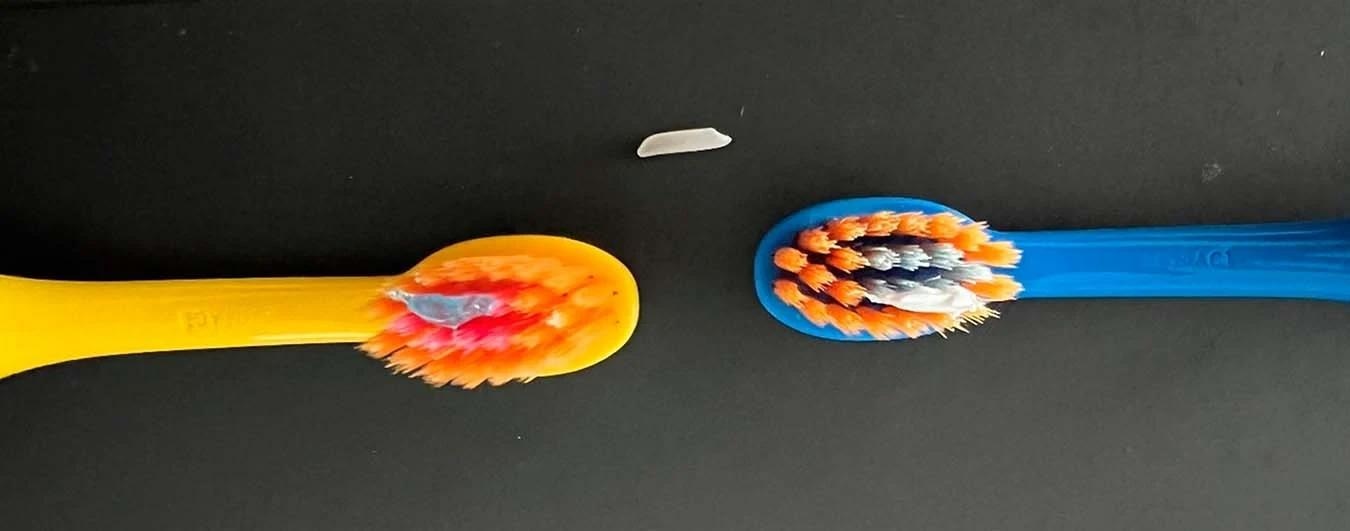
    Photograph of the reference doses (i.e., a grain of rice-size amount of toothpaste as recommended for toothpastes for children aged up to 24 months with 1000 ppm fluoride) of toothpaste A (left) and toothpaste B (right) on children’s toothbrushes. A natural grain of rice was used as model. Both amounts were dosed by an experienced dentist.

    Photograph of the reference doses (i.e., a grain of rice-size amount of toothpaste as recommended for toothpastes for children aged up to 24 months with 1000 ppm fluoride) of toothpaste A (left) and toothpaste B (right) on children’s toothbrushes. A natural grain of rice was used as model. Both amounts were dosed by an experienced dentist.

    To be included in the study, they needed to use fluoride toothpaste for children at home regularly. Parents of children older than two years were asked to provide a dose based on what they did before the child’s second birthday. This was considered to be representative of how much they would give their children at home.

    The weight of each dose was determined and compared with the ‘optimal’ recommendation of one grain. Parents were also asked to state how frequently their child’s teeth were brushed every day to calculate fluoride exposure, as well as their knowledge of the optimal doses.

    Findings

    The children were, on average, 24 months old at the time of the study, and 61 parents met the inclusion criteria. More than 60% of parents said that their children brushed twice daily, while about 23% said they brushed thrice daily.

    The average value of a reference dose of fluoride was 0.039-0.045g; however, parents dosed their children with 0.263-0.281g of fluoride on average. The overdose factor was between 5.6 and 8.2.

    More than 60% of parents did not know about fluoride health warnings or conditions for its use. Nearly 15% used fluoride tablets in addition to fluoride toothpaste for their child.

    Conclusions

    These findings show that children may be receiving overdoses of fluoride from their parents. The authors noted that they may be underestimating children’s exposure to the substance, as fluoride is also present in foods such as rice, cow milk, and bananas, as well as drinking water and sometimes salt.

    However, even fluoride intake through toothpaste exceeded what is considered to be an upper limit to avoid dental fluorosis. Further research should undertake a comprehensive risk assessment, including other sources of fluorides, and also consider the possibility of neurotoxicity as an outcome. It should also take socioeconomic factors into account.

    One of the reasons for large dose sizes could be that television commercials often showcase excess amounts of toothpaste on brushes. For example, previous studies had shown that most advertisements depicted a large swirl of paste that covered the entire head of the brush, far exceeding the recommended dose. The flavor of toothpaste may also be palatable to children, leading them to ingest more.

    Since dispensing a rice grain’s worth of fluoride may be challenging for parents, the researchers suggest using fluoride-free toothpaste varieties, including some other anti-caries substances.

    These could include calcium sodium phosphosilicate or hydroxyapatite, of which the latter has been clinically shown to be protective against caries. It is safe for infants and toddlers if swallowed and can reduce bacterial colonization on the surface of teeth. Encouraging parents to replace fluoride toothpaste with efficient and safe alternatives can promote oral care in young children – and keep them safe from fluorosis.

    Journal reference:

    [ad_2]

    Source link