Tag: Fuel

  • New Catalyst Could Provide Liquid Hydrogen Fuel of the Future

    New Catalyst Could Provide Liquid Hydrogen Fuel of the Future

    [ad_1]

    Chemistry Catalyst Concept

    Researchers are developing a hydrogen-based car fuel system with zero greenhouse emissions, using a liquid converted by a catalyst. The method, still under research, faces challenges like catalyst durability and the eco-friendliness of hydrogen production, highlighting the need for political support for renewable energy.

    Researchers at Lund University in Sweden have developed an innovative car fuel system that operates in a circular manner, minimizing greenhouse gas emissions. This system utilizes a unique liquid that, when combined with a solid catalyst, transforms into hydrogen fuel for the car. After usage, the spent liquid is removed from the vehicle’s tank and recharged with hydrogen, making it ready for reuse. This process forms a closed-loop system that significantly reduces environmental impact.

    In two research articles, Lund researchers have demonstrated that the method works, and while it is still basic research, it has the potential to become an efficient energy-storage system in the future.

    “Our catalyst is one of the most efficient around, at least if you look at publicly available research,” says Ola Wendt, professor at the Department of Chemistry at Lund University, and one of the authors.

    Addressing Climate Impact and Exploring Hydrogen Gas

    Finding alternative ways of producing, storing, and transforming energy in order to reduce carbon dioxide emissions from fossil fuels is necessary to reduce the impact on the climate. One way involves much-talked-about hydrogen gas, which many see as a future solution for energy storage. Nature stores energy in chemical bonds, and hydrogen contains the highest energy density in relation to its weight.

    “However, gas can be difficult to handle, so we are looking at liquid fuel charged with hydrogen that can be delivered at a pump, in a way broadly similar to what happens at petrol stations today,” says Ola Wendt.

    The concept is known as LOHC (liquid organic hydrogen carriers) and is not new as such. The challenge is in finding as efficient a catalyst as possible, that can extract the hydrogen from the liquid.

    The system is intended to work using a liquid that is “charged” with hydrogen. The liquid is pumped through a solid catalyst which extracts the hydrogen. This can be used in a fuel cell – which converts chemical fuel to electricity – while the “spent” liquid carries on to another tank. The only emission is water.

    Refueling and Large Scale Production

    The spent liquid can then be emptied at a filling station before refueling with new, charged liquid. This would probably mean large-scale production of the substance, comparable to today’s oil refineries. 

    “We converted more than 99 percent of the hydrogen gas that was present in the liquid,” says Ola Wendt.

    Researchers have also been calculating whether it might be possible to use the fuel for larger vehicles such as buses, trucks, and aircraft.

    “With the large tanks that they have, it might be possible to cover almost the same distance as you can with a tank of diesel. You would also convert around 50 percent more energy compared to compressed hydrogen,” says Ola Wendt.

    Components and Challenges

    The liquids used are isopropanol (which is a common ingredient in screenwash) and 4-methylpiperidine.

    Does this sound a little too good to be true? Yes – for now at least, a number of challenges remain. One is that the lifespan of the catalyst is rather limited. Another is that iridium, which the catalyst is based on, is a precious metal.

    “But we estimate that you need about two grams of iridium per car. This could be compared to today’s exhaust-cleaning catalytic converters, which contain about three grams of platinum, palladium, and rhodium, which are also precious metals,” says Ola Wendt.

    This is a technical solution based on basic research. If a decision was made to go for a finished product, Ola Wendt believes that the concept could be ready in ten years’ time – provided that it is economically viable and that there is interest from society.

    Another problem is how hydrogen is produced – today, most production is not climate-friendly. The hydrogen then needs to be stored and transported in an effective way, which is not that straightforward today. There are also the risks of refueling with compressed hydrogen. The Lund researchers hope to solve this with their method.

    “Ninety-eight percent of all hydrogen today is fossil-based, produced from natural gas. The byproduct is carbon dioxide. From an environmental point of view, the notion of producing hydrogen for steel, batteries, and fuel is pointless if it is done using natural gas,” says Ola Wendt, but he explains that there is a lot of research going on into how “green hydrogen” might be produced by splitting water into hydrogen and oxygen with the help of renewable energy.

    At the same time, Ola Wendt believes that political decisions are required for renewable and climate-friendly alternatives to gain a proper foothold.

    “It needs to be cheaper, and it takes political decisions. Renewables have no chance of competing with something that you just dig out of the ground, where transport is almost the only cost, as is the case with fossil fuels,” he concludes.

    References: “Acceptorless dehydrogenation of 4-methylpiperidine by supported pincer-ligated iridium catalysts in continuous flow” by Kaushik Chakrabarti, Alice Spangenberg, Vasudevan Subramaniyan, Andreas Hederstedt, Omar Y. Abdelaziz, Alexey V. Polukeev, Reine Wallenberg, Christian P. Hulteberg and Ola F. Wendt, 27 July 2023, Catalysis Science & Technology.
    DOI: 10.1039/D3CY00881A

    “Iridium-Catalyzed Dehydrogenation in a Continuous Flow Reactor for Practical On-Board Hydrogen Generation From Liquid Organic Hydrogen Carriers” by Alexey V. Polukeev, Reine Wallenberg, Jens Uhlig, Christian P. Hulteberg and Ola F. Wendt, 09 March 2022, ChemSusChem.
    DOI: 10.1002/cssc.202200085


    [ad_2]

    Source link

  • Sunlight to Syngas: Revolutionizing Methane Reforming

    Sunlight to Syngas: Revolutionizing Methane Reforming

    [ad_1]

    Energy Fuel Gas Production Concept Art

    Scientists have developed a novel photocatalyst system for efficient syngas production from methane steam reforming, using solar energy and operating under atmospheric pressure. This technology marks a significant step towards sustainable syngas production and a post-carbon energy future. Credit: SciTechDaily.com

    A new solar-driven photocatalysis method for syngas production from methane steam reforming promises a more sustainable and efficient approach to syngas generation.

    Recent research reveals a breakthrough in solar-driven syngas production, marking a potential transition to a post-carbon energy era. This innovative process involves the reforming of methane steam, a method that heats methane with steam in the presence of a catalyst to generate hydrogen and carbon monoxide, collectively known as syngas. Syngas is a valuable resource, serving as a versatile fuel.

    Challenges in Methane Steam Reforming

    Historically, achieving the necessary chemical reactions for methane steam reforming has been challenging. The process typically demands high temperatures between 700 and 1000 degrees Celsius and pressures exceeding 20 bar. These demanding conditions have limited its practicality and efficiency.

    Syngas Photocatalysis Made Easy

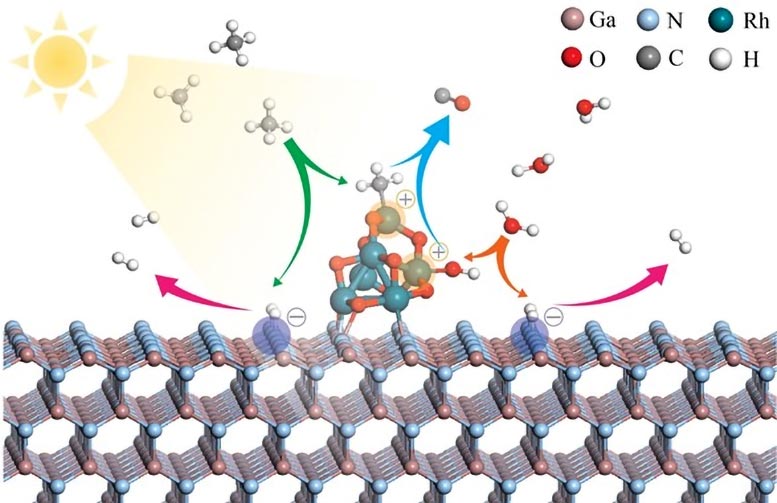
    Schematic for simultaneous adsorption/activation of CH4 and H2O by RhOx/GaN system based on density functional theory calculations. Credit: Li et al.

    Photocatalysis: A Novel Approach

    Baowen Zhou and his team introduce a pioneering photocatalysis platform that enables syngas production in a quartz chamber under atmospheric pressure illuminated by a 300 W Xenon lamp without any other energy inputs. The core of this technology is based on group III nitride nanowires enhanced with rhodium nanoclusters.

    Mechanism of the Photocatalytic Process

    Detailed theoretical calculations, microscopic examinations, and in situ spectroscopic measurements have demonstrated that the RhOx/GaN@InGaN nanowires are capable of activating both methane and water molecules under light exposure. Just add light, and methane is split into methyl anions and hydrogen species, while water is split into hydrogen species and hydroxide. Subsequent reactions, facilitated by rhodium and gallium nitride, lead to the formation of syngas.

    Efficiency and Stability of the New System

    The effectiveness of this new method is evident, with a production rate of 8.1 mol syngas per gram of hydrogen and 10493 mol syngas per mol rhodium oxides observed over a 300-minute stability test. This represents a significant advancement in syngas production technology.

    Reference: “A semiconducting hybrid of RhOx/GaN@InGaN for simultaneous activation of methane and water toward syngas by photocatalysis” by Dongke Li, Zewen Wu, Yixin Li, Xiaoxing Fan, S M Najib Hasan, Shamsul Arafin, Md Afjalur Rahman, Jinglin Li, Zhouzhou Wang, Tianqi Yu, Xianghua Kong, Lei Zhu, Sharif Md Sadaf and Baowen Zhou, 21 November 2023, PNAS Nexus.
    DOI: 10.1093/pnasnexus/pgad347


    [ad_2]

    Source link

  • Breakthrough Discovery Could Help Improve Fuel Production

    Breakthrough Discovery Could Help Improve Fuel Production

    [ad_1]

    Chemistry Catalyst Concept

    Researchers at Washington State University have discovered self-sustained oscillations in the Fischer Tropsch process, a key industrial method for converting coal, natural gas, or biomass into liquid fuels. This breakthrough, revealing oscillatory behavior rather than a steady state in the reaction, could lead to more efficient and controlled fuel production. The discovery offers a new, knowledge-based approach to catalyst design and process optimization in the chemical industry.

    Researchers at Washington State University have made a significant breakthrough in understanding the Fischer Tropsch process, a key industrial method for converting coal, natural gas, or biomass into liquid fuels. Unlike many catalytic reactions that maintain a steady state, they found that the Fischer Tropsch process exhibits self-sustained oscillations, alternating between high and low activity states.

    This insight, published in the journal Science, opens up possibilities for optimizing the reaction rate and increasing the yield of desired products, potentially leading to more efficient fuel production in the future.

    “Usually, rate oscillations with large variations in temperature are unwanted in the chemical industry because of safety concerns,” said corresponding author Norbert Kruse, Voiland Distinguished Professor in WSU’s Gene and Linda Voiland School of Chemical Engineering and Bioengineering. “In the present case, oscillations are under control and mechanistically well understood. With such a basis of understanding, both experimentally and theoretically, the approach in research and development can be completely different – you really have a knowledge-based approach, and this will help us enormously.”

    Rethinking Catalyst Design

    Although the Fischer Tropsch process is commonly used for fuel and chemical production, researchers have had little understanding of how the complex catalytic conversion process works. The process uses a catalyst to convert two simple molecules, hydrogen and carbon monoxide, into long chains of molecules – the hydrocarbons that are used widely in daily life.

    While a trial-and-error approach has been used in research and development in the fuels and chemical industries for more than a century, researchers will now be able to design catalysts more intentionally and tune the reaction to provoke oscillatory states that could improve the catalytic performance.

    The researchers first came upon the oscillations by accident after graduate student Rui Zhang approached Kruse with a problem: he wasn’t able to stabilize the temperature in his reaction. As they studied it together, they discovered the surprising oscillations.

    “That was pretty funny,” Kruse said. “He showed it to me, and I said, ‘Rui, congratulations, you have oscillations! And then we developed this story more and more.”

    The researchers not only discovered that the reaction develops oscillatory reaction states, but why it does so. That is, as the temperature of the reaction goes up due to its heat production, the reactant gases lose contact with the catalyst surface and their reaction slows down, which reduces the temperature. Once the temperature is sufficiently low, the concentration of the reactant gases on the catalyst surface increases and the reaction picks up speed again. Consequently, the temperature increases to close the cycle.

    Theoretical and Experimental Convergence

    For the study, the researchers demonstrated the reaction in a lab employing a frequently used cobalt catalyst, conditioned by adding cerium oxide, and then modeled how it worked. Co-author Pierre Gaspard at the Université Libre de Bruxelles developed a reaction scheme and theoretically imposed periodically changing temperatures to replicate the experimental rates and selectivities of the reaction.

    “It’s so beautiful that we were able to model that theoretically,” said corresponding author Yong Wang, Regents Professor in WSU’s Voiland School who also co-advised Zhang. “The theoretical and the experimental data nearly coincided.”

    Kruse has been working on oscillatory reactions for more than 30 years. The discovery of the oscillatory behavior with the Fischer Tropsch reaction was very surprising because the reaction is mechanistically extremely complicated.

    “We have a lot of frustration sometimes in our research because things are not going the way you think they should, but then there are moments that you cannot describe,’’ Kruse said. “It’s so rewarding, but ‘rewarding’ is a weak expression for the excitement of having had this fantastic breakthrough.”

    Reference: “The oscillating Fischer-Tropsch reaction” by Rui Zhang, Yong Wang, Pierre Gaspard and Norbert Kruse, 5 October 2023, Science.
    DOI: 10.1126/science.adh8463

    The work was supported by the Chambroad Chemical Industry Research Institute Co., Ltd., the National Science Foundation, and the Department of Energy’s Basic Energy Sciences Catalysis Science program.


    [ad_2]

    Source link