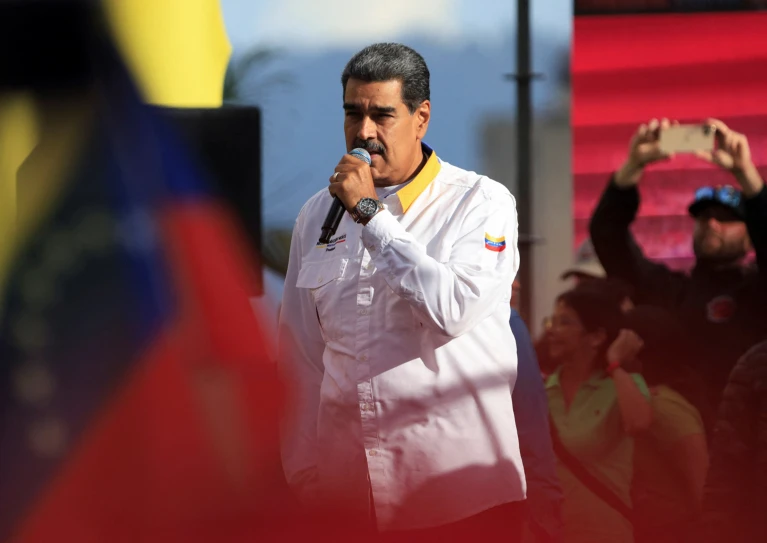
Venezuelan President Nicolás Maduro speaks at a march in early August following a disputed election the month before.Credit: Maxwell Briceno/Reuters
As President Nicolás Maduro continues a crackdown on his political opposition, researchers in Venezuela are increasingly considering leaving the country. His government has detained more than 1,600 people, including students and professors, since the National Electoral Council declared him the winner of July’s contested presidential election, according to Foro Penal, a human-rights organization based in Caracas. Edmundo González, who ran against Maduro in the election, fled for Spain on 8 September to avoid being arrested.
The Venezuelan health-care workers secretly collecting COVID stats
Scientists, some of whom spoke to Nature on the condition of anonymity because they fear retribution from the government, say that Venezuelan research was already censored and underfunded before the election, but that they anticipate things will get even worse. They point to a bill passed by Maduro’s administration last month that regulates non-governmental organizations (NGOs), which some researchers rely on for funding or to help publish their research. This latest chapter in Maduro’s reign could spell the end for independent science in the country, they say.
“I am afraid to talk to you,” retired biologist Jaime Requena told Nature as he nervously prepared to leave the country, fearing that his passport would be confiscated by authorities to prevent his departure. “Science here is going down the drain quickly.”
The Maduro administration did not respond to a request for comment.
Venezuela’s Ministry of Popular Power for Science and Technology has reported that about 24,000 people are employed in research and development. However, that number is an overestimate because it includes anyone who has a degree and staff who clean and maintain laboratories, says Requena, who has been monitoring the number of scientists in the country. In 2004, when science in Venezuela was more stable, there were only about 7,100 scientists actively engaged in research in the country, says Requena, who is a member of the Venezuelan Academy of Physical, Mathematical and Natural Sciences.
Because the science ministry no longer publishes clear, reliable information on its spending, Requena assesses research output in scientific journals as an indicator of the health of Venezuelan science. An as-yet unpublished analysis that he carried out last year suggests that there are now, at most, 1,200 still-active scientists.
Leaving in droves
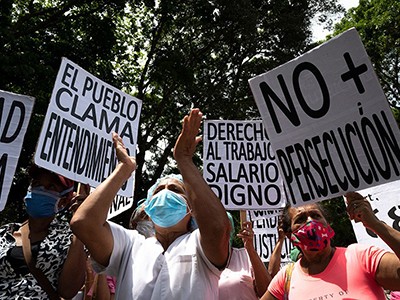
Protests erupted after Maduro was named the winner of the July presidential election. The European Union, the United States and most South American countries have questioned the legitimacy of the result and called for Maduro to release a full tally of the votes.
Protestors demonstrate in Puerto La Cruz, Venezuela, on 29 July following the disputed presidential election.Credit: Samir Aponte/Reuters
Venezuela’s economy has been in crisis since Maduro took office in 2013. The country’s gross domestic product fell from about US$373 billion at its peak in 2012 to about $44 billion at its lowest point in 2020 and has now recovered slightly to $106 billion. National science funding is around 0.3–0.4% of that (the average for countries in the Organisation for Economic Co-operation and Development is 2.7%). Nearly 8 million people — about one-quarter of Venezuela’s population — are estimated to have fled to avoid violence, hunger and poverty.
Young scientists have left in droves seeking out high-quality education or stable career prospects. Those who remain are mostly older researchers — Requena’s research suggests the average age is 55 — who are financially stable or can use international connections to get funding.
But even senior researchers have left, too. María Eugenia Grillet, a 64-year-old biologist who studies the epidemiology of mosquito-borne diseases, moved to Colombia in December 2023 to avoid power outages and to be able to conduct research freely, among other factors. Before that, she had been a researcher at the Central University of Venezuela in Caracas, where she earned $70 per month. “Daily life is very hard for everyone, and it’s going to get worse given the political situation,” she says.
In short supply
Public research institutions and universities, which employ the vast majority of the scientists that remain in Venezuela, are having trouble keeping their doors open because of the government’s lack of revenue, and because of politically-appointed officials mismanaging education and science budgets, researchers say. Equipment, supplies and personnel are all scarce.
“But it’s not just funding” that’s a problem, says Cristina Burelli, the director of SOSOrinoco, an advocacy group in Caracas that works with researchers who anonymously document the ecological degradation of the country’s forests. “It’s the de-institutionalization and de-professionalization of the industry,” she adds. “It’s the deliberate effort to take out anyone who knows anything, anyone who can question the government.”
Academic freedom in the country began to disappear under Maduro’s predecessor, Hugo Chávez, whose government, in the name of twenty-first-century socialism, took control of funding that had previously been given directly to researchers by private companies. Chávez also gave ‘communal councils’ — groups of local citizens — the power to set university budgets and elect university vice-chancellors.
A terrifying law
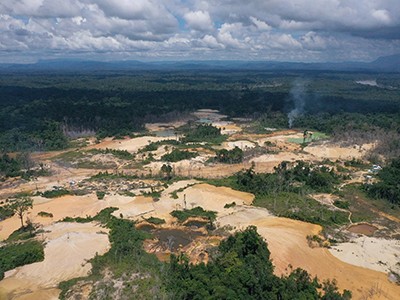
Today, people who study topics that potentially present a publicity problem for Venezuela — the resurgence of once-eradicated diseases or the pollution of the Amazon rainforest as a result of illegal mining, for instance — tell Nature that they work anonymously, or from another country where they are out of the government’s reach, or they self-censor what they publish.
Illegal mining in the Amazon hits record high amid Indigenous protests
Researchers are concerned by the passing of a law, which rights groups have called the anti-NGO bill. Approved on 15 August, this legislation requires NGOs to share information about their funding, which is sometimes awarded to research projects, with the Venezuelan government. According to the law, this is to ensure that civil-society groups do not promote “fascism, intolerance or hatred for racial, ethnic, religious, political, social, ideological, or gender reasons”.
Researchers who spoke to Nature say that the law gives the government the discretion to prosecute anyone whose motives it does not agree with. “Academics at [leading universities] are absolutely terrified by the anti-NGO law and are therefore silenced,” a group of Venezuelan researchers told Nature in a statement after they requested anonymity.
Requena says that science in Venezuela is one step closer to its death. “Science ensures that we are not isolated, that our brains can come together to produce things that help all of humanity,” he says. “It gives a sense of being part of humanity, and I can’t imagine not feeling like I’m a part of humanity.”
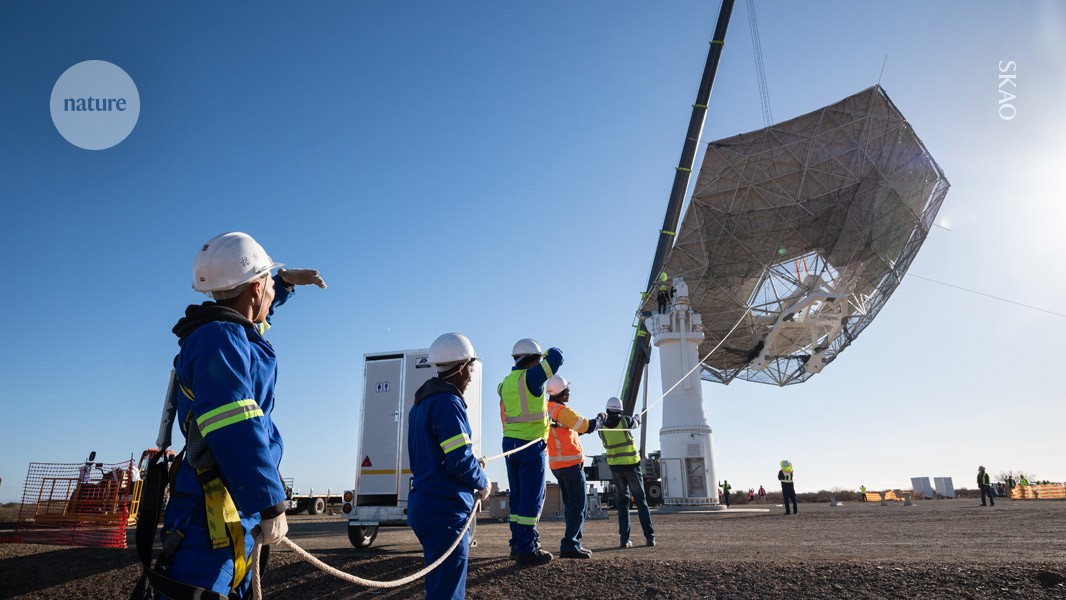
The world’s largest telescope, the Square Kilometre Array (SKA), which is based in Australia and South Africa, is changing its plans and will not be expanding into eight African countries on its original timetable.
In August, SKA director-general Philip Diamond said in a briefing at the International Astronomical Union’s general assembly in Cape Town, that the observatory’s plans had “evolved”. The project will be unable to fund a large expansion into other countries on the original timescale that had been agreed on when the project’s main sites were selected in 2012.
Diamond told Nature that “the ability to go from the current funding to another large monolithic phase of the project is probably just impractical. What we’re looking at now is much more of a phased, continual deployment.”
Pontsho Maruping, managing director of the South African Radio Astronomy Observatory (SARAO) in Cape Town, says that this will not affect the scientific scope of the project, but that the timing of its goals will depend on the availability of funding. “As soon as more funding is committed, more infrastructure will be deployed, including remote stations,” she says.
Nature’s news team contacted the African Astronomical Society, based in Cape Town, and the Ghana Space Science and Technology Institute in Accra, to ask whether the changes would lead to a loss in research capacity in some African nations. They referred enquiries to the SARAO and the SKA Observatory global headquarters (SKAO), near Manchester, UK.
Whether the telescope will ever reach its target ‘square kilometre’ is not clear. Diamond said that it will not happen during his tenure as director-general. “It’s for future leaders to take us there.”
First images
SKA telescopes are interferometers, in which multiple dishes or antennas act as a single telescope. Together, they collect radio signals emitted by celestial objects. Astronomers hope that the array will shed light on some of the most enigmatic problems in astronomy, such as how galaxies form, the nature of dark matter and whether there is life on other planets.
So far, the SKAO has secured €2.1 billion (US$2.3 billion) from its ten official members: Australia, Canada, China, Italy, the Netherlands, Portugal, South Africa, Spain, Switzerland and the United Kingdom.
This funding covers the first ten years of the telescope’s construction and operation (2021–30), accounting for roughly 10% of the planned dishes and antennas. This includes 197 three-storey mid-frequency dishes in South Africa and 131,072 low-frequency antennas in western Australia, grouped into smaller arrays. Both telescopes — called SKA-Mid and SKA-Low — have produced their first images.
A second phase, with a starting date of 2020, was meant to comprise around 2,000 radio dishes in Botswana, Ghana, Kenya, Madagascar, Mauritius, Mozambique, Namibia and Zambia, along with South Africa, and a total of one million antennas in Australia. The total collecting area would be around one square kilometre, hence the name.
Enter Botswana
Maruping says that the SKAO’s decision to delay the second phase “does not stop us partnering with African partner countries and SKA members to deliver astronomy infrastructure as appropriate”.
For example, next year, Botswana, one of the eight partner countries, will get its first SKA dish through a collaboration with South Africa and Germany, with a funding arrangement outside of the initial SKA plan.
“It’s a game-changer for the science in Botswana,” says Kgomotso Thelo, a project manager at the Botswana International University of Science and Technology (BIUST) in Palapye. “We’ll begin to have those astronomers working on the data that’s generated from their own telescope.”
The Max Planck Institute for Radio Astronomy in Bonn, Germany, and the German Center for Astrophysics in Görlitz are contributing the dish hardware, costing about €6 million. Meanwhile, Botswana is providing local support and covering infrastructure costs and South Africa is supplying other components, says Michael Kramer, an astronomer and director of the Max Planck Institute for Radio Astronomy.
The Max Planck Society, along with South Africa’s government and the Astronomical Observatory of Capodimonte in Naples, Italy, are currently funding the addition of 14 dishes to South Africa’s 64-dish MeerKAT telescope, which will ultimately be incorporated into the SKA.
Similarly, the Botswana dish will also be incorporated into SKA. “The construction and operation of the dish will be the first significant astronomical facility to be sited in Botswana,” says Michael Bode, an emeritus professor of astrophysics at Liverpool John Moores University, UK.
Botswana has just a handful of professional astronomers, Thelo says. “It’s going to be a tough road ahead, but if you’ve got partners who have done it before, it makes it much easier for us,” he adds.
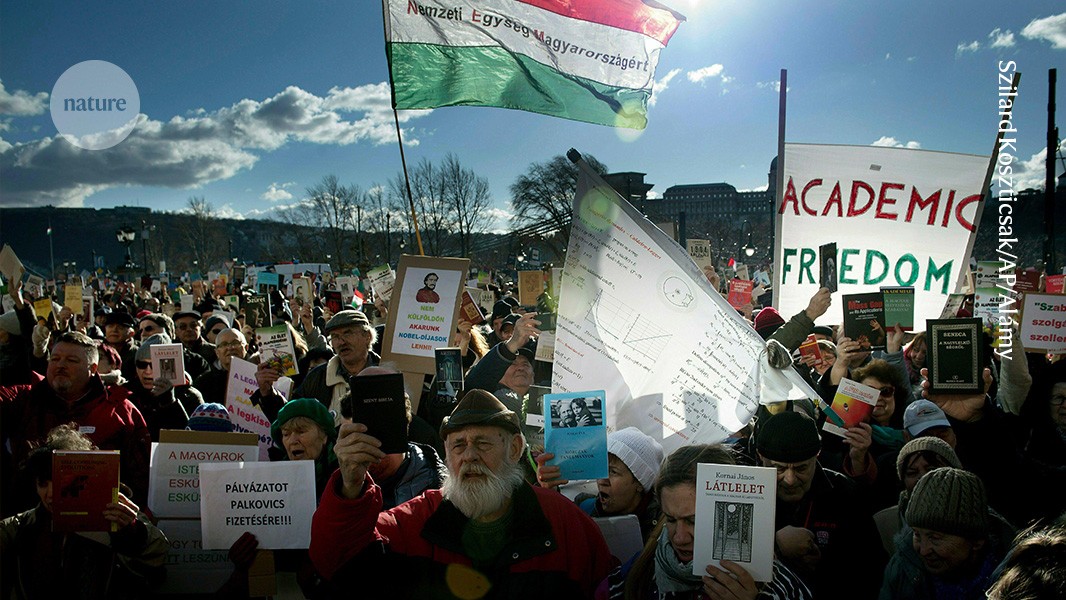
Demonstrators in Hungary protest against the reorganization of the Hungarian Academy of Sciences in 2019.Credit: Szilard Koszticsak/AP/Alamy
Researchers in Hungary worry that the country could be facing brain drain in science, after the European Union suspended funding for research projects at some universities.
In December 2022, the Council of the European Union, a group of government ministers from each of the EU’s 27 countries, agreed to freeze funding for research and exchange programmes — amounting to around €6.3 billion (US$7 billion) — for higher-education and cultural institutions in Hungary, including 21 universities.
All of the institutions are run by public-interest trusts, a management model introduced in 2021 by the Hungarian government when it restructured higher education. The model handed control of institutions to boards of government-appointed trustees, which the EU argued breached principles of the rule of law.
The European Council ban applies to Horizon Europe, the world’s largest international research and innovation programme, worth around €95.5 billion a year. It also affects the Erasmus+ Programme for student and doctoral-candidate exchanges. The programme helps young people in Europe to further their education, receive career training and participate in sports, and has a budget of €26.2 billion each year.
All respondents had PhDs and were 31 to 45 years old. The results were published by the Hungarian Young Academy, an organization affiliated with the Hungarian Academy of Sciences that aims to support young researchers.
Impact on early-career scientists
Almost 9% of respondents who had active EU grant applications at the time of their response said that, although their institutions were not affected by the suspension, international partners had wanted to exclude them from already-running consortia. All of these respondents said that they had managed to convince their collaborators to let them participate.
One in five of those polled said communication with international collaborators had become more difficult; many had been asked to change their job or affiliation so they could stay in a collaboration.
Survey co-author Balázs Lengyel, an economic geographer at the Centre for Economic and Regional Studies in Budapest, says the results offer anecdotal evidence that some national funders in Europe have signalled that having a Hungarian partner in a consortium could be a disadvantage. “Many of us worry that this situation stigmatizes Hungarian researchers, and we are pushed back within the European Research Area [the system of programmes integrating scientific resources across Europe], to which we belong,” he adds.
Finally, 16% of respondents said they had already considered changing their affiliation or seeking further affiliations in Hungary.
The authors conclude: “Our data clearly indicate that early-career researchers have realized that the restrictions will not only mean limited access to funding, but also the weakening of their research networks, the isolation of the Hungarian scientific community, and reduced training opportunities.”
“These findings highlight that the international reputation of Hungarian science has been dealt a body blow by the suspension.”
Balázs Lengyel fears that Hungarian scientists will be unfairly excluded from European research programmes.Credit: Balázs Lengyel
Survey co-author Imola Wilhelm, a biologist at the Biological Research Centre at Szeged, Hungary, who co-chairs the Hungarian Young Academy, says the situation has left early-career researchers in the country feeling isolated at a crucial time in their careers, when they are establishing their professional networks across Europe. The ban is affecting Hungarian universities and research institutes that are not officially excluded, she adds.
Katalin Solymosi, a plant biologist at Eötvös Loránd University in Budapest, warns that excluding young researchers — including Erasmus+ students — means that international collaborations and networks will suffer in the long term. “Restoring lost networks and collaborations or trust is much harder than destroying it,” she adds.
Academic freedom
The report notes that the funding suspension was triggered by a perceived erosion of transparency and academic freedom in Hungary.
The EP Academic Freedom Monitor 2023, carried out by the European Parliamentary Research Service (EPRS) and published in February, reviewed academic freedom in ten EU member states, including Hungary, and concluded that Hungary (alongside seven other EU countries) had seen a “statistically significant decline in academic freedom or aspects thereof” during the previous ten years.
The report says: “Special attention is needed for the situation in Hungary where the level of academic freedom has fallen further in recent years and is low compared not just to all other EU Member States, but also globally (the bottom 20–30% of countries worldwide).”
Out of the ten countries studied, only in Hungary had the report’s authors identified “systemic and structural infringements of academic freedoms”.
According to Freedom House, a political advocacy non-profit organization in Washington DC, these infringements include the revocation of accreditation and funding for gender-studies programmes by Prime Minister Viktor Orbán’s government, led by the right-wing Fidesz party. In 2019, Orbán’s government stripped the 200-year-old Hungarian Academy of Sciences of its network of research institutions.
Katalin Solymosi worries that damaged international collaborations will be difficult to repair.Credit: Bea Bulla
László Bódis, deputy state secretary for innovation at Hungary’s Ministry of Culture and Innovation, told Nature: “The Hungarian government developed a detailed proposition and submitted it to the Commission to ensure that Hungarian students and researchers are not excluded from the European research scene for the sole purpose of political expediency.”
“It is regrettable and outrageous that Hungary still has not received any feedback on these proposals from the Commission since last November, that is for nine months.”
Damage limitation
In June, the EU sought to clarify its position, stressing that Hungarian researchers can still take part in Horizon Europe projects, even if their institution cannot apply for funding from the programme.
The ban means Hungarian researchers based at any of the 21 affected universities cannot access EU funding, but they can still participate in Horizon Europe projects.
Meanwhile, the government in Hungary has made moves to try to plug the gap created by the funding freeze. The Budapest-based National Research, Development and Innovation Office (NKFIH) — a government body that provides public funding for research and development — has set up a ‘governmental guarantee fund’ to cover the Hungarian financial contributions to research projects that have been accepted by the Horizon Europe scheme but are unable to receive funds following what it calls the EU Commission’s “discriminatory decision”.
An initial budget of €13 million for 2023 and €20 million for 2024 was set aside for this by the Hungarian government for affected projects.
There is also the HU-RIZON International Research Excellence Cooperation Programme, which offers grants from an overall budget of €20 million to higher-education institutions to promote the formation of Hungarian-led international research consortia.
So far, 57 projects at 14 universities have been implemented with funding from the guarantee fund, and this year, 12 proposals have been submitted to HU-RIZON.
Lengyel says: “Although these new funding schemes might help important research, Hungarian universities and research organizations should be able to participate and compete in European calls.
“There is no doubt that it is difficult to develop the international competitiveness of the Hungarian science and innovation ecosystem without these opportunities.”
Academics and researchers are sceptical that the issue will be solved quickly, but agree that efforts should continue.
Wilhelm says: “I am pessimistic about the long-term effects. Even if the decision is reversed, it is unlikely that those who have left the country will return, and the negative perception of the Hungarian research community will not be immediately alleviated.”
Gábor Kemenesi, a virology researcher at the University of Pécs in Hungary, also has a downbeat view, but says: “Things like this new study have finally got some data which we can show. Data and opinions like this are important because they can reach both sides of the political negotiation. This could be solved.”
Continued discussion between the EU and the Hungarian government should be encouraged, argues Lengyel: “An open discussion is needed, including all involved parties and the Hungarian academic community as well, whose reputation and opportunities are at stake but, in my opinion, have been largely ignored so far.”
Biology labs generate large amounts of single-use plastic waste, such as pipette tips and trays.Credit: Eplisterra/Getty Images
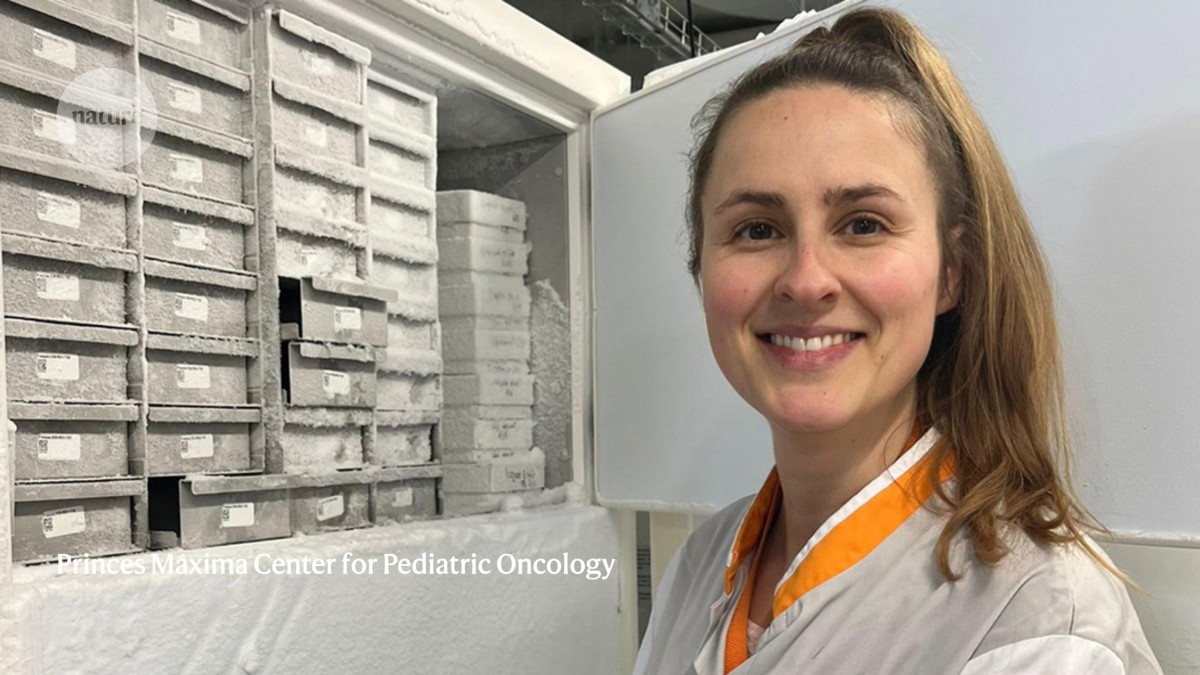
Single-use plastic has always been a concern of Caitlin Broadbent, a sustainability technician at King’s College London. Each month, researchers in the institute’s Drosophila fly facilities discard more than 20,000 polystyrene vials, contributing to an alarming increase in plastic waste as the laboratories continue to expand.
The disposal of these vials, along with flies and food, involves incineration at high temperatures, which generates substantial carbon emissions. With the environmental impact growing, addressing this issue is an urgent priority for the team.
But times are changing, says Broadbent. Through a project funded by King’s College, her team, along with an undergraduate student working on the project, is developing a business case for switching to glass containers. “While using glass vials was common in the past, implementing this change now requires careful consideration of costs, labour, safety and materials,” Broadbent says.
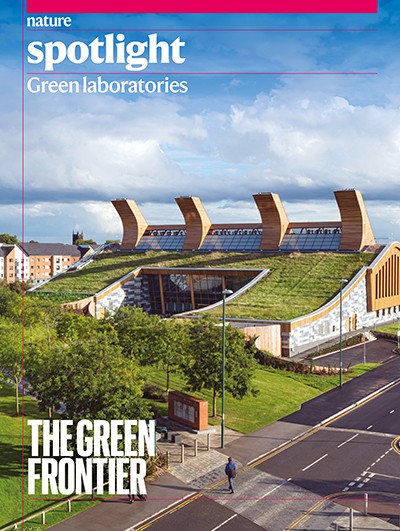
Nature Spotlight: Green laboratories
If you have worked in a biology lab, you will probably remember the large amount of plastic waste generated every day. This is especially true for plastic products such as pipette tips, Petri dishes and Falcon tubes, which are designed to be used once, or for a short time, before being discarded. A highly cited Correspondence article published in Nature in 2015 estimated that 5.5 million tonnes of plastic waste was being generated yearly by labs worldwide1, on the basis of data collected from the biosciences department at the University of Exeter, UK. That equates to around 2% of the total amount of plastic waste produced globally at that time.
In another study, conducted in 2021 by the Roslin Institute’s microbiology lab at the University of Edinburgh, UK, a team of seven scientists was able to cut its plastic usage by 43 kilograms in a month, saving around 516 kg of waste annually from incineration2. Extrapolating this for the roughly 200 researchers in their institute, the authors estimated that more than 17,000 kg of biohazard waste could be avoided if all labs took up similar plastic-reducing measures. These included adopting reusable metal loops instead of single-use plastic for bacteria inoculation, and reusing plastic tubes after chemically decontaminating them.
Caitlin Broadbent at work in a Drosophila fly facility at King’s College London. Polystyrene fly vials are placed on a tray and into a laboratory dishwasher. Most will come out clean, but occasionally some need to be run through again.Credit: Caitlin Broadbent
The authors noted that adopting their practices would require considerable operational and behavioural changes, which often acts as a deterrent. For instance, a metal loop used to plate bacteria needs to be heated to ensure biological decontamination, which takes time, and the plastic containers used to store chemicals have to be transported to a specialist facility for cleaning.
Before mass manufacturing of single-use plastics, reusing wooden and metal tools was a common lab practice. Advances in plastic production are enabling scientists to spend less time on cleaning and more on research, but these steps have also created a big plastic-waste problem for society, prompting universities and research institutions to take action.
Money, education and partnerships
Globally, university operators are aware of their plastic addiction and have made various commitments to reduce their reliance on single-use plastic. In the United Kingdom, University College London has pledged that its campus will be free of single-use plastic by the end of 2024, a goal shared by the Australian National University in Canberra. The University of California, Berkeley, has committed to meeting the same target by 2030.
A 2019 master’s thesis investigated the plastic-waste strategies of 76 of the country’s higher-learning institutions. The author found that around 64% of waste-cutting pledges were limited strictly to catering settings, and included banning plastic coffee cups and food containers. Only 6% of the measures aimed to reduce single-use plastic in laboratories. Importantly, for reasons such as labour constraints and costs, most of the universities had not quantified the success of their efforts to reduce plastic waste.
To incentivize a shift away from single-use plastics in research, universities have rolled out funding mechanisms and educational workshops. SustainableLabs, a dedicated team at King’s College London, is helping labs to achieve accreditation in sustainability under an international scheme called the Laboratory Efficiency Assessment Framework, or LEAF. “One success story we had was how a PhD student led a lab to replace single-use non-recyclable plastic well-plates with reusable ceramic well-plates for brain-section immunohistochemistry staining,” says Broadbent.
“At our Drug Control Centre, where strict protocols prevent cross-contamination in drug testing, we have also implemented a sustainable approach by reusing glass test tubes, plastic centrifuge tubes and plastic scintillation vials. By utilizing a dishwasher and standardized cleaning practices, we significantly reduce plastic waste while maintaining the high standards required for our research.”
Some institutions, including the University of the West of England Bristol (UWE Bristol), have also partnered with firms to recycle plastic waste generated from labs. “It is not easy to identify companies that specialize in recycling plastic waste from labs,” says Joanna Dainton, head of circular economy and responsible consumption at the university. “When we first decided to partner with RecycleLab, a start-up specializing in recycling non-hazardous plastic waste such as plastic that has not been in contact with biological materials like blood and cells from labs, we wanted to test the market to understand what they could offer.”
Ultimately, says Dainton, the trial data showed that the programme worked well, and, as a result, UWE Bristol has formalized a partnership between its College of Health, Science & Society and RecycleLab, which is based in Chipping Norton, UK. “Through this partnership, we expect to recycle over 600 kg of plastic waste, which is approximately 10% of the plastic waste generated by the college each year.
A student in Joanna Dainton’s team at the University of the West of England Bristol, UK, demonstrates the lab’s plastic-recycling project.Credit: Marcus Olivant
“The challenge right now, to get more organizations to consider recycling their plastic waste, will be scale and price,” says Dainton. “At the moment, RecycleLab is not as cheap as large multinational recycling companies, partly because they do not yet have the customer base, but there is real potential here as lab plastics are a global issue across teaching institutions and hospitals.”
In a report produced in 2022, the UK Royal Society of Chemistry recommended practices to help institutions cut back on single-use plastic. Besides incentivizing initiatives and attitudes that work in favour of sustainable research and educational workshops, these practices support the creation of roles dedicated to lab environmental-sustainability programmes. They also encourage the use of digital technologies to record, quantify and share sustainability-related experimental design and outcomes.
Trials and tribulations
These changes don’t come without challenges. Mark Fretz, an architecture and built-environment specialist at the University of Oregon in Eugene, notes that in his research, which involves collecting air, water and surface microbiomes, it is hard to eliminate single-use plastic altogether. To avoid cross-contaminating samples, he and his team rely on copious amounts of sterile collection equipment during their fieldwork, including individually packaged, plastic microcentrifuge tubes and polystyrene Petri dishes.
Fly vials that have had their plugs removed are soaked in hot water and ChemGene disinfectant for two hours. This loosens the fly food and dead flies.Credit: Caitlin Broadbent
“Back in the lab, after sample collection, most of the reagents for DNA/RNA extraction and library preparation are also packaged in plastic,” Fretz says. “We could substitute some of the plastic with glassware; but it comes with challenges for lab safety as glass is more likely to break accidentally and create a hazardous spill.”
Fretz says that although the team has tried using glass and stainless steel in place of plastics in active-air and surface-microcosm studies, each collection can have upwards of 500–1,000 samples, which means that substantial time and space is needed for cleaning and sterilizing. “We don’t have the staff, lab space or budget for projects to take on this additional workload, so plastic single-use consumables have become the de facto solution,” he says.
A reason for optimism
In its 2022 report, the Royal Society of Chemistry found that 79% of the researchers surveyed knew that their lab activities affected the environment, and 84% wanted to reduce the adverse environmental impact of their work. Another 63% said that they had made changes in the previous two years to reduce that impact, or that of their research groups or departments.
A similar sentiment emerged at the University of Manchester, UK, where a scheme has saved more than 24,000 pieces of plastic each academic year by reducing plastic use in lab practical classes. Surveys conducted after the classes found that 97% of the nearly 400 respondents were pleased to be part of a scheme that was working to reduce single-use plastic in practical sessions.
Dainton says that the success of initiatives to reduce plastic use has a lot to do with changing mindsets. “We have started educating undergraduates on what types of plastics can be recycled, hoping that early awareness will make them conscious of their choice of research materials in the future.” Furthermore, “the wide variety of plastics used in labs makes the recycling process complicated, so clear communication is important to prevent contamination of recycling”.
Broadbent says researchers often tell her that they want to change their plastic-consumption habits but don’t know how or lack the resources, or that “they have some colleagues who are not on board”. This is why it is important for universities to have funding mechanisms to support a change in behaviours. Such mechanisms could include money to upgrade lab equipment for glassware washing, and workshops to change mindsets and debunk myths, such as that using washable glassware carries a high risk of contamination.
“There’s still a long way to go, but there is reason for hope,” says Broadbent.
Some UK universities might not receive support from the new Labour government, despite their financial struggles.Credit: Christopher Furlong/Getty
There are two stages to going bankrupt, according to a character in the 1926 Ernest Hemingway novel The Sun Also Rises: first gradual, and then sudden. Many UK universities are approaching step two, as Nature reports in a Careers feature. High inflation and frozen student fees have created a perfect financial storm. To add to that, in January, the UK government banned most international students from bringing their dependants into the country. This is further fuelling existing perceptions that the nation is becoming less welcoming, resulting in a marked fall in the students who contribute to balancing the books.
All of this helps to explain why there is a crisis: the state does not directly pay universities in England, Northern Ireland and Wales to teach students, as happens elsewhere. Instead, universities rely heavily on tuition fees for income, with students essentially their paying customers, as if universities were for-profit businesses. Any government typically would let businesses fail if they don’t make a profit. The 11-week-old Labour government of Prime Minister Keir Starmer doesn’t seem inclined to see universities differently to businesses. It should.
UK university departments on the brink as higher-education funding crisis deepens
To be clear, not all UK universities are suffering equally. Older, world-renowned ones, such as the 24 members of the Russell Group of research-intensive universities, are comparatively less at risk, because they have enough longevity and reputation to both secure credit and attract students from abroad, who pay higher fees than home students.
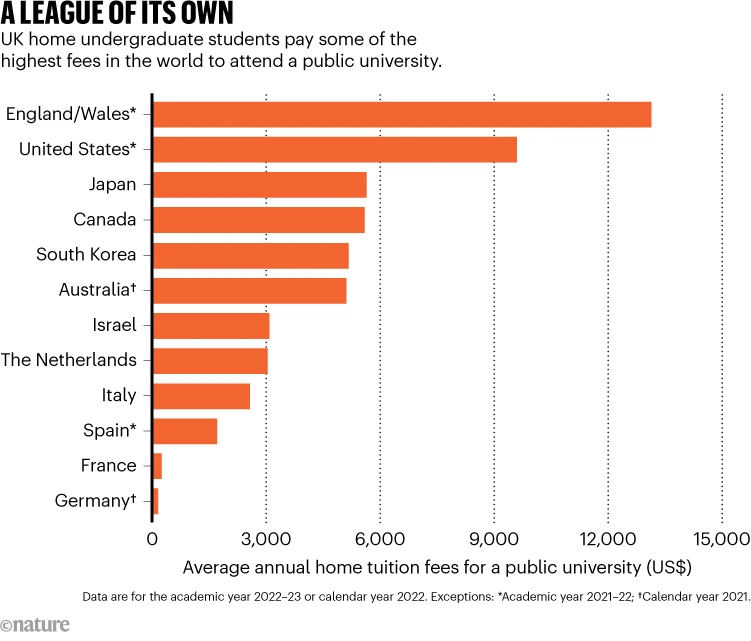
A ‘squeezed middle’ of newer institutions are less fortunate. They are more reliant on home students, whose tuition fees are currently capped at £9,250 (US$12,300) a year in England and Wales and £4,750 in Northern Ireland (Scottish students do not pay to attend universities in Scotland). Many of these institutions have also borrowed heavily to fund buildings to make them more attractive to students and to keep up with their more famous competitors (A. R. Bell et al. Int. Rev. Econ. Finance82, 771–783; 2022).
Some 108 degree-awarding institutions in England are expected to be in deficit by the end of this year, according to the Office for Students, the English universities regulator. Many of those working in higher education say that soon — very soon — one of these universities will become insolvent. In many cases, the cost of educating a UK undergraduate student is more than the amount the student pays the university.
A bankruptcy would be a disaster. The universities most at risk are among the largest employers in their towns and cities, and more likely to educate students who will be the first in their families to receive higher education, compared with Russell Group universities.
UK’s new science minister on budget battles, Brexit and AI leadership
So far, the government’s message seems to be that universities are on their own. Higher-education leaders must behave like business owners — and face the consequences of the market if they fail.
Labour’s thinking fails an important test. Universities organize much of the nation’s research, which is subject to different financial arrangements from teaching. In 2021, UK taxpayers contributed £12.8 billion (US$17 billion) in funding to researchers, mostly at universities. That subsidy comes partly on the understanding that innovation and technologies emanating from universities push society forward and boost economic growth. A report commissioned by Universities UK, the London-based umbrella body for UK universities, found that every £1 of public investment generates £14 of economic benefit (see go.nature.com/3xztcrf). It makes little sense to treat academic research as a public investment, but higher education as a private-sector industry. If universities can’t educate those who will be the scientists of the future, their research output is going to be severely diminished.
Other countries show that it doesn’t have to be this way (see ‘A league of its own’). Many European governments pump billions into higher-education funding as well as research. Students pay a small charge, or a heavily subsidized tuition fee, to cover the costs of a degree. Government scholarships are also available in many countries. China, which has the world’s largest higher-education sector, with more than half of its secondary-school graduates enrolling in tertiary education, operates on a similar model. Even in the United States, public universities receive some direct funding from their state governments as well as charging tuition fees.
Source: OECD Education at a Glance 2024
The UK government faces a mountain of problems: prisons are overflowing, the National Health Service is in serious trouble and the economy is barely growing. Some say that UK citizens don’t expect public money to be used to save a struggling supermarket or clothing label, so why should a government bail out a struggling university? One alternative being discussed is to allow universities to increase student fees, in exchange for them agreeing to limit international students. That could be the worst of all worlds: it would confirm that the United Kingdom is less welcoming to people from other countries, and subsequent generations of home students would be punished with ever-increasing fees.
Universities are important places for investing in young people; they are a space, often far away from home, where for a few years, the next generation learns independence and agency. Universities — through research, innovation and their role as employers — are also necessary for economic growth, which Labour has committed to boosting. But market success cannot be the only measure if the United Kingdom is to achieve its growth ambitions. The future has to include long-term, stable public investment in universities, too.
As a student in China in the late 1980s, I spent several wonderful semesters studying zoology and botany. I vividly remember the joy of a summer field trip, immersed in taxonomy and biodiversity, where I learnt about a weed called goose-grass. Its well-developed root system makes it difficult to pull out of the soil — earning it the nickname the ‘Dunzhao donkey’, because those attempting to extract it look like exhausted donkeys squatting on the ground.
Taxonomy is crucial for biodiversity conservation — if we can’t properly identify animals, plants and fungi, we can’t find ways to preserve them. But since my student years, working as an ecologist in Shandong, China, I’ve witnessed a decline in the teaching of this important subject. Credit hours for botany and zoology modules have halved at many universities in China. The length of field trips has been reduced owing to lack of funding.
No basis for claim that 80% of biodiversity is found in Indigenous territories
It’s a similar story worldwide. Funding for projects involving taxonomy dropped drastically in the United Kingdom in the 1990s, replaced by those using molecular biology and genetics. Taxonomists in Europe worry that they themselves are becoming an endangered species, with retiring experts often not being replaced. And some low- and middle-income countries (LMICs), including tropical nations that contain some of the world’s biodiversity hotspots, have long faced a shortage of domestic talent.
Decades on, and the costs of these cuts are now apparent. Biodiversity initiatives are struggling to find specialists. For example, in China, hundreds of surveys of animals, plants and fungi are under way, with the aim of improving the conservation of native habitats and species. But many organizers have found it difficult to recruit qualified researchers. Qiao Gexia, an entomologist at the Chinese Academy of Sciences in Beijing, has voiced concern that, as current taxonomists retire, there will be a reduction in studies of important taxa — such as termites, which are crucial to ecosystems but also can damage buildings, roads and bridges, and earwigs, which are useful for pest control but are detrimental to fruit production (see go.nature.com/3msjcxh).
Indeed, a lack of taxonomic knowledge, especially at the local level, is leading to errors. For example, in 2022, a common fish in Xiaoqing River, China, was mistakenly reported to be an endangered species, causing confusion among conservationists and the public.
Harrowing trends: how endangered-species researchers find hope in the dark
If taxonomic knowledge is not maintained, it will become harder to prevent species becoming extinct.
That’s why I feel it’s so important that the Kunming Biodiversity Fund — aimed at supporting global biodiversity conservation — includes a substantial pot of money for biodiversity education. The fund was launched in Beijing in May. Its co-chairs, the Chinese government and the United Nations Environment Programme, hope that the initial investment of 1.5 billion yuan (US$210 million) from China will attract other countries, institutes and organizations to invest in the fund. The money will be used to help LMICs meet the goals of the Kunming–Montreal Global Biodiversity Framework, which has been agreed on by almost 200 countries. The framework sets out 23 targets to be reached by 2030 and 4 goals for 2050, all of which aim to see humans living in harmony with nature.
The first projects to be supported by the Kunming fund are expected to be announced before the start of the COP16 UN biodiversity conference on 21 October, at which progress towards meeting the biodiversity framework targets will be discussed and evaluated. As yet, education has not been mentioned as a focus — but I think it should be.
I would like to see 10% of the Kunming fund’s annual budget put aside for education. It’s crucial to build up taxonomic know-how in LMICs that lack it, and to ensure that it is preserved in those where it might be dwindling.
One priority should be funding programmes in LMICs that teach students taxonomic methods, such as observation of specimens, and modern techniques for assessing the biodiversity of animal and plant communities.
Can floating homes make coastal communities resilient to climate risk?
Laying camera traps and analysing the footage, for instance, is often cheaper, easier and requires fewer people than using live traps does. Analysis of DNA gathered from soil, water or air can be used to accurately assess the species in a local community, without the need to spot them all in the wild. And training in the use of online digital herbaria and collection galleries will enable young scientists to share knowledge and resources across countries.
Universities can support this endeavour by incentivizing biodiversity and taxonomy courses for their students, perhaps by giving them more credits. And they should also offer general courses in taxonomy and biodiversity to students outside the biological sciences, to build awareness.
Some might argue that a focus on direct conservation efforts is the best way for the Kunming fund to help achieve the framework’s 2030 targets. But education is the key to reaching many of those goals, especially because those living in a particular country are the ones best placed to understand its flora and fauna.
Ignoring education will waste the Kunming fund’s resources. There can be no sustainable support for global conservation efforts without generation after generation of properly educated specialists. A lack of expertise will be devastating for the estimated one million species facing extinction worldwide today.
The views expressed are the author’s own and do not necessarily represent those of their institution.
After a decade building quantum-computing hardware, Jacques Carolan decided he needed a change. “I wanted to work on technologies that were more directly related to human health,” he says. So in 2021, he pivoted to neuroscience with the aim of building optical technologies to understand the brain.
Last year, another opportunity turned Carolan’s head. The UK government was setting up a high-risk research funding agency. It was modelled on the famed US Defense Advanced Research Projects Agency, or DARPA, which helped to pioneer some of the world’s most consequential technologies, including the Internet and personal computers. The UK version, the Advanced Research and Invention Agency (ARIA), aimed to mimic that success, except that it avoids DARPA’s connection to military research. ARIA sought its inaugural programme directors with a seductive application question: if you had £50 million in research funding to change the world, what would you do?
Carolan applied, highlighting his interest in developing technologies to treat neurological disorders. He is now one of the first eight programme directors at ARIA, where he has unusual freedom to select the projects that receive money from a 4-year, £800-million (US$1-billion) budget. “It’s been a wild journey,” says Carolan.
US agency launches experiments to find innovative ways to fund research
Funders and scientists around the world are watching to see whether ARIA can succeed in one of the most difficult challenges in science — working out how to spur researchers to develop truly revolutionary innovations.
Formally established in 2023 by an act of Parliament, ARIA is now in its first year of full operation. Its mission is to “empower scientists and engineers to reach for the edge of the possible and unlock breakthroughs that can benefit everyone”, says its chief executive, Ilan Gur, a materials engineer and entrepreneur who moved from Berkeley, California, to lead ARIA in London.
ARIA joins an ecosystem of funders that is dominated by UK Research and Innovation (UKRI), a government super-funder with a £9-billion annual budget that oversees discipline-specific research councils, and Innovate UK, which aims to commercialize technologies. But the research councils can be conservative in what they fund, and Innovate UK mainly aids technology transfer, says Paul Nightingale, who studies innovation policy at the University of Sussex near Brighton, UK.
“Having something that is focused on pushing the boundaries of really extreme, ambitious research — and having it managed in a DARPA sort of way — that isn’t something that UKRI really can do,” he says.
UKRI was consulted extensively on ARIA’s creation, says Daniel Shah, chief of investment planning and strategy at UKRI, and the organizations’ leaders connect regularly. “We’re looking to learn from the ARIA experience, and they’re looking to learn from us,” he says.
After the government announced ARIA’s creation in 2021, some researchers criticized its planning as being slow and opaque. But science-policy specialists say the agency has moved quickly since ‘exiting stealth mode’, as Gur puts it, last year. Almost all of the directors ARIA recruited have now defined their programme’s research focus. Carolan’s is on precision neurotechnologies; others span topics from artificial intelligence (AI) safety and robotics to engineering plants that are more resilient to pests and climate change. Some have advertised their first funding calls and made their first awards.
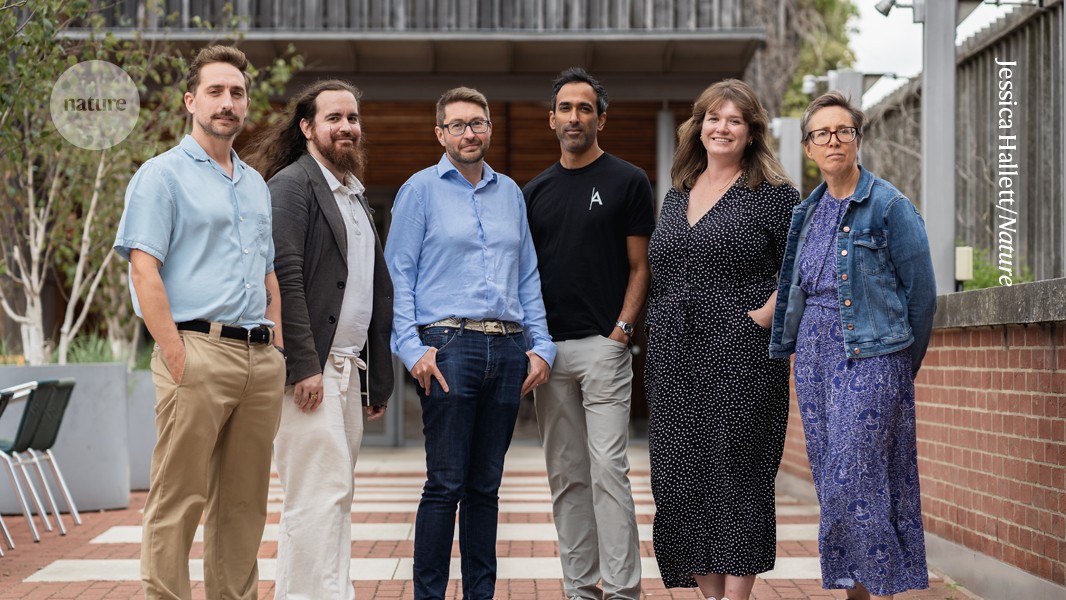
ARIA’s chief executive, Ilan Gur, was a programme manager at the US agency ARPA-E.Credit: Jessica Hallett/Nature
Enshrined in the directors’ roles is the ability to “shut-down or pivot dead-end efforts or double down on those that show promise”, says ARIA’s website — freedoms that don’t exist elsewhere in UK research funding.
The D-word
The idea of a ‘UK ARPA’ has been explored for years, says David Bott, an innovation specialist who holds a fellowship at Warwick Manufacturing Group, a privately funded research centre at the University of Warwick in Coventry, UK. Bott previously led a precursor to Innovate UK called the Technology Strategy Board, and as far back as 2013, he was part of a UK government fact-finding mission to study DARPA. But the idea came to fruition after appearing as an election-manifesto promise made by Boris Johnson’s Conservative Party in 2019.
Capturing the freedom of DARPA was the guiding principle in ARIA’s design — just without the focus on defence, says James Phillips, a systems neuroscientist who left research to lay the policy groundwork for ARIA in the UK Prime Minister’s office in 2020.
Although DARPA was founded as ARPA in 1958 by the US government in response to the Soviet launch of the Sputnik satellite, the defence element became integral to the US agency’s operations. Its ultimate goal was to ensure US technological supremacy on the battlefield. A truth that many in research funding acknowledge is that war is a more urgent incentive for progress than the more general goal of improving society.
But the defence focus is not the only thing that made DARPA successful, says Victor Reis, a retired US government official who directed the agency from 1990 to 1991. Four things were key to DARPA’s effectiveness, says Reis: freedom to make decisions, moving fast, term limits for programme managers and the ability to forge relationships with the most important people in research and industry.
The UK launched a metascience unit. Will other countries follow suit?
DARPA’s programme managers and office directors had more autonomy and power than is typical at funding agencies, and Reis found that making rapid decisions on their proposals was the key to being an effective head. “I said I will sign anything within 24 hours,” he says. “That made a lot of happy campers.”
Phillips’s small team especially wanted to define the scope of ARIA’s legal freedoms to operate as it pleased. For instance, would the new agency make a funding decision that government disagrees with? “That was very, very important to us,” says Phillips, now a senior policy adviser at the Tony Blair Institute for Global Change, a think tank in London. “Most of the time this research fails, and that’s what government doesn’t understand.”
Phillips’s other priority was finding the right leader — someone with intimate knowledge of the ARPA model. “The way we described this was a bit like a yoghurt culture. You’ve got to get a bit of the old culture to start the new one,” he says. Gur, an early programme manager at the US Advanced Research Projects Agency–Energy, a DARPA-style offshoot, was the ideal candidate, says Phillips.
Edge of the possible
The first cohort of programme directors began their term last October, and along with Gur, have a three-year term that can be extended.
The directors’ starting point was to define ‘opportunity spaces’ — areas “bigger than a programme, smaller than a field”, says Carolan, where they see scope for an innovation that would be highly consequential for society, but which lack attention and funding.
Most of those spaces have been honed into programmes, such as the one Carolan developed on neurotechnology, which is backed by £69 million. It highlights the burden of neurological diseases, from conditions such as Parkinson’s disease to mental-health disorders. Carolan hopes to help create technologies that will interface with the brain at the circuit level, because most brain disorders are rooted in its wiring, he says.
Essential to success, say the programme directors, is the freedom to fund a diverse community of scientists, technologists and businesses that might work together towards a goal, although taking different approaches. “How you fund science shapes how you do science,” says Gemma Bale, one of ARIA’s directors. She and others see ARIA as part of a wave of experimentation in metascience — the science of how research is conducted and funded.
Sarah Bohndiek (left) and Gemma Bale co-direct an ARIA programme called Forecasting Tipping Points.Credit: Jessica Hallett/Nature
This month, Bale and her co-director, Sarah Bohndiek, announced their programme, called Forecasting Tipping Points. As the name suggests, it seeks to create an early-warning system for Earth’s climate tipping points. Bale and Bohndiek, both medical physicists who do part-time academic research at the University of Cambridge, UK, highlight huge gaps in monitoring Earth’s vulnerable environment. “We risk crossing climate tipping points within the next century,” says Bohndiek. “Without any early warning, we have no adequate way of preparing, adapting, mitigating or intervening.”
Scientific strength
ARIA’s overall annual budget is only 1.2% of the UK government’s 2022 spending on research and development. By comparison, DARPA’s, at $4.2 billion, represents 2.2% of the US federal government’s 2022 spend. Still, Gur sees the strength of ARIA as lying in the scientific talent that it can draw on.
There are a few comparable programmes around the world, says Nightingale, including Innosuisse in Switzerland; Innovation Fund Denmark; and the German agency SPRIND. SPRIND was established in 2019 and has a similar annual budget to ARIA — about €220 million (US$240 million) in 2024 (see ‘Disruptive funders’).
Source: Agency budgets analysed by Nature
Rafael Laguna de la Vera, SPRIND’s director, based in Leipzig, says that he was consulted by Phillips’s team and speaks occasionally to the ARIA leadership. SPRIND’s funding approach is more ‘bottom-up’ than ARIA’s, says Laguna de la Vera — the German agency maintains a rolling call for funding proposals. He says that the main challenge in building a disruptive funder has been convincing government ministries to give the agency the freedom to operate differently from existing funders.
“Our reason for existence is to do it differently than we did before. So here you have the conflict.” After establishing the agency, Laguna de la Vera fought for three years to get the German government to pass a law, similar to ARIA’s act of Parliament, that guarantees the funder freedoms in operation.
Nightingale suggests that the US Office of Naval Research — which is smaller than DARPA, with a $2.4 billion budget request for 2025 — might be a comparable agency. He says this is because of the way it selects the most promising applicants at industrial laboratories or universities, and because its outcomes have had a disproportionate impact.
First contracts
Researchers and science-policy specialists who Nature contacted say it’s hard to evaluate ARIA or find much to criticize so far, given that the agency has just started work. But a positive sign is that it has recruited well, Nightingale and others say. “It’s a very impressive, smart team,” says David Willetts, a former UK science minister who retains a strong interest in research and innovation policy.
At ARIA, Carolan is now fielding proposals for his first funding calls. Internal and external experts help to review applications. But the ARIA directors have the freedom to ultimately decide who receives funding.
Jacques Carolan is director of an ARIA programme on precision neurotechnologies.Credit: Jessica Hallett/Nature
Other programme directors are flexing their freedoms in different ways. David ‘davidad’ Dalrymple, director of the £59-million programme on safeguarded AI, last month appointed artificial-intelligence pioneer Yoshua Bengio as his programme’s scientific director, to offer strategic advice and technical feedback. That appointment was an early indication of success, says Phillips, given Bengio’s sought-after status. The goal of Dalrymple’s programme is to construct an AI ‘gatekeeper’ system that is tasked with understanding and reducing the risks of other AI agents.
Feedback from the research community has also been positive. “I think they are doing something very, very important,” says Phillip Stanley-Marbell, a computer engineer whose firm Signaloid signed ARIA’s first funding contract, on improving the efficiency of large language models. Signaloid, a spin-out company of the University of Cambridge, hopes this work will contribute to wider efforts to stop the models ‘hallucinating’ information.
Stanley-Marbell, who also has a post at the University of Cambridge, has had a varied career in academia and at industry giants such as Apple. The difference with his previous grants is that the deliverables in his ARIA contract are specific and the contract can be terminated at any time. “It’s been a very rigorous but very pleasant process — very factual and very rational,” he says.
One controversial feature of ARIA is that, unlike other UK government funders and DARPA, it is not subject to freedom-of-information requests about its work. Laguna de la Vera says that exemption from such requests is a positive for a disruptive funder, in part because many people making the requests might misinterpret what an agency is doing. It also protects competitive interests, he argues. “It has nothing to do with military innovation or anything, but you want to be secret, right? Because we want to make this happen here in Europe and not to be stolen in a nanosecond by people we don’t like.”
UK ‘DARPA’ should let the sunshine in
ARIA says that the exemption was debated extensively by Parliament, and it keeps its “scientists’ focus where it matters most”. The agency adds that it is committed to building in the open, and publishes information on all its programmes and funded projects.
Exemption from scrutiny is a benefit, but also a risk, says Nightingale. “It may be that ARIA will invest in areas of research that are controversial, and then there will be pushback,” he says. “There are always trade-offs.”
At DARPA, there was an incentive to avoid controversy, says Reis, recalling what his superiors told him: “You can do whatever you want. Just stay out of the papers.”
A decade to shine
It will take years to evaluate ARIA’s success, say Nightingale and others. The agency’s existence is guaranteed for ten years in law, and Gur says that is the timescale over which its impact should be measured.
“One measure is a programme or a project that we fund leads to a technological breakthrough that just changes the conversation globally on what people think is possible,” he says.
But that will take time. At the end of Carolan’s programme, in four years, he doesn’t expect to have achieved it. “The length of the programme isn’t long enough to build a breakthrough technology, get it through the regulatory pipeline, do all your preclinical models and get into humans,” he says. His measure of success is “to de-risk technologies such that other folks can pick it up at the end of the programme”.
In future, Willetts would like to see big-spending government departments invest some of their money to develop technologies that originated from ARIA programmes. That “would be a great sign of success” that could make ARIA stand out globally, he says.
Many agree that it’s essential to accept failure in the arena of high-risk research. Maybe out of 20 projects, says Nightingale, 19 won’t do anything, but one could change the game. “Failure is a feature, not a bug.”
Institutional filing cabinets hoard tens of thousands of evaluation studies.Credit: HUM Images/Universal Images Group/Getty
On 22 and 23 September, world leaders will meet in New York City at an unusual Summit of the Future. Devised by United Nations secretary-general António Guterres, the meeting aims to bolster global efforts to build a better world. Guterres is visibly frustrated by the glacial progress towards achieving the Sustainable Development Goals (SDGs) — the bold commitments made in 2015 to tackle inequality, poverty, climate change and more by 2030. It is now clear that most of the goals will be missed.
The world’s goals to save humanity are hugely ambitious — but they are still the best option
A question on the minds of many delegates, including scientists, will be how the world can do better. One answer is to turn to research — and some of what is needed already exists but lies neglected. As things stand, governments and institutions have tens of thousands of ‘evaluation studies’ that were commissioned to assess whether a policy or programme was completed, whether it worked, how much it cost and what barriers got in the way. Few of the commitments that will emerge from next week’s summit will be more useful than an undertaking by all parties to open their vaults and help researchers to synthesize the best of the available evidence. Governments spend trillions on public services each year. Rigorous, independent evaluations offer a robust way for scientists, policymakers and citizens to learn which policies are worth continuing, which should be modified or expanded and which shelved.
Evaluations come in many flavours. Some are impact evaluations, such as randomized controlled trials conducted to measure the success of a programme as it is rolled out — as was the case for an initiative to see whether booster classes improve learning in refugee camps. Others evaluate processes or programmes by reviewing documents, data and interviews once a project is completed. Some are published in academic journals. Many are not.
The most comprehensive database of development impact evaluations, held by the non-profit International Initiative for Impact Evaluation (3ie), contains some 17,000 of these studies. Most have been published in the past 15 years, reflecting the growing pressure on governments and international funders to show that their money is being spent well and making a difference.
What’s the best way to tackle climate change? An ‘evidence bank’ could help scientists find answers
Yet transparency is not the norm. Many evaluations remain buried in institutional vaults, inaccessible or unknown to many. Often, the reports are read by just a handful of people before being filed away.
The UN is helping to change this. The Global SDG Synthesis Coalition, formed in 2022, is a group of some 40 UN organizations that want to make better use of the mountain of studies in their filing cabinets. The UN Development Program (UNDP) alone has upwards of 6,600, and there are tens of thousands more across other UN and national agencies, says Isabelle Mercier, who leads the UNDP’s independent evaluation office.
The aim of this coalition is to synthesize UN evaluations and other research to extract lessons on five themes in relation to the SDGs: partnership, people, planet, prosperity and peace. The first synthesis report, on partnership, was published in September 2023 (see go.nature.com/3xr5srk). It drew on several hundred studies to examine prospects for the SDG 17 — how factors such as trade, technology and cooperation could accelerate all of the targets.
One of its findings is that collaborations between low- or middle-income countries are often more fruitful than those between high- and low-income nations. For instance, after Brazil moved from a paper-based to an electronic census in 2010, officials shared their experience and technology on data collection with countries in Latin America, the Caribbean and Africa.
Tracking what works
National governments are also paying more attention to evaluations. In 2021, the UK government launched an Evaluation Task Force to ensure that more spending decisions are based on evidence as to what works. In April, it launched a registry to improve civil servants’ access to hundreds of evaluation reports, and mandated that government departments register studies there. In the United States, the Foundations for Evidence-Based Policymaking Act, which became law in 2019, requires federal agencies to have a designated evaluation officer and associated plans. In 2023, the Australian government set up the Australian Centre for Evaluation (ACE) to inject research into policy.
What scientists need to do to accelerate progress on the SDGs
In the same year, the Inter-American Development Bank and several other major funders signed a Global Evidence Commitment, developed by 3ie, pledging to use and produce more research on which policies work. This momentum is encouraging, but more is needed. At present, countries and institutions tend to conduct and use their own evaluations and evidence syntheses, leading to duplication. Some of those studies lack rigour or fail to capture the lived experience of those affected by policies.
A Global Evidence Report commissioned by the UK Economic and Social Research Council, the country’s main social-sciences research funder, and published on 9 September (see go.nature.com/3twyhsi), called for shared investment into research evidence by the international community. It recommends, for instance, establishing a fund to evaluate programmes and synthesize evidence on pressing topics, such as how to tackle climate change and support ageing populations.
These are good ideas. Nations at next week’s summit should back them and, in so doing, help to reinvigorate global efforts to solve the world’s biggest problems. Better evidence can light the way to a brighter future, faster.