The Kongsbreen and Kronebreen glaciers in Svalbard, Norway,
Åslund/Norwegian Polar Institute/Greenpeace
The mighty collision of two glaciers – Kongsbreen and Kronebreen – in Svalbard, Norway, is captured in a woven patchwork of black and white images taken by the Norwegian Polar Institute in 1967 (main picture, top). Nearly six decades later, a striking panorama of the same site reveals the dramatic ice loss in the Arctic due to climate change (main picture, bottom).
“It was difficult to witness because it was such a stark change from the archive photos,” says Christian Åslund, the photographer who captured the most recent shot of the two glaciers. “You get a sense of how it has been and how it should be – it’s a completely different landscape now.”
The sharp contrast between the two panoramas demonstrates the disproportionate impact of rising temperatures in the Arctic. The region is warming more than twice as quickly as the rest of the planet in a phenomenon called Arctic amplification. This is largely due to the loss of sea ice, which becomes increasingly vulnerable to melting as it continues to dwindle. This August was the warmest ever recorded in the Svalbard region, says Åslund.
“I hope these photos serve as a reminder for people that we can all do something to collectively try to turn this tide around,” says Åslund. “We have a global responsibility to slow climate change. I don’t think it is too late.”
The first explorers known to have reached the North Pole spent weeks dragging their sleds across the rough pack ice. Now, people can travel most of the way there from the comfort of a cruise ship, their passage eased by the catastrophic melting of ice caused by climate change.
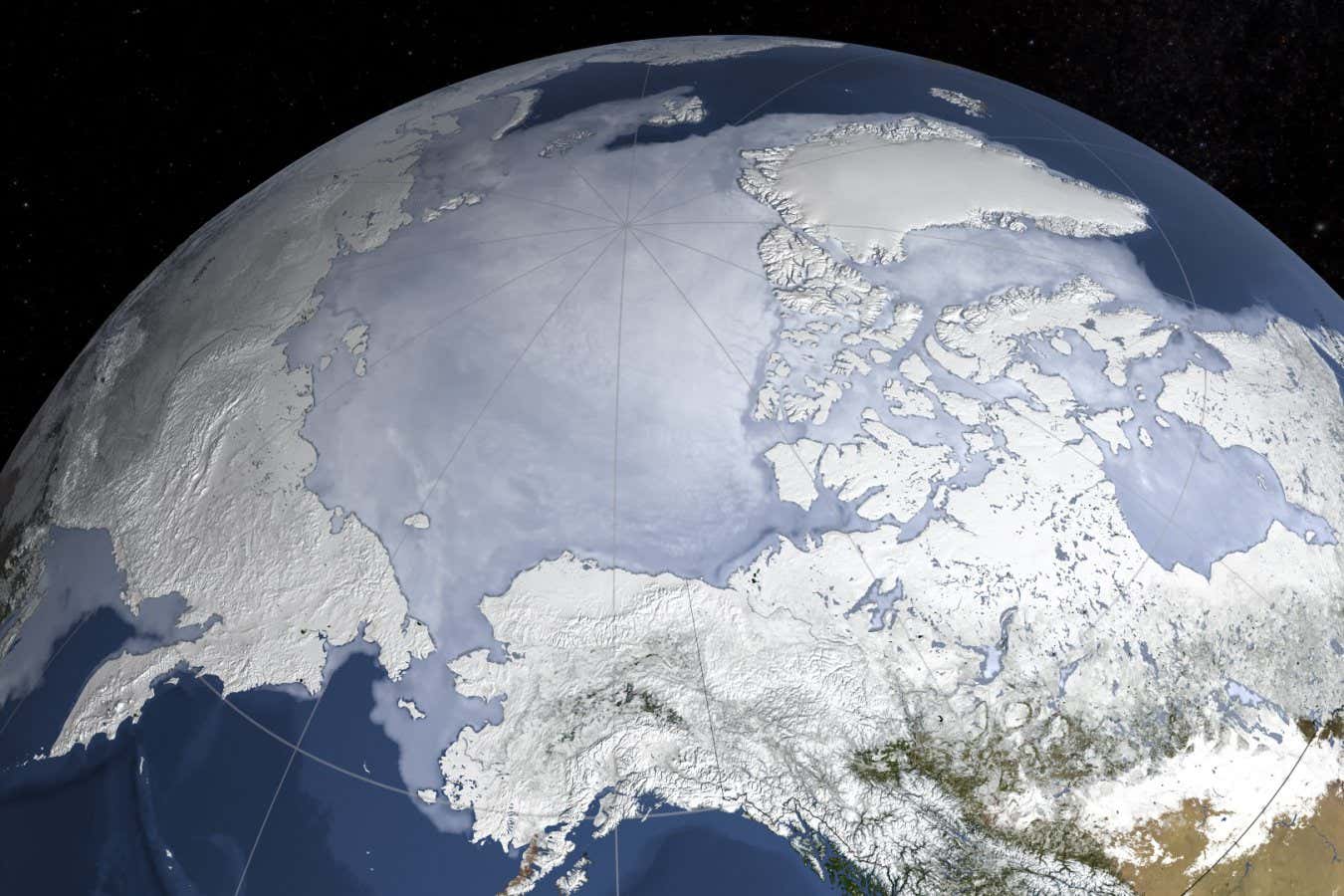
The Arctic is shedding ice at a rate of 12 per cent per decade and is set to be ice-free in the summer by the 2030s – regardless of how fast we cut emissions from now on. Meanwhile, in Antarctica, the vast Thwaites glacier is cracking under the pressure of global warming, and Antarctic sea ice has been tracking at record lows in 2024 for the second year running.
We must cut emissions, and fast, but that alone won’t be enough to stop the runaway melt in the Arctic. To buy us time and to buttress this delicate habitat from a warming world, geoengineering is probably our only hope.
One solution comes from start-up Real Ice, which plans to use seawater to thicken the Arctic’s ice. It is controversial. Geoengineering of this sort, opponents argue, risks distracting humanity from the gargantuan task of cutting emissions.
Of all our geoengineering options, refreezing the poles is perhaps the most benign
Yet there are good reasons to push ahead. Alongside the spectacular wildlife and rich cultural heritage there, the polar regions do the world a huge favour. Their white caps reflect solar radiation back into space, helping to keep Earth’s climate cool. The loss of Arctic sea ice also triggers a whole host of other feedbacks that would amplify climate change and play havoc with weather systems around the world.
Of all our geoengineering options, refreezing the poles is perhaps the most benign. There are, of course, risks. Thorough impact assessments will be vital to minimise any harmful effects on wildlife, local communities or wider Earth systems. But without action, the ice will disappear, destabilising the global climate.
Cuts to greenhouse gas emissions should have started decades ago. The delay has left us with no time to be squeamish about geoengineering.
Queshque glacier in Peru is retreating because of global heating
Emilio Mateo/Aspen Global Change Institute
Mountain glaciers in the Andes are almost certainly the smallest they have been for at least 130,000 years, a study of rocks exposed by the melting ice has found.
“This shocked us, frankly,” says Andrew Gorin at the University of California, Berkeley. “I think this is clear evidence that at least one region in the world has now departed the hospitable climatic conditions that have fostered the development of human civilisation.”
The Andes mountain range is so high up that there are permanent glaciers in many places, even in tropical areas. In fact, almost all of the world’s tropical glaciers are in the Andes.
It has been clear for decades that these glaciers are both thinning and retreating as a result of global heating. But how this compares with what happened in the more distant past hasn’t been clear.
Gorin and his colleagues have analysed 20 samples of rock that were recently exposed due to the retreat of four tropical glaciers in the Andes. They looked for isotopes of carbon and beryllium that form when exposed rock is hit by cosmic rays, which can reveal when a glacier last retreated past a certain point.
Similar studies in northerly regions of the world have shown that glaciers there were at their smallest a few thousand years ago, around the middle of the current interglacial period. This is because changes in Earth’s orbit resulted in northern areas getting more winter sunshine, says Gorin, causing glaciers to retreat.
While the shrinking of northern glaciers in the mid-interglacial was a regional rather than global phenomenon, the researchers expected to find something similar in the Andes at that time. Instead, levels of the isotypes they found were so low that they were almost undetectable.
“This is an alarm bell. It’s the canary in the coal mine for mountain glaciers everywhere,” says Gorin.
“We’re quickly blowing past climate milestones that we thought were decades away,” he says. “We chose the specific locations that we sampled at these glaciers with the implicit assumption that these glaciers were not smaller than they have ever been in human history.”
The findings show directly that these glaciers didn’t retreat as far as they have today at any time in the past 11,700 years. Before this point, there was a global glacial period, and studies by other teams show that the tropics were cooler then.
While the study doesn’t say this, Gorin agreed when asked that this means Andean glaciers have almost certainly shrunk to the smallest they have been since at least the previous interglacial, around 130,000 years ago.
“I’d bet my life savings that your assertion that these glaciers are now the smallest they’ve been since the last interglacial is true,” he says. “However, due to the limitations of the technique we used to address this question, we can’t definitively prove that fact, and this is why we don’t say so in the article.”
“This is a shocking piece of research,” says Liam Taylor at the University of Leeds in the UK. “Undoubtedly, the science is conclusively showing that glaciers across the Andes are in a state that they haven’t been in since before the Holocene began 11,700 years ago, and this is directly caused by human activities changing the climate.”
The retreat of glaciers is already affecting farming, drinking water supplies, sanitation and hydropower in the region, says Taylor. This is because glaciers act as reservoirs, storing winter snowfall and releasing meltwater in the summer.
“Many of the glaciers in this region have now passed ‘peak water’, meaning that meltwater that supplies freshwater downstream is drying up,” he says.
In the past century, tens of thousands of people in Peru have also been killed by floods caused by the bursting of lakes formed as the glaciers retreated, says Stephan Harrison at the University of Exeter in the UK. More such disasters could occur around the world as mountain glaciers retreat.
Climate models suggest that mountain glaciers will lose more than 90 per cent of their ice by the end of the century, he says, leaving just a few small glaciers in the highest areas.
THIS frigid scene in the Coast mountains in British Columbia, Canada, is a sight to behold – but enjoy it while you can as it may not be like this for much longer.
When snow falls in places like this, it becomes compacted into thick ice that flows over the land and forms a glacier, creating giant reservoirs of water that sustain life when melting occurs. These are an ancient and vital resource.
Burtynsky took the shot from a helicopter and was shocked to see that the glaciers had receded dramatically compared with 20 years ago, when he last visited. The glaciers in this range date as far back as 150,000 years, but they are shrinking rapidly because of warming as a result of human activity.
“When that’s gone, it’s gone, and the whole ecosystem and the whole life system will change forever,” says Burtynsky. His images are designed to serve as a reminder of what has been lost, he says. New Works also focuses on soil erosion in Turkey and the impact of coal mining on Australia.
Burtynsky is currently displaying in another exhibition in London, Extraction/Abstraction. This also explores the human impact on the planet and is at the Saatchi Gallery until 6 May.