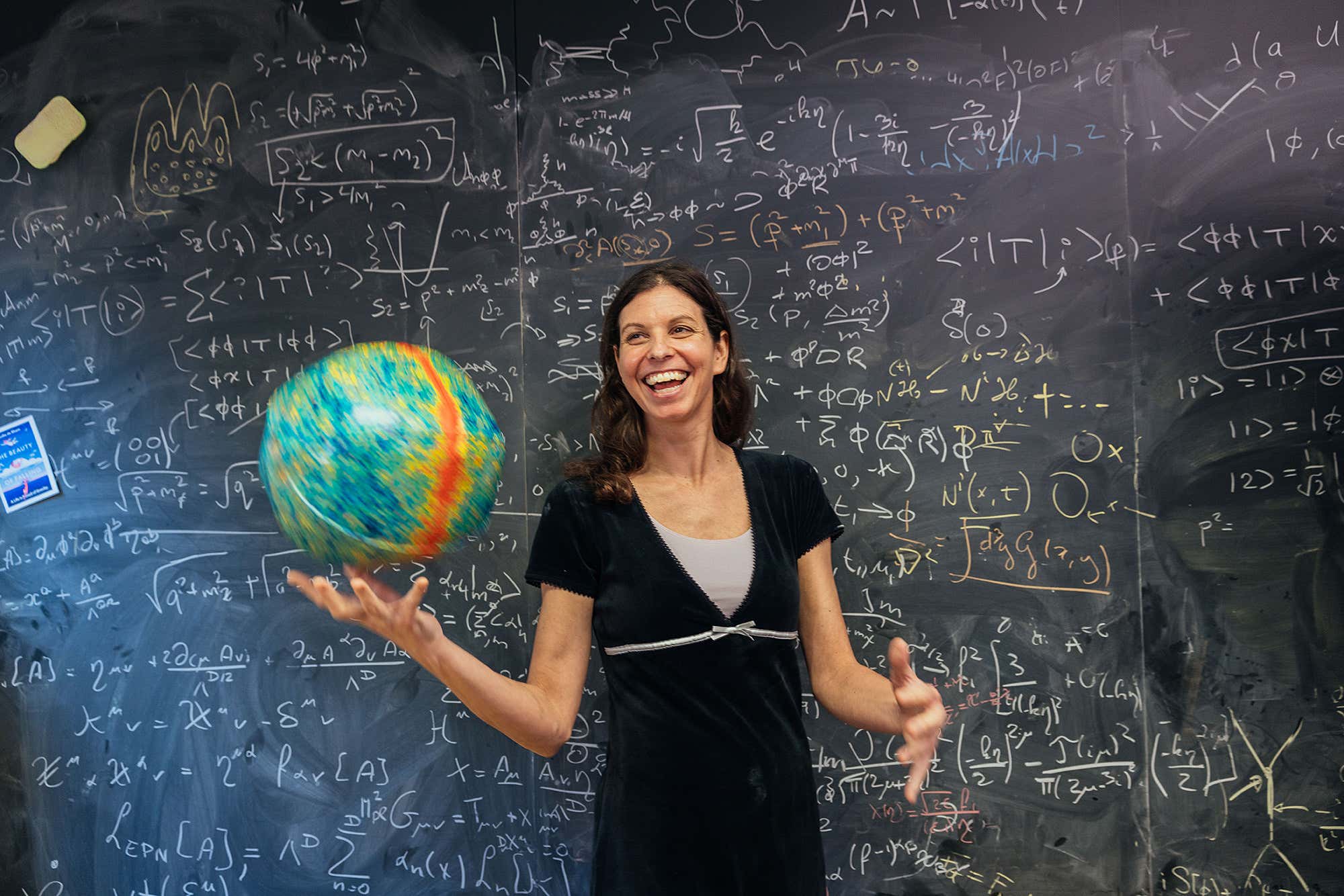
THE fans roar into life, pumping air upwards at 260 kilometres per hour. Decked out in a baggy blue jumpsuit, red helmet and plastic goggles, Claudia de Rham steps forward into a glass chamber and… whoosh! Suddenly she is suspended in mid-air, a wide grin on her face, thrilling to the simulated experience of free fall.
I had persuaded de Rham, a theoretical physicist at Imperial College London, to come indoor skydiving with me at iFLY London. It seemed fitting, given that much of her life has been dedicated to exploring the limits and true nature of gravity – and launching ourselves out of a plane wasn’t an option, at least on this occasion.
As she describes in her new book, The Beauty of Falling, de Rham trained to be a pilot and then an astronaut, only for a medical problem to scupper her chances of the ultimate escape from gravity. But she has gone on to explore this most familiar and mysterious force in a more profound way, as a theorist, and made an impression by asking a radical question: what does gravity weigh?
By that she means the graviton, the hypothetical particle thought to carry this force. If it has mass, as de Rham suspects, that would open a new window onto gravity. Among other things, we might finally spot a “gravitational rainbow” that would betray the existence of gravitons – and with them, a long-sought quantum description of gravity.
As de Rham floats on air, she makes it look easy. She is soon ascending to…
You can sip your coffee thanks to the fundamental forces of nature
Vladimir Arndt / Alamy
The following is an extract from our Lost in Space-Time newsletter. Each month, we hand over the keyboard to a physicist or mathematician to tell you about fascinating ideas from their corner of the universe. You can sign up for Lost in Space-Time for free here.
Though our world is bewildering in its diversity, all known natural phenomena can be classified into just a few categories. Four of these – gravitational, electromagnetic, strong nuclear and weak nuclear – are…
But there may be opportunities to indirectly spot the signatures of those gravitons.
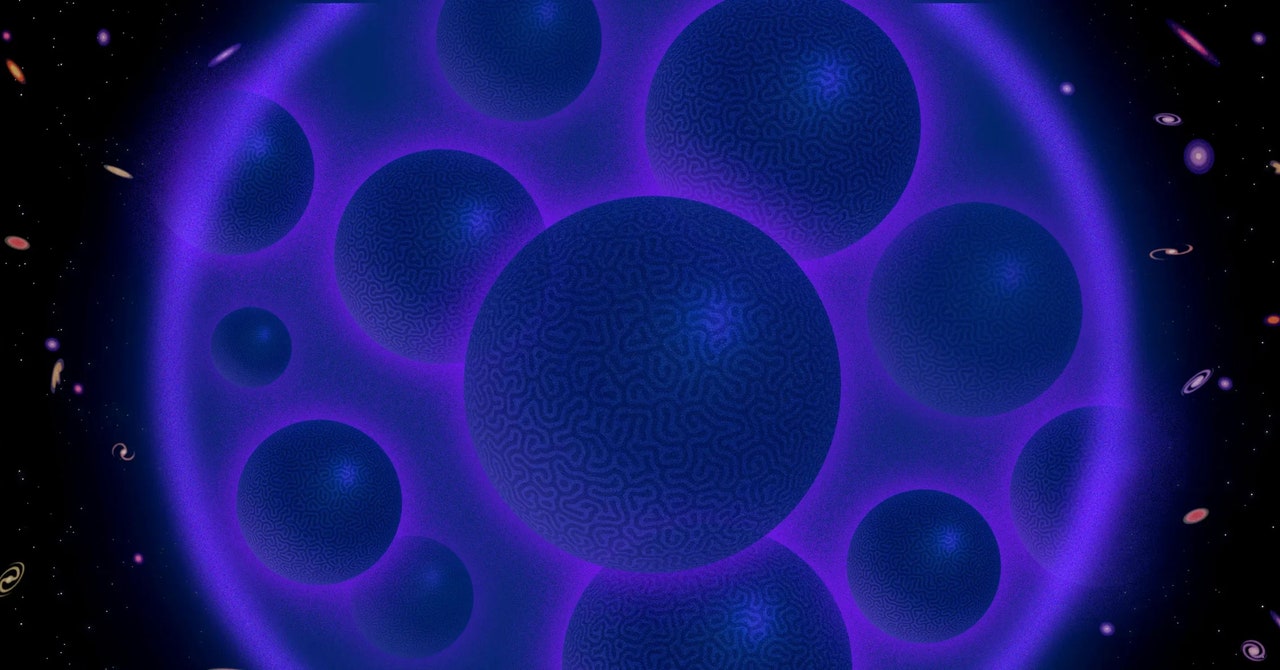
One strategy Vafa and his collaborators are pursuing draws on large-scale cosmological surveys that chart the distribution of galaxies and matter. In those distributions, there might be “small differences in clustering behavior,” Obied said, that would signal the presence of dark gravitons.
When heavier dark gravitons decay, they produce a pair of lighter dark gravitons with a combined mass that is slightly less than that of their parent particle. The missing mass is converted to kinetic energy (in keeping with Einstein’s formula, E = mc2), which gives the newly created gravitons a bit of a boost—a “kick velocity” that’s estimated to be about one-ten-thousandth of the speed of light.
These kick velocities, in turn, could affect how galaxies form. According to the standard cosmological model, galaxies start with a clump of matter whose gravitational pull attracts more matter. But gravitons with a sufficient kick velocity can escape this gravitational grip. If they do, the resulting galaxy will be slightly less massive than the standard cosmological model predicts. Astronomers can look for this difference.
Recent observations of cosmic structure from the Kilo-Degree Survey are so far consistent with the dark dimension: An analysis of data from that survey placed an upper bound on the kick velocity that was very close to the value predicted by Obied and his coauthors. A more stringent test will come from the Euclid space telescope, which launched last July.
Meanwhile, physicists are also planning to test the dark dimension idea in the laboratory. If gravity is leaking into a dark dimension that measures 1 micron across, one could, in principle, look for any deviations from the expected gravitational force between two objects separated by that same distance. It’s not an easy experiment to carry out, said Armin Shayeghi, a physicist at the Austrian Academy of Sciences who is conducting the test. But “there’s a simple reason for why we have to do this experiment,” he added: We won’t know how gravity behaves at such close distances until we look.
The closest measurement to date—carried out in 2020 at the University of Washington—involved a 52-micron separation between two test bodies. The Austrian group is hoping to eventually attain the 1-micron range predicted for the dark dimension.
While physicists find the dark dimension proposal intriguing, some are skeptical that it will work out. “Searching for extra dimensions through more precise experiments is a very interesting thing to do,” said Juan Maldacena, a physicist at the Institute for Advanced Study, “though I think that the probability of finding them is low.”
Joseph Conlon, a physicist at Oxford, shares that skepticism: “There are many ideas that would be important if true, but are probably not. This is one of them. The conjectures it is based on are somewhat ambitious, and I think the current evidence for them is rather weak.”
Of course, the weight of evidence can change, which is why we do experiments in the first place. The dark dimension proposal, if supported by upcoming tests, has the potential to bring us closer to understanding what dark matter is, how it is linked to both dark energy and gravity, and why gravity appears feeble compared to the other known forces. “Theorists are always trying to do this ‘tying together.’ The dark dimension is one of the most promising ideas I have heard in this direction,” Gopakumar said.
But in an ironic twist, the one thing the dark dimension hypothesis cannot explain is why the cosmological constant is so staggeringly small—a puzzling fact that essentially initiated this whole line of inquiry. “It’s true that this program does not explain that fact,” Vafa admitted. “But what we can say, drawing from this scenario, is that if lambda is small—and you spell out the consequences of that—a whole set of amazing things could fall into place.”
Original storyreprinted with permission fromQuanta Magazine, an editorially independent publication of theSimons Foundationwhose mission is to enhance public understanding of science by covering research developments and trends in mathematics and the physical and life sciences.
WHAT if there were a perfect board game? Some combination of boards and pieces and rules – maybe with a few yet-to-be invented additions – that would create an unsurpassable experience, the only board game anyone ever wants to play?
That’s how physicists feel about the theory of everything, a putative “final” framework that would explain all reality in one fell swoop. This is the ultimate goal for physics, with Stephen Hawking once memorably writing that to find it would be to know “the mind of God”.
It is an audacious mission, so much so that some people consider it quixotic. At this stage, there can be no doubt that breaking reality down into ever more fundamental pieces hasn’t quite worked. But the potential payoff of a final theory is so huge that some physicists doggedly refuse to give up, and now they are pivoting towards a radical new approach.
Since a theory of everything has to explain all the constituent parts of reality, including space and time, the idea is that we must start from an even more basic premise. That is why a spate of new would-be final theories aren’t grounded in physics at all, but in a wild landscape of abstract geometry. Perhaps the ultimate scientific truth lies within the mathematics of a metaphysical jewel that computes the universe, or a shimmering tapestry of triangles and tetrahedrons?
That might strike you as outlandish, but it makes sense to Peter Woit, a mathematician at Columbia University in New York. “Our best theories are already very deeply geometrical,”…
But the solar system contains more than two masses. In fact, it started as a big cloud of dust without any planets and without the sun, and every speck of dust had an attractive interaction with every other speck. That’s a lot of complicated stuff going on, but there’s a trick we can use to simplify it. If the dust is evenly distributed, then a particle on the outside of the cloud would experience a gravitational force as though all of the other dust was concentrated at a single point in the middle of the cloud.
So what would this giant cloud of dust do? Well, each piece would experience a force pulling it toward the center of the cloud. It would essentially collapse in on itself. Just to get a feel for what this would look like, I built a computational model using 100 masses to represent all the dust. Here’s what it would look like:
Video: Rhett Allain
Of course, that does not look like our solar system. The reason is that the cloud of dust that formed our solar system started off with a slight rotation. Why does that matter? In order to answer that, we have to think about what happens when an object moves in a circle.
Going in Circles
Imagine you have a ball attached to a string, and you swing it around in a circle. As the ball moves, its velocity changes direction. Since we define acceleration as the rate of change of velocity, this ball must have an acceleration. Even if it’s moving at a constant speed, it will be accelerating because of its circular motion. We call this centripetal acceleration—which literally means “center pointing,” since the direction of the acceleration vector is toward the center of the circle. See, words make sense sometimes.
We can also find the magnitude of this centripetal acceleration. It depends on both how fast the object is moving (v) as it speeds around the circle and the radius of the circle (r). However, sometimes it’s more useful to describe circular motion with angular velocity (ω).
The linear velocity (v) measures how far an object travels in a unit of time (e.g., meters per second). Angular velocity measures how much of the circle it traverses in a unit of time. How can we measure that? If you drew a line from the center of the circle to a starting point and another line to the ball’s position after one second, those two lines would define an angle. So angular velocity measures the angle that the ball covers (in radians per second). It basically tells you how fast an object rotates around a center point. With that, we get the following two definitions for centripetal acceleration (ac).