Tag: Heart

  • Interatrial shunt may offer differential benefits based on heart failure type

    Interatrial shunt may offer differential benefits based on heart failure type

    [ad_1]

    Patients with heart failure who had a small shunt inserted between the heart’s left and right atria did not see any significant benefits overall compared with those who received a placebo procedure after a median of 22 months follow-up, in a study presented at the American College of Cardiology’s Annual Scientific Session.

    The trial, called RELIEVE-HF, is the first randomized placebo-procedure controlled trial of interatrial shunting that included patients with both major types of heart failure: heart failure with reduced ejection fraction (HFrEF) and heart failure with preserved ejection fraction (HFpEF). While the trial did not meet its primary endpoint, it moves the field forward by offering signals that the benefits and risks of interatrial shunts may vary by heart failure type, according to researchers.

    When you examine the outcomes in patients with heart failure across a broad range of left ventricular ejection fraction, the Ventura interatrial shunt was extremely safe but did not improve outcomes compared with no treatment. However, in a prespecified analysis, data suggest that the shunt may be beneficial in patients with HFrEF and worsen outcomes in patients with HFpEF. We believe further studies are warranted to confirm the benefits we observed in patients with reduced ejection fraction.”


    Gregg Stone, MD, professor of cardiology and population health sciences at Icahn School of Medicine at Mount Sinai in New York and study’s first author

    Heart failure is a condition in which the heart becomes too weak or stiff to effectively pump blood, leading to fatigue, organ damage, shortness of breath and an increased risk of life-threatening cardiovascular events. In HFrEF, the heart muscle becomes weak and does not squeeze as hard as it should. In HFpEF, the left ventricle becomes stiff and does not properly fill with blood.

    The Ventura shunt is one of several interatrial devices being tested to aid in the treatment of heart failure. It is designed to form a small connection or passage between the left and right atria to allow blood to leave the left atrium—especially as left atrial pressure rises—thus reducing the pressure in the left atrium and the lungs. High left atrial pressure is a primary cause of shortness of breath and hospitalizations related to heart failure.

    The trial randomized 508 patients at 94 sites in North America, Europe, Israel, Australia and New Zealand. All participants had symptomatic heart failure despite taking medications at maximally tolerated doses. About 40% of participants had HFrEF and 60% had HFpEF.

    Participants were randomly assigned to undergo a procedure to insert the Ventura shunt or a placebo procedure in which a script was followed with all the same protocols to mask patients as to whether the shunt was inserted. Operators were aware of which procedure each patient received but patients, their families and the rest of the medical teams taking care of the patient after the procedure were not. Researchers tracked outcomes in each participant for at least one year and up to two years.

    The results showed no significant difference between groups in terms of the trial’s primary endpoint, a hierarchical composite ranking of death from any cause; heart transplant or left ventricular assist device; heart failure hospitalizations; worsening of outpatient heart failure events; and change in quality of life, as measured using the Kansas City Cardiomyopathy Questionnaire (KCCQ). This hierarchical composite approach for assessing efficacy allows diverse types of outcomes to be incorporated in ranked fashion into an overall “win ratio” reflecting the overall outcome of a drug or device.

    In a pre-planned analysis focused on heart failure type, patients with HFrEF who received the shunt were found to have improvements across all outcomes assessed (especially fewer hospitalizations for heart failure), while those with HFpEF who received the shunt were found to have increased rates of death and heart failure hospitalizations. This difference could be attributed to the greater compliance or flexibility of the heart muscle with HFrEF, potentially allowing it to more easily accommodate the extra blood flowing into the right atrium, Stone said.

    There were no device-related or procedure-related major adverse cardiovascular or neurologic events in either group during the duration of the trial.

    Surprisingly, a marked improvement in quality of life as measured with KCCQ was observed across all groups—including those who received a placebo procedure, both with HFrEF and HFpEF—suggesting that the metric may not be a reliable indicator for quality-of-life outcomes in this context, Stone said.

    “There was a tremendous placebo effect,” he said. “These observations, especially the fact that quality of life improved in HFpEF patients who were more likely to be hospitalized for heart failure and had reduced survival after shunt treatment, raise questions about the interpretation of this quality-of-life measure in these kinds of trials.”

    Although the observed differences in outcomes among people with different types of heart failure may inform future research and development for interatrial devices, the researchers said that the trial was not powered to show differences in the two types of heart failure. As such, these results should be considered exploratory. They also said that the results may not be applicable to other interatrial shunts beyond the Ventura shunt.

    The study was funded by V-Wave Medical.

    Stone will be available to the media in a press conference on Saturday, April 6, 2024, at 10:45 a.m. ET / 14:45 UTC in Room B203.

    Stone will present the study, “A Double-blind, Randomized Placebo Procedure-controlled Trial of an Interatrial Shunt in Patients with HfrEF and HfpEF: Principal Results from the RELIEVE-HF Trial,” on Saturday, April 6, 2024, at 9:30 a.m. ET / 13:30 UTC in the Hall B-1 Main Tent.


    [ad_2]

    Source link

  • MADs show comparable blood pressure reduction to CPAP in hypertensive patients with sleep apnea

    MADs show comparable blood pressure reduction to CPAP in hypertensive patients with sleep apnea

    [ad_1]

    People with hypertension and obstructive sleep apnea were no less likely to see their blood pressure drop over six months if they used a mandibular advancement device (MAD), which is inserted onto the teeth similar to a bite guard. compared to a continuous positive airway pressure (CPAP) device, according to research featured at the American College of Cardiology’s Annual Scientific Session. Hypertension, or high blood pressure, is a common risk factor for cardiovascular disease. People with obstructive sleep apnea experience frequent sleep interruptions due to the airway closing periodically during sleep. Since obstructive sleep apnea can cause or worsen hypertension, medical guidelines recommend the use of a CPAP machine to help keep airways open by delivering pressurized air through the mouth and nose.

    MADs are designed to help keep the airway open by repositioning the lower jaw and moving the tongue forward. Previous studies have shown that CPAP devices outperform MADs in terms of apnea-hypopnea index, the standard metric used to measure sleep apnea severity. However, there is evidence that MADs may be better tolerated than CPAP, which some people find too uncomfortable or cumbersome for sustained use.

    In this study, MADs were found non-inferior in terms of change in the average 24-hour ambulatory mean blood pressure at six months and they resulted in a larger reduction across multiple secondary blood pressure parameters compared with CPAP. According to researchers, higher adherence among people assigned to use the MAD device could help explain the findings.

    Looking at the totality of evidence available in the literature, it is still reasonable to say that CPAP is the first-line treatment until we have more data on the MAD. However, for patients who truly cannot tolerate or accept using a CPAP, we should be more open minded in looking for an alternative therapy such as a MAD, which based on our study, numerically had a better blood pressure reduction in patients compared with a CPAP.”


    Ronald Lee Chi-Hang, MD, professor of medicine at Yong Loo Lin School of Medicine, National University of Singapore, senior consultant in the department of cardiology at National University Heart Centre, Singapore, and one of the study authors

    For the study, 321 people with uncontrolled hypertension and high cardiovascular risk underwent a sleep study to determine whether they had obstructive sleep apnea. Of these, 220 people were found to have moderate to severe obstructive sleep apnea and were randomly assigned to receive a MAD or CPAP device. Participants were instructed to use their assigned device for six months while sleeping to the degree that they could tolerate it. Both devices had built-in trackers that recorded use.

    At six months, people assigned to the MAD group experienced a drop in 24-hour ambulatory mean blood pressure that was 1.64 mmHg larger, on average, than those assigned to CPAP, meeting the threshold for non-inferiority and the trial’s primary endpoint. Compared with the CPAP group, the MAD group also showed a larger between-group reduction in all ambulatory blood pressure measures, especially nighttime blood pressure when the devices were being used, and an increased proportion of patients achieving a systolic blood pressure below 120 mmHg by the end of the study. None of the participants experienced symptomatic hypotension.

    The adherence data revealed that over half (56.5%) of those who were assigned to use the MAD used the device for six or more hours per night on average over the study period, while under one-quarter (23.2%) of those assigned to CPAP did so.

    “The MAD patients simply used the device longer,” Chi-Hang said. “That also might explain why the blood pressure reduction at nighttime, when the patients are actually using it, had a better reduction in the MAD arm.”

    Adherence to the American Academy of Sleep Medicine’s recommendation of four or more hours of use in at least 70% of nights overall was similar between groups, with 69.4% of those in the MAD group and 64.3% of those in the CPAP group meeting this recommendation. Both groups saw a reduction in daytime sleepiness and the results showed no between-group differences in cardiovascular biomarkers.

    Overall, researchers said the results underscore the importance of treating sleep apnea as part of a broader effort to control hypertension and reduce cardiovascular risk.

    “People should be aware that over 400 million people globally have moderate-to-severe obstructive sleep apnea, and it is underdiagnosed and may be a contributing factor to their high blood pressure,” Chi-Hang said. “Especially for patients whose blood pressure is hard to control or who have a lot of excessive daytime sleepiness, [it is important to] go see a physician about sleep apnea and get treated if necessary.”

    Since the study was conducted in Singapore and most study participants were of East Asian descent, researchers said further studies in more diverse populations are necessary to determine whether the findings are generalizable to other racial and ethnic groups. Chi-Hang also said that the timing of the study, which was conducted during travel lockdowns during the COVID-19 pandemic, may have influenced the results by increasing adherence.

    The researchers plan to conduct further studies focused on comparing the impacts of the different types of devices on cognition.

    The study was funded by the Singapore Ministry of Health.

    This study was simultaneously published online in the Journal of the American College of Cardiology at the time of presentation.

    Chi-Hang will present the study, “Mandibular Advancement Device Versus CPAP for Blood Pressure Reduction in Obstructive Sleep Apnea and High Cardiovascular Risk—A Randomized Clinical Non-inferiority Trial,” on Saturday, April 6, 2024, at 4:15 p.m. ET / 20:15 UTC in the Thomas B. Murphy Ballroom 4.

    [ad_2]

    Source link

  • Investigational drug plozasiran shows promise in reducing severe hypertriglyceridemia

    Investigational drug plozasiran shows promise in reducing severe hypertriglyceridemia

    [ad_1]

    In patients with severely elevated triglyceride levels at risk for developing acute pancreatitis, the investigational drug plozasiran reduced triglyceride levels by an average of 74% after 24 weeks of use without causing any significant safety concerns, according to research presented at the American College of Cardiology’s Annual Scientific Session.

    Plozasiran produced significant reductions in triglyceride levels below the threshold associated with elevated risk for pancreatitis, with a favorable safety profile. These data support the initiation of pivotal studies of plozasiran for the treatment of severe hypertriglyceridemia.”

    Daniel Gaudet, MD, PhD, professor of medicine at the University of Montreal and the study’s lead author

    Triglycerides are blood lipids (fats) that store unused calories and provide energy to the body. An estimated 1 in 5 U.S. adults—and more than 2 in 5 of adults aged 60 years and older—have elevated triglycerides, defined as over 150 mg/dL. High levels of triglycerides and the lipid particles on which they are carried in the blood can contribute to the formation of “plaques” in the arteries that impede blood flow and can lead to heart attacks and strokes. Severe hypertriglyceridemia—defined as triglyceride levels over 500 mg/dL—can also cause pancreatitis, an inflammatory process in the pancreas that can be life threatening.

    ApoC3 is a protein produced in liver cells that inhibits the liver’s ability to clear fats such as triglycerides out of the body. Plozasiran works by reducing the production of ApoC3, thereby enabling the liver to increase its clearance of triglycerides and other fats. The SHASTA-2 trial tested the effectiveness and safety of plozasiran as an add-on to existing lipid-lowering treatment in patients with severe hypertriglyceridemia.

    A total of 229 patients (average age 55 years, 78% men and 90% White) were enrolled in the trial in eight countries. Patients’ average triglyceride level at baseline was about 900 mg/dL. Most also had at least three of the following risk factors: elevated risk for or history of cardiovascular disease, diabetes, low HDL (“good”) cholesterol and high body mass index.

    Patients were randomly assigned to one of four groups. Three groups received two injections of plozasiran at one of three doses (10 mg, 25 mg or 50 mg); the fourth group received two injections of a placebo. The first injection was given on day one and the second at week 12. The study was double-blinded, meaning that neither the patients nor their clinicians knew who was receiving the drug and who was receiving the placebo until the study was over.

    The study’s primary endpoint was the percentage change in fasting triglyceride levels from study entry to 24 weeks. Secondary endpoints included the percentage change in ApoC3 at 24 weeks and every four weeks from baseline through 48 weeks and in fasting triglyceride levels every four weeks through 48 weeks. All patients were followed for 36 weeks after the second dose (for a total of 48 weeks).

    At 24 weeks, the average reduction in triglyceride levels in plozasiran-treated patients was 74%, compared with 17% in patients who received the placebo. At 48 weeks the average reduction was 58% in patients who received the highest doses of plozasiran compared with 7% for those in the placebo group. The average reduction in ApoC3 was 78% for plozasiran-treated patients versus 1% for the placebo group at 24 weeks. At 48 weeks, ApoC3 levels were reduced by 48% on average among patients receiving the highest doses of plozasiran, whereas ApoC3 levels increased 4% in the placebo group.

    At 24 weeks, over 90% of patients who received the higher doses (25 mg or 50 mg) of plozasiran saw their triglyceride levels fall to below 500 mg/dL, the commonly accepted threshold for an increase in risk for pancreatitis. At 48 weeks, 77% of these patients still had triglyceride levels of less than 500 mg/dL. More than 50% of patients on higher doses achieved triglyceride levels of below 150 mg/dL (i.e., in the normal range) at 24 weeks.

    “Significant and durable dose-dependent reductions in ApoC3 and triglycerides persisted through week 48, or 36 weeks after patients received their second dose of plozasiran,” Gaudet said.

    Severe hypertriglyceridemia is a challenging condition for which few effective treatments are currently available, he said.

    “From the patients’ standpoint, the possibility that in the near future there could be an agent that safely and effectively lowers severely elevated triglyceride levels and reduces or eliminates the risk of developing pancreatitis is extraordinary,” he said.\

    Limitations of the study are its relatively small size and short duration and a lack of diversity among the enrolled patients, Gaudet said. The planned phase 3 study will be conducted in a patient population that will include more women and more patients from racial and ethnic minorities.

    “What we want to know is how sustained is the effect of plozasiran in a larger, more diverse cohort,” he said.

    The study was funded by Arrowhead Pharmaceuticals, the manufacturer of plozasiran.

    Gaudet will be available to the media in a press conference on Sunday, April 7, 2024, at 9:30 a.m. ET / 13:30 UTC in Room B203.

    Gaudet will present the study, “Plozasiran (ARO-APOC3), An Investigational RNAi Therapeutic, Demonstrates Profound And Durable Reductions In APOC-3 And Triglycerides (TG) In Patients With Severe Hypertriglyceridemia (SHTG), SHASTA-2 Final Results,” on Sunday, April 7, 2024, at 8:00 a.m. ET / 12:00 UTC in the Hall B-1 Main Tent.

    [ad_2]

    Source link

  • Ten doctors on FDA panel reviewing Abbott heart device had financial ties with company

    Ten doctors on FDA panel reviewing Abbott heart device had financial ties with company

    [ad_1]

    When the FDA recently convened a committee of advisers to assess a cardiac device made by Abbott, the agency didn’t disclose that most of them had received payments from the company or conducted research it had funded — information readily available in a federal database.

    One member of the FDA advisory committee was linked to hundreds of payments from Abbott totaling almost $200,000, according to a database maintained by the Department of Health and Human Services. Another was connected to 100 payments totaling about $100,000 and conducted research supported by about $50,000 from Abbott. A third member of the committee worked on research supported by more than $180,000 from the company.

    The government database, called “Open Payments,” records financial relationships between doctors and certain other health care providers and the makers of drugs and medical devices. KFF Health News found records of Abbott payments associated with 10 of the 14 voting members of the FDA advisory panel, which was weighing clinical evidence for a heart device called TriClip G4 System. The money, paid from 2016 through 2022 — the most recent year for which the database shows payments — adds up to about $650,000.

    The panel voted almost unanimously that the benefits of the device outweigh its risks. Abbott announced on April 2 that the FDA had approved TriClip, which is designed to treat leakage from the heart’s tricuspid valve.

    The Abbott payments illustrate the reach of medical industry money and the limits of transparency at the FDA. They also shed light on how the agency weighs relationships between people who serve on its advisory panels and the makers of drugs and medical devices that those committees review as part of the regulatory approval process.

    The payments do not reflect wrongdoing on the part of the agency, its outside experts, or the device manufacturer. The database does not show that any of the payments were related directly to the TriClip device.

    But some familiar with the process, including people who have served on FDA advisory committees, said the payments should have been disclosed at the Feb. 13 meeting — if not as a regulatory requirement, then in the interest of transparency, because the money might call into question committee members’ objectivity.

    “This is a problem,” Joel Perlmutter, a former FDA advisory committee member and a professor of neurology at Washington University School of Medicine in St. Louis, said by email. “They should or must disclose this due to bias.”

    The Open Payments database records several kinds of payments from drug and device makers. One category, called “associated research funding,” supports research in which a physician is named a principal investigator in the database. Another category, called “general payments,” includes consulting fees, travel expenses and meals connected to physicians in the database. The money can flow from manufacturers to third parties, such as hospitals, universities, or other corporate entities, but the database explicitly connects doctors by name to the payments.

    At the public meeting to consider the TriClip device, an FDA official announced that committee members had been screened for potential financial conflicts of interest and found in compliance with government requirements.

    FDA spokesperson Audra Harrison said by email that the agency doesn’t comment on matters related to individual advisory committee members.

    “The FDA followed all appropriate procedures and regulations in vetting these panel members and stands firmly by the integrity of the disclosure and vetting processes in place,” she said. “This includes ensuring advisory committee members do not have, or have the appearance of, a conflict of interest.”

    Abbott “has no influence over who is selected to participate in FDA advisory committees,” a spokesperson for the company, Brent Tippen, said in a statement.

    Diana Zuckerman, president of the National Center for Health Research, a think tank, said the FDA shouldn’t have allowed recipients of funding from Abbott in recent years to sit in judgment of the Abbott product. The agency takes too narrow a view of what should be disqualifying, she said.

    One committee member was Craig Selzman, chief of the Division of Cardiothoracic Surgery at the University of Utah. The Open Payments database connects to Selzman about $181,000 in associated research funding from Abbott to the University of Utah Hospitals & Clinics.

    Asked in an interview if a reasonable person could question the impartiality of committee members based on the Abbott payments, Selzman said: “People from the outside looking in would probably say yes.”

    He noted that Abbott’s money went to the university, not to him personally. Participating in industry-funded clinical trials benefits doctors professionally, he said. He added: “There’s probably a better way to provide transparency.”

    The FDA has a history of appointing people to advisory committees who had relationships with manufacturers of the products under review. For example, in 2020, the doctor who chaired an FDA advisory committee reviewing Pfizer’s covid-19 vaccine had been a Pfizer consultant.

    Appearance issues

    FDA advisory committee candidates, selected to provide expert advice on often complicated drug and device applications, must complete a confidential disclosure report that asks about current and past financial interests as well as “anything that would give an ‘appearance’ of a conflict.”

    The FDA has discretion to decide whether someone with an “appearance issue” can serve on a panel, according to a guidance document posted on the agency’s website. Relationships more than a year in the past generally don’t give rise to appearance problems, according to the document, unless they suggest close ties to a company or involvement with the product under review. The main question is whether financial interests would cause a reasonable person to question the member’s impartiality, the document says.

    The FDA draws a distinction between appearance issues and financial conflicts of interest. Conflicts of interest occur when someone chosen to serve on an advisory committee has financial interests that “may be impacted” by their work on the committee, an FDA explainer says.

    If the FDA finds a conflict of interest but still wants the applicant on a panel, it can issue a public waiver. None of the panelists voting on TriClip received a waiver.

    The FDA’s approach to disclosure contrasts with rules for conferences at which doctors earn credit for continuing medical education. For example, for a recent conference in Boston on technology for treatment of heart failure, including TriClip, the group holding the meeting directed speakers to include in their slide presentations disclosures going back 24 months.

    Those disclosures — naming companies from which speakers had received consulting fees, grant support, travel expenses, and the like — also appeared on the conference website.

    Unbridled enthusiasm

    The FDA has designated TriClip a “breakthrough” device with “the potential to provide more effective treatment or diagnosis of a life-threatening or irreversibly debilitating disease” compared with current treatments, an agency official, Megan Naber, told the advisory committee.

    Naber said that for breakthrough devices, the “totality of data must still provide a reasonable assurance of safety and effectiveness” but the FDA “may be willing to accept greater uncertainty” about the balance of risks and benefits.

    In a briefing paper for the advisory committee, FDA staff pointed out findings from a clinical trial that didn’t reflect well on TriClip. For example, patients treated with TriClip had “numerically higher” mortality and heart failure hospitalization rates during the 12 months after the procedure compared with a control group, according to the report. Tippen, the Abbott spokesperson, didn’t respond to a request for comment on those findings.

    The committee voted 14-0 that TriClip was safe for its intended use. The panel voted 12-2 that the device was effective, and it voted 13-1 that the benefits of TriClip outweighed the risks.

    The committee member to whom the database attributes the most money from Abbott, Paul Hauptman, cast one of the votes against the device on effectiveness and the sole vote against the device on the bottom-line question of its risks versus benefits.

    Hauptman said during the meeting that the question of safety was “very, very clear” but added: “I just felt the need to pull back a little bit on unbridled enthusiasm.” Who will benefit from the device, he said, “needs better definition.”

    Hauptman, dean of the University of Nevada-Reno School of Medicine, is connected to 268 general payments from Abbott totaling about $197,000 in the Open Payments database. Some payments are listed as going to an entity called Keswick Cardiovascular.

    Hauptman said in an email that he followed FDA guidance and added, “My impartiality speaks for itself based on my vote and critical comments.”

    Some committee members voted in favor of the device despite concerns.

    Marc Katz, chief of the Division of Cardiothoracic Surgery at the Medical University of South Carolina, is linked to 77 general payments totaling about $53,000 from Abbott and worked on research supported by about $10,000 from the company, according to Open Payments.

    “I voted yes for safety, no for effectiveness, but then caved and voted yes for the benefits outweighing the risks,” he said in the meeting.

    In an email, he said of his Abbott payments: “All was disclosed and reviewed by the FDA.” He said that he “can be impartial” and that he “openly expressed … concerns about the treatment.”

    Mitchell Krucoff, a professor at Duke University School of Medicine, is connected to 100 general payments totaling about $105,000. Some went to a third party, HPIC Consulting. He also worked on research supported by about $51,000 from Abbott, according to Open Payments.

    He said during the meeting that he voted in favor of the device on all three questions and added that doctors have “a lot to learn” once it’s on the market. For instance: By using the device to treat patients now, “do we set people up for catastrophes later?”

    In an email, Krucoff said he completed a “very thorough conflict of interest screening by FDA for this panel,” which focused not only on Abbott but also on “any work done/payments received from any other manufacturer with devices in this space.”

    John Hirshfeld Jr., an emeritus professor of medicine at the University of Pennsylvania, is linked by the database to six general payments from Abbott totaling $6,000. Two of the payments linked to him went to a nonprofit, the Cardiovascular Research Foundation, according to the database. He voted yes on all three questions about TriClip but said at the meeting that he “would have liked to have seen more rigorous data to support efficacy.”

    In an email, Hirshfeld said he disclosed the payments to the FDA. The agency did not deem him to have a conflict because he had no stake in Abbott’s success and his involvement with the company had ended, he said. Through the conflict-of-interest screening process, he said, he had been excluded from prior advisory panels.


    Kaiser Health NewsThis article was reprinted from khn.org, a national newsroom that produces in-depth journalism about health issues and is one of the core operating programs at KFF – the independent source for health policy research, polling, and journalism.

    [ad_2]

    Source link

  • COVID-19 shatters decades of global health progress, slashing life expectancy

    COVID-19 shatters decades of global health progress, slashing life expectancy

    [ad_1]

    A recent study published in The Lancet presented the global burden of 288 mortality causes and life expectancy decomposition.

    The Global Burden of Diseases, Injuries, and Risk Factors Study (GBD) has been analyzing causes of human death for over three decades, which has been used to guide policies, monitor/assess health interventions, and reduce risk factors. Assessing cause-specific mortality trends helps inform health policies, which must evolve to account for changes in the global health landscape.

    Mortality patterns evolve continually as some areas succeed in reduction efforts while other causes linger in specific locations. Further, there have been improvements in several causes of death in the past three decades, some of which have substantially narrowed geographically and are concentrated in smaller areas.

    Study: Global burden of 288 causes of death and life expectancy decomposition in 204 countries and territories and 811 subnational locations, 1990–2021: a systematic analysis for the Global Burden of Disease Study 2021. Image Credit: tomertu / ShutterstockStudy: Global burden of 288 causes of death and life expectancy decomposition in 204 countries and territories and 811 subnational locations, 1990–2021: a systematic analysis for the Global Burden of Disease Study 2021. Image Credit: tomertu / Shutterstock

    About the study

    In the present study, researchers presented mortality concentrations and life expectancy decomposition. GBD 2021 provided a comprehensive set of the fatal disease burden for 288 causes by sex and age in 204 countries and territories between 1990 and 2021, an update from previous estimates for 1990–2019. The team calculated years of life lost (YLLs) as the product of death count for each cause, age, sex, year, and location, as well as standard life expectancy at each age.

    Cause-specific mortality rates were computed using the causes of death ensemble model for most causes, and alternative strategies were applied to model causes with unusual epidemiology or insufficient data. Diseases and injuries were classified into four levels, with both non-fatal and fatal causes. Level 1 causes included three broad aggregate categories: 1) non-communicable diseases (NCDs), 2) communicable, maternal, neonatal, and nutritional (CMNN) diseases, and 3) injuries.

    Level 2 disaggregated these categories into 22 clusters, which were further disaggregated into levels 3 and 4 causes. Life expectancy was decomposed by cause of death, year, and location to explore cause-specific effects on life expectancy between 1990 and 2021. Concentrated causes were estimated using the coefficient of variation and mortality concentration (the fraction of the population affected by 90% of deaths).

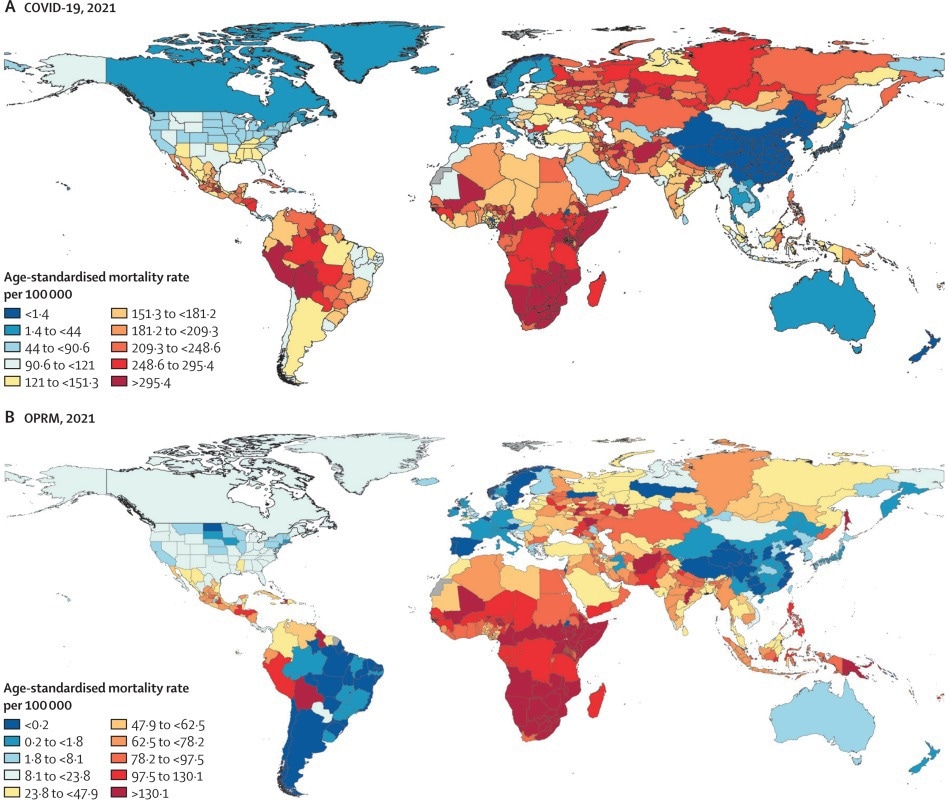
    Global choropleth maps of COVID-19 (A) and OPRM (B) for 2021 that show sub-national detail where available.

    Global choropleth maps of COVID-19 (A) and OPRM (B) for 2021 that show sub-national detail where available. OPRM=other pandemic-related mortality.

    Findings

    During 1990–2019, the annual rate of change in all-cause global mortality ranged between -0.9% and 2.4%. The corresponding rate in age-standardized deaths ranged between -3.3 and 0.4%. Nevertheless, deaths increased by 10.8% worldwide in 2020 compared to 2019. This persisted in 2021, with a 7.5% increase relative to 2020. Likewise, the age-standardized mortality rate showed a similar pattern, increasing 8.1% in 2020 and 5.2% in 2021.

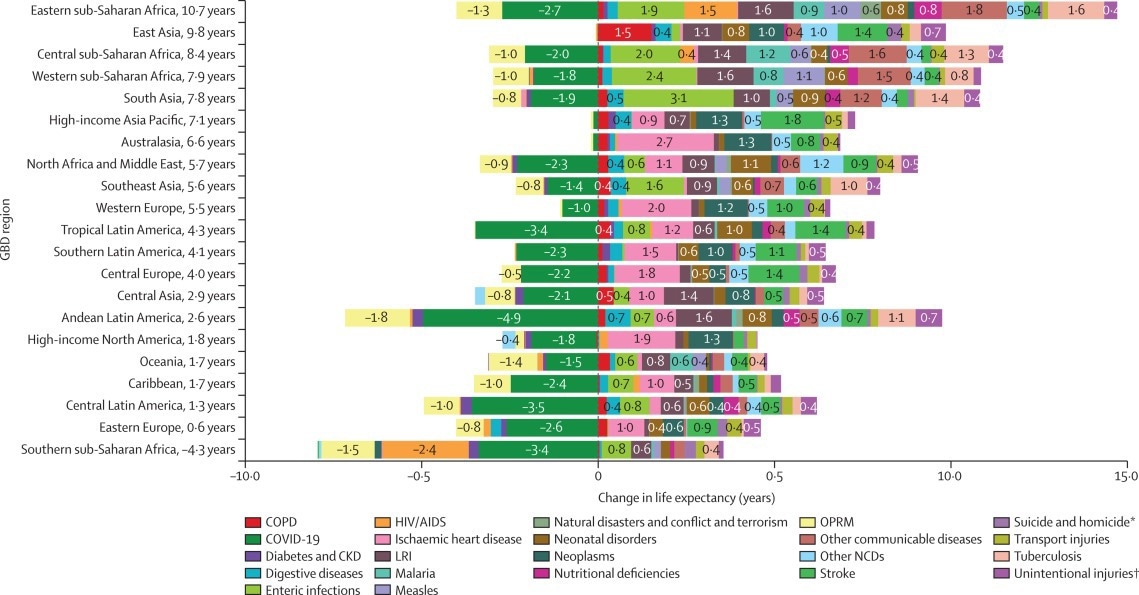
    Each row represents the change in life expectancy from 1990 to 2021 for a given GBD region. A bar to the right of 0 represents an increase in life expectancy due to changes in the given cause, and a bar to the left of 0 represents a decrease in life expectancy for a given cause. For readability, labels indicating a change in life expectancy of less than 0·3 years are not shown.

    Each row represents the change in life expectancy from 1990 to 2021 for a given GBD region. A bar to the right of 0 represents an increase in life expectancy due to changes in the given cause, and a bar to the left of 0 represents a decrease in life expectancy for a given cause. For readability, labels indicating a change in life expectancy of less than 0·3 years are not shown. CKD=chronic kidney disease. COPD=chronic obstructive pulmonary disease. GBD=Global Burden of Diseases, Injuries, and Risk Factors Study. LRI=lower respiratory infection. NCD=non-communicable disease. OPRM=other pandemic-related mortality. *Does not include war and terrorism. †Does not include natural disasters.

    In 2020-21, coronavirus disease 2019 (COVID-19) deaths and other pandemic-related mortality (OPRM) altered mortality patterns for the leading causes of age-standardized death. At level 3, the rankings of the four mortality causes (1. ischemic heart disease, 2. stroke, 3. chronic obstructive pulmonary disease, and 4. lower respiratory infections) with the highest age-standardized rates in 2019 were the same as in 1990.

    However, in 2021, stroke became the third leading cause of age-standardized mortality, as COVID-19 eclipsed it as the second leading cause. Besides, OPRM was the fifth leading cause, whereas lower respiratory infections became the seventh leading cause. Although the impact of COVID-19 on age-standardized mortality was similar to that of common obstructive pulmonary disease in 2020, it increased by 60.2% in 2021.

    Around 4.8 million and 7.89 million deaths occurred worldwide due to COVID-19 in 2020 and 2021, respectively. Age-standardized rates varied highly among GBD super-regions, with the highest in sub-Saharan Africa and the lowest in Southeast and East Asia and Oceania. OPRM and COVID-19 deaths also varied substantially by age, with older age groups being disproportionately affected.

    In 1990, the three leading causes of YLLs globally were CMNN diseases. Further, neonatal disorders remained the leading cause in 2019, but NCDs, viz., ischemic heart disease and stroke, replaced the second and third leading causes, respectively. However, COVID-19 was the second leading cause of YLLs in 2021, with neonatal disorders and ischemic heart disease ranking first and third, respectively.

    There have been long-standing positive trends in global life expectancy since the 1990s. Overall, life expectancy increased by 7.8 years between 1990 and 2019. However, during 2019-21, it decreased by 2.2 years due to COVID-19 and OPRM. Despite this decline, there was an overall increase of 6.2 years throughout the study period.

    The decrease in mortality from enteric infections (paratyphoid, typhoid, and diarrheal diseases) affected the increase in global life expectancy. The reduction in deaths due to lower respiratory infection had the second most significant impact. All seven super-regions had an increase in life expectancy from 1990 to 2021.

    Southeast and East Asia and Oceania had the highest gain (8.3 years), mainly due to lower mortality from chronic respiratory diseases. South Asia had the second largest gain (7.8 years) in life expectancy, mainly due to decreased mortality from enteric infections. Notably, Latin America and the Caribbean superregion had the largest decline in life expectancy (3.6 years) due to COVID-19.

    The decline in mortality due to enteric disease substantially impacted global life expectancy. Mortality concentration emerged as 160 countries/territories made progress in CMNN disease mortality. Deaths were more concentrated in some regions or countries. For instance, 90% of deaths due to enteric infections in areas with 63% of the population of children under five years in 1990 reduced to areas with 51% of the population in 2021.

    Further, the reduction in lower respiratory infections positively affected life expectancy in regions such as eastern and western sub-Saharan Africa and Andean Latin America. Moreover, reductions in stroke increased life expectancy by 0.8 years. However, stroke deaths were not concentrated. Overall, NCDs did not show a mortality concentration at large.

    Conclusions

    In sum, the present analysis offered insights into the global disease landscape before and during the two years of the COVID-19 pandemic. The findings showed that, after three decades of life expectancy improvements and reductions in age-standardized mortality rates, COVID-19 disrupted trends in the epidemiological transition, reversing long-standing progress.

    COVID-19 was the second leading age-standardized cause of death in 2021, profoundly impacting global life expectancy. It decreased life expectancy approximately as much as reductions in communicable diseases and NCDs have improved over decades. The study suggests that improved life expectancy outcomes could be achieved by leveraging past successes in mortality reduction.

    [ad_2]

    Source link

  • Acetaminophen at moderate doses may alter heart function

    Acetaminophen at moderate doses may alter heart function

    [ad_1]

    The common painkiller acetaminophen was found to alter proteins in the heart tissue when used regularly at moderate doses, according to a new study conducted in mice. Researchers will present their work this week at the American Physiology Summit, the flagship annual meeting of the American Physiological Society (APS), in Long Beach, California. 

    We found that regular use of acetaminophen at concentrations that are considered safe-;equivalent to 500 mg/day-;causes numerous signaling pathways inside the heart to be altered. These results prompt me to consider using acetaminophen at the lowest effective dose and for the shortest duration possible.” 


    Gabriela Rivera, study’s first author

    Gabriela Rivera is a doctoral student working in the laboratory of Aldrin Gomes, PhD, at the University of California, Davis

    Acetaminophen, the active ingredient in Tylenol and many other pain medications, is generally thought to carry a low risk of harmful side effects when used as directed. It is often recommended over non-steroidal anti-inflammatory medications (NSAIDs) such as ibuprofen for people with high blood pressure or heart disease. 

    In the past, studies examining the possible effects of acetaminophen on the heart have resulted in mixed findings. However, Rivera says that previous research has consistently suggested that using acetaminophen regularly at high doses is more likely to cause heart problems than using it only occasionally and at lower doses. 

    Looking at the levels of various proteins in tissues is a common way scientists assess how well the body is carrying out its normal functions. Using mice, Rivera and colleagues in the Gomes lab studied how acetaminophen affects the balance of proteins in the heart. They gave some mice plain water, while others were given water containing an amount of acetaminophen equivalent to 500 mg (the amount contained in one tablet of extra-strength Tylenol) per day in an adult human. 

    After seven days, the mice given acetaminophen showed significant changes in the levels of proteins associated with biochemical pathways involved in a range of functions, such as energy production, antioxidant usage and the breakdown of damaged proteins.

    “We expected two to three pathways to be altered, but we found over 20 different signaling pathways being affected,” Rivera said. 

    The results suggest that long-term medium- to high-dose acetaminophen use could cause heart issues as a result of oxidative stress or the buildup of toxins that are produced as acetaminophen breaks down, Rivera said. While our bodies can usually clear such toxins before they cause damage, it may be harder for the body to keep up when medium- to high- doses are taken consistently over time. 

    One caveat is that the research was done in mice and cannot necessarily be extrapolated to humans, Rivera noted. Researchers suggested aiming to limit acetaminophen use to a few days at a stretch and discussing any concerns regarding high-dose acetaminophen use with a person’s health care provider. 

    [ad_2]

    Source link

  • Neuroscientists identify age-defying RNAs in the brain

    Neuroscientists identify age-defying RNAs in the brain

    [ad_1]

    Certain RNA molecules in the nerve cells in the brain last a life time without being renewed. Neuroscientists from Friedrich-Alexander-Universität Erlangen-Nürnberg (FAU) have now demonstrated that this is the case together with researchers from Germany, Austria and the USA. RNAs are generally short-lived molecules that are constantly reconstructed to adjust to environmental conditions. With their findings that have now been published in the journal Science, the research group hopes to decipher the complex aging process of the brain and gain a better understanding of related degenerative diseases.

    Most cells in the human body are regularly renewed, thereby retaining their vitality. However, there are exceptions: the heart, the pancreas and the brain consist of cells that do not renew throughout the whole lifespan, and yet still have to remain in full working order.

    Aging neurons are an important risk factor for neurodegenerative illnesses such as Alzheimer’s. A basic understanding of the aging process and which key components are involved in maintaining cell function is crucial for effective treatment concepts:”


    Prof. Dr. Tomohisa Toda, Professor of Neural Epigenomics at FAU and at the Max Planck Center for Physics and Medicine in Erlangen

    In a joint study conducted together with neuroscientists from Dresden, La Jolla (USA) and Klosterneuburg (Austria), the working group led by Toda has now identified a key component of brain aging: the researchers were able to demonstrate for the first time that certain types of ribonucleic acid (RNA) that protect genetic material exist just as long as the neurons themselves. “This is surprising, as unlike DNA, which as a rule never changes, most RNA molecules are extremely short-lived and are constantly being exchanged,” Toda explains.

    In order to determine the life span of the RNA molecules, the Toda group worked together with the team from Prof. Dr. Martin Hetzer, a cell biologist at the Institute of Science and Technology Austria (ISTA). “We succeeded in marking the RNAs with fluorescent molecules and tracking their lifespan in mice brain cells,” explains Tomohisa Toda, who has unique expertise in epigenetics and neurobiology and who was awarded an ERC Consolidator Grant for his research in 2023. “We were even able to identify the marked long-lived RNAs in two year old animals, and not just in their neurons, but also in somatic adult neural stem cells in the brain.”

    In addition, the researchers discovered that the long-lived RNAs, that they referred to as LL-RNA for short, tend to be located in the cells’ nuclei, closely connected to chromatin, a complex of DNA and proteins that forms chromosomes. This indicates that LL-RNA play a key role in regulating chromatin. In order to confirm this hypothesis, the team reduced the concentration of LL-RNA in an in-vitro experiment with adult neural stem cell models, with the result that the integrity of the chromatin was strongly impaired. 

    “We are convinced that LL-RNAs play an important role in the long-term regulation of genome stability and therefore in the life-long conservation of nerve cells,” explains Tomohisa Toda. “Future research projects should give a deeper insight into the biophysical mechanisms behind the long-term conservation of LL-RNAs. We want to find out more about their biological function in chromatin regulation and what effect aging has on all these mechanisms.”

    Source:

    Journal reference:

    Zocher, S., et al. (2024) Lifelong persistence of nuclear RNAs in the mouse brain. Science. doi.org/10.1126/science.adf3481.

    [ad_2]

    Source link

  • New machine learning model achieves breakthrough in heart disease prediction with over 95% accuracy

    New machine learning model achieves breakthrough in heart disease prediction with over 95% accuracy

    [ad_1]

    In a recent study published in Scientific Reports, researchers developed a machine learning-based heart disease prediction model (ML-HDPM) that uses various combinations of information and numerous recognized categorization methods.

    Study: Comprehensive evaluation and performance analysis of machine learning in heart disease prediction. Image Credit: Summit Art Creations/Shutterstock.comStudy: Comprehensive evaluation and performance analysis of machine learning in heart disease prediction. Image Credit: Summit Art Creations/Shutterstock.com

    Background

    Heart disease is a worldwide health risk that healthcare professionals must evaluate and treat with medical examinations, advanced imaging techniques, and diagnostic procedures. Promoting heart-healthy practices and early diagnosis can help minimize cardiovascular disease incidence and enhance overall health.

    Current approaches such as machine learning, deep learning, and sensor-based data collection produce promising findings but have limitations such as uneven diagnostic accuracy and overfitting.

    The proposed approaches use modern technology and feature selection procedures to enhance heart disease diagnosis and prognosis.

    About the study

    In the current study, researchers built the ML-HDPM model for accurate cardiac disease prediction.

    The researchers used the Cleveland database, the Switzerland database, the Long Beach database, and the Hungary database to obtain cardiovascular data. They pre-processed clinical data followed by feature selection, feature extraction, cluster-based oversampling, and classification.

    They used training data to fit the model with the feature set, compute importance scores, and remove the lowest feature scores to achieve the desired feature.

    The genetic algorithm (GA) comprised population initialization, selection, crossover, and mutation to determine if the termination criterion was satisfied.

    The researchers undersampled raw data samples with majority labels and clustered samples with minority labels to merge the training set and perform synthetic minority over-sampling (SMOTE) to generate model output.

    The model selects relevant features using the recursive feature elimination method (RFEM) and the genetic algorithm (GA), which improves the model’s resilience. Techniques such as the under-sampling clustering oversampling technique (USCOM) correct data imbalances.

    The classification task uses multiple-layer deep convolutional neural networks (MLDCNN) and the adaptive elephant herd optimization method (AEHOM).

    Model classifiers were principal component analysis (PCA), support vector machine (SVM), linear discriminant analysis (LDA), decision tree (DT), random forest (RF), and naïve Bayes (NB).

    The model combines supervised infinite feature selection with an upgraded weighted random forest algorithm. The ML-HDPM pre-processing step assures data integrity and model efficacy. Extensive feature selection uncovers important properties for predictive modeling.

    A scalar technique achieves a consistent feature effect, while SMOTE corrects for class imbalance. The genetic algorithm employs natural selection principles to generate several solutions in a single generation.

    The strategy’s performance is assessed via simulated testing and compared to existing models. The testing, training, and validation datasets comprised 80%, 10%, and 10% data, respectively.

    Results

    ML-HDPM performed admirably over a wide range of critical evaluation criteria, as evidenced by the comprehensive examination. Using training data, the ML-HDPM model predicted cardiovascular disease with 96% accuracy and 95% precision.

    The system’s sensitivity (recall) yielded 96% accuracy, while F-scores of 92% reflected its balanced performance. The ML-HDPM specificity of 90% is noteworthy.

    ML-HDPM provides accurate and reliable results. It incorporates complex technologies such as feature selection, data balance, deep learning, and adaptive elephant herding optimization (AEHOM). These strategies allow the model to reliably forecast cardiac disease, which improves clinical decisions and patient outcomes.

    ML-HDPM outperforms other algorithms in training (95%) and testing (88%). The success is due to the combination of complex feature extraction, data imbalance corrections, and machine learning.

    Feature selection algorithms enable finding significant qualities associated with cardiovascular health, allowing them to detect subtle patterns indicative of cardiovascular disease.

    Data correction using efficient data balancing techniques guarantees model training on representative datasets, including deep learning using the MLDCNN approach and AEHOM optimization to improve model accuracy.

    ML-HDPM, a deep learning model, has lower false-positive rates (FPR) in training (8.20%) and testing (15%) than other approaches due to feature selections, data balance, and improved machine learning components in ML-HDPM.

    The model had high true-positive rates (TPR) in the training (96%) and testing (91%) datasets due to feature identification, data balance, and deep-learning improvements. The approach improves the model’s capacity to identify true positives.

    Conclusion

    The study presents a unique ML-HDPM approach that incorporates feature selections, data balance, and machine learning to improve cardiovascular disease prediction.

    The balanced F-values for accuracy and recall, high accuracy and precision rates, and low false-positive rates in the training and testing datasets highlight the promising potential of the model in cardiovascular diagnostic applications.

    The findings indicate that the ML-HDPM model can increase the precision and speed of identifying cardiovascular diseases, thus improving the standard of care.

    However, further investigation is required to improve model optimization and data quality and investigate its use by healthcare professionals in real-world settings.

    [ad_2]

    Source link

  • Dietary choices are linked to higher rates of preeclampsia among Latinas

    Dietary choices are linked to higher rates of preeclampsia among Latinas

    [ad_1]

    For pregnant Latinas, food choices could reduce the risk of preeclampsia, a dangerous type of high blood pressure, and a diet based on cultural food preferences, rather than on U.S. government benchmarks, is more likely to help ward off the illness, a new study shows.

    Researchers at the USC Keck School of Medicine found that a combination of solid fats, refined grains, and cheese was linked to higher rates of preeclampsia among a group of low-income Latinas in Los Angeles. By contrast, women who ate vegetables, fruits, and meals made with healthy oils were less likely to develop the illness.

    The combination of vegetables, fruits, and healthy oils, such as olive oil, showed a stronger correlation with lower rates of preeclampsia than did the Healthy Eating Index-2015, a list of dietary recommendations designed by the U.S. Department of Agriculture and the Department of Health and Human Services.

    The study, published in February by the Journal of the American Heart Association, yielded important information on which food combinations affect pregnant Latinas, said Luis Maldonado, the lead investigator and a postdoctoral scholar at the Department of Population and Public Health Sciences at USC Keck. It suggests that dietary recommendations for pregnant Latinas should incorporate more foods from their culture, he said.

    “A lot of studies that have been done among pregnant women in general have been predominantly white, and diet is very much tied to culture,” Maldonado said. “Your culture can facilitate how you eat because you know what your favorite food is.”

    Preeclampsia is estimated to occur in about 5% of pregnancies in the U.S. and is among the leading causes of maternal morbidity, according to the Centers for Disease Control and Prevention. It typically occurs during the third trimester of pregnancy and is associated with obesity, hypertension, and chronic kidney disease, among other conditions.

    There isn’t a way to cure or predict preeclampsia. The disease can damage the heart and liver and lead to other complications for both the mother and the baby, including preterm birth and even death.

    Rates of preeclampsia have increased in the past two decades nationally. In California, rates of preeclampsia increased by 83% and hypertension by 78% from 2016 to 2022, according to the most recent data available, and the conditions are highest among Black residents and Pacific Islanders.

    Maldonado said 12% of the 451 Latina women who participated in the study developed preeclampsia, a number almost twice the national average. More than half of the participants, who averaged 28 years old, had pre-pregnancy risks, such as diabetes and high body mass index.

    Maldonado and his team used data from the Maternal and Developmental Risks from Environmental and Social Stressors Center, a USC research group that studies the effects of environmental exposures and social stressors on the health of mothers and their children.

    The subjects, who were predominantly low-income Latinas in Los Angeles, completed two questionnaires about their diet during the third trimester of their pregnancy. The researchers identified two significant patterns of eating: one in which the most consumed foods were vegetables, oils, fruits, whole grains, and yogurt; and a second in which the women’s diet consisted primarily of solid fats, refined grains, cheese, added sugar, and processed meat.

    Women who followed the first eating pattern had a lower rate of preeclampsia than those who followed the second.

    When Maldonado and his team tested for a correlation between lower rates of preeclampsia and the Healthy Eating Index-2015, they found it was not statistically significant except for women who were overweight before pregnancy.

    The Healthy Eating Index includes combinations of nutrients and foods, like dairy and fatty acids. Maldonado said more research is needed to determine the exact profile of fruits, vegetables, and oils that could benefit Latina women.

    When it comes to diet, the right messaging and recommendations are vital to helping pregnant Latinas make informed decisions, said A. Susana Ramírez, an associate professor of public health communication at the University of California-Merced.

    Ramírez has conducted studies on why healthy-eating messages, while well intended, have not been successful in Hispanic communities. She found that the messaging has led some Latinos to believe that Mexican food is unhealthier than American food.

    Ramírez said we need to think about promoting diets that are relevant for a particular population. “We understand now that diet is enormously important for health, and so to the extent that any nutrition counseling is culturally consonant, that will improve health overall,” Ramírez said.

    This article was produced by KFF Health News, which publishes California Healthline, an editorially independent service of the California Health Care Foundation. 


    Kaiser Health NewsThis article was reprinted from khn.org, a national newsroom that produces in-depth journalism about health issues and is one of the core operating programs at KFF – the independent source for health policy research, polling, and journalism.

    [ad_2]

    Source link

  • Unlocking the secrets of long-lived RNAs in brain cells

    Unlocking the secrets of long-lived RNAs in brain cells

    [ad_1]

    After two decades in the United States, Martin Hetzer returned home to Austria in 2023 to become the 2nd President of the Institute of Science and Technology Austria (ISTA). A year into his new role, the molecular biologist remains engaged in the realm of aging research.

    Hetzer is fascinated by the biological puzzles surrounding the aging processes in organs like the brain, heart, and pancreas. Most cells comprising these organs are not renewed throughout a human’s entire life span. Nerve cells (neurons) in the human brain, for instance, can be as old as the organism, even up to more than a century, and must function for a lifetime. This remarkable age of neurons might be a major risk factor for neurodegenerative disorders such as Alzheimer’s disease. Crucial to comprehending these kinds of ailments is a deeper understanding of how nerve cells function over time and maintain control. This potentially opens doors to therapeutically counteract the aging processes of these specific cells.

    The latest collaborative publication by Hetzer, Tomohisa Toda from the Friedrich-Alexander University Erlangen-Nürnberg (FAU), who is also associated with the Max Planck Center for Physics and Medicine, Erlangen, and colleagues, gives new insights into this underexplored field of intricate mechanisms. For the first time in mammals, the study shows that RNA-;an essential group of molecules important for various biological processes inside the cell-;can persist throughout life. The scientists identified specific RNAs with genome-protecting functions in the nuclei of nerve cells of mice that remain stable for two years, covering their entire lives. The findings, published in the journal Science, underpin the importance of long-lived key molecules for maintaining a cell’s function.

    Longevity of key molecules

    The inside of cells is a very dynamic place. Some components are constantly renewed and updated; others stay the same their whole lives. It is like a city in which the old buildings blend in with the new ones. DNA found in the nucleus-;the city’s heart-;for instance, is as old as the organism. “DNA in our nerve cells is identical to DNA within the developing nerve cells in our mother’s womb,” explains Hetzer.

    Unlike stable DNA, which is constantly being repaired, RNA, especially messenger RNA (mRNA), which forms proteins upon DNA’s information, is characterized by its transient nature. The cellular scope, however, extends beyond mRNA to a group of so-called non-coding RNAs. They do not turn into proteins; instead, they have specific duties to contribute to the overall organization and function of the cell. Intriguingly, their lifespan remained a mystery. Until now.

    RNAs that last the whole life

    Hetzer and Co. set out to decipher that secret. Therefore, RNAs were labeled, i.e. “marked”, in the brains of newborn mice. “For this labeling, we used RNA analogs-;structurally similar molecules-;with little chemical hooks that click fluorescent molecules on the actual RNAs,” explains Hetzer. This assured efficient tracking of the molecules and powerful microscopic snapshots at any given time point in the mice’s lives.

    Surprisingly, our initial images revealed the presence of long-lived RNAs, in various cell types within the brain. We had to further dissect the data to identify the ones in the nerve cells. Fruitful collaboration with Toda’s lab enabled us to make sense of that chaos during brain mapping.”


    Martin Hetzer, Institute of Science and Technology Austria

    Collaboratively, the researchers were able to focus solely on long-lived RNAs in neurons. They quantified the molecules’ concentration throughout a mouse’s life, examined their composition and analyzed their positions.

    While humans have an average life expectancy of around 70 years, the typical lifespan of a mouse is 2.5 years. After one year, the concentration of long-lived RNAs was slightly reduced compared to newborns. However, even after two years, they remained detectable indicating a lifelong persistence of these molecules.

    RNAs help protect the genome

    Additionally, the scientists proved long-lived RNAs’ prominent role in cellular longevity. They found out that long-lived RNAs in neurons consist of mRNAs and non-coding RNAs and accumulate near the heterochromatin-;the densely packed region of the genome, typically homing inactive genes. Next they further investigated the function of these long-lived RNAs.

    In molecular biology, the most effective approach to achieve this is by reducing the molecule of interest and observing its subsequent effects. “As their name and our previous experiments suggest, these long-lived RNAs are extremely stable,” says Hetzer. The scientists, therefore, employed an in vitro (outside a living organism) approach, using neuronal progenitor cells-;stem cells with the capacity to give rise to neural cells, including neurons. The model system allowed them to effectively intervene with these long-lived RNAs. A lower amount of long-lived RNAs caused problems in the heterochromatin architecture and stability of genetic material, eventually affecting the cells’ viability. Thus, the important role of long-lived RNAs’ in cellular longevity was clarified.

    The study highlights that long-lived RNAs may function in the lasting regulation of genome stability. “Lifelong cellular maintenance during aging involves an extended life span of key molecules like the long-lived RNAs, we just identified,” Hetzer adds. The precise mechanism, however, remains unclear. “Together with unidentified proteins, long-lived RNAs likely form a stable structure that somehow interacts with the heterochromatin.” Upcoming research projects in Hetzer’s lab are set on finding these missing links and understanding the biological characteristics of these long-lived RNAs.

    Source:

    Journal reference:

    Zocher, S., et al. (2024) Lifelong persistence of nuclear RNAs in the mouse brain. Science. doi.org/10.1126/science.adf3481.

    [ad_2]

    Source link