Tag: High Blood Pressure

  • Mouse models shed light on the effects of metformin use during pregnancy on offspring

    Mouse models shed light on the effects of metformin use during pregnancy on offspring

    [ad_1]

    With the rise in gestational diabetes and metabolic disorders during pregnancy, metformin is also being prescribed more frequently. Although it is known that the oral antidiabetic agent can cross the placental barrier, the impacts on the brain development of the child are largely unknown. An interdisciplinary research team from the German Institute of Human Nutrition Potsdam-Rehbrücke (DIfE) have now been able to demonstrate in a mouse model that although metformin has positive effects in pregnant animals, it does not in the offspring. The results were published in the specialist journal Molecular Metabolism.

    Current figures show that around one in six pregnant women worldwide are affected by a special form of diabetes known as gestational diabetes. According to the Robert Koch Institute, 63,000 women in Germany were affected by the disease in 2021, and the trend is increasing.

    These numbers are alarming because excessively high blood sugar levels during pregnancy are associated with negative consequences for mother and child. This increases the risk of affected women developing type 2 diabetes later on and their children have a higher risk of developing metabolic disorders and being overweight.

    Long-term effect of metformin on offspring is unclear

    For several years, the placenta-crossing oral antidiabetic agent metformin has been increasingly gaining importance as an alternative to insulin administration when lifestyle changes show no success during the treatment of gestational diabetes. However, there are currently only a few studies on the long-term effects of metformin on the health of offspring. It is known that metformin has an impact on the AMPK signaling pathway, which regulates the networking of nerve cells during brain development.

    The interdisciplinary team of DIfE researchers led by Junior Research Group Leader Dr. Rachel Lippert therefore grappled with two central questions: Is metformin treatment only beneficial for the mother or also the child? And does metformin treatment lead to long-term negative physiological changes in the offspring, especially in connection with the development of neuronal circuits in the hypothalamus, a critical region in the regulation of energy homeostasis?

    Mouse models shed some light

    To answer the key questions, the researchers used two mouse models to represent the main causes of gestational diabetes: severe obesity of the mother before pregnancy and excessive weight gain during pregnancy. These metabolic states were achieved by means of different feeding patterns, with the mice receiving either a high-fat or control diet. The antidiabetic treatment of female mice and their offspring took place during the lactation period as this corresponds to the third trimester of a human pregnancy in terms of brain development.

    Treatment involved insulin, metformin, or a placebo, whereby the dosage was based on standard human treatments. The research team collected data on the body weight of the mice, analyzed various metabolic parameters and hormones, and examined molecular signaling pathways in the hypothalamus.

    Maternal metabolic state is crucial

    “As a result of antidiabetic treatment in the early postnatal period, we were able to identify alterations in the weight gain and hormonal status of the offspring, which were critically dependent on the metabolic state of the mother,” explains Lippert. Furthermore, sex-specific changes in hypothalamic AMPK signaling in response to metformin exposure were also observed. Together with the metformin-induced shift in the examined hormone levels, the results indicate that the maternal metabolic state must be taken into account before starting the treatment of gestational diabetes.

    Focusing on prevention

    According to Rachel Lippert, treatment of gestational diabetes in future could entail developing a medication that is available for all and does not cross the placenta.

    Given the increasing prevalence, education about gestational diabetes and preventive measures are of vital importance. If we can find a way to manage lifestyle and diet more proactively, we are in a better position to exploit the potential of gestational diabetes treatment.”


    Dr. Rachel Lippert, Junior Research Group Leader 

    Source:

    Journal reference:

    Cantacorps, L., et al. (2024). Developmental metformin exposure does not rescue physiological impairments derived from early exposure to altered maternal metabolic state in offspring mice. Molecular Metabolism. doi.org/10.1016/j.molmet.2023.101860.

    [ad_2]

    Source link

  • Childhood ‘lazy eye’ linked to increased health risks in adulthood

    Childhood ‘lazy eye’ linked to increased health risks in adulthood

    [ad_1]

    Adults who had amblyopia (‘lazy eye’) in childhood are more likely to experience hypertension, obesity, and metabolic syndrome in adulthood, as well as an increased risk of heart attack, finds a new study led by UCL researchers.

    In publishing the study in eClinicalMedicine, the authors stress that while they have identified a correlation, their research does not show a causal relationship between amblyopia and ill health in adulthood.

    The researchers analyzed data from more than 126,000 participants aged 40 to 69 years old from the UK Biobank cohort, who had undergone ocular examination.

    Participants had been asked during recruitment whether they were treated for amblyopia in childhood and whether they still had the condition in adulthood. They were also asked if they had a medical diagnosis of diabetes, high blood pressure, or cardio/cerebrovascular disease (ie. angina, heart attack, stroke).

    Meanwhile, their BMI (body mass index), blood glucose, and cholesterol levels were also measured and mortality was tracked.

    The researchers confirmed that from 3,238 participants who reported having a ‘lazy eye’ as a child, 82.2% had persistent reduced vision in one eye as an adult.

    The findings showed that participants with amblyopia as a child had 29% higher odds of developing diabetes, 25% higher odds of having hypertension and 16% higher odds of having obesity. They were also at increased risk of heart attack – even when other risk factors for these conditions (e.g. other disease, ethnicity and social class) were taken into account.

    This increased risk of health problems was found not only among those whose vision problems persisted, but also to some extent in participants who had had amblyopia as a child and 20/20 vision as an adult, although the correlation was not as strong.

    Corresponding author, Professor Jugnoo Rahi (UCL Great Ormond Street Institute for Child Health, UCL Institute of Ophthalmology and Great Ormond Street Hospital), said: “Amblyopia is an eye condition affecting up to four in 100 children. In the UK, all children are supposed to have vision screening before the age of five, to ensure a prompt diagnosis and relevant ophthalmic treatment.

    “It is rare to have a ‘marker’ in childhood that is associated with increased risk of serious disease in adult life, and also one that is measured and known for every child – because of population screening.

    “The large numbers of affected children and their families, may want to think of our findings as an extra incentive for trying to achieve healthy lifestyles from childhood.”

    Amblyopia is when the vision in one eye does not develop properly and can be triggered by a squint or being long-sighted.

    It is a neurodevelopmental condition that develops when there’s a breakdown in how the brain and the eye work together and the brain can’t process properly the visual signal from the affected eye. As it usually causes reduced vision in one eye only, many children don’t notice anything wrong with their sight and are only diagnosed through the vision test done at four to five years of age.

    A recent report from the Academy of Medical Sciences involving some researchers from the UCL Great Ormond Street Institute for Child Health, called on policymakers to address the declining physical and mental health of children under five in the UK and prioritize child health.

    The team hopes that their new research will help reinforce this message and highlight how child health lays the foundations for adult health.

    Vision and the eyes are sentinels for overall health – whether heart disease or metabolic dysfunction, they are intimately linked with other organ systems. This is one of the reasons why we screen for good vision in both eyes.


    We emphasize that our research does not show a causal relationship between amblyopia and ill health in adulthood. Our research means that the ‘average’ adult who had amblyopia as a child is more likely to develop these disorders than the ‘average’ adult who did not have amblyopia. The findings don’t mean that every child with amblyopia will inevitably develop cardiometabolic disorders in adult life.”


    Dr Siegfried Wagner, First Author, UCL Institute of Ophthalmology and Moorfields Eye Hospital

    The research was carried out in collaboration with the University of the Aegean, University of Leicester, King’s College London, the National Institute for Health and Care Research (NIHR) Biomedical Research Centre (BRC) at Moorfields Eye Hospital and UCL Institute of Ophthalmology and the NIHR BRC at UCL Great Ormond Street Institute of Child Health and Great Ormond Street Hospital.

    The work was funded by the Medical Research Council, the NIHR and the Ulverscroft Foundation.

    Source:

    Journal reference:

    Wagner, S. K., et al. (2024) Associations between unilateral amblyopia in childhood and cardiometabolic disorders in adult life: a cross-sectional and longitudinal analysis of the UK Biobank. eClinicalMedicine. doi.org/10.1016/j.eclinm.2024.102493.

    [ad_2]

    Source link

  • Nanoparticle therapy offers hope for aortic aneurysm treatment

    Nanoparticle therapy offers hope for aortic aneurysm treatment

    [ad_1]

    Aortic aneurysms are bulges in the aorta, the largest blood vessel that carries oxygen-rich blood from the heart to the rest of the body. Smoking, high blood pressure, diabetes, or injury can all increase the risk of aneurysms, which tend to occur more often in Caucasian male smokers over the age of 65. 

    The soft tissues that make up blood vessels act essentially like rubber bands, and it’s the elastic fibers within these tissues that allow them to stretch and snap back. These fibers are produced primarily before and just after birth. After that, they don’t regenerate or undergo natural repair after injury. So when they become injured or diseased, the tissue weakens and causes an aneurysm, which can grow over time. After about seven to 10 years, it typically reaches the rupture stage.”


    Professor Anand Ramamurthi, Chair of the Department of Bioengineering in Lehigh University’s P.C. Rossin College of Engineering and Applied Science

    During that period, there is no treatment. Patients are screened regularly via imaging to monitor the rate of the aneurysm’s growth. Once it’s deemed big enough to potentially rupture (an occurrence that is fatal 90 percent of the time), surgery is the only option. But it’s a risky one for elderly patients.

    Ramamurthi and his team are working on minimally invasive ways to regenerate and repair these elastic fibers using polymeric or biological nanocapsules, called nanoparticles, that are designed to release novel regenerative therapeutics. Their innovative techniques could enable treatment soon after an aneurysm is detected and potentially slow, reverse, or even stop its growth. Findings from their most recent paper, published in the Journal of Biomedical Materials Research, build on their earlier work and represent a step toward a future where surgery is no longer the best, and only, treatment option. 

    “In previous research, we’ve identified drugs and gene-silencing agents that can actually coax adult diseased vascular cells to produce new elastic fibers and inhibit the enzymes that break down existing fibers,” he says. “We’ve also been working on how to deliver these therapeutics efficiently only at the site of tissue repair.”

    The team has also developed a nanoparticle design called active-targeting that incorporates small protein fragments, or peptides, on the nanoparticle’s surface. “These peptides recognize components that are unique to the aneurysm tissue. So when the nanoparticles are injected into the bloodstream, they stick only to the aneurysm wall, where they slowly degrade and release the drug.

    For this paper, he says, the researchers “investigated how the nanoparticles actually penetrate the blood vessel wall to deliver the drug to the affected tissue.”

    All blood vessels are lined with a protective barrier made of endothelial cells, which can become “leaky” as inflammation from tissue damage or disease breaks down the endothelium and creates gaps between the cells. These gaps allow white blood cells to move in and start the tissue repair process, and they also serve as the entry point for nanoparticles that accelerate healing.

    “We wanted to know how the shape and the aspect ratio of these nanoparticles affect their ability to cross that endothelial cell barrier,” says Ramamurthi. 

    It was a critical question to answer because not all nanoparticles are created alike, and if they can’t penetrate the barrier, they can’t repair the tissue.

    Ramamurthi and his team developed a novel cell culture model in which they simulated disease and then examined mechanisms of transport: specifically, how nanoparticles of different kinds interacted with endothelial cells and moved through them. Did they enter through gaps among the endothelial cells (a process called extravasation) or through the cells themselves (what’s known as translocation)?

    “Let’s say a nanoparticle goes through an endothelial cell. Some of it might stay within that cell and not come out the other side, which means you lose that particle, and it’s no longer useful to the healing process. The goal is transportation with minimal retention.”

    The team found that rod-shaped particles, as opposed to spherical particles, with a high aspect ratio (i.e., long and skinny versus short and stubby) were selectively taken up by diseased endothelial cells. “And they showed very little uptake into healthy endothelial cells compared with the spheres, which is good because we don’t want them interacting with healthy vessel walls,” he says.

    They also found that particles reached the tissue primarily by extravasation (or via the cell gaps). “The longer and skinnier they were, the less likely they were to remain within the endothelial cell layer, which means they’re getting through to the affected tissue for more effective therapy.”

    The team will now integrate these findings with their work on active targeting-;incorporating components on the surface of nanoparticles that recognize proteins expressed by diseased cells-;in animal models.

    The ultimate goal is to develop a nonsurgical regenerative therapy capable of slowing aneurysm growth. For example, increasing the current growth-to-rupture stage from seven years to 15 years. An even more ambitious outcome, says Ramamurthi, would be to revert that growth. 

    “Regression of aneurysm growth would be the preferred long-term outcome,” he says. “That’s a long way off, but we’re excited because these findings will help guide us on how to design our nanoparticles for more efficient delivery to the aneurysm wall. It’s an opportunity to get closer to that reality.”

    Source:

    Journal reference:

    Yau, J., et al. (2024). Assessing trans‐endothelial transport of nanoparticles for delivery to abdominal aortic aneurysms. Journal of Biomedical Materials Research Part A. doi.org/10.1002/jbm.a.37667.

    [ad_2]

    Source link

  • Cardiovascular health variances in women’s lifespan

    Cardiovascular health variances in women’s lifespan

    [ad_1]

    Women’s cardiovascular disease risks and outcomes differ throughout the lifespan from those of men, according to a collection of studies devoted to cardiovascular medicine research focused on women of all ages, published today in a special “spotlight” issue of the Journal of the American Heart Association, an open access, peer-reviewed journal of the American Heart Association.

    Cardiovascular disease kills more women than all forms of cancer combined. Among females 20 years and older, nearly 45% are living with some form of cardiovascular disease, and less than 50% of women entering pregnancy in the U.S. have good heart health. In addition, more than half of deaths from high blood pressure are in women. Yet, women make up only 38% of participants in cardiovascular disease clinical trials, according to the American Heart Association.

    The special Go Red for Women issue of the Journal, in recognition of American Heart Month, features studies that reveal insights such as: how diet may affect the high preeclampsia risk in pregnant Hispanic/Latina women; how women were less likely than men to receive bystander CPR and automated external defibrillator (AED) treatment, as well as survive the first 30 days post-hospitalization after out-of-hospital cardiac arrest; and how rehospitalization rates differ in women with heart failure and obstructive sleep apnea. In yet another study featured, researchers report that while the incidence of intracerebral hemorrhage (bleeding within the brain), the second most common stroke type, was lower in women, women were more likely to die one year after a stroke than men.

    Below are highlights of some of the manuscripts in this issue,

    • Prospective Associations of Accelerometer-measured Machine-learned Sedentary Behavior with Mortality among Older Women: The OPACH Study

    Steve Nguyen, Ph.D., et al.; University of California, San Diego, La Jolla, California

    This team studied sedentary behavior patterns in nearly 6,000 older women (average age 79 years) to determine the impact of sitting time on death from cardiovascular disease and all causes. Using a measurement tool powered by machine learning to accurately classify sitting time, researchers found those who sat more than 11.6 total hours a day and had longer bouts of uninterrupted sitting had a 57% higher risk of death from all causes and a 78% increased risk of death from cardiovascular disease. This was compared to women who sat less than 9.3 hours a day. The increased risk of death was consistent regardless of age, body mass index, physical functioning, cardiovascular disease risk factors, physical activity intensity and race/ethnicity. Reducing overall sedentary behavior and uninterrupted sitting time would likely have large public health benefits in an aging society, according to researchers.

    • Sex Differences in the Relationship between Schizophrenia and the Development of Cardiovascular Disease

    Hidehiro Kaneko, M.D., Ph.D., et al.; University of Tokyo, Tokyo, Japan

    Researchers studied cardiovascular disease risk in people with schizophrenia, a serious psychotic disorder and one of the top 15 leading causes of disability worldwide. Schizophrenia results in severe, chronic mental illness characterized by disturbances in perception, thought and behavior. The study found a strong association between schizophrenia and risk of developing cardiovascular disease in adults, but particularly in women. This higher risk in women may be related to hormonal changes during pregnancy and menopause, or reports that women are more sedentary than men. Nevertheless, the findings point to the need for health care professionals to take a thorough and gender-focused approach to cardiovascular disease prevention due to the notable role schizophrenia seems to play in cardiovascular disease. The researchers suggest that it’s crucial to promote physical activity, especially among women with schizophrenia, as inactivity may have increased the risk in female participants in this study. Healthcare providers should routinely screen and treat schizophrenia as part of standard clinical practice, with special attention to women, authors wrote.

    • Maternal Dietary Patterns During Pregnancy Are Linked to Hypertensive Disorders of Pregnancy Among a Predominantly Low-Income US Hispanic/Latina Pregnancy Cohort

    Luis E. Maldonado, Ph.D., M.P.H., et al.; Keck School of Medicine, University of Southern California

    In a study of more than 400 predominantly low-income, pregnant Hispanic/Latina women in Los Angeles, researchers found that a diet characterized by higher intakes of solid fats, refined grains and cheese was strongly associated with greater odds of having had a hypertensive disorder of pregnancy including preeclampsia during pregnancy.

    Other papers in the spotlight issue include:

    • Association of Sex With Cardiovascular Outcomes in Heart Failure Patients With Obstructive or Central Sleep Apnea -; Jian Zhang, M.D., Ph.D., et al.; Chinese Academy of Medical Sciences and Peking Union Medical College, Beijing, China
    • Pregnancy History at 40 Years of Age as a Marker of Cardiovascular Risk -; Liv G. Kvalvik, M.D., Ph.D., et al.; University of Bergen, Bergen, Norway
    • Sex Differences in the Epidemiology of Intracerebral Hemorrhage Over 10 Years in a Population-Based Stroke Registry -; Simona Sacco, M.D., et al.; University of L’Aquila, L’Aquila, Italy
    • Sex Differences in Revascularization, Treatment Goals, and Outcomes of Patients With Chronic Coronary Disease: Insights From the ISCHEMIA Trial -; Harmony R. Reynolds, M.D., FAHA, et al.; NYU Grossman School of Medicine, New York City
    • Sex Differences in Receipt of Bystander CPR Considering Neighborhood Racial and Ethnic Composition -; Audrey L. Blewer, Ph.D., M.P.H., et al.; Duke University, Durham, North Carolina
    • Hypertension in Pregnancy among Immigrant and Swedish Women – A Cohort Study of All Pregnant Women in Sweden -; Axel C. Carlsson, Ph.D., et al.; Karolinska Institutet, Huddinge, Sweden
    • Sex Differences In Out-of-Hospital Cardiac Arrest Survival Trends -; R. L. A. Smits, et al.; Amsterdam University Medical Center, Amsterdam, The Netherlands;
    • Posttraumatic Stress Disorder is Associated With Elevated Risk of Incident Stroke and Transient Ischemic Attack in Women Veterans -; Ramin Ebrahimi, M.D., et al.; University of California, Los Angeles; Veterans Affairs Greater Los Angeles Healthcare System, Los Angeles; and
    • Sex differences in Outcomes of Acute Myocardial Injury After Stroke -; Michela Rosso, M.D., et al.; University of Pennsylvania, Philadelphia.

    Source:

    Journal reference:

    Mujahid, M. S. & Peterson, P. N., (2024) JAHA Go Red for Women Spotlight on Women and Cardiovascular Disease and Stroke. Journal of the American Heart Association. doi.org/10.1161/JAHA.124.035104.

    [ad_2]

    Source link

  • Genetic variants influence blood pressure from early in life

    Genetic variants influence blood pressure from early in life

    [ad_1]

    Certain genes associated with hypertension affect blood pressure from early in life, and they increase the risk of cardiovascular disease as you get older. However, you can do something about it.

    We are talking about really small differences, so small that they may fall within what is considered normal blood pressure. The problem is that they tend to last your whole life.” 


    Karsten Øvretveit, PhD Candidate at the Norwegian University of Science and Technology’s (NTNU) Department of Public Health and Nursing

    He is one of the researchers behind a new study that has looked at the relationship between gene variants and blood pressure in the population.

    The study shows that high blood pressure occurs in all age groups and that it is related to hereditary factors.

    “We found that genetic factors affect blood pressure from the first years of childhood and throughout your entire life,” says Øvretveit.

    Genetic data from large population studies

    High blood pressure is the main cause of heart attacks and strokes, and cardiovascular disease is the second most common cause of death in Norway, accounting for 23 per cent of all deaths in 2022.

    The direct medical cause of high blood pressure is unknown in many cases, but research shows that our genes play a signifcant role.

    “Lifestyle diseases are often caused by a combination of heredity and environment. Diseases are often the result of not only one, but very many genetic variants,” says Øvretveit.

    In order to find out how much a person is at risk of high blood pressure, researchers have used genetic data from large population studies. This has helped them develop a genetic risk score, which indicates how much your exact genetic makeup puts you at risk.

    Developing genetic risk scores

    Put very simply, a certain value is placed on each gene variant, which reflects the extent to which it can affect blood pressure. The variants are then “weighted”, i.e. some genes weigh more heavily than others, and the genetic risk score is then the sum of the genetic effects.

    “This is how people who are particularly at risk can be identified, and measures can be taken at an early stage before the condition is expressed.

    By keeping their blood pressure alow level, people with a high genetic risk score can achieve a lower risk of disease than people diagnosed with high blood pressure who we consider genetically protected,” says Øvretveit.

    To study the significance of the genetic risk, the researchers have used health data from participants in the HUNT Study from Trøndelag and from the British ‘Children of the 90s’ study. The latter includes health data from nearly 14,000 children from the time they were born until they were in their twenties. The Health Survey in Trøndelag (HUNT) is a large, Norwegian population-based health survey that includes health information and biological material from the inhabitants of Trøndelag. Since the first collection round in 1984, 250,000 people from Trondheim have participated.

    By comparing the blood pressure of the children who had the highest genetic risk with the children who were lowest on the scale, the researchers were able to see how the average blood pressure in the first group was higher from as early as the age of three. The difference lasted throughout their childhood and became more pronounced in adulthood.

    Difference increases with age

    “Although the differences in blood pressure are not very large, the time component is important. If your blood pressure is slightly elevated over many years, it will affect how prone you are to cardiovascular disease and kidney disease,” says Øvretveit.

    When the researchers compared the risk scores and health data of the HUNT Study participants, they saw that the differences in blood pressure between the participants with the highest and those with the lowest risk persisted throughout their whole lives.

    “We have been able to follow the same people from when they were around 37 until they were approximately 70 years old. We found that the differences persisted and resulted in various disease risks, where the differences in disease were quite large.”

    The researchers also found more positive results: if measures are taken, such as lifestyle changes and medications, the risk of disease can be significantly reduced.

    “By keeping their blood pressure at a low level, people with a high genetic risk score can achieve a lower risk of disease than people diagnosed with high blood pressure who we consider genetically protected. It seems that controlling your blood pressure matters more than genetics,” says Øvretveit.

    Large population studies provide good data

    As a basis for the study, Øvretveit and colleagues have used findings from the largest genetic study on blood pressure currently available, which includes data from over a million people. Øvretveit believes the study shows the possibilities that lie in genetic data from large population studies.

    “I don’t think you should start measuring blood pressure in every single child, but the type of data we have used in this study can be used in the future not only to prevent disease, but also to address the risk factors associated with a disease,” says Øvretveit.

    Is it a problem that Europeans are overrepresented in population studies?

    “Yes, it is, but we are now actively working on developing genetic risk scores that are adapted to other populations, and that can be used across many different populations,” says Øvretveit.

    To date, the researchers have identified around 1500 gene variants that have a clear connection with blood pressure, but the biological effect that many of these genes have on blood pressure is not known. In order to find a reliable method, the researchers had to identify high-risk combinations of gene variants and combinations that posed a lower risk through a process of trial and error. 

    “A common method for creating a risk score for genetic disease is to include only those gene variants that are known to have a strong connection with the disease,” says Øvretveit.

    But there are other methods such as including gene variants that produce effects we are more uncertain about. As a result, we get a lot more data in the calculation. 

    “Complex blood pressure traits may be affected by far more gene variants than we have identified so far. The methods we have developed allow this to be taken into account, but we also have to keep in mind that the individual effects of these variants are small,” says Øvretveit.

    The method that gave the most accurate risk score included over a million gene variants.

    “But there are far more that have a known connection with high blood pressure,” says Øvretveit.

    Source:

    Journal reference:

    Øvretveit, K., et al. (2023). Polygenic risk scores associate with blood pressure traits across the lifespan. European Journal of Preventive Cardiology. doi.org/10.1093/eurjpc/zwad365.

    [ad_2]

    Source link

  • Study finds J-shaped association between dietary thiamine intake and worsening mental acuity

    Study finds J-shaped association between dietary thiamine intake and worsening mental acuity

    [ad_1]

    There seems to be a J-shaped curve between dietary thiamine (vitamin B1) and worsening mental acuity among cognitively healthy older people, suggests research published in the open access journal General Psychiatry.

    The sweet spot seems to be a daily intake of 0.68 mg, below which there is relatively little impact. But higher daily intake was strongly associated with cognitive decline, with the optimal maintenance dose 0.6 to less than 1 mg/day, the findings show.

    Thiamine is an essential water-soluble B vitamin involved in energy metabolism and brain neurotransmitter activity. Good dietary sources include whole grains, fortified breakfast cereals, legumes, liver, and salmon.

    Small previously published studies suggest that high doses can improve cognitive function in people with mild cognitive impairment or early stage dementia. But it’s not clear if usual dietary intake is associated with slowing, or speeding up, cognitive decline.

    To explore this further, the researchers used publicly available data from the China Health and Nutrition Survey (CHNS), a long term multipurpose study which began in 1989, and which included nearly half the country’s population by 2011.

    In 1997, 2000, 2004 and 2006, mental acuity was repeatedly assessed for cognitively healthy participants aged 55 and above. The current study is based on 3106 participants, with an average age of 63, and at least two rounds of survey data.

    Information on diet was collected in each survey round, supplemented by detailed data on personal dietary intake over 24 hours on 3 consecutive days of the week, and collected in person by trained investigators. Nutrient intake was calculated using the Chinese food composition tables.

    Three tests of immediate and delayed recall of a 10-word list, counting backwards from 20, and serial subtraction of 7 five times from 100, taken from the Telephone Interview for Cognitive Status–modified (TICS-m), were used to evaluate verbal memory, attention, and numerical fluency, respectively. 

    A higher score for each item (including verbal memory [0-20 points], attention [0-2 points] and calculation [0-5 points]) indicates better cognitive function, with a global cognitive score ranging from 0 to 27 points and also a composite score ranging from -1.82 to 1.67 standard units.

    The average monitoring period was nearly 6 years, during which time a J-shaped association emerged between dietary thiamine intake and the pace of decline in cognitive function over 5 years.

    Average thiamine intake was 0.93 mg/day, but the threshold seemed to be a daily intake of 0.68 mg. There was no significant association with cognitive decline below this level. 

    But above 0.68 mg/day, each daily unit (1 mg/day) increase in thiamine intake was associated with a significant fall of 4.24 points in the global cognitive score and 0.49 units in the composite score within 5 years. Since the global cognitive score ranges from 0 to 27 points, a decline of about 4 points means a decline in cognitive function of at least 15%

    These associations were stronger among those who were obese, had high blood pressure or who were non-smokers, although after further in depth analysis, the modifying effect of high blood pressure and smoking became statistically insignificant,

    To further explore the optimal range of dietary thiamine for maintaining cognitive function, intake was further divided into 0.4, 0.6, 0.8, 1, 1.2 and 1.4 mg/day.

    This showed that the lowest risk was associated with a thiamine intake of 0.6 to less than 1 mg/day. Similar patterns were also observed after accounting for daily intake of other B vitamins (riboflavin and niacin) and other foods, such as red or processed meat.

    None of the other variables, including age, sex, alcohol consumption and dietary intake of fat, protein or carbohydrate, significantly changed the findings.

    This is an observational study, and as such, can’t establish cause, acknowledge the researchers. And 24-hour dietary recall only captures information on specific days and may not be completely accurate. The study also focused on older people in China, so the findings may not be applicable to other nationalities and age groups, they add.

    “Thiamine deficiency may lead to an insufficient supply of energy to the neurons of the brain and decreased acetylcholine signaling in the brain, which may impair cognitive function,” suggest the researchers, by way of an explanation for their findings.

    “If substantiated by further research, our study highlights the importance of maintaining optimal dietary thiamine intake levels in the general older population to prevent cognitive decline.”

    Source:

    Journal reference:

    Liu, C., et al. (2024). J-shaped association between dietary thiamine intake and the risk of cognitive decline in cognitively healthy, older Chinese individuals. General Psychiatry. doi.org/10.1136/gpsych-2023-101311.

    [ad_2]

    Source link

  • Healthy plant-based diets linked to lower risk of obstructive sleep apnea

    Healthy plant-based diets linked to lower risk of obstructive sleep apnea

    [ad_1]

    People who eat a healthy, plant-based diet that is high in vegetables, fruit, whole grains and nuts are less likely to suffer with obstructive sleep apnea (OSA), according to a study published today (Wednesday) in ERJ Open Research. However, people eating an unhealthy plant-based diet, high in refined carbohydrates, sugary drinks, high-sugar and high-salt foods, are at a higher risk of OSA.

    People with OSA often snore loudly, their breathing starts and stops during the night, and they may wake up several times. Not only does this cause tiredness, but it can also increase the risk of high blood pressure, stroke, heart disease and type 2 diabetes.

    The new study is one of the first large-scale analyses to investigate the correlation between plant-based diets and OSA risk. Researchers say its findings suggest that eating a healthy, plant-based diet may help prevent or treat OSA.

    The research was led by Dr Yohannes Melaku from Flinders University in Adelaide, Australia.

    Risk factors for obstructive sleep apnoea may stem from genetics or behavior, including diet. Previous research has primarily focused on the impact of calorie restriction, specific dietary elements and weight loss. There’s a gap in our knowledge of how overall dietary patterns affect OSA risk. With this study, we wanted to address that gap and explore the association between different types of plant-based diets and the risk of OSA.”


    Dr Yohannes Melaku from Flinders University

    The research included data on 14,210 people who were taking part in the US National Health and Nutrition Examination Survey.

    Participants were asked to explain everything they had eaten over the last 24 hours. Researchers categorized this information according to whether people were eating a healthy plant-based diet (including whole grains, fruits, vegetables, nuts, legumes, tea and coffee) or a diet high in animal foods (including animal fat, dairy, eggs, fish or seafood and meat). They also looked at whether people were eating an unhealthy, plant-based diet (including refined grains, potatoes, sugar-sweetened drinks, sweets, desserts and salty foods).

    Participants also answered a questionnaire designed to gauge whether they are likely to be suffering from OSA.

    People with diets highest in plant-based food were 19% less likely to be suffering with OSA, compared with those eating diets lowest in plant-based food. Those eating a largely vegetarian diet were also at a lower risk. However, people eating a diet high in unhealthy plant-based foods were at a 22% higher risk, compared to those eating low amounts of these foods.

    The researchers also found differences in the risks for women and men, with a plant-based diet having a stronger correlation with OSA risk for men and an unhealthy plant-based diet having a bigger increase on women’s risk.

    Dr Melaku said: “These results highlight the importance of the quality of our diet in managing the risk of OSA. It’s important to note these sex differences because they underscore the need for personalized dietary interventions for people with OSA.

    “This research doesn’t tell us why diet is important, but it could be that a healthy plant-based diet reduces inflammation and obesity. These are key factors in OSA risk. Diets rich in anti-inflammatory components and antioxidants, and low in harmful dietary elements, can influence fat mass, inflammation, and even muscle tone, all of which are relevant to OSA risk.”

    The researchers now plan to investigate the links between eating ultra-processed food and OSA risk in the same group of people. They also intend to study the interaction between diet and OSA risk over the longer term.

    Professor Sophia Schiza is Head of the European Respiratory Society’s assembly on sleep disordered breathing, based at the University of Crete, Greece, and was not involved in the research. She said: “Obstructive sleep apnoea is a frequently occurring condition, and a significant number of individuals remain unaware of their own diagnosis despite the associated risks. There are treatments available for OSA, and patients can also take certain steps to improve their condition. This involves refraining from smoking, maintaining a healthy weight, and staying physically active.

    “The findings of this study propose that modifying our diet might be beneficial in managing or avoiding OSA. Being aware that incorporating a wide variety of vegetables, fruits, and whole grains into our diet while minimizing the consumption of unhealthy foods and sugary drinks can greatly improve our overall health. We need to make it as easy as possible for everyone to adopt a healthy diet.”

    Source:

    Journal reference:

    Melaku, Y. A., et al. (2024) Plant-based and vegetarian diets are associated with reduced obstructive sleep apnoea risk. ERJ Open Research. doi.org/10.1183/23120541.00739-2023.

    [ad_2]

    Source link

  • Is snoring related to high blood pressure?

    Is snoring related to high blood pressure?

    [ad_1]

    A recent study published in the journal npj Digital Medicine explored the association between snoring and hypertension using home-based monitoring technologies. Findings indicate that people who spend more time snoring at night are more likely to have uncontrolled hypertension.

    Study: Regular snoring is associated with uncontrolled hypertension. Image Credit: Doreen Salcher / ShutterstockStudy: Regular snoring is associated with uncontrolled hypertension. Image Credit: Doreen Salcher / Shutterstock

    Background

    Snoring, which happens when the soft tissue in the upper airway narrows and vibrates, is a common phenomenon thought to occur in up to 83% of men and 71% of women. It has been associated with partial obstruction of airways, sleep apnea, and damage to surrounding areas such as carotid arteries.

    Snoring may also be an indication of high blood pressure and lead to poor sleep quality, thus increasing the risk of hypertension. Researchers have raised concerns about using self-reported data or short-term observations to assess health risks associated with snoring. Recent technological advancements allow for home-based monitoring strategies to be integrated into research and provide important insights into the relationships between snoring and health.

    About the study

    People who registered to use a sleep sensor placed under their mattresses and a home-based blood pressure monitor from July 2020 to April 2021 were included in the study. The sensor generated an estimated apnea-hypopnea index (eAHI), detected snoring, and identified stages of sleep using proprietary algorithms. Blood pressure was collected from the measurements taken using the blood pressure monitor by the participants.

    Mean snoring duration and mean eAHI were the exposure variables used in the analysis, which included linear and logistic regressions and the calculation of odds ratios but also addressed the possibility of non-linear associations using restricted cubic splines. Interactions with BMI, sex, and age were considered. Sensitivity analyses adjusted the initial models with total time spent sleeping and accounted for within-day blood pressure variation.

    Findings

    A total of 12,287 people were included in the study, with the average participant aged 50 years and overweight with a body mass index (BMI) of 28 kg/m2. Nearly 90% of the participants were male. For each individual, a median of 29 blood pressure recordings and 181 sleep and snoring recordings on average were collected.

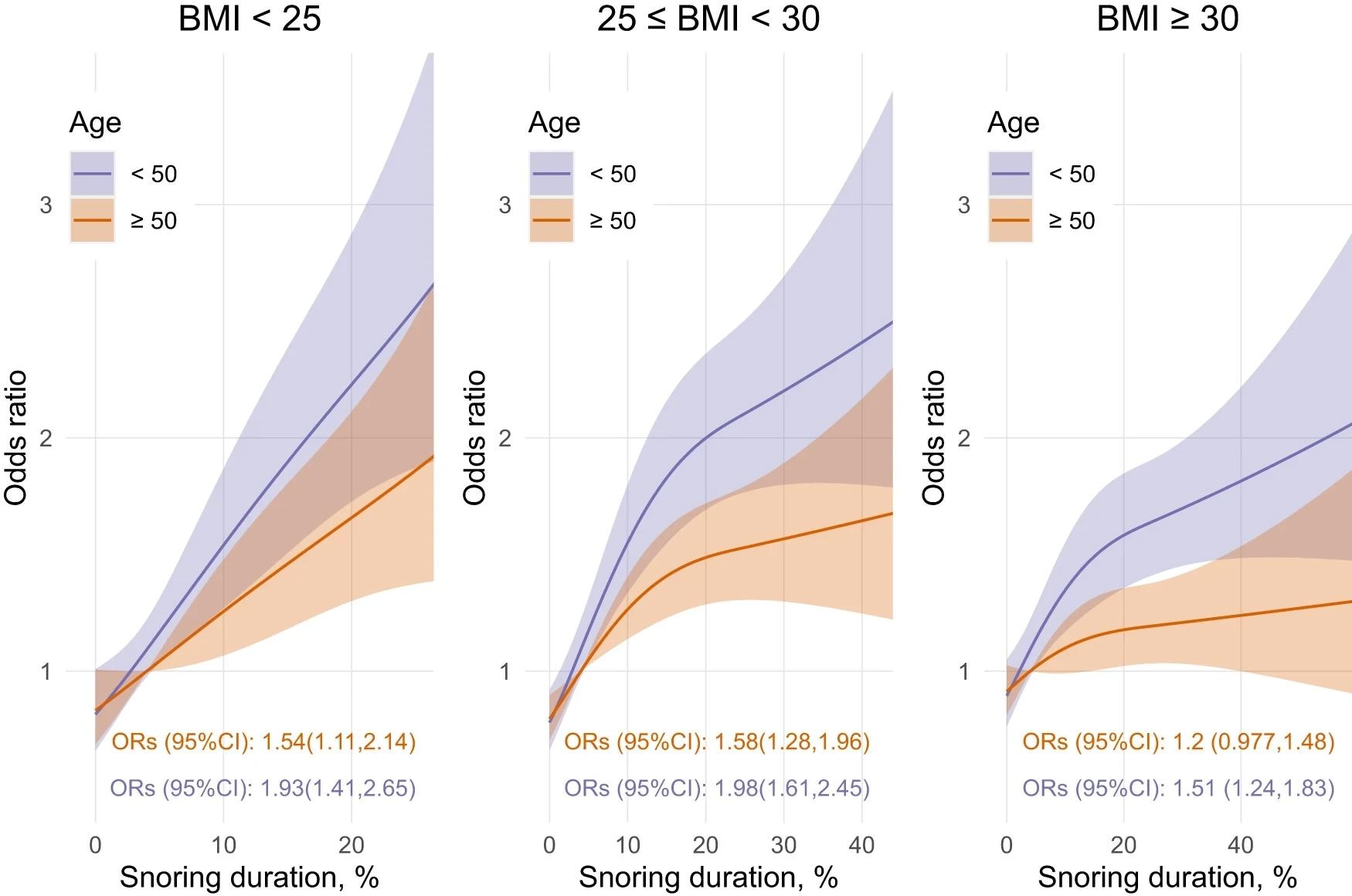
    Models use 3 knots restricted cubic spline and interaction with age categories (median split in years) and BMI categories (kg/m2). ORs (95%CI) represents the difference between the 5% and the 75% percent of the snoring duration distribution. Note that the 5% and 75% percent were determined separately for each BMI category; hence, slightly different x-axis.Models use 3 knots restricted cubic spline and interaction with age categories (median split in years) and BMI categories (kg/m2). ORs (95%CI) represents the difference between the 5% and the 75% percent of the snoring duration distribution. Note that the 5% and 75% percent were determined separately for each BMI category; hence, slightly different x-axis.

    Nearly half of the participants snored for more than 5% of the night, but only 7% spent more than 30% of the night snoring; time spent snoring was higher for men than women. The correlation coefficient between the eAHI and snoring duration was 0.42, and people with obstructive sleep apnea (OSA) spent more time snoring on average than those without the condition.

    After adjusting for sex, eAHI, and BMI, people who snored longer had higher diastolic and systolic blood pressure by 3-4 mmHg on average. The effect sizes of interactions with age and obese status were small, though significant.

    Participants who did not have OSA but had high snoring levels had a 3.8 mmHg higher systolic blood pressure and 4.5 mmHg higher diastolic blood pressure than those who did not snore or have sleep apnea. The effect of snoring without OSA on blood pressure was comparable to that of OSA without snoring on blood pressure.

    The duration of snoring was significantly correlated with uncontrolled hypertension, regardless of sex, though associations were stronger for people with a BMI<30 and less than 50 years old. People less than 50 years old with a normal BMI showed an increase in hypertension likelihood of 98% if they snored.

    In sensitivity analyses, researchers adjusted for the total time spent asleep, but this did not significantly affect their findings. For example, models that adjusted for sleep time found that higher snoring duration was associated with an 88% rise in uncontrolled hypertension.

    Conclusions

    The findings indicate that snoring regularly at night is strongly associated with high blood pressure and uncontrolled hypertension, regardless of the presence or severity of OSA, especially among middle-aged and overweight men who made up the majority of the studied population. The authors recommend that snoring be considered a part of the clinical care of sleep-related problems and hypertension management.

    This study overcomes certain limitations of previous explorations in this field, which relied either on self-reported snoring data or recordings from a single night and were thus unable to account for night-to-night variability. However, the study did not assess confounding factors such as the use of alcohol, tobacco, and caffeine, diet, medications, and exercise.

    Findings from the predominantly male, obese, and middle-aged population cannot be generalized to other groups. Another important consideration is that people more concerned about their health are more likely to register to use the devices, potentially confounding the findings. Further studies can focus on addressing these issues and strengthen the evidence base on this topic.

    Journal reference:

    • Regular snoring is associated with uncontrolled hypertension. Lechat, B., Naik, G., Appleton, S., Manners, J., Scott, H., Nguyen, D.P., Escourrou, P., Adams, R., Catcheside, P., Eckert, D.J. npj Digital Medicine (2024). 10.1038/s41746-024-01026-7, https://www.nature.com/articles/s41746-024-01026-7

    [ad_2]

    Source link

  • Pilates lowers blood pressure in hypertensive patients, study finds

    Pilates lowers blood pressure in hypertensive patients, study finds

    [ad_1]

    A study published in the Journal of Human Hypertension reveals that Pilates training programs are safe for patients with hypertension and that these programs can be incorporated as a part of their rehabilitation.

    Study: The efficacy of Pilates method in patients with hypertension: systematic review and meta-analysis. Image Credit: ESB Professional / ShutterstockStudy: The efficacy of Pilates method in patients with hypertension: systematic review and meta-analysis. Image Credit: ESB Professional / Shutterstock

    Background

    Hypertension or high blood pressure is a major public health concern because of its widespread prevalence. The condition significantly increases the risk of cardiovascular disease and associated disability and mortality. Although medicines can effectively treat hypertension, consistent treatment adherence is the primary requisite for optimal outcomes.

    Available evidence indicates that a combination of pharmacological and non-pharmacological interventions is highly effective in managing all risk factors associated with hypertension. In particular, physical exercise is considered to be an excellent intervention to reduce blood pressure in hypertensive patients. This intervention effectively reduces blood pressure even in patients who are low responsive to anti-hypertension medications.

    Among various types of physical activities, aerobic exercise is considered the primary option for managing blood pressure. In addition, isometric exercise, dynamic resistance exercise, and high-intensity interval training have shown positive effects in hypertensive patients. However, despite many health benefits, these physical activities are generally associated with a low adherence rate.

    In this systematic review and meta-analysis, scientists have explored the effectiveness of Pilates training programs in managing blood pressure in hypertensive patients. They have considered Pilates an alternative physical exercise option because of its adaptability in various conditions, such as rehabilitation and fitness.   

    Study design

    The scientists searched across four electronic databases for randomized clinical trials and comparative studies that investigated the effect of Pilates training on blood pressure in patients with hypertension.

    A total of four randomized clinical trials and seven comparative studies were included in the final analysis. All these studies were published between 2015 and 2023. Regarding the methodological quality of selected studies, one was low quality, four were good quality, and six were high quality.

    The selected studies included a total of 458 participants with decompensated hypertension, arterial hypertension, or normal tension. All arterial hypertensive participants received anti-hypertensive treatment during the Pilates training.

    Nine out of eleven selected studies used Pilates-based Mat as their study intervention; one used Pilates with apparatus, and one used both. In comparative studies, the control groups performed aerobic exercises or daily life activities.   

    Important observations

    A considerable proportion of selected studies described the positive impacts of Pilates training programs in managing blood pressure in hypertensive patients. Data from three randomized controlled trials and two comparative studies was included in the meta-analysis.

    The findings revealed that Pilates has significantly higher potency in reducing systolic, diastolic, and mean blood pressure compared to other physical activity interventions employed in control groups.

    The meta-analysis of data from four comparative studies indicated that Pilates exerts similar blood pressure-lowering effects in hypertensive and normotensive participants. However, these effects were not statistically significant.

    Study significance

    The meta-analysis finds that Pilates is safe and effective for managing blood pressure in hypertensive patients. However, it might not necessarily have superior effects compared to other physical exercise interventions.

    Most studies included in the systematic review and meta-analysis highlight the significant positive effects of Mat Pilates on blood pressure. This suggests that the incorporation of exercises that require isometric strength could be helpful in lowering blood pressure.

    Mat Pilates is a low-to-moderate-intensity exercise. In contrast, Pilates with apparatus is a high-intensity exercise. Studies that employed Pilates with apparatus could not find any significant blood pressure-lowering effects. This indicates that the intensity of Pilates is an important factor to consider while applying this intervention for blood pressure management. In support of this hypothesis, existing literature depicts that light or moderate aerobic exercise is more effective than high-intensity aerobic exercise in reducing blood pressure.

    Although the findings of the meta-analysis indicated blood pressure-lowering effects of Pilates, overall, it was found that Pilates does not have greater effects than aerobic exercises. Moreover, a combination of aerobic exercise and Pilates failed to demonstrate greater benefits.

    Based on these observations, scientists advise incorporating Pilates as a part of the rehabilitation approach to manage blood pressure in hypertensive patients. However, it should be noted that Pilates may not necessarily offer greater benefits than aerobic exercises and that it may not necessarily help improve adherence to training programs.

    Journal reference:

    • Daniel González-Devesa. 2024. The efficacy of Pilates method in patients with hypertension: systematic review and meta-analysis. Journal of Human Hypertension. DOI: 10.1038/s41371-024-00899-110.10,  https://www.nature.com/articles/s41371-024-00899-1

    [ad_2]

    Source link

  • Flexitarian diet linked to lower cardiovascular risk, study finds

    Flexitarian diet linked to lower cardiovascular risk, study finds

    [ad_1]

    A new study published in BMC Nutrition examines the cardiovascular risk associated with different dietary patterns.

    Study: Plant-based diets and cardiovascular risk factors: a comparison of flexitarians, vegans and omnivores in a cross-sectional study. Image Credit: Antonina Vlasova / Shutterstock.com Study: Plant-based diets and cardiovascular risk factors: a comparison of flexitarians, vegans and omnivores in a cross-sectional study. Image Credit: Antonina Vlasova / Shutterstock.com

    How different diets impact cardiovascular health

    Omnivorous diets are often rich in meat and meat products, with the average intake in Germany being above the recommended limit of 600 grams each week. High meat intake has been associated with an increased risk of obesity, high blood pressure, insulin resistance, abnormally high blood lipids, and arterial stiffening, all of which are risk factors for cardiovascular disease (CVD).

    In contrast, less than 40% of people in Germany are physically active, most of whom spend less than 2.5 hours every week in physical activity. However, moderate activity could reduce the risk of atherosclerosis, a prime risk factor for CVD.

    CVD is the leading cause of death around the world, as it accounts for over half of all deaths. Both modifiable and non-modifiable risk factors contribute to the development of CVD, the latter of which include a poor diet and unhealthy lifestyle.

    Ecologists claim that a plant-based diet is ideal for the earth’s human population in terms of health, sustainability, animal welfare, and cost-effectiveness. However, rather than an all-or-nothing approach, there could be a happy medium with people mainly eating plant-based food coupled with occasional meat and processed meat intake. In contrast to vegetarians, this type of individual is referred to as a flexitarian.

    While the typical omnivore diet has been associated with an increased CVD risk, a plant-based diet appears to reduce the risk of CVDs. However, little research to date has evaluated the impact of a flexitarian diet on CVD risk.

    About the study

    Study participants between 25 and 45 years old were divided into three groups. The first group comprised long-term flexitarians (FXs) who ingested 50 grams of meat or meat products each day, whereas the second group consisted of vegans who did not eat any foods of animal origin, and the third group included omnivores, whose diet included 170 grams of meat and meat products every day.

    The researchers examined blood samples for various markers of CVD, blood pressure, arterial wall compliance, and whether the individual had metabolic syndrome (MetS), characterized by insulin resistance, high blood glucose levels, and an increased weight circumference. These measurements were compared with dietary patterns using multiple tools to characterize diet quality, food intake, and physical activity levels.

    What did the study show?

    Body mass index (BMI) values were similar for all three groups; however, FX women had lower body fat than omnivore women, with this difference not observed in men. Vegan women had the lowest body fat percentage of all study participants.

    Vegetable intake increased from omnivores to vegans, with FXs and vegans consuming twice and three times as much vegetables as omnivores, respectively. Both vegans and FXs consumed twice as many fruits as omnivores.

    FXs consumed significantly fewer plant-based milk or dairy alternatives, with neither favored among omnivores. Similar patterns were observed for nuts and legumes.

    Meat intake was lowest among vegans and significantly less among FXs as compared to omnivores. Plant-based meat alternatives were primarily consumed among vegans, with some intake reported among FXs. Egg intake was double among omnivores as compared to FXs.

    The best diet quality was observed among vegans, followed by FXs, which correlates with previous reports.

    All CVD markers were at similar levels in all groups, whereas the lowest fasting glucose levels were observed in vegans. MetS marker scores were significantly better in vegans and FXs than omnivores; however, all groups were associated with low-risk score levels.

    Meat and dairy intake were closely associated with total cholesterol levels; however, dairy intake was negatively correlated with fruit and vegetable intake, including legumes and meat substitutes. Soft drinks, sweets, and meat consumption were correlated with increasing low-density lipoprotein (LDL) cholesterol.

    MetS scores were related to processed meat and meat consumption and sweets intake but negatively associated with fruit intake. Total inflammation was not correlated with any group.

    What are the implications?

    Dietary choices are crucial to reducing CVD risk, as confirmed by this pilot study on the flexitarian diet in relation to CVD risk factors. Although not an intervention study, the current study allowed for direct observation of several parameters in three distinctive groups, especially MetS scores and arterial stiffness.

    A vegan diet appears to be associated with the best cardiovascular health; however, MetS and arterial stiffness were more favorable in flexitarians than in the other groups. Thus, flexitarian diets also confer significant benefits compared to omnivorous eating patterns.

    Reducing meat and processed meat products intake, as in flexitarianism, may contribute to CVD risk factor advantages.”

    Journal reference:

    • Bruns, A., Greupner, T., Nebl, J., & Hahn, A. (2024). Plant-based diets and cardiovascular risk factors: a comparison of flexitarians, vegans and omnivores in a cross-sectional study. BMC Nutrition. doi:10.1186/s40795-024-00839-9.

    [ad_2]

    Source link