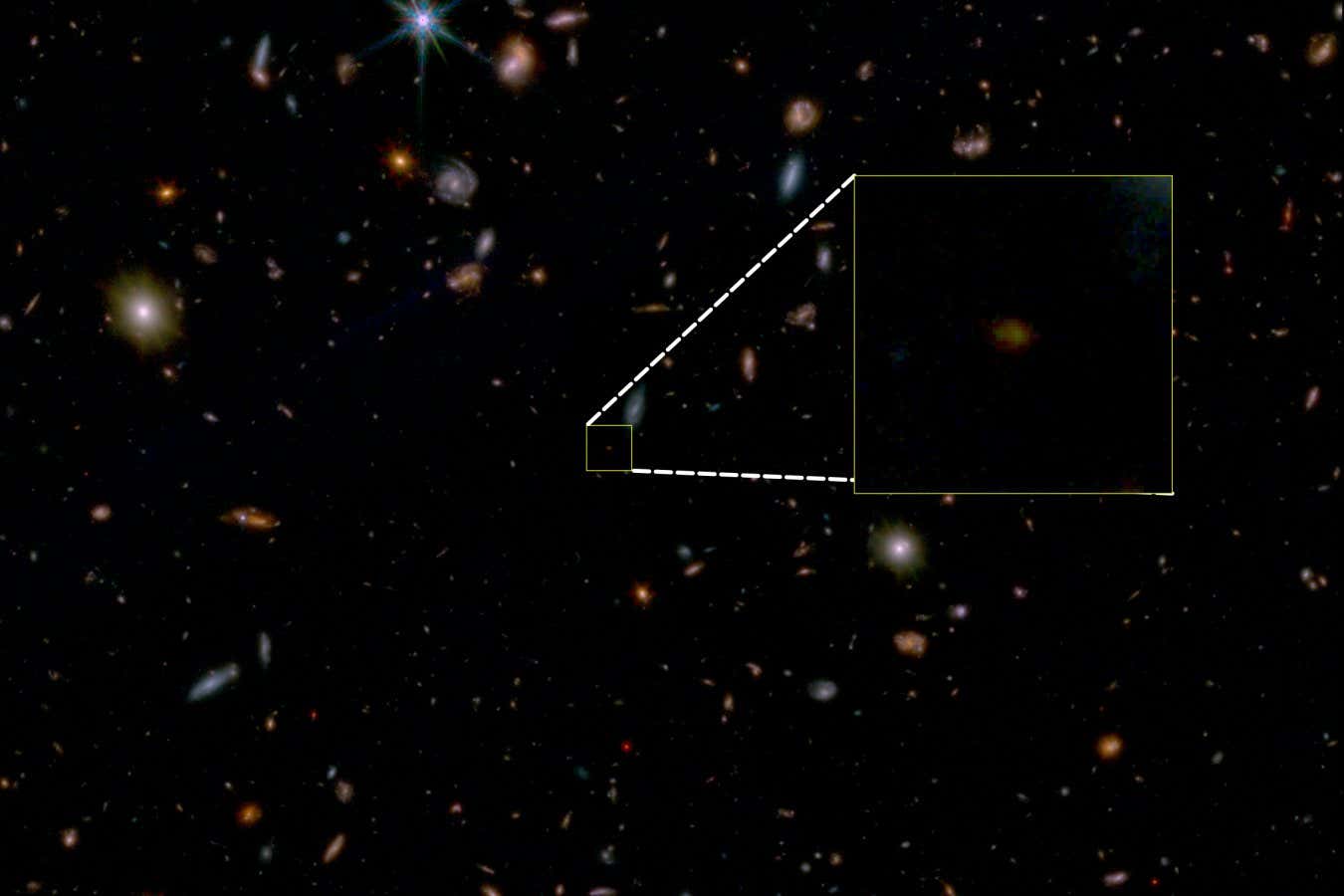
The James Webb Space Telescope can capture detailed images of distant galaxies
JADES Collaboration
A strange galaxy in the early universe lived fast and died young. It is the most distant “dead” galaxy, meaning it is no longer forming any new stars, ever spotted.
The galaxy JADES-GS+53.15508-27.80178 was discovered in 2010, but astronomers at the time were not able to characterise it in detail. Francesco D’Eugenio at the University of Cambridge and his colleagues observed it again with the James Webb Space Telescope (JWST) and found that its star formation…
Researchers have tracked the development of supernova 1987A since the stellar explosion began
NASA/STScI/CfA/P.Challis
Scientists have finally figured out what is at the centre of a nearby supernova. Supernova 1987A is the first stellar explosion that we have been able to track in detail since it began, and now we know that it left behind a hot neutron star.
There are two possible objects that can be left behind after a star explodes in a supernova: a neutron star, which is a dense stellar corpse made up of primarily neutrons, and…
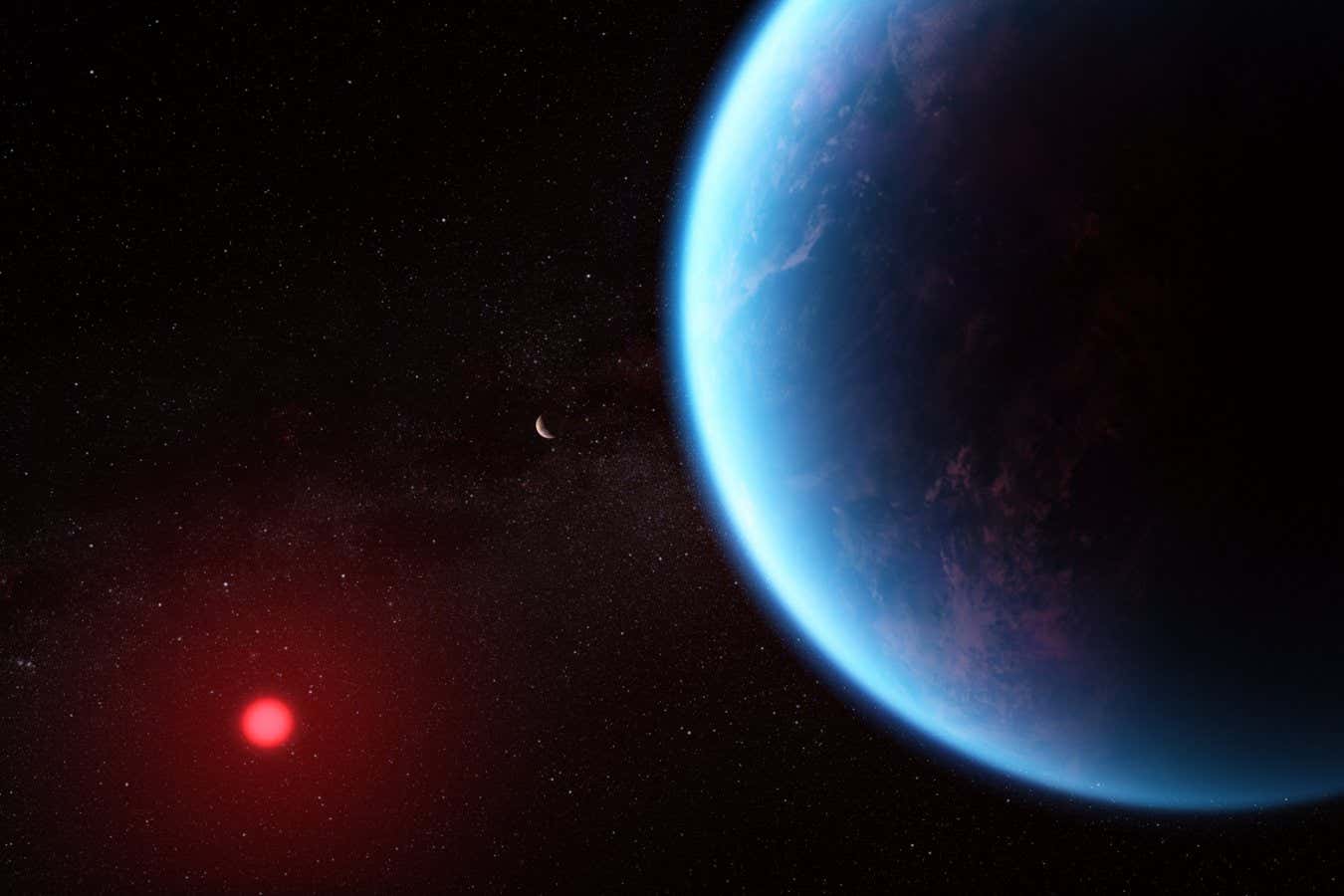
An illustration of exoplanet K2-18b based on scientific observations
NASA, ESA, CSA, Joseph Olmsted (STScI)
A type of planet thought to be capable of supporting life may actually be covered in hot magma. The chemical properties of these so-called hycean exoplanets – which were previously thought to host liquid water oceans – may instead indicate magma seas.
Oliver Shorttle at the University of Cambridge and his colleagues came to this conclusion using observations from the James Webb Space Telescope (JWST) of the exoplanet K2-18b. This world is archetypically hycean – a name given to planets with a hydrogen-rich atmosphere above a liquid ocean. These planets also tend to be between the size of Earth and Neptune, with chemistry in their atmospheres that suggests liquid water exists on the surface – making them prime targets in the hunt for life beyond Earth.
However, recent models of K2-18b’s climate indicate that it may be hotter than previously thought, sweltering enough that any water oceans would have boiled away long ago. “The ground is kind of moving beneath our feet, from a theoretical perspective, as to the conditions on this planet,” says Shorttle.
The researchers investigated how it would affect the planet’s atmospheric chemistry if these oceans were made of magma rather than water, which would be consistent with the hotter predicted temperatures. They found that this matched the JWST observations just as well as water oceans.
“These two radically different regimes look very similar,” says Shorttle. “It makes the detection of habitable conditions on a super Earth or sub-Neptune-sized planet more complicated than we might have hoped.”
This means that we probably need more detailed data to tell the difference between a potentially habitable world with water oceans and a broiling, inhospitable magma world. For K2-18b, Shorttle says the question should be resolved by additional JWST observations in the coming years. And when it comes to other hycean worlds, we may have to develop new ideas of how to search for liquid water.
Uranus, showing all of its rings and nine of the planet’s 27 moons
NASA, ESA, CSA, STScI
This amazing shot of Uranus, taken by the James Webb Space Telescope (JWST), has given us our most complete view yet of the planet, with its rings and turbulent atmosphere revealed in glorious detail.
In April, JWST used its infrared sensors to image Uranus and give us a clearer view of the ice giant’s rings of rock and dust, which had only previously been directly imaged twice, by the Voyager 2 spacecraft and Earth-based Keck Observatory. In that April image, 11 of Uranus’s 13 known rings could be seen, but the final two were too faint to show up.
JWST has now followed up those observations using a wider field of view and more wavelengths of infrared light, revealing the rings in even more detail and showing us the elusive final two rings.
The view above also shows nine of Uranus’s 27 moons, which are all tilted at the same 98-degree angle away from the sun as the planet itself. Another new image from JWST, below, shows five more moons (Oberon, Umbriel, Ariel, Miranda and Titania) glowing like blue stars, bringing the total displayed to 14.
This JWST picture of Uranus shows five more moons, shining like blue stars around the planet. They are (clockwise from top): Oberon, Umbriel, Ariel, Miranda and Titania
STScI Copyright: NASA, ESA, CSA, STScI
The tilt of the planet gives different sides of Uranus prolonged periods of sunlight and darkness – each of its seasons lasts 21 Earth years – resulting in its polar cap and atmospheric storms, which can both be seen more clearly in the top picture. The storms are just below the southern edge of the broad, white polar cap, seen as white wisps against the blue backdrop.
Although Uranus takes 84 years to orbit the sun, the planet takes only 17 hours to complete a rotation, so its atmosphere and moons can move more quickly than a standard telescope exposure. Astronomers used a combination of long and short exposure times with JWST to create the above images, so that its changing features can be smoothed over.
The James Webb Space Telescope (JWST) has helped make 2023 a year of astonishing cosmic images. But the groundbreaking telescope was far from the only source of visual wonderment, because a series of new missions sent back pictures from space, and the view from Earth wasn’t bad either. Here are six of the images that dazzled us the most.
The star in the top picture was caught by JWST getting ready to explode. It is called WR 124 and is about 30 times the mass of the sun.
When stars that big run out of hydrogen to burn in their core, they begin to fuse heavier elements instead. This fusion creates powerful blasts of energy, blowing out gusts of wind at velocities in the millions of kilometres per hour. When those powerful winds strip away the outer layers of the star, it becomes what is known as a Wolf-Rayet star.
Within a few million years of being stripped, it blows up in a supernova. The purplish blotches in this picture are the clouds of dust and gas that used to be WR 124’s outer layers – it has already lost about 10 times the mass of the sun – and without those layers intact, it is now doomed to go supernova.
A solar tornado seen from Earth
Andrew McCarthy and Jason Guenzel
Next up, we have the tallest solar tornado ever recorded (above). The event occurred on 14 March, when the rotation of the sun’s magnetic fields churned up the plasma near its north pole. This feature rose from the sun’s surface until the giant flare reached 178,000 kilometres tall – that is nearly 14 times the diameter of Earth.
This image was the result of a painstaking collaboration between astrophotographers Jason Guenzel and Andrew McCarthy. They used a high-speed camera to record the event, and took five days and 90,000 individual shots to create their picture. The sun looks furry in the image because it is covered in millions of churning geysers of plasma that last only a few minutes each.
Newborn star Herbig-Haro 211, captured by JWST
ESA/Webb, NASA, CSA, Tom Ray (Dublin)
This luminous explosion (above) reveals a newborn star’s incredible supersonic jets. These make it what is known as a Herbig-Haro object. The star itself is hidden in the dark cloud of gas from which it formed, but as the jets shoot out on either side of it, they slam into surrounding gas and dust, creating huge shock waves and lighting up.
This particular object, called Herbig-Haro 211, is about 1000 light years from Earth in the constellation Perseus. That makes it one of the nearest Herbig-Haro objects we know of, which is why JWST was able to capture the most detailed image of one ever taken. This revealed strange wiggles in the jets, which may indicate that Herbig-Haro 211 actually has a companion star.
Jupiter’s moon Io
NASA/JPL-Caltech/SwRI/MSSS/Brian Swift/CC BY
Getting back to our own solar system, we move on to Jupiter’s moon Io (above). In October, NASA’s Juno spacecraft passed just 11,645 kilometres over this moon’s surface, taking this stunning image as it passed by. This is one of best photographs of Io ever taken, detailed enough to show the shadows of some of its enormous volcanoes.
Despite being only slightly larger than Earth’s moon, Io is thought to be studded with more than 400 active volcanoes, making it the most geologically active object in the solar system. The lava flows from those volcanoes give Io its distinctive mottled colours, which are enhanced in this image. In 2024, Juno will get even closer to this strange little moon’s surface, providing even more detail on its ever-changing geology.
India’s Vikram lander on the lunar surface, part of the Chandrayaan-3 mission
ISRO
And on to our own moon. On 23 August, India’s Chandrayaan-3 mission became the first to land near the south pole of our moon. This picture (above) of the Vikram lander on the lunar surface was taken a week later by the mission’s Pragyan rover. Studying the south pole of the moon, which Chandrayaan-3 began, is particularly important because of the large amounts of ice there, which could be useful for future human exploration and possible permanent moon bases.
An amateur astronomer’s view of comet Nishimura
Javier Zayas/Moment RF/Getty Images
Our final image is of a more fleeting nature. Above is the comet Nishimura, seen from Earth as it streaked across the night sky.
Two rare green comets made dramatic appearances in the skies this year. First, in early February, the comet C/2022 E3 made its first close pass to Earth in 50,000 years. Then, in August, amateur astronomer Hideo Nishimura discovered another comet – now named after him – which remained visible for about two months. These comets appear green because the gas around their rocky nuclei contains diatomic carbon, which is a relatively rare substance made of pairs of bound carbon atoms.
Make the most of the image of Nishimura now because the comet takes about 437 years to orbit the sun, so won’t be seen again until the 25th century.