Tag: longreads

  • The World’s Most Important Industry Has a New Captain—and She’s Piloting It Into the 21st Century

    The World’s Most Important Industry Has a New Captain—and She’s Piloting It Into the 21st Century

    [ad_1]

    Around us at Zephyros, kids and silverware clamor and motorbikes cough, but Marina’s voice is barely above a whisper. “When the hippopotamuses quarrel, then the frogs get stepped on,” she says of geopolitical conflicts, including the war in Ukraine.

    She’s sphinxlike, at times. I’m starting to think she may have the rare quality that Fitzgerald’s characters called “repose,” a kind of physical self-possession seen only in people who lack neurotic tics like face-touching. Marina never fidgets. And her soft voice is not shyness, I’m learning. She speaks in verdicts. Her straight brown-black hair, ballerina physique, and air of frankness bring to mind a Hellenic Frida Kahlo. But tactically reserved.

    Also sharing from our platters of tomatoes, taramosalata, and sea bream is the man Marina unfailingly calls “Mr. Markakis.” A proud figure who can only be described as looking like a sea captain, Constantine J. Markakis runs Dorian’s Greek subsidiary. He’s talking about how nation-states behave like their icons: Russia like a bear, England like a lion, and so on.

    The objects of Marina’s word of derision, this time, are the other families from Oinoussai, the island where the Hadjipateras mariners go their start. There are five original Oinoussaian clans—Hadjipateras, Kollakis, Lemos, Lyras, and Pateras—and nearly three dozen illustrious families trace their fortunes to the island. In spite of these accomplishments, several of the Oinoussaian diaspora, in Marina’s view, have become hidebound in their approach to shipping, too slow to modernize and expose their fleets and finances to public scrutiny and investment. Marina’s line of the Hadjipateras clan is, by contrast, “progressive.” Indeed, over 15 decades, it has pivoted unsentimentally from sail to steam, from steam to tankers, from private to public.

    Marina’s approach to social equity and climate action is also earnestly progressive. Dorian is known among seafarers for high wages, excellent benefits, and perks for its crews, including cruise-ship amenities like gyms, karaoke, and onboard holiday celebrations. At TMV, Marina and Soraya helped create Transact Global, a network for nontraditional fund managers, mostly women, so they can trade strategies, build solidarity, and gain greater access to capital.

    For the past decade, Marina has also served as vice chair of the Intertanko environmental committee—that’s the International Association of Independent Tanker Owners, which was founded in Oslo in 1970 to address safety in shipping. Members of the committee, of course, are still in the “energy” sector—meaning fossil fuels. (The LPG in Dorian’s name stands for liquid petroleum gas, a natural gas that is better than coal but far from green.) But, perhaps to offset their guilt, they concentrate on emission reduction, alternative fuels, ballast water and waste management, ship recycling, anti-biofouling measures, and underwater noise reduction. The shipowners I meet later are now confident the industry will meet the UN’s demand that ship emissions, which account for some 3 percent of greenhouse gases, be reduced by 40 percent by 2030.

    In spite of this collective project, I encounter several shipping executives in Greece who talk as if they are above both the climate crisis and the affairs of humankind. “Who cares about Ukraine?” asks a well-heeled exec whose business has evidently been inconvenienced by the sanctions imposed on Russia since the war started. This small-mindedness profoundly displeases Marina, who nonetheless sidesteps most third-rail subjects, including Russia, China, and Gaza.

    [ad_2]

    Source link
  • 2054, Part VI: Standoff at Arlington

    2054, Part VI: Standoff at Arlington

    [ad_1]


    18:46 April 15, 2054 (GMT‑5)

    Arlington National Cemetery

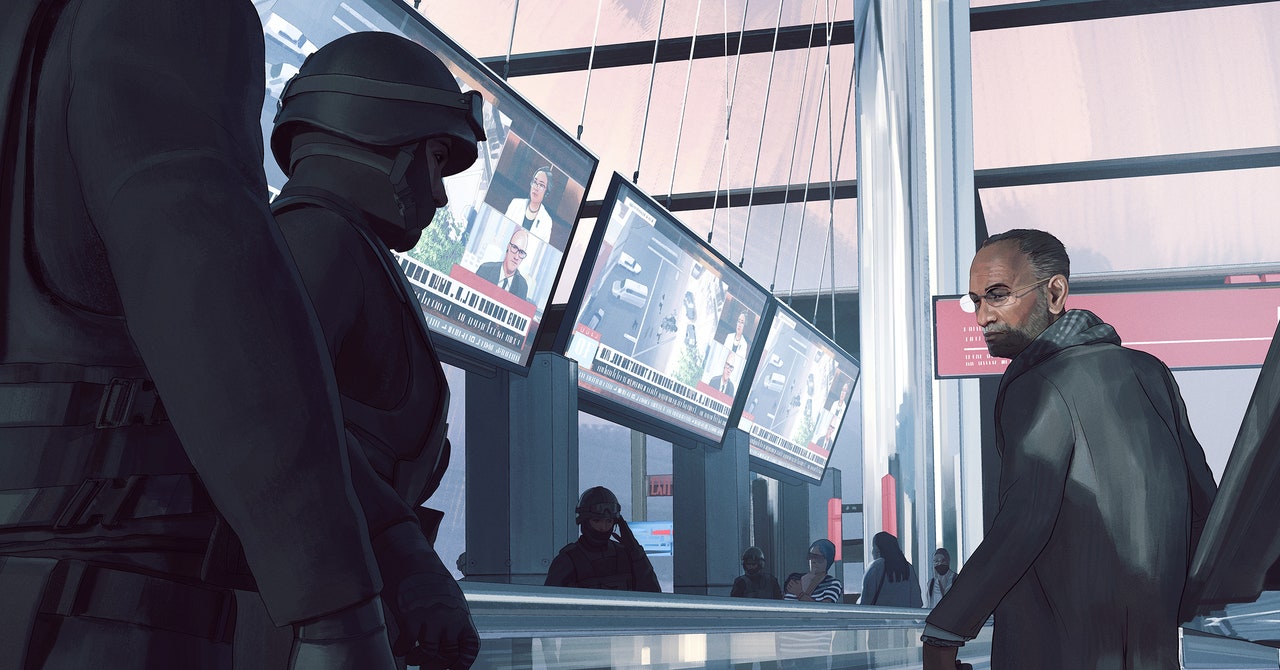
    That night in her apartment Julia Hunt ordered in sushi and watched the coverage of Slake’s botched press conference on her living room sofa. Days later, Slake’s panicked responses to the questions about Castro’s death continued to air, and they appeared even worse on the news.

    Hunt raised a piece of salmon sashimi between two chopsticks as she read the chyron for the next story: Castro Autopsy Leaked on Common Sense Confirms Foul Play and White House Lies. She dropped the fish onto her lap.

    News of the withheld autopsy exploded. On every channel the prime-time anchors flashed printed copies of the report to the camera. They read whole sections aloud, describing the dimensions of the marble-sized mass of cells inexplicably lodged in Castro’s aorta and the excerpted transcript of the autopsy itself, in which the chief internist concluded, “This can’t be the same heart.”

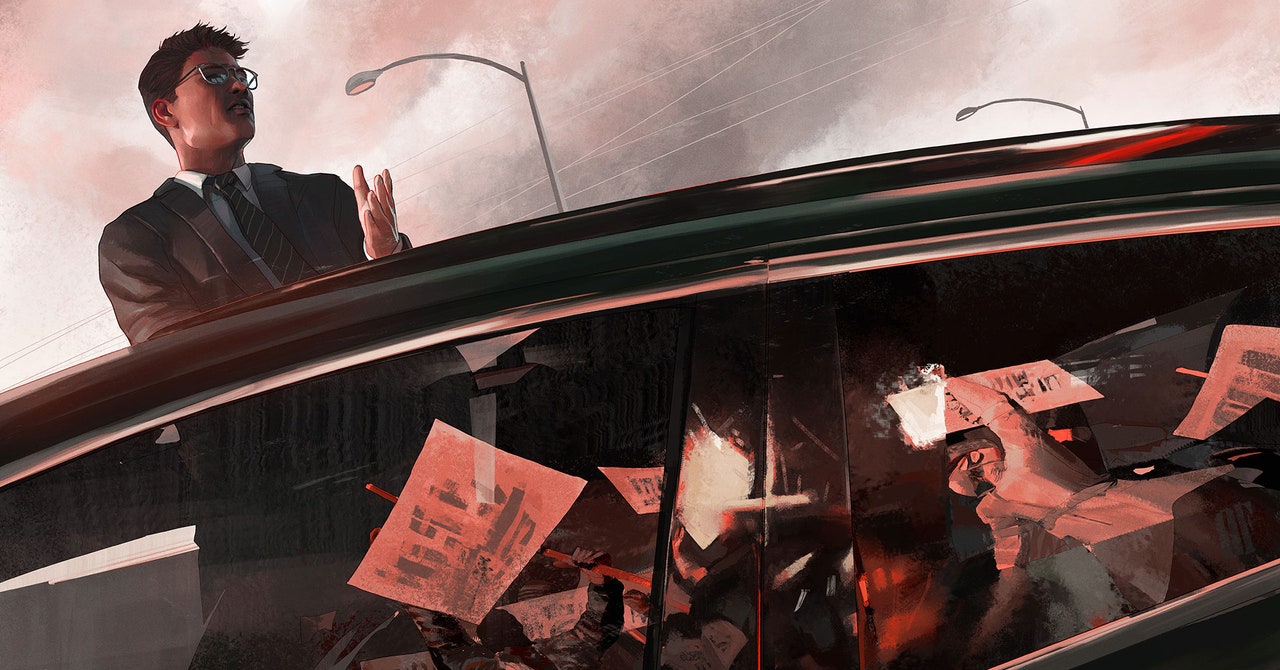
    Within the hour, Truthers flooded the streets in cities around the country. As Hunt scrolled the channels, a news crew in Lafayette Park was conducting interviews with the growing mass of protesters, one of whom she recognized; it was the man in the wheelchair she’d met on the Metro. She had thought of him often. Now she learned his identity: retired gunnery sergeant Joseph William Sherman III. Beneath his name on the screen were the words Truther Volunteer Organizer. She placed his name in a search engine and learned that he’d lost his legs in the Spratly Islands and that the Chinese nuclear attack on San Diego had killed his wife and three daughters, who’d lived at nearby Camp Pendleton. Hunt could hear in Sherman’s voice how deeply he resented a president who while alive flaunted constitutional norms by clinging to power for an attempted fourth term and whose successor, Smith, now flaunted norms again by withholding an autopsy and refusing to be transparent about his predecessor’s death.

    “Point your camera here,” said Sherman, thumbing toward his missing legs. “I sacrificed these for my country, and you’re going to lie to me … you’re going to lie to all of us.” He gestured expansively to a cluster of Truthers who’d placed him at their center, the core of them veterans, wearing old military fatigues adorned with medals that dangled from their chest pockets. “It’s a lie that Smith is the legitimate president when he so clearly had a hand in killing Castro. Is this what America has become? Dreamers drunk on power led by a dictator-president. Lies to the many so long as it gives power to the few.” Sherman held the camera’s focus with his insistent blue eyes.

    His tone was so resolved, the correspondent felt compelled to answer him. In a meek voice, she said, “I don’t know.”

    “Of course you don’t.” Sherman leaned into the camera. “President Smith,” he began, “you are illegitimate. You will find that everyday Americans—we patriots who demand the truth about your crimes and the excesses of the Dreamers—will not be led by a thief, by someone who stole the presidency. We served our country before, and we’ll serve it again. And don’t even think of trying to place your predecessor in Arlington’s hallowed ground.” Sherman swiveled around, turning his back to the camera, and wheeled himself away.

    The news cut to commercial.

    Julia Hunt rested her head against the arm of her sofa, her eyes still glued to the screen. Weeks of exhaustion swept over her. While she waited for the program to return, she fell into a black wilderness of sleep. Deep into this sleep, in the early hours of the morning, she began to dream: Here, in the dream, she is asleep in her girlhood bedroom and is woken before dawn by a noise, the sound of something hitting the floor. Her surroundings are familiar, the adobe ranch house in New Mexico where Sarah Hunt had raised her. Wearing her nightgown, she carefully shuts the door behind her and steps into the dark corridor. At its far end a single band of light escapes from the base of another door. She begins to walk down the corridor. The tiles are cool beneath her bare feet. As she draws closer, she can hear what sounds like a struggle.

    [ad_2]

    Source link

  • 2054, Part V: From Tokyo With Love

    2054, Part V: From Tokyo With Love

    [ad_1]

    Zhao Jin cast an appraising glance at Mohammad, who moved his food around on his plate and said, “He won’t be a senator for much longer.”

    “No,” Zhao Jin answered. “He won’t.”

    “He’ll be in the White House soon.”

    “It would seem so.”

    “He won’t take Lily Bao with him,” added Mohammad.

    “Would Kennedy have become president if instead of Jackie he’d married a German? The daughter of Rommel or Guderian? The wounds of America’s last war remain open, and Shriver is too much of a coward to risk his political career for her. Also, there’s something else.”

    “What’s that?” the elder James Mohammad asked impatiently.

    Zhao Jin volleyed his gaze between them, as if he were weighing whether to share this last bit of information. “The sequence of code on Common Sense. In your reports, you mention concerns that it was stolen from an Okinawa-based researcher you’ve funded, a Dr. Yamamoto.”

    “Yes,” said Mohammad. “That’s my concern.”

    “Before Lily Bao set off on her own, she worked for the Tandava Group. I assume you’re familiar with them.”

    Again, Mohammad nodded.

    “Although they’ve divested themselves of the asset, they once had a significant investment in Neutronics, a biotech company. Lily Bao managed that account for the Tandava Group’s founder, Dr. Sandeep Chowdhury. At that time, Neutronics was doing cutting-edge work in nanorobotics, quantum computing, and bioengineering, including early-phase research of remote gene editing under the guidance of Dr. Ray Kurzweil. You’ve heard of him, of course.”

    Both nephew and uncle nodded.

    “He vanished some years ago after leaving Neutronics,” added Zhao Jin. “It seems the company wanted to turn a profit off his research, while he wanted to go further with it.”

    “What does this have to do with my nephew and Lily Bao?” grumbled the elder James Mohammad.

    “Truthers in America are agitating for a commission to investigate President Castro’s death,” said Zhao Jin. “Belief is spreading that there was foul play—an assassination. The sequence of code that allegedly killed Castro, the one released on Common Sense, what if that sequence of code wasn’t stolen from Dr. Yamamoto’s lab? What if it came from Neutronics?”

    “Can you prove that?” asked Mohammad.

    “Do I need to? If Shriver climbs a little higher, to the vice presidency or even higher still, his ties to Lily Bao and Neutronics are leverage we’ll have over him, a way to exercise control. That will give us an invaluable edge over the Americans.”

    “So you want to blackmail Shriver?” asked Mohammad.

    Zhao Jin scoffed. “That’s such an ugly term, and it won’t be necessary.” He asked if he might share a parable from his country. “Once there was a boy who was trying to figure out how to earn the money for a special toy that he wanted but couldn’t afford. On hearing his predicament, a friend of his at school explained that most adults had at least one deep, dark secret and that this made it very easy to get what you wanted from them by simply stating, ‘I know the whole truth,’ even if you don’t know anything. The boy thought this sounded like it might be a way to get the money he needed out of his parents. That day, when he came home from school, he decided to try out his scheme. He found his mother as she was preparing dinner in the kitchen and gave her a grave look, saying, ‘I know the whole truth!’ His mother quickly reached into her apron and handed him a 1,000-yuan note, saying, ‘Don’t tell your father.’ Pleased that his scheme seemed to work, he waited for his father to get home that evening. Greeting him at the door, the boy said, ‘I know the whole truth!’ His father, glancing from side to side, took out his wallet and pressed 2,000 yuan into the boy’s hand, saying, ‘Not a word to your mother!’ Even more pleased and closer to affording his new toy, the boy thought he would try this trick on a stranger. The next morning, on his way to school, he saw the mailman walking up his front path. He looked the mailman squarely in the eye and said, ‘I know the whole truth!’ The mailman quickly dropped his mailbag, fell to his knees, opened his arms, and exclaimed, ‘Son! Finally! Come give your daddy a hug!’”

    [ad_2]

    Source link

  • 2054, Part IV: A Nation Divided

    2054, Part IV: A Nation Divided

    [ad_1]

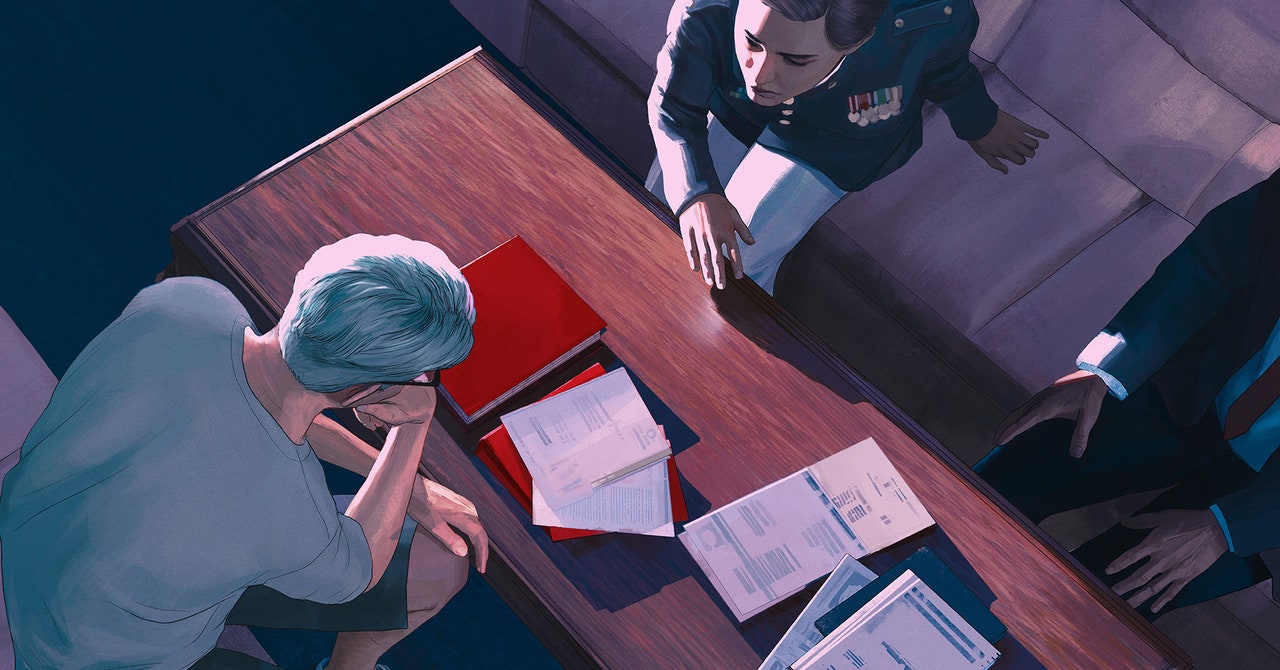
    Wisecarver stepped across the threshold. “Good morning, Mr. President.” He gave a little nod. Beneath his arm he carried a single binder. “Good morning, Trent.” Smith gestured for Wisecarver to sit with him on the sofa while Hunt and Hendrickson sat opposite. As they settled in, Julia caught Wisecarver glancing at the half dozen other binders spread across the coffee table, as if gauging the competition. The president cleared his throat. “As you all know, Speaker Wisecarver believes a unity government, in which I’d select a vice president from his party, would be in the best interests of our country …”

    Julia felt her godfather shift in his seat, as if he couldn’t quite stomach the idea that Wisecarver’s interest in the matter had anything to do with the country as opposed to his own naked ambition. While the president spoke, Wisecarver looked around the room, his eyes running the walls. As Speaker, he’d been in the Oval Office plenty of times before as a guest of President Castro, but he seemed to be taking it all in for the first time, as if he were rearranging the furniture in his imagination and, quite literally, measuring the drapes.

    Smith finished. It was Wisecarver’s turn to speak: “With the loss of President Castro, our country has gone through a significant trauma. Now it’s time for us to heal. The formation of a unity government is an important first step in that healing process. The people are in the streets telling us this. We can’t afford to ignore them any longer. Really, we have little choice in the matter. Either we heal together, or we tear ourselves apart.”

    “Is that a suggestion?” Hendrickson asked. “Or an ultimatum?”

    “It’s a reality, Bunt.” Wisecarver glanced down at the binders on the table. “If you pick one of those candidates, you’re tying my hands.”

    “Tying your hands how?” Hendrickson leaned forward so that he was perched on the edge of the sofa.

    “Well, for starters, they won’t go home anytime soon,” and Wisecarver gestured to the encampment out the window. “There’s also the commission investigating President Castro’s death to consider, a process that could drag on, depending on who we in the Congress appoint to lead it. If you need more reasons than those two, I could continue.”

    “That won’t be necessary,” the president said to Wisecarver. He turned to Hendrickson with a look like a child pleading with an overly protective parent. He couldn’t sustain this level of conflict, the protests around the country, the machinations of his political rivals. Like any performer, Smith cared deeply what other people thought of him and couldn’t tolerate being hated, or at least being hated to this degree. He had all of a politician’s neediness without any of the cunning. He was doomed.

    Julia Hunt could see her godfather reconsidering what Wisecarver offered. A unity government would de-escalate the current crisis, at least in the near term. In the long term, elevating a Truther could prove an astute move. It would diffuse Wisecarver’s power within the party. Also, depending on who that person was, having steady leadership—at least steadier than Smith—could help stabilize the country, or at least keep it from tearing itself apart, to use Wisecarver’s words. But it all depended on who he was proposing.

    Hendrickson asked for the name.

    Wisecarver reached across the coffee table and handed him the binder he’d brought, with its pages of due diligence. Julia Hunt leaned over her godfather’s shoulder as he opened it. Of course, she thought. On the first page she glimpsed the official portrait of Senator Nat Shriver.


    COMING SOON

    2054, Part V: From Tokyo With Love
    “Had this all been contrived? Had his life become a game in which everyone knew the rules but him?”


    From 2054: A Novel, by Elliot Ackerman and Admiral James Stavridis, USN, to be published on March 12th, 2024, by Penguin Press, an imprint of Penguin Publishing Group, a division of Penguin Random House LLC. Copyright © 2024 by Elliot Ackerman and James Stavridis.

    If you buy something using links in our stories, we may earn a commission. This helps support our journalism. Learn more.

    Let us know what you think about this article. Submit a letter to the editor at [email protected].

    [ad_2]

    Source link

  • 2054, Part III: The Singularity

    2054, Part III: The Singularity

    [ad_1]

    Lily didn’t want to approach B.T. She thought that might seem too aggressive; instead, she wanted him to notice her. At the roulette table, he had placed his chips on black, so she’d placed hers on red, and that had been enough. “Lily Bao,” he said, a smile barging its way onto his lips as he saw her from down the table. “Why am I not surprised it’s you who found me first?”

    Lily was still collecting the last of her winnings. “Can I buy you a drink?”

    B.T. leaned over, grabbed a pair of her chips, and tossed them as a gratuity to the dealer, who nodded in appreciation. B.T. then turned toward her, his one eyebrow raised, and said, “The drinks here are free, kiddo.”

    They crossed the casino to the restaurant, walking arm in arm beneath its ceiling painted with kitschy Italianate frescoes and studded with security cameras, dozens of black, watchful orbs. At B.T.’s request, the maître d’ agreed to open up a closed section in order to grant them a little extra privacy. “Come here often?” Lily asked, impressed.

    B.T. shrugged and replied, “Depends on your definition of often.” He ordered the two of them a prewar bottle of Bordeaux, a Château Lafite Rothschild. “The 2031,” he said authoritatively, which elicited a little bow from the maître d’, who answered, “Right away, Dr. Yamamoto,” before returning to the front of the restaurant.

    Lily suppressed a laugh. “Look at you.”

    “Look at me what?”

    The 2031 … Right away, Dr. Yamamoto …” B.T.’s gaze dipped self-consciously toward his place setting. Lily reached across the white linen tablecloth and took his hands in hers. “It’s really good to see you.”

    “How’d you find me?” B.T. asked. As Lily opened her mouth to speak, he modified the question: “Wait, why’d you find me?” This was more complicated. The long answer began more than a decade before, when, awkward and alone, they’d met freshman year in Cambridge. Back then, they’d clung to each other as if drowning while they navigated the twin challenges of life away from home and MIT’s relentless academic load. B.T. had been Lily’s first boyfriend, a relationship that’d lasted a total of three months. In a season of firsts, he had, on a futon in her dorm room, become her first lover. Lily suspected she was his first lover, too, though he improbably alluded to other affairs. When he forgot Valentine’s Day and then her birthday within a three-week span, and had then taken her to dinner to make up for both but forgot his wallet so she’d wound up paying, she had had enough. Mindful of his feelings, she’d suggested that they would make better friends than lovers. His relief at this suggestion was palpable, the only mutual breakup Lily had ever experienced.

    After breaking up, they spent even more time together. For Lily—who’d lost her father, her country, and eventually her mother, all before the age of 20—B.T. began to feel like the only family she had. When the academic load at MIT proved too much for her and it seemed she might flunk out, B.T. intervened. He became her tutor, and they spent hours on those subjects she could barely pass; the ones that came so easily to him. For her part, Lily had taken on the role of older sister and confidant, over the years helping B.T. clean up his messes with other people (a heated disagreement with a professor over a grade, the poorly chosen phrase when critiquing a colleague’s work, the concerns of future employers who’d heard of B.T.’s “tricky” reputation). Which was, ultimately, the why of his question to her. “Because I know you’ve made a mess, B.T.”

    [ad_2]

    Source link

  • 2054, Part II: Next Big Thing

    2054, Part II: Next Big Thing

    [ad_1]

    A bloody Sunday followed. In Tucson, a Border Patrol officer fired a rubber bullet that struck a Truther protester in the eye, killing her. When the news broke, the Homeland Security secretary resigned. But a single resignation wasn’t enough. Truther activists, organized into self-styled Truther brigades, ransacked a half-dozen federal buildings from Los Angeles to Boston in one frenzied afternoon. By Monday evening a crop of resignations, from the secretary of defense to the director of Health and Human Services, had arrived on Hendrickson’s desk.

    As chief of staff, Hendrickson had quietly requested these resignations. He delivered them to the new president. By the end of that week, it seemed the Truthers had achieved their goal of mass resignations within the administration and their protests subsided, but a sense of crisis remained. “Sir,” Hendrickson told the newly appointed president, “we’ve stopped the bleeding, but the patient is still on the table with a weak set of vitals.”

    18:22 March 19, 2054 (GMT+1)

    Lagos Island, Lagos

    This investment could blow up in his face. James Mohammad had hired three separate security firms to breach Yamamoto’s personal servers, and all three had reached the same conclusion: His servers were clean, containing no indication that the proprietary research on remote gene editing that Mohammad had bought exclusive rights to at great expense had been transferred. A fragment of code from that research had surfaced on Common Sense only a few days before. The code was incomplete, meaningless out of context, but its origin was unmistakable.

    The search algorithms Mohammad had in place to recognize even a portion of the code, anywhere, had picked it up immediately. But B.T.’s servers were clean … If he wasn’t the leak, then who was? Ultimately, this breach represented a human failure as opposed to a technological one. Yes, B.T.’s talents were undeniable, but so, too, were his weaknesses. A gambler through and through, B.T.’s impulses often got in the way of his genius. Mohammad should’ve known not to trust him.

    James Mohammad was a gambler, too, but he went about it in a different way. If asked, he would describe himself as a private investor. His investment vehicles rotated—Dark Stone Enterprises, Clear Wood Equity, Broad Water Capital—their names, like so many similar firms, fitting a common pattern: the interplay of an element and an adjective, striving at permanence. Like B.T., Mohammad had had a transient youth, moving every few years with his father, Benjamin Mohammad, a Nigerian diplomat of great promise. Like many globe-trotting elites from former Commonwealth countries, Mohammad’s father dropped him off at Eton at age 13. Shortly thereafter, in 2036, his parents succumbed to the pandemic forever associated with that dismal year. The old Etonians, never known for embracing outsiders, had, after Mohammad’s personal tragedy, allowed him to finish out the term but couldn’t find the wherewithal to underwrite the rest of his education. Then, unexpectedly, an uncle intervened.

    Much later, after a series of failed investments had taken the grown-up James Mohammad to the brink of bankruptcy, his uncle again intervened, offering to underwrite his losses and future investments so long as he—on occasion—shared with the Nigerian government discreet, nonpublic information related to those investments. Mohammad didn’t quite know how to think about the benefits of his arrangement until, one evening over a drink, an American tech investor 10 years his junior confessed to working in intelligence and described a similar relationship with his own government. He had a specific term for it: He was working as a NOC, non-official cover.

    Whatever his title, Mohammad knew that researchers like B.T. were on the cusp of implementing remote gene editing, a profound scientific breakthrough. If molecules really were the new microchips, the promise of remote gene editing was that the body could be manipulated to upgrade itself. Few could comprehend the implications: Governments would no longer need to roll out logistically complex and onerous vaccination campaigns to combat ever-quickening pandemic cycles and viral variants; advanced genetic therapies could be administered remotely, with far greater ease, by triggering the gene-altering properties of mRNA through wireless communication, the equivalent of sending a molecular-level software upgrade; and this was to say nothing of potential enhancements in human physiology and intelligence. The seamless integration of technology and biology was hardly a new idea. Decades before, in the opening years of the century, visionaries like the technologist Ray Kurzweil had predicted the coming of the so-called Singularity. Now, with the prospect of remote gene editing, Mohammad believed that moment had finally arrived.

    It was clear to Mohammad that a new Great Game was afoot. Whatever global order currently existed could only be characterized as no order at all. China and the United States had forfeited their dominance with a near-world-ending conflict; Russia’s decline had continued post-Putin, and the eastern part of Siberia was in effect a Chinese colony; and his native Nigeria had developed with intent and impact internationally, often cooperating with Brazil. And, of course, Japan—long written off, given its declining demographics—had leveraged artificial intelligence, robotics, and quantum computing to compensate for a diminished workforce, often trading with India, which offered a vast market for its technologies.

    [ad_2]

    Source link

  • 2054, Part I: Death of a President

    2054, Part I: Death of a President

    [ad_1]

    “But do you understand what you did wrong?”

    She struggled to look him directly in the eye. Her gaze instead fell over his shoulder, where the news was streaming live on his computer screen. Hendrickson was familiar with this posture of avoidance. Since Julia’s adoption at 9 by his old friend Sarah Hunt, Hendrickson had been a mainstay, the person Sarah called when Julia broke curfew, mouthed off to a teacher, or, on one occasion, accused her adoptive mother of being the one responsible for her parents’ deaths two decades before, in San Diego, where they—along with thousands of other migrant workers—had vanished in a flash of nuclear light, leaving no trace.

    Hendrickson repeated his question. He wanted an assurance that Julia understood what she had done wrong. Except that Julia knew she’d done nothing wrong. Senator Nat Shriver was vice chair of the Senate Select Committee on Intelligence, or SSCI, which everyone in DC pronounced “sissy.” Shriver had a right to read the report.

    12:16 March 12, 2054 (GMT‑5)

    The Ritz‑Carlton, Tysons Corner

    Lily Bao sat on the edge of the mattress, buttoning her white silk blouse. One at a time, she picked the scattered pillows off the floor. She made the bed, retucking the swirl of mussed sheets into neat hospital corners, flattening out the duvet. She’d learned to do this as a girl in Newport, helping her mother, who’d worked as a maid in dingy hotels when they’d first immigrated to the US. No matter how wealthy Lily became, she always made the bed herself.

    He had just left—she so rarely said his name; it was as if he existed in her life only as a pronoun. They’d gotten less than an hour together, a working lunch, as he’d referred to it in his text the night before. It had been, admittedly, one of many such “lunches,” always in a hotel room that she booked. She didn’t mind. She understood his constraints, even though he was single. Like a sailor married to the sea, he was married to his profession, which was politics, and just as a sailor both loves and fears the sea, he loved and feared the people he served, and so kept his relationships out of view. Because who knew how his enemies could use her against him?

    Nat Shriver had plenty of enemies. She’d known this about him before she’d known anything else. A great-grandnephew of Maria Shriver, he was equal parts Shriver, Schwarzenegger, and Kennedy … also equal parts California and Massachusetts. He was everything to everyone, a best friend, a worst enemy. The only thing he wasn’t was boring, neutral; it didn’t matter who you were, you had an opinion about Nat Shriver. This senator who a growing number of Americans believed might eliminate the tyranny of one-party rule.

    He was also, to Lily Bao’s great surprise, her lover.

    12:17 March 12, 2054 (GMT‑5)

    São Paulo to JFK

    As Chowdhury gazed vacantly out the window, the flight attendant, a middle-aged, heavily lipsticked brunette who appeared to be from another era of air travel, placed her hand on his arm, startling him, so that he felt a slight tremor in his chest. “My apologies,” she said. “Is there anything I can get you before we land?” He asked for some water. Beads of sweat had begun to gather on his forehead, and before he could calm himself with a sip, he felt a minor and not entirely unpleasant vibration in his left wrist, the work of a cardiologist in New Delhi who had installed a serotonin dispenser near his radial artery. Chowdhury took a couple of deep breaths, sipped his water, and turned on the news.

    The US president, Ángel Castro, appeared onscreen before a crowd. Square-jawed, with a pompadour of thick black hair, which had hardly grayed in his 10 years in office, Castro stood at a dais with a flotilla of gray-hulled warships behind him at anchor. The chyron read: Twentieth Anniversary of Wén Rui Incident Commemorated in San Diego. It was no coincidence that Chowdhury had chosen today to return to the United States. What surprised him was that the president had decided to mark the anniversary as well. Castro had never before, in the three terms of his administration, wrapped himself in the events of that disastrous war.

    [ad_2]

    Source link

  • ‘Over Time the Trust Will Come’: An Exclusive Interview With TikTok’s CEO

    ‘Over Time the Trust Will Come’: An Exclusive Interview With TikTok’s CEO

    [ad_1]

    TikTok has irreversibly bent our culture’s trajectory, but that doesn’t guarantee it’ll be around to reap the benefits. (India banned the app long ago, and it’s under growing scrutiny in a handful of other countries.) It has walked the political tightrope this far, but any bad PR could knock it off. Maybe that’s why TikTok’s chief comms officer—who used to work in US politics herself—made a show of recording my conversation with Chew with her phone.

    The overprotectiveness isn’t surprising, of course. TikTok knows Chew can’t play the game in quite the same way many of his Silicon Valley counterparts do (taunting the media, for example, will always be off-limits for him). Instead, he has chosen a gentler kind of evangelism, telling people that things really are nicer in his walled garden, if only they’ll give the app a chance. And that the garden will be even nicer if we all produce more content.

    This interview has been edited for length and clarity.

    Shou Zi Chew: Almost every time I visit a new city, I try and meet a few creators. And then I follow them on my TikTok. So it becomes like a friendship, sending messages, and we just stay in touch.

    Dexter Thomas: That is cool.

    It’s really fun, yeah. [Chew pulls out his phone.] Follow me, I’m @shou.time. I’m going to follow you.

    OK.

    This is you, right? [reading from my first post] Uh, your caption says, “This is a terrible app.”

    Well, I didn’t like it back then because it was all Musical.ly kids. My opinion has changed.

    You have only two comments on this post. OK. You should post more.

    I should. But right now, here we are in Mesa, Arizona, at the first live TikTok concert. Why Mesa?

    Well, the weather is fantastic this time of the year.

    I guess, but why not Los Angeles? Why not New York? Is this a soft launch to see if it works?

    With the first time, you make sure you manage your expectations, right? It is important that the event goes smoothly. The whole point was, how do we make the best of technology offline, online?

    I also hear you’re sponsoring the Met Gala.

    Yeah.

    Why?

    Why not? Did you see the press release about it? It’s very cultural. Fashion is an incredibly important part of TikTok. Louis Vuitton has 12 million followers on our app.

    I think the world doesn’t know much about you as a person. So let’s leave TikTok alone. Who is Shou Zi Chew?

    Oh, who am I? I grew up in Singapore. I was born there, my great-grandfather moved there many years ago. I had a typical Singaporean childhood. I wanted to see the world, because Singapore is fantastic, but it’s tiny. So I went to the UK for college. I joined Goldman Sachs, worked there for a couple of years, met an internet entrepreneur who started an investment company to invest in Facebook. So I joined him, and through that I met the guy who founded ByteDance. And in his earliest iteration, the idea was so simple, but so powerful. So I met him in 2012, and … [The door opens and a couple walks in. They are the owners of AZ Taco King.]

    [ad_2]

    Source link