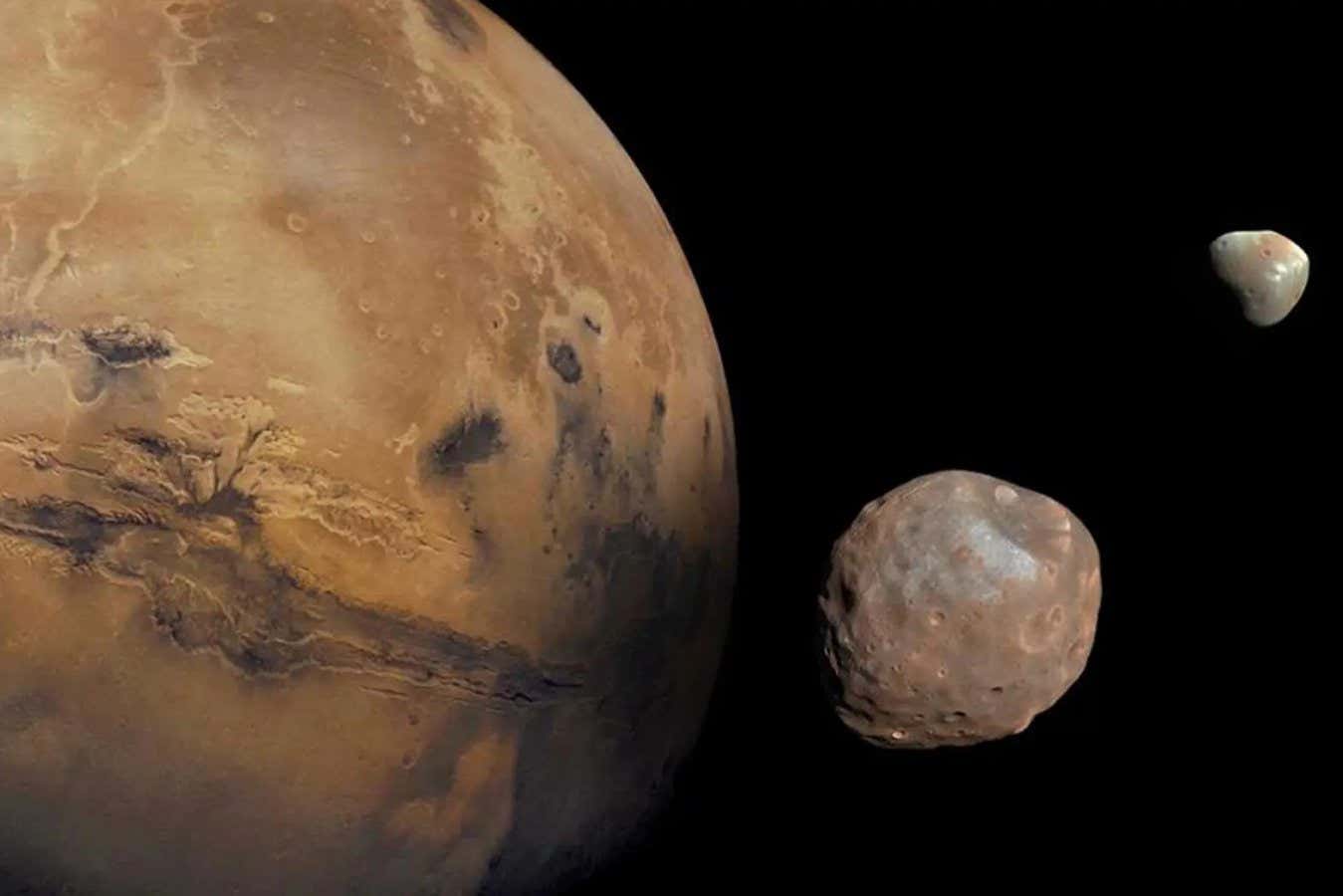
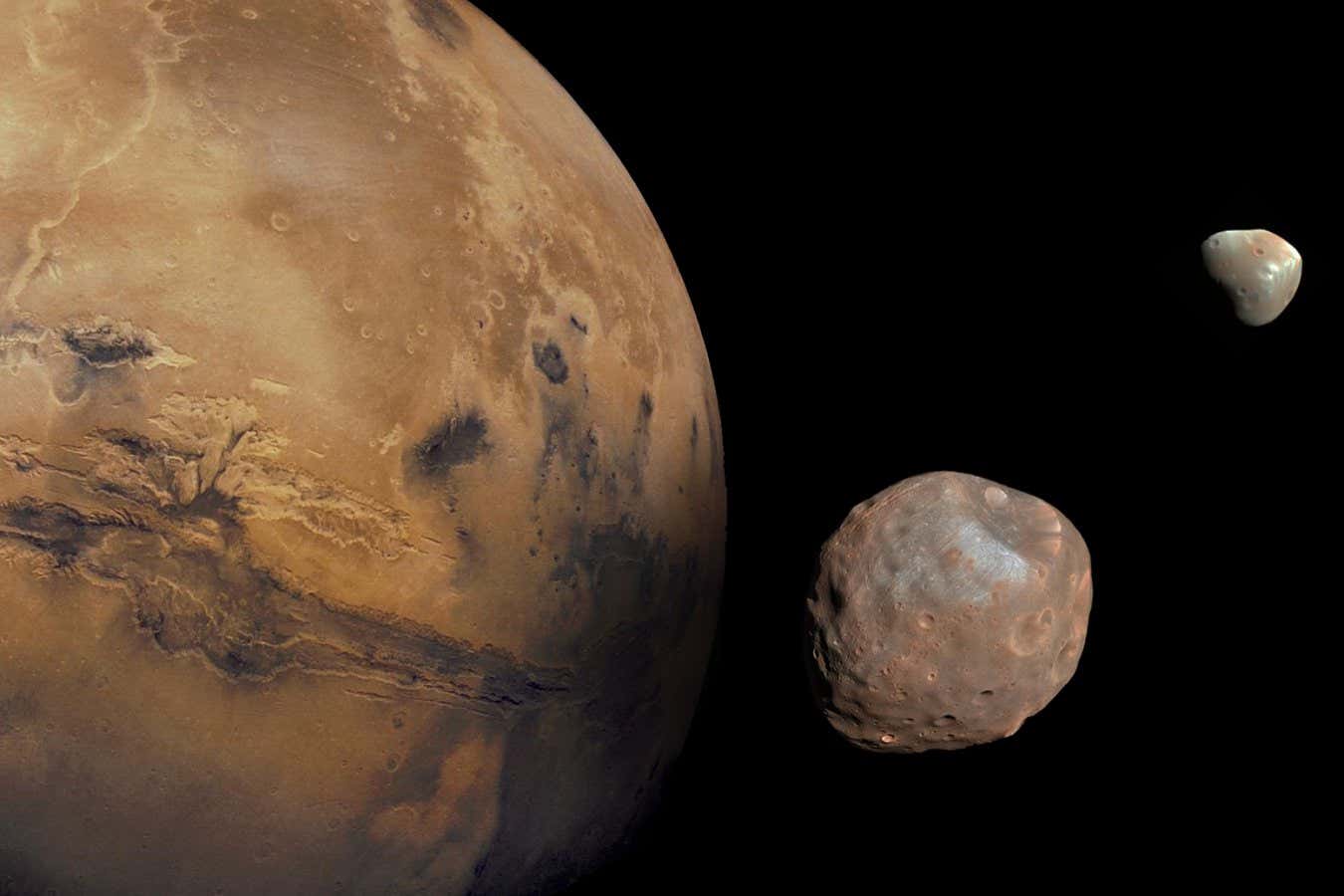
Mars has two irregularly shaped moons, an inner moon named Phobos and an outer moon named Deimos
NASA/JPL-Caltech/GSFC/Univ. of Arizona
The two moons of Mars may once have been a single comet that was ensnared and split by the planet – and an upcoming mission could find out for certain.
How Mars got its two moons, Phobos and Deimos, is a bit of a mystery. They are small, 27 and 15 kilometres across respectively, and both orbit around the planet’s equator. Astronomers have suggested that they may have formed after a collision on Mars’s…
When a single small meteorite struck Mars a few million years ago, it didn’t just create one crater. It ultimately created billions of them. The main crater, called Corinto, is just under 14 kilometres across, but the debris from that meteorite collision formed about two billion additional craters, called secondaries.
When a meteorite slams into the ground, it can blast a huge plume of rocks into the air. When these rocks fall back down, they create their own smaller craters, often in chains and…
The planets are in a gravitational dance around the sun
Shutterstock/Johan Swanepoel
The gravitational tug of Mars may be strong enough to stir up Earth’s ocean, shifting its sediments as part of a 2.4-million-year climate cycle, researchers claim.
It has long been accepted that wobbles in Earth’s orbit around the sun influence the planet’s climate, with these Milankovitch cycles operating on periods measured in thousands of years. Now, Adriana Dutkiewicz at the University of Sydney and her colleagues say they have found a 2.4-million-year “Grand Cycle”, which they believe is driven by Mars and has had dramatic impacts on currents in Earth’s oceans for at least 40 million years.
The evidence for this cycle comes from almost 300 deep-sea drill cores that reveal unexpected variation in the deposition of ocean sediment. During periods of stable ocean currents, oceanographers expect sediment to settle in steady layers, but unusual currents and eddies can see it accumulate elsewhere.
According to the team, absences or hiatuses in the sediment deposition record line up with times when Mars’s gravity exerts maximum force on Earth, subtly impacting our planet’s orbital stability. This changes solar radiation levels and climate, manifesting as stronger currents and eddies in the oceans.
Team member Dietmar Müller, also at the University of Sydney, acknowledges that the distance between Earth and Mars is so vast that it is hard to conceive of any significant gravitational force being exerted. “But there are so many feedbacks that can amplify even subtle changes,” he says. “Mars’s impact on Earth’s climate is akin to a butterfly effect.”
Benjamin Mills at the University of Leeds, UK, says the drill cores provide more evidence for the existence of “megacycles” in global environmental change.
“Many of us have seen these multi-million-year cycles in various different geological, geochemical and biological records – including during the famous explosion of animal life in the Cambrian Period,” he says. “This paper helps cement these ideas as key parts of environmental change.”
But Matthew England at the University of New South Wales in Sydney says that while he welcomes the work and thinks it adds to an understanding of climate cycles at a geological scale, he isn’t convinced by the paper’s conclusions.
“I’m sceptical of the link to Mars, given its gravitational pull on Earth is so weak – at only about one one-millionth of that of the sun,” he says. “Even Jupiter has a stronger gravitational field for Earth.”
England also points out that even if Mars is having an influence, it is nothing compared with human-driven climate change. “Greenhouse gas forcing is like a sledgehammer in comparison, so this has no bearing on present-day climate, where we are seeing melting ice sheets reduce the ocean overturning circulation.”
NASA/JPL-Caltech/Malin Space Science Systems/Texas A&M University
The mystery of where Mars’s two moons came from may finally be solved. If Phobos and Deimos were formed when an icy object smashed into Mars, it could explain their contradictory properties, which have long baffled researchers.
Measurements of the geological makeup of Phobos and Deimos, including tentative signs of water, have suggested that they are more similar to asteroids than to Mars itself, hinting that they may be captured asteroids. However, that explanation would not account for their circular orbits, which instead hint…
A female robot is created to be the perfect girlfriend for her owner in Sierra Greer’s novel Annie Bot
Alamy Stock Photo
From Adrian Tchaikovsky to Hao Jingfang and Natasha Pulley, a host of big science fiction names have new titles out this month. We readers can choose if we want to peer into the ruins of an alien civilisation, follow the possibility of a coming singularity and its fallout or enter the world of a sex robot – to all of which I say, yes please, bring it on. I think I am most excited, though, about Stuart Turton’s new high-concept thriller, in which a murder takes place on an island surrounded by a fog that has destroyed the rest of the planet – crime and sci-fi, one of my favourite blends.
If all these new titles aren’t enough to keep you busy this March, you could dive back into Cixin Liu’s epic The Three-Body Problem, in anticipation of Netflix’s forthcoming adaptation. Or why not come and join us at the New Scientist Book Club, where we have just started reading Martin MacInnes’s novel In Ascension. Moving from a mysterious trench at the bottom of the Atlantic to deep space, it is just out in paperback and is a stunning read.
Is Tchaikovsky propping up the science fiction industry single-handedly? He is so prolific and reliably excellent that I think he might be. Alien Clay is the first of two new novels out over the next few months and is set on Kiln, a far-distant world where the ruins of an alien civilisation have been discovered. Professor Arton Daghdev, who has always wanted to study alien life, is exiled to Kiln for his political activism, and must work in a labour camp there. Can he discover the world’s secrets before it kills him?
I am a big Turton fan: I adore his clever, high-concept murder mysteries, from his debut, The Seven Deaths of Evelyn Hardcastle, to his most recent historical crime novel, The Devil and the Dark Water. His latest outing has a definite science fiction tinge to it. It takes place in a world destroyed by a killing fog that swept the planet. The only thing to survive is the island, where 122 villagers and three scientists live in harmony – until one of the scientists is found stabbed to death, triggering a lowering of the island’s security system that will allow the fog to sweep across and kill everyone within 107 hours if the murder isn’t solved. That is already a lot to take in, but everyone’s memories have also been wiped by the security system. This sounds complex, but I trust Turton to be brilliant, so it is next on my list.
Mars is the setting for Natasha Pulley’s new novel
Pulley is a relatively recent discovery for me, after my mum finally persuaded me to find time to read her historical, fantastical novel The Watchmaker of Filigree Street (it was a joy). This latest is set after an environmental catastrophe. January, a refugee from Earth who is now a second-class citizen on Mars because his body has yet to adjust to the lower gravity, enters a marriage of convenience with xenophobic Mars politician Aubrey Gale – who turns out to be very different from how they appear in the Martian press. I love a good romance – couple that with a sci-fi setting, and this is a must-read for me.
2054: A Novel by Elliot Ackerman and James Stavridis
Stavridis is not just a novelist, but also Admiral James Stavridis, formerly supreme allied commander at NATO. He and Ackerman are the authors of the bestseller 2034. In this follow-up, it is 20 years after the nuclear war between the US and China when the US president collapses and dies during an address to the nation. Conspiracy theories spread, and civil war ensues. Meanwhile, computer scientists and intelligence experts believe they know what lies behind the assassination: a profound breakthrough in AI. This sounds thrilling and provocative, and one to devote a good chunk of time to reading.
The Hugo award-winning Jingfang’s new sci-fi thriller takes place in a future in which a mysterious and highly intelligent alien race makes contact. Three scientists who aren’t convinced the aliens are a threat join forces in an attempt to prevent a potentially disastrous military response.
Our sci-fi columnist Emily Wilson rates this novel very highly. Described as a great fit for fans of Never Let Me Go and My Dark Vanessa, among which I definitely count myself, it is the story of Annie Bot, a female robot created to be the perfect girlfriend for her owner Doug. Trouble is, she starts to wonder what she really wants from life.
By the authors of the podcast drama series Victoriocity, this novel is described as perfect for fans of Terry Pratchett and Douglas Adams – hi, that’s me. It is set in 1887 “Even Greater London”, an “urban plane” covering the entire lower half of England, where the “engineer-army” of Isambard Kingdom Brunel builds and demolishes whatever it thinks needs it. Meanwhile, Archibald Fleet and Clara Entwhistle have set up the country’s first private detective agency and take on a kidnapping case the police, unable to crack a series of impossible bank robberies, are too busy for.
This first-contact novel is the sequel to Johnstone’s The Space Between Us and sees the alien Enceladons now disappeared into the water off the west coast of Scotland. I am going to start with the first in this series I think. I really rate Johnstone as a crime author (his Skelfs series is laced with morbidly dark humour) so I am keen to give his sci-fi a try too.
This satirical slice of cyberpunk sounds like fun. It follows a TV sensation of the novel’s title, as its next season is set to be hosted in the neo-medieval statelet Inner Azhuur, which has been shut off from the world (by choice) for almost a century…until now. A group of misfits who will attempt to run the country must be assembled by the show’s producers, to entertain viewers around the world.
We are promised plant-based skyscrapers, a zombie apocalypse and the effects of time dilation on married life in Adam Marek’s third short story collection, as well as reluctant sex robots, and the bad parenting skills of billionaire space industrialists.
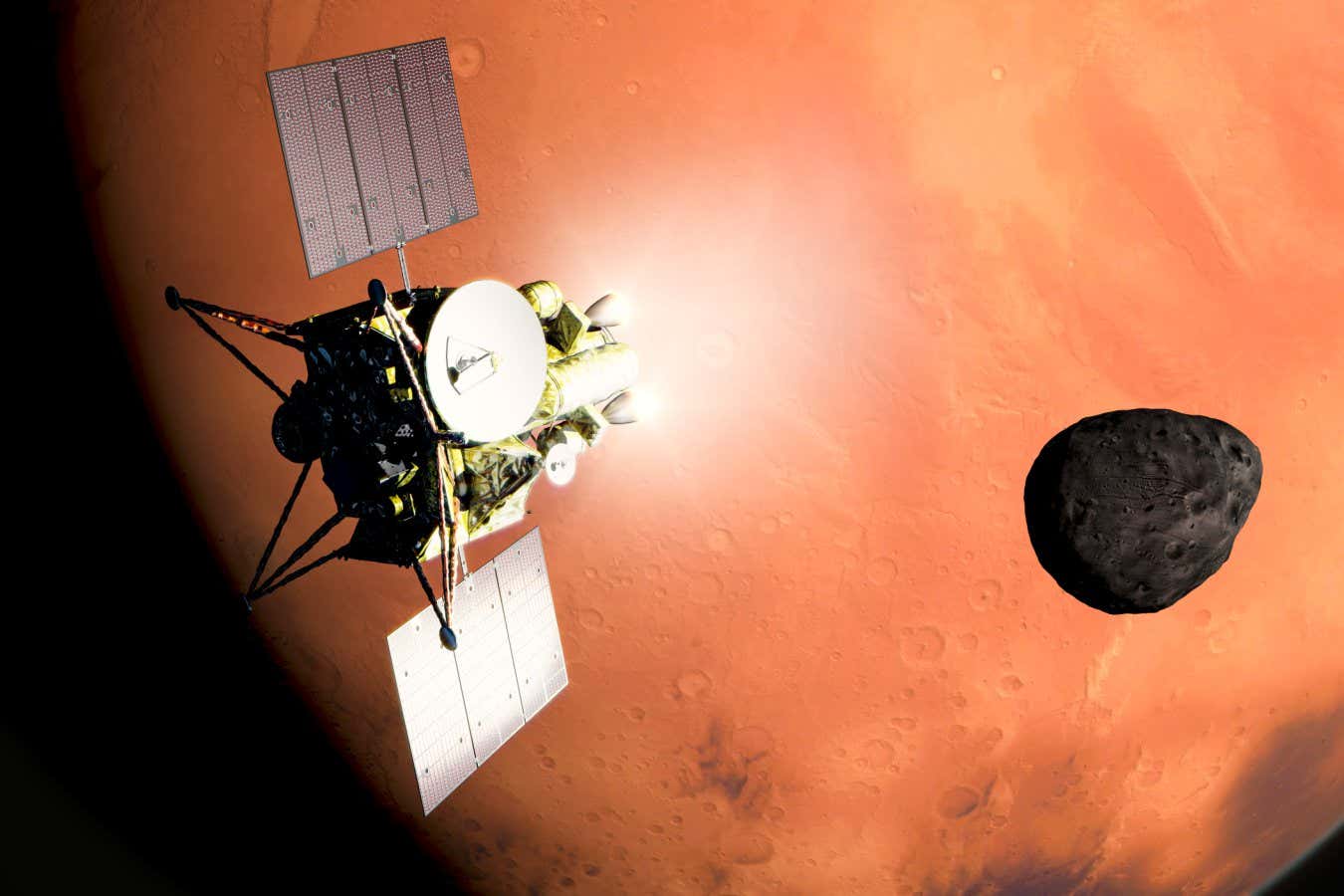
The Martian Moons eXploration mission is slated to launch for Phobos in September 2024 – once it gets there, it will drop off a rover, pick up some samples and head home
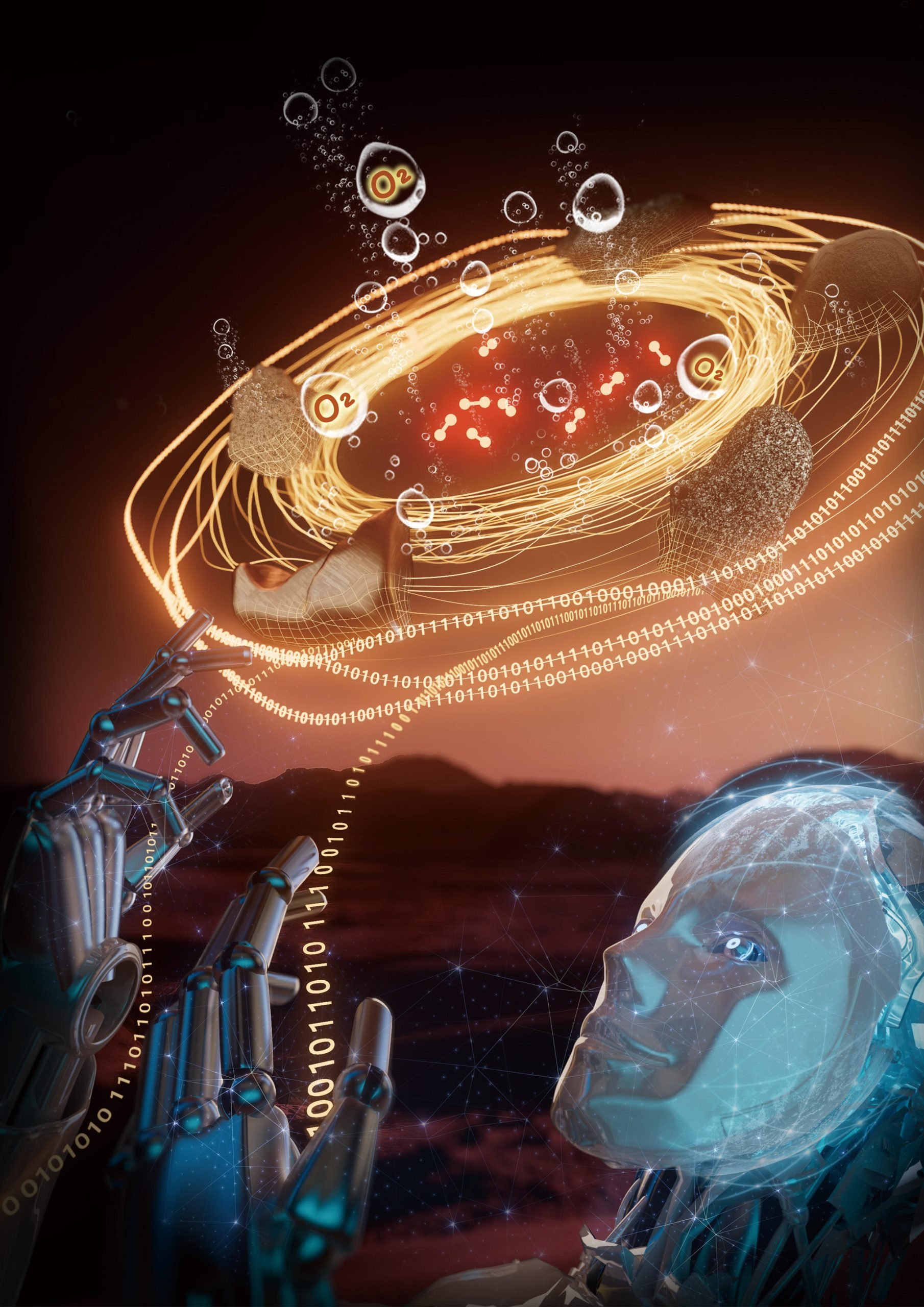
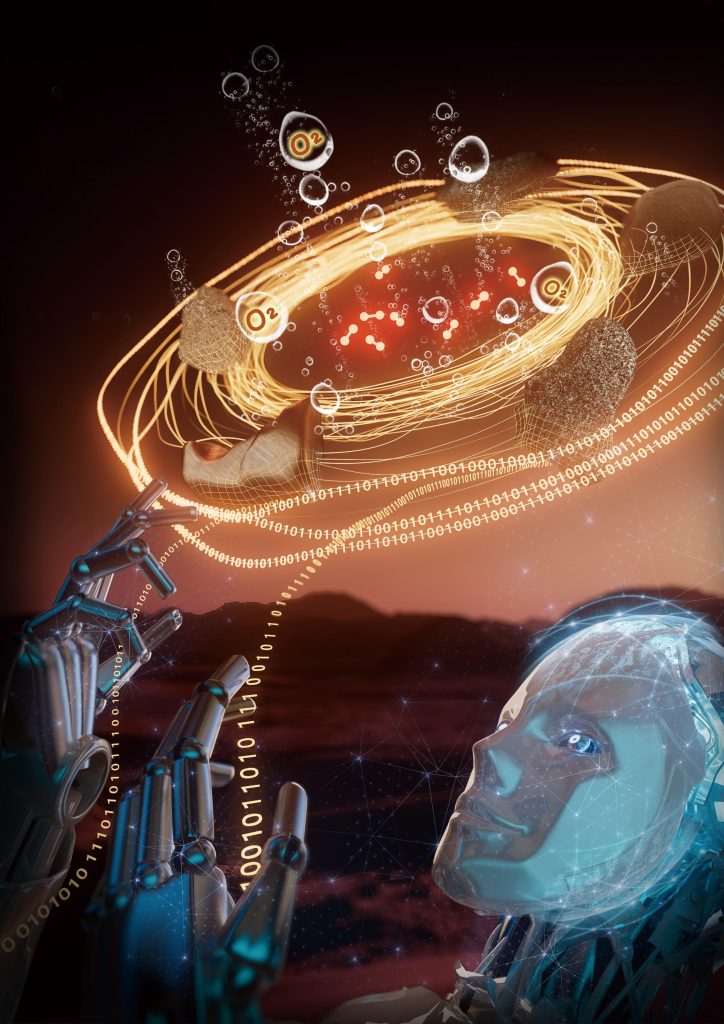
Recent breakthroughs in synthesizing oxygen on Mars using a robotic AI-chemist to create OER catalysts from Martian meteorites mark a significant step towards realizing the dream of Mars colonization. This technology promises to establish an oxygen factory on Mars, bringing human habitation on the planet closer to reality. Credit: AI-Chemist Group at the University of Science and Technology of China
An AI chemist has successfully created a catalyst for producing oxygen from Martian meteorites.
Immigration to and living on Mars have often been themes in science fiction. Before these dreams can become reality, humanity faces significant challenges, such as the scarcity of vital resources like oxygen needed for long-term survival on the Red Planet. Yet, recent discoveries of water activity on Mars have sparked new hope for overcoming these obstacles.
Scientists are now exploring the possibility of decomposing water to produce oxygen through electrochemical water oxidation driven by solar power with the help of oxygen evolution reaction (OER) catalysts. The challenge is to find a way to synthesize these catalysts in situ using materials on Mars, instead of transporting them from the Earth, which is of high cost.
Advancements in AI and Martian Chemistry
To tackle this problem, a team led by Prof. Luo Yi, Prof. Jiang Jun, and Prof. Shang Weiwei from the University of Science and Technology of China (USTC) of the Chinese Academy of Sciences (CAS), recently made it possible to synthesize and optimize OER catalysts automatically from Martian meteorites with their robotic artificial intelligence (AI)-chemist.
Their research, in collaboration with Deep Space Exploration Laboratory, was recently published in the journal Nature Synthesis.
“The AI chemist innovatively synthesizes OER catalyst using Martian material based on interdisciplinary cooperation,” said Prof. Luo Yi, leading scientist of the team.
In each experimental cycle, the AI chemist first analyzes the elemental composition of the Martian ores using the laser-induced breakdown spectroscopy (LIBS) as its eyes. Then, it carries out a series of pretreatments on the ores, including weighing in the solid-dispensing workstation, preparing feedstock solutions in the liquid-dispensing workstation, separation from liquid in the centrifugation workstation, and solidification in the dryer workstation.
A robotic AI-Chemist makes useful Oxygen generation catalysts with Martian meteorites. Credit: AI-Chemist Group at University of Science and Technology of China
The resulting metal hydroxides are treated with Nafion adhesive to prepare the working electrode for OER testing at the electrochemical workstation. The testing data are sent to the computational ‘brain’ of the AI chemist in real-time for machine learning (ML) processing.
The AI chemist’s ‘brain’ employs quantum chemistry and molecular dynamics simulations for 30,000 of high-entropy hydroxides with different elemental ratios and calculates their OER catalytic activities via density functional theory. The simulation data are used to train a neural network model for rapidly predicting the catalysts’ activities with different elemental compositions.
Finally, through Bayesian optimization, the ‘brain’ predicts the combination of available Martian ores needed for synthesizing the optimal OER catalyst.
Achieving a Breakthrough in Oxygen Production
So far, the AI chemist has created an excellent catalyst using five types of Martian meteorites under unmanned conditions. This catalyst can operate steadily for over 550,000 seconds at a current density of 10 mA cm-2 and an overpotential of 445.1 mV. A further test at -37 °C, the temperature on Mars, confirmed that the catalyst can steadily produce oxygen without any apparent degradation.
Within two months, the AI chemist has completed the complex optimization of catalysts that would take 2000 years for a human chemist.
The team is working to turn the AI chemist into a general experiment platform for various chemical syntheses without human intervention. The reviewer of the paper highly remarked: “This type of research is of wide interest and is under rapid development in organic/inorganic material synthesis and discovery.”
“In the future, humans can establish an oxygen factory on Mars with the assistance of an AI chemist,” said Jiang. Only 15 hours of solar irradiation is needed to produce sufficient oxygen concentration required for human survival. “This breakthrough technology brings us one step closer to achieving our dream of living on Mars,” he said.
Reference: “Automated synthesis of oxygen-producing catalysts from Martian meteorites by a robotic AI chemist” by Qing Zhu, Yan Huang, Donglai Zhou, Luyuan Zhao, Lulu Guo, Ruyu Yang, Zixu Sun, Man Luo, Fei Zhang, Hengyu Xiao, Xinsheng Tang, Xuchun Zhang, Tao Song, Xiang Li, Baochen Chong, Junyi Zhou, Yihan Zhang, Baicheng Zhang, Jiaqi Cao, Guozhen Zhang, Song Wang, Guilin Ye, Wanjun Zhang, Haitao Zhao, Shuang Cong, Huirong Li, Li-Li Ling, Zhe Zhang, Weiwei Shang, Jun Jiang and Yi Luo, 13 November 2023, Nature Synthesis. DOI: 10.1038/s44160-023-00424-1