Tag: Molecular Physics

  • Opposites Attract, Likes Repel? Scientists Overturn Fundamental Principle of Physics

    Opposites Attract, Likes Repel? Scientists Overturn Fundamental Principle of Physics

    [ad_1]

    Hexagonal Cluster Formation

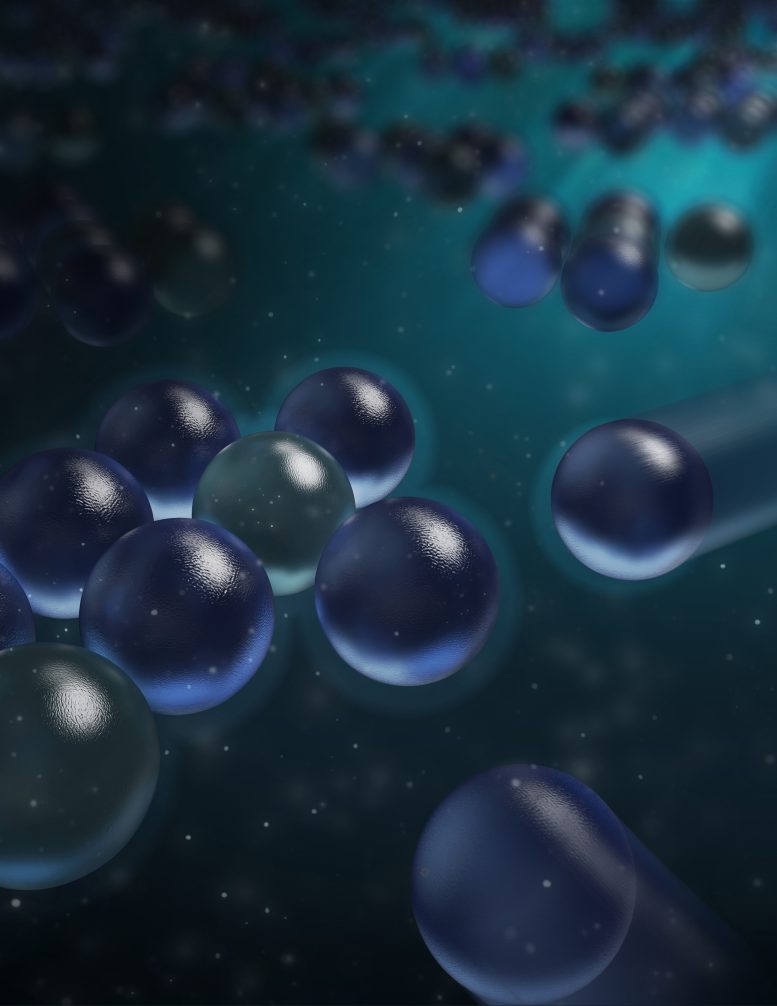
    A new study has overturned a fundamental principle of physics by demonstrating that similarly charged particles can attract each other in a solution, with the effect varying between positive and negative charges depending on the solvent. This discovery has significant implications for various scientific processes, including self-assembly and crystallization. The research reveals the importance of solvent structure at the interface in determining interparticle interactions, challenging long-held beliefs and indicating a need for a re-evaluation of our understanding of electromagnetic forces. Credit: Zhang Kang

    “Opposites charges attract; like charges repel” is a fundamental principle of basic physics. However, a new study from Oxford University, recently published in the journal Nature Nanotechnology, has demonstrated that similarly charged particles in solution can, in fact, attract each other over long distances.

    Just as surprisingly, the team found that the effect is different for positively and negatively charged particles, depending on the solvent.

    Besides overturning long-held beliefs, these results have immediate implications for a range of processes that involve interparticle and intermolecular interactions across various length-scales, including self-assembly, crystallization, and phase separation.

    The team of researchers, based at Oxford’s Department of Chemistry, found that negatively charged particles attract each other at large separations whereas positively charged particles repel, while the reverse was the case for solvents such as alcohols.

    These findings are surprising because they seem to contradict the central electromagnetic principle that the force between charges of the same sign is repulsive at all separations.

    Experimental Observations

    Now, using bright-field microscopy, the team tracked negatively charged silica microparticles suspended in water and found that the particles attracted each other to form hexagonally arranged clusters. Positively charged aminated silica particles, however, did not form clusters in water.

    Using a theory of interparticle interactions that considers the structure of the solvent at the interface, the team established that for negatively charged particles in water, there is an attractive force that outweighs electrostatic repulsion at large separations, leading to cluster formation. For positively charged particles in water, this solvent-driven interaction is always repulsive, and no clusters form.

    This effect was found to be pH dependent: the team was able to control the formation (or not) of clusters for negatively charged particles by varying the pH. No matter the pH, the positively charged particles did not form clusters.

    Solvent-Specific Effects and Further Discoveries

    Naturally, the team wondered whether the effect on charged particles could be switched, such that the positively charged particles form clusters and the negatives do not. By changing the solvent to alcohols, such as ethanol, which has different interface behavior to water, this is exactly what they observed: positively charged aminated silica particles formed hexagonal clusters, whereas negatively charged silica did not.

    According to the researchers, this study implies a fundamental re-calibration in understanding that will influence the way we think about processes as different as the stability of pharmaceutical and fine chemical products or the pathological malfunction associated with molecular aggregation in human disease. The new findings also provide evidence for the ability to probe properties of the interfacial electrical potential due to the solvent, such as its sign and magnitude, which were previously thought immeasurable.

    Professor Madhavi Krishnan (Department of Chemistry, Oxford University), who led the study, says: “I am really very proud of my two graduate students, as well as the undergraduates, who have all worked together to move the needle on this fundamental discovery.”

    Sida Wang (Department of Chemistry, Oxford University), a first-author on the study, says: “I still find it fascinating to see these particles attract, even having seen this a thousand times.”

    Reference: “A charge-dependent long-ranged force drives tailored assembly of matter in solution” by Sida Wang, Rowan Walker-Gibbons, Bethany Watkins, Melissa Flynn and Madhavi Krishnan, 30 February 2024, Nature Nanotechnology.
    DOI: 10.1038/s41565-024-01621-5


    [ad_2]

    Source link

  • The Surprising Phenomenon of Kinetic Asymmetry

    The Surprising Phenomenon of Kinetic Asymmetry

    [ad_1]

    Molecular Asymmetry Art Concept

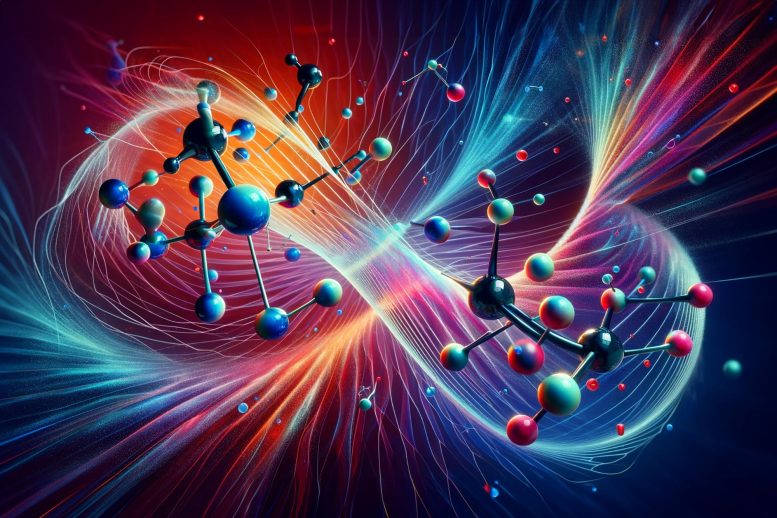
    A team of researchers has uncovered a novel way that molecules can interact non-reciprocally without external forces, through a mechanism involving kinetic asymmetry. This discovery challenges traditional views on molecular interactions and could have profound implications for understanding life’s evolution and designing molecular machines. Credit: SciTechDaily.com

    Scientists have found that molecules can interact in a non-reciprocal manner without external forces, a discovery that could change our understanding of molecular interactions and the evolution of life.

    Researchers from the University of Maine and Penn State discovered that molecules experience non-reciprocal interactions without external forces.

    Fundamental forces such as gravity and electromagnetism are reciprocal, where two objects are attracted to each other or are repelled by each other. In our everyday experience, however, interactions don’t seem to follow this reciprocal law. For example, a predator is attracted to prey, but the prey tends to flee from the predator. Such non-reciprocal interactions are essential for complex behavior associated with living organisms.

    For microscopic systems such as bacteria, the mechanism of non-reciprocal interactions has been explained by hydrodynamic or other external forces, and it was previously thought that similar types of forces could explain interactions between single molecules.

    In work published in the prestigious Cell Press journal Chem, UMaine theoretical physicist R. Dean Astumian and collaborators Ayusman Sen and Niladri Sekhar Mandal at Penn State have published a different mechanism by which single molecules can interact non-reciprocally without hydrodynamic effects.

    This mechanism invokes the local gradients of reactants and products due to the reactions facilitated by every chemical catalyst, a biological example of which is an enzyme. Because the response of a catalyst to the gradient depends on the catalyst’s properties, it is possible to have a situation in which one molecule is repelled by, but attracts, another molecule.

    Kinetic Asymmetry: A Key Factor

    The authors’ “Eureka moment” occurred when, in their discussion, they realized that a property of every catalyst known as the kinetic asymmetry controls the direction of response to a concentration gradient. Because kinetic asymmetry is a property of the enzyme itself, it can undergo evolution and adaptation. The non-reciprocal interactions allowed by kinetic asymmetry also play a crucial role in allowing molecules to interact with each other, and may have played a critical role in the processes by which simple matter becomes complex.

    Molecules Exhibit Non-Reciprocal Interactions Without External Forces

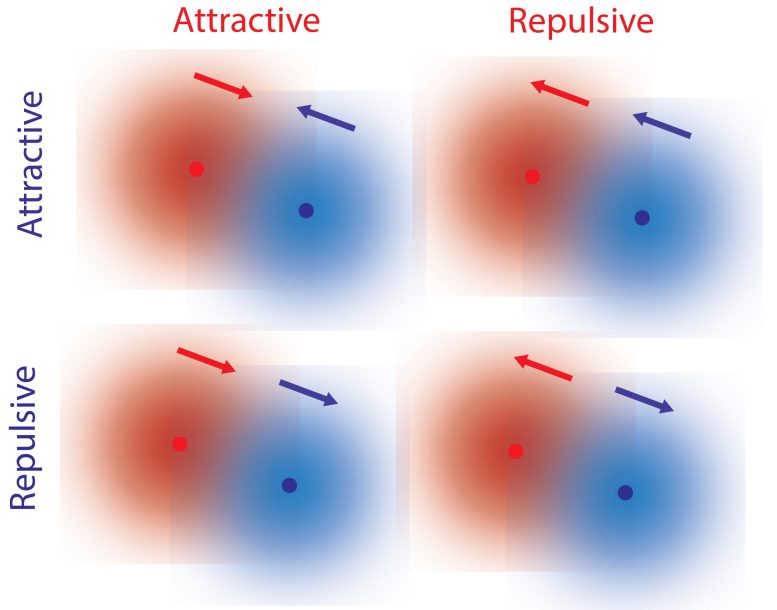
    A graphic illustrating the four possible interactions between two particles, where the arrows indicate the force experienced by the particle of that color due to the gradient surrounding the particle of the other color. The interactions shown in the upper left-hand and lower right-hand corners illustrate reciprocal interactions where the two particles attract each other, or where they repel each other, respectively. The upper right-hand graphic illustrates a situation where the red particle attracts the blue particle, but the blue particle repels the red particle. The lower left-hand graphic illustrates a situation where the red particle repels, but is attracted to, the blue particle. Graphic courtesy of R. Dean Astumian. Credit: R. Dean Astumian

    Much previous work has been done by other researchers on what happens when non-reciprocal interactions occur. These efforts have played a central role in the development of a field known as “active matter.” In this earlier work, the non-reciprocal interactions were introduced by incorporation of ad hoc forces.

    The research described by Mandal, Sen, and Astumian, however, describes a basic molecular mechanism by which such interactions can arise between single molecules. This research builds on earlier work in which the same authors showed how a single catalyst molecule could use energy from the reaction it catalyzed to undergo directional motion in a concentration gradient.

    Impact on Biomolecular Machines and Early Life

    The kinetic asymmetry that features in determining the non-reciprocal interactions between different catalysts has also been shown to be important for the directionality of biomolecular machines, and has been incorporated in the design of synthetic molecular motors and pumps.

    The collaboration between Astumian, Sen, and Mandal aims to reveal the organizational principles behind loose associations of different catalysts that may have formed the earliest metabolic structures that eventually led to the evolution of life.

    “We’re at the very beginning stages of this work, but I see understanding kinetic asymmetry as a possible opportunity for understanding how life evolved from simple molecules,” Astumian says. “Not only can it provide insight into complexification of matter, kinetic asymmetry can also be used in the design of molecular machines and associated technologies.”

    Reference: “A molecular origin of non-reciprocal interactions between interacting active catalysts” by Niladri Sekhar Mandal, Ayusman Sen and R. Dean Astumian, 29 December 2023, Chem.
    DOI: 10.1016/j.chempr.2023.11.017

    Astumian joined UMaine’s Department of Physics and Astronomy in 2001. His research focuses on biophysics, condensed matter physics, and chemically driven molecular machines.

    He was named a fellow of the American Association for the Advancement of Science (AAAS) In 2016. His other honors include the Galvani Prize of the Bio-electrochemical Society, the Humboldt Prize, the Feynman Prize, and the Royal Society of Chemistry Horizon Prize, the Perkin Prize in physical organic chemistry.


    [ad_2]

    Source link