Tag: Neurodegenerative Diseases

  • Scientists identify new therapeutic approach for combating neurodegenerative diseases

    Scientists identify new therapeutic approach for combating neurodegenerative diseases

    [ad_1]

    A team led by scientists at the Case Western Reserve University School of Medicine has identified a new therapeutic approach for combating neurodegenerative diseases, offering hope of improved treatments for Alzheimer’s disease, Parkinson’s disease, Vanishing White Matter disease and multiple sclerosis, among others. 

    Neurodegenerative diseases, which affect millions of people worldwide, occur when nerve cells in the brain or nervous system lose function over time and ultimately die, according to the National Institutes of Health. Alzheimer’s disease and Parkinson’s disease are the most common.

    The research team’s new study, published online February 20 in the journal Nature Neuroscience, focused on astrocytes-;the brain’s most abundant cells, which normally support healthy brain function. Growing evidence indicates astrocytes can switch to a harmful state that increases nerve-cell loss in neurodegenerative diseases.

    The researchers created a new cellular technique to test thousands of possible medications for their ability to prevent these rogue astrocytes from forming. 

    By harnessing the power of high-throughput drug-screening, we’ve identified a key protein regulator that, when inhibited, can prevent the formation of harmful astrocytes.”


    Benjamin Clayton, lead author and National Multiple Sclerosis Society career transition fellow in the laboratory of Paul Tesar at the Case Western Reserve School of Medicine

    They found that blocking the activity of a particular protein, HDAC3, may prevent the development of dangerous astrocytes. The scientists discovered that by administering medications that specifically target HDAC3, they were able to prevent the development of dangerous astrocytes and significantly increase the survival of nerve cells in mouse models.

    “This research establishes a platform for discovering therapies to control diseased astrocytes and highlights the therapeutic potential of regulating astrocyte states to treat neurodegenerative diseases,” said Tesar, the Dr. Donald and Ruth Weber Goodman Professor of Innovative Therapeutics and the study’s principal investigator. 

    Tesar, also director of the School of Medicine’s Institute for Glial Sciences, said more research needs to be done before patients might benefit from the promising approach. But, he said, their findings could lead to the creation of novel therapies that disarm harmful astrocytes and support neuroprotection-;perhaps improving the lives of people with neurodegenerative illnesses in the future.

    “Therapies for neurodegenerative disease typically target the nerve cells directly,” Tesar said, “but here we asked if fixing the damaging effects of astrocytes could provide therapeutic benefit. Our findings redefine the landscape of neurodegenerative disease treatment and open the door to a new era of astrocyte targeting medicines.”

    The team included additional researchers from the Case Western Reserve School of Medicine, and from the George Washington School of Medicine, The Ohio State University and the University of Tampa.

    The research was supported by grants from the National Institutes of Health, National Multiple Sclerosis Society and Hartwell Foundation, and philanthropic support by sTF5 Care and the R. Blane & Claudia Walter, Long, Goodman, Geller and Weidenthal families.

    Source:

    Journal reference:

    Clayton, B. L. L., et al. (2024). A phenotypic screening platform for identifying chemical modulators of astrocyte reactivity. Nature Neuroscience. doi.org/10.1038/s41593-024-01580-z.

    [ad_2]

    Source link
  • Deep learning shines a new light on Parkinson’s detection through the eye

    Deep learning shines a new light on Parkinson’s detection through the eye

    [ad_1]

    A recent Scientific Reports study discusses the potential of retinal fundus imaging as a diagnostic screening modality for Parkinson’s disease (PD).

    Study: Deep learning predicts prevalent and incident Parkinson’s disease from UK Biobank fundus imaging. Image Credit: recep art / Shutterstock.com

    Background

    PD is associated with a gradual decline in motor control and several non-motor symptoms due to the progressive loss of dopaminergic neurons in the substantia nigra of the brain.

    PD-related deaths have more than doubled since 2000, mainly because of the lack of good-quality interventions among the elderly. Thus, further research is needed to better understand the pathology of PD and develop early diagnostic systems.

    The retina, often referred to as a window to the brain, provides a viable avenue for assessing neuropathological processes associated with many neurodegenerative diseases. Despite recent progress, clinical findings on retinal degeneration are not always inconclusive, which warrants further research to enhance retinal diagnostic power.

    To this end, artificial intelligence (AI) algorithms, including deep learning models and conventional machine learning algorithms, have emerged as efficient diagnostic tools.

    About the study

    Developing a deep understanding of retinal biomarkers of PD requires a thorough knowledge of the structural degeneration of the retinal vasculature. Although this is often difficult to achieve clinically, AI could aid in elucidating the complex relationships at the local and global spatial levels of the retina. The present study proposes the use of AI algorithms to address the aforementioned challenge and is one of the first extensive AI studies on diagnosing PD from fundus imaging. 

    The study’s primary aim was to systematically profile the classification performance across various phases of PD progression, including incident and prevalent PD. By neglecting any feature selection methods or external quantitative measures, the researchers maximized the diagnostic ability of AI algorithms. Robustness was established through deep learning and conventional machine learning methods. 

    Study findings

    Deep neural networks outperformed conventional machine learning models and exhibited notable performance in the detection of PD in retinal fundus images. The model successfully predicted the incidence of PD before formal diagnosis with a sensitivity level of 80% from zero to 5.07 years.

    Between 5.07 and 5.57 years, sensitivity rose to 93.33% and then reduced to 81.67% between 5.57 and 7.38 years. These results are promising, as they show the potential for early disease intervention.

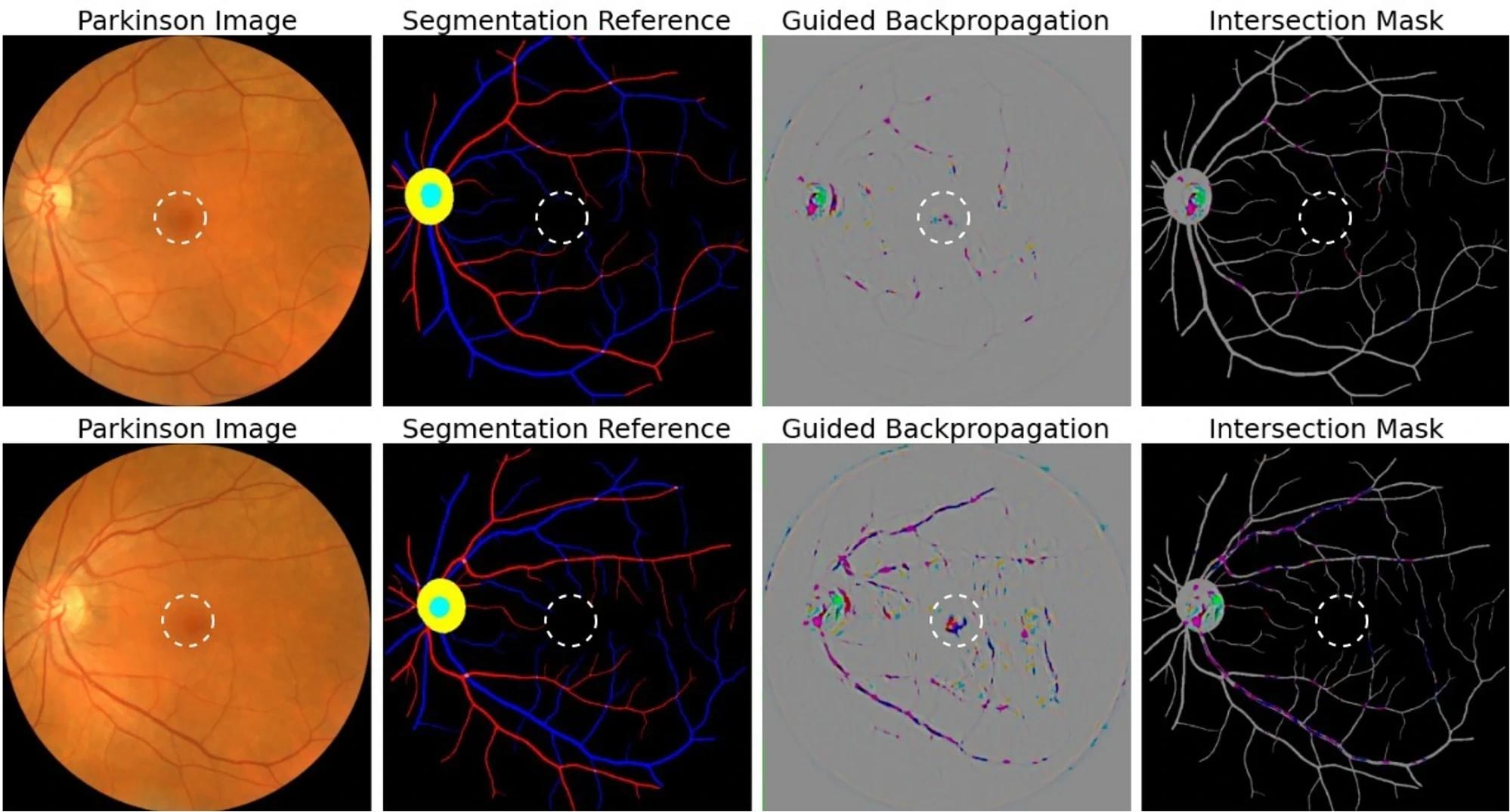
    Attribution correspondence of retinal features. In the first column, an artery-vein (red and blue, respectively) map is combined with the optic cup (teal) and optic disc (yellow) generated from the AutoMorph deep learning segmentation module. A white dashed line is shown as an estimate for the foveal region. In the third column, a predicted attribution map is generated using the guided backpropagation algorithm on top of the AlexNet model. The intersection of the salient features with the segmentation is shown in the last column. The images represent the left (top) and right (bottom) eyes from the same subject, demonstrating distinct feature distributions for prediction.Attribution correspondence of retinal features. In the first column, an artery-vein (red and blue, respectively) map is combined with the optic cup (teal) and optic disc (yellow) generated from the AutoMorph deep learning segmentation module. A white dashed line is shown as an estimate for the foveal region. In the third column, a predicted attribution map is generated using the guided backpropagation algorithm on top of the AlexNet model. The intersection of the salient features with the segmentation is shown in the last column. The images represent the left (top) and right (bottom) eyes from the same subject, demonstrating distinct feature distributions for prediction.

    Automated deep neural networks can complement ophthalmologists to identify disease biomarkers and perform the high-throughput evaluation. To date, AI-based PD assessment using the retina is rare. Importantly, prior research did not compare deep learning and conventional machine learning methods.

    In contrast, the current study evaluated a wide range of deep learning and conventional machine learning methods to consider the entire fundus image as a diagnostic medium. Moreover, prevalent and incident PD patients were successfully differentiated from appropriately matched healthy controls with an accuracy of 68%.

    Conclusions

    In the current study, conventional machine learning models were outperformed by deep learning models to precisely predict PD from retinal fundus images. This method was robust to image perturbations, which is promising for early treatment.

    This work is expected to provide the foundation for future research and act as an algorithm selection reference for both its interpretability and performance.

    A fundamental limitation of this study is the dataset size, which could be improved to capture a broader range of presentations of PD. Second, the study is based on the United Kingdom population, thereby limiting the generalizability of the findings.

    An additional limitation of the current study is that the researchers did not report how this approach could be applied to different severity levels of PD. Although the current study was focused on PD, it remains unclear whether other neurogenerative diseases like Alzheimer’s disease, as well as certain eye diseases, share similar degeneration patterns or biomarkers.

    Future research should also investigate whether the model predictions can inform ophthalmologists’ grading. However, this could be complicated as the visual biomarkers of common eye diseases are better understood than those of PD.

    Taken together, these limitations necessitate additional research using diverse samples to establish the trustworthiness of AI models in clinical settings.

    Journal reference:

    • Tran, C., Shen, K., Liu, K., et al. (2024). Deep learning predicts prevalent and incident Parkinson’s disease from UK Biobank fundus imaging. Scientific Reports 14(1);1-12. doi:10.1038/s41598-024-54251-1

    [ad_2]

    Source link

  • Researchers introduce a pioneering approach to combat neurodegenerative diseases

    Researchers introduce a pioneering approach to combat neurodegenerative diseases

    [ad_1]

    Researchers led by Northwestern University and the University of Wisconsin-Madison have introduced a pioneering approach aimed at combating neurodegenerative diseases such as Alzheimer’s disease, Parkinson’s disease and Amyotrophic lateral sclerosis (ALS).

    In a new study, researchers discovered a new way to enhance the body’s antioxidant response, which is crucial for cellular protection against the oxidative stress implicated in many neurodegenerative diseases.

    The study published today (Feb. 16) in the journal Advanced Materials. 

    Nathan Gianneschi, the Jacob & Rosaline Cohn Professor of Chemistry at Northwestern’s Weinberg College of Arts and Sciences and member of the International Institute for Nanotechnology, led the work with Jeffrey A. Johnson and Delinda A. Johnson of the University of Wisconsin-Madison School of Pharmacy.

    Targeting neurodegenerative diseases

    Alzheimer’s disease, characterized by the accumulation of beta-amyloid plaques and tau protein tangles; Parkinson’s disease, known for its loss of dopaminergic neurons and presence of Lewy bodies; and ALS, involving the degeneration of motor neurons, all share a common thread of oxidative stress contributing to disease pathology. 

    The study focuses on disrupting the Keap1/Nrf2 protein-protein interaction (PPI), which plays a role in the body’s antioxidant response. By preventing the degradation of Nrf2 through selective inhibition of its interaction with Keap1, the research holds promise for mitigating the cellular damage that underlies these debilitating conditions. 

    “We established Nrf2 as a principal target for the treatment of neurodegenerative diseases over the past two decades, but this novel approach for activating the pathway holds great promise to develop disease-modifying therapies,” Jeffrey Johnson said.

    Limitations of current therapeutics

    The research team embarked on addressing one of the most challenging aspects of neurodegenerative disease treatment: the precise targeting of PPIs within the cell. Traditional methods, including small molecule inhibitors and peptide-based therapies, have fallen short due to lack of specificity, stability and cellular uptake.

    The study introduces an innovative solution: protein-like polymers, or PLPs, are high-density brush macromolecular architectures synthesized via the ring-opening metathesis polymerization (ROMP) of norbornenyl-peptide-based monomers. These globular, proteomimetic structures display bioactive peptide side chains that can penetrate cell membranes, exhibit remarkable stability and resist proteolysis.

    This targeted approach to inhibit the Keap1/Nrf2 PPI represents a significant leap forward. By preventing Keap1 from marking Nrf2 for degradation, Nrf2 accumulates in the nucleus, activating the Antioxidant Response Element (ARE) and driving the expression of detoxifying and antioxidant genes. This mechanism effectively enhances the cellular antioxidant response, providing a potent therapeutic strategy against the oxidative stress implicated in many neurodegenerative diseases.

    The innovation behind protein-like polymers

    PLPs, developed by Gianneschi’s team, could represent a significant breakthrough in halting or reversing damage offering hope for improved treatments and outcomes.

    Focusing on the challenge of activating processes crucial for the body’s antioxidant response, the team’s research offers a novel solution. The team provides a robust, selective method enabling enhanced cellular protection and offering a promising therapeutic strategy for a range of diseases including neurodegenerative conditions. 

    Through modern polymer chemistry, we can begin to think about mimicking complex proteins. The promise lies in the development of a new modality for the design of therapeutics. This could be a way to address diseases like Alzheimer’s and Parkinson’s among others where traditional approaches have struggled.”


    Nathan Gianneschi, the Jacob & Rosaline Cohn Professor of Chemistry at Northwestern’s Weinberg College of Arts and Sciences 

    This approach not only represents a significant advance in targeting transcription factors and disordered proteins, but also showcases the PLP technology’s versatility and potential to revolutionize the development of therapeutics. The technology’s modularity and efficacy in inhibiting the Keap1/Nrf2 interaction underscore its potential for impact as a therapeutic, but also as a tool for studying the biochemistry of these processes. 

    A collaboration of minds 

    Highlighting the study’s collaborative nature, Gianneschi’s team worked closely with experts across disciplines, illustrating the rich potential of combining materials science with cellular biology to tackle complex medical challenges. 

    “We were contacted by Professor Gianneschi and colleagues proposing to use this novel PLP technology in neurodegenerative diseases due to our previous work on Nrf2 in models of Alzheimer’s disease, Parkinson’s disease, ALS and Huntington’s disease,” Jeffrey Johnson said. “We had never heard of this approach for Nrf2 activation and immediately agreed to initiate this collaborative effort that led to the generation of great data and this publication.” 

    This partnership underscores the importance of interdisciplinary research in developing new therapeutic modalities.

    Impact

    With the development of this innovative technology, Gianneschi, his colleagues at the International Institute for Nanotechnology and the Johnson Lab at the University of Wisconsin-Madison, are not just advancing the field of medicinal chemistry, they are opening new pathways to combat some of the most challenging and devastating neurodegenerative diseases faced by society today. As this research progresses towards clinical application, it may soon offer new hope to those suffering from diseases of oxidative stress such as Alzheimer’s and Parkinson’s diseases. 

    “By controlling materials at the scale of single nanometers, we’re opening new possibilities in the fight against diseases that are more prevalent than ever, yet remain untreatable,” Gianneschi said. “This study is just the beginning. We’re excited about the possibilities as we continue to explore and expand the development of macromolecular drugs, capable of mimicking some of the aspects of proteins using our PLP platform.”

    Source:

    Journal reference:

    Carrow, K. P., et al. (2024). Inhibiting the Keap1/Nrf2 Protein‐Protein Interaction with Protein‐Like Polymers. Advanced Materials. doi.org/10.1002/adma.202311467.

    [ad_2]

    Source link

  • Study links Agent Orange exposure to neurodegenerative diseases

    Study links Agent Orange exposure to neurodegenerative diseases

    [ad_1]

    Agent Orange, an herbicide used during the Vietnam War, is a known toxin with wide-ranging health effects. Even though Agent Orange has not been used for decades, there is increasing interest in its effects on the brain health of aging veterans. A new study by scientists at Brown University reveals the mechanisms by which Agent Orange affects the brain and how those processes can lead to neurodegenerative diseases.

    The research shows that exposures to Agent Orange herbicidal chemicals damage frontal lobe brain tissue of laboratory rats with molecular and biochemical abnormalities that are similar to those found in early-stage Alzheimer’s disease. An early online version of this paper detailing the findings was published on Feb. 13 and is scheduled for publication in the Journal of Alzheimer’s Disease.

    The findings could have important implications for military veterans who were exposed to Agent Orange during the Vietnam War, said study author Dr. Suzanne M. De La Monte, a Brown University physician-scientist.

    If we can show that prior exposure to Agent Orange leads to subsequent neurodegenerative disease, then that gives veterans a chance to get help.”


    Dr. Suzanne M. De La Monte, Brown University physician-scientist

    But the study’s findings have much broader significance, she added, because the toxins in Agent Orange are also present in lawn fertilizers.

    “These chemicals don’t just affect veterans; they affect our entire population,” said De La Monte, who is a professor of pathology and laboratory medicine and neurosurgery at Brown’s Warren Alpert Medical School.

    Agent Orange is a synthetic defoliating herbicide that was widely used between 1965 and 1970 during the Vietnam War. Members of the U.S. military were exposed to the chemical when stationed close to enemy territory that had been sprayed by aircraft. Government reports show that exposure to Agent Orange also caused birth defects and developmental disabilities in babies born to Vietnamese women residing in the affected areas. Over time, studies showed that exposure to Agent Orange was associated with an increased risk of some cancers as well as cardiovascular disease and diabetes.

    Research also revealed associations between Agent Orange exposures and later development of nervous system degenerative diseases, and significantly higher rates and earlier onsets of dementia. However, in the absence of a proven causal link between Agent Orange and aging-associated diseases, there has been a need for studies that improve understanding of the process by which the herbicide affects the brain.

    “Scientists realized that Agent Orange was a neurotoxin with potential long-term effects, but those weren’t shown in a clear way,” De La Monte said. “That’s what we were able to show with this study.”

    The analysis was conducted by De La Monte and Dr. Ming Tong, a research associate in medicine at Brown; both are also associated with Rhode Island Hospital, an affiliate of the Warren Alpert Medical School. Their research builds upon their recent studies of exposure to Agent Orange chemicals on immature human cells from the central nervous system showing that short-term exposure to Agent Orange has neurotoxic and early degenerative effects related to Alzheimer’s.

    The researchers investigated the effects of the two main constituents of Agent Orange (2,4-dichlorophenoxyacetic acid and 2,4,5-trichlorophenoxyacetic acid) on markers of Alzheimer’s neurodegeneration using the samples from the frontal lobes of laboratory rats. The mature, intact brain tissue samples included a full complex array of cell types and tissue structures.

    The scientists treated the samples to cumulative exposure to Agent Orange, as well as to its separate chemical constituents, and observed the underlying mechanisms and molecular changes.

    They found that treatment with Agent Orange and its constituents caused changes in the brain tissue corresponding to brain cell degeneration, and molecular and biochemical abnormalities indicative of cytotoxic injury, DNA damage and other issues.

    The approach used by the researchers helped them better characterize the neuropathological, neurotoxic and neurodegenerative consequences of Agent Orange toxin exposures in young, otherwise healthy brains, as would have been the case for Vietnam War-era military personnel and many local residents in Vietnam.

    “Looking for the early effects tells us that there is a problem that is going to cause trouble later on and also gives us a grip on the mechanism by which the agent is causing trouble,” De La Monte said. “So if you were going to intervene, you would know to focus on that early effect, monitor it and try to reverse it.”

    Del La Monte hopes to be involved in additional research on human brain tissue to evaluate the long-term effects of Agent Orange exposures in relation to aging and progressive neurodegeneration in Vietnam War veterans.

    The use of Agent Orange was prohibited by the U.S. government in 1971. However, the chemicals remain in the environment for decades, De La Monte said. According to the study authors, the widespread, uncontrolled use of Agent Orange in herbicide and pesticide products is such that one in three Americans has biomarker evidence of prior exposure.

    Despite growing recognition of the broad toxic and carcinogenic effects of 2,4-dichlorophenoxyacetic acid, the researchers noted that concern has not achieved a level sufficient for federal agencies to ban its use. The researchers conclude that the results of this study and another recent publication support the notion that Agent Orange as well as its independent constituents (2,4-dichlorophenoxyacetic acid and 2,4,5-trichlorophenoxyacetic acid) exert alarming adverse effects on the mature brain and central nervous system.

    “That’s why it’s so important to look into the effects of these chemicals,” De La Monte said. “They are in the water; they are everywhere. We’ve all been exposed.”

    This research was supported by the National Institute on Alcohol Abuse and Alcoholism at the National Institutes of Health (R01AA011431, R01AA028408).

    Source:

    Journal reference:

    de la Monte, S. M., & Tong, M. (2024). Agent Orange Herbicidal Toxin-Initiation of Alzheimer-Type Neurodegeneration. Journal of Alzheimer’s Disease. doi.org/10.3233/JAD-230881.

    [ad_2]

    Source link

  • Study discovers a direct connection between the brain and its surrounding environment

    Study discovers a direct connection between the brain and its surrounding environment

    [ad_1]

    In a recent study of the brain’s waste drainage system, researchers from Washington University in St. Louis, collaborating with investigators at the National Institute of Neurological Disorders and Stroke (NINDS), a part of the National Institute of Health (NIH), discovered a direct connection between the brain and its tough protective covering, the dura mater. These links may allow waste fluid to leave the brain while also exposing the brain to immune cells and other signals coming from the dura. This challenges the conventional wisdom which has suggested that the brain is cut off from its surroundings by a series of protective barriers, keeping it safe from dangerous chemicals and toxins lurking in the environment.

    Waste fluid moves from the brain into the body much like how sewage leaves our homes. In this study, we asked the question of what happens once the ‘drain pipes’ leave the ‘house’-;in this case, the brain-;and connect up with the city sewer system within the body.”


    NINDS’s Daniel S. Reich, M.D., Ph.D

    Reich’s group worked jointly with the lab of Jonathan Kipnis, Ph.D., a professor at Washington University in St. Louis.

    Reich’s lab used high-resolution magnetic resonance imaging (MRI) to observe the connection between the brain and body’s lymphatic systems in humans. Meanwhile Kipnis’s group was independently using live-cell and other microscopic brain imaging techniques to study these systems in mice.

    Using MRI, the researchers scanned the brains of a group of healthy volunteers who had received injections of gadobutrol, a magnetic dye used to visualize disruptions in the blood brain barrier or other kinds of blood vessel damage. Large veins are known to pass through the arachnoid barrier carrying blood away from the brain, and these were clearly observed on the MRI scans. As the scan progressed, a ring of dye appeared around those large veins that slowly spread out over time, suggesting that fluid could make its way through the space around those large veins where they pass through the arachnoid barrier on their way into the dura.

    Kipnis’s lab was making similar observations in mice. His group injected mice with light-emitting molecules. Like with the MRI experiments, fluid containing these light-emitting molecules was seen to slip through the arachnoid barrier where blood vessels passed through.

    Together, the labs found a “cuff” of cells that surround blood vessels as they pass through the arachnoid space. These areas, which they called arachnoid cuff exit (ACE) points, appear to act as areas where fluid, molecules, and even some cells can pass from the brain into the dura and vice versa, without allowing complete mixing of the two fluids. In some disorders like Alzheimer’s disease, impaired waste clearance can cause disease-causing proteins to build up. Continuing the sewer analogy, Kipnis explained the possible connection to ACE points:

    “If your sink is clogged, you can remove water from the sink or fix the faucet, but ultimately you need to fix the drain,” he said. “In the brain, clogs at ACE points may prevent waste from leaving. If we can find a way to clean these clogs, its possible we can protect the brain.”

    One implication of ACE points is that they are areas where the immune system can be exposed to and react to changes occurring in the brain. When mice in Dr. Kipnis’s lab were induced to have a disorder where the immune system attacks the myelin in their brain and spinal cord, immune cells could be seen around ACE points and even between the blood vessel wall and the cuff cells; this led over time to a breakdown of the ACE point itself. When the ability of immune cells to interact directly with ACE points was blocked, the severity of infection was reduced.

    “The immune system uses molecules to communicate that cross from the brain into the dura mater,” said Kipnis. “This crossing needs to be tightly regulated, otherwise detrimental effects on brain function can occur.”

    Reich and his team also observed an interesting connection between the participants’ age and the leakiness of ACE points. In older participants, more dye leaked into the surrounding fluid and space around the blood vessels.

    “This might point to a slow breakdown of the ACE points over the course of aging,” said Reich, “and this could be consequential in that the brain and immune system can now interact in ways that they’re not supposed to.”

    The connection to aging and the disruption of a barrier separating the brain and immune system fits with what has been observed in aging mice and in autoimmune disorders like multiple sclerosis. This newfound link between the brain and immune system could also help explain why our risk for developing neurodegenerative diseases increases as we get older, but more research is needed to confirm this connection.

    This study was supported by the NINDS Intramural Research Program, the National Institute on Aging (AG034113, AG057496, AG078106), and the Cure Alzheimer’s Fund BEE Consortium.

    Source:

    Journal reference:

    Smyth, L. C. D., et al. (2024). Identification of direct connections between the dura and the brain. Nature. doi.org/10.1038/s41586-023-06993-7.

    [ad_2]

    Source link

  • Interdisciplinary dream team receives $3 million grant to revolutionize Alzheimer’s diagnosis

    Interdisciplinary dream team receives $3 million grant to revolutionize Alzheimer’s diagnosis

    [ad_1]

    What do a synthetic chemist, a medical imaging expert, and a neurologist have in common? They’re coming together in the Biomedical Imaging Center at the Beckman Institute for Advanced Science and Technology to develop better diagnostic tools and imaging agents to detect early-stage Alzheimer’s disease and other neurodegenerative diseases.

    The dream team

    A team led by Liviu M. Mirica along with Wawryzneic “Wawosz” Dobrucki and Dr. Daniel A. Llano received a $3 million grant from the U.S. National Institute on Aging of the National Institutes of Health to develop and test multi-modal imaging agents for the detection of Alzheimer’s disease and related dementias. This grant is one of the first federal grants to bridge Beckman’s Magnetic Resonance Imaging Laboratory and Molecular Imaging Laboratory. They are both part of Beckman’s Biomedical Imaging Center.

    I’m really excited about the opportunity to collaborate with different scientists from different fields.” 


    Liviu M. Mirica, synthetic chemist and the William H. and Janet G. Lycan Professor of Chemistry, School of Chemical Sciences, University of Illinois Urbana-Champaign

    His research group specializes in building and characterizing synthetic inorganic molecules in vitro: outside of the body.

    Dobrucki, the Neil and Carol Ruzic Scholar for Biomedical and Translational Sciences, is an imaging expert who works extensively with PET scanning in Beckman’s Molecular Imaging Laboratory.

    “I’m looking forward to high-resolution imaging of the brain and its structures,” Dobrucki said.

    Llano, a professor of molecular and integrated physiology and a physician-surgeon, is a practicing neurologist who sees patients daily and specializes in in vivo brain studies: those inside the body.

    “The potential impact that this project will have on Alzheimer’s is what I’m most excited about,” Llano said.

    Understanding Alzheimer’s disease

    Alzheimer’s disease is a neurodegenerative disease that negatively affects brain function and cognitive abilities. Along with Parkinson’s disease, amyotrophic lateral sclerosis, and other disorders, Alzheimer’s falls under the category of amyloid diseases. Amyloids are small groups of abnormally fibrous or misfolded proteins that do not commonly serve a purpose in the body.

    A key marker of Alzheimer’s disease is the presence of amyloid plaques: large buildups of smaller beta-amyloid peptide aggregates. Peptides are short chains of amino acids that eventually create proteins. Neuroinflammation and oxidative stress in the brain are also major markers of Alzheimer’s.

    The detection and treatment of neurodegenerative diseases is especially difficult because of the blood-brain barrier, a semipermeable system of blood vessels and capillaries that controls the flow of ions, molecules, and cells between the blood and the brain. To be effective, imaging agents and drug therapies (which are made of molecules or antibodies) need to be able to pass through.

    Diagnosis and treatment

    Diagnosing Alzheimer’s disease with a high degree of accuracy requires identifying the amyloid aggregates and can only be completed during post-mortem investigation. This creates a need for diagnostic tools that can quickly locate soluble beta-amyloid peptide aggregates and larger amyloid plaques in a living patient.

    PET and MRI are two noninvasive imaging methods commonly used in clinical settings. However, no MRI contrast agents that target amyloid aggregates have been developed. The few FDA-approved PET imaging agents are insufficient at detecting small-scale amyloid abnormalities or in some cases, lead to false-positives test results when diagnosing Alzheimer’s.

    It’s important to develop diagnostic tools to target smaller beta-amyloid peptides and other signs of neuroinflammation and oxidative stress for a variety of reasons, Mirica said. Creating multi-modal tools that can be used for both PET and MRI scans will give researchers a better idea of who is at risk for developing Alzheimer’s, who truly has the disease, and at what stage.

    The $3M plan

    Mirica, Dobrucki, and Llano will receive the $3 million grant over the course of five years to generate novel dual-purpose imaging agents that can easily pass the blood-brain barrier and are compatible with both PET and MRI scanners.

    This will enable the detection of neurodegenerative diseases at earlier stages and “will help tremendously in developing better therapies,” Mirica said.

    Brad Sutton, a professor of bioengineering and the technical director of Beckman’s Biomedical Imaging Center, will assist the team by performing in vivo MRI studies. They will then evaluate the imaging agent’s ability as a dual modality diagnostic agent for Alzheimer’s disease and related dementias.

    Already, Mirica and his collaborators have developed a series of customized molecules that can cross the blood-brain barrier and help detect both smaller soluble beta-amyloid peptides and larger insoluble amyloids.

    They have also developed a copper-based PET imaging agent that led to the successful imaging of amyloid plaques in transgenic Alzheimer’s mice. Looking ahead, the team believes that these agents can be developed to pass through the blood-brain barrier in humans and image multiple markers of Alzheimer’s disease and other neurodegenerative diseases at earlier stages.

    [ad_2]

    Source link