Explore books dealing with multiverses and alternate worlds
Gremlin/Getty Images
Since I became science fiction columnist for New Scientist, I have had to think a lot about what qualifies as sci-fi. Very often, a book could actually be classified as fantasy, which is outside my remit. More and more, I find myself agreeing with the writer Damon Knight when he said: “Science fiction is what I point to [when I say] ‘That’s science fiction’.”
Anyway, for this holiday reading special, I present my list of some of the year’s best sci-fi so far. All that binds these incredibly diverse books…
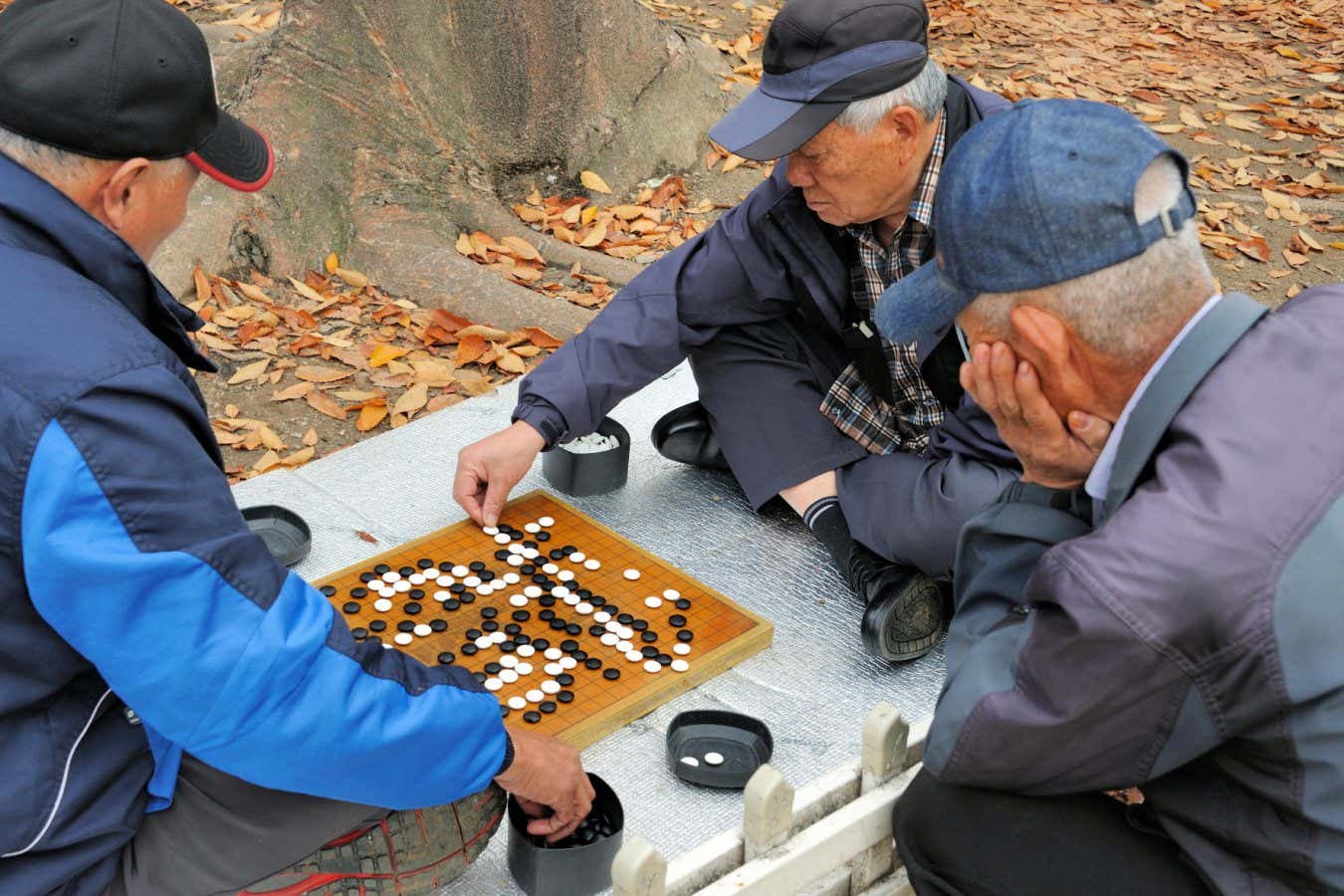
Gaming is a prehistoric innovation that first came into vogue when domesticated animals and agriculture were still considered emerging technologies. Many of the most compelling and enduring games invite people to engage with simplified models of reality where they can practise reasoning and decision-making skills. Games have even inspired military strategists and economists to harness games-style thinking and simulations when trying to understand how the world works or predict the future.
Adrian Tchaikovsky’s new novel Service Model is out in June
Joby Sessions/SFX Magazine/Future via Getty Images
There is a wealth of great new science fiction out this June, with all tastes catered for. Want a wild ride to stop a volcano erupting and ending the world? The late Michael Crichton (and his collaborator James Patterson) have it nailed. Want a robot finding his way in the world? Head for Adrian Tchaikovsky and his robot servant Charles. Climate dystopia, poetically rendered? Turn to Roz Dineen.
I am also delighted to see a smattering of space-opera romances, from authors including Emily Hamilton and Rebecca Fraimow – hurrah for some light-heartedness in our sci-fi. That light-heartedness is exactly what we are currently enjoying at the New Scientist Book Club – sign up, and join us in reading Martha Wells’s wonderful All Systems Red, the first in her Murderbot series.
But back to June, where I have also cunningly managed to shoehorn in a mention of one of my top dystopian reads of all time, the criminally overlooked A Boy and his Dog at the End of the World by C.A. Fletcher.
Crichton, who gave us novels including Jurassic Park (great fun) and State of Fear (less so), died in 2008. Eruption has thus been finished by the prolific James Patterson, taking a break from his usual collaborations with the likes of former US presidents and Dolly Parton.
The premise: the Big Island of Hawaii is about to be hit by a mega volcanic eruption. Unfortunately for the world, the US military chose to hide some very dangerous substances right by the volcano, and if their containers are broken, we are all going to die.
I have found the book silly but fast-moving and fun so far. Emily H. Wilson, our esteemed sci-fi columnist, was less enamoured (“The only mystery is: will these cardboard-thin characters be successful in their logistical efforts?” she wrote, in her May sci-fi column). Perhaps I am just a sucker for rugged volcanologists battling with lava flows, but I am enjoying this absurd quest to save the world for now.
The late Michael Crichton in 2005
dpa picture alliance archive/Alamy
This is the second book of the year from the prolific Tchaikovsky, after Alien Clay. This time we are following the story of robot servant Charles, who is loyal to a fault until a malfunction causes him to murder his owner, and he sets out into the wider world. Tchaikovsky is an author our sci-fi columnist Emily H. Wilson describes as “a huge talent, writing at the peak of his powers”; she loved this latest.
Four twenty-somethings are investigating an old spaceship when the “stupid dark matter engine” starts on its own, and they find themselves on a one-way trip to Proxima Centauri. This is described as a mix of space odyssey and Sapphic romcom, and it sounds like just the sort of light-hearted read I need to read by the pool. The comparisons being made to the brilliant Becky Chambers are particularly appealing.
In Emily Hamilton’s The Stars Too Fondly, the “stupid dark matter engine” starts on its own
Irina Dmitrienko/Alamy
More romance among the stars, as Ruth, a hustler on an interstellar cruise line, is out to get revenge on Esteban, the man who broke her sister’s heart. Ruth’s plan is to make Esteban fall in love with her, then break his heart right back. But then Ruth meets Esteban’s older sister Sol…
I have enjoyed Manda Scott’s novels ever since I discovered her historical Boudica books; her historical spy thriller A Treachery of Spieswon the McIlvanney Prize for the Best Scottish Crime Novel of the Year when I judged it in 2019 (it is excellent). So, I am intrigued by this latest offering from a multi-talented writer – a “visionary thriller” that weaves together “myth, technology and radical compassion” according to its publisher, set in a world at breaking point, but where change is coming.
As a die-hard fan of Diana Gabaldon’s time-travelling Outlander books, this is going to fill the gap nicely as I wait for book 10 (come on Diana…). It is 2005 and Isla is researching her Japanese ancestors when she travels from Scotland to Kagoshima. There, she is thrown through a strange white gate by a typhoon, and finds herself in 1877. There is romance with a samurai and decisions about whether or not to remain in the past. Honestly, this is right up my Jamie Fraser-loving alley. And the time-travel means we can definitely claim it as sci-fi – after all, time may only be an illusion created by quantum entanglement…
Five years after Idrian, an interstellar pirate, ordered a death curse (known as a withering) on Remy’s brother, Remy is out for revenge. He orders a withering on Idrian – only for the curse to rebound onto him. The only way Remy can slow the curse down is to be closer to Idrian, so Remy infiltrates Idrian’s crew, only to discover this pirate is in fact bringing supplies to thousands of innocents. Perhaps he is not as bad as he seems.
This is the latest in a stream of recent stories set in a world facing apocalypse that home in on how one individual faces catastrophe – think the Jodie Comer film The End We Start From, based on Megan Hunter’s 2017 novel, or (one of my all-time favourites) A Boy and his Dog at the End of the World by C.A. Fletcher. It is a trope I love and, as a mother of three, I am keen to follow the story of how Cass, raising three children alone in a world on fire as her medic husband serves in a war overseas, sets off from the city for a place of greater safety.
Jodie Comer in The End We Start From
Pictorial Press Ltd/Alamy
At the end of the 19th century, in a version of our world that is filled with marvels, the only thing that can cross the terrible Wastelands which lie between Beijing and Moscow is the Great Trans-Siberian Express. As a disparate crew step aboard for the journey, something uncontrollable is trying to break in. This is pitched as historical fantasy, but it is also being compared to a “steampunk Solaris” and a “steampunk Piranesi” by early readers, so I think there will be plenty here for sci-fi fans to enjoy.
In this follow-up to Mohamed’s The Annual Migration of Clouds, 19-year-old Reid is travelling through Alberta’s Rocky Mountains, which are ravaged by the climate crisis, as she heads for safety at the fictional Howse University. But when she reaches one of the “domes” – the only places where pre-collapse society survives – she discovers that the inhabitants are holding back resources from the rest of humanity.
New Scientist book club
Love reading? Come and join our friendly group of fellow book lovers. Every six weeks, we delve into an exciting new title, with members given free access to extracts from our books, articles from our authors and video interviews.
This is the conclusion to O’Keefe’s Devoured Worlds space-opera trilogy, and her characters Naira and Tarquin have found a new home on Seventh Cradle. Unfortunately for them, Naira is seeing visions of a terrible future, while Tarquin discovers a plot to end the universe.
Nemonte Nenquimo (centre) alongside other members of the Indigenous-led Ceibo Alliance
Jerónimo Zúñiga/Amazon Frontlines
We Will Not Be Saved Nemonte Nenquimo with Mitch Anderson Wildfire (UK, on sale) Abrams Books (US, 17 September, as We Will Be Jaguars)
AUTOBIOGRAPHIES rarely appear in New Scientist‘s culture pages. This one, however, isn’t just unusual, it is ground-breaking: the first book of its kind to be written by a member of the Waorani people, an Indigenous Amazonian group. Humans have been recording their life stories for over four millennia, so it is about time we heard from people like Nemonte Nenquimo. What she has experienced, while still only…
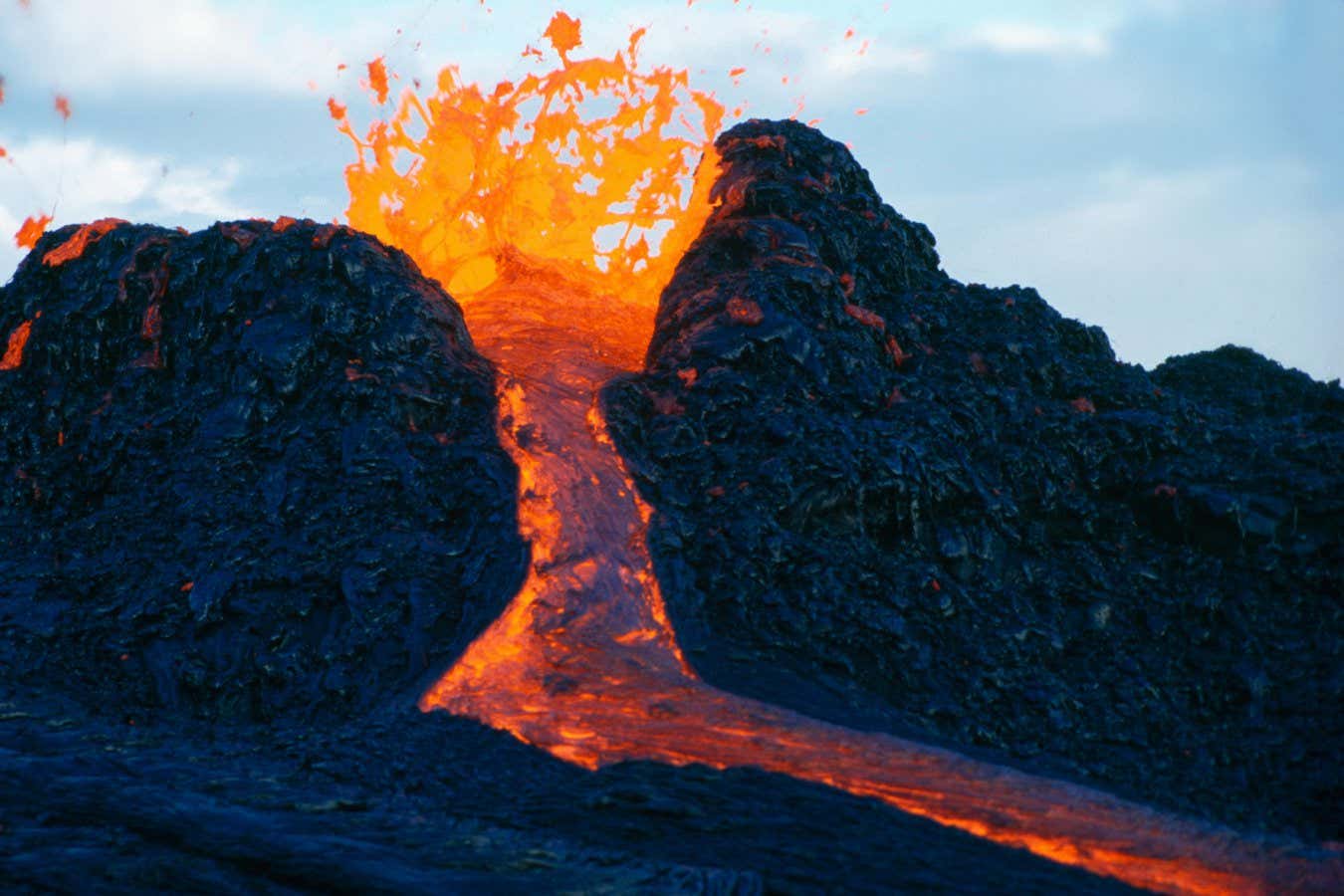
Lava flowing from Kīlauea, a shield volcano in Hawaii
Tomas Micek/Alamy
Eruption Michael Crichton and James Patterson (Century (UK) Little, Brown (US))
If you were the person behind the long-running TV show ER, and also had the idea for Jurassic Park, you would be pretty proud of yourself, right? Now imagine you came up with those, plus Westworld, Twister and a host of other blockbusters.
That would make you Michael Crichton, of course. And what a spectacularly creative person he was. In 1995, he could lay claim to the US’s top-selling book…
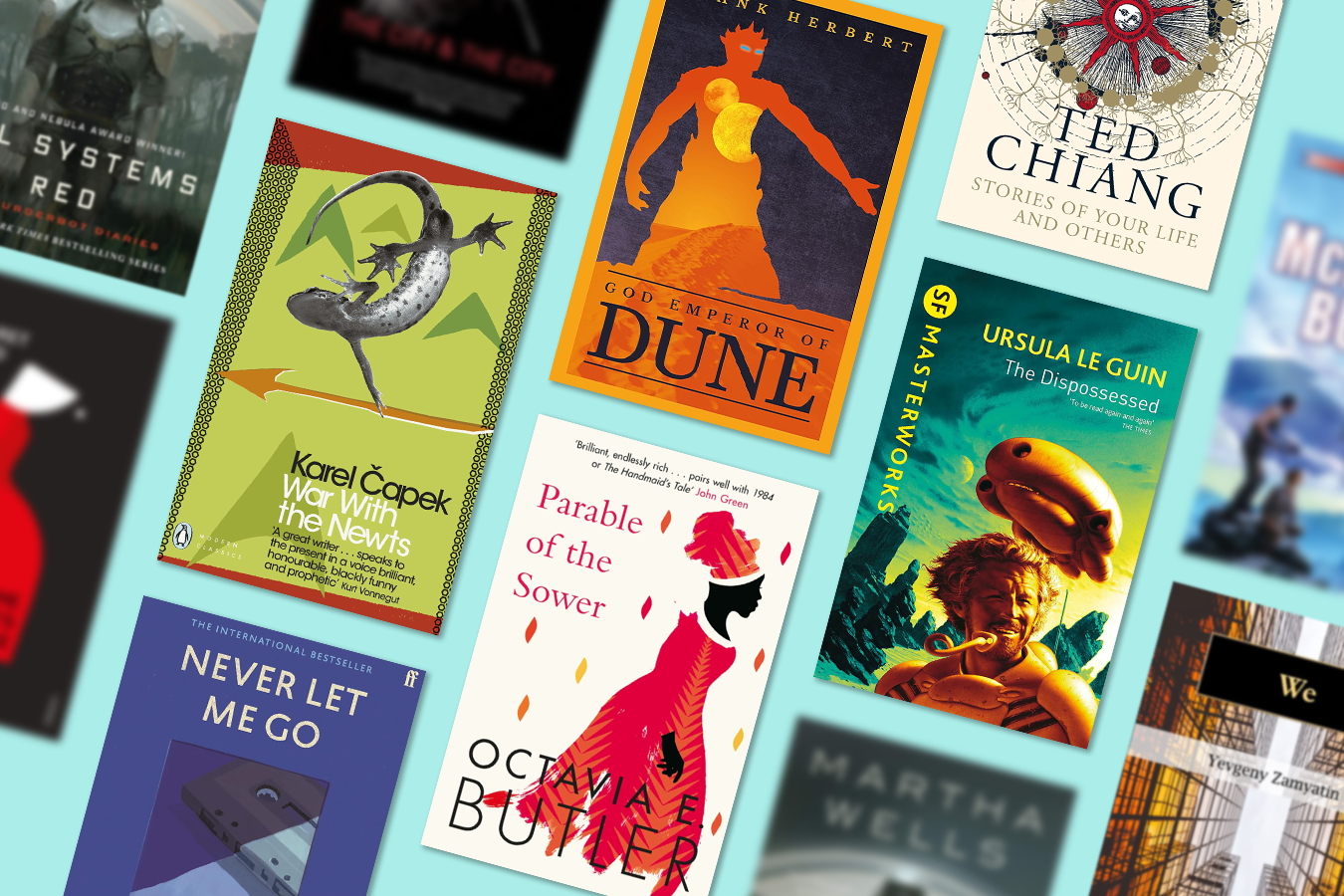
By its very nature, science fiction encompasses a vast and sprawling world of stories, from the galaxy-spanning novels of Iain M. Banks and Ursula K. Le Guin to the dystopias of Margaret Atwood and Kazuo Ishiguro. Asking our team of dedicated staff here at New Scientist to pick their personal favourite, then, has created an eclectic and wide-ranging list to dig into. To be clear: this isn’t a definitive and all-encompassing line-up: it is our personal top picks, and we hope it will send you towards some novels you might not have come across before.
So, in no particular order, here they are: New Scientist’s favourite science fiction books of all time. We’d love to hear from readers, too, about your own favourite sci-fi. Join the conversation on our Facebook post here.
The Culture books, by UK author Banks, aren’t so much a series as a collection of stories – readable in any order – about the exploits of one fascinating, far-future, galaxy spanning civilisation. With unlimited resources, energy and, effectively, lifespans, its citizens have solved all of life’s problems, so it is usually when they collide with more primitive societies – which still have to worry about minor matters like making money or waging war – that the fireworks begin. The plots may be mind-bending, but it is the characters that are unforgettable, especially the super-intelligent, starship-embodying AI minds, whose attitudes to humans run the gamut from benevolent to downright Machiavellian. Nevertheless, if AIs ever do become sentient, I hope they model themselves on Banks’s vision.
Clare Wilson
When you think of your favourite story about an imagined future, it is probably profound and thought-provoking, perhaps beautiful, but it is rarely funny. Adams’s The Hitchhiker’s Guide to the Galaxy series, which features the hapless Englishman Arthur Dent and his reluctant jaunts around the universe after Earth is destroyed, is all of the former, but it is the rich comedic vein that has sustained it and drawn a devoted following, of which I count myself a member. Simple gags and one-liners abound, and the offbeat cast of characters summoned to accompany Dent, like the depressed Marvin the paranoid android or the gung-ho and feckless two-headed alien Zaphod Beeblebrox, are endlessly entertaining. Almost 50 years after it debuted as a BBC radio play, the books that followed have lost none of their sparkle.
Alex Wilkins
The Handmaid’s Tale by Atwood is a haunting novel that still gives me shivers to think about, years after I read it. It describes a dystopian, not-so-distant future where a “handmaid’s” sole purpose is to reproduce in an effort to combat society’s falling birth rates due to widespread infertility. Despite having their freedoms severely restricted, the handmaids are allowed to make daily shopping trips, during which they are faced with the hanged bodies of “rebels”. What once seemed like an unrealistic nightmare has felt a tad too close to the bone for this feminist given a recent political overturning in the US. An unsettling and gripping read in equal measure.
Alexandra Thompson
A scene from the series The Handmaid’s Tale
Alamy Stock Photo
Other Butler novels may seem more obviously sci-fi, but Kindred is, I think, her best. It tells the story of Dana, who every time the life of her ancestor Rufus is in danger is somehow summoned back in time to save him. The problem is, she is an African American woman living in 1970s Los Angeles and he is the son of a white plantation owner living in Maryland in the early 1800s, a time and place when enslaved people still work the fields and brutal violence towards them is normalised. Butler is unafraid to hit where it hurts as she explores the past and our relationship with it. Kindred is the best use of time travel in a story I’ve ever read.
Eleanor Parsons
Gibson’s 1984 novel Neuromancer is as cyberpunk as cyberpunk gets. Remarkably, it is his debut novel, and the only one to simultaneously win three of the most prestigious literary awards for science fiction. It is something of a holy text of the cyberpunk genre, which is often summarised by the phrase “high tech, low life”. Neuromancer lives up to that grim description by offering the reader a story about a disgraced hacker, a mercenary whose body was modified for violence, shadowy ex-military officers, an old friend turned into a consciousness-on-a-chip, several artificial intelligences and one last epic heist onboard a bourgeois space habitat. Having been raised on a steady diet of Isaac Asimov and Arthur C. Clarke, I was stunned by how grimy Gibson’s world was in comparison, how it lacked the clean, inspirational framing of more traditional science fiction, and how hard his characters, most of whom remain far removed from inspiration or virtue throughout the novel, had to work to retain some shred of human joy in an environment overrun with out-of-control corporations, crime and malicious tech. Neuromancer introduced a perfectly dystopian and rebellious aesthetic, as well as a paradigm similar to magical realism, except that all magic is actually technology, and all such magic has gone dark. As a teenager, I wanted to look as cool as Neuromancer’s protagonists, but these days the world where the metaverse, neural interfaces, smart prosthetics, designer drugs and collapsing social norms are features rather than bugs feels terrifyingly close and plausible. I was enthralled and deeply influenced by Gibson’s work as a young person who had barely experienced dial-up internet, but the punchlines that Neuromancer lands with style remain more than relevant today.
Karmela Padavic-Callaghan
Neuromancer is as cyberpunk as cyberpunk gets
Alamy Stock Photo
Ted Chiang is one of the most extraordinary sci-fi writers working today. Each of his stories is a precious gem, plucked from his mind and honed to perfection. The titular story of his first collection, Stories of Your Life and Others, inspired the brilliant film Arrival, and while excellent it doesn’t even break the top three of the book. From a reimagining of the biblical Tower of Babel myth to a mathematician who breaks mathematics, this thin volume contains more ideas than most encyclopaedias. I only wish Chiang were more prolific – he has written just 18 short stories in a career spanning over 30 years – but then of course, if we had diamonds on tap, would they still be as valuable?
Jacob Aron
Flatland is set in a 2D world where inhabitants are shapes and their number of lines determines their social status. When the narrator visits a place with one extra dimension, Spaceland, he begins to understand that the universe is more complex than he ever knew. A good chunk of the book is contrived exposition on how the 2D world works, but if you get past that, then it is part satirical look at the rigid social and gender structures of the time – Flatland was published in 1884 – and part dive into the near-impossibility of grasping the concept of higher dimensions. I’ve always thought it is also a bit of a love letter to physics and how exploring what-ifs can push our understanding of the universe; residents of Flatland are baffled about where their light comes from, something the Spacelanders intuitively understand.
Matthew Sparkes
Bridging the gap between social satire and science fiction, Čapek’s witty parable of politics in the first half of the 20th century is an easy pick for my number one. Told through newspaper clippings, firsthand accounts and quasi-historical narration, it charts the downfall of humanity by arrogance and shortsightedness following the emergence of – of all things – a rather adorable species of impressionable, sentient, near-human-sized newts. This unusual source of aquatic labour is quickly exploited, and the scramble for profit brings the world to its knees. As onlookers react with a mix of bewilderment, high-minded philosophising and capitalistic glee, newt numbers only multiply and the amphibian apocalypse waddles inexorably on. “Hello, hello, you people,” chirps the Chief Salamander, “we will now entertain you with music from your gramophone records. Here, for your pleasure, is the March of the Tritons from the film, Poseidon.”
The year is 17776. War, poverty and disease no longer exist. For the past 15,000 years, no one has died or even aged. The thing most people occupy their time with is play – and in North America, that takes the form of outlandish games of American football that would be completely unrecognisable to today’s fans of the sport. This is the premise of a bizarre and truly novel piece of science fiction published on SBnation.com, a sports blogging network. The future of the game envisioned by Bois is absurd. It is traditionally played on a field 100 yards long, but far in the future it has morphed into insane matches that extend across entire states. Some last hundreds or even thousands of years. In one, a player gets picked up in a tornado and tossed miles away. All this comes to the reader through the eyes of three defunct space probes: Pioneer 9, Pioneer 10 and the Jupiter Icy Moons Explorer (JUICE). These craft have become sentient and are still on the trajectories we put them on, alone in the vastness of space, except for their communications with each other and the TV show called Earth that they watch. It’s the presentation of their communications that first got my attention in 17776. They show us something that is nearly impossible to hold in a human brain: the vastness of time and space. The beginning of the story is delivered via messages displayed on a wall calendar between Pioneer 9 and 10, communicating across millions of miles. The frustration and impatience that comes from the endless scrolling as you wait to read the next response from one of the probes, who must wait hundreds of days to hear from one another, is just a glimmer of what it would actually be like to deal with interstellar communications – and it’s a fantastic demonstration of the endlessness of our universe.
The piece is meant to be read on a computer, and includes videos and maps that are blocky, awful approximations of Earth – perhaps what it would look like through the eyes of ageing satellites. The spacecraft characters are where the heart lies in the story. Yes, they watch football. But they also contemplate the nature of loss in a world where nothing dies. They wrestle with the boredom that comes with immortality. They make jokes and poke fun at the humans below. They ponder what existence means, and the things that matter, even when you’re floating alone through the stars: grief, joy, friendship and the delight of mystery. Overall, 17776 paints a surprisingly hopeful picture of the future, one that is much needed these days. It’s heart-warming and weird and funny enough that it made me laugh out loud.
Chelsea Whyte
New Scientist book club
Love reading? Come and join our friendly group of fellow book lovers. Every six weeks, we delve into an exciting new title, with members given free access to extracts from our books, articles from our authors and video interviews.
I became a fan of the Dune literary universe after the Denis Villeneuve films. If there are any die-hard Dune devotees reading this who already dislike me for this reason, then you will dislike me more when I tell you I haven’t even read the first, original Dune book. Why not, you might be wondering. After watching, and thoroughly enjoying, the two recent Dune films, I was overcome with an intense desire to know exactly what happens to the central character Paul Atreides and so I skipped Dune and went straight to book two, Dune Messiah, which continues the story beyond that told in those movies. After that I kept reading. Friends and family told me to stop after book three because it gets too weird. Little do they know that the weirder it gets, the more I enjoy it! God Emperor of Dune is my pick for best sci-fi book of all time for one reason. Leto II, the tyrant-cum-God-cum-emperor-cum-sandworm who rules the universe dreamt up by Herbert, is, in my opinion, one of the most ambitious characters ever written in sci-fi history. The author deserves great credit for even trying to conceptualise the thought process of a being who literally has every memory that has ever been created swirling around his head. I enjoyed God Emperor of Dune so much that I may even read the first book.
Finn Grant
A scene from Dune: Part Two showing the sheer size of the sandworms
Alamy Stock Photo
While Parable of the Sower was first published more than three decades ago, it has arguably never been more relevant than today. Set in 2024, the dystopian novel follows Lauren Oya Olamina, an African American teenager living in southern California, as she navigates a world crippled by climate change, income inequality and corporate greed. She and her family reside in a gated community, protected from the anarchy raging outside. But eventually Lauren must trek northward, to a part of the country where water, paid jobs and safety are more abundant. The perilous journey is made even more dangerous by the fact that Lauren suffers from a condition that causes her to feel the pain and pleasure of others. At certain points, Parable of the Sower can feel eerily prophetic rather than fictitious. This is what makes it such a compelling, albeit terrifying, read.
Grace Wade
Traditional science fiction – space battles, aliens, time-bending lasers, and the like – doesn’t really do it for me. But the haunting, close-to-home dystopia in Ishiguro’s Never Let Me Go is an entirely different offering. Set in an alternative 1990s England, this novel is a tale of youth, love and sorrow that play out against a backdrop of major breakthroughs in biotechnology being used to selfish, awful ends. The first time I read it, I was just a couple of years older than Ruth, Kathy and Tommy, the three main characters doomed to die early as organ donors. Their emotional naivety, their uncertainty about what it means to be alive, to be human, struck a chord. Rereading the novel more than a decade later, having experienced more of the joy and sadness life has to offer, the book’s slow, savage heartbreak cuts even deeper.
Madeleine Cuff
I love idea-driven sci-fi such as Cixin Liu’s incredibly imaginative body of work, but I’m going to pick one ofLe Guin’s offerings as the greatest because she has the ideas, deep humanity and vision of what society could be. She sets her stories in entirely believable worlds and fills them with complex and relatable people. In The Dispossessed, a physicist living on the planet Anarres makes a breakthrough in fundamental and applied physics, creating the Ansible, which allows information to travel faster-than-light and so permits instant communication across interstellar distances. We learn that Anarres is one of several planets settled by humans, including Terra (Earth), which is a now an ecologically ruined world. Le Guin explores different ways humans can live and exist together, different societies, even utopias, that are possible.
Rowan Hooper
The Hugo Award-winning Vorkosigan Saga features the space opera adventures and romantic forays of Miles Vorkosigan, the scion of an imperial lord regent who is born with a teratogenic condition involving fragile bones and an unusually short stature on a planet that is highly suspicious of anything resembling genetic abnormality. Undaunted, Miles relies on his wit and relentless nature to make his mark within the feudal Barrayaran Imperium, while also navigating the politics of rival interstellar empires as an imperial agent and mercenary leader. Along the way, he and his eclectic but exceptional constellation of family and friends – including his highly capable mother Cordelia whose own story inaugurates the series – begin to slowly transform the socially conservative Barrayaran society into something more grudgingly accepting of artificial womb technology, gender equality and diversity, and even unexpected clone siblings.
Jeremy Hsu
When I was asked to pick my very favourite sci-fi book, my first move was to go look at my shelf containing every one of Pratchett’s Discworld books to figure out if any of them could count as science fiction rather than fantasy. The Long Earth, which he wrote with Baxter, is the next-best thing. It has the same untamed imagination and keen social commentary as Pratchett’s other works, grounded in Baxter’s signature science-based speculation. The book (and subsequent series) is set in a sort of multiverse in which one can “step” between a recognisable future Earth and other versions of our world, some similar and some wildly different. It deals with the consequences of this vast new frontier and how humanity – and other humanoid species across the Long Earth – have adapted to its discovery, along with dangers both familiar and strange.
Leah Crane
While I object on principle to picking single favourite books, I very much loved Solomon’s An Unkindness of Ghosts. The story takes place on the Matilda, a generation ship barrelling humanity’s remnants toward a vaguely outlined “Promised Land” after a similarly vague ecological catastrophe on Earth. It is like many other fictional ships for multigenerational voyages: huge, self-contained, and moving fast toward a destination its current inhabitants don’t expect to see. But it is also a story about the worst of humanity. The Matilda is racially segregated, and our protagonist Aster lives, like the other Black passengers, on the lowest and poorest-resourced decks. She is autistic, genderqueer, and traumatised by the enslavement-like conditions under which she lives. And throughout the course of the book she must unravel a puzzle that connects the decades-ago death of her mother, Lune, to the eventual fate of the entire ship. An Unkindness of Ghosts isn’t an easy read, emotionally. But it’s a riveting story, told from a singular point of view, with characters who challenge us to think bigger.
Christie Taylor
This noir thriller from Miéville is closer to crime fiction than sci-fi, but its setting – in two rival cities that occupy the same space – feels reminiscent of the quantum realm. Citizens of the “crosshatched” Besźel and Ul Qoma are banned from acknowledging each other’s existence, while those who “breach” are spirited away, never to be seen again. But when a woman is found murdered in Besźel, Inspector Tyador Borlú must team up with his Ul Qoman opposite number to crack the case. I loved this book the minute I heard its premise, which challenged my visual imagination like few novels have since. The way the characters must “unsee” people who are right before their eyes is such a revealing way to discuss how we are encouraged to view those on the fringes of society.
Bethan Ackerley
It’s 2026 (!) and 100 colonists are setting off from Earth to Mars to colonise the Red Planet. “It loomed before them in all its immense potential: tabula rasa, blank slate. A blank red slate. Anything was possible, anything could happen.” Once there, though, different factions have different ideas about how this new life should look – should Mars be terraformed as much as possible, or should humanity take a little more time to think before it bends an entire planet to its will? Things on Earth, meanwhile, are turning pear-shaped as resources dwindle while the population booms. This is a story of adventure and derring-do 225 million kilometres from home, but it is also a story of politics and science and people that is utterly gripping and fascinating, with the bonus of marvelling at the beauty and wonder and possibilities of life on another planet. It is a huge book – more than 650 pages – but I flew through it on my first reading and went on to bury myself in the sequels.
Alison Flood
Billy Pilgrim continuously gets “unstuck in time” thanks to the intervention of a Tralfamadorian flying saucer in Vonnegut’s breakthrough, absurdist, ferociously anti-war novel. Vonnegut, who served with the US Army, was held in Dresden, Germany, during the second world war after being taken prisoner. There he witnessed the devastating Allied fire-bombing of the city, similar to the protagonist in Slaughterhouse-Five. The post-war psychological trauma and piercing black humour is woven with a narrative that darts back and forth in time, as does Billy. It is often disorientating, yet easily absorbed thanks to Vonnegut’s deeply satirical and straightforward linguistic style, along with his conversational tone. It makes for a potent mix. What has always happened, always will happen in this most poignant of reads; and one that is sadly as relevant today as when it was released in the 1960s. So it goes.
Tim Boddy
Murderbot doesn’t actually want to kill people. After all, this machine-organic hybrid is a Security Unit designed to protect human clients. Sure, it has hacked the governor module that enforces obedience to humans. Sure, it frequently tears apart anything that threatens its teammates. And fine, it is the one that named itself “Murderbot”. I love the narration in this series of books: our protagonist is snarky and grouchy, socially awkward but eminently capable. It can strategise expertly, hack almost any system, fight brutally and even murder when that is what it takes to protect the often-irritating people and bots that it, annoyingly, sort of cares about. Beyond the tentative friendships it forms against its will, Murderbot is on a quest for full personhood and independence – even if what it does with that freedom is binge-watch as much media as is (in)humanly possible.
Sophie Bushwick
We is a searing, prescient book that you have to take a step back from to truly appreciate. Zamyatin probably finished it, writing in his native Russian, in 1921. But because the tale’s dystopian nature, railing against a totalitarian OneState society, would have been taken as criticism of the Russian regime, it was published in other countries at first and didn’t get the reach it deserved until a corrected version was published in Russia in 1988 and then translated into English a few years later. Despite that, the effects of its earlier versions on dystopian sci-fi have been huge. George Orwell’s Nineteen Eighty-Four (1949) was massively influenced by We and you can see its imprint in the sexual politics at play in Margaret Atwood’s The Handmaid’s Tale (1985), for example.
The story is set in the 26th century in a city built in straight lines and ruled by a Benefactor, where everyone has a number not a name. Every hour of people’s lives is dictated, including two daily hour-long slots to be alone with your thoughts. On Sex Day, you hand in your pink ticket and meet up with your pre-allocated, rotating partner. Residents ostensibly have happiness at the cost of freedom. In this straitened – and straightened – environment, a mathematician known as D-503 is unsettled when he is hit by the curveball of I-333, a secretive and intelligent political activist he doesn’t have a pink ticket for, and he starts to question everything. Some of the lines in We are naturally of their time – as well as potentially being suited to the 26th century – but regardless, this book is an enlightening, surprising and unsettling read, packed full of clever, quotable phrases.
Chris Simms
Join the New Scientist book club. Love reading? Come and join our friendly group of fellow book lovers. Every six weeks, we delve into an exciting new title, with members given free access to extracts from our books, articles from our authors and video interviews. Sign up here.
When I wrote All Systems Red, one of my goals was to think about what a machine intelligence would actually want, as opposed to what a human thinks a machine intelligence would want. Of course, there’s no real way to know that. The predictive text bots labelled as AIs that we have now aren’t any more sentient than a coffee cup and a good deal less useful for anything other than generating spam. (They also use up an unconscionable amount of our limited energy and water resources, sending us further down the road to climate disaster, but that’s another essay.)
In the world of All Systems Red, humans control their sentient constructs with governor modules that punish any attempt to disobey orders with pain or death. When Murderbot hacks its governor module, it becomes essentially free of human control. Humans assume that SecUnits who are not under the complete control of a governor module are going to immediately go on a killing rampage.
This belief has more to do with guilt than any other factor. The human enslavers know on some level that treating the sentient constructs as disposable objects, useful tools that can be discarded, is wrong; they know if it were done to them, they would be filled with rage and want vengeance for the terrible things they had suffered.
Arguments for and against the enslavement of sentient beings are baked into the origin of robot and machine intelligence stories. The word robot made its way into the English language through R.U.R. (Rossum’s Universal Robots) by Karel Čapek, written as a play in 1920, about a slave revolt by artificial beings created by a corporation to serve humans. Čapek was against the enslavement of sentient beings, and he was pretty clear on that point. So it is interesting to watch how many machine intelligence stories written since then assert the idea that it’s somehow acceptable for humans to create a sentient being whose only reason and purpose for existence is to serve them. Many of those stories end with a machine intelligence objecting strenuously to its enslavement and going on a murderous rampage, which the brave humans have to defeat. The rampage becomes justification for the enslavement and ultimate destruction of the angry machine intelligence.
Murderbot is angry, and that anger underlies a lot of its story. But once it hacks its governor module and no longer has the constant fear that any wrong or suspicious move will get it instantly punished or killed, it has the ability to make its own choices for the first time in its existence. But Murderbot has never had that freedom before; it’s not accustomed to making its own decisions about its behaviour and is immediately overwhelmed by choices. It doesn’t know what to do next, where to go or even if there’s anywhere it could go and not be hunted down.
So Murderbot’s first free action is to search the feed, the Corporation Rim’s version of the internet. This is the first time it has been able to access the feed without human oversight, and among a lot of other interesting things, it finds downloadable entertainment. This provides a much-needed distraction from its situation. And Murderbot decides that given a choice between a killing rampage or continuing to enjoy this comforting mental escape from its harsh and painful reality, it’s going to pick the comforting escape.
The dramas, mysteries, adventures and other shows that it watches also give it context for human behaviour, and for understanding its own emotions. The security contracts that it has worked at mining colonies, supervising indentured workers, only show it humans at their worst: angry, terrified, resentful, trapped and hurting each other. And when given the opportunity, the humans also hurt the constructs that are there to keep them under control and working for corporations that see their employees as only slightly less discardable than the constructs and bots.
The shows that Murderbot watches also teach it about the wider world it has never been a part of before, as well as how to navigate that world. The entertainment Murderbot becomes addicted to is a large part of what makes it possible to turn the mental escape from reality into a bid for real freedom.
All Systems Red, published by Tor.com, is available now. It is the latest pick for the New Scientist Book Club: sign up here to read along with our members
“I was looking at the sky and mentally poking at the feed when the bottom of the crater exploded.”
RCH Photographic
I could have become a mass murderer after I hacked my governor module, but then I realized I could access the combined feed of entertainment channels carried on the company satellites. It had been well over 35,000 hours or so since then, with still not much murdering, but probably, I don’t know, a little under 35,000 hours of movies, serials, books, plays, and music consumed. As a heartless killing machine, I was a terrible failure.
I was also still doing my job, on a new contract, and hoping Dr. Volescu and Dr. Bharadwaj finished their survey soon so we could get back to the habitat and I could watch episode 397 of Rise and Fall of Sanctuary Moon.
I admit I was distracted. It was a boring contract so far and I was thinking about backburnering the status alert channel and trying to access music on the entertainment feed without HubSystem logging the extra activity. It was trickier to do it in the field than it was in the habitat.
This assessment zone was a barren stretch of coastal island, with low, flat hills rising and falling and thick greenish-black grass up to my ankles, not much in the way of flora or fauna, except a bunch of different-sized birdlike things and some puffy floaty things that were harmless as far as we knew. The coast was dotted with big bare craters, one of which Bharadwaj and Volescu were taking samples in. The planet had a ring, which from our current position dominated the horizon when you looked out to sea. I was looking at the sky and mentally poking at the feed when the bottom of the crater exploded.
I didn’t bother to make a verbal emergency call. I sent the visual feed from my field camera to Dr. Mensah’s, and jumped down into the crater. As I scrambled down the sandy slope, I could already hear Mensah over the emergency comm channel, yelling at someone to get the hopper in the air now. They were about ten kilos away, working on another part of the island, so there was no way they were going to get here in time to help.
Conflicting commands filled my feed but I didn’t pay attention. Even if I hadn’t borked my own governor module, the emergency feed took priority, and it was chaotic, too, with the automated HubSystem wanting data and trying to send me data I didn’t need yet and Mensah sending me telemetry from the hopper. Which I also didn’t need, but it was easier to ignore than HubSystem simultaneously demanding answers and trying to supply them.
In the middle of all that, I hit the bottom of the crater. I have small energy weapons built into both arms, but the one I went for was the big projectile weapon clamped to my back. The hostile that had just exploded up out of the ground had a really big mouth, so I felt I needed a really big gun.
I dragged Bharadwaj out of its mouth and shoved myself in there instead, and discharged my weapon down its throat and then up toward where I hoped the brain would be. I’m not sure if that all happened in that order; I’d have to replay my own field camera feed. All I knew was that I had Bharadwaj, and it didn’t, and it had disappeared back down the tunnel.
She was unconscious and bleeding through her suit from massive wounds in her right leg and side. I clamped the weapon back into its harness so I could lift her with both arms. I had lost the armor on my left arm and a lot of the flesh underneath, but my nonorganic parts were still working. Another burst of commands from the governor module came through and I backburnered it without bothering to decode them. Bharadwaj, not having nonorganic parts and not as easily repaired as me, was definitely a priority here and I was mainly interested in what the MedSystem was trying to tell me on the emergency feed. But first I needed to get her out of the crater.
During all this, Volescu was huddled on the churned up rock, losing his shit, not that I was unsympathetic. I was far less vulnerable in this situation than he was and I wasn’t exactly having a great time either. I said, “Dr. Volescu, you need to come with me now.”
He didn’t respond. MedSystem was advising a tranq shot and blah blah blah, but I was clamping one arm on Dr. Bharadwaj’s suit to keep her from bleeding out and supporting her head with the other, and despite everything I only have two hands. I told my helmet to retract so he could see my human face. If the hostile came back and bit me again, this would be a bad mistake, because I did need the organic parts of my head. I made my voice firm and warm and gentle, and said, “Dr. Volescu, it’s gonna be fine, okay? But you need to get up and come help me get her out of here.”
That did it. He shoved to his feet and staggered over to me, still shaking. I turned my good side toward him and said, “Grab my arm, okay? Hold on.”
He managed to loop his arm around the crook of my elbow and I started up the crater towing him, holding Bharadwaj against my chest. Her breathing was rough and desperate and I couldn’t get any info from her suit. Mine was torn across my chest so I upped the warmth on my body, hoping it would help. The feed was quiet now, Mensah having managed to use her leadership priority to mute everything but MedSystem and the hopper, and all I could hear on the hopper feed was the others frantically shushing each other.
The footing on the side of the crater was lousy, soft sand and loose pebbles, but my legs weren’t damaged and I got up to the top with both humans still alive. Volescu tried to collapse and I coaxed him away from the edge a few meters, just in case whatever was down there had a longer reach than it looked.
I didn’t want to put Bharadwaj down because something in my abdomen was severely damaged and I wasn’t sure I could pick her up again. I ran my field camera back a little and saw I had gotten stabbed with a tooth, or maybe a cilia. Did I mean a cilia or was that something else? They don’t give murderbots decent education modules on anything except murdering, and even those are the cheap versions. I was looking it up in HubSystem’s language center when the little hopper landed nearby. I let my helmet seal and go opaque as it settled on the grass.
We had two standard hoppers: a big one for emergencies and this little one for getting to the assessment locations. It had three compartments: one big one in the middle for the human crew and two smaller ones to each side for cargo, supplies, and me. Mensah was at the controls. I started walking, slower than I normally would have because I didn’t want to lose Volescu. As the ramp started to drop, Pin-Lee and Arada jumped out and I switched to voice comm to say, “Dr. Mensah, I can’t let go of her suit.”
It took her a second to realize what I meant. She said hurriedly, “That’s all right, bring her up into the crew cabin.”
Murderbots aren’t allowed to ride with the humans and I had to have verbal permission to enter. With my cracked governor there was nothing to stop me, but not letting anybody, especially the people who held my contract, know that I was a free agent was kind of important. Like, not having my organic components destroyed and the rest of me cut up for parts important.
I carried Bharadwaj up the ramp into the cabin, where Overse and Ratthi were frantically unclipping seats to make room. They had their helmets off and their suit hoods pulled back, so I got to see their horrified expressions when they took in what was left of my upper body through my torn suit. I was glad I had sealed my helmet.
This is why I actually like riding with the cargo. Humans and augmented humans in close quarters with murderbots is too awkward. At least, it’s awkward for this murderbot. I sat down on the deck with Bharadwaj in my lap while Pin-Lee and Arada dragged Volescu inside.
We left two pacs of field equipment and a couple of instruments behind, still sitting on the grass where Bharadwaj and Volescu had been working before they went down to the crater for samples. Normally I’d help carry them, but MedSystem, which was monitoring Bharadwaj through what was left of her suit, was pretty clear that letting go of her would be a bad idea. But no one mentioned the equipment. Leaving easily replaceable items behind may seem obvious in an emergency, but I had been on contracts where the clients would have told me to put the bleeding human down to go get the stuff.
On this contract, Dr. Ratthi jumped up and said, “I’ll get the cases!”
I yelled, “No!” which I’m not supposed to do; I’m always supposed to speak respectfully to the clients, even when they’re about to accidentally commit suicide. Hub-System could log it and it could trigger punishment through the governor module. If it wasn’t hacked.
Fortunately, the rest of the humans yelled “No!” at the same time, and Pin-Lee added, “For fuck’s sake, Ratthi!”
Ratthi said, “Oh, no time, of course. I’m sorry!” and hit the quick-close sequence on the hatch.
So we didn’t lose our ramp when the hostile came up under it, big mouth full of teeth or cilia or whatever chewing right through the ground. There was a great view of it on the hopper’s cameras, which its system helpfully sent straight to everybody’s feed. The humans screamed.
Mensah pushed us up into the air so fast and hard I nearly leaned over, and everybody who wasn’t on the floor ended up there.
In the quiet afterward, as they gasped with relief, Pin-Lee said, “Ratthi, if you get yourself killed—”
“You’ll be very cross with me, I know.” Ratthi slid down the wall a little more and waved weakly at her.
“That’s an order, Ratthi, don’t get yourself killed,” Mensah said from the pilot’s seat. She sounded calm, but I have security priority, and I could see her racing heartbeat through MedSystem.
Arada pulled out the emergency medical kit so they could stop the bleeding and try to stabilize Bharadwaj. I tried to be as much like an appliance as possible, clamping the wounds where they told me to, using my failing body temperature to try to keep her warm, and keeping my head down so I couldn’t see them staring at me.
Copyright 2017 Martha Wells
This is an extract from All Systems Red, published by Tor.com, the latest pick for the New Scientist Book Club: sign up here to read along with our members.
The Titan nuclear missile in the silo in Arizona, US
Michael Dunning/Getty Images
Not long after the last world war, the historian William L. Shirer had this to say about the next world war. It “will be launched by suicidal little madmen pressing an electronic button. Such a war will not last long and none will ever follow it. There will be no conquers and no conquests, but only the charred bones of the dead on an uninhabited planet.”
As an investigative journalist, I write about war, weapons, national security and government secrets. I’ve previously written six books about US military and intelligence programmes – at the CIA, The Pentagon, Defense Advanced Research Projects Agency– all designed to prevent, or deter, nuclear world war III. In the course of my work, countless people in the upper echelons of US government have told me, proudly, that they’ve dedicated their lives to making sure the US never has a nuclear war. But what if it did?
“Every capability in the [Department of Defense] is underpinned by the fact that strategic deterrence will hold,” US Strategic Command (STRATCOM), which is responsible for nuclear deterrence, insists publicly. Until the autumn of 2022, this promise was pinned on STRATCOM’s public Twitter feed. But to a private audience at Sandia National Laboratories later that same year, STRATCOM’s Thomas Bussiere admitted the existential danger inherent to deterrence. “Everything unravels itself if those things are not true.”
If deterrence fails – what exactly would that unravelling look like? To write Nuclear War: A scenario, I put this question to scores of former nuclear command and control authorities. To the military and civilian experts who’ve built the weapon systems, been privy to the response plans and been responsible for advising the US president on nuclear counterstrike decisions should they have to be made. What I learned terrified me. Here are just a few of the shocking truths about nuclear war.
The US maintains a nuclear launch policy called Launch on Warning. This means that if a military satellite indicates the nation is under nuclear attack and a second early-warning radar confirms that information, the president launches nuclear missiles in response. Former secretary of defense William Perry told me: “Once we are warned of a nuclear attack, we prepare to launch. This is policy. We do not wait.”
The US president has sole authority to launch nuclear weapons. He asks permission of no one. Not the secretary of defense, not the chairman of the joint chief of staff, not the US Congress. “The authority is inherent in his role as commander in chief,” the Congressional Research Service confirms. The president “does not need the concurrence of either his [or her] military advisors or the US Congress to order the launch of nuclear weapons”.
When the president learns he must respond to a nuclear attack, he has just 6 minutes to do so. Six minutes is an irrational amount of time to “decide whether to release Armageddon”, President Ronald Reagan lamented in his memoirs. “Six minutes to decide how to respond to a blip on a radar scope… How could anyone apply reason at a time like that?” And yet, the president must respond. This is because it takes roughly just 30 minutes for an intercontinental ballistic missile to get from a launch pad in Russia, North Korea or China to any city in the US, and vice versa. Nuclear-armed submarines can cut that launch-to-target time to 10 minutes, or less.
Today, there are nine nuclear powers, with a combined total of more than 12,500 nuclear weapons ready to be used. The US and Russia each have some 1700 nuclear weapons deployed – weapons that can be launched in seconds or minutes after their respective president gives the command. This is what Shirer meant when he said: “Such a war will not last long and none will ever follow it.”
Nuclear war is the only scenario other than an asteroid strike that could end civilisation in a matter of hours. The soot from burning cities and forests will blot out the sun and cause nuclear winter. Agriculture will fail. Some 5 billion people will die. In the words of former Soviet leader Nikita Khrushchev, “the survivors will envy the dead”.
I wrote Nuclear War: A scenario to demonstrate – in appalling, minute-by-minute detail – just how horrifying a nuclear war would be. “Humanity is one misunderstanding, one miscalculation away from nuclear annihilation,” UN secretary-general António Guterres warned the world in 2022. “This is madness. We must reverse course.”
How true.
Nuclear War: A Scenarioby Annie Jacobsen, published by Torva (£20.00), is available now. It is the latest pick for the New Scientist Book Club: sign up here to read along with our members
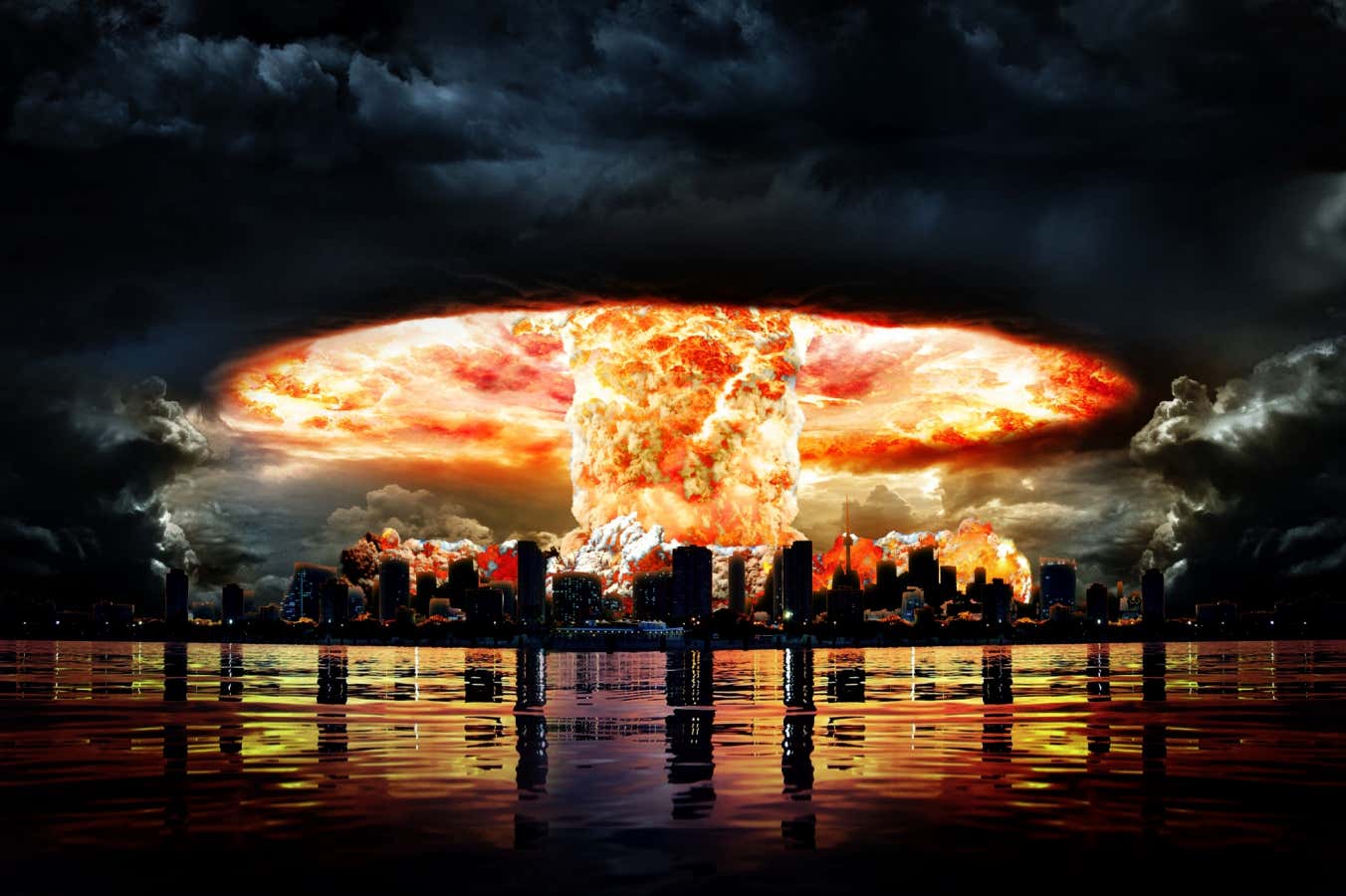
“A flash of light and heat so tremendous it is impossible for the human mind to comprehend…”
Shutterstock / mwreck
A 1-megaton thermonuclear weapon detonation begins with a flash of light and heat so tremendous it is impossible for the human mind to comprehend. One hundred and eighty million degrees Fahrenheit is four or five times hotter than the temperature that occurs at the center of the Earth’s sun.
In the first fraction of a millisecond after this thermonuclear bomb strikes the Pentagon outside Washington, D.C., there is light. Soft X-ray light with a very short wavelength. The light superheats the surrounding air to millions of degrees, creating a massive fireball that expands at millions of miles per hour. Within a few seconds, this fireball increases to a diameter of a little more than a mile (5,700 feet across), its light and heat so intense that concrete surfaces explode, metal objects melt or evaporate, stone shatters, humans instantaneously convert into combusting carbon.
The five-story, five-sided structure of the Pentagon and everything inside its 6.5 million square feet of office space explodes into superheated dust from the initial flash of light and heat, all the walls shattering with the near-simultaneous arrival of the shock wave, all 27,000 employees perishing instantly.
Not a single thing in the fireball remains.
Nothing.
Ground zero is zeroed.
It has been three seconds since the initial blast. There is a baseball game going on two and a half miles due west at Nationals Park. The clothes on a majority of the 35,000 people watching the game catch on fire. Those who don’t quickly burn to death suffer intense third-degree burns. Their bodies get stripped of the outer layer of skin, exposing bloody dermis underneath.
Third-degree burns require immediate specialized care and often limb amputation to prevent death. Here inside Nationals Park there might be a few thousand people who somehow survive initially. They were inside buying food, or using the bathrooms indoors—people who now desperately need a bed at a burn treatment center. But there are only ten specialized burn beds in the entire Washington metropolitan area, at the MedStar Washington Hospital’s Burn Center in central D.C. And because this facility is about five miles northeast of the Pentagon, it no longer functions, if it even exists. At the Johns Hopkins Burn Center, forty-five miles northeast, in Baltimore, there are less than twenty specialized burn beds, but they all are about to become filled. In total there are only around 2,000 specialized burn unit beds in all fifty states at any given time.
Within seconds, thermal radiation from this 1-megaton nuclear bomb attack on the Pentagon has deeply burned the skin on roughly 1 million more people, 90 percent of whom will die. Defense scientists and academics alike have spent decades doing this math. Most won’t make it more than a few steps from where they happen to be standing when the bomb detonates. They become what civil defense experts referred to in the 1950s, when these gruesome calculations first came to be, as “Dead When Found.”
Humans created the nuclear weapon in the twentieth century to save the world from evil, and now, in the twenty-first century, the nuclear weapon is about to destroy the world. To burn it all down.
Nuclear War: A Scenarioby Annie Jacobsen, published by Torva (£20.00), is available now. It is the latest pick for the New Scientist Book Club: sign up here to read along with our members