Queensland Pacific Metals provides an update on the status of the Moranbah project and the TECH project and how these already-promising works continue to show the company’s commitments to sustainable battery metals and clean energy.
Queensland Pacific Metals December 2023 Quarterly Report has provided further insight into their ongoing commitments to sustainable battery metals and the growth of the business.
The Moranbah project
In the previous article, Queensland Pacific Metals (QPM) updated us on the Moranbah project and the TECH project, stating that Moranbah had been 100% acquired by QPM.
Moranbah is a project that collects waste gases from metallurgical coal mining that would otherwise go to waste, and processes said gas to be used for sustainable energy.
The Moranbah project is capable of producing up to 30 petajoules per annum. The purpose of this acquisition, via subsidiary Queensland Pacific Metals Energy (QPME), was to de-risk the energy supply to the TECH project as well as to generate standalone revenue.
Now, in their December 2023 report, QPM confirms that operations of the Moranbah project have been efficient, with no incidents that caused a loss of time, a consistent growth of both production and revenue every month, and a reduction of base operating costs from the previous owners of the project. In January 2024, the Moranbah Project became cash-flow positive.
During the process of acquiring the Moranbah project, the previous owners were producing 28 terajoules (TJ) per day, which declined to 23TJ per day. Having acquired the project, and to date, QPME has brought production back up to around 28TJ per day, with all signs pointing towards continued growth of this number throughout 2024. This efficiency has seen a turnaround in revenue production, as in September 2023, Moranbah saw a revenue of $4.7m but an operating loss of $4.9m, whereas in January the company produced in excess of $12.3m, with an operation surplus of $2m, all while both retaining key operating staff and bringing aboard new members of the team.
QPME already has a number of customers that excess gas is sold to, and has inquiries coming for more, as well as sending gas to the nearby Townsville Power Station.
The TECH project
The TECH project (Townsville Energy Chemical Hub) is a project aiming to produce sustainable battery metals such as nickel- and cobalt-sulphate in an efficient and clean manner.
In the previous update, QPM told us about some of the advancements that had been made in the feasibility of the project, including:
Pilot test work that confirmed the project could make nickel-sulphate that meets offtake agreements for several large clients;
Construction of a pilot plant for aluminium and iron hydrolysis test work; and
Via partner Lava Blue, operation pilot plant for High Purity Alumina (HPA) production.
Now the TECH project has reached a point where the lead engineers have been demobilised, as the majority of workstreams are mature enough to do so. The project continues to be worked on to increase project optimisation and to reduce costs. December 2023 saw a 62% reduction from the previous two quarters average, and 2024 should see a continued fall in cost.
The TECH project is also set to continue to be funded in the face of depreciating spot values of battery metals, particularly nickel and lithium. Although the near future may be difficult, QPM remains confident that the project will remain attractive to investors, especially given the continued optimisation of the project making it as robust as possible when the economic conditions surrounding the materials change to a more positive light.
Meanwhile, alongside Lava Blue, QPM has completed the first campaign of their HPA demonstration plant, producing 62kg of 4N (or 99.99% purity) HPA. This initial batch serves as a confirmation that the TECH project’s flowsheet is successful, and provides a series of samples to be used in offtake marketing.
Both the projects are in strong alignment with Federal and State objectives, as the TECH project deals with nickel, which is a strategic metal according to the Critical Metals Office and Australian Federal Government.
Along with advanced manufacturing and resource downstream processing, elite ESG credentials, and its support of the sustainable battery metals, and electric vehicles industry, TECH not only complies with governmental policies but it is strongly favoured by them.
For the Moranbah project, the gas produced is a critical transitional energy source, and sees a lot of carbon reduction, aligning the project with the 30% methane reduction target from COP28. On top of everything, QPM will investigate funding from the National Reconstruction Fund for the TECH project and the Queensland Government’s $520m Low Emissions Industry Partnerships fund for carbon abatement in the Bowen Basin for the Moranbah project.
QPM’s support for sustainable battery metals and energy
It’s clear to see that QPM has many assets that support its business, as well as itself supporting various industries and a transition to sustainable practices. It is also clear that they intend to keep up this momentum, and as we travel into 2024, the horizon looks bright for QPM.
Please note, this article will also appear in the seventeenth edition of our quarterly publication.
Olimpia Pilch, Co-Founder and Senior Advisor of the Critical Minerals Association Australia, considers the outlook for Australian critical minerals, navigation of turbulent markets, crucial policy changes, and international significance.
In 2023, Western governments turned to penning strategies, signing agreements and banding together through the Minerals Security Partnership (MSP) – of which Australia is a member – and funding projects across MSP and allied nations. Notably, Australia and the UK signed a statement of intent to support the critical minerals sector, as well as one with Germany; they courted the US and inked the Compact aimed at enhancing bilateral co-operation; shook hands with France over a bilateral agreement on critical minerals; celebrated a milestone in the critical minerals investment partnership with India; and Australia’s Prime Minister Anthony Albanese visited China’s President Xi Jinping in an effort to calm down the turbulent relationship at a time when tensions over critical minerals (especially gallium, germanium, graphite, and rare earths) had been escalating as US and China continue a tit-for-tat.
For Australia, like many Western nations, China is its biggest trading partner (accounting for 34% of exports), and if prompted, could cause chaos for Australia’s resources sector and, as a result, the economy (with exports of predominantly iron ore, bauxite, gold, coal, and lithium – generating a record AU$455bn in export revenue in the 2022-23 financial year). Maintaining traditional trade relations and the search for new partners has dominated Australia’s strategy on the global stage as a ‘dig-and-ship’ nation that has not yet capitalised on sovereign value-added processing and refining, which remains in the tight grip of China.
Turbulent markets
While the Australian Government embarked on a quest for new friends, the industry faced an existential problem. The optimism of analysts projecting astronomical shortfalls between demand for critical minerals and green technologies and supply was not shared by equity markets in 2023.
Key issues remained: the technologies were not being built at the rate expected, China’s economy was showing signs of a slow-down, and Chinese consumers began falling out of love with electric vehicles (Tesla’s sales alone dropped 17.8% in November 2023 – some attributing this to the China’s phase-out of US$28 billion worth of incentives over 2009-2022).
Investors had little appetite for backing pre-feasibility exploration projects that would not stack up economically with a downturn in prices. And the sharp downturn came, fuelled by China’s overcapacity and economic slowdown, claiming not only the cash-strapped juniors but also high-cost casualties including – the legendary Mt Isa, Core Lithium’s Grants mine, and Wyloo Metal’s Kambalda – with lithium returns at -81.43%, nickel at -45.21%, and platinum at -7.67% for the year 2023. For better or worse, Australia’s resources sector is paying the price for decisionsmade in Beijing. Troubles in China spell troubles for down under.
Late-stage critical minerals projects, however – particularly 15 rare earth projects with a proposed investment of $7.3bn – have enjoyed a surge in investment. The Albanese Government also stepped in with an AU$2bn expansion in critical minerals financing aimed at doubling the Critical Minerals Facility’s capacity to finance Australian critical minerals mining and processing projects.
The story in lithium also continued, with total committed investments increasing by $2.5bn despite the rocky equity markets. However, the spending was committed to either expansions or the bigger end of town rather than junior explorers and their new finds. The increase from $6.7bn in 2022 to $11.8bn in 2023 in the value of committed critical minerals projects, confirms Federal Minister for Resources and Northern Australia Madeleine King’s statement that “the road to net zero runs through Australia’s resources sector” and the world remains hungry for Australia’s resources. However, Australia’s export revenues depend on more than three lithium projects, reaffirming the need for a robust critical minerals strategy.
Critical Minerals Strategy 2023-2030
Australia’s Critical Minerals Strategy 2023-2030 focuses on re-positioning the nation as a globally significant producer of raw and processed critical minerals. The strategy aims to incubate the fledgling sector to take advantage of geostrategic and economic benefits associated with resources needed for the energy transition. To successfully move further up the value chain and reap the additional benefits of Australia’s natural endowment, the government will need to focus on creating an enabling business environment that promotes innovation and commercialisation within the midstream processing and refining space.
The Strategy also focuses on critical minerals’ biggest challenge – financing–specifically that of strategic projects in the midstream. The government aims to support the industry through ‘well-designed support’ to help de-risk projects and attract private investment to projects deemed important to Australia’s goals.
So far, the Australian Government has awarded A$100m to projects – a drop in the ocean when it comes to building modern and ‘green’ refining facilities that can easily run into the billions. However, the National Reconstruction Fund has AU$1bn earmarked for ‘value-add in resources’. Another AU$50.5m has been committed to establishing the Australian Critical Minerals Research and Development Hub to begin tackling technological challenges that Chinese companies have built expertise in and Australia is found lacking in.
On the partnership side, diversification and partnerships with like-minded nations (government speak for non-China, Russia, North Korea, or Iran) are highlighted as the Australian Government continues to court potential buyers for its critical minerals. Australia is also committing more resources to monitor whether competitors are investing in the nation’s critical minerals sector, with AU$2.2m to be spent over four years by the Treasury to ‘develop more sophisticated ways of tracking foreign investment patterns.’ This comes as no surprise after the Government blocked a takeover of a lithium miner by a China-linked company. Greater protectionism of Australian sovereignty is likely to ruffle some investors’ feathers, particularly those who have enjoyed decades of quick profits.
On the environmental, social, and governance (ESG) front, there’s still some debate as to whether Australia is a ‘world leader.’ While it may indeed be the case for Australia in terms of political stability and absence of violence and terrorism; government effectiveness, regulatory quality, and accountability; the rule of law and control of corruption; the critical minerals sector – especially at the project level – has some issues that limit the nation’s ability to claim that title, particularly in indigenous matters and corporate governance. That being said, there are plenty of outstanding projects demonstrating exemplary ESG practices. The Australian Government is also cooperating with international standards bodies and encouraging discussions between the sector and First Nations people under the banner of ‘benefit sharing.’
Not meeting in the middle
The strategic role of the midstream cannot be stressed enough. Currently, China monopolises the midstream space globally for many critical minerals – such as gallium, lithium, graphite, and manganese – by Indonesia for nickel, Brazil for niobium, and the US for beryllium. Although many nations have a variety of resources that can be extracted, it is the processing and refining that ultimately add value and influence both the upstream prices and downstream access to critical materials. Moving from a ‘dig and ship model’ is no simple task. The successful creation of an Australian – specifically Australian-owned- midstream industry – will depend on the presence of the following five must-have ingredients:
Access to finance deployed at speed (non-traditional – grants, low-interest loans, sovereign guarantees, and underwriting);
Access to low-cost, ‘clean’ energy sources;
Access to modern infrastructure (that a company does not have to invest in first) such as deep water ports, rail, roads, etc;
Industry-orientated innovation and technological developments and;
Expert know-how and a highly skilled talent pipeline.
Given the geopolitical influences on critical minerals value chains and lack of a clear offtake route, private investors are more likely to back Chinese joint ventures or projects with significant Chinese backing, leaving critical minerals projects that are aiming to reposition themselves for the Western market at a disadvantage. This is not surprising as the majority of the demand is in China. Backing a project that is destined for either an unknown or weak market is a risky game, and investors want to both speed up and increase their returns while the demand projections look promising.
Investors are in the business of making money, not securing Australia’s geostrategic ambitions or sovereignty; the latter two fall within the government’s remit. However, long-term diversification and economic growth require greater public-private partnerships to compete effectively against other nations’ state-controlled competition. Industry needs to contribute expertise and business know-how, and the government must provide some form of counterbalance to international market distortions and geopolitical fallouts.
The difficulty lies in striking a balance to avoid moving too far away from free-market values.
However, the market and government are at odds, with some investors calling for less government meddling and greater freedom to cut deals with whomever they want. However, as demonstrated by China, Indonesia, and the US, critical minerals markets and state intervention are unlikely to decouple anytime soon. It is also unlikely that many investors and shareholders will have free license to sell strategic assets to foreign entities of concern without some government intervention.
It is worth noting that contrary to free-market ideology, leaving the creation of an Australian midstream to the markets will either perpetuate Australia’s current ‘dig and ship model’ or attract competitors willing to accept lower profits for greater market share or even a monopoly. Australian companies venturing further down the value chain face limited options to tap into an alternative downstream market to sell their products, restricted access to alternative capital sources (securing of which typically takes significantly longer than Chinese investment), and technological barriers, including know-how and access to equipment. Naturally, China is unlikely to support the growth of alternative midstream industries and has already restricted the exports of rare earth processing technology.
Most significantly, Australia, like other nations, cannot compete with China on cost. Instead, technological development and innovation can support ‘economies of flexibility’ focusing on modular plants and processes that can service multiple commodities based on the flow of input material. This would require either co-operation between numerous producers or vertical integration. The location of processing plants and refineries within industrial hubs or clusters can, if strategically planned, create ecosystems of waste-to-reagent use between multiple co-located plants through the adoption of circular economy principles, leading to reductions in cost over time.
Stiff international competition
China is not the only worry facing Australia’s critical minerals sector. Domestic issues also stand in the way: Restrictive bureaucracy, changes to industrial policy (e.g. same job, same pay), the inability to streamline planning and permitting across all its States, and a lack of early investment in key supporting infrastructure. These are leaving Australian operations increasingly too expensive for the China-controlled markets, where cheaper alternatives are arising across the global south. African and Latin American jurisdictions increasingly use finance from China, India, Saudi Arabia, and the US. Not only can projects in some global south nations reach production much quicker, but they also come with significantly lower costs and better profit margins.
That said, the good news is that the stability and reliance of Australia’s established systems position it favourably on the global stage. In its 2022 survey, the Fraser Institute ranked Western Australia and South Australia as second and sixth, respectively, for investment attractiveness globally, while South Australia also ranked third for policy perception.
Australia also maintains an advantage when it comes to courting carmakers and other OEMs – a reputation for responsible practices. Increasingly, as the carbon craze demands lower footprints, and automakers are terrified of protests against poor mining practices, doing things ‘the right way’ carries certain benefits.
Yet, globally, price remains king – and so do returns on investment. As Australia’s top diplomats focus on being the key supplier for the world’s energy transition, the balancing act of maintaining a competitive critical minerals sector without sacrificing responsibility while bridging the gap between its free-market ideals and the monopolistic stranglehold of its largest trading partner will be Australia’s most significant challenge.
Please note, this article will also appear in the seventeenth edition of our quarterly publication.
Mink’s drilling and exploration for battery metals nickel, copper, and cobalt, in Ontario, continues with compelling projects in the emerging Timmins Nickel District, an area currently attracting global interest.
Mink Ventures Corporation (TSXV:MINK) is a Canadian mineral exploration company exploring for battery metals (nickel, copper, cobalt) at its Warren and Montcalm projects in the Timmins Nickel District, Ontario, Canada.
Mink’s flagship Montcalm project covers 40km² adjacent to Glencore’s former Montcalm Mine, which had historical production of 3.93 million tonnes of ore grading 1.25% Ni, 0.67% Cu and 0.051% Co (Ontario Geological Survey, Atkinson, 2010). Its Warren project is located just 35km away.
These projects sit on the western edge of the Porcupine Camp and approximately 50km southwest of Canada Nickel’s Crawford project, which has attracted significant investment and attention recently by major mining companies and battery manufacturers seeking opportunity and a secure Canadian supply of these battery metals.
Both of Mink’s polymetallic critical minerals projects are ideally situated with low geopolitical risk factors. Ontario is a top-ranking Canadian mining jurisdiction. The province is mineral-rich, with a wide range of deposits that significantly contribute to the economy and the local communities.
Polymetallic deposits typically offer better value per ton, especially when located in established mining camps with existing infrastructure. Access and infrastructure to Mink’s projects are exceptional. Plentiful green hydropower and all-weather roads run adjacent to Mink’s projects, as well as mining infrastructure in the long-established Timmins Mining Camp.
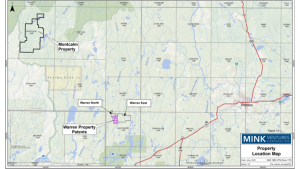
Fig. 1: Detailed location map
Further, a straightforward permitting process for both of Mink’s projects adds tremendous value to the equation and provides for highly cost-effective exploration due to the availability of drills, crews, skilled labour force, equipment, and lower mobilisation costs. In Mink’s case, there are significant efficiencies in logistics to move between its two projects, located only 35km apart along the same Montcalm Mine Road.
This article is focused on the Warren nickel-copper-cobalt project, as Mink is initiating a 500m drill programme on the A Zone at Warren. The Warren property covers 1,010 hectares of land in the Whitesides Township, approximately 35km west of Timmins, Ontario. (See Fig. 1) The first phase of drilling will consist of a series of short holes on the A Zone to determine the extent of the mineralisation down plunge, down dip, and along strike before evaluating the other mineralised zones and numerous untested priority geophysical targets on the property.
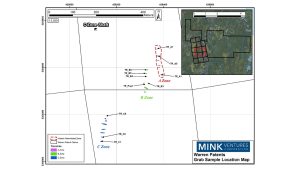
The A Zone (See Fig. 2) was selected as a high-priority target for drill testing as a result of an extensive geological review of data, a field examination, and a confirmation sampling programme conducted in summer 2023 by company geologists.
In July 2023, Mink acquired these underexplored patented mining claims. The Warren patents have had a sporadic exploration history from the late 1920s to the present, and several promising historical mineralised Cu Ni zones were outlined. The majority of the battery metals exploration completed on the property to date is in an area representing a very minimal portion of the property, and was completed well over 60 years ago as the patents were locked up and relatively untouched.
With the favourable geology, recent geophysics, and extensive surface mineralisation observed, there is a significant opportunity for new discoveries on the patents and across the expanded Warren project, including additional staked claims (Warren East) and acquired claims (Warren North). Mink’s work commitment to earn a 100% interest in the patents is $300,000. The company will make a significant dent in that obligation with this initial drill programme, which is expected to last two to three weeks. Mink has been fortunate to receive exploration grants through Ontario’s OJEP programme, and as such, half of this initial drill programme will be offset with the non-dilutive capital provided.
Fig. 2: Trench location map
Property highlights
Prospecting, sampling, and a geological evaluation of known mineralised zones A, B, and C was completed in the summer of 2023 to locate the most prospective zones of mineralisation for drill testing. A total of 20 reference grab samples were taken;
Sampling efforts confirmed the presence of extensive zones of mineralisation; recent sampling demonstrated excellent copper grades and significant nickel, cobalt and silver grades associated with some of the best copper grades;
The sampling efforts confirmed that the highest priority target is the A Zone, where approximately 120m of the zone is exposed in a series of trenches in outcrop. The A Zone trenches noted excellent copper values ranging from 1.075% to 2.08%. Nickel values from the A Zone ranged from 0.313% to 0.348% Ni, and cobalt values ranged from 0.0389% to 0.0498% Co. Some interesting silver values ranging from 10.3ppm to 23.8ppm were also associated with some of the better copper values on the A Zone;
To date, the Warren patents host three known zones with copper, nickel, and cobalt mineralisation; these have been designated A, B, and C. Two historical bulk samples were completed on the Warren patents; the first bulk sample returned 0.21% Cu, 0.96% Ni, 0.11% Co and 0.10% Zn, and a second bulk sample returned 2.83% Cu, 0.58% Ni, 0.10% Co and 0.13% Zn. The combined A-B zones and the C zone have projected strike lengths of 800 and 1,000 metres respectively, from geophysical data;
In the 1950s, a resource calculation of 385,000 tons of 1% Cu + Ni was outlined by Jade Oil & Gas on the Warren patents. Jade Oil and Gas drilled 23 holes to test Zones A and B in the mid-1950s. Highlights include 2.5% Cu+Ni over 7.6m and 2.8% Cu+Ni over 8.2m (Please be aware that the resource calculation is historical in nature and is not NI43-101 compliant; it is not to be relied upon and is reported as a historical statement only. Note: The methods and parameters used to prepare this estimate and the category of the estimate are unknown. A qualified person has not done sufficient work to classify the historical estimate as current mineral resources or mineral reserves, and the company is not treating the historical estimate as current mineral resources or reserves. References: Technical Report for Western Troy Capital Resources on the Warren Property (W. Hawkins P. Eng, 2021) and Maxmin, Magnetometer and VLF Surveys Evaluation Report, Whitesides and Massey Twp. Claims (C. Mackenzie Consulting Geologist, 1990); and
Despite fairly significant historical work on both the A and B zones in the past, the bulk of the battery metals exploration efforts were limited to relatively shallow drilling and/or surface work. Consequently, there is limited understanding of the geometry of these mineralised zones at depth. The first phase of drilling by MINK will consist of a series of short holes on the A Zone to determine the extent of the mineralisation down plunge, down dip, and along strike prior to evaluating the other mineralised zones and numerous untested priority geophysical targets in a second phase programme.
Warren property geological discussion
Mink’s expanded Warren project is hosted within the Kamiskotia Gabbro Complex (KGC), and it is thought to be broadly equivalent to the Montcalm Gabbro Complex (MGC) but separated by a granitic arch. The MGC hosts the former Montcalm Mine, which produced approximately 3.93 million tonnes grading 1.25% Ni, 0.67% Cu and 0.05% Co (OGS, Atkinson, B., 2010).
Gabbro complexes such as MGC and KGC are known to be prospective for magmatic nickel-copper sulfide deposition, as demonstrated by the Montcalm Mine located within the MGC. The Warren property complements Mink’s Montcalm property due to the distinctly similar prospective geological environments found in the MGC and the KGC, as well as the presence of significant Cu Ni zones on the Warren property.
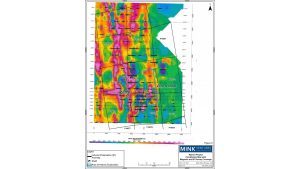
As highlighted above, the Warren patents have had a sporadic exploration history from the late 1920s to the present day, and several promising historical mineralised Cu Ni zones were outlined. The majority of the battery metals exploration on the property was completed in an area representing a very minimal portion of the property and completed well over 60 years ago. More recent geophysical surveys from the early 1990s and 2008-2009 outlined a series of untested targets along strike from known mineralisation and/or new targets proximal to known mineralisation. These targets are particularly evident in the accompanying magnetic and IP compilation map shown in Fig. 3.
Q&A:
How does Mink Ventures plan to use historical data and advanced technologies to identify and validate drill targets specifically for the Warren project?
Company geologists have re-evaluated the very limited available historical drill data. A property visit was made to examine the surface exposure of the zone, which is exposed over 120m of strike length in a series of trenches. Re-sampling of the zones confirmed excellent base metal values. With a geological evaluation of the surface exposure and some strike and dip measurements, a series of short drill holes have been proposed to confirm the dip and plunge of the zone and tenure of the mineralised zone.
Fig. 3: Warren project – compilation map
Once an understanding of the zone geometry is confirmed, deeper holes will be considered in a subsequent phase. Mink may consider using the new 3D Borehole IP geophysics system it used at Montcalm, which can seek both disseminated and massive sulfide mineralisation for a 250m radius around boreholes and further at depth to map any zones in 3D.
What steps will Mink take to validate and expand upon the historical resource calculation in the Warren project, ensuring accuracy and compliance?
A series of drill holes in multiple phases of drilling will be required to establish the size and dimension of the zone. Canadian geologists comply with NI43-101 professional standards, which will ensure the accurate representation of all field data collected.
How will Mink prioritise community engagement and address environmental considerations?
Mink is operating in a part of Northern Ontario, where there is a clear and articulate process to build solid relationships and work side by side with local communities and First Nations. MINK’s projects fall in the traditional territory governed by the Waban Tribal Council, which has developed a straightforward process and model for discussion and negotiations that is now being replicated across Canada and admired globally.
The overall intent of the process they have developed to use with mining companies is to provide winning outcomes for all stakeholders while providing for and protecting future generations and showing consideration for the environment from start to finish. Mink is in the process of completing a draft Memorandum of Understanding (MOU) for submission to ensure co-operation even at this early stage of battery metals exploration.
Further, Mink complies with all the environmental and permitting requirements of the province. The mineralised zones at Warren that are currently being evaluated are present on patented mining claims, which means the company controls surface rights and mineral rights. Early-stage battery metals exploration efforts like diamond drilling do not require permitting when working on patented claims.
However, the same standard of care concerning the environment is taken as if we were working on regular claims, and all activities adhere to the same permit guidelines.
How does Mink plan to optimise existing advantages for cost-effective exploration at the Warren project, and what are the anticipated challenges?
The Warren project is located in the Timmins camp with proximity to infrastructure, mills, workforce, and experienced exploration contractors, including diamond drillers. All-in diamond drill costs are in the range of approximately CAD$230 per metre. This is exceptionally reasonable when compared with drill programmes conducted outside of established mining areas, such as the Canadian Arctic, where costs may be three to four times higher per metre. Access to the Warren Project is reasonable from established roads, but winter access for the Warren Project is best due to the ground conditions.
How does Mink intend to address historical gaps and explore untested targets along strike from known mineralisation?
The company will conduct several days of prospecting and sampling to evaluate the numerous mineralised occurrences across the property. Recent sample data, a relatively recently induced polarisation survey, and the information from this current drill programme compiled into the geological database will allow for prioritising the best targets for the next round of drill testing.
What are the primary exploration goals that Mink Ventures aims to achieve with the drilling programmes at the Warren project, and how do these align with the company’s broader objectives?
The primary goal of the current programme is to confirm the orientation and tenure of mineralisation in known historical zones of mineralisation to build an NI43-101 compliant resource that can be grown and eventually attract a JV partner with mining capability. Mink Ventures is an exploration company aiming to secure the best projects as cost-effectively as possible while providing significant opportunities to make new discoveries and enabling our shareholders to ride the Lassonde curve. Mink has two strategically located, highly prospective, polymetallic critical minerals projects in a well-built company with a very attractive share capital structure. This combination is set up to deliver value to our shareholders.
Please note, this article will also appear in the seventeenth edition of our quarterly publication.
The University of Adelaide’s Professor Michael Goodsite and Associate Professor Carl Spandler outline the steps that Australia must take to provide nickel in a manner that meets market demand.
Nickel is important for Australia due to its wide-ranging global applications. It is essential for our global energy transition, where it is used in batteries and other components of technology, contributing to a more sustainable future.
Australia’s nickel mining operations, with major deposits in Western Australia (WA) and Queensland, primarily contribute almost 12% of the global nickel production (0.16 million tonnes of nickel in 2023), and there are an estimated 21 million tonnes of nickel in reserve in Australia, which equates to 22% of global reserves (USGS commodity summary for Nickel, 2023).
Nickel has been used by humankind for over 5,000 years, and given its uses, especially in the transition to green energy, strong growth in demand for nickel is expected globally. Growing global demand should be a benefit for Australia; however, Australia must compete with international competitors, especially those in our own region, such as Indonesia and China.
Thus, the price for nickel is largely driven by supply in other countries, and a weak metal price leads to uncertainty with Australian nickel operations.
Indeed, in January 2024 alone, WA’s Ravensthorpe nickel mine announced that it was cutting 30% of its workforce, and the on-site staff at the Savannah nickel mine were made redundant. Even BHP isn’t immune to the downturn in the price of nickel: the mining giant has announced it is mothballing its nickel concentrator at Kambalda, WA.
Nickel was just last year classified as a strategic material by the Australian Government, but this classification has not yet mitigated the impact of low prices for either it or another strategic material: aluminium, as Alcoa Kwinana alumina refinery, also announced in January a phased shutdown, which will result in around 1,000 job losses.
Key facts about nickel in Australia
Australia recently announced a Strategic Materials list, including nickel, which means that nickel projects will be able to access billions of dollars of funding made available to strategic materials projects. Australia considers nickel and five other materials (aluminium, copper, phosphorous, tin and zinc) strategic as they do not yet meet the requirement to be critical.
The Strategic Materials List contains minerals:
Important for the global transition to net zero and broader strategic applications, specifically the priority technologies set out in the Critical Minerals Strategy.
For which Australia has geological potential for resources.
In demand from our strategic international partners.
However, their supply chains are not currently vulnerable enough to meet the criteria for the Critical Minerals List. They might become if more Australian miners and processors suspend operations.
Although global demand will increase for nickel and Australia has rightly classified nickel as a strategic resource, it must do more. Having access to a strategic resource is not enough, key efforts must be made in trade relations to best secure operations to provide the nickel in a manner that meets market demand.
Green nickel
An opportunity for Australia is to use its renewable energy resources to abate the greenhouse gas emissions associated with some nickel mining and processing techniques, to deliver on ‘green nickel’.
By doing this, suppliers can expect to trade nickel commodities or the products that they are used in, when produced or manufactured in Australia at a ‘green’ premium; thus, making ongoing nickel operations in our country more attractive, ultimately benefitting us and the world through a supply of green nickel commodity and know-how.
Australia can, and should, deliver on the charge Elon Musk issued in July 2020: “Tesla will give you a giant contract for a long period of time if you mine nickel efficiently and in an environmentally sensitive way.”