A quickly cooling Atlantic Ocean could dampen hurricane threats from the Pacific
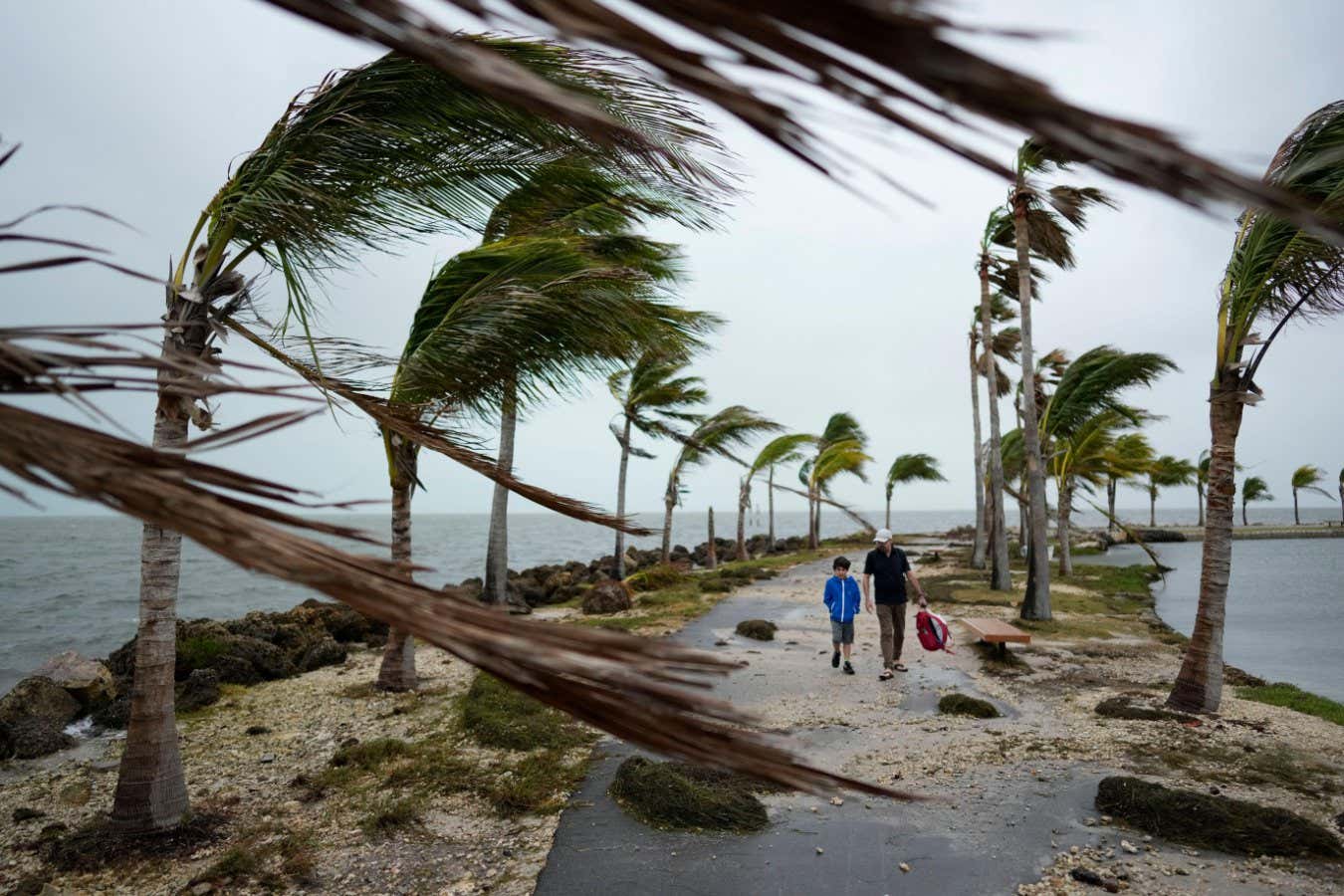
Rebecca Blackwell / Associated Press / Alamy
Over the past three months, the shift from hot to cool temperatures in the equatorial Atlantic Ocean has happened at record speed. This emerging “Atlantic Niña” pattern comes just ahead of an expected transition to a cooler La Niña in the Pacific Ocean, and these back-to-back events could have ripple effects on weather worldwide.
The swing towards cooler temperatures in both oceans is a welcome change after more than a year of record heat at land and sea,…
After over a year of record-high global sea temperatures, the equatorial Atlantic is cooling off more quickly than ever recorded, which could impact weather around the world
It was 21 years ago that I trekked and swam solo, without resupply, across the icy Arctic Ocean from Canada to the North Geographic Pole. The feat hasn’t yet been repeated and probably won’t be due to a drop in sea-ice cover caused by warming resulting from greenhouse gas emissions far to the south.
It had taken three attempts over 15 years before success in 2003 in reaching the pole, around 770 kilometres from Canada in the central Arctic Ocean’s “high seas”. By then, the nature of the 75-day challenge had morphed to require an amphibious element – swimming between…
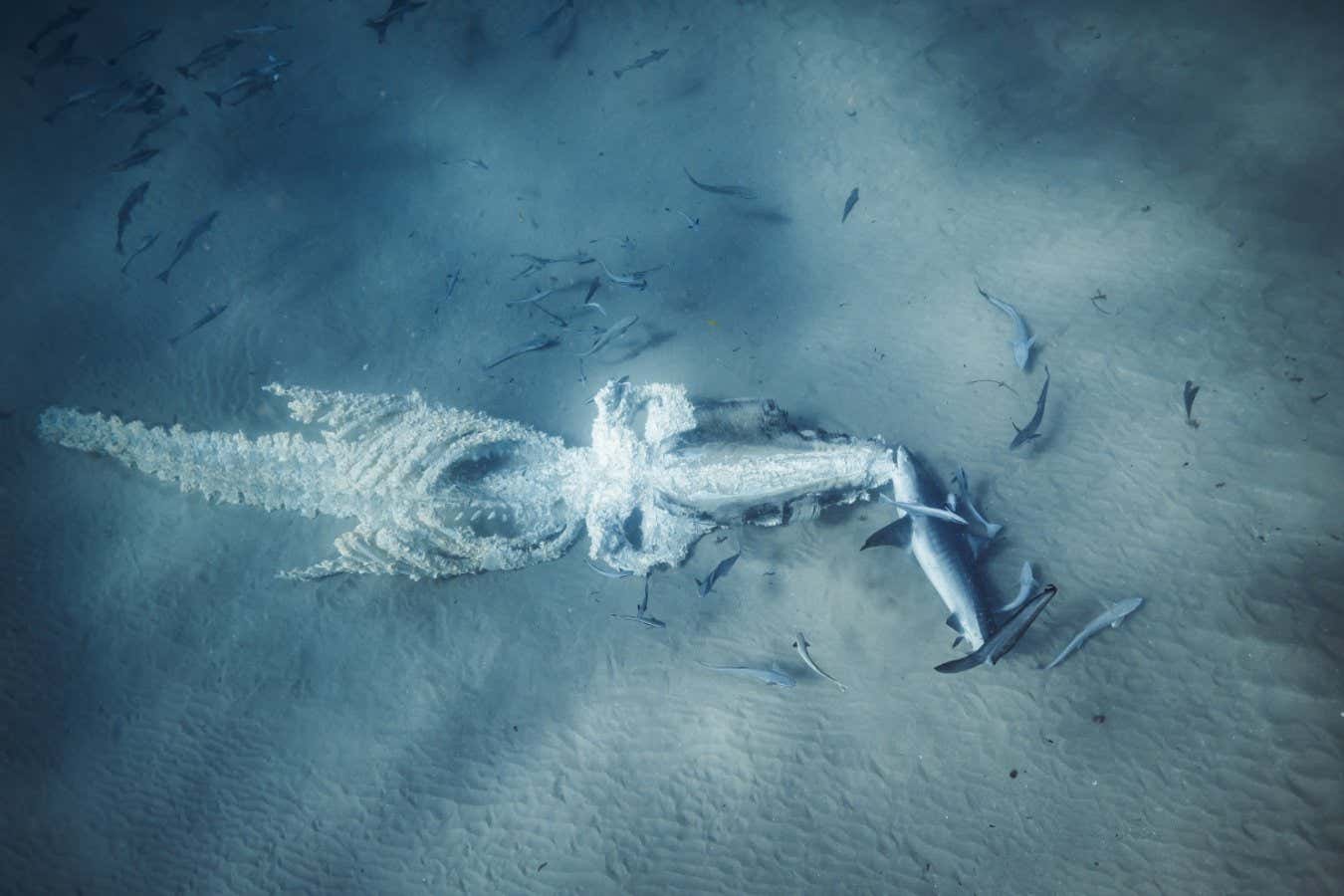
Whale remains being eaten by a tiger shark and other scavengers on the seabed
Laura Gourgas
Computer models could help predict the drift of dead whales so authorities can safely let their remains decompose naturally in the ocean.
Dead whales attract large numbers of sharks and, if washed onto busy beaches, are extremely smelly and unsightly, creating logistical problems for local governments. If ocean currents take them into shipping lanes, they pose a major hazard to passing vessels.
While most dead cetaceans never wash ashore, every year, 30 to 40 carcasses get stranded on the coast of Australia, for example. The numbers have been increasing since commercial whaling was mostly abolished in the 1980s.
These carcasses may be left to decompose where they lie, buried on the beach, taken to landfill, composted, rendered into biodiesel, blown up into smaller pieces with explosives or taken out to sea, where they will drift for days or weeks before sinking.
Sometimes, after being towed and released, the carcasses get washed ashore again somewhere else, simply moving the problem.
Computer models can predict where floating objects will drift, but this is hard to do accurately for dead whales because of their unusual size and shape, says Olaf Meynecke at Griffith University in Queensland, Australia.
“The most important thing is to know whether the whale will drift back to shore,” says Meynecke.
To learn more, he and his team closely monitored the drift of a dead humpback whale off the Queensland coast.
On 16 July 2023, the 14-metre-long floating whale, weighing up to an estimated 25 tonnes, was spotted by a volunteer coastguard. The whale was headless, which led researchers to speculate that it may have been killed by a boat strike.
By the next day, the carcass had drifted 4 kilometres. After locating it, Meynecke and his colleagues attached a satellite tracker.
On 18 July, the whale washed onto land. It was then towed 30 kilometres offshore and released again, after which the team followed its course for 150 kilometres over the course of another week. Finally, either the carcass sank or the tracker failed.
His team found that in the first few days after death, when the carcass was floating highest in the water, up to 1.5 metres above the surface, wind strength was the greatest factor in the drift direction.
“Current was only important when the carcass was decomposed and the body was less buoyant,” says Meynecke.
After the satellite data was collected, the team used a search-and-rescue computer model to see what paths it simulated for various objects that resembled the profile of a dead whale, including a skiff, a life raft and a small vessel called a panga, based on the same location and weather conditions.
The predicted locations were accurate in the first few days, but between 10 and 20 kilometres off after six days, says Meynecke.
He hopes to repeat the study with more carcasses to assess different scenarios and provide more accurate estimates of where whale remains will drift.
Moving a dead whale from a beach to a landfill can cost authorities more than A$10,000 (nearly US$7000) and it also removes large amounts of nutrients from the ocean food chain, says Meynecke.
“The goal is to provide local authorities with a tool to be able to quickly determine whether it is feasible to tow a whale out to sea and know where it will end up.”
The Ocean Sciences Building at the University of Washington in Seattle is a brightly modern, four-story structure, with large glass windows reflecting the bay across the street.
On the afternoon of July 7, 2016, it was being slowly locked down.
Red lights began flashing at the entrances as students and faculty filed out under overcast skies. Eventually, just a handful of people remained inside, preparing to unleash one of the most destructive forces in the natural world: the crushing weight of about 2½ miles of ocean water.
In the building’s high-pressure testing facility, a black, pill-shaped capsule hung from a hoist on the ceiling. About 3 feet long, it was a scale model of a submersible called Cyclops 2, developed by a local startup called OceanGate. The company’s CEO, Stockton Rush, had cofounded the company in 2009 as a sort of submarine charter service, anticipating a growing need for commercial and research trips to the ocean floor. At first, Rush acquired older, steel-hulled subs for expeditions, but in 2013 OceanGate had begun designing what the company called “a revolutionary new manned submersible.” Among the sub’s innovations were its lightweight hull, which was built from carbon fiber and could accommodate more passengers than the spherical cabins traditionally used in deep-sea diving. By 2016, Rush’s dream was to take paying customers down to the most famous shipwreck of them all: the Titanic, 3,800 meters below the surface of the Atlantic Ocean.
Engineers carefully lowered the Cyclops 2 model into the testing tank nose-first, like a bomb being loaded into a silo, and then screwed on the tank’s 3,600-pound lid. Then they began pumping in water, increasing the pressure to mimic a submersible’s dive. If you’re hanging out at sea level, the weight of the atmosphere above you exerts 14.7 pounds per square inch (psi). The deeper you go, the stronger that pressure; at the Titanic’s depth, the pressure is about 6,500 psi. Soon, the pressure gauge on UW’s test tank read 1,000 psi, and it kept ticking up—2,000 psi, 5,000 psi. At about the 73-minute mark, as the pressure in the tank reached 6,500 psi, there was a sudden roar and the tank shuddered violently.
“I felt it in my body,” an OceanGate employee wrote in an email later that night. “The building rocked, and my ears rang for a long time.”
“Scared the shit out of everyone,” he added.
The model had imploded thousands of meters short of the safety margin OceanGate had designed for.
In the high-stakes, high-cost world of crewed submersibles, most engineering teams would have gone back to the drawing board, or at least ordered more models to test. Rush’s company didn’t do either of those things. Instead, within months, OceanGate began building a full-scale Cyclops 2 based on the imploded model. This submersible design, later renamed Titan, eventually made it down to the Titanic in 2021. It even returned to the site for expeditions the next two years. But nearly one year ago, on June 18, 2023, Titan dove to the infamous wreck and imploded, instantly killing all five people onboard, including Rush himself.
Earth’s energy imbalance, a key measure of global warming, has doubled in the past 20 years, raising concerns about how much heat the oceans are absorbing
A 2020 rule put limits on harmful sulphur dioxide pollution in shipping emissions
Robert McGouey / Industry / Alamy
A sharp drop in sulphur dioxide emissions from ships since 2020 may warm the planet more than expected this decade, although researchers disagree on the magnitude of this change in temperature.
“If our calculation is right, that would suggest this decade will be really warm,” says Tianle Yuan at the University of Maryland, Baltimore County. Combined with background warming due to rising greenhouse gas concentrations, the added heat could mean 2023’s record-breaking temperatures will be the “norm” in coming years, he says. Yuan described the change as an unintended “geoengineering termination shock”.
However, other climate researchers say there are issues with the new numbers. “This is a timely study, but it makes very bold statements about temperature changes and geoengineering which seem difficult to justify on the basis of the evidence,” says Laura Wilcox at the University of Reading in the UK.
The study adds to an ongoing debate among climate scientists about the consequences of an International Maritime Organization (IMO) rule that slashed the amount of sulphur dioxide pollution in shipping emissions after 2020. That added air pollution from burning heavy marine fuel was linked to tens of thousands of deaths each year.
However, those aerosols also had a cooling effect on the climate by reflecting solar radiation directly as well as through their brightening influence on clouds over the ocean. Researchers expected that slashing those emissions would result in some warming due to the loss of sulphur dioxide’s cooling effects. But the magnitude of anticipated warming ranged widely.
Yuan and his colleagues have now estimated the warming effect of the 2020 rule using satellite observations of cloud conditions, along with mathematical models of how clouds might change in response to the expected reduction in sulphur aerosols.
The researchers calculate the drop increased the amount of solar energy heating the oceans by between 0.1 and 0.3 watts per square metre, around double that of some earlier estimates. This effect was more acute in areas of the ocean with lots of shipping activity: the North Atlantic, which has been anomalously hot since last year, experienced a warming influence more than triple the average, according to the study.
The researchers then calculated how this warming influence, known as “radiative forcing”, would change global temperatures, using a simplified climate model that leaves out the influence of the deep ocean. They found the 2020 change translated to an additional rise of about 0.16°C in global average temperatures in the seven years after emissions dropped, effectively doubling the rate of warming during that period compared with previous decades.
“This forcing is not a greenhouse gas forcing. It’s a shock,” says Yuan. “So it’s going to be a blip in the temperature record for this decade.”
The new numbers are on the high end, but are in line with estimates using other methods, says Michael Diamond at Florida State University. The modelled results match those from a study that directly measured the change in clouds after 2020 in one region of the Atlantic Ocean, for instance.
However, other researchers dispute how the team calculated the resulting change in global temperatures. Zeke Hausfather at Berkeley Earth, a climate think tank, says the researchers conflated warming influence over the oceans with warming over the entire planet, and that their simplified climate model found a more rapid temperature rise than would occur in reality. “It’s really hard to justify more than 0.1°C warming in the near term using modern climate models,” says Hausfather.
If the new estimates prove accurate, however, it could help explain some of the huge jump in temperatures seen over the past year. Rising concentrations of greenhouse gases from burning fossil fuels and a shift to El Niño conditions were responsible for most of the heat, but a still unexplained gap has fuelled discussion about whether climate change may be accelerating.
“[The change in shipping emissions] goes some way towards closing the gap that we perceive,” says Gavin Schmidt at NASA. But “it’s not the whole story”.
The warm El Niño pattern in the Pacific Ocean combined with global warming and other factors to create the hottest year on record – and this year may not be any cooler
Last year’s marine heatwaves saw an unprecedented decline in the growth of phytoplankton and algae, which many animals in the oceans depend on for food
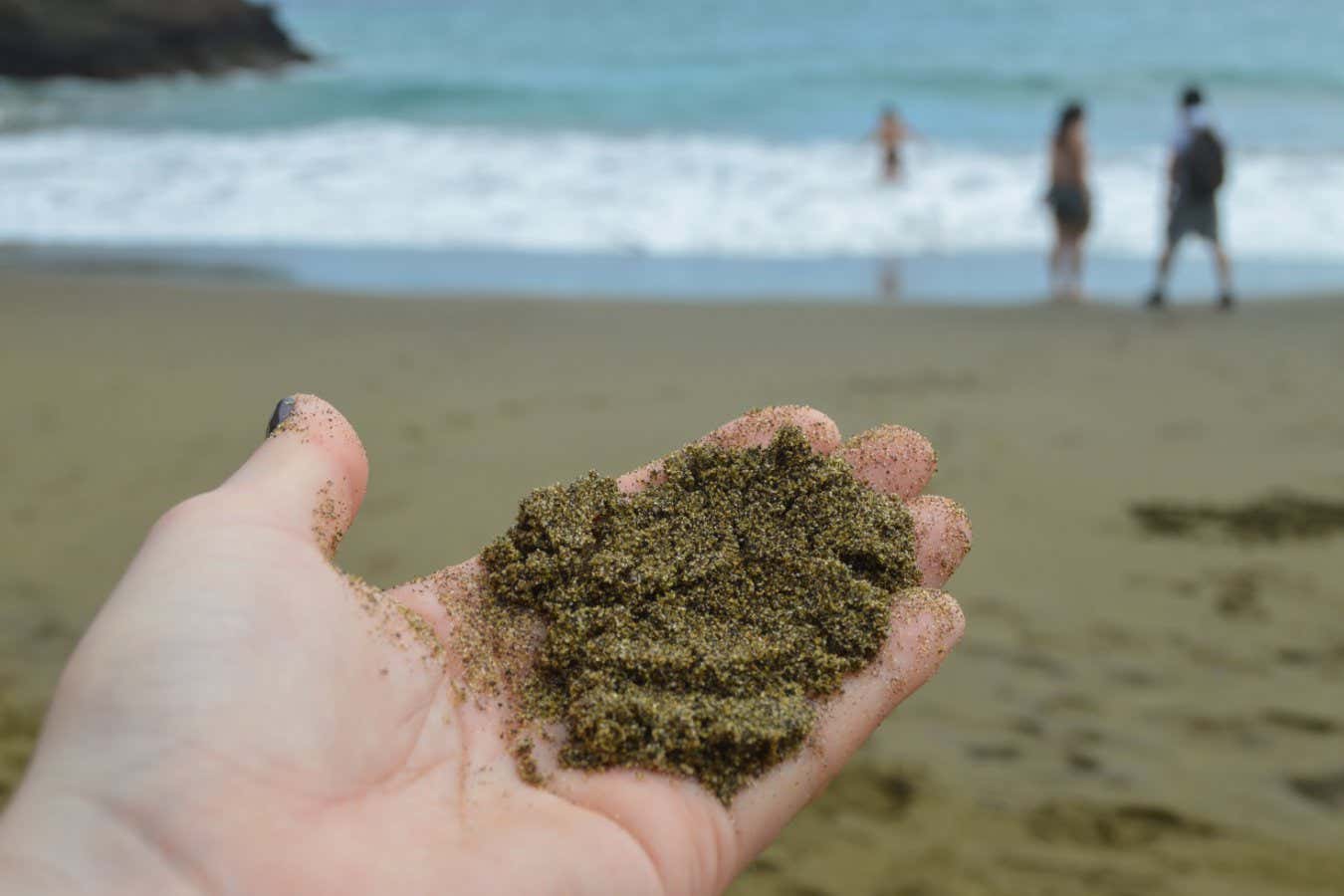
Olivine sands can be found on some beaches in Hawaii
Sara Komo/Shutterstock
Dumping alkaline green sand into shallow seas could increase ocean absorption of carbon dioxide by 8 per cent this century, according to a modelling study.
Oceans take up almost a third of the CO2 we emit into the atmosphere and researchers are exploring ways to boost that amount. Dissolving 1 gigatonne a year of ground-up olivine, a common, greenish mineral made mainly of magnesium, iron, silicon and oxygen, in shallow seas could reduce atmospheric CO2 levels by 10…