Tag: Planetary science

  • Is the Mars rover’s rock collection worth $11 billion?

    Is the Mars rover’s rock collection worth $11 billion?

    [ad_1]

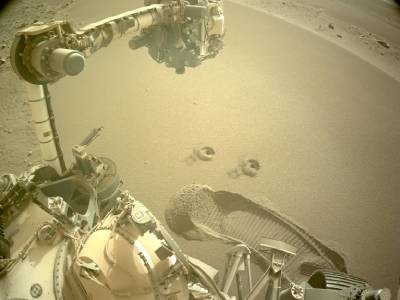
    An image from NASA's Mars Perseverance rover taken while it drills for rock samples.

    The Perseverance rover drills a rock core from the edge of the ancient river delta in Jezero Crater on Mars.Credit: NASA/JPL-Caltech

    The Woodlands, Texas

    Scientists are on edge as they wait for NASA to answer two of the most consequential questions in Mars exploration. Where on the red planet will the Perseverance rover collect its final rock samples? And can NASA and the European Space Agency (ESA) even afford to fly the mission’s hard-won samples — the prize at the end of a decades-long quest — back to Earth?
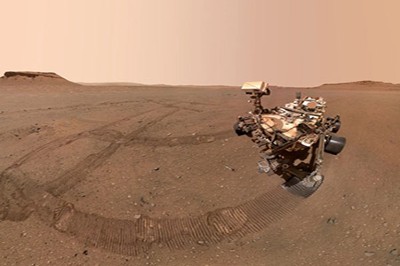
    Over the past few years, Perseverance has been exploring an ancient river delta in Mars’s Jezero Crater, with the aim of finding signs of past life. The rover’s belly is now stuffed with 17 tubes of Martian rock, dirt and air that scientists say represent an astounding geological collection. “The science is only getting better as we see what Perseverance keeps collecting,” says Laurie Leshin, director of NASA’s Jet Propulsion Laboratory (JPL) in Pasadena, California. But the rover’s instruments aren’t sophisticated enough to determine whether molecules in the samples point to signs of life, or to determine the samples’ age, and so reveal something about the history of Mars. For that, laboratories on Earth are needed.

    However, bringing Perseverance’s samples back could cost as much as US$11 billion, an independent panel concluded in a scathing engineering analysis last year. That’s more than NASA can afford. By the end of this month, it and ESA are supposed to find a cheaper way to achieve Mars sample return — or risk leaving the carefully collected rocks where they are.

    Adding to the drama, Perseverance’s planners are debating what other science the rover should do before it has to stop exploring. The original mission plan was to explore the ancient river delta and then drive up out of the crater — where there are even older rocks that could tell scientists more about the history of Mars. But as Perseverance approaches Jezero’s rim (see ‘Epic journey’), some engineers are advocating for it to turn around and wait at a lower altitude, where it might be safer and cheaper to pick up the samples.

    EPIC JOURNEY. Map shows route of the Perseverance rover which has been exploring the Jezero Crater on Mars for 3 years.

    Source: Nature adaptation from NASA/JPL-Caltech/MSSS/JHU-APL/Brown University

    John Mustard, a planetary scientist at Brown University in Providence, Rhode Island, wants the rover to stick to the original plan. The rocks currently on board are “great, but they’re not sufficient to be the transformative samples that we want them to be”, he says. “They’re not Apollo-scale,” he adds, referring to the Moon rocks collected by Apollo astronauts in the 1960s and 1970s that revolutionized scientific understanding of the Moon and Earth.

    He and other scientists pressed the case for exiting the crater last week at the Lunar and Planetary Science Conference in The Woodlands, Texas. All eyes are now on NASA to see what it decides.

    “Right now what we can say is, we’re committed to [Mars sample return] being the best value,” says Lindsay Hays, acting lead scientist for Mars sample return at NASA headquarters in Washington DC. “My focus is really on making sure that we get as much science out of what we can get.”

    A long quest

    NASA has been working on various concepts for bringing rocks back from Mars since the 1980s. Perseverance, the fifth in a string of increasingly sophisticated Mars rovers from the agency, landed in Jezero in 2021 to maximize scientists’ chances of finding signs of past life, if it ever existed. Jezero was once filled with water: a river flowed into it that created an ancient delta similar to those on Earth, which can preserve organic material — usually the remnants of plants and other organisms that came from upstream.
    So far, Perseverance hasn’t spotted any obvious signs of ancient life, such as fossils, with its cameras. The best chance of finding past Martian life would be to analyse the rocks the rover has collected for materials rich in carbon, including organic compounds, that might have been created by the decay of long-dead organisms, says Tanja Bosak, a geobiologist at the Massachusetts Institute of Technology in Cambridge. This analysis would need to happen on Earth.

    Two of the rock cores are particularly promising for this; they are fine-grained mudstones from the delta that could have trapped organic material. Other cores collected by Perseverance include once-molten rocks from the crater floor that could be analysed to determine the age of that region; sedimentary rocks from the river delta that hold a history of how Mars’s climate and habitability changed through time; and rocks from the delta’s edges that appear to have interacted with deep groundwater, another potentially habitable environment, for long periods.

    Stay or go?

    The rover is currently exploring a narrow band of rock near the crater’s rim that is rich in carbonate minerals. On Earth, carbonates commonly form along lake shorelines and can preserve evidence of life. But scientists are still debating whether Jezero’s band represents an ancient shoreline.

    In the coming months, the rover will roll onto the rim; after that, the question is whether it will leave the crater. If so, it would explore ‘basement’ rocks from around 4 billion years ago — older than the 3.5-billion-year-old delta — and fossilized hydrothermal vents that could have been a haven for Martian life.

    Image of a rock sample collected by NASA's Mars Perseverance rover.

    When Perseverance drills a rock core such as this one, collected in October 2023, with its robotic arm, it then seals the specimen in a sample tube for safekeeping.Credit: NASA/JPL-Caltech/ASU

    But going to this region, known as Nili Planum, might involve more risk than NASA is now willing to take. One concern is that Nili Planum is several hundred metres higher than the crater floor, so the atmosphere above it is thinner, making it more difficult — and expensive — for a sample-retrieval mission to land there.

    Scientists are also concerned about how much farther the rover can physically roll before it gives out. Perseverance has travelled nearly 25 kilometres since landing, but mission scientists think it might be able to cover another 70–90 kilometres. If this is confirmed by testing at JPL, it might be able to reach some of Nili Planum’s most intriguing rocks, which are around 16 kilometres from the rover’s current location, and then make it back into the crater for pick up. If Perseverance does die unexpectedly, it has already left a backup collection of ten cores on the floor of Jezero Crater.

    Budget constraints

    Now the focus turns to money and how much NASA can invest in bringing the samples back. The mission is part of NASA’s planetary sciences portfolio, which currently spends $2.7 billion annually.
    NASA has said it doesn’t want to spend more than 35% of its budget on the mission to retrieve the samples in any given year. “Whatever we implement for Mars sample return is going to be done in the context of a balanced planetary science portfolio,” Lori Glaze, director of NASA’s planetary sciences division, told the conference. But the uncertainty about how much funding might be available to work on Mars sample return forced JPL to lay off 8% of its employees last month.

    Much of the cost for Mars sample return comes from its complexity. According to current plans, NASA would build a lander to retrieve the samples and a rocket to carry them off the surface to orbit Mars. ESA would contribute a spacecraft that would capture the samples in Mars orbit and transfer them to Earth. ESA has not discussed its budget for Mars sample return as publicly as NASA has, but European planetary scientists have expressed “consistent and strong science support” for the programme, says Gerhard Kminek, ESA’s lead scientist for Mars sample return in Noordwijk, the Netherlands.

    If NASA and ESA can figure out a path forwards, the rock collection would touch down on Earth no earlier than 2033. Meanwhile, the agencies have competition: China has announced plans to return Mars rocks to Earth at around the same time.

    [ad_2]

    Source link
  • Private Moon lander is dying — it scored some wins for science

    Private Moon lander is dying — it scored some wins for science

    [ad_1]

    Leaning on its side in the fading sunlight near the Moon’s south pole,

    the first commercial spacecraft to soft-land on the Moon
    is about to die. Mission controllers expect the Odysseus lander to lose power sometime on 28 February, six days after it touched down.

    They will try to wake Odysseus again in about three weeks, when the Sun is overhead and shining light onto its solar panels. Chances are low that it will survive the freezing lunar night, although a Japanese lander

    unexpectedly did so, waking up earlier this week
    .

    Space experts say that Odysseus, built by Intuitive Machines of Houston, Texas, counts as a success in the fledgling business of commercial lunar exploration. It is also the first US spacecraft to land on the Moon in more than half a century. All 12 of its payloads made it to the lunar surface, including six from NASA. Five of those NASA instruments have gathered scientific data, including measurements of radiofrequency interference leaking from Earth. The sixth, a retroreflector array that can be pinged to measure the distance between the lunar surface and other objects, will be tested in the coming months.

    “What we’re seeing here is at least the beginnings of validating this concept, where NASA can trust commercial companies with this lunar landing service,” says Laura Forczyk, executive director of the space consulting firm Astralytical in Atlanta, Georgia. Odysseus

    is the second spacecraft to launch
    in NASA’s Commercial Lunar Payload Services (CLPS) programme; the first, from the Pittsburgh, Pennsylvania-based company Astrobotic,

    did not make it to the lunar surface
    because of a propellant leak. NASA paid Intuitive Machines US$118 million to help develop Odysseus.

    Even though it was mostly successful, Odysseus encountered numerous challenges that underscore just how difficult it is to get to the Moon and operate on its surface. “When you’re trying things in a new way, with new technology, you’re going to expect bumps in the road,” Forczyk says.

    A bumpy landing

    Odysseus launched on 15 February but ran into several problems, including an issue with its navigational star-tracking equipment that had to be fixed as it flew towards the Moon. As mission controllers prepared for its landing, they also realized that the spacecraft’s laser rangefinders, which help it to navigate down to the lunar surface, were not working. Engineers had to upload new software that would command Odysseus to use a separate laser instrument onboard, provided by NASA as a test, to help it land.

    But during that last-minute manoeuvre, mission controllers forgot to update part of an algorithm — so Odysseus touched down around 1.5 kilometres from its planned landing site and pitched onto its side. The landscape where it ended up was much rougher than anticipated, so “we hit harder and sort of skidded along the way”, says Steve Altemus, chief executive for Intuitive Machines. Odysseus broke at least one of its six legs, causing it to slowly tip over at a resting angle of about 30 degrees to the lunar surface.

    That meant that some of its solar panels were not seeing as much sunlight as expected, and that its high-gain antenna could not be used to communicate with Earth. Mission controllers in Houston have been working overtime to get as much data from the lander as possible before it dies.

    Mixed performance

    As of 28 February, the company has released only one image of Odysseus on the lunar surface, taken by a narrow-field-of-view camera on the side of the lander. A student-built camera named EagleCam, which was supposed to eject off the lander and photograph its descent, was switched off because of the problems with the rangefinders.

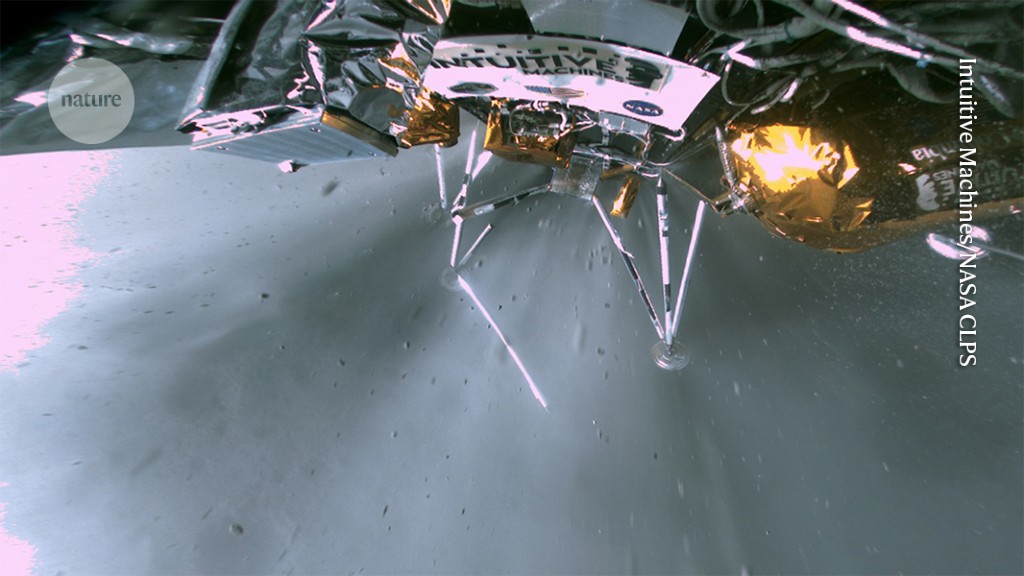
    Odysseus’ landing strut during landing on February 22nd performing its primary task, absorbing first contact with the lunar surface.


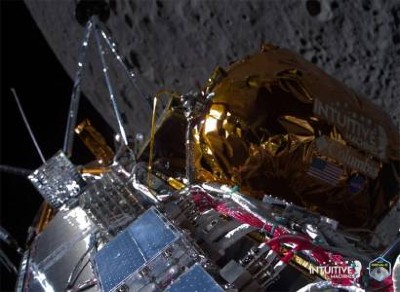
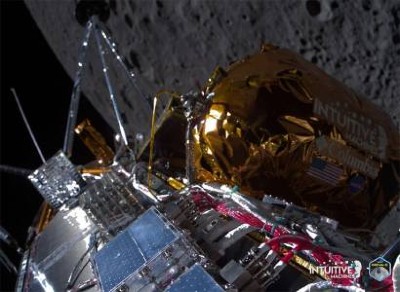
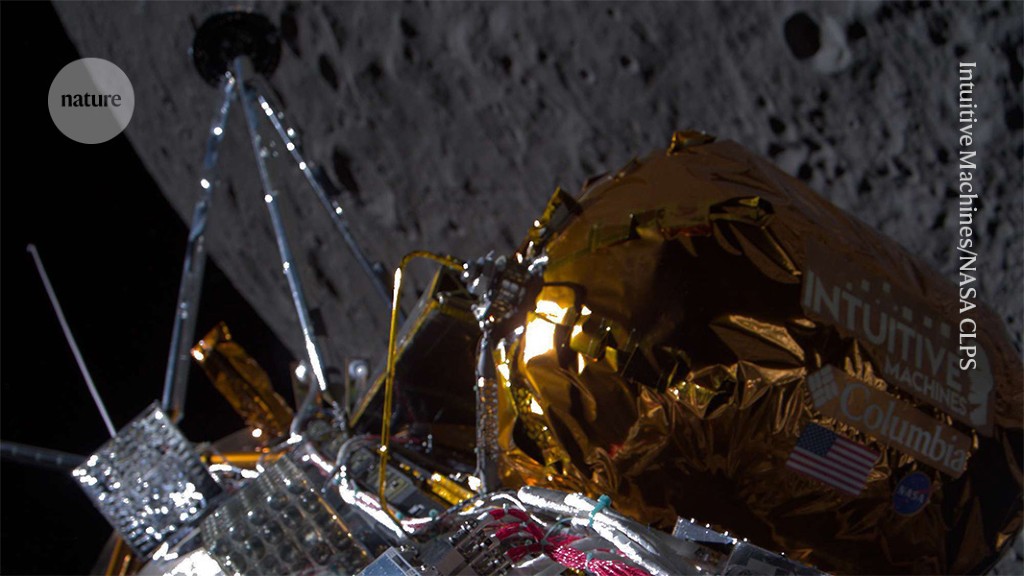
    Odysseus took this image of itself lying tilted on the Moon’s surface with a camera on the side of the lander.


    Credit: Intuitive Machines/NASA CLPS

    The problems during landing also meant that one of NASA’s main payloads, a set of four cameras meant to measure how rocket exhaust interacts with the lunar surface, also did not gather observations during landing. They were switched on during the last days of the lander, however. A separate, non-NASA astronomical imaging system reported collecting pictures of the lunar landscape and of Odysseus itself, but those photos won’t be released until 29 February.

    Other instruments in the NASA collection were more successful, including the radioantennas that measured radiofrequency interference from Earth.

    Odysseus’s mixed performance has sharpened attention on upcoming CLPS launches. Future NASA payloads include valuable instruments such as an ice drill and a rover that need to land successfully — and right-side-up — so that they can operate, says Carolyn van der Bogert, a planetary scientist at the University of Muenster in Germany. NASA wants the CLPS missions to help support its long-term goal of sending astronauts to the lunar south pole in the years ahead.

    Intuitive Machines’ next launch is slated to carry that ice drill to the Moon sometime later this year. Astrobotic is supposed to fly the rover to the lunar surface, but its launch might be delayed until at least next year, while the company works to incorporate lessons from its failed mission last month.

    [ad_2]

    Source link

  • Japanese Moon-lander unexpectedly survives the lunar night

    Japanese Moon-lander unexpectedly survives the lunar night

    [ad_1]

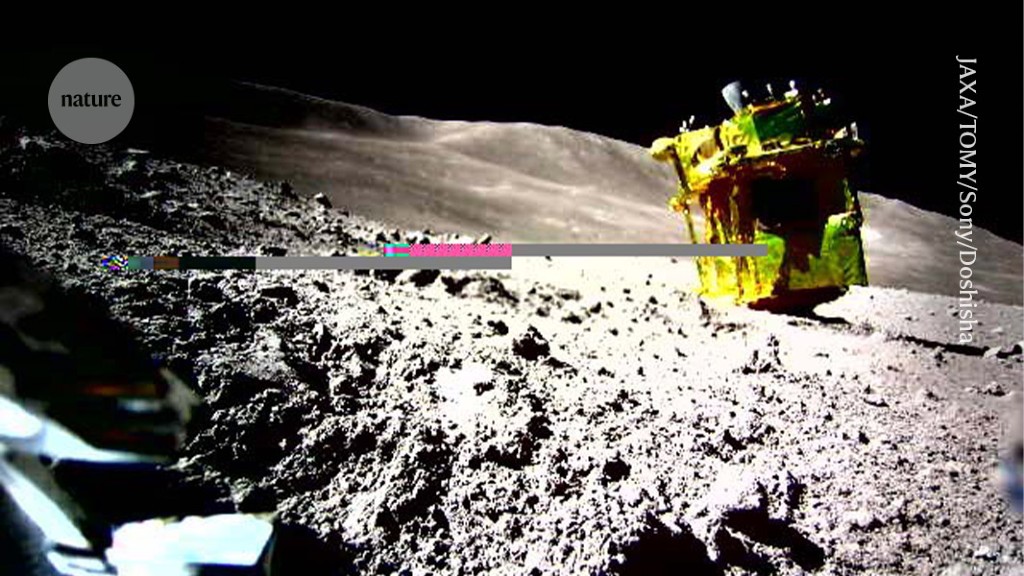
    Images of the Lunar surface taken and transmitted by LEV-2(SORA-Q).

    The lander was photographed upside down on the lunar surface. Credit: JAXA/TOMY Company/Sony Group Corporation/Doshisha

    Defying expectations, Japan’s spacecraft, which touched down with unprecedented precision near the Moon’s equator last month, has survived the harsh lunar night and started communicating with Earth again. On Sunday, a command was sent to the Smart Lander for Investigating Moon, or SLIM, and a response was received, according to the Japanese Space Agency (JAXA).

    SLIM was not designed to survive the deep cold night on the lunar surface, where temperatures drop below minus 130 degrees Celsius. JAXA’s engineers had remained hopeful that it would make it through the night, says SLIM project manager Shinichiro Sakai, but its message home was “a nice surprise”. “We knew that some of NASA’s Surveyors survived, so we felt we should also have some chance,” he says.

    He believes the lander’s communications system, onboard computer and solar panels are working. JAXA announced later on social media that it was attempting to take new images with a multiband spectroscopic camera used to study the composition of rocks.

    It’s been a rollercoaster ride for SLIM. Despite a successful on-target landing, JAXA lost contact with SLIM for some days when it rolled upside down. With its solar panels oriented the wrong way, it had only a trickle of energy with which to snap a photo and send it home before lunar night fell. The next lunar sunset for SLIM will take place on Thursday.

    During the lunar day, extreme heat also becomes a problem for SLIM. With the Sun high, its radio electronics overheat very quickly and Sakai says the team will need to wait for the temperature to cool later in the week before they restart scientific investigation.

    Electronic circuit boards can fail when they get too warm or cold, because they are built with different materials and the materials have different contraction rates, says Simeon Barber, a planetary scientist from Open University in Milton Keynes, UK. “It can generate significant twisting and stretching forces, and cause components or joints to crack or be pulled apart,” he says.

    Both SLIM and the US spacecraft Odysseus, which made history last week by becoming the first privately built Moon-lander to complete a soft touchdown, experienced issues with landing positions. “Landing on the Moon is as difficult as it has always been,” says Barber.

    The two recent spacecraft were built within many constraints, in particular cost, which places limits on their size and technology. “The two landers got almost everything right, but went awry at the last moments,” he says.

    However the teams have obtained lots of data that will inform future attempts. “The best way to land successfully is to keep trying and to learn from previous attempts,” says Barber.


    [ad_2]

    Source link

  • First private Moon lander touches down on lunar surface to make history

    First private Moon lander touches down on lunar surface to make history

    [ad_1]

    Odysseus passes over the near side of the Earth's Moon following lunar orbit insertion on February 21, 2024.

    The spacecraft Odysseus passes over the Moon on 21 February on its way a successful landing on 22 February.Credit: Intuitive Machines/NASA CLPS

    In a historic lunar accomplishment, the first private spacecraft to land successfully on the Moon touched down on 22 February. The spacecraft, named Odysseus and built by Intuitive Machines in Houston, Texas, also became the first US lunar lander since 1972, when the last crew of Apollo astronauts visited the Moon.

    Odysseus offered up some nail-biting moments in the hours before landing, such as the malfunction of the laser rangefinders that were supposed to help guide its autonomous journey down to the lunar surface. Mission engineers had to upload a software patch to jury-rig it to use a secondary laser provided by NASA instead.

    The exact state of the spacecraft remained unclear immediately after its landing, which occurred at 5:23 p.m. Houston time. But it was sending a faint signal back to mission control in Houston, indicating that at least some portion of it had survived the touchdown. “Odysseus has found its new home,” said mission director Tim Crain as the control room burst into cheers.

    Lunar return

    Regardless of how operational the spacecraft might be going forward, the landing is a major shot in the arm for US and commercial efforts to return to the Moon. NASA paid for much of the private mission and is counting on companies such as Intuitive Machines to help ferry equipment and scientific instruments to the Moon in preparation for returning astronauts there.

    “The US has returned to the Moon,” said NASA administrator Bill Nelson. “Today is a day that shows the power and promise of NASA’s commercial partnerships.”

    The first images from the lunar surface are expected within a few hours of the landing, depending on how communications with the spacecraft go. If Odysseus’s scientific payloads check out successfully, they could collect data for up to seven days, until night falls at the landing site and there is no more solar power left for operations.

    Five of the last nine Moon landing attempts have failed. Among the failures is a mission launched last month by Astrobotic in Pittsburgh, Pennsylvania, which ran out of fuel within hours of launch due to a valve malfunction. But also last month, the Japanese space agency succeeded in putting its SLIM lander near Shioli crater near the Moon’s equator, although the spacecraft landed upside down.

    Speedy traveller

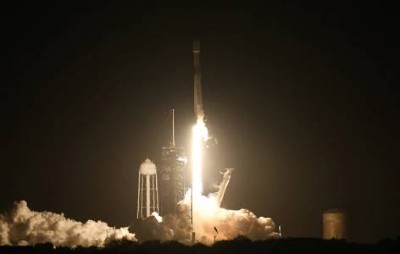
    Odysseus launched on 15 February from Cape Canaveral in Florida, and headed directly for the Moon. Along the way, it fired its engine several times to set itself on the correct trajectory and transmitted images of the Earth and the Moon. It entered lunar orbit on 21 February, initially circling 92 kilometres above the surface before making its landing attempt.

    The spacecraft fired its engines to descend to a lower altitude, then moved into an autonomous series of maneouvres in which it re-oriented itself and began assessing the craters and boulders beneath. It navigated towards its intended landing site and fired its engines again to slow its descent, ultimately touching down on the surface.

    The six-legged, phone-booth-sized spacecraft landed near the Malapert A crater, around 300 kilometres from the lunar south pole. NASA is interested in the Moon’s south pole because the region’s dirt and shadowy craters might contain ice that could provide fuel and other resources for future lunar explorers. Most lunar landers have visited the Moon’s equatorial regions; the only mission that has landed near the south pole is India’s Chandrayaan-3, which touched down last August.

    Bargain missions

    Odysseus is the second launch, after Astrobotic’s attempt, in NASA’s Commercial Lunar Payload Services (CLPS) programme, which aims to incentivize small aerospace companies to fly payloads for NASA and others to the Moon at low cost. NASA paid Intuitive Machines $118 million to develop Odysseus, which is a fraction of the cost of a typical interplanetary mission.

    NASA has six payloads on board Odysseus, including a set of cameras to study how rocket exhaust interacts with the lunar surface. The space agency wants to use CLPS flights to test technologies for its own return to the Moon, including plans to send astronauts to the lunar south pole as soon as 2026. A second Intuitive Machines Moon mission is slated to carry an ice drill to the south polar region, perhaps by the end of this year.

    Odysseus is the first craft to burn a methane-based rocket fuel in space. Methane-based propellants are more efficient and environmentally friendlier than conventional rocket propellants such as those including kerosene. But they can also be more difficult to work with because they need to remain at ultra-cold temperatures. Several other aerospace companies are planning to use methane fuels in the future.

    [ad_2]

    Source link
  • How to test a Moon landing from Earth

    How to test a Moon landing from Earth

    [ad_1]

    An animated sequence of two images from NASA's Lunar Reconnaissance Orbiter before and after the impact of Israel's Beresheet Moon lander.

    The Moon’s surface before and after Israel’s Beresheet Moon lander crash landed, as spotted by NASA’s Lunar Reconnaissance Orbiter.Credit: NASA/GSFC/Arizona State University

    Commercial companies and national space agencies alike are racing to land on the Moon. Japan’s SLIM Moon lander, the most recent craft to land on the lunar surface, is now in sleep mode. But this does not mark the end of Moon missions for the year. Next week, Intuitive Machines in Houston, Texas, plans send a lander to the Moon. And later this year, China and the private companies Firefly Aerospace and ispace all aim to launch robotic lunar landers.

    Although lunar ambitions might have risen around the world, achieving a successful touchdown with a robotic lander remains a daunting challenge. Four out of the eight lunar landing attempts made in the past five years have failed — Israel’s Beresheet, India’s Chandrayaan-2, Japan’s Hakuto-R and Russia’s Luna 25. This highlights the fact that although researchers can test for some eventualities before sending a lander to the Moon, many uncertainties remain. Nature takes a look at some key tests and challenges involved in preparing a lunar lander for its mission.

    Enduring the load

    Like every space-bound craft, lunar landers are subject to the intense, sustained vibrations and roar of a rocket launch. To avoid mechanical damage, the lander is tested in acoustic chambers, which have large stereo-speaker-like noise horns to simulate launch sounds, and on shaker tables that produce launch-like vibrations.

    Scientists also test lunar landers under the kinds of load that could be imparted during touch down. For example, the Indian Space Research Organisation (ISRO) dropped the legs of its successful Chandrayaan-3 lander, Vikram, on test beds made of simulated lunar soil to ensure that they could tolerate a high vertical velocity of three metres per second.

    Firefly Aerospace, based in Cedar Park, Texas, has conducted more than 100 drop tests on lunar soil simulants and sand to test its lander’s legs. Firefly aims to carry ten payloads to the Moon for NASA in late 2024 as part of the space agency’s Commercial Lunar Payload Services (CLPS) programme. “We even tested leg drops on concrete because it’s harder than anything we’ll land on,” says William Coogan, Firefly’s chief lunar lander engineer.

    Preparing for space

    In space, landers are subject to near-vacuum conditions, fast-moving orbits and harsh sunlight unfiltered by Earth’s atmosphere. These can lead landers to experience swift and huge temperature changes and can cause radiation damage to electronics.

    To ensure their structural integrity, every lander spends days — or even weeks or months — in ‘thermovac’ chambers. These achieve a vacuum similar to that experienced in space and on the Moon, simulate the possible temperature swings and even replicate unfiltered sunlight using powerful xenon lamps and mirrors. Landers often host computers and avionic electronics systems made of ‘radiation-hardened’ components, each of which is tested to not only endure the high mechanical stresses of spaceflight, but also work despite being irradiated at dosage levels expected in each mission.

    Protecting lunar landers from the harsh space environment is only part of the story, however. Engineers also need to ensure that the hardware and software function together as expected. The roughly three-second delay in two-way communications between Earth and the Moon makes it impossible for engineers on Earth to reliably guide lunar landings. This means that robotic landers must function autonomously during their lunar descent.

    Kalpana Kalahasti, associate project director of Chandrayaan-3, says her team spent the bulk of the mission’s development time coming up with and overseeing tests of the lander’s programs. These included fitting a helicopter with the lander’s sensors so that the team could mimic different descent phases. The sensors used for the earlier, unsuccessful Chandrayaan-2 lander were tested using aeroplanes. “Since testing sensors on aircraft doesn’t simulate hover or low-altitude phases of a lunar landing, we switched to using helicopters for Chandrayaan-3 to better mimic varying altitudes and velocities,” says Kalahasti.

    The Chandrayaan-3 team also examined whether the engines achieved the required dynamic throttling during descent, and assessed the navigation system’s ability to hover and avoid hazards before touchdown using crane-based set-ups on Moon-like terrain.

    Other tests can include antenna testing for communications equipment and optical testing for cameras. For NASA’s upcoming VIPER rover mission, which is intended to traverse rocky terrain at the Moon’s south pole, scouting for water ice, the agency drove a model of its rover in simulated terrain with varying slopes and rock distributions to test wheel slips, sinkages and traction, and to determine how it performed and what needed improvement.

    Simulated Moon landings

    When hardware can’t be tested, simulations fill the gap. To get a better idea of how a lander might behave on the Moon, engineers characterize hardware sensors and put them into simulations, says Coogan.

    Mission teams simulate key milestones, such as reaching lunar orbit, to identify what types of problem a lander can handle by itself, and what needs to be addressed by mission control on Earth. “Some real-time data from an ongoing mission is ingested into simulations to test critical commands before sending it to a lander,” says Laura Crabtree, co-founder of Epsilon3, a web-based spacecraft testing and operations platform used by several companies that are building lunar landers. This helps to give engineers a more reliable idea of how the lander will behave and respond in real-world situations.

    Simulations are also a great way to discover the ways a landing system might fail. “We formed a dedicated simulation group to characterize the [Chandrayaan-3] lander’s ability to recover from off-track trajectories during descent,” says Kalahasti. The group’s members also simulated alternative paths the lander could take if something didn’t work as expected. And they tested various extreme landing scenarios until the system failed. Once they knew the lander’s limits, they were able to modify it as needed.

    Known unknowns

    However, some aspects of space travel — such as the performance of a lander’s propulsion system — cannot be tested on Earth. “You can’t simulate weightlessness,” says Crabtree. “Until you fire a thruster, you will not definitively know the precise force it imparts.” She says the solution is to make a system that compares expected versus actual thrust to understand by how much the lander’s performance has deviated. Reserves of propellant are built in to make up for such differences.

    For example, Russia’s Luna 25 lander crashed on the Moon as it tried to reduce its orbit size on 19 August 2023. The Russian space agency’s investigation found that this was due to an engine firing for 50% longer than necessary. The fault probably stemmed from the software not being designed to prioritize data from the accelerometer, which would have registered that Luna 25 had achieved its desired velocity change.

    It’s also hard to predetermine the safest patch for a lander to touch down on. “During the final landing phase, a lander will see new features not present in onboard orbital imagery, including any hazards,” says Coogan. Earth-based tests of the features a lander can identify only represent some aspects of Moon-like terrain. This is why engineers tested SLIM’s ability to identify features from lunar orbit before beginning its descent.

    Private moonshot challenges

    Private companies such as Japan’s ispace and those involved in NASA’s CLPS programme face extra challenges. They typically cannot invest as much money or time into lander testing as a government space agency. This was highlighted on 25 April 2023 with the crash of ispace’s first lunar lander. During a media briefing, ispace’s chief technology officer Ryo Ujiie said that the company changed the landing site shortly before launch, and the simulations previously used to test the lander’s descent didn’t use terrain representative of the conditions the lander ultimately faced.

    These challenges are likely to increase, because 2024 will see companies competing to be the first private enterprise to successfully land on the Moon. For these organizations, there is a trade-off between development costs and customer revenue, but a mission failure would be worse. “Unsuccessful missions can be very expensive to a company,” says Coogan.

    [ad_2]

    Source link
  • Mimas’s surprise ocean prompts an update of the rule book for moons

    Mimas’s surprise ocean prompts an update of the rule book for moons

    [ad_1]

    Nature, Published online: 07 February 2024; doi:10.1038/d41586-024-00194-6

    The shifting orbit of one of Saturn’s moons indicates that the satellite has a subsurface ocean, contradicting theories that its interior is entirely solid. The finding calls for a fresh take on what constitutes an ocean moon.

    [ad_2]

    Source link

  • The Solar System has a new ocean — it’s buried in a small Saturn moon

    The Solar System has a new ocean — it’s buried in a small Saturn moon

    [ad_1]

    A false colour image from NASA of Mimas transiting Saturn’s ring shadows.

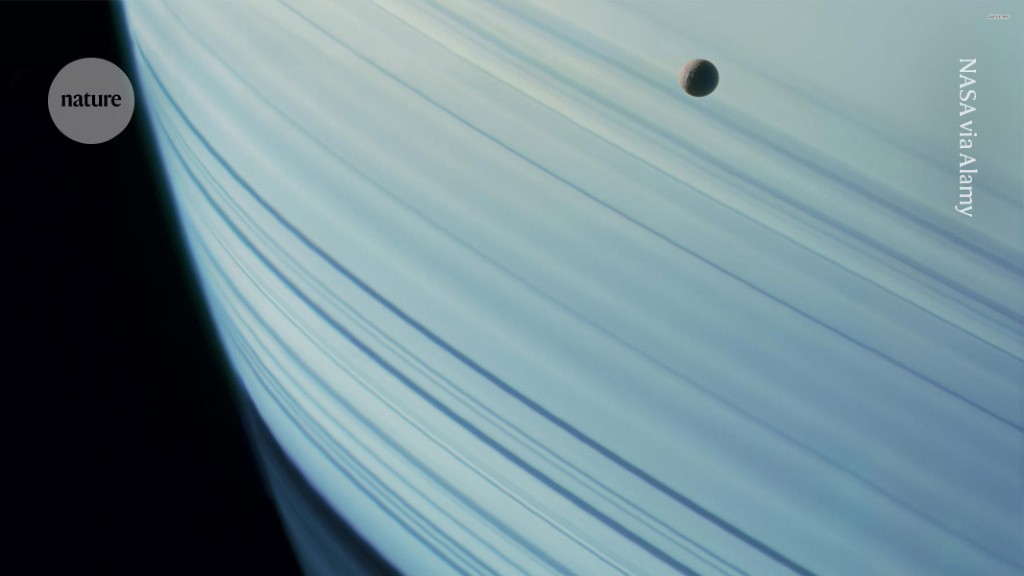
    Striped by its rings’ shadows, Saturn (light blue; artificially coloured) looms behind its moon Mimas (grey sphere), which conceals a liquid ocean underneath its surface.Credit: NASA via Alamy

    There’s a newfound ocean in the outer Solar System, and it’s in a very surprising place1. Mimas, a mid-sized moon of Saturn, turns out to have an ocean beneath its icy surface — despite looking too geologically inert to have water sloshing inside.

    Mimas joins a growing list of icy moons that are also ocean worlds. The fact that boring-looking Mimas has an ocean means that “you could have liquid water almost anywhere”, says Valéry Lainey, an astronomer at the Paris Observatory.

    That’s important because interactions between ocean water and rock, which would occur where a buried ocean meets a moon’s rocky core, can generate enough chemical energy to sustain living organisms. If there are more stealth ocean worlds out there similar to Mimas, there are greater chances of extraterrestrial life.

    Peek-a-boo ocean

    The discovery, reported today in Nature by Lainey and his colleagues, largely resolves the long-standing question of whether Mimas has an ocean. Many researchers hadn’t expected it to: Mimas’s geology does not display signs of a possible buried ocean, such as the icy rafts that jostle on Jupiter’s moon Europa or the geysers that spew from Enceladus, another icy moon of Saturn.

    But in 2014, a team that included Lainey and that was led by Radwan Tajeddine, an astronomer then at the Paris Observatory, analysed images taken by NASA’s Cassini spacecraft, which explored Saturn and its moons between 2004 and 2017. By studying how the 400-kilometre-wide Mimas wobbled in its orbit around Saturn, the researchers concluded that it had either a buried ocean or a rugby-ball-shaped core2. As more scientists studied how an ocean could have formed and evolved, it became harder to explain the geology of Mimas without invoking an ocean3.

    In the 2024 study, Lainey and his colleagues seem to have nailed the case. They went further than they had in 2014, by analysing not just the orbit’s wobble but also how Mimas’s rotation around Saturn changed over time. The team combined Cassini observations with simulations of Mimas’s interior and its orbit to conclude that there must be an ocean 20–30 kilometres below Mimas’s surface.

    Solid evidence

    The work is the best evidence yet for an ocean in Mimas, says Alyssa Rhoden, a planetary scientist at the Southwest Research Institute in Boulder, Colorado, who will report similar conclusions at a conference next month in Texas. “I am happy to move Mimas from the ‘maybe possibly an ocean world’ category to the ‘yeah it really could be an ocean moon’ category,” she says.

    But it seems to be a young ocean — having formed in the past 25 million years, compared with almost 4 billion years ago for Earth’s first ocean. If the ocean had been around for longer, it would have begun to exert its influence on Mimas’s icy surface by now, for example by fracturing it. At some point in the recent past, Lainey says, Mimas was probably travelling on a stretched-out orbit that caused it to gravitationally interact with other Saturnian moons. That tidal interaction would have heated up Mimas, melting its interior and creating the ocean.

    Ultimately, the pockmarked Mimas could evolve to look similar to smooth Enceladus, which is coated in ice created by water spraying through cracks in its shell. And beyond Saturn, the discovery suggests that several moons of Uranus could also be hiding oceans of their own, despite looking static and frozen on their surfaces.

    “There are no boring moons,” Rhoden says.

    [ad_2]

    Source link