This story originally appeared in Grist and is part of the Climate Desk collaboration.
In 2023, the fast-fashion giant Shein was everywhere. Crisscrossing the globe, airplanes ferried small packages of its ultra-cheap clothing from thousands of suppliers to tens of millions of customer mailboxes in 150 countries. Influencers’ “#sheinhaul” videos advertised the company’s trendy styles on social media, garnering billions of views.
At every step, data was created, collected, and analyzed. To manage all this information, the fast fashion industry has begun embracing emerging AI technologies. Shein uses proprietary machine-learning applications — essentially, pattern-identification algorithms — to measure customer preferences in real time and predict demand, which it then services with an ultra-fast supply chain.
As AI makes the business of churning out affordable, on-trend clothing faster than ever, Shein is among the brands under increasing pressure to become more sustainable, too. The company has pledged to reduce its carbon dioxide emissions by 25 percent by 2030 and achieve net-zero emissions no later than 2050.
But climate advocates and researchers say the company’s lightning-fast manufacturing practices and online-only business model are inherently emissions-heavy — and that the use of AI software to catalyze these operations could be cranking up its emissions. Those concerns were amplified by Shein’s third annual sustainability report, released late last month, which showed the company nearly doubled its carbon dioxide emissions between 2022 and 2023.
“AI enables fast fashion to become the ultra-fast fashion industry, Shein and Temu being the fore-leaders of this,” said Sage Lenier, the executive director of Sustainable and Just Future, a climate nonprofit. “They quite literally could not exist without AI.” (Temu is a rapidly rising ecommerce titan, with a marketplace of goods that rival Shein’s in variety, price, and sales.)
In the 12 years since Shein was founded, it has become known for its uniquely prolific manufacturing, which reportedly generated over $30 billion of revenue for the company in 2023. Although estimates vary, a new Shein design may take as little as 10 days to become a garment, and up to 10,000 items are added to the site each day. The company reportedly offers as many as 600,000 items for sale at any given time with an average price tag of roughly $10. (Shein declined to confirm or deny these reported numbers.) One market analysis found that 44 percent of Gen Zers in the United States buy at least one item from Shein every month.
That scale translates into massive environmental impacts. According to the company’s sustainability report, Shein emitted 16.7 million total metric tons of carbon dioxide in 2023 — more than what four coal power plants spew out in a year. The company has also come under fire for textile waste, high levels of microplastic pollution, and exploitative labor practices. According to the report, polyester — a synthetic textile known for shedding microplastics into the environment — makes up 76 percent of its total fabrics, and only 6 percent of that polyester is recycled.
Four in ten children in Central London who travelled to school by car switched to more active modes of transport, such as walking, cycling, or public transport, following the introduction of the Ultra-Low Emission Zone (ULEZ), according to new research.
Only two in ten children made this switch over the same period in Luton, the comparison area without an Ultra-Low Emission Zone.
Car travel contributes to air pollution, a major cause of heart and lung diseases, including asthma attacks. Beyond this, it limits children’s opportunities for physical activity, hindering their development and mental health and increasing their risk of obesity and chronic illnesses.
Despite UK guidelines recommending a daily average of 60 minutes of moderate-to-vigorous physical activity for school-aged children and adolescents, less than half (45%) of children aged 5-16 met these levels in 2021.
Air quality in ULEZ vs non-ULEZ zones
In April 2019, London introduced the ULEZ to help improve air quality by reducing the number of vehicles on the road that do not meet emissions standards.
According to Transport for London, the central London ULEZ reduced harmful nitrogen oxides by 35% and particulate matter by 15% in central London within the first ten months of its introduction.
The study examined data from almost 2,000 children aged six to nine years attending 84 primary schools in London and the control area, Luton. 44 schools were located with catchment areas within or bordering London’s ULEZ, and these were compared to a similar number in Luton and Dunstable.
The researchers collected data from June 2018 to April 2019, prior to ULEZ implementation, and again from June 2019 to March 2020, the year after implementation of the ULEZ but prior to COVID-19-related school closures.
Among London children who travelled by car prior to the introduction of the ULEZ, four in ten (42%) switched to active modes, while one in 20 (5%) switched from active to inactive modes.
In contrast, only two in ten (20%) children in Luton swapped from car travel to active modes, while a similar number (21%) switched from active to car travel.
This means that children in London within the ULEZ were 3.6 times more likely to shift from car travel to active travel modes compared to those in Luton, who were far less likely (0.11 times) to switch to inactive modes.
The impact of switching to active travel modes
The ULEZ’s impact on switching to active travel modes was strongest for children living more than half a mile (0.78km) from school.
This was likely because many children who live closer to school already walked or cycled to school prior to the ULEZ, and therefore, there was more potential for change in those living further away from their school.
The study’s first author, Dr Christina Xiao from the Medical Research Council (MRC) Epidemiology Unit at the University of Cambridge, said: “The introduction of ULEZ was associated with positive changes in how children travelled to school, with a much larger number of children moving from inactive to active modes of transport in London than in Luton.
“Given children’s heightened vulnerability to air pollution and the critical role of physical activity for their health and development, financial disincentives for car use could encourage healthier travel habits among this young population, even if they do not necessarily target them.”
After ULEZ was introduced in Central London, the total number of vehicles on the roads fell by 9%, and by one-third (34%) for vehicles that failed to meet the required exhaust emission standards, with no clear evidence of traffic moving instead to nearby areas.
More than half of uncollected plastic garbage is burned
Tim Gainey/Alamy
Around 1.5 billion people around the world do not have access to garbage collection services, and how they dispose of their plastic waste has become a serious environmental problem.
Most of these households resort to burning their plastic waste or dumping it in the environment, according to a new analysis, which argues comprehensive collection services are the only way to make a dent in global plastic pollution.
Costas Velis at the University of Leeds, UK, and his colleagues used waste data from local governments, as well as census data, to model the flow of plastic waste in city regions around the world. An AI algorithm was then trained on this data to predict how waste is generated and dealt with for more than 50,000 city regions globally.
This bottom-up approach provides an “unprecedented” look at how plastic waste is treated and why it becomes pollution in different countries, says Velis. “It hasn’t been done before,” he says.
Velis’s team estimates that 52.1 million tonnes of plastic waste, a fifth of the global total, becomes pollution every year, mostly generated in poorer countries where garbage collections are unreliable or non-existent. Instead of being dealt with properly, most of this plastic waste is incinerated in homes, on streets or in small dumps, without any environmental controls.
Around 57 per cent of uncollected plastic garbage is dealt with in this way, the researchers estimate, with the remaining 43 per cent left to litter the environment. Burning plastic not only produces greenhouse gases, but also releases cancer-causing dioxins, particulate pollution and heavy metals, all of which are damaging to human health.
In general, low-income countries produce much less plastic waste per person, but much more of that waste ends up polluting the environment. In higher-income countries, by comparison, the vast majority of waste is collected and processed, with littering the largest cause of plastic pollution.
The findings underscore the need for low-income countries to receive support to establish comprehensive waste collections for all citizens, says Velis. India, Nigeria and Indonesia were flagged as the countries with the highest plastic pollution rates.
The research comes ahead of talks set to take place in November in Busan, South Korea, where countries will consider adopting the world’s first plastic waste treaty. Velis is calling for the treaty to contain measures requiring countries to steadily increase the proportion of their waste handled by proper facilities, with high-income countries providing greater funding assistance. “The absence of waste collection is the biggest contributor to the [plastic pollution] problem,” he says.
If you stood on the banks of the Cache la Poudre River in Colorado after the 2020 Cameron Peak Fire, the rumbling water may have appeared black. This slurry of ash and charred soil cascaded toward the reservoirs that supply drinking water for the downstream city of Fort Collins, home to around 170,000 people. Although the water looked clear again several weeks later, Charles Rhoades, a research biogeochemist at the US Forest Service Rocky Mountain Research Station, says he is still seeing contaminants from the fire in the watershed.
Recent studies have found that while some watersheds begin to recover within five years of a fire, others may be fundamentally altered, never fully returning to their pre-fire conditions. And with wildfires becoming more common, much larger, and burning for longer as the world warms, hydrologists, ecologists, and water-management officials are scrambling to understand and mitigate the consequences fire-contaminated water can have on humans and ecosystems.
In a healthy forest, there’s a lot of “litter” on the ground—pine needles, dead leaves, debris. “It acts like a sponge,” says Rhoades. “As rainfall comes in, it moves through that layer slowly and can trickle into the soil.” When fires scorch the land, they burn that vegetation and organic matter, leaving behind a bare landscape that’s highly susceptible to erosion. Instead of filtering into the ground, rain will slide right off the surface, moving quickly, picking up soil, and carrying it into streams and rivers. Not only does this cause sediment build-up, but it can disrupt the water chemistry. Rhoades found elevated levels of nutrients, like nitrogen, in rivers almost 15 years after a high-severity fire. These nutrients can lead to harmful algal blooms, although they don’t directly impact drinking water quality. But other sites show increased levels of heavy metals like manganese, iron, and even lead after a major fire, which can complicate water-treatment processes.
Other regions across the western US, like Taos, New Mexico, and Santa Cruz, California, have faced similar issues, as wildfires increase in frequency and duration due to climate change and decades of fire-suppression practices. For much of the 20th century, the US Forest Service and other land management agencies aimed to keep all fires from burning, believing it was the best way to protect forests. But naturally occuring, low-severity fires improve forest health, preventing the accumulation of dense underbrush and dead trees that act as fuel.
“We have this huge buildup of fuel on the landscape from 140 years of fire suppression, and we know that the consequences of that—combined with increases in severe weather—make the likelihood of really intense fire behavior much higher than it used to be,” says Alissa Cordner, an environmental sociologist and professor at Whitman College in Washington state and volunteer wildland firefighter. “We also have more and more people living next to forests and migrating to places in the wildland-urban interface.” Any municipality is at risk of water contamination if a wildfire burns through its watershed.
“Consumers rarely know about all this stuff that’s going on under the hood,” says Rhoades. After a wildfire, water providers work tirelessly to ensure residents don’t experience the effects in their taps, which requires collaboration between land agencies, like the Forest Service, USGS, and local governing bodies. They perform regular water testing, install sediment-control structures, and sometimes, alter water treatment protocols to deal with the increased load of contaminants.
Chemical engineers at the University of British Columbia have developed a new system that traps and breaks down harmful PFAS chemicals in water using an activated carbon filter and a patented catalyst. This innovative solution is efficient, cost-effective, and works even in low light conditions, making it suitable for diverse settings.
A new water treatment system developed by UBC researchers efficiently removes and destroys PFAS pollutants using a dual-action catalyst, offering a sustainable and cost-effective solution for water purification challenges.
Chemical engineers at the University of British Columbia have created a new system that both captures and treats PFAS substances—commonly referred to as “forever chemicals”—in a unified process.
Per- and polyfluoroalkyl substances (PFAS) are widely used in manufacturing consumer goods like waterproof clothing due to their resistance to heat, water, and stains. However, they are also pollutants, often ending up in surface and groundwater worldwide, where they have been linked to cancer, liver damage, and other health issues.
“PFAS are notoriously difficult to break down, whether they’re in the environment or in the human body,” explained lead researcher Dr. Johan Foster, an associate professor of chemical and biological engineering in the faculty of applied science. “Our system will make it possible to remove and destroy these substances in the water supply before they can harm our health.”
Catch and destroy
The UBC system combines an activated carbon filter with a special, patented catalyst that traps harmful chemicals and breaks them down into harmless components on the filter material. Scientists refer to this trapping of chemical components as adsorption.
UBC chemical engineering student researcher Pani Rostami. Credit: UBC Applied Science/Paul Joseph
“The whole process is fairly quick, depending on how much water you’re treating,” said Dr. Foster. “We can put huge volumes of water through this catalyst, and it will adsorb the PFAS and destroy it in a quick two-step process. Many existing solutions can only adsorb while others are designed to destroy the chemicals. Our catalyst system can do both, making it a long-term solution to the PFAS problem instead of just kicking the can down the road.”
No light? No problem
Like other water treatments, the UBC system requires ultraviolet light to work, but it does not need as much UV light as other methods.
During testing, the UBC catalyst consistently removed more than 85 percent of PFOA (perfluorooctanoic acid, a type of forever chemical) even under low light conditions.
“Our catalyst is not limited by ideal conditions. Its effectiveness under varying UV light intensities ensures its applicability in diverse settings, including regions with limited sunlight exposure,” said Dr. Raphaell Moreira, a professor at Universität Bremen who conducted the research while working at UBC.
For example, a northern municipality that gets little sun could still benefit from this type of PFAS solution.
“While the initial experiments focused on PFAS compounds, the catalyst’s versatility suggests its potential for removing other types of persistent contaminants, offering a promising solution to the pressing issues of water pollution,” explained Dr. Moreira.
From municipal water to industry cleanups
The team believes the catalyst could be a low-cost, effective solution for municipal water systems as well as specialized industrial projects like waste stream cleanup.
They have set up a company, ReAct Materials, to explore commercial options for their technology.
“Our catalyst can eliminate up to 90 percent of forever chemicals in water in as little as three hours—significantly faster than comparable solutions on the market. And because it can be produced from forest or farm waste, it’s more economical and sustainable compared to the more complex and costly methods currently in use,” said Dr. Foster.
Reference: “Hybrid graphenic and iron oxide photocatalysts for the decomposition of synthetic chemicals” by Raphaell Moreira, Ehsan B. Esfahani, Fatemeh A. Zeidabadi, Pani Rostami, Martin Thuo, Madjid Mohseni and Earl J. Foster, 21 August 2024, Communications Engineering. DOI: 10.1038/s44172-024-00267-4
The research was supported by an NSERC Discovery grant.
“Our strategy uses a small amount of designer solvent to absorb plastic particles from a large volume of water,” said Gary Baker, an associate professor in the University of Missouri’s Department of Chemistry. Credit: Sam O’Keefe/University of Missouri
A team at the University of Missouri has devised a method to eliminate most nanoplastics from water using eco-friendly solvents, suitable for both fresh and saltwater applications.
Nanoplasticst are an emerging enemy of human health. Much smaller in size than the diameter of an average human hair, nanoplastics are invisible to the naked eye.
Linked to cardiovascular and respiratory diseases in people, nanoplastics continue to build up, largely unnoticed, in the world’s bodies of water. The challenge remains to develop a cost-effective solution to get rid of nanoplastics while leaving clean water behind.
Now, researchers at the University of Missouri have developed a revolutionary liquid-based solution that eliminates more than 98% of these microscopic plastic particles from water. This method, detailed in new study published in ACS Applied Engineering Materials, promises significant advancements in water purification technology.
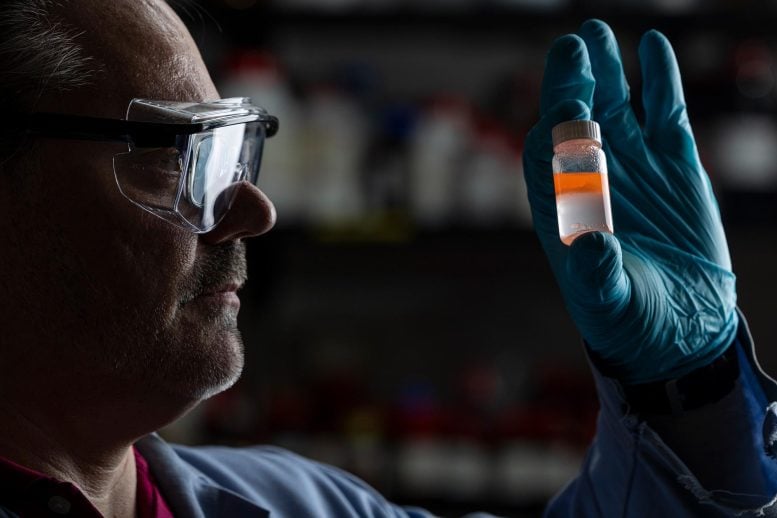
Gary Baker, an associate professor in the University of Missouri’s Department of Chemistry, looks at a bottle of a new liquid-based solution that eliminates more than 98% of microscopic plastic particles from water. Credit: Sam O’Keefe/University of Missouri
“Nanoplastics can disrupt aquatic ecosystems and enter the food chain, posing risks to both wildlife and humans,” said Piyuni Ishtaweera, a recent alumna who led the study while earning her doctorate in nano and materials chemistry at Mizzou. “In layman’s terms, we’re developing better ways to remove contaminants such as nanoplastics from water.”
Innovative Purification Methods
The novel method — using water-repelling solvents made from natural ingredients — not only offers a practical solution to the pressing issue of nanoplastic pollution but also paves the way for further research and development in advanced water purification technologies.
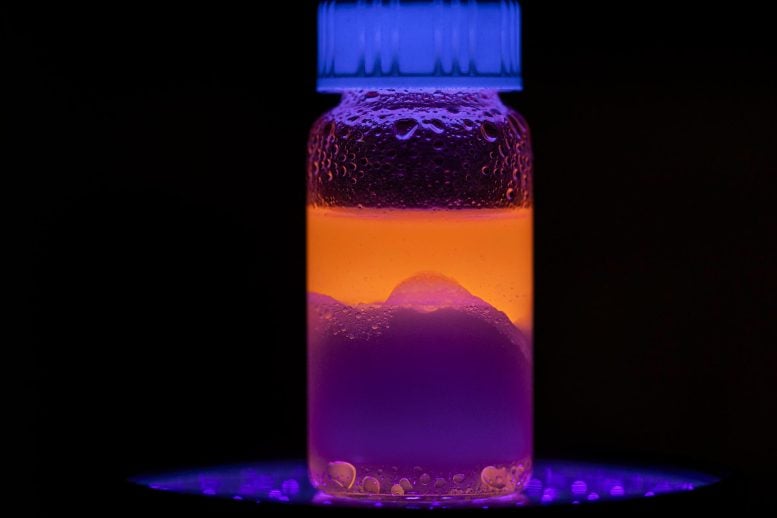
Once mixed with water and allowed to reseparate, the solvent floats back to the surface, carrying the nanoplastics within its molecular structure. Credit: Sam O’Keefe/University of Missouri
“Our strategy uses a small amount of designer solvent to absorb plastic particles from a large volume of water,” said Gary Baker, an associate professor in Mizzou’s Department of Chemistry and the study’s corresponding author. “Currently, the capacity of these solvents is not well understood. In future work, we aim to determine the maximum capacity of the solvent. Additionally, we will explore methods to recycle the solvents, enabling their reuse multiple times if necessary.”
Scaling and Future Applications
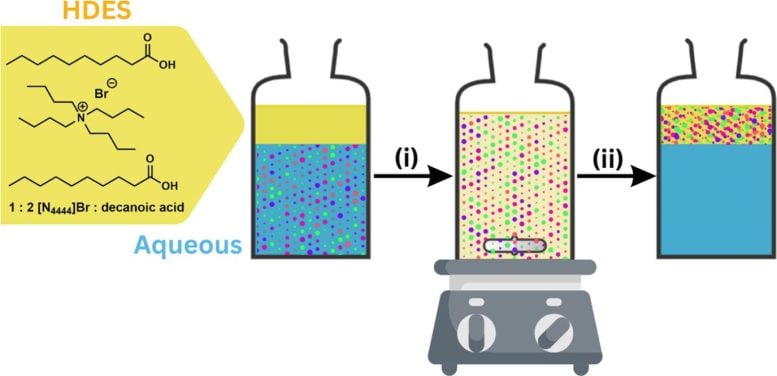
Initially, the solvent sits on the water’s surface the way oil floats on water. Once mixed with water and allowed to reseparate, the solvent floats back to the surface, carrying the nanoplastics within its molecular structure.
In the lab, the researchers simply use a pipette to remove the nanoplastic-laden solvent, leaving behind clean, plastic-free water. Baker said future studies will work to scale up the entire process so that it can be applied to larger bodies of water like lakes and, eventually, oceans.
This illustration outlines the two-step extraction method. Credit: Gary Baker
Implications and Next Steps
Ishtaweera, who now works at the U.S. Food and Drug Administration in St. Louis, noted that the new method is effective in both fresh and saltwater.
“These solvents are made from safe, non-toxic components, and their ability to repel water prevents additional contamination of water sources, making them a highly sustainable solution,” she said. “From a scientific perspective, creating effective removal methods fosters innovation in filtration technologies, provides insights into nanomaterial behavior and supports the development of informed environmental policies.”
The Mizzou team tested five different sizes of polystyrene-based nanoplastics, a common type of plastic used in the making of Styrofoam cups. Their results outperformed previous studies that largely focused on just a single size of plastic particles.
Reference: “Nanoplastics Extraction from Water by Hydrophobic Deep Eutectic Solvents” by Piyuni Ishtaweera, Colleen L. Ray, Wyland Filley, Garrett Cobb and Gary A. Baker, 4 June 2024, ACS Applied Engineering Materials. DOI: 10.1021/acsaenm.4c00159
Researchers at The University of Texas at Austin have developed a way to fingerprint forever chemical pollution, which could help authorities trace them to their source when they end up in aquifers, waterways or soil.
Tracking forever chemical pollution involves passing samples through a strong magnetic field and then reading the burst of radio waves their atoms emit.
This reveals the composition of carbon isotopes in the molecule and gives the chemical its fingerprint, a feat that had not previously been achieved with forever chemicals.
According to Cornelia Rasmussen, a research assistant professor at the University of Texas Institute for Geophysics at the Jackson School of Geosciences, the work is important because it allows scientists to track the spread of forever chemicals in the environment.
It’s previously been difficult to track forever chemical pollution
The super strong molecular bonds that give forever chemicals their handy characteristics — which are put to use in everything from fire retardants to non-stick surfaces and slow-release drugs — also keep them from breaking down in the environment, causing them to build up as pollution in soil and organic material to which they easily stick.
The U.S. Environmental Protection Agency plans to regulate forever chemical pollution, which includes PFAS, and eliminate most of it from drinking water.
However, the molecular bonds of the chemicals also make them difficult to trace. Conventional chemical fingerprinting involves breaking molecules apart in a mass spectrometer, which doesn’t work well with the tough molecular bonds of forever chemicals.
Instead, the researchers turned to a technology called nuclear magnetic resonance (NMR) spectroscopy, which measures a molecule’s structure and identifies its isotopes without breaking it apart.
Determining a mix of carbon isotopes
Isotopes refer to chemical elements with differences in the number of neutrons in their atoms. Forever chemicals are made by bonding carbon isotopes to the element fluorine, which almost never happens in nature. Once the molecular bonds form, they are virtually unbreakable.
Because the mix of carbon isotopes bonding to each fluorine atom is unique to how the chemical was manufactured, this information can be used like a fingerprint to trace forever chemical pollution.
“Part of the reason this has worked out so well is because we’re assembling tools from different areas of science that don’t normally mix and using them to do something no one’s really done before,” explained David Hoffman, an associate professor at the Department of Molecular Biosciences in UT’s College of Natural Sciences.
Piloting the technique for commercial use
The researchers tested their technique on samples that included pharmaceuticals and a common pesticide. Rasmussen and Hoffman are now conducting a pilot study to see how the technique will fare on pollutants that show up in the city of Austin’s creeks and wastewater.
If successful, the technique could be useful for state and federal agencies who want to track the spread of water-borne forever chemical pollution.
Rasmussen said that the work has opened up a new layer of isotope information in organic chemistry that could find many applications beyond tracking forever chemicals, such as detecting counterfeit drugs or astrobiology.
A new study suggests that two of the planet’s most pressing environmental stressors – plastic pollution and seawater flooding – have the potential to alter the growth and reproductive output of coastal plants.
The study is one of the first to examine the combined effects of seawater flooding and microplastic pollution on coastal plants.
It showed that both stressors had some effects on the species tested, with microplastics impacting the plants’ reproduction while flooding caused greater tissue death.
The research is published in Environmental Pollution.
BIO-PLASTIC-RISK: Assessing the impact of environmental stressors
The study was carried out as part of BIO-PLASTIC-RISK, a £2.6m project led by the University of Plymouth and supported by the Natural Environment Research Council.
It focused on buck’s horn plantain, a low-growing coastal plant native to Europe, Asia and North Africa – but also found in the United States, Australia, and New Zealand – which commonly grows in sand dune and beach shingle coastal habitats.
Coastal plants were grown in soil containing conventional or biodegradable plastics for 35 days before being flooded with seawater for 72 hours, replicating the kinds of flooding events increasingly associated with storms and coastal storm surges.
“On a global scale, habitats such as coastal dunes and grasslands help protect communities in the form of coastal defences and wind protection.
“They also play a critical role in supporting biodiversity but are coming under increasing threat from climate change and a number of other environmental factors,” explained Dr Mick Hanley, Associate Professor in Plant-Animal Interactions and senior author of the study
Exposure to combined stressors further affects coastal plants
Being exposed to microplastics and flooding together—a threat likely to increase due to climate change and plastic use—had a more pronounced impact on the resource allocation of coastal plants.
This led to coastal plants exhibiting altered growth and experiencing a short-term suppression in their photosynthetic efficiency.
These responses affect the plant’s ability to capture water, nutrients and sunlight and contribute to ecosystem wellbeing.
The researchers said this signposts the potential for microplastics to present an elevated risk when in combination with additional stressors like seawater flooding. As a result, establishing the threats presented by multiple co-occurring stressors on ecosystem resilience is a priority.
Dr Winnie Courtene-Jones, the study’s lead author, said: “This research highlights the potential for microplastics, composed of conventional and biodegradable plastic, to detrimentally affect plant functioning.
“It also indicates that the effect of microplastics can be magnified by other environmental factors, such as rising sea levels and coastal flooding.
“Studies such as this help us appreciate the potential harm posed by microplastics to a range of organisms and ecosystem resilience generally.”
Dr Hanley concluded: “This study emphasises that we should not be looking at those threats in isolation as put together, their impacts can be more pronounced.
“That is particularly worrying given that both microplastic pollution and coastal flooding are projected to worsen and intensify over the coming decades unless ambitious global actions are implemented.”
Dr Thomas Shahady of the Center for Water Quality at the University of Lynchburg, outlines how E. coli and its contribution to water pollution could help improve detection strategies.
Our freshwater streams and rivers are under siege. An abundance of scientific literature warns about the dangers of water pollution and, in particular, sediment plaguing these systems. What is happening? Why is this occurring? Why are we not stopping it?
I believe it is our approach. We sample water and draw upon causal relationships. We look at land use surrounding at a particular study site and assume that the water running over surrounding land generates resultant problems. We point to agriculture dumping tonnes of nutrients or urbanisation generating excessive water flow and eroding stream banks.
Sewage, livestock, and failing septic systems flowing into streams cause health concerns and outbreaks. All these concerns exist, but are they the primary problem? I suggest they are not.
The presence of E. coli in freshwater
E. coli is a ubiquitous bacterium used as an Indicator Microorganism (IM). Studies suggest that as IMs increase, so does the likelihood of disease-bearing pathogens in water.
But this relationship is causal. The mechanisms producing elevated E. coli in freshwater may be more emblematic of water pollution and, in particular, sedimentation than any elevation in health concerns.
Sedimentation is understood as a wicked problem’ without any discernable solution. It is a fundamental part of the landscape where stream channels carve and meander through time and over vast stretches.
Streams are known to accumulate fine sediments, and the study of stream morphology or shape is the science of understanding the sediment–stream channel relationship.
But at this point in history, streams are simply overwhelmed with sediment and with increasing loading as land is disturbed, and stream channels beckon for any solution to return them to a greater sense of normalisation.
Issues with pollutant testing methods
This is where the idea of E. coli as a surrogate is suggested. Understandably, this bacterium is a good indicator species for water health as it associates with gut flora from warm-blooded animals and correlates well with sewage and animal faecal wastes.
But it is not a benign organism once released into the environment. Studies have provided good evidence that not only does it associate with sediments, but it thrives there even multiplying with the ability to generate very high levels.
Once disturbed or released, it will cause very high readings of water pollution well above any suggested regulatory level.
Therefore, streams carrying an ever-burgeoning sediment load with an abundance of E. coli growing and thriving in the sediments may now overwhelm us as an IM. We need to ask the questions to determine how much E. coli observed in our testing is generated in the stream itself.
How much is supplanted from external sources and then measured in the system simply when the sediment is disturbed? How are we supposed to discern land use impact or septic tank problems in a stream if the system is overwhelmed with our best indicator microorganism?
Understanding the use of E. coli as a surrogate
While studies are ongoing working to discern between the instream and external loading of these sediments, external and internal E. coli is not easily understood. This is particularly concerning as this problem may mask an ability to pinpoint the exact location of pollutants.
Furthermore, it may suggest greater contamination exists in an area (such as agriculture) when, in reality, the high readings may reflect build-up in the area due to sediment and bacteria collecting in the area.
Fig. 2: Stream system overburdened with sediment. This sediment has an extremely high E. coli count associated with it making our ability to measure where the sediment has originated from
E. coli may be a better expression of sedimentation than any other freshwater problem. Arguably, billions of dollars are spent worldwide to improve water quality and lower E. coli to acceptable levels.
Stream restoration is ongoing and best management practices are another industry selling stream improvements. What if the system is so bogged down with legacy sediment that all of this effort will not be realised until this sediment is flushed out in the oceans? Are the streams even possible to cleanse as ever more sediment is continually added through land disturbance? How can we decide what is effective if we cannot measure it?
Perhaps overwhelming concentrations of E. coli in streams are telling us we can’t—we have hit a point in time when there is a level of degradation at which improvement is fleeting and won’t be realised for many more generations.
Gauging how water is responding to clean up efforts
Environmental improvements to tackle water pollution are often competing with each other. For example, the overwhelming movement to remove dams to allow rivers to return to a more natural pattern is also unleashing decades of trapped sediment.
Fencing cattle and land improvements to minimise erosion can be offset by developing farmland into sub-developments. As we work on improvements in one area of the river, it is getting worse somewhere else. The overwhelming sedimentation demonstrates this plague on a healthy stream.
E. coli may be the measure to gauge how the river is responding.
Even molecular techniques are difficult to discern. While Bacteroides is a good source indicator, these tests are expensive and do not identify the bacteria multiplying in the sediment as it does not discern between dean and living source genetic material. Hence, you may have strong increases in E. coli without any concurrent source identification.
If the predominant source of bacteria is the river itself, we have lost the ability to monitor for contamination. Rivers need to cleanse themselves of excessive sedimentation to improve these techniques, helping us pinpoint pollutant sources and clean them up.
Streamlining the water recovery process
I believe an evolution needs to occur in our use of E. coli indicators.
In highly impacted watersheds, this test demonstrates sedimentation, and excessive readings suggest excessive sedimentation. We can track improvements or flushing by observing the lowering of E. coli levels through time. In many instances, rivers just need time to recover.
Once a river or stream has hit a point of recovery, this test will allow us to pinpoint areas of concern and needed improvement.
However, this will only occur when the river has improved, and sediment has been flushed through the system.
This is why this test is so important—it can show the level of improvement over time and then fine tune our restoration efforts.
It truly is an indicator, and when we expand our thinking toward what it is actually indicating, we can push toward much-needed improvements in water pollution strategies.
The Government has announced a rapid review of the Environmental Improvement Plan (EIP) to be completed by the end of the year to deliver legally binding environmental targets and save nature.
The Government will develop a new statutory plan to protect and restore the UK’s natural environment with delivery plans to meet each of its ambitious environmental targets.
This will focus on cleaning up our waterways, reducing waste across the economy, planting millions more trees, improving air quality and halting the decline in species by 2030.
The review will engage with stakeholders across the environment and nature, farming, resources, waste, and water sectors, working with businesses, local authorities, and civil society across the country to develop new ambitious plans to save nature.
This covers the actions taken under the previous government to deliver environmental targets between 1 April 2023 and 31 March 2024 and reveals the dire state of the natural environment.
The all-species indicator has shown an overall decline to around 69% of its starting value in 1970. In Great Britain, 16% of species are threatened with extinction.
Beach litter remains abundant on UK coastlines, with plastic items constituting over 88% of the total litter collected.
Secretary of State for the Environment, Food and Rural Affairs, Steve Reed, said: “Britain is one of the most nature-depleted countries in the world.
“Our animal species face extinction. Our precious landscapes are in decline. Our rivers, lakes and seas are awash with sewage and pollution. Air pollution continues to plague our towns and cities.
“That is why today we begin to chart a new course. Working with civil society, business and local government, we will develop an ambitious programme to turn the tide and save nature.”
Commitments to environmental targets
The Government is committed to protecting and restoring nature and delivering environmental targets.
The Secretary of State has set out five new priorities for the government:
Clean up rivers, lakes and seas
Create a roadmap to move Britain to a zero-waste economy
Boost food security
Ensure nature’s recovery
Protect communities from dangers of flooding
“We are facing a crisis point…but the work of change has begun”.
This review is an important step in turning the page on nature recovery and will provide the foundations for delivering these targets.
This includes the Government’s manifesto promise to expand nature-rich habitats such as wetlands, peat bogs and forests so people can enjoy and wildlife can thrive, including on public land.