Tag: Science China Press

  • Enhancing Catalysis With Co-Cu Alloy Nanoparticles

    Enhancing Catalysis With Co-Cu Alloy Nanoparticles

    [ad_1]

    Cu Mediated Controllable Preparation and Performance Optimization for Co Nanoparticles

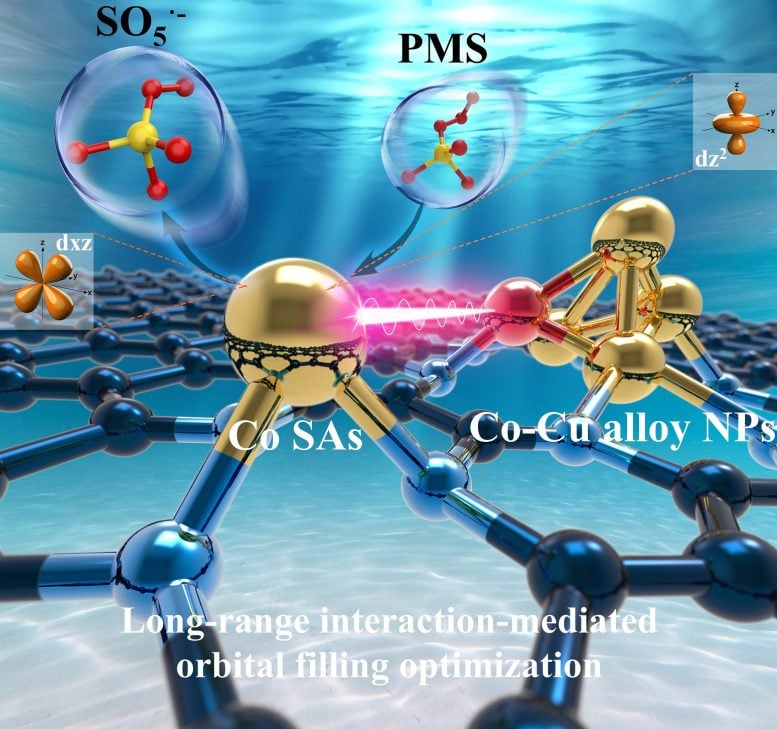
    Cu heteroatoms in Co nanoparticles−mediated long−range interaction regulates dz2/dxz orbital occupancy of satellite Co single atom to enhance Fenton−like reaction. Credit: Science China Press

    Scientists have developed Co-Cu alloy nanoparticles that efficiently activated chemical reactions for pollutant degradation, outperforming traditional methods and providing insights into atomic-level interactions in catalysts.

    Recent research has focused on the combined effects of atomic clusters (ACs) or nanoparticles (NPs) and single atoms. However, prior studies have typically concentrated on basic interactions between pure NPs and single atoms (SAs), offering a limited perspective. They have not fully explored how modifications to NPs or ACs could enhance the overall activity of the complete metal NPs/ACs@M-N-C entity. Consequently, there is still much to learn about the precise construction and performance enhancement of the entire metal NPs/ACs@M-N-C structure.

    In a new study, Co-Cu alloy NPs@Co-N-C (CC@CNC) was constructed using Co/Cu-modified zeolitic imidazolate framework-8 (ZIF-8) as precursor, followed by the pyrolysis and acid etching. The incorporation of Cu-induced formation of Co-Cu alloy NPs, originating from the low Tammann temperature of Cu, which was verified by the negative cohesive energy of Co10Cu3 (−0.06454, intending to aggregation) compared to that of Co13 (+1.690995, intending to dispersion).

    Enhanced Efficiency in Chemical Reactions

    The Co-Cu alloy NPs-supported Co SAs showed superior PMS activation efficiency compared to Co NPs-supported Co SAs (Co NPs@Co-N-C, C@CNC), evidenced by the decreased energy barriers of PMS adsorption (increased Co–O bond length)/PMS oxidation (increased O-H bond length and decreased O-O bond length) and SO5·- desorption (increased Co-O bond length), through optimizing dz2-O (PMS) and dxz-O (SO5·-) interaction.

    Therefore, the CC@CNC highly efficiently removed 80.67% of 20 mg/L carbamazepine (CBZ) within 5 min, which was superior to the C@CNC counterpart (58.99% within 5 min). The serial quasi in situ techniques indicated the occurred PMS oxidation reaction on Co SAs, which can selectively generate 1O2 to effectively eliminate CBZ. This study can lay a solid foundation for the performance optimization strategy and underlying mechanism revelation in metal multiple-atom assembly@metal SAs catalysts at the atomic orbital level.

    Reference: “Cu-optimized long-range interaction between Co nanoparticles and Co single atoms: Improved Fenton-like reaction activity” by Fan Mo, Zelin Hou, Qixing Zhou, Xixi Chen, Weitao Liu, Wendan Xue, Qi Wang, Jianling Wang, Tong Zheng and Zongxin Tao, 11 May 2024, Science Bulletin.
    DOI: 10.1016/j.scib.2024.05.002


    [ad_2]

    Source link

  • Unbiased PEC Cells Achieve Unprecedented Efficiency

    Unbiased PEC Cells Achieve Unprecedented Efficiency

    [ad_1]

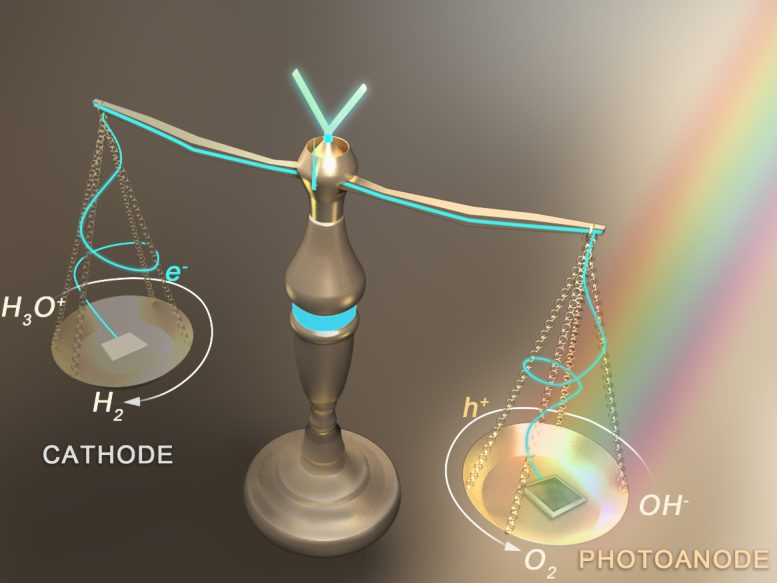
    Concept Art of the Bias Distribution

    The bias distribution of the anode and cathode in the PEC overall reaction cell is like two trays of the balance, and the fulcrum corresponds to the short-circuit potential of the PEC cell. Credit: Science China Press

    Over the last decade, the photoelectrochemical (PEC) process for overall water-splitting (OWS) has seen comprehensive development, particularly in the areas of new catalysts, methods of characterization,, and reaction mechanisms. When comparing the hydrogen evolution reaction (HER) to the oxygen evolution reaction (OER), the latter is considered the more challenging aspect of OWS, primarily due to its sluggish kinetics.

    To reduce the bias consumption of photoanodes, a series of OER alternative half-reactions have been developed, such as alcohols, urea, and ammonia oxidation reactions. The ultimate goal of photochemistry is to fabricate an efficient two-electrode unbiased PEC cell. However, most of the previous studies only focused on the properties of the working electrode in the three-electrode cell, while the polarization on the counter electrode was largely ignored. The synergistic mechanism between anodic oxidation and cathodic reduction half-reactions is still unclear.

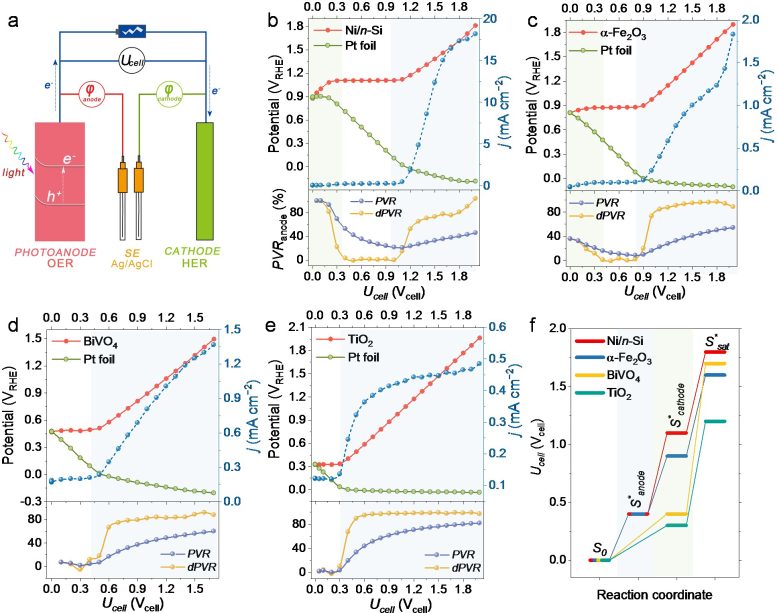
    Schematic of Bias Distribution Measurements and Typical Bias Distribution in PEC OWS Cells

    a) Schematic of bias distribution measurements. b–e) Bias distribution in PEC OWS cells with different photoanodes and f) corresponding OWS activation pathways. Credit: Science China Press

    Recently, Professor Yuchao Zhang’s group proposed an experimental method to measure the bias distribution in a two-electrode PEC cell, systematically studying the bias distribution between representative photoanodes and Pt cathodes in PEC OWS cells. For the first time, they showed that the OER half-reaction is not always the rate-limiting factor of the OWS, and the bias consumption of electrodes depends on the photovoltage of the photoanode and the Fermi level of the cathode.

    Further studies by using Ni/n-Si as the model photoanode showed that the bias distribution in the overall reaction can be effectively adjusted by tuning the electrolyte pH and coupled half-reactions. Accordingly, they proposed a descriptor to evaluate the compatibility between various half-reactions, which pointed out a general method for designing an efficient PEC overall reaction cell. Inspired by this, they fabricated an unbiased PEC cell consisting only of a Ni/n-Si photoanode and a Pt cathode with a photocurrent of 5.3 ± 0.2 mA cm−2.

    Reference: “Bias distribution and regulation in photoelectrochemical overall water-splitting cells” by Kun Dang, Siqin Liu, Lei Wu, Daojian Tang, Jing Xue, Jiaming Wang, Hongwei Ji, Chuncheng Chen, Yuchao Zhang and Jincai Zhao, 06 February 2024, National Science Review.
    DOI: 10.1093/nsr/nwae053


    [ad_2]

    Source link

  • Unlocking the Secrets of Thermoelectric Materials for Future Energy

    Unlocking the Secrets of Thermoelectric Materials for Future Energy

    [ad_1]

    Thermoelectrocatalysis Waste Heat Recycling

    Thermoelectric materials, once primarily focused on converting waste heat to electricity, now facilitate catalytic processes, offering innovative solutions for energy efficiency and environmental enhancements.

    Thermoelectric materials, crucial for converting thermal to electrical energy and reducing waste, have broadened their utility beyond heat recovery to catalysis, driven by natural and industrial heat gradients.

    With the rapid development of human society, the demand for energy has experienced explosive growth. However, at the current stage, the utilization efficiency of primary energy is less than 40%, with the rest being lost in the form of waste heat, leading to serious energy waste and exacerbating environmental issues.

    Thermoelectric materials, as a new energy material capable of directly converting thermal energy to electrical energy, have gained increasing attention in the field of waste heat recovery. When there is a temperature difference at the two ends of thermoelectric materials, a thermoelectromotive force is generated within the material, thus achieving the conversion of thermal energy to electrical energy.

    Emerging Applications of Thermoelectric Materials

    In addition to utilization as electric generators, thermoelectric materials have opened new directions for catalysis in recent years. The small temperature gradient (<100 °C) caused by the widespread heat in nature and industrial production provides sufficient driving force for catalytic reactions.

    This enables the reuse of low-grade waste heat resources to drive different catalysis processes such as hydrogen production, organic synthesis, environmental purification, and biomedical applications. It offers a new solution for improving energy utilization efficiency, energy conservation, emission reduction, and green catalysis.

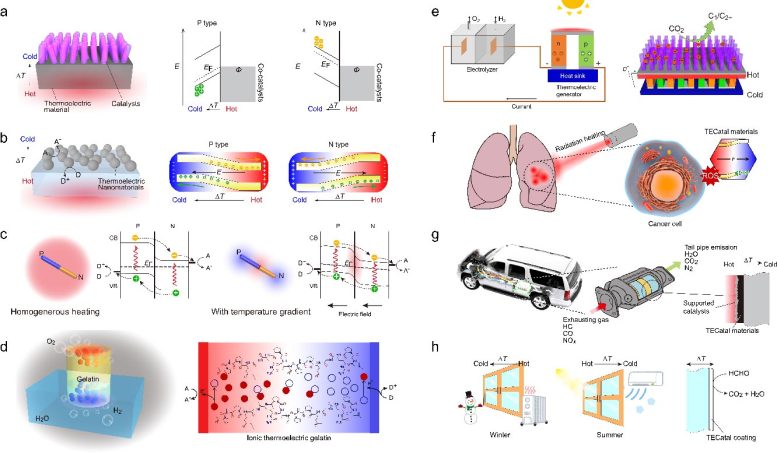
    Working Modes and Potential Applications of Thermoelectrocatalytic Materials

    Working modes of TECatal systems: (a) hybrid structure mode, (b) single-phase mode, (c) P-N nanojunction mode, and (d) thermogalvanic cell mode. Potential applications of TECatal materials in (e) H2 production and CO2 reduction, (f) tumor therapy, (g) vehicle tail gas treatment, and (h) window glass coating for indoor air purification. Credit: Science China Press

    Advances and Future Prospects in Thermoelectrocatalysis

    Based on the recent advances in this emerging area, the team from the Institute of Quantum and Sustainable Technology at Jiangsu University, has proposed the conceptual application direction of thermoelectrocatalysis (TECatal) and systematically summarized existing thermoelectric catalytic materials and working modes. Four major working modes were suggested, including hybrid structure mode, single-phase mode, P-N nanojunction mode, and thermogalvanic cell mode.

    The study explores ways to improve the performance of thermoelectric catalytic materials through optimization of thermoelectric properties, band engineering, microstructures, and stability. Furthermore, the prospects of thermoelectric catalytic materials in areas such as green energy, tumor treatment, and environmental governance were proposed and discussed, providing important references for the future development of this field.

    Reference: “Thermoelectrocatalysis: an emerging strategy for converting waste heat into chemical energy” by Yuqiao Zhang, Shun Li, Jianming Zhang, Li-Dong Zhao, Yuanhua Lin, Weishu Liu and Federico Rosei, 25 January 2024, National Science Review.
    DOI: 10.1093/nsr/nwae036


    [ad_2]

    Source link

  • Unlocking the Mysteries of Open-Shell Catalysts

    Unlocking the Mysteries of Open-Shell Catalysts

    [ad_1]

    Chemistry Catalyst Concept

    New research uncovers how spin effects in iron-catalyzed hydrosilylation influence catalytic behavior, enhancing reaction rates and precision in regioselectivity. This breakthrough offers significant potential for advancing catalyst design.

    Metal complex catalysts can be categorized from the standpoint of their spin states into two distinct types: closed-shell catalysts and open-shell catalysts. Closed-shell catalysts, which do not possess unpaired electrons and are commonly based on noble metals like palladium, have been more thoroughly researched and are prevalently used in industrial applications. In contrast, open-shell catalysts, characterized by their unpaired electrons and frequently derived from more abundant metals like iron, present a differing approach.

    Open-shell catalysts navigate different potential energy surfaces through spin transitions, displaying catalytic behaviors markedly distinct from closed-shell catalysts. This divergence offers exciting new avenues in synthetic chemistry and is garnering increasing interest.

    However, the development of open-shell catalysts is hindered by a limited understanding of their spin effects and a lack of effective control methods. Unraveling these spin effects is crucial for improving the design of crust-abundant metal catalysts and could potentially revolutionize catalysis, a prospect of significant research importance.

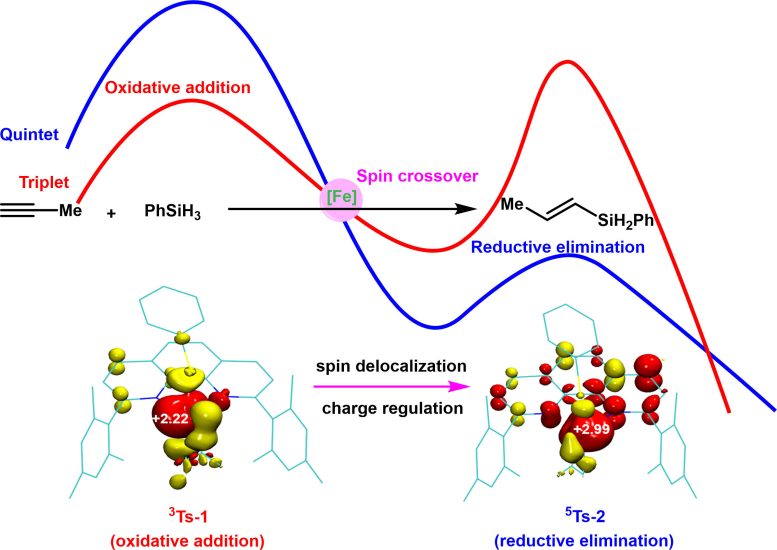
    Schematic Representation of the Spin Effect in Open Shell Iron Catalysts

    The iron-catalyzed hydrosilylation of alkynes undergoes two potential energy surfaces, the triplet (red) and quintet (blue) states, where the spin crossover effectively lowers the reaction energy barrier, and the spin-delocalization between iron and ligand dynamically modulate the oxidation and spin states of the metal center. Credit: Science China Press

    To tackle these scientific challenges, Shou-Fei Zhu’s research group at Nankai University conducted a comprehensive study on the spin effects in iron-catalyzed hydrosilylation of alkynes, blending experimental work with theoretical calculations. They uncovered a novel mechanism where the spin state of open-shell iron catalysts modulates both reactivity and selectivity. These findings are recently published online in the National Science Review, with Peng He, a doctoral student at Nankai University, as the first author.

    Experimental Findings and Theoretical Insights

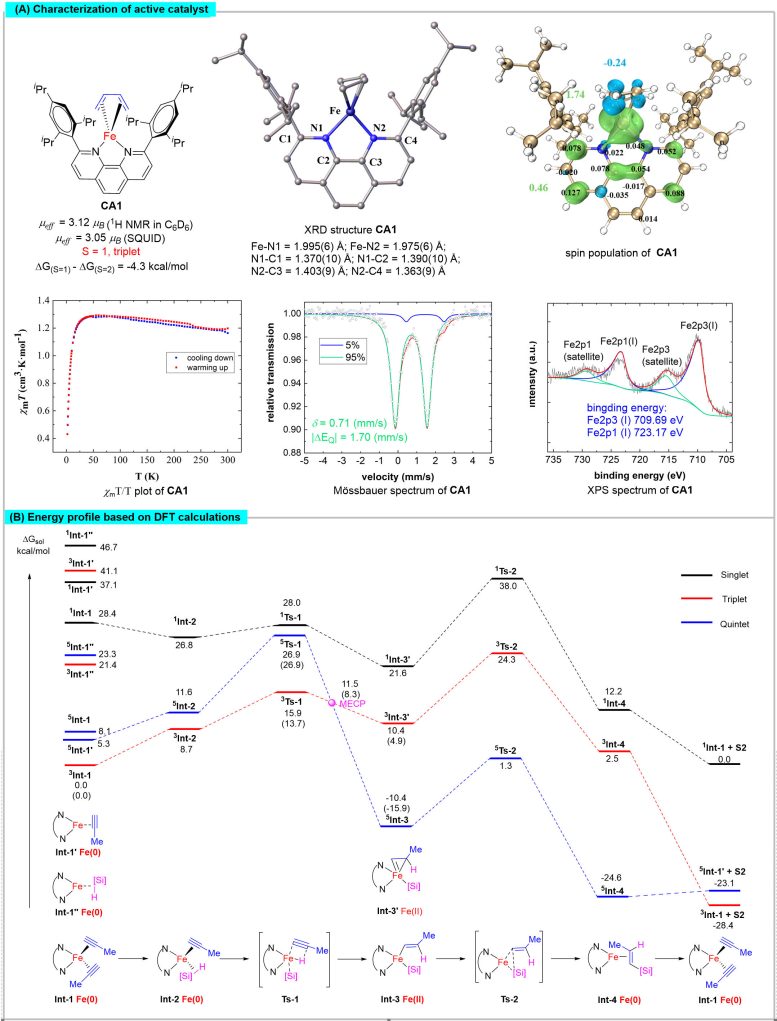
    The team synthesized a range of active iron complexes, whose structures were elucidated through X-ray single-crystal diffraction. They characterized the magnetic properties, metal valence states, and spin multiplicity of the iron center using techniques like superconducting quantum interferometry, X-ray photoelectron spectroscopy, and Mössbauer spectroscopy.

    Synthesis and Characterization of Active Intermediates and Theoretical Calculation of the Reaction

    (A) Characterization of the single crystal structure and related magnetic, valence and spin states of the active catalyst and calculation of the electronic structure; (B) DFT calculations of the energy profile during the reaction. Credit: Science China Press

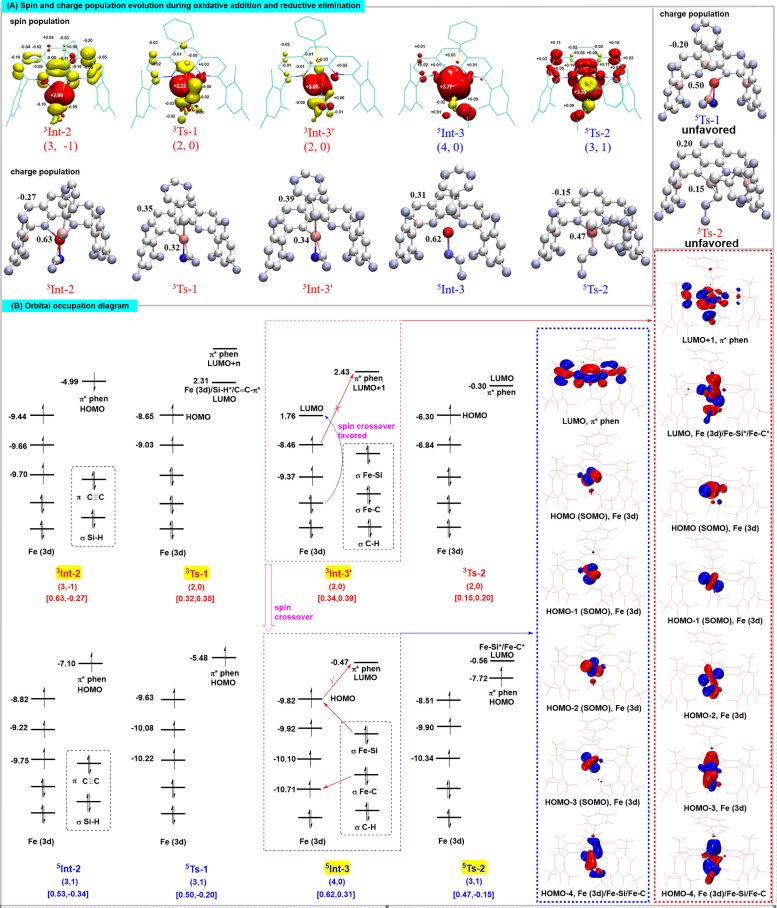
    Theoretical calculations revealed the pivotal role of spin-delocalization interactions between iron and the 1,10-phenanthroline ligand in regulating the spin and oxidation states of the iron center. This regulation forms the structural foundation for the unique spin effects observed in iron catalysts.

    Controlled experiments indicate that the reaction proceeds as a two-electron redox process, catalyzed by zero-valent iron species. These stages occur on potential energy surfaces of different spin multiplicities, with the iron catalyst facilitating transitions between these surfaces through spin crossover. This adaptability fulfills the contrasting electrostatic demands of oxidative addition and reductive elimination, significantly lowering the energy barriers of these elementary processes and thereby enhancing the reaction rate.

    Central Metal Charge Analysis and Orbital Occupation Diagram of Reaction Process

    (A) Spin and charge population changes of key intermediates and transition states during the reaction process; (B) Electronic structure and orbital occupation of key intermediates and transition states during the reaction process. Credit: Science China Press

    Impact on Regioselectivity and Conclusion

    Spin effects also critically influence high regioselectivity. Iron catalysts adjust the spin delocalization states of complexes through specific spin states. These adjustments modulate the intramolecular noncovalent interactions within transition states, impacting their stability and enabling precise control of regioselectivity.

    In summary, this study elucidates the spin effect in iron-catalyzed hydrosilylation of alkynes. The catalyst dynamically modulates the iron center’s spin and oxidation states through spin-delocalization, promoting both oxidative addition and reductive elimination processes with diametrically opposed electrostatic requirements in the catalytic cycle. Additionally, it influences regioselectivity by altering noncovalent interactions in the transition states. These insights are poised to guide the discovery and application of open-shell catalysts.

    Reference: “Spin effect on redox acceleration and regioselectivity in Fe-catalyzed alkyne hydrosilylation” by Peng He, Meng-Yang Hu, Jin-Hong Li, Tian-Zhang Qiao, Yi-Lin Lu and Shou-Fei Zhu, 20 December 2023, National Science Review.
    DOI: 10.1093/nsr/nwad324


    [ad_2]

    Source link