Tag: The Innovation Platform Issue 20

  • How Earth Observation satellite data is used to benefit society

    How Earth Observation satellite data is used to benefit society

    [ad_1]

    The UK Space Agency outlines its role as Chair of the Committee on Earth Observation Satellites (CEOS) in utilising satellite data to tackle global challenges.

    The UK Space Agency recently assumed the Chair of the Committee on Earth Observation Satellites, marking a significant milestone for the UK in the global space community. This transition positions the UK at the forefront of international efforts to enhance the utility and impact of Earth Observation (EO) data.

    The handover ceremony, held on 24 October at the CEOS Plenary in Montreal, saw the UK Space Agency’s Chief Executive, Dr Paul Bate, take on the role of CEOS Chair for 2025. Taking on this high-profile position underscores the UK’s commitment to leveraging space-borne observations to address some of the most pressing global challenges. As the new Chair, the UK Space Agency will lead CEOS in its mission to coordinate civil space-borne observations of the Earth, ensuring that satellite data is effectively used to benefit society.

    One of the primary goals of the UK Space Agency is to unlock the power of Earth Observation satellite data. This involves enhancing the accessibility and usability of satellite data for various applications, from improving public services to inspiring the next generation through initiatives like CEOS in Schools, with a Youth Summit planned to be held at the UK’s CEOS Plenary in Bath in November 2025.

    The UK’s leadership in CEOS comes at a crucial time. As The Innovation Platform celebrates its 20th edition, CEOS celebrates its 40th anniversary and renews its collective commitment to addressing global challenges through the Montreal Statement.

    Earth Observation plays a pivotal role in the UK space sector, providing invaluable data for a wide range of applications. The UK is a world leader in Earth Observation tools, technologies, and data use, with a portfolio of activities spanning the entire value chain. From early technology development to missions and the harnessing of trusted data for use by a variety of businesses, the UK Space Agency champions the sector’s growth and innovation.

    Earth Observation satellite data for climate monitoring

    One of the key areas where Earth Observation data is making a significant impact is climate monitoring. Satellites provide a unique vantage point to observe the Earth’s climate system, offering critical data for understanding and mitigating the effects of climate change. The UK Space Agency’s role in CEOS will involve leading discussions on national strategies to drive the uptake of Earth Observation data for public service and climate action. This includes working closely with international partners to ensure that satellite data is fully utilised in global climate initiatives, such as the UNFCCC Global Stocktake, a process for evaluating progress on climate action at a global level and identifying gaps.

    earth observation satellites
    © ESA

    At the national scale, the UK Space Agency recently funded a series of grants that aim to foster climate services innovation by developing UK business-viable ideas using space data to address the impacts of climate change. These services will help identify opportunities for green financing that could support sustainable business growth.

    The UK is also involved in a range of Earth observation missions that contribute to global capabilities. These include the European Space Agency’s TRUTHS mission, which will improve confidence in climate forecasts; Biomass, which will monitor the world’s forests; Microcarb, a ground-breaking French-UK satellite mission for carbon monitoring; and the various Sentinel missions of the European Copernicus programme with its associated services.

    Earth Observation and the role of Copernicus

    The Copernicus programme, a European system established in 2014 that uses satellites and other technologies to monitor the Earth, provides a wealth of data and sophisticated services that are crucial for managing our environment, understanding and tackling the effects of climate change, and safeguarding everyday lives. The programme’s free and open data policy has driven an increased uptake in the use of space-generated data, benefiting not only the government and academic sectors but also UK businesses. Since its operations began, the mission has generated over 30 PB of data, with more than 14 million products made available to users to date.

    The upcoming launch of the Sentinel 1C satellite on December 3, 2024, is a key mission under the Copernicus programme. This satellite will provide enhanced continuity for the constellation’s capabilities by delivering high-resolution radar imagery and data essential for monitoring environmental changes and supporting climate action. Sentinel 1C will focus on delivering critical information for disaster response, land and ocean monitoring, and ice observation.

    Earth Observation for disaster management and infrastructure

    In addition to climate monitoring, Earth Observation data is essential for disaster management. Satellites can provide real-time data on natural disasters, such as hurricanes, floods, and wildfires, enabling timely and effective response efforts.

    The UK space sector’s commitment to Earth Observation extends beyond environmental monitoring. Satellite data is also used for urban planning, clean energy, and biodiversity monitoring. For instance, it can help cities plan for sustainable growth by providing insights into land use, infrastructure development, and environmental impact. Similarly, satellite data can support the transition to clean energy by identifying optimal locations for renewable energy projects and monitoring their performance.

    © ESA

    The UK Space Agency’s leadership in CEOS will focus on exploring strategies to bridge the gaps between this satellite data and its users, ensuring that this valuable information is accessible to those who need it most.

    Earth Observation and international collaboration

    The UK’s leadership in CEOS also highlights the importance of international collaboration in the space sector. By working with other space and meteorological agencies, the UK Space Agency aims to promote the goals and objectives of CEOS on the global stage. This includes participating in key international events, such as the recent COP-29 in Baku, Azerbaijan, ESA’s Living Planet Symposium in Vienna in June, and the UK hosting the CEOS Plenary in Bath in November 2025.

    These efforts will ensure that the UK remains at the forefront of global Earth Observation initiatives, driving innovation and fostering collaboration across the international space community.

    The UK’s role as CEOS Chair represents a unique opportunity to lead global efforts in using satellite data to address some of the most pressing challenges facing humanity. From climate action and disaster management to urban planning and clean energy, Earth Observation data has the potential to transform the way we understand and interact with our planet. The UK Space Agency’s leadership in CEOS will be instrumental in unlocking this potential, ensuring that satellite data is effectively used to benefit society and drive sustainable development.

    Please note, this article will also appear in the 20th edition of our quarterly publication.

    [ad_2]

    Source link

  • Tackling the global threat of antimicrobial resistance

    Tackling the global threat of antimicrobial resistance

    [ad_1]

    The World Health Organization details the issue of antimicrobial resistance and sets out the actions that need to be taken to reduce the threat.

    Driven by the misuse and overuse of antimicrobials, antimicrobial resistance (AMR) is one of the top global public health and development threats. AMR is a problem for all countries at all income levels and tackling it requires the efforts of everyone across the globe.

    The complexity of the AMR issue means that it requires both sector-specific actions in the human health, food production, animal and environmental sectors, and a co-ordinated approach across these sectors. During the 2015 World Health Assembly, countries adopted the Global Action Plan (GAP) on AMR with a commitment to the development and implementation of multisectoral national action plans with a One Health approach to tackle AMR. One Health refers to an integrated, unifying approach that aims to achieve optimal and sustainable health outcomes for people, animals, and ecosystems. The GAP was subsequently endorsed by the Governing Bodies of the Food and Agriculture Organization of the United Nations (FAO), the World Organisation for Animal Health (WOAH, formerly known as OIE), and the United Nations Environment Program (UNEP).

    To learn more about the severity of the AMR threat and what actions can be taken by us all to reduce it, The Innovation Platform spoke to the World Health Organization.

    How much of a global burden is AMR?

    Antimicrobial resistance is a major global threat, putting modern medicine, food supplies and economies at risk.  The emergence and spread of drug-resistant microbes threaten our ability to treat common infections and conduct life-saving procedures like chemotherapy, caesarean sections, organ transplants, and other routine procedures.

    It is estimated that bacterial AMR alone is the direct cause of more than 1.25 million global deaths and a contributing factor to approximately five million deaths per year.

    Although AMR is a challenge that affects countries in all regions and of all income levels, low- and middle-income countries (LMICs) are more affected, as health systems are less able to prevent, diagnose, and treat infections. Limited access to affordable vaccines, antimicrobial medicines and diagnostics, as well as lack of clean water, sanitation and hygiene (WASH) and poor infection prevention and control, also increase the threat of AMR.

    The World Bank estimates that, by 2030, AMR is expected to cause a yearly global economic loss of up to $3.4tn, and that associated costs are expected to push 28 million people into extreme poverty.

    What is driving the increase in AMR?

    The spread of AMR is largely driven by the overuse and misuse of antimicrobials in human and animal health, as well as in agriculture.

    When antimicrobials are used incorrectly or excessively, resistant microbes emerge and spread, making that specific antimicrobial ineffective against subsequent infections caused by those microbes. The result is that another antimicrobial must then be used, which, if again, overused or misused, may result in further resistance, leading to fewer or no options for treating that infection.

    antimicrobial resistance
    © shutterstock/Alena Matrosova

    It is a vicious cycle, and one that is speeding up. Since the 1930s, the introduction of new antibiotics has been followed by the emergence of resistance, usually within a decade. Whereas, since the 1980s, the emergence of resistance now tends to happen faster, usually within three years. This can be due to a number of factors, including increased antibiotic use, globalisation and travel, environmental contamination, inadequate infection control, the lack of antibiotics, and the rapid adaptability of bacteria.

    Meanwhile, the pipeline of new antibiotics is drying up; only 13 new antibiotics were introduced to the market between 2017 and 2023. In part, due to low profitability but also high development costs, regulatory challenges, and bacterial adaptation.

    Difficulties in vaccine development also arise from scientific complexity, rigorous testing requirements, funding shortfalls, public perception issues, and unfavourable market dynamics.

    Other factors which contribute to the spread of AMR include poor infection and disease prevention; limited awareness and training on AMR among key stakeholders; and lack of enforcement of relevant laws and policies. A lack of investments in strengthening primary healthcare in most LMICs, supporting veterinary services, and enhancing bio-security measures in animal food production also contribute to the AMR challenge.

    How is the WHO working to tackle the issue of antimicrobial resistance? How are you collaborating with other organisations to do so?

    WHO, the Food and Agriculture Organization of the United Nations (FAO), the UN Environment Programme (UNEP), and the World Organisation for Animal Health (WOAH) have joined forces to respond to AMR through a ‘One Health’ approach, covering human, animal, food security, and environmental health.

    Known as the Quadripartite, the four organisations, co-ordinated through a Joint Secretariat hosted by WHO, collaborate on global advocacy, technical guidance, and political engagement to address the threat of AMR.

    WHO developed the Strategic and operational priorities to address drug-resistant infections in the human health sector, 2025-2035. These priorities provide a guiding framework for accelerated national and global actions, aligned with strategies developed by WHO regional offices, and based on a people-centred approach and core package of interventions.

    WHO also collaborates with a range of stakeholders to strengthen global AMR surveillance to enhance the accuracy and reliability of AMR estimates. This data-driven approach improves accountability and supports countries in tracking their progress against national action plans. They can also track progress against the UN SDG indicator ( 3.d.2) that tracks blood-stream infections due to two drug-resistant pathogens.

    By providing guidance, tools and technical support to national public health authorities, WHO also supports countries to implement National Action Plans to curb the spread of AMR.

    What is needed to hit the target of a 10% reduction in human deaths from AMR by 2030? Is it looking like a feasible target currently?

    Achieving a 10% reduction in human deaths from AMR by 2030 will require strong commitment and accelerated, co-ordinated action. Following the recent High-Level Meeting on AMR at the UN General Assembly, leaders at the 79th UN General Assembly must now translate the commitments in the political declaration into action across human health, agriculture, and environmental sectors. This includes securing sustainable financing, with a goal of mobilising at least $100m to support national AMR action plans, particularly in low- and middle-income countries.

    antimicrobial resistance
    © shutterstock/nobeastsofierce

    Essential actions include improving infection prevention, enhancing surveillance, and promoting antimicrobial stewardship to ensure appropriate use of medicines. Expanding the One Health model to address environmental factors is also critical, as is embedding AMR efforts within broader public health frameworks achieving Universal Health Coverage, through strengthening primary healthcare.

    It looks like a feasible target based on a modelling exercise undertaken by Lewnard et al. 2024, Mendelson et al. 2024 as part of The Lancet Series on Antimicrobial Resistance: The need for sustainable access to effective antibiotics.

    National action plans enumerate many interventions as potential strategies to reduce the burden of bacterial antimicrobial resistance (AMR). In a modelling analysis, the authors estimated that improving infection prevention and control programmes in low-and middle-income healthcare settings could prevent at least 337,000 (95% CI 250,200-465,200) AMR-associated deaths annually. Ensuring universal access to high-quality water, sanitation, and hygiene services would prevent 247,800 AMR-associated deaths. Additionally, paediatric vaccines would prevent another 181,500 AMR-associated deaths. This can be achieved from both direct prevention of resistant infections and reductions in antibiotic consumption.

    These estimates translate to prevention of 7.8% (5.6–1.0) of all AMR-associated mortality in LMICs by infection prevention and control, 5.7% (3.7–8.0) by water, sanitation, and hygiene, and 4.2% (3.4–5.1) by vaccination interventions. Their findings indicate that reducing global AMR burden by 10% by the year 2030 is achievable with existing interventions – but these prevention strategies must be complemented by greater efforts to establish national structures to optimise the use of antimicrobials, greater awareness and training, and ensuring access to basic health services, timely diagnosis, and safe and quality-assured medicines.

    Please note, this article will also appear in the 20th edition of our quarterly publication.

    [ad_2]

    Source link

  • Realising fusion energy’s potential in Europe

    Realising fusion energy’s potential in Europe

    [ad_1]

    Massimo Garribba, Deputy Director-General responsible for the co-ordination of EURATOM policies in the Directorate-General for Energy at the European Commission, details Europe’s journey towards the realisation of fusion energy.

    As Europe works towards achieving net zero targets and sustainability goals, could fusion – powering the sun and stars – be the energy of the future?

    With a long history in fusion science and technology, Europe is well positioned as a leader in the journey to fusion commercialisation. Most notably, Europe is home to one of the most ambitious energy projects in the world – ITER, located in southern France. ITER is a major international collaboration working to build the world’s largest tokamak – an experimental machine designed to validate the scientific and engineering viability of fusion energy. ITER Members will then be able to be design their prototype or demonstration power plants on the basis of ITER construction experience, technological and scientific results. This will further drive the transition from a scientific experiment to fusion commercialisation.

    The EU also co-funds EUROfusion consortium through the Horizon Europe Euratom Research and Training Programme. Via this consortium, European fusion laboratories collaborate to further advance the fusion research, design and manufacture systems that are necessary for the future fusion reactors.

    To find out more about Europe’s fusion activities, The Innovation Platform spoke to Massimo Garribba, Deputy Director-General responsible for the co-ordination of EURATOM policies, Directorate-General for Energy, European Commission.

    Can you elaborate on the current state of fusion in the EU?

    The European Union (EU) considers fusion has the potential to provide a safe, cost-efficient and sustainable solution to European and global energy needs in the future. For this reason, the EU has supported for decades cutting-edge research and innovation, with the goal of developing fusion power plants for electricity production for a greener and more sustainable energy mix.

    The EU is part of one of the most ambitious energy projects in the world – ITER. Located in the south of France, ITER is a unique project to build the world’s largest and most advanced fusion machine – a tokamak. Once completed, ITER will be approximately 30m high and 30m wide, weighing 23,000 tonnes. It aims to prove the technical and scientific feasibility of using the fusion process for electricity production. Tokamaks are vacuum-chambered devices designed to replicate on Earth the process of fusion – the energy source of the sun and stars – using a powerful magnetic field generated by superconducting magnets.

    Beyond ITER, the EU collaborates with Japan on fusion activities under the Broader Approach Agreement. This privileged partnership oversees the development of key infrastructures, such as a test facility for fusion materials (The International Fusion Materials Irradiation Facility / Engineering Design and Engineering Validation Activities – IFMIF-EVEDA). The materials to be used in fusion reactors will need to withstand immense temperature and neutron fluence generated during the fusion process. Under the same agreement, the EU and Japan have jointly built a tokamak device known as JT-60SA. This device, located in Naka, Japan, is currently the largest operational superconducting tokamak in the world, after its inauguration in December 2023. JT-60SA was designed to support the operation of ITER by providing a complementary research and development programme.

    Recently, Spain and Croatia have teamed up to lead the development of the International Fusion Materials Irradiation Facility – Demo Oriented Neutron Source (IFMIF-DONES), which is being constructed in Spain. IFMIF-DONES builds on the results of IFMIF-EVEDA and will provide a neutron source essential for further testing and validating materials that will be used in future fusion power plants.

    The EU has also been supporting research in national fusion laboratories and universities, such as the Joint European Torus (JET) in the UK and the Wendelstein 7-X stellarator in Germany. Now, we are looking into opportunities to support joint initiatives between the private and public sectors. For instance, the European Innovation Council has recently awarded a €2.5m grant to a fusion start-up to support progress on the design of its stellarator and the integration of key stellarator components. We are encouraging EU fusion start-ups to work and co-operate with EU fusion laboratories, but also with industrial partners who are part of the current ITER supply chain.

    How can findings from major European fusion activities and organisations such as JET, EUROfusion and ITER inform the future direction of European fusion development?

    Fusion development is a long-term endeavour that requires sustained efforts across various initiatives, including the ones you mentioned.

    ITER is one of the most complex machines ever to be constructed. It is meant to establish a demonstration fusion power plant and there are no shortcuts on this path. ITER will help demonstrate the feasibility of technologies needed for a fusion power plant, bridging the gap between today’s smaller-scale experimental fusion devices and the future demonstration of fusion power plants. Through ITER, scientists will be able to study plasmas under conditions similar to those expected in a future power plant and test essential technologies such as heating, control, diagnostics, cryogenics, and remote maintenance. Moreover, ITER will provide a unique opportunity to test, under real fusion conditions, the production of one of the fusion fuels for future fusion reactors: tritium.

    fusion energy
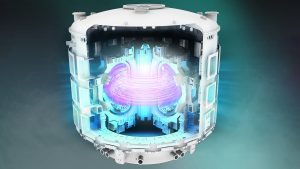
    Illustration of the ITER tokamak © ITER Organization

    In other words, ITER operations and the results of its research and experiments in the production of tritium and construction materials for fusion machines are necessary steps for the EU to transition fusion energy from research to demonstration reactors.

    The findings from major European fusion activities, such as JET and EUROfusion, play a crucial role in informing the future of European fusion development. The JET machine concluded its operational journey on 18 December 2023, over four decades after its inception. It has been fundamental in laying the groundwork for ITER and future fusion power plants through its innovative deuterium-tritium experiments. JET also played a key role in training several generations of fusion scientists and engineers across Europe.

    EUROfusion – a consortium of around 30 national fusion research laboratories across the EU – conducts fusion research under the Euratom Research and Training Programme. This focuses on the development of key fusion-related technologies, advancing training and education, and the development of the conceptual design of a future demonstration fusion power reactor (DEMO). EUROfusion’s co-ordinated efforts continue to drive progress in critical technologies while fostering new generations of fusion experts.

    The collective knowledge obtained from all these different initiatives (e.g. on plasma behaviour, fusion materials, operational challenges, etc.), will shape the future course of European fusion development. Co-ordinated research efforts will help the EU transition from research to industrialisation, paving the way for the development and operation of commercial fusion power plants.

    What are the main bottlenecks preventing fusion energy from being fully realised? How can these be removed?

    There are a series of key technological bottlenecks related to the demonstration of critical technologies of future fusion reactors. For example, the qualification of materials that can withstand the extreme conditions within fusion reactors, or the demonstration of key components’ performance under reactor conditions. The development of plasma scenarios and the remote maintenance design and qualification remain significant challenges as well.

    Another important bottleneck is the demonstration of tritium production within the reactor for fuel self-sufficiency. Fusion reactors rely on tritium, which is scarce in nature. Therefore, future commercial power plants will need to ‘breed’ their own tritium for economic viability. Breeding blanket concepts are being developed, and will need to be tested, to produce tritium fuel directly during the fusion reaction.

    Addressing these challenges is crucial for fusion to transition from experimental reactors to a reliable and sustainable energy source. This can be achieved by the fusion industry and research institutions complementing their knowledge and helping to close the technological gaps affecting the path to fusion energy generation.

    What is needed to enable fusion research and technology to flourish in Europe?

    Several key actions are required to support the growth and development of fusion research and technology.

    Firstly, we need to secure continued and sufficient commitment of financial, technical, and human resources to complete the ITER project. Despite the challenges the project is facing and the rise of private investment in multiple fusion machine designs, ITER remains not only highly relevant, but in fact the centrepiece of global efforts towards the commercialisation of fusion energy.

    Secondly, an appropriate fusion-specific regulatory framework will also facilitate the deployment of fusion technologies. In this regard, the European Commission has launched a dialogue with the European nuclear safety authorities in the European Nuclear Safety Regulators Group on possible regulatory approaches to fusion facilities.

    Thirdly, as indicated in Draghi’s latest report on the future of European competitiveness, we need to create ‘a stable and predictable fusion ecosystem for industrial innovation, leveraging the ITER project, while ensuring a clear technology development roadmap.’ A coherent EU-level approach should be adopted to facilitate research and technology innovation, incentivise private sector engagement, de-risk investments when necessary, and create the environment where private companies and publicly funded research organisations work hand in hand towards a common goal – bringing fusion energy to the grids.

    Finally, once the first commercial power plants are built, there will be a massive industrial effort required to scale up production. Therefore, we will need to support the EU utilities and supply chain industry to be well positioned – either as fusion energy deployers or as key suppliers to leading commercial fusion projects.

    How close do you think Europe is to fusion commercialisation?

    We are seeing several private initiatives working to achieve electricity production with ambitious timelines. Some of them have announced that they will demonstrate significant progress within the next five years, aiming for a technology readiness level (TRL) of 4 or 5 and potential net energy gain or high-power multiplication. These companies plan to complete a pilot plant between 2030 and the mid-2030s. The success of these plants depends on the performance of the upcoming devices, securing further funding, and resolving design, engineering, procurement, and construction issues. We also need to recognise important differences between public and private approaches to fusion technology development: Public initiatives, like ITER, aim to develop the entire fusion system, including fusion-enabling technologies such as blanket breeding and tritium technologies. While it may require more time, this comprehensive approach addresses long-term issues critical to the future commercial deployment of fusion power plants.

    It’s hard to predict an exact timing, but we can realistically expect to still have some decades of work ahead of us before achieving fusion commercialisation. Although, there’s always hope for a breakthrough or major discovery in the meantime.

    What is important to keep in mind is that the benefits of having fusion energy as a part of the future energy mix are worth pursuing and we remain committed to making fusion energy a reality as fast as possible.

    Please note, this article will also appear in the 20th edition of our quarterly publication.

    [ad_2]

    Source link

  • Investigating microplastics in Georgia’s aquatic systems

    Investigating microplastics in Georgia’s aquatic systems

    [ad_1]

    The joint Environmental Toxicology & Chemistry Laboratory (ETCL) at Savannah State University (Savannah, Georgia, US) is collaborating with others to track suspended particulate, sediment, and fauna-associated microplastic distributions in Georgia’s aquatic environments, employing paired water and sediment sampling to enhance data collection.

    Coastal Georgia, US estuaries are at risk for microplastic accumulation due to human population density. The connection to the large intra-coastal waterway system and adjacent sounds within the region points to the waters within Gray’s Reef National Marine Sanctuary (GRNMS) being potentially influenced.¹ Therefore, it is necessary to understand microplastic abundance in the lower estuaries and sounds and GRNMS.

    All sounds along the Georgia coast may be influencing the concentration of plastics within GRNMS. In past studies in the region, water from the Altamaha River to GRNMS flowed southeast at ~1 km/h, which indicated that waters in the Altamaha Sound are influencing waters within GRNMS¹. Additionally, coastal Georgia waters are relatively understudied areas for microplastic abundance. There have been three publications 2,3,4 and a thesis⁵ to date that reported microplastic abundance within the Coastal Georgia region. Thus, the goal of this project is to address the aforementioned gaps in understanding microplastic abundance, reservoirs, and fate within and from the primary Coastal Georgia river systems (Savannah, Ogeechee, Altamaha, and Satilla) out to GRNMS.

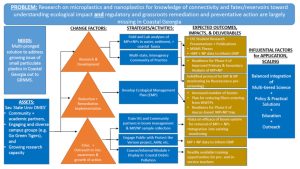
    Key elements of these improvements can be seen in the Theory of Change schematic outlined below (Fig. 1).

    Water, sediment, and faunal sampling

    Following our established protocol⁵, water samples are taken within the shelf and coastal Georgia waters and GRNMS with a focus on sampling the coastal Georgia estuary systems and transects to GRNMS. ETCL is partnering with the National Oceanic & Atmospheric Administration’s (NOAA’s) GRNMS to access platforms of opportunity to sample the water and sediments and measure bathymetry and water flows. Depending on location, a manta net with a mesh size of 300 µm⁶ or whole water samples are taken using metal buckets for microplastic analysis.4,5 The net is towed outside of propwash for three minutes at an average speed of 1.2 knots.⁵ A calibrated flowmeter is attached to the mouth of the net, and its readings are used in calculating the amount of water sampled. In shallow-water systems, the same procedure is followed but using a smaller net. Samples are transferred to glass jars in the field. If metal buckets are used for water collection, the bucket contents are poured over a series of covered sieves, and deionised water is used to transfer sieve contents into a glass and metal muffled vial for storage until processing occurs.⁴ At a minimum, salinity and temperature are measured at each site.

    Fig. 1: Theory of Change schematic to describe purpose, actions, and expected outcomes of the Excellence In Research: The Fate of Microplastics in the Georgia Bight project (National Science Foundation award: 2301650)

    Paired with water sampling, sediments are taken at the same locations. As of 2022, <20 studies have reported utilising a paired sampling approach, with the first report in 2018.⁷ This experimental design was developed to provide insight into the spatial abundance of microplastics in coastal Georgia waters and GRNMS (water data) and temporal microplastic abundance (sediment data). Focused paired sampling is needed to further understand the patchy distribution of microplastics and the variability between each sample, as seen in Geiger.5

    As in previous collections, a Ponar grab or similar is used to collect surface sediment samples,⁵ at all sites except GRNMS or for SWEEP-K/kayak-based sampling (described below). Sediment samples are taken after surface water sampling, and every effort is made to reduce the disturbance of surface sediments.

    Surface sediments from GRNMS are being collected via GRNMS-contracted divers or GRNMS Staff in the same manner as previously permitted by NOAA for Geiger and Ebanks in the Marine Protected Area (GRNMS-2021-001).  Sediments are scooped into a glass jar and refrigerated at 4-6°C, if possible, or at room temperature in the laboratory until sample processing occurs.

    Exposed sediments from human-powered vessels such as SWEEP-K are collected using a surface scooping approach comparable to that described above for GRNMS collections, and only the top 2-3 cm are retained. The depth of sediment samples, especially because they are homogenised, results in combining various temporal deposition events, and every effort is made to take this into account because incorporation of deeper sediments can result in underestimation of microplastic abundance, if sediments from periods prior to the manufacturing of plastics are included.

    Sediments can serve as a long-term sink for microplastics,⁸ thus, determining the sediment deposition rate in the dynamic Georgia Bight environment is helpful to assess the amount of plastic that settles into the sediments.

    Further, any estimations of the time of deposition will assist in framing the discussion of the time of settlement of microplastics in the target environments. Sediment traps or similar will be deployed at the sampling sites to determine the settling rates of sediment in situ.

    Organisms are collected using a 5-minute trawl, cast net, or similar in coastal Georgia waters.⁹ Organisms are sorted and identified in the field. As a standard procedure, when >10 individuals are collected for the target species, ten are retained for microplastic analysis.

    Amongst the organisms being studied in student-led projects are chironomids,10 oysters, palaemonid shrimps, penaeid shrimps, and gelatinous zooplankton. The goal is to study organisms commonly found across the study areas in surface water, mid-water, and benthic areas, including those exhibiting sessile and mobile life stages. Samples are stored on ice and frozen upon arrival at the ETCL until sample processing occurs.

    Studying the shallows

    Several tiers of motorised vessels are being used in this microplastic research. However, to access the shallowest of waters and intertidal zones where some oysters and other target habitats are located close to human developments, the team has been developing and testing human-powered crafts as platforms for studying locations that are closest to land-based anthropogenic inputs for small particulate plastics. Measurements and sample collections are often challenging in shallow waters, especially tidally influenced systems.

    The Shallow-Water Estuary Exploration and Profiling by Kayak (SWEEP-K) platform is being designed, developed, tested, and utilised within this project as a vessel with a variable suite of sensors that are mountable on a human-powered craft to allow for efficient exploration and profiling of an estuary system while gathering georeferenced water chemistry and nutrient data. The four major components of the system are a human-powered craft, a support crate for the sensor package, a marine sensor package, geolocation, visual cataloguing, and a weather-sensing system.

    The system will include a weather-tight marine 12v DC electrical system, including a 20 amp-hour Lithium-ion deep cycle battery, multiple 12v marine outlets, a data logger (as required by the instrumentation), and provision for a 55-watt solar panel and solar electric charger. A modular mounting and rigging system will facilitate sampling points for the marine sensors to be approximately 30.5 cm below the waterline and with a 30.5 cm lateral separation from the beam of the human-powered craft. The primary sensors that have been selected are for temperature, pH, salinity, turbidity, optical dissolved oxygen, chlorophyll, and optical nitrate to include a suite of water quality parameters that are complimentary to those measured in deeper waters. The marine sensor package may be customised, as required, to facilitate profiling of an estuary for a specific characteristic, with sampling and other sensor-based measurements deployable via an outrigger kit system.

    coastal georgia
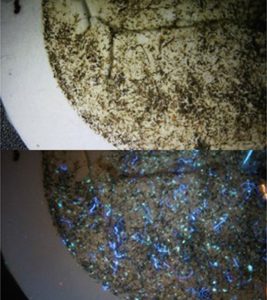
    Fig. 2: Photographs of filters from an Ogeechee River water sample taken with a Nightsea® fluorescence-modified stereomicroscope by J Bird at approximately 30x magnification. Image was taken under white light, followed by [Bottom] an image taken with 360-380 nm UV light and no filter. Raman spectroscopy-confirmation (secondary analysis) indicates that, in general, a particle that fluoresces orange is likely plastic, blue may be plastic, and green is seldom plastic

    Lastly, geolocation, visual cataloguing, and weather sensor systems will be mounted on a vertical mast attached to the support crate to place the sensors above the head of the vessel operator and will contain a GPS unit, a 360°- time-lapse camera, a solar irradiation sensor, and an air temperature sensor. This package will assist in the mapping and categorising of an estuary via geo-referenced sensors and weather data.

    Water tracking

    Utilising Maker Buoy®, SonTek® Castaway conductivity-temperature-depth (CTD), and acoustic Doppler coupled profiling (ADCP) technology, the Hintz lab is leading the charge to determine water flows. Because the water flows in the coastal areas associated with this project are variably impacted by tides,11 precipitation runoff,12 and winds,13 this team is utilising repeated coordinated tracking of water movement in shallow-water and lower estuarine areas as well as tracking within and near GRNMS and moored devices in the targeted waterways for Eulerian measurements of temperature, salinity, pressure, and other parameters, as needed.

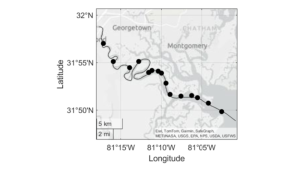
    Within 2024, observations and sampling have been predominantly in the Wassaw and Ossabaw sound estuaries, with a particular focus on water tracking in the Ossabaw Sound-Ogeechee River System (Fig. 3).

    coastal georgia
    Fig. 3: Map of Ossabaw Sound and lower reaches of Ogeechee River (RM 00-35). Black circles mark locations of conductivity, temperature, and depth measurements with SonTek® Castaway CTD. The black line marks the deep channel through the meandering river

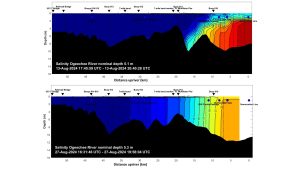
    Remote monitoring of the lower Ogeechee River bottom salinity was done to test systems and gauge the interaction between tides, river flow, and coastal storms such as Tropical Storm Debby in August 2024, which resulted in catastrophic flooding of coastal municipal areas in the region (Fig. 4).

    Fig. 4: TOP: While Tropical Storm Debby-related flood waters receded on 13 August, strong river flow blocked saline tidal waters from overflowing extensive sandbar sills near the entrance to the seven-mile bend at Fort McAllister State Park
    BOTTOM: Two weeks later, after flood waters receded completely, tidal salinity remained well downriver, with initial salinity reaching into but not through the seven mile bend

    Groups of these low-cost drifters with GPS units attached are being deployed in the field into each of the Georgia river systems on the southeast coast. A set of drifters will be monitored until contact is lost to determine water flow patterns from each river system. This information will be key in determining the extent of the influence of Georgia coastal waters, a likely carrier of small particulate plastics, on GRNMS.

    Primary and secondary analysis of particles

    Stereomicroscopes are being used as a primary analysis method to quantify the abundance of microplastics in water, sediment, and organismal samples. for preliminary identification isolation, cataloguing, and characterisation of particulates prior to instrumental analysis.⁶

    Polymer type cannot be definitively identified by stereomicroscope, although particles could be nominally identified as plastic as opposed to a naturally occurring substance by use of the stereomicroscope. Particles that are suspected to be plastic (“probable plastic”) are isolated onto a tagged location affixed to an aluminium disc. While a standardised method for reporting microplastic values has not yet been developed, this team is working with other scientists who are studying small particulate plastics toward the goal of developing standardised procedures.

    Graduate student James Bird has been developing and testing a fluorescence procedure using blue- and UV-light sources that are responsive to optical brightening agents and other additives that are particularly found in textiles. This approach reduces analysis time and improves accuracy and precision in users visualising and isolating probable plastics during this first analytical stage. The procedure involves a series of steps in which the user evaluates attributes of the particles being viewed, including appearance under blue-, white-, and UV-lights (Fig. 2), as well as brittleness, surface appearance, and other texture-based attributes. Considering that secondary analysis of samples isolated by novice users with the stereomicroscope resulted in 60-70% particle affirmation on Raman spectroscopy as plastic, this lab group expects improved confirmation rates as users become more proficient with the fluorescence-added primary analysis technique.

    Raman microscopy secondary analysis

    In partnership with Jay Brandes of the University of Georgia Skidaway Institute of Oceanography, micro-Raman spectroscopy is being used as the consistent secondary analysis method for probable plastic particles from samples to identify plastic polymer type with a modified procedure.14 A 785 nm-laser on a confocal Raman microscope is used to identify presumed plastic particles.15 Raman spectra are typically recorded in the 400-2,300 cm¹ wave number range. The gradient is set at 600 lines/mm. A high-sensitivity cooled electron-multiplying charge-coupled device (EMCCD) detector is used. The Raman system is operated by LabSpec6 software (Horiba®). The KnowItAll® software is used to compare Raman-generated spectra to known spectra within the KnowItAll® library.

    Pyrolysis Gas chromatography-mass spectroscopy (pyr-GC/MS) secondary analysis
    In partnership with Ashok Deshpande of NOAA’s Northeast Fisheries Science Center Chemistry Laboratory, Pyrolysis GC/MS will also be used for comparative secondary analysis.16 A microplastic particle <1 mg is placed in a quartz tube, which is then placed in a platinum coil and heated to 750 °C.16 The heating process vaporises the microplastic particle into small chemical fragments or monomers that are unique to a given polymer type.16 These fragments are separated on a gas chromatographic column and identified by using a mass spectrometer, which can also identify plastic additives.16

    References

    1. Cohen and Gleason 2015
    2. Lee and Sanders 2015
    3. Keisling et al. 2019
    4. Sanders and Brandes 2020
    5. Geiger 2021
    6. Setälä et al. 2016
    7. Sagawa et al. 2018
    8. Claessens et al. 2011
    9. Thublin 2018
    10. Ransome 2022
    11. Blanton et al. 2004
    12. Benke et al. 2000
    13. Garvine 1985
    14. Araujo et al. 2018
    15. Hidalgo-Ruz et al. 2012
    16. Ravit et al. 2017

    Please note, this article will also appear in the 20th edition of our quarterly publication.

    [ad_2]

    Source link

  • How NASA is utilising AI technologies on Earth and in space

    How NASA is utilising AI technologies on Earth and in space

    [ad_1]

    David Salvagnini, Chief Artificial Intelligence Officer at NASA, spoke to The Innovation Platform Editor Georgie Purcell to discuss how AI technologies are shaping the trajectory of NASA’s work.

    For decades, NASA has been using artificial intelligence (AI) technology to support and optimise its work across the agency, both on Earth and in space. NASA uses AI to help plan and schedule missions for planetary rovers, analyse satellite datasets, diagnose and detect anomalies, develop autonomous systems, and much more.

    Some of the AI tools used at NASA involve machine learning, which uses data and algorithms to train computers on making classifications, formulating predictions, and uncovering similarities or trends across large datasets. Utilising AI tools has a range of game-changing benefits for NASA’s work, including streamlining decision-making, saving resources, and enhancing workforce efficiency.

    To find out more about NASA’s AI activities and what the future holds for such technologies at the agency, Georgie Purcell spoke to David Salvagnini, Chief Artificial Intelligence Officer at NASA.

    What role do AI technologies play in NASA’s work?

    NASA has been very involved in the use of artificial intelligence and machine learning in several ways, particularly for more traditional means. Predominantly, these technologies have been used in our science work to assist in the discovery of objects in our solar system or distant solar systems. One example is a capability called ExoMiner, which uses AI trained by machine learning to identify exoplanets and even planets and distant solar systems. Interestingly, this used data collected as far back as 15 years ago and, through the AI models, was able to identify objects that had not previously been discovered.

    Another area where the use of AI technologies is prevalent is autonomy. For example, the Mars Perseverance Rover must safely navigate the surface of Mars and avoid obstacles or hazards whilst dealing with the potential risk of a communication delay between Mars and Earth. Much like you may see in autonomous vehicles on the market today, an on-board AI system helps the Rover to process the environment around it and render decisions as to how the vehicle should manoeuvre. The autonomous nature of the system removes the issue of a propagation delay if the rover had to communicate with a controller on Earth. This technology has been heavily tested as part of the systems engineering process here at NASA, mitigating and derisking the use of AI in this case.

    In collaboration with IBM, we recently released an AI Prithvi-weather-climate foundational model for a variety of weather and climate use cases. The model offers a flexible and scalable way to address a myriad of challenges related to short-term weather and long-term climate projection. The resulting data from the model is published openly, so anyone can access and use it. A lot of peer review and collaboration is involved in this type of work.

    The use of AI in space is very exclusive. With traditional AI that a company may use, a large-scale compute backend, like a Cloud provider, is the processing engine for much of that work. In space, we do not have access to a Cloud platform. When we think about the future of AI and how we can continue to enable AI on space-based systems operating in extreme environments, we must account for several different factors. Such things include the extreme environment itself, the radiation that the electronics are exposed to, power budget, and compute limitations. Unlike here on Earth, it is not as simple as buying more power when it comes to a space-based vehicle – there are tight budgets and weight limitations to honour. There are many unique elements to how NASA will use AI, especially in support of a space-based mission, that create particularly complex challenges for us. However, NASA has a long history of overcoming such challenges.

    What potential does AI have for the future of NASA’s missions?

    One area where AI will play a key role is in helping to make things more adaptive and autonomous. In general aircraft today, for example, there is a crew but there are also autopilot systems that control the aeroplane for most of the flight. This technology is very deterministic – if the speed changes, a change will be made to the control. Similarly, NASA is currently carrying out work to be able to more dynamically adapt to different environments – whether it be in orbit, or on the surface. We are working to gain a much higher degree of situational awareness of an environment, which can then be fed to an autonomous system. The autonomous system can much more reliably carry out a response to a set of conditions that are more dynamic.

    ai technologies on earth and in space
    © shutterstock/Sergey Nivens

    Orbital debris is a huge problem for NASA and is of rising concern as space activity continues to increase at a rapid pace. We recently released a Space Sustainability Strategy to measure and assess space sustainability for Earth, Earth orbit, the cislunar space, and deep space. AI will play a significant role in this, not only for the detection of orbital debris but also in some of the actions that may be taken by systems for remediation.

    There is also the use of AI in adaptive communication systems. We often think of communication like a phone as a single mode. However, the space environment presents a much more complex need where multiple communication networks are used to place a call. AI can be used to understand the conditions at a point in time and then select the optimal communication path based on conditions and the timeliness requirements of that data being sent. AI will play a large part in optimising communications and increasing communication reliability.

    We are also going to see AI models interacting with other AI models. Separate AI models with separate understandings of different parameters can co-operate to provide increased awareness of factors such as our climate, for example. There’s a lot of excitement around the potential there.

    There’s also a lot of more personal and day-to-day things that NASA will pursue in the area of AI. For example, NASA is examining ways in which AI can help its workforce, from developing imagery to summarising notes from a meeting. It is important to see AI not as a threat that will replace the work of humans but as a tool to make our work easier and more efficient.

    Can you provide some recent examples of projects focused on AI technologies?

    The Prithvi climate model I mentioned earlier is a great example.

    Another example is the use of AI to design structural components. AI enables a much more fluid and non-linear design than those made by humans. AI can also generate the component much quicker than humans, yet achieve equal or better results than the human-generated version when the component is stress tested.

    The Mars Perseverance Rover and the Ingenuity Mars Helicopter that flew on the surface of Mars are some key examples of how adaptive onboard AI is helping in our research. In addition, we are also looking at longer-term human space flight – beyond the moon. For instance, we are developing technology designed to deal with medical crew emergencies. Typically, astronauts are not medical doctors and, in the case of such factors as a communications blackout, they may be unable to contact an expert back on Earth for assistance. It is important that they are equipped to deal with the emergency in real time. We are working to provide crew with an AI capability to help quickly diagnose medical conditions and suggest potential treatment actions.

    What challenges have you found when implementing AI technologies and how are these being addressed?

    As I mentioned earlier, there is the issue of electronics on, for example, a space-based system operating in an extreme environment and exposed to radiation. There is also the power budget and weight constraints. They are enormous challenges that those of us working with AI on Earth don’t have to think about. There is also the added challenge of having to bring that compute with you – you can’t just reach out to the Cloud to help process a large pile of data. Space brings a whole different, unique set of challenges.

    There is a lot of fear surrounding the implementation of AI. Rightfully so, people are concerned about such things as ethical and responsible use, privacy, and transparency. It will take time for us to get comfortable with the technology and the potential that it brings. Thankfully, unlike other federal agencies, NASA is not involved with providing public services, such as processing claims for health benefits. Such agencies have a lot more work in terms of addressing the responsible, privacy, and ethical use concerns that exist.

    There are also cultural difficulties. Like any organisation, we have to address workforce upskilling and reskilling. Some people are eager to jump into AI at full speed, while others are quite reserved about it. Every organisation has sceptics who are a little alarmed about new things and aren’t yet comfortable with them. If I didn’t account for that as a challenge, I would be remiss. We have to meet people where they are, and then help them to be equipped to effectively use these tools, to know what tool is best for which need, and help them to use the tools responsibly. It’s going to take time for the entire workforce to be ready to fully embrace all that AI offers. However, I must stress that the culture at NASA is very trailblazing. When people at NASA see an opportunity that is enabled by the use of technology, they are often eager to embrace it. Although there’s risk inherent in adopting any new technology, NASA is quite effective at managing risk. NASA will balance innovation with prudent risk management as we adopt and implement more and more AI, especially when complementing the entire workforce with Generative AI tools.

    Please note, this article will also appear in the 20th edition of our quarterly publication.

    [ad_2]

    Source link

  • Securing Ontario’s role in the global research and innovation space

    Securing Ontario’s role in the global research and innovation space

    [ad_1]

    Nolan Quinn, Minister of Colleges and Universities for Ontario, details plans to accelerate research and innovation in Ontario to compete on a global scale.

    In the southernmost Canadian province of Ontario, advancing research and innovation is high on the agenda. The research sector is a vital source of innovation and commercialisation in the province and is a leading contributor to Ontario’s global competitiveness and productivity.

    In May 2024, the Ontario government announced an investment of almost C$200m over the next three years to support the advancement of Ontario-made research and innovation at six leading research institutes. The funding will help keep ideas, expertise and intellectual property in the province and support long-term economic growth.

    To find out more about how Ontario is advancing its research and innovation sector, The Innovation Platform spoke to Nolan Quinn, Minister of Colleges and Universities, Ontario.

    How important is innovation in Ontario? What is Ontario doing to accelerate its research and development space?

    Ontario is proud to be leading the way in innovation across a variety of vital industries. Our government remains committed to leveraging critical investments that foster an environment where the economy can thrive.

    Since 2018, Ontario has invested C$740m in 1,301 research projects through its competitive research programmes, leveraging more than C$1.18bn in funding from federal and third-party contributions.

    From 2018 onwards, the Ontario government’s competitive research programme investments have supported the creation of more than 120,000 training opportunities for researchers, and students across the province.

    The research investments have contributed to 40,900 publications that were cited more than 557,000 times, 421 patents being granted, 76 spin-off companies being created and 594 new jobs at those spin-offs.

    The Ontario government has this year committed to invest almost C$200m in Ontario-made innovation over the next three years. Why is this so important?

    Ontario is home to some of the brightest and most innovative minds – and the world is taking notice. This investment will not only lead to growth in Ontario-made innovation on the global market, but it will also create more high-paying jobs in our own backyard. This investment will support Ontario’s research capacity in talent, infrastructure, and operations, which will help train the next generation of skilled workers. This investment also provides funding for basic, applied, and experimental research across disciplines that lead our province to significant scientific breakthroughs.

    Not only do these scientific advancements and discoveries improve the lives of Ontarians, but they also transform the lives of people across the globe. Our ministry recognises that, in order to make these profound scientific discoveries, research must be properly supported, and we are proud to do so.

    What are the biggest issues that research and development in Ontario is trying to tackle?

    Our government is committed to building the Ontario of tomorrow – one with advanced medical care, efficient vehicles, adaptive technology, and so much more so our province can continue to thrive. In light of this, our ministry has identified a few priority areas for innovation. These include life sciences (e.g., cancer, rare diseases); genomics; medical devices; automotive, including electric vehicles (EVs); critical minerals; artificial intelligence (AI), including advanced computing; and quantum technology.

    In addition to the priority areas, the government also provides funding for basic and applied cutting-edge research across all fields of inquiry, ranging from STEM disciplines to social sciences, arts and humanities, to ensure both economic and societal benefits to the province.

    How important is international collaboration and financial support for Ontario’s innovation space?

    Ontario is leading the way in innovation – not only in Canada, but across the globe. Facilitating connections between the post-secondary sector and industry both domestically and abroad is critical to ensuring that Ontario remains a leader of scientific and technological advancement on the global stage. Our strong international relationships also allow us to leverage the knowledge from the brightest minds across the world to improve the lives of Ontarians.

    We are working with post-secondary institutions, research institutes, research organisations and industry around the world to foster an innovative environment for a prosperous Ontario.

    That said, our government’s priority is to ensure that the social and economic opportunities that result from homegrown innovation benefit Ontarians and the Ontario economy first and foremost.

    Canada has recently joined the Horizon Europe programme under Pillar II. What does this mean for Ontario?

    Ontario has a strong record of engaging with our European partners to advance critical innovation and research opportunities. We welcome federal engagement with the European Union to further strengthen these endeavours.

    Please note, this article will also appear in the 20th edition of our quarterly publication.

    [ad_2]

    Source link

  • Pioneering ethical AI implementation across the EU

    Pioneering ethical AI implementation across the EU

    [ad_1]

    The European Commission’s AI Office plays an integral role in implementing the AI Act, promoting ethical AI use, and supporting innovation.

    In recent years, the rapid advancement of artificial intelligence (AI) has transformed various sectors, prompting regulatory bodies to establish frameworks for its ethical and safe deployment.

    At the forefront of this initiative is the European AI Office, tasked with implementing the AI Act across the European Union. This office serves as a hub of expertise, guiding the governance of AI technologies and ensuring compliance with established regulations.

    By fostering innovation and facilitating the responsible use of AI, the AI Office plays a pivotal role in shaping Europe’s digital landscape, promoting a future where AI contributes positively to society while mitigating potential risks.

    To learn more, The Innovation Platform spoke with the AI Office to discuss its initiatives and the significant impact it aims to make in advancing AI innovation across various industries.

    Can you detail how the AI Office will contribute to the implementation of the AI Act? What are the main units within the AI Office and their respective functions?

    The European AI Office is the centre of AI expertise across the EU. It plays a key role in implementing the AI Act by supporting the governance bodies in Member States in their tasks. It also enforces the rules for general-purpose AI models. This is underpinned by the powers given to the Commission by the AI Act, including the ability to conduct evaluations of general-purpose AI models, request information and measures from model providers, and apply sanctions.

    Furthermore, the AI Office makes use of its expertise to support the implementation of the AI Act by contributing to the coherent application of the AI Act across the Member States, including the set-up of advisory bodies at the EU level, facilitating support and information exchange.

    In addition, the AI Office develops tools, methodologies, and benchmarks for evaluating the capabilities and reach of general-purpose AI models and classifying models with systemic risks. The AI Office also leads in drawing up state-of-the-art codes of practice to detail out rules in cooperation with leading AI developers, the scientific community, and other experts. Once the AI Act applies, the AI Office will be investigating possible infringements of rules, including evaluations to assess model capabilities, and requesting providers to take corrective action.

    Finally, the AI Office is preparing guidance and guidelines, implementing and delegated acts, and other tools to support effective implementation of the AI Act and monitor compliance with the regulation.

    The organisational set-up of the European AI Office consists of five units and two advisors, reflecting its mandate. These include: the ‘Excellence in AI and Robotics’ unit; the ‘Regulation and Compliance’ unit; the ‘AI Safety’ unit; the ‘AI Innovation and Policy Coordination’ unit; the ‘AI for Societal Good’ unit; Lead Scientific Advisor, and Advisor for International Affairs.

    What role does the AI Office play in fostering innovation and research in AI? Can you elaborate on your work with the GenAI4EU Initiative?

    The AI Office promotes an innovative ecosystem of trustworthy AI, to reap the societal and economic benefits.

    In January 2024, the Commission has launched an AI innovation package to support startups and SMEs in developing trustworthy AI that complies with EU values and rules. Both the ‘GenAI4EU’ initiative and the AI office were part of this package. The ‘GenAI4EU’ initiative will contribute to the development of novel use cases and emerging applications in Europe’s 14 industrial ecosystems, as well as the public sector. Application areas include robotics, health, biotech, manufacturing, mobility, climate, and virtual worlds.

    In 2025, we will ensure access to new, tailored supercomputing capacity for AI start-ups and industries through an AI Factories initiative.

    ethical ai
    © shutterstock/chayanuphol

    More generally, the Commission supports AI innovation financially through Horizon Europe and the Digital Europe programme dedicated to generative AI. This support will generate an additional overall public and private investment of around €4bn until 2027. We also have in place accompanying initiatives to strengthen the EU’s generative AI talent pool through education, training, skilling, and reskilling activities. Further encouragement of public and private investments in AI start-ups and scale-ups is done through venture capital or equity support, including via new initiatives of the EIC accelerator Programme and InvestEU.

    Moreover, the Commission is accelerating the development and deployment of Common European Data Spaces, made available to the AI community, for whom data is a key resource to train and improve their models.

    Finally, we have set up the Large AI Grand Challenge, whose winners announced in June 2024 are four innovative AI start-ups from Europe and who shared the prize of €1m and eight million computational hours.

    Can you provide some examples of where you think the work of the AI Office will make the biggest difference over the coming years? Are there any initiatives already underway?

    Making the EU a leader in AI innovation is a priority for the Commission for the next mandate, as announced by President Ursula von der Leyen in her political guidelines. President von der Leyen has also announced an upcoming Apply AI Strategy to boost new industrial uses of AI and to improve the delivery of a variety of public services, such as healthcare. We will also prioritise the establishment of a European AI Research Council, allowing us to pool all our AI research resources.

    How does the AI Office ensure the development and use of trustworthy AI across the EU? How will the AI Office engage with the public on AI and its development?

    The Commission aims to foster trustworthy AI across the internal market. The AI Office, in collaboration with relevant public and private actors and the startup community, contributes to this by advancing actions and policies to reap the societal and economic benefits of AI across the EU, providing advice on best practices and enabling ready access to AI sandboxes, real-world testing and other European support structures for AI uptake.

    The Office is also encouraging innovative ecosystems of trustworthy AI to enhance the EU’s competitiveness and economic growth, aiding the Commission in leveraging the use of transformative AI tools and reinforcing AI literacy.

    Collaboration, both internationally and across disciplines, is crucial to the AI Office’s work. Can you provide some examples of how these partnerships support the AI Office’s objectives and the wider AI industry?

    At international level, the AI Office contributes to a strategic, coherent, and effective EU approach, by promoting the EU’s approach to trustworthy AI, including collaboration with similar institutions worldwide, fostering international cooperation and governance on AI and supporting the development and implementation of international agreements on AI.

    To effectively carry out all tasks based on evidence and foresight, the AI Office continuously monitors the AI ecosystem, technological and market developments, the emergence of systemic risks, and any other relevant trends. Collaboration with a diverse range of institutions, experts, and stakeholders is essential for the AI Office.

    At an institutional level, the AI Office works closely with the European Artificial Intelligence Board, formed by Member State representatives and the European Centre for Algorithmic Transparency (ECAT) of the Commission. The Scientific Panel of independent experts ensures a strong link with the scientific community. Further technical expertise is gathered in an Advisory Forum, representing a balanced selection of stakeholders, including industry, startups and SMEs, academia, think tanks, and civil society. The AI Office may also partner up with individual experts and organisations.

    It will also create fora for cooperation of providers of AI models and systems, including general-purpose AI, and similarly for the open-source community, to share best practices and contribute to the development of codes of conduct and codes of practice.

    The AI Office also oversees the AI Pact, which allows businesses to engage with the Commission and other stakeholders, such as sharing best practices and joining activities. This engagement has started before the AI Act entered into force and will allow businesses to plan ahead and prepare for the full implementation of the AI Act.

    Please note, this article will also appear in the 20th edition of our quarterly publication.

    [ad_2]

    Source link

  • Germany boosts investment in fusion research

    Germany boosts investment in fusion research

    [ad_1]

    Professor Christian Linsmeier, Director of the Institute for Fusion Energy and Nuclear Waste Management, outlines Germany’s recent increase in funding for fusion research and the Institute’s role in advancing fusion technology.

    Germany has been investing in fusion research for several decades, creating a programme that encompasses  a variety of projects and topics. About a year and a half ago, the German government announced an increase in funding to further advance these efforts towards the construction of the first fusion reactor.

    The German fusion programme is carried out by three research organisations: the Max-Planck-Institute for Plasma Physics (IPP), with two locations: the main site in Garching and another in Greifswald, along the Baltic coast. At the Garching site, researchers operate the ASDEX Upgrade tokamak. The Greifswald facility is home to the globally renowned Wendelstein 7-X stellarator, celebrated for being the most advanced and closest to a reactor among current technologies.

    The Max-Planck-Institute for Plasma Physics is Germany’s leading fusion research institution, representing approximately three-quarters of the nation’s research efforts in this area. The IPP operates these devices and conducts essential plasma physics research to advance fusion technology. The Karlsruhe Institute of Technology plays a significant role in this field. Finally, the Jülich Research Centre (FZJ) houses the Institute of Fusion Research and Nuclear Waste Management, which consists of two primary institutes: one focused on fusion research (IFN-1) and the other on nuclear waste management (IFN-2).

    FZJ, with its IFN-1, specialises in the research areas of plasma-wall interactions and plasma-facing materials and components. This includes the diagnostics and modelling of the edge plasmas of tokamaks and stellarators, the physics of plasma-wall interactions, as well as development, characterisation and testing of materials and components for the plasma-facing units. As one of the few international research sites, FZJ includes nuclear aspects by operating a lab with hot cells in a radiation-controlled area.

    Investment in Germany’s fusion landscape

    Germany has launched a programme called Fusion 2040, stimulating collaborative efforts among fusion researchers and industry. The programme has been allocated a budget of €370m for the next four years. This funding is in addition to Germany’s standard fusion budget and contributions to the European Union’s ITER programme. Notably, this €370m constitutes supplementary funding for cooperative activities between research centers and the fusion industry. This strategy aims to realise a fusion reactor by transferring knowledge from research to industry.

    The Fusion 2040 programme was established by interactions between the federal government and fusion research representatives and finally commenced its first project between FZJ and industry partners on November 1, 2024.

    Our strategy is to utilise this funding to strengthen traditional research institutions such as Jülich, Karlsruhe, Garching and Greifswald and promote collaborative efforts between fusion researchers and industry partners. This funding concept by federal ministries, known in German as ‘Verbundprojekte, i.e. Collaborative Projects,’ requires us to establish partnerships with industry stakeholders for any topics submitted within this programme.

    The situation is quite flexible, allowing for a small part of the industry to link with a larger public sector or vice versa. There are various options available. The primary aim is to leverage the knowledge we have developed over decades in fusion, plasma-wall interactions, technology, and plasma physics, transferring that knowledge to industry to foster its growth. This concept of collaborative projects is not new; it typically requires funding from federal government sources in other technological areas as well, and it must be accomplished in collaboration with industry.

    The Institute of Fusion Research and Nuclear Waste Management

    The Jülich contribution to the German fusion programme via the Plasma Physics institute within the Institute of Fusion Energy and Nuclear Waste Management (IFN-1), is the smallest organisational partner within the German fusion programme. Our primary focus is on plasma interactions with and materials for the first wall and divertor. This topic is closely linked to understanding plasma physics at the edge of the fusion plasma, the physics of the plasma-material interactions, as well as surface and materials physics and chemistry. Therefore, this field is, by definition, genuinely multi-disciplinary. Our strength lies in our ability to study the behaviour of particles at the plasma edge, bridging the plasma-material interface, and extending a few centimetres into the materials.

    There are many institutes worldwide specialising in materials and plasma physics; however, none combine these fields in the same way we do. Our team consists of engineers, material scientists, chemists, and physicists who collaborate to address the challenges related to optimising plasma-facing components and their interactions with fusion plasma. Ultimately, this interface determines the components’ lifetime and, therefore, the economic viability of fusion as a new primary energy source.

    Researching edge plasma

    The fusion process occurs primarily in the hot plasma core, while the edge plasma limiting that volume presents additional unique challenges. Transitioning from the hot core to the wall requires a high-density barrier to confine the plasma and maintain temperature; without it, surrounding structures risk damage. The principles governing edge plasma physics are distinct from those of the core.

    The core plasma behaves mostly like a fluid, but at the edge, individual atomic collisions and neutral atom behaviour become significant. Our research is focused on the edge plasma in order to control the plasma-material interface. In fusion reactors, perfect confinement is unrealisable, as it would suffocate the plasma and halt fusion reactions that generate alpha particles and impurities from wall erosion. Therefore, it is vital to remove fusion byproducts, mainly helium, and impurities, through the edge plasma to sustain fusion reactions.

    We are investigating edge plasma and developing models and codes, including EIRENE and ERO 2, which are widely used in the fusion community for edge plasma processes. Our work also explores interactions with the reactor wall, studying particles that escape the plasma toward the first wall or the divertor, where most power and particles are expelled.

    These areas experience high power and particle loads.
    In fusion systems, we focus on a range of up to 20 megawatts per square meter, managing heat and particle load effectively.

    Developing effective materials

    The German Helmholtz Fusion programme, focuses on four key areas: Stellarator, Tokamak (both led by IPP), Materials and Fusion Technology (led by KIT), and Plasma-Wall Interactions, which we lead at Forschungszentrum Jülich (FZJ). Plasma-wall interactions are relevant to both stellarators and tokamaks, enabling us to apply our findings across different fusion confinement concepts.

    Our research examines the interactions between plasma and wall materials, particularly those exposed to plasma. Effective materials must demonstrate low erosion rates, minimal retention of fuel (specifically deuterium and tritium), and efficient heat transfer to prevent overheating in the divertor.

    Tungsten is a strong candidate due to its properties, including a high melting point of over 3,400 degrees Celsius. However, it is very brittle, especially after exposure to high temperatures and neutrons, which can further increase brittleness.

    Tungsten’s high surface binding energy leads to quite a high sputtering threshold, meaning that if the energy of impinging plasma particles is maintained below that threshold, erosion is minimised. This characteristic significantly extends the lifespan of the divertor and first wall, making tungsten a preferable choice despite its brittleness. Clearly, the lifetime of plasma-facing components before a necessary replacement greatly impacts the economy of fusion as an electricity source.

    The brittleness issue of tungsten is tackled and solved by one of our main material development strategies: By integrating tungsten fibers into a tungsten matrix – and providing a stable and well-defined interface between fibers and matrix – the brittleness problem can be solved. Such fiber-matrix composites behave like a ductile material, although the constituents are still brittle. The trick is the clever interface: cracks, which would immediately destroy a brittle component, are stopped at these internal interfaces and can therefore control the macroscopic behaviour of such a composite material.

    Besides its intrinsic brittleness, pure tungsten poses an additional problem in case of an off-normal reactor condition. In a loss-of-coolant accident with air ingress, the plasma-facing components quickly reach high temperatures due to the decay of neutron-activated elements. Above around 700°C, air and humidity react with pure tungsten, producing tungsten oxide, which sublimates at these temperatures. This volatilisation of activated elements raises safety concerns in such an accident scenario.

    Our approach to solving this issue is inspired by stainless steel, where pure iron, which tends to rust, is alloyed with elements like chromium to create a rust-resistant material. We applied this principle to tungsten by selecting specific alloying elements, including also chromium, to develop what we call a self-passivating tungsten alloy. This innovation enhances tungsten’s stability in the presence of moisture and air without sacrificing its premier qualities as a plasma-facing material.

    Our research in these two exemplary material fields, conducted over approximately 15 years, led to the development of these material solutions to a degree where a transfer into the industry – and, therefore, an upscaling from lab scale to production – has started.

    Dedicated and specialised technology

    In addition to our focus on material development, edge plasma physics and modelling, we design diagnostic systems, including spectrometers, for fusion facilities like the Wendelstein 7-X and over decades for the European tokamak JET in Culham. Our instruments investigate interactions between edge plasma and the first wall and are essential tools for studying the physics of plasma-wall interactions at large-scale fusion devices.

    As a further research field, we specialise in Jülich in analysing hydrogen isotopes in materials, particularly also the hydrogen isotopes deuterium and tritium. Hydrogen isotopes can weaken tungsten, steel, and other metals by penetrating into atomic spaces in the lattice of metal atoms. To analyse these changes, we use e.g. thermal desorption analysis, ion-beam based accelerator techniques, as well as laser-based techniques. For the latter, we also develop technological concepts in order to apply them not only in a laboratory environment but also as analysis techniques compatible with large-scale fusion devices like ITER.

    Finally, we operate a specific laboratory with a controlled area and hot cells to handle and analyse radioactive materials and components, e.g. after exposure to neutrons and the respective activation reactions.

    Research at neutron-exposed components

    In a fusion reaction, deuterium combines with tritium to produce an alpha particle (a Helium-4 nucleus) and a neutron. The neutron, as indicated by its name, is electrically neutral. However, the plasma itself is contained within a magnetic cage in a stellarator or tokamak; the neutrons from the fusion reaction escape because they carry no charge and are, therefore, not affected by the magnetic field.

    As the neutron travels through materials – specifically the first wall and the blanket behind it – it plays a beneficial role in breeding tritium. However, neutron impact also has drawbacks, as it can alter the properties of the materials it passes through. The neutron can displace some atoms, which leads to disorder and affects material properties, including hydrogen or tritium trapping, as well as mechanical properties.

    Another important aspect to consider is the divertor, which experiences very high power loads. It is crucial to test both the materials and components under these high power loads and in exposure to plasmas, including after exposure to neutrons. Typically, when a material has been exposed to neutrons, it becomes radioactive due to various transmutation reactions.

    Therefore, it is essential to have a controlled-area laboratory where the radioactivity of all incoming and outgoing samples is monitored and measured. If the radioactivity of the samples is too high, additionally, a hot cell may be required within that controlled laboratory space in order to protect operators and the environment during the experiments with those components and materials.

    State-of-the-art facilities

    Our “High-Temperature Materials Laboratory – HML” is unique, providing the ability to handle radioactive materials and components. In particular, they can be exposed to electron beam devices for high-power loading tests, as well as to plasmas from a linear plasma device for plasma-wall interaction studies. These devices are located in hot cells and provide a unique environment for these studies.

    Unlike tokamaks or stellarators, the new linear plasma device “JULE-PSI” generates plasma in a horizontal column, allowing us to simulate reactor first wall conditions with greater operational control than in large fusion devices. This allows well-defined plasma-material interaction studies. Currently, we are constructing two new hot cells to house JULE-PSI and the electron beam device “JUDITH 3”. These cells will enable us to safely work with radioactive materials irradiated in nuclear reactors.

    Globally, our linear plasma device JULE-PSI is one of a kind; while other labs can also handle nuclear materials, none have a linear plasma setup like JULE-PSI within a hot cell. This allows for a comprehensive exploration of plasma-wall interactions under conditions that are unique to a fusion reactor.

    Cooperation is key

    We work together with various large-scale fusion devices, including Wendelstein 7-X, JET, and other international facilities. This is particularly significant for us when combining our extensive laboratory and theory research on plasma-wall interactions with research at large fusion experiments.

    Although we operate as a separate institute and are not part of the Max-Planck-Institute for Plasma Physics (IPP), the Greifswald branch of the Max-Planck Institute for Plasma Physics frequently seeks our expertise in plasma-wall interactions. They do not have a dedicated Department of Plasma-Wall Interactions, so this responsibility falls to us in Jülich. Our work includes operating research devices, conducting physics research, and engaging in modelling.

    To the UK, we have strong connections, particularly with Culham as the JET site, and this network is expanding as the UK STEP programme progresses. In Europe, we also collaborate with the WEST tokamak located in Cadarache, France, to expose materials and components in the course of our cooperative research. Outside Europe, we have particularly strong collaborations with colleagues in Hefei, China, who operate EAST (Experimental Advanced Superconducting Tokamak), a modern superconducting tokamak, leading in many aspects of tokamak research. In the US, the Oak Ridge National Laboratory is one of our strong partners, along with the University of Wisconsin at Madison.

    The outlook for fusion

    Germany’s fusion research landscape has significantly evolved with the emergence of four notable companies, two of which focus on magnetic fusion: Proxima Fusion and Gauss Fusion. Both companies focus on a stellarator fusion reactor (like Wendelstein 7-X). In particular Gauss Fusion’s efforts are centred on constructing the stellarator as core of a fusion reactor facility, including the necessary infrastructure.

    While the concept of nuclear fusion differs from traditional energy methods, concerns about its long-term viability persists. However, successful demonstrations have generated global interest, particularly in the US and Europe.

    Facilities like the Joint European Torus (JET) are crucial for fusion research but primarily serve experimental purposes. Unlike experimental setups, developing a reactor that generates electricity requires specialised design and careful consideration of operational parameters. The focus must shift towards energy production, necessitating significant investment and large-scale construction, as exemplified by ITER in southern France, which relies on extensive infrastructure to function effectively.

    Achieving fusion power in a first-of-a-kind reactor still depends on government funding and support, as no large-scale industrial project of this magnitude can succeed without it. Typically, such developments take about 20 years, similar to past advancements in photovoltaics and wind energy, which have also relied and still rely on government initiatives.

    Overall, the current landscape for realising fusion in Germany is quite positive. We are witnessing an influx of additional funding, and our objective is to construct a fusion reactor rather than merely establish a new experimental setup. The Fusion 2040 programme, designed to attract industry involvement, is a pivotal component in the development of a fusion reactor. This collaboration is only feasible if we set a clear goal and allocate funding to support it, something the government is currently facilitating. I am convinced that we can be optimistic that this initiative will continue with the aim of developing the first prototype reactor.

    Please note, this article will also appear in the 20th edition of our quarterly publication.

    [ad_2]

    Source link

  • Elevating Québec’s research through international collaboration

    Elevating Québec’s research through international collaboration

    [ad_1]

    Marco Blouin, Director General Science and Partnerships, Ministère de l’Économie, de l’Innovation et de l’Énergie, Québec government, explains how international collaboration is accelerating Québec’s research, development, and innovation.

    Research and innovation has long been at the forefront of Québec’s economic landscape. Over many years, Québec has established a scientific research base of international calibre and has built strong relationships with stakeholders in the research and innovation ecosystem across the globe. Québec is positioning itself as a leader in innovative fields such as artificial intelligence (AI) and quantum technologies. In 2024, Canada officially joined the Horizon Europe programme under Pillar II, opening up ample opportunity for Québec to propel its research and development (R&D).

    The Innovation Platform spoke to Marco Blouin, Director General Science and Partnerships, Ministère de l’Économie, de l’Innovation et de l’Énergie, Québec government to discover more about Québec’s research and innovation landscape and find out what the new Horizon Europe partnership could do for the province.

    What role can Québec play in the global innovation landscape?

    We like to think of ourselves as punching above our weight when it comes to science and innovation globally, especially on the research side. Our overall R&D spending is significantly higher than the Canadian average. In terms of academic publications, between 2010 and 2021, the share of joint publications that involve both a Québec-based researcher and an international partner has grown from 45% to 61% of the total. We maintain two universities in the top 200 of the main international rankings. We also have two university incubators in the top ten of the UBI Global Ranking.

    However, because we are relatively small, when it comes to turning this research expertise into innovations, we also need to set some strategic priorities. There are several sectors that are key to our innovation capabilities: aerospace, artificial intelligence (AI) and quantum, life sciences, energy transition and electrification, for example. These are sectors in which our research and innovation is recognised internationally, and where we have an industrial base that can support the transfer of our research into commercial products.

    We know that this expertise has value to our partners, and we need to push our ambition further to remain attractive collaborators on the global stage.

    We aim to leverage some of these key sectors through strategic initiatives. To give you an example, our government supports the development of innovation zones in some of these key areas, and across our province. For now, we have four of them – digital technologies, quantum technologies, energy transition, and aerospace – and there might be more to come. Innovation zones concentrate, within a specific geographic area, our expertise in a particular sector. It brings together researchers, industries, and investors in attractive living environments so that we have a critical mass that allows us to develop our innovation capabilities further in these sectors. Our innovation zones are also meant to serve as a showcase for international partners.

    Our geographic position and our identity as a province also have an impact on how we view our contribution to global innovation. I will give you two very different examples to illustrate this.

    On technological innovation, because of our location and our networks, we tend to act as a bridge between Europe and North America. For example, in the southern part of the province, close to the US border, we have created our innovation zone on digital technologies, Technum Québec. The zone notably features the Miqro Innovation collaborative center (C2MI) – the largest R&D centre in Canada focusing on the manufacturing of electronic systems, including semiconductors. Our investments in this centre and this zone are part of a broader joint commitment between Canada and the US to develop a cross-border innovation corridor for semiconductors. At the same time, though, this digital technology ecosystem is active in the development of partnerships with European collaborators in the quantum and photonics industry – for example, in the Netherlands. We try to use this bridge-building position between Europe and North America to our advantage.

    If I zoom out, we are also very active in terms of science diplomacy. In Québec, we have a dedicated Québec Research Fund, headed by our Chief Scientist, Professor Rémi Quirion. It is an explicit mandate of our Chief Scientist to contribute to the reputation and outreach of our research expertise and excellence abroad. In 2024, Professor Quirion acts as a president of the International Network for Governmental Science Advice (INGSA), which is present in 110 countries. For us, this is a unique opportunity to voice some of our science priorities and concerns globally, such as the responsible use of AI technologies, for example.

    How important is international collaboration and support to Québec’s research and development sector?

    As I said, given that we are a small nation, we need to rely on international collaborations to grow our research and innovation. If we want our research to have an impact in fields that are of global relevance and interest to solve big societal challenges – such as, energy transition and climate change, digital transformations, medical and biomedical research, just to name a few – it is crucial that we join our efforts and funding capacity with partners outside of Québec.

    quebec's research
    © shutterstock/Thx4Stock team

    This is also true of innovation, if we think of our start-ups in the technology sector. We have a very solid ecosystem in Québec to raise and support them, but our domestic market is too small to allow them to grow. In our current Québec Research and Innovation Investment Strategy – which covers the years 2022-2027 – we have defined a series of actions to accelerate the transition of our most promising start-ups and scale-ups to the international market.

    To help us, we are also fortunate to count on a diplomatic network that is rather unique for a provincial entity. We have 34 diplomatic representations in 19 countries across the globe, and about half of them include specialised policy advisors that focus on research and innovation, in key territories and markets such as London, Paris, Munich, Seoul, Los Angeles, etc.

    Can you provide an example of a successful project supported by international funding?

    One interesting example I can think of is the Horizon 2020-funded ICE_GENESIS project, which focused on advanced simulation means and tools to address icing problems on aircrafts. As I mentioned above, the aerospace industry is central to our economy, and a lot of our industrial R&D takes place in this sector.

    The total amount of the project, whose first phase started in 2019, is €21m. In addition to EU funding, many industrial and institutional partners have contributed to this funding, including Bombardier on the Québec side, as well as our government, via our programme for international research collaborations that helped our industrial research consortium CRIAQ to take part in the project. Our financial contribution to the overall project has been rather modest (around €400,000), but it had a fantastic leverage effect that secured the participation in the project of some of our best local experts on the modelling of aircraft aerodynamics – I am thinking of Professor Éric Laurendeau at Polytechnique Montréal, and his team of researchers and students. It also contributed to convincing Bombardier to join this collaborative effort alongside other major industry partners like Airbus and Dassault. Ultimately, the benefits are huge both for our industry, as we develop new modelling tools, and for our research community. On the research side, for example, Professor Laurendeau’s team is developing numerous research exchanges and collaborations with some of the best institutions in this area in Germany (T.U. Braunschweig) and France (ONERA Toulouse), such as joint doctoral theses.

    ICE_GENESIS is a great example of the type of international collaboration that we aim to support in the context of Canada’s association to Horizon Europe. We will leverage our research expertise, bring our industry into successful consortia thanks to our intermediary organisations like CRIAQ, whose job it is to create these connections, and tie these projects together with our strategic initiatives like innovation zones.

    Why is the new partnership between Canada and Horizon Europe an important development for Québec?

    Europe is a very natural partner for our international research and innovation collaborations. If we look at our in-house data, US-based researchers are our main partners in joint academic publications. However, France, the UK and Germany then follow. I already mentioned above why Europe is an important component of our innovation and research and innovation strategy. More broadly, it also reflects the reality of our inward and outward research mobility flows, which predominantly occur with Europe, and which ultimately contribute to the establishment of strong research networks. This also matters for our capacity to compete for talent attraction and retention.

    With regards to Horizon Europe more specifically, we know that under the previous programme, Horizon 2020, 30% of the funded projects involving Canadian partners had a participating Québec-based institution. Even before Canada’s association to the programme, we were already well-positioned, even though of course in most cases our participation to Horizon projects was self-funded. Now that association provides us with the possibility or receiving direct funding for our researchers and companies, we want to take advantage of our existing networks and develop new partnerships. It is certainly a major opportunity!

    We are particularly interested in the fact that association covers Pillar II of the programme – with a strong focus on collaborative research between the public and private sector – and in six clusters that roughly match the domestic structure of our ecosystem. Years ago, we created what we call our industrial research sector groups, whose mission is to support companies in our strategic sectors by facilitating collaborations with researchers. We have nine of them, on aerospace (CRIAQ – which I mentioned before), aluminium (CQRDA), industrial bioprocesses (CRIBIQ), biopharmaceuticals (CQDM), energy and electric transportation (InnovÉÉ), advanced materials (PRIMA), information and communications technology (PROMPT), medical technologies (MEDTEQ+), and metals transformation (CRITM). Some of them are already well-connected to European partners, but we think that they could greatly benefit from the opportunities of association, and that they will help consolidate our domestic expertise to join Horizon-funded consortia.

    Please note, this article will also appear in the 20th edition of our quarterly publication.

    [ad_2]

    Source link

  • Ensuring the responsible development of Europe’s mining sector

    Ensuring the responsible development of Europe’s mining sector

    [ad_1]

    Editor Georgie Purcell spoke to Florian Anderhuber, Deputy Director General of Euromines, to discuss Europe’s current potential for mineral development and how its mining sector can be accelerated to meet the demand for critical and strategic raw materials.

    Driven by the green and digital transitions, global demand for critical and strategic raw materials is greater than ever at present. This demand places significant pressure on Europe, which has been highly dependent on other countries for its mineral supply for many years. Despite vast potential for mineral exploration and development, only a few EU countries have active mines. In a bid to address domestic supply issues, the European Commission has introduced a series of policies and strategies to accelerate critical mineral development in the EU and establish secure supply chains. Such policies include the Critical Raw Materials Act, the Net Zero Industry Act, and the REPowerEU plan.

    Euromines is the recognised representative of the European metals and minerals mining industry and works to promote responsible industry practices and reflect the adequate consideration of mining in EU policy making. Euromines serves as a co-operative network that evaluates the impact of European and international policies and legislations on the mining industry and define common positions and actions. Amongst its work, Euromines has introduced the Sustainable Mining Initiative to help promote its members’ sustainability achievements and implementations in their daily operations. Through the Initiative, Euromines shares best practices in circular economy, decarbonisation, and community.

    Editor Georgie Purcell spoke to Florian Anderhuber, Deputy Director General of Euromines, to gain a more in-depth look at Europe’s mining sector and the work of Euromines.

    Can you tell us more about Euromines as an organisation and elaborate on your key goals?

    Euromines is the business association of the European mining industry. We cover a total of 54 different minerals and metals mined in Europe – from hot commodities such as lithium, to more well-established materials like copper and iron ore and minerals such as potash and magnesite. We also focus on the entire ecosystem of mining, including the technology providers.

    Our objectives include positioning and presenting the advantages of a robust license to operate of the European mining industry; demonstrating that we are a responsible player; demonstrating the cutting-edge technologies that we are using and developing in Europe; and highlighting the advantages that mining in Europe can bring for global mining. Our key goal is to have a thriving, innovative, clean, and sustainable mining industry in Europe that is providing the raw materials that we need for our daily life, and particularly for the ‘twin’ digital and green transition.

    What is Europe’s current potential for critical raw material development?

    There is very large potential for strategic and critical raw materials in Europe. For example, there are several lithium projects in the pipeline currently and we are continuously discovering new deposits for copper, nickel and other materials that are classed as critical or strategic. Europe also has deposits for other essential minerals and materials that underpin a sustainable society and living standard.

    One of the larger impediments facing raw materials exploration and development in Europe is the existing geological data. A lot of the data that we have is outdated or superficial. The exploration of the ground has had to go deeper and wider to have a better understanding of what the full potential is. Over the last 30 years, there has been a cutback in precisely this kind of understanding due to a lot of raw materials being imported. This trend is now being reversed, predominantly due to the twin transition and raw material demands.

    The current permitting frameworks are also impeding mining: contradictory or overlapping legislation and requirements, and procedures that take up to 15 years or more need to be made leaner and more streamlined to ensure responsible operations to get off the ground in a timely manner.

    On the energy side, we would like to replace oil, coal and gas with solar and wind – ramping up the demand for materials such as copper, nickel, and lithium. This places pressure on Europe, given that we have a huge dependency on other countries for a lot of the raw materials needed for clean technologies. For lithium, as an example, there is currently no single operating mine or refinery in Europe and more than 90% of Europe’s lithium supply comes from outside of the continent.

    In terms of reducing Europe’s dependencies, the Critical Raw Materials Act, coupled with the Net-Zero Industry Act, is a very important step forward for European thinking. This shows a move away from simply considering raw materials as a good to purchase.

    Why is it so important to ensure the responsible development of Europe’s mining sector?

    Mining does and will always have an environmental impact because it is dealing with the ground itself. We are taking from the ground, so it is vitally important to consider what we take to the ground, what we give back to society, and how much of it is borrowed in the long term. Unfortunately, this responsible attitude towards mining is not reflected in some other parts of the world, where the ground is being torn up and left.

    europe's mining sector
    © shutterstock/FCG

    In addition, there is the question of fairness and honesty. We want to have green technology and clean electricity, so the underlying raw material space must be equally clean – otherwise, the calculation simply will not even out and we will not be able to achieve our 2050 objectives or the Sustainable Development Goals. It is essential to have a long-term sustainable vision for infrastructure, jobs, and settlements that occur during the life of a mine.

    Can you elaborate more on Euromines’ Sustainable Mining Initiative and how this leads the direction of your work?

    The Sustainable Mining Initiative was launched around two years ago to demonstrate best practices in sustainable mining. It aims to bring together the different stakeholders of the mining universe to exchange on and disseminate best practices, as well as enhancing understanding of how mining can contribute to a more sustainable planet. It is driven by the members who have a very strong stake in sustainable mining and mineral production, and it is a vehicle to approach wider society and policymakers with our work.

    One thing that became clear was that a lot of our members have amazing projects with very unique setups when it comes to environmental protection, and climate change mitigation. However, this is not well-recognised and it leaves a vacuum that is being filled with very ugly pictures from other parts of the world, where mining is sometimes operating under abysmal circumstances. This is not mining that we want, nor that we wish to compete with. However, the challenge lies with setting a price. This is an issue that the Sustainable Mining Initiative strives to tackle.

    How important is innovation in Europe’s mining sector? What is needed to enable innovation and R&D to prosper in this field?

    A sustainable mine has a cost. It is not cheap to run or transform a sustainable mine. Our industry is a price taker, meaning that our prices are dictated by global markets. These prices must absorb costs and allow for certain profit in order to attract investment. Achieving this boils down to efficiency, energy, and automation.

    Innovation is one of the major factors that can help mining in Europe to be profitable. In the global competition, many mines have a cost structure where, for example, labour costs are insignificant and environmental protection costs are non-existent. To survive amongst this kind of competition, innovative technologies that allow for smarter, cleaner and better mining are hugely important. For example, there are mines using technology to remotely operate heavy machinery, improve efficiency and help to alleviate health and safety obstacles.

    There is also the use of digital tools for selective mining. For certain deposits, efficiency can be increased by mining selectively. This reduces the amount of material that has to be transported and means that processing already begins at a greater purity, reducing waste.

    Innovation can also play a significant role in decarbonisation. For example, European mines were the first to install trolley lines for electrifying trucks, reducing diesel use and increasing efficiency. Such a truck runs twice as fast as a diesel-powered truck.

    We also have very innovative mine suppliers in Europe that continuously work on increasing efficiencies, cleaning up processes, making them carbon neutral, and electrifying. The advantage here in Europe is that these methods can be tested on the mines that are operational already.

    It is crucially important to remain innovative in the long run because, in many instances, we don’t know what direction certain chemistries are heading in, or where demand is heading. For example, the International Energy Agency predicts an eightfold growth in lithium demand by 2040. This is very significant given that, just 15 years ago, lithium gained little attention. Being able to maintain a continuous deposit of lithium, for example, requires continuous evaluation of what kind of innovations you can have in the process or how you can adapt them over time. This requires a lot of flexibility and a lot of brain power to move forward. Additionally, not every deposit is the same. In Europe, we have some very complex deposits that need specific technologies, new technologies, or adaptable technologies to allow you to continue operating.

    The need to reduce environmental impacts also requires new and innovative technologies. In European mining, given that the legal framework is very strict in terms of mining and permitting, this is incentivising a lot of innovation.

    How is Euromines working to promote and support innovation in the mining sector?

    The Sustainable Mining Initiative is our main tool to promote and showcase innovation and what is possible.

    We also have the Horizon Europe programme. Whilst we are not participating as a member in this, we try to provide input and relay funding calls to our members to encourage them to apply and participate in funding options.

    Hydrogen is also a very important topic for us as an alternative energy carrier to natural gas. For the production of heat, it is necessary. We are gathering different projects and pilots from our members that have to adjust their process with an increased share of hydrogen in the gas network.

    Please note, this article will also appear in the 20th edition of our quarterly publication.

    [ad_2]

    Source link