A gallium cast used to make a channel system in a soft gel, mimicking blood vessels
Subramanian Sundaram/BU and Harvard University
Lab-grown organs for transplant are one step closer thanks to a technique for making artificial blood vessels using 3D printers and liquid metal.
One challenge in developing organs in the lab is to reproduce the microscopic structure of blood vessels that permeate the tissue. In the body, cells are supported by the extracellular matrix (ECM), a gel-like network of proteins such as collagen that acts as a natural scaffolding, giving structure to tissues and organs.
The severed pig’s head had come from the local abattoir. It would have typically been discarded, but Zvonimir Vrselja, a neuroscientist at Yale School of Medicine, and his colleagues had other ideas. Four hours after this particular animal was decapitated, they removed its brain from its skull. They then connected the dead brain’s vasculature to tubes that would pump a special cocktail of preserving agents into its blood vessels and turned the perfusion machine on.
That was when something incredible happened. The cortex turned from grey to pink. Brain cells started producing proteins. Neurons juddered back to life, displaying signs of metabolic activity indistinguishable from that of living cells. Basic cellular functions, activities that were supposed to irreversibly cease after blood flow stopped, were restored. The pig’s brain wasn’t alive, exactly – but it certainly wasn’t dead.
Now, for the first time, the team is using the technique on human brains.
“We are trying to be transparent and very careful because there’s so much value that can come out of this,” says Vrselja. Reanimating – in a sense – a dead human brain would have tremendous medical benefits. Researchers could trial drugs on cellularly active human brains, leading to improved treatments. Similar techniques are already being used to better preserve other human organs for transplants, too. And in what is perhaps the most immediately useful application, the resuscitation technology involved raises the possibility of saving people on the cusp of death.
The problem is that it is an ethically complicated undertaking, to put it mildly. And by…
An implantable heart pump could free up children awaiting transplants for activities
PeopleImages.com – Yuri A/Shutterstock
When children with heart failure await transplants, they typically stay at the hospital for months to years, tethered to a bulky blood-pumping device. But an implantable heart pump could allow them to wait at home.
Regulators in the US and Europe have approved one device, the Berlin Heart, for long-term use in younger children awaiting a heart transplant. But this life-saving tool comes with limitations, says Christopher Almond at Stanford University in California. It attaches to the heart via two large tubes, hindering children’s movement. Berlin Heart also requires that children remain in hospital so they can be monitored for risks like stroke and infection.
Almond and his colleagues tested a newer device, the Jarvik 2015, in seven children with heart failure between 7 months and 7 years old. It can be implanted into the heart and connects to an external battery pack worn at the waist. The device works by pumping blood from the heart’s left ventricle into the main vessel that sends blood throughout the body.
The researchers implanted the pump during open-heart surgery, monitoring children in hospital afterwards. On average, children used it for 115 days. All seven survived and five received heart transplants. Of the other two, one spontaneously recovered while the other switched to a device that also supports right ventricle function after their heart’s right side failed, unrelated to the Jarvik 2015. One child experienced a severe stroke, a known risk of cardiac assistive devices.
Most children didn’t experience any pain with the device and they were able to engage in most activities. “With less material outside the body and not being tethered to a large pump, that child is actually able to be a bit more free and move around,” says Almond.
Larger trials must investigate whether the pump could enable children to wait for a transplant at home, says Almond. Children in the US typically wait three to 12 months for a transplant, while those in Europe may wait up to two years.
“The Berlin Heart is very successful, bridging patients to transplant, and we’ve become quite expert in the use of it,” says Elizabeth Blume at Boston Children’s Hospital. “[But] we hope that new devices will be able to allow children be discharged home, like adults.”
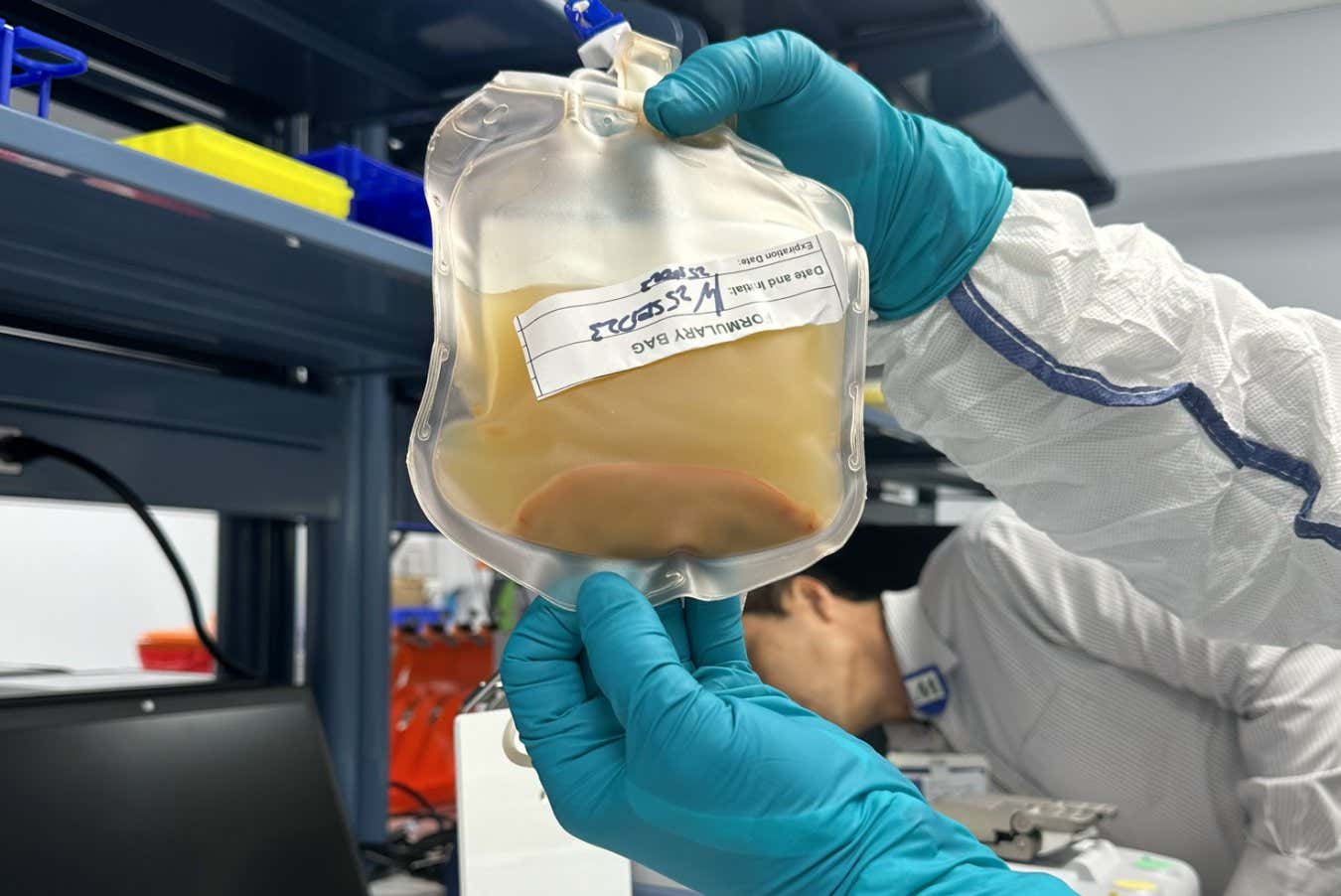
Solution with the hepatocytes (liver cells) in suspension
LyGenesis
For the first time, a person has received an experimental treatment to transform one of their lymph nodes into a functioning miniature liver. We won’t know for months whether the therapy works, but if it does, it could revolutionise the treatment of liver disease.
“This is a technology that could, in just the next few years, potentially eliminate the wait list for liver transplants,” says Michael Hufford at LyGenesis, a biotechnology company in Pennsylvania.
The kidney transplant procedure is the first of its kind in a living person
Michelle Rose/MASSACHUSETTS GENERAL HOSPITAL
Surgeons have successfully transplanted a pig kidney into a 62-year-old man living with end-stage kidney disease. The recipient, Richard Slayman, is recovering well and is expected to be discharged from the hospital soon, mere days after the surgery.
Is this the first ever pig kidney transplant?
This is the first time a pig kidney has been transplanted into a living human, which makes it a significant milestone in the field of xenotransplantation, or the transfer of animal organs to humans.
“The success of this transplant is the culmination of efforts by thousands of scientists and physicians over several decades,” said Tatsuo Kawai at Massachusetts General Hospital in a statement. “Our hope is that this transplant approach will offer a lifeline to millions of patients worldwide who are suffering from kidney failure.”
Strictly speaking, however, this isn’t the first ever pig-to-human kidney transplant. The procedure has been performed five times in the past, all in people who were declared brain-dead and kept on life support. The most recent of these took place in July 2023 by Robert Montgomery at NYU Langone Health and his colleagues. That kidney functioned for more than a month without signs of rejection or infection.
When did the surgery take place?
Kawai and his colleagues performed the surgery on 16 March. The procedure lasted 4 hours, and the kidney began producing urine and the waste product creatinine soon after, according to reporting by The New York Times. Slayman has also been able to stop dialysis, a further indication of the kidney’s proper functioning.
Where did the pig kidney come from?
The organ was provided by the pharmaceutical company eGenesis, which breeds pigs that have been genetically engineered to carry certain human genes and to lack a particular set of pig genes that are harmful to humans. These genetic modifications reduce the likelihood of transplant rejection, when the immune system attacks the organ and causes it to fail. Slayman is also receiving a cocktail of immune-suppressing drugs to further lower this risk. So far, there is no sign of rejection and Slayman is able to walk on his own. His doctors hope to discharge him from the hospital soon.
What do we know about the recipient?
Slayman has type 2 diabetes, high blood pressure and kidney disease. He had previously received a human kidney from a donor in December 2018. However, the organ showed signs of failure approximately five years later. He started dialysis in May of last year, but experienced complications, requiring visits to the hospital every two weeks. This had a serious impact on his quality of life while he awaited a second transplant.
More than 100,000 people in the US are waiting for an organ transplant, of whom 17 die each day. The US Food and Drug Administration authorised the experimental transplant for Slayman due to a lack of other treatment options.
“I saw it not only as a way to help me, but a way to provide hope for the thousands of people who need a transplant to survive,” said Slayman in a statement.
Have there been xenotransplant procedures involving other organs?
Only two other people have undergone a xenotransplant, both of whom received a genetically modified pig heart. The first, a man named David Bennett, passed away two months later, potentially due to complications from a pig virus called porcine cytomegalovirus. As such, scientists genetically inactivated this and similar viruses in the pig that Slayman’s kidney came from.
The second recipient, a man named Lawrence Faucette, died from transplant rejection six weeks afterwards.