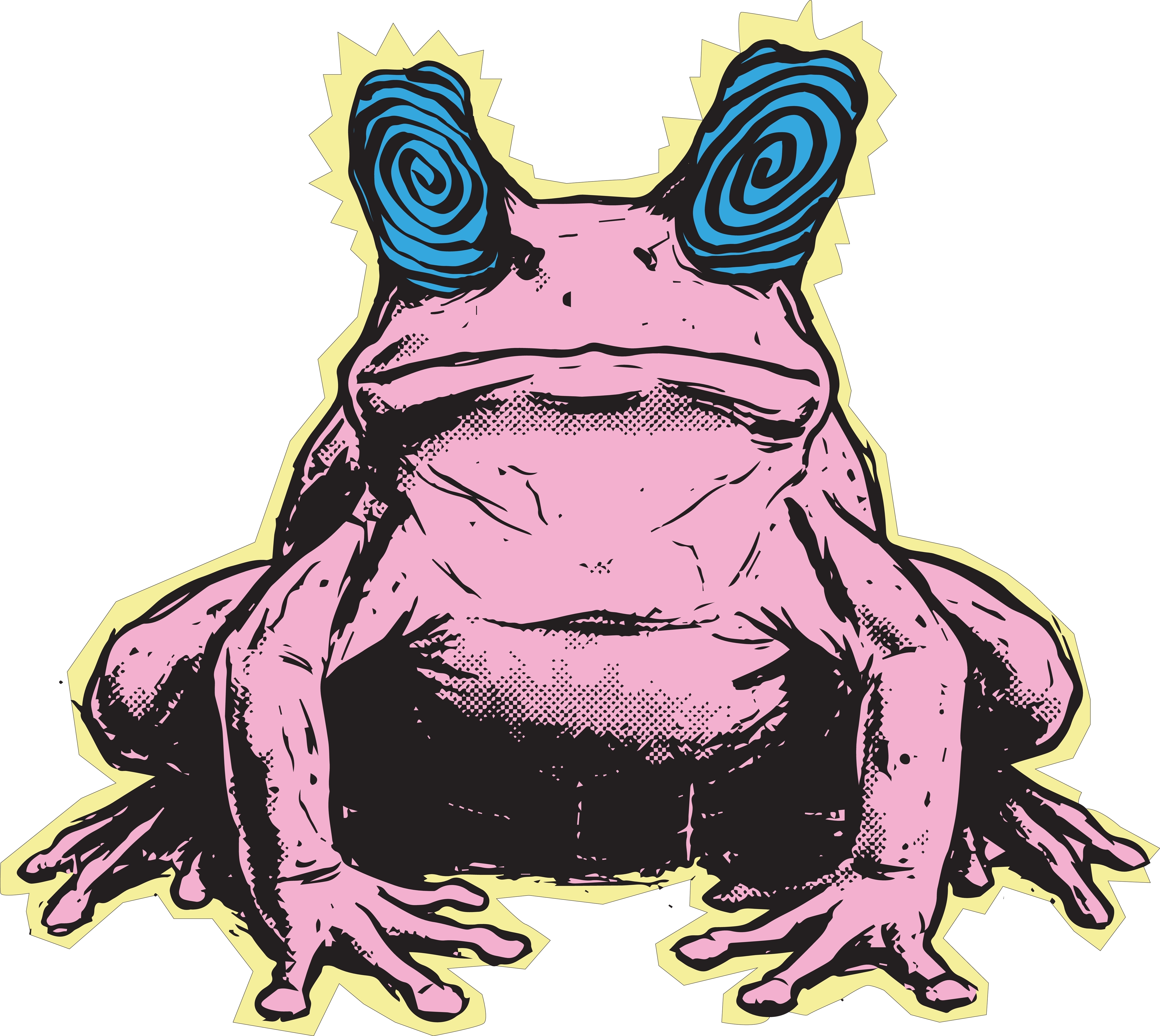
Toad smoking has been called “the Everest of psychedelics.” Over the past decade, this practice has “gone exponential,” a clinical psychologist who studies psychedelics tells journalist Kimon de Greef, in his new book, The Ego Trip: Psychedelic Toads, a Trail of Deaths and the Guru Who Peddled Transcendence. In the book, De Greef traces the messianic rise of the practice, the colorful and controversial characters who help to popularize it, as well as the casualties they leave in their wake.
Smoking toad, as de Greef points out, isn’t the same thing as licking toad, which can lead to a miserable and painful death. Instead, it involves pressing on special glands in the toad’s skin like pimples until they spurt a pale milky substance that can then be dried into flakes and smoked in pipes. The hallucinogenic compound these hardened secretions contain has the not-so-mystical sounding name of 5-MeO-DMT, which can also be synthesized in a lab. Many people seem to find the extraordinarily altering experience of using it to have powerful healing properties. Others, however, have found themselves totally undone by it.
Read more: “The Psychedelic Scientist”
I recently spoke with de Greef about the therapeutic potential of 5-MeO-DMT, the magnetic personality of the man who became El Doctor Sapo (aka the toad doctor), the current state of the psychedelic renaissance, and the uncertain fate of the toads.
You describe people risking cartel violence and prison time to collect a substance released from this Sonoran Desert toad that in those who take it produces total annihilation of the ego for 30 minutes, and can also sometimes lead to psychosis, bodily injury, and even death. What is it about this psychedelic that makes people take such risks?
The risks of taking it drive the risks of collecting it, and at the core of the story is the universal urge to seek, transcend, and heal. Many people feel dissatisfaction, pain, or worse in their daily lives for all sorts of reasons relating to how the world is today. This substance promises rapid deliverance from that. At least that’s the marketing for it—and for many people that’s the reality. That’s rapidly taken the substance from super marginal to something more like a pop-culture phenomenon and created a commercial market for toad secretion—to the extent that all kinds of marginalized, impoverished residents of Sonora in Northern Mexico are now incentivized to guard and look for toads in one of the most dangerous territories of the world.
Many of the toad collectors are local to their area. My understanding is that the economy’s structured the way it is because people can’t move around too freely, so they collect in their zone, but it still can be super dangerous for the collectors. It’s arguably worse for the toads.
Do you think any of that would’ve happened without Octavio, El Doctor Sapo, the so-called psychedelic superstar who was its chief promoter for so long?
The molecule is so singular in its effects and powerful that it probably would’ve happened, but I don’t think it would’ve happened in the way that it did. And something crucial that Octavio brought to the phenomenon was this plausible origin story of indigenous use.
It’s impossible to know how the tape would’ve played otherwise, but it was instrumental to have this notion of indigenous sacrament. That took it from being this fringe, bizarre, slightly gross thing having to do with the toad and recoded it into this language of shamanism and spiritual exploration and healing. It’s been hugely consequential for the toads, for Octavio, and for the Seri people, in complicated ways.
Eventually, given what’s going on at large with psychedelics, I feel like someone would’ve done something with it and found a following. It seems too powerful and too of the moment not to have happened. But I imagine that story would’ve taken a completely different path, which I can’t really imagine.
What was it like meeting Octavio? Why do you think he was such a powerfully charismatic and magnetic personality for so many people?
I felt his charisma when I was with him, at least in his good moments. He’s one of the most charismatic people I’ve spent time with. He’s warm. He’s interested in people. He’s supremely confident. That confidence is attractive. I’ve been trying to resist psychologizing about him too much, but he tells a story about having a psychedelic-mediated encounter with the divine during his 20s, and I think deep within his psyche, he does believe that he’s on a divine Messianic quest. That’s attractive. When someone believes that they’re on a mission and saving the world at a deep level, I think that radiates out to other people.
From what I understand about his youth, he’s naturally intelligent. People have been drawn to him and followed him since he was a kid. There’s a story of him tricking his schoolboy friends into giving him their money so that they could win the lottery. Some people are just born, for whatever reason, with the sort of ability to become a guru. Not everyone can become one. He’s handsome to many people. He’s got long shaggy dark hair and tan skin. He looks like a Messiah.
Gurus get generated at some frequency by societies or different cultures. People pop up, and they have that inclination and ability. But Octavio also had this substance that takes many people to a completely transcendent space. It’s not like he’s just a charismatic yoga teacher or a charismatic preacher or a charismatic Bitcoin advisor. He’s a charismatic administrator of the “God molecule,” so there was a feedback loop. This guru had probably the most powerful stuff out of all the gurus. That helped him as well. And that fed into the charisma that people perceived from him.
Why is this one psychedelic called the God molecule? What is so different about the experience from what happens on other classic psychedelics like psilocybin or LSD?
Abundant trip reports from people who have done many different psychedelics suggest it’s phenomenologically quite distinct. A classic hallucinogenic experience is of someone observing a radically altered reality, whether that’s visual hallucinations or sounds or encounters with entities. The 5-MeO-DMT experience much more frequently seems to involve a dissolution of the self. It’s not like I’m existing in a different reality. It’s more that I’m not existing anymore. Beyond that ego boundary for many people seems to be the sense of oneness. The language gets sort of mystical and woo-woo but people come back and they say, “I’ve been at the source of all consciousness.”
There are interesting trip reports from people who have been advanced meditators, for example. They report that their meditation practice, which has often taken many years of hard work, leads them to a similar place that the God molecule leads them to.
I don’t know a ton about the neuroscience of it, but it does hit a different neuroreceptor compared to most other psychedelics. It’s doing something slightly different in the brain. Similarly, they’ve done some brain scan work at Imperial College London that compares the neural circuits of meditators and people on 5-MeO-DMT. I’ll probably botch the precise similarities and differences, but it seems to inhibit a whole lot of top-down brain function. There’s a mystical explanation of where it goes, and then there’s also this neuronal circuit that can get activated that has the same effects as intense spiritual practice or a near-death experience, the kinds of things that people otherwise need to do to get to this kind of non-dual ego-dissolved place.
The name the God molecule was coined by a guy named Martin Ball, who fleetingly appears in the book. He was a practicing Buddhist for many years, and he tried a lot of psychedelics. He’s written me some sort of huffy messages because I hadn’t credited him with that name. In the footnotes, I did credit him.
You note in the book that you encountered many deceptions in your reporting. What were the most memorable or surprising of these deceptions?
My way into the story started with a deception in that I was reporting on white sage poaching, and a guy who was seemingly involved in that economy during my interview with him, at some point, announced, “You should be interviewing me about psychedelic toads. I’m surprised you’re not asking me about that.” And I said, “That sounds interesting.” Then he said, “I invented it. You can go and check out the Vice documentary about me.”
In truth, there was a VICE documentary about him claiming to have been the person who wrote the pamphlet about how to smoke toad under the pseudonym Albert Most. Soon after that, VICE put out a whole new documentary because the real guy had contacted them.
And then, the last time I saw Octavio involved a deception where he was gifting his daughter and consuming himself this substance in a dropper bottle. I was asking what it was, and he said it was some kind of essential oil supplement. He swore it wasn’t psychoactive. I had no good reason to trust him, but in a lapse of concentration, I took some and then forgot about it until the psychoactive effects kicked in half an hour later. That was a wild, completely unintentional, coda to my reporting with him.
I’ve been telling people that if I read that passage as a reader, I would have suspicions about the journalist’s truthfulness in claiming to have done it accidentally. But it was entirely an accident. There were no gonzo reportage plans there. It was like, “It’s been a long day.” And then I was like, “What the hell have I done?”
I navigated these deceptions by just trying to do 101 journalism and check stories multiple times with people. Nothing fancy. From the get-go, I tried to approach this wild topic and wild phenomenon of these radically altered states as journalistically and as squarely as possible, because I’m interested in how psychedelics interface with the everyday world. There’s this notion and wish that people have that changing their internal reality automatically changes external reality, but it doesn’t. The body that’s consuming 5-MeO-DMT is still a physical body in the physical world with a specific chain of people bringing the medicine into that body and an economy around that. It’s not an escape from politics or the structures of reality. I was interested in reporting out those contact points between the experience and the world that people return to afterwards, because a lot of psychedelic writing gravitates toward the internal.
This brings to mind a line you recount near the end of the book. Someone tells you that turning the God molecule into a commercial psychiatric drug could make it like the new opiate of the masses, a way to pacify people essentially, and keep them functioning inside the industrial machine. What do you think of that idea?
There’s immense clinical therapeutic potential in 5-MeO-DMT. And it’s wise and responsible for society to explore those potential uses. The data so far have been strikingly positive. There are countless millions of people around the world whose needs aren’t being met by conventional psychiatry, mental healthcare, or cultural tradition. But the trajectory that commercial drug development takes, the inevitable constraints that it has to confront, risks denaturing the experience or forcing it in ways that might be at odds with good outcomes or patient safety. For example, drug regulators regulate drugs. They don’t regulate therapy. From their perspective, this makes a ton of sense.
Let’s say I come to you and say, “I’ve got this miracle drug that cures depression, but you should accompany it with 10 hours of preparation,meditation, and journaling and afterwards you should do a debrief in a circle and then more journaling.” A drug regulator very reasonably could ask, “How do we know that this is the drug working?” They need to isolate it out, but that system doesn’t really make a lot of sense when you’re talking about something that interferes with a person’s subjective experience so radically.
Similarly, commercial drug development is hugely expensive, and it requires a ton of upfront capital with no guaranteed return. The people with that kind of money are making lots of risky bets and expect some of them to pay off. Then you need IP. The other concern is that part of the appeal of 5-MeO-DMT is its affordability and scalability because it’s much faster than most other psychedelics. That’s a pragmatic concern if you want to bring psychedelic therapies to as many people as possible.
But some researchers I spoke to saw that in another way. If you’re making a substance that dissolves the self and takes people toward these transcendent planes, and then sends them back to their lives where whatever circumstances were in place and contributing to the depression before probably still exist—whether that’s poverty, precarious housing,systemic racism, or traumatic family dynamics—the experience doesn’t necessarily change any of that. Someone used the term spiritual gaslighting. It’s like sending people to a clinic to have this drug-mediated spiritual high, and then sending them back home. If you’ve got a drug that can perform the central function of religion, bringing people into a more spiritual experience, there’s a dystopian sci-fi future that’s possible. I’m not saying it will happen, but it’s weird stuff. And a lot of conventional psychiatry has been critiqued as primarily just a pacifier to take the edge off so that people can continue to be productive citizens without being so depressed that they can’t work.
You describe how Octavio completely ignored the integration stuff, what’s often called “set and setting” in the research world, in spite of constant pressure from others in the psychedelic community to provide more structure and support. He operated like a cowboy. That’s likely why he had so many horrible mishaps on his watch, including a number of deaths.
In many cases, he did succeed. Thousands and thousands of Octavio’s clients credit him with life-changing experiences. Many addicts became clean. People have surmounted trauma. That’s because the molecule is remarkable. If you give 100 people the molecule, especially at high doses, a large proportion will reach some plane of spiritual existence, some kind of epiphany that helps them. There are some interesting debates among some psychedelic researchers about whether the subjective experience is what drives the benefit or if it’s all just neurocircuitry, rebooting the brain, that perhaps you could activate the circuits and engineer the psychoactive experience out.
But anecdotally, according to an integration specialist I spoke to this week, it seems like 1 in 10 people taking 5-MeO-DMT have adverse experiences. Even a good trip can introduce complications for people if it challenges their core beliefs about reality. For example, if someone’s an atheist and they have a divine encounter, that could pull the rug out later in terms of them making sense of who they are. People experience something called ontological shock, or they have depersonalization, dissociative spells where everyday reality feels uninhabitable or remote or alien to them. It does seem like more cautious preparation and especially integration work can help make that 1 in 10 rate a little bit lower.
One of the things with this substance that’s most challenging is when people resist it, because it comes on so quickly. They can end up in this very stuck, hellish place. Helping people understand what to expect and feel like they can trust and go with it seems to be something that helps on the front end. And then on the back end—especially as this gets into more “normal” populations, not the psychedelic underground—it appears to be helpful for clinical trial participants to have people around them in their communities who can talk to them and understand them, who have the language to talk about this kind of mystical experience. That’s where integration work becomes really important.
But Octavio demonstrates that you can get quite far and still help a lot of people by being completely reckless. That’s scary to me.
One other note: I think the set and setting included the claim that this was an indigenous ritual. For many seekers, non-indigenous people, that’s a useful mental framework. “Okay, this is what wise people with a connection to ancient forms of spirituality did. This is an ordeal that they went through. I can get through this.” Unfortunately, that story about the indigenous rituals seems to be much more complicated, if not completely fabricated. That’s the thing I’ve thought about a lot. Did that story function as a placebo effect? How many more people had good experiences with it as a consequence of that?
What do you make of the fact that this psychedelic molecule is so widespread in nature, but mostly exclusive to the Americas? You write in the book that it’s not just found in these toads, but also in a bunch of different plants, which I was really surprised to learn.
It’s also in some grass in Australia. Sheep eat it, and they get something called the staggers, which is a neurological condition that can be fatal. But in answer to your question, it’s a tryptamine, and the tryptamines are this class of molecules that occur widely, but I’m not sure why. Tryptamines can convert from one form to another quite easily. Bufotenine, serotonin, 5-MeO-DMT, regular N,N-DMT—they’re all slight variations on the same molecular theme. It just seems to be something that nature produces from time to time. I don’t even know what it does in the plants, to be honest, because it’s a neurotransmitter. In the toads, it’s part of their defense secretions.
As for the Latin America thing, something that’s weird is that so many psychoactive plants and traditions are clustered in Latin America, not just 5-MeO-DMT. That’s a very reliable pattern. I don’t really know why. It could be that all these psychedelics are similar in structure and had an adaptive radiation. But it did mean that Octavio’s story about the Seri tribe origins had a ring of plausibility. Mexico has more than 10 psychedelic rituals: mushrooms, peyote, morning glory seeds. So with the toad, it was like, “Okay, that makes sense. There’s a cultural frame for this.”
What’s the latest on how the toad populations are faring?
Nobody really knows. It’s devilishly difficult to survey most of their habitat because it’s in cartel territory. The week before I was in Sonora, some botany student was murdered while he was doing field work. That really drove it home for me: Wow! You can’t just go out with your field kit and count toads.
There’s another dynamic which I didn’t write about in the book really, which is the curse of the common animal. The Sonoran Desert toad was just ubiquitous. People weren’t interested in it. It was just something that was there. People tend to study animals that are rare or remarkable. And the Sonoran Desert toad is remarkable, but there’s a toad that lives in an adjacent range called the spade foot toad. It has a shorter life cycle and more extreme drought and desert adaptations. There’s been a cottage industry of studying that toad. But for the Sonoran Desert toad, there wasn’t a good baseline.
Anecdotally, places that were rich in toads are no longer rich in toads, and collectors who used to get large numbers of toads quickly now have to hunt much longer and they get fewer. It’s impossible to conclusively say that that’s due to harvesting pressure because similarly, there isn’t any robust way of assessing harvesting pressure. But we can confidently say that each summer kilograms of the secretion have been harvested, and you can backwards infer that that means hundreds of thousands of toads have been squeezed in this three-month window when they’re above ground. But it could also be that the toads are affected by climate change, pollution, or habitat transformation. Amphibians are a vulnerable group of species, generally. It’s a sad irony with the toad, because they’ve proven to be so spectacularly resilient.
The Sonoran Desert toad’s fossil record shows that it lived in the area before it became a desert and one of the driest places in the world. The toad just figured out how to remain there by making these extreme alterations to its life cycle. But within 15 years, coinciding with the toad-smoking boom, they’re thin on the ground. That’s true of all animals living in the Anthropocene. Humans change things too quickly for anything to adapt. It’s tragic. It’s such a special creature. It’s even more special for this secular magic that it produces, this molecule that can radically alter consciousness. That’s wonderful and strange. The fact that it seems to be suffering while people are benefiting from the psychedelic experiences that it elicits says a lot about what humans are like.
You mention in the book that attitudes toward psychedelics shifted pretty radically around 2018 when some of the first studies showed that they had promise for treating addiction, depression, and other illnesses, and when Michael Pollan’s book How to Change Your Mind came out. Do you think that that optimism has been tempered at all in the years since,or does it just keep growing?
There was a real boom in optimism slightly predating Pollan’s book, but 2018 seemed to mark this watershed moment. In research circles, there seems to be more caution. In psychedelic communities, there seems to be a little bit more caution. That said, there’s still tons of money going into psychedelic drug development, more and more every year. The Trump administration, seemingly at the behest of Joe Rogan texting the president, has aggressively cut regulatory red tape to accelerate the development and approval of psychedelic medicines.
Psychedelics seem to experience these pendulum swings, where people are either all in or banning them. At least that’s what’s happened in this country. It’s not an original take—it’s something that people say often—but it’s useful to think of them as powerful tools. Tools can be used to do amazing arts or repair things, and they can also be hugely destructive. It matters how they’re used and what becomes most important is the intention and the expertise with which people use them.
There’s still quite a long way to go before society at large learns to constructively integrate psychedelic experiences at a large scale. I don’t even know if it can be done because a lot of the lessons that people derive from psychedelics are antithetical to the society we live in. There are also the psychedelic purists—and Octavio is one of them—who believe if you change everyone’s minds, you can change the world. But my reporting on the 5-Meo-DMT space race to develop it for therapeutic use suggests to me that there’s no easy escape from human nature.
The things we struggle with are going to continue to be there and sometimes amplified in the attempt to expand access to psychedelic experience.
Enjoying Nautilus? Subscribe to our free newsletter.
Lead Image: hrisqvrb / Shutterstock