Dark Mode Light Mode
Join us on a journey where chemistry meets creativity, and the wonders of science unfold. Quench your intellectual thirst with thought-provoking articles that transcend the boundaries of conventional knowledge.

First Evidence in Humans That BPA Can Alter Insulin Sensitivity

First Evidence in Humans That BPA Can Alter Insulin Sensitivity First Evidence in Humans That BPA Can Alter Insulin Sensitivity


A ubiquitous industrial chemical commonly used in food and beverage packaging may quietly mess with the body’s insulin sensitivity when ingested.

Bisphenol A (BPA) is one of the highest-volume chemicals produced worldwide.

Since the 1960s, it has been used to manufacture an unfathomable number of plastic packages and epoxy resins, which coat the insides of many food and beverage cans.

By some estimates, BPA is so widely consumed that it is present in the urine of more than 90 percent of the US population.

But is that safe?

US health guidelines might say yes, but the first experimental evidence in humans has now found that ingesting BPA, even at low doses, may reduce insulin sensitivity in the short term.

Plastic bottles can contain BPA. (fotoblend/pixabay)

“Given that diabetes is a leading cause of death in the US, it is crucial to understand even the smallest factors that contribute to the disease,” said senior author and diabetes researcher Todd Hagobian when presenting the preliminary results at the Scientific Sessions of the American Diabetes Association in 2024.

“We were surprised to see that reducing BPA exposure, such as using stainless steel or glass bottles and BPA-free cans, may lower diabetes risk.”

The findings are now published in The Journal of Clinical Endocrinology & Metabolism.

In a randomized, double-blind clinical trial, 40 young adults were exposed to a ‘safe’ dose of BPA – as per the US Environmental Protection Agency (EPA)’s lifetime exposure threshold – or a placebo.

After five days, peripheral insulin sensitivity decreased by 9 percent in the BPA group, while it rose slightly in the placebo group.

While many animal and observational studies have hinted at BPA’s links to metabolic health, surprisingly few experiments have put that association to the test.

“These results provide the first published experimental evidence in humans that short-term oral BPA administration may impair insulin sensitivity,” conclude researchers at California Polytechnic State University (CPSU) and Rutgers University.

“[They] carry important clinical and public health implications, suggesting that BPA exposure, even at doses currently considered ‘safe,’ may contribute to the development of insulin resistance.”

Larger trials are needed to see how these findings generalize to the rest of the population, but the short-term changes are concerning, especially when they are put into context.

“When considered alongside prior epidemiological, animal, and human studies,” argue researchers at CPSU, “the present findings add to the growing body of evidence that regulatory agencies should critically reevaluate the established reference dose for BPA.”

Today, the US EPA maintains that the lifetime safety threshold for BPA ingestion is a reference dose of 0.05 milligrams per kilogram of body weight per day.

If kept under that threshold, government officials think that BPA is unlikely to produce appreciable harm.

But that number was first established in 1988, and a lot has changed since.

Scientists have known that BPA can mimic estrogen in the body with potentially hazardous effects for nearly a century now.

In the 1990s, however, we learned something new. This was when researchers first noticed that BPA was leaching from heated polycarbonate packaging into our food and drink.

Further experiments showed that BPA had the power to produce estrogen-like activity in human cells.

In 1997, the first study in living animals found that feeding a low daily dose of BPA to pregnant mice induced negative reproductive effects in male offspring.

In the decades since, thousands more animal studies have shown negative effects of BPA at low doses.

Subscribe to ScienceAlert's free fact-checked newsletter

What’s more, population-wide studies among humans have found higher levels of BPA exposure are linked to numerous health issues, including fertility and reproductive problems, altered neurodevelopment, cardiovascular issues, type 2 diabetes, and insulin resistance.

This does not mean that BPA is necessarily causing all of these issues, but amid mounting concern, BPA was phased out of US baby bottles and sippy cups.

Even among healthy adults, however, some evidence suggests unwanted effects could occur at doses the EPA currently considers safe.

In 2019, for instance, researchers at CPSU conducted a randomized trial among 11 college-aged participants. Compared to a placebo, they found that a low dose of oral BPA resulted in immediate effects on glucose and insulin concentrations.

But the findings couldn’t distinguish between issues with insulin secretion or insulin sensitivity.

So the research team conducted a larger trial among 40 healthy young adults over five days, using more precise insulin measurements.

Half of the participants were randomly assigned to receive a daily placebo, while the other half received a low dose of BPA, within the EPA’s safety threshold. All followed the same diet otherwise.

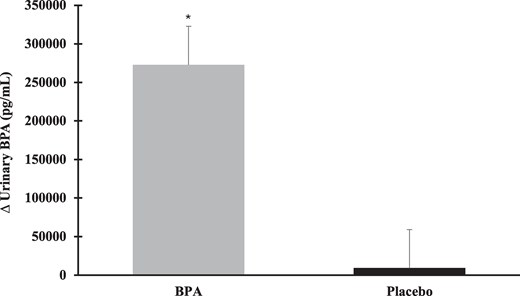
As expected, those who consumed the daily dose of BPA had higher concentrations of the chemical in their urine.
First Evidence in Humans Finds BPA Can Change Insulin Sensitivity
Change in urinary BPA concentrations in the BPA group versus the placebo. (Seal et al., The Journal of Clinical Endocrinology & Metabolism, 2026)

At the end of the 5 days, this group also showed significantly decreased insulin sensitivity in their peripheral tissues.

Interestingly, estrogen was unlikely to explain the reduction.

The authors could not fully distinguish between insulin sensitivity in the periphery and in the liver, but they found no difference in a commonly used index of the latter.

“This suggests that BPA may have interfered with insulin-stimulated glucose metabolism in skeletal muscle,” the team concludes.
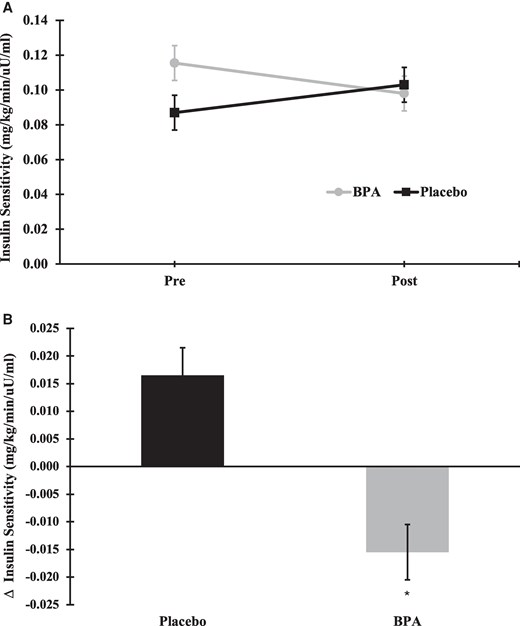
First Evidence in Humans Finds BPA Can Change Insulin Sensitivity
A) Insulin sensitivity in BPA-50 and PL between baseline and post-treatment clamps; (B) change in insulin sensitivity in PL and BPA-50. (Seal et al., The Journal of Clinical Endocrinology & Metabolism, 2026)

Previous evidence linking BPA exposure to insulin resistance has been mainly associative, but this new study is a double-blind, placebo-controlled, randomized clinical trial.

This means it gets us closer to a possible cause than ever before.

But participants in the trial were young, college-aged adults, which means the findings may not extend to the population as a whole.

“It is not clear how BPA interacts with people who have obesity or prediabetes/type 2 diabetes, and this warrants attention,” writes the research team.

Related: ‘Forever Chemicals’ May Be Weakening The Bones of Children, Study Warns

Given the emerging evidence, BPA is no longer allowed in most food and beverage products in Europe.

But regulatory bodies in the US have not reevaluated BPA in over a decade.

This year, US lawmakers introduced a “No Toxics in Food Packaging Act”, which would ban BPA from food packaging.

Previous versions of the bill have failed.

The study is published in The Journal of Clinical Endocrinology & Metabolism.

This article was fact-checked by Rebecca Dyer and edited by Rebecca Dyer. While we pride ourselves on our process, we are only human. If you spot a mistake, please let us know.




Source link

Keep Up to Date with the Most Important News

By pressing the Subscribe button, you confirm that you have read and are agreeing to our Privacy Policy and Terms of Use
Add a comment Add a comment

Leave a Reply

Your email address will not be published. Required fields are marked *

Previous Post
EU Copernicus Sentinel-3C launches successfully

EU Copernicus Sentinel-3C launches successfully

Next Post
Why the Postpandemic Tech Bust Sent Billionaires to Trump

Why the Postpandemic Tech Bust Sent Billionaires to Trump

Advertisement