


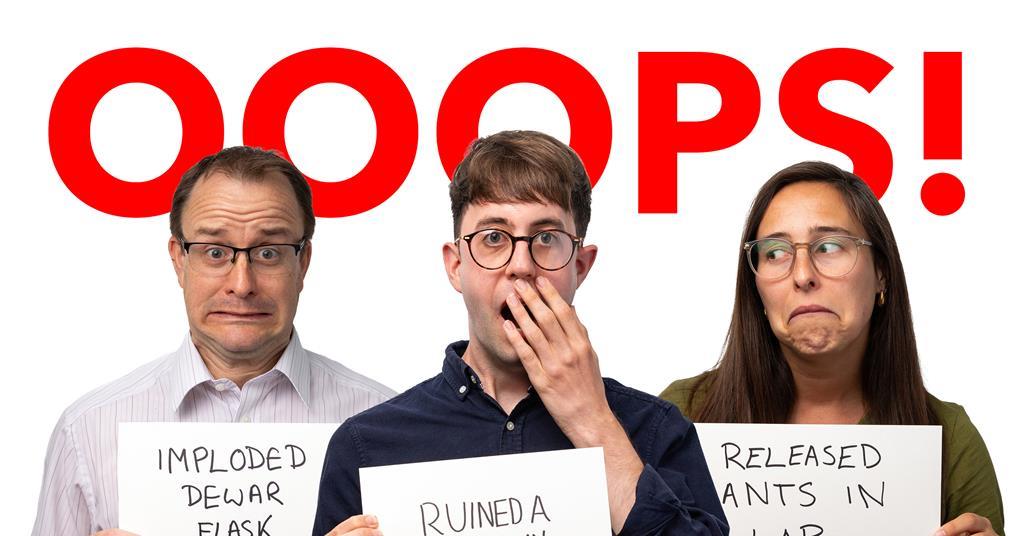
Imploded a Dewar flask
Phillip Broadwith, business editor
I was using a methanol/liquid nitrogen bath to cool a reaction to -100°C. When doing this, it’s important to stir well while mixing to get a kind of slushy slurry. Then you keep adding liquid nitrogen every now and again to stop it warming up. I can’t quite remember what I did wrong – maybe the reaction went on longer than expected and condensed atmospheric water into the bath, or maybe I added too much liquid nitrogen and the whole thing froze solid. But, at some point, there was a massive bang as the mixture expanded under the frozen crust and the glass vacuum Dewar that the bath was in imploded. Those things are pretty expensive as a piece of lab kit goes, so I was looking pretty sheepish when my supervisor turned up.
Smashed an illicit thermometer
Emma Pewsey, comment and careers editor
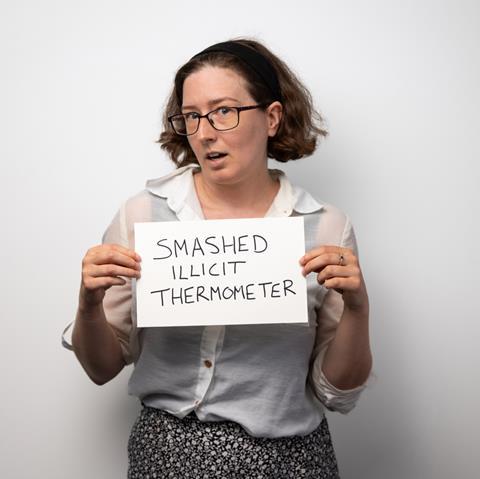
I broke a mercury thermometer that I was secretly using a week after we’d all been told to stop using mercury thermometers. My secret was revealed when the department safety team had to help clean up my mess. I was embarrassed more than anything. If you have any mercury thermometers lying around your lab – which can be surprisingly common in older departments – I suggest that you get rid of them. Just not in the way that I did.
Ruined a column
Mason Wakley, science correspondent
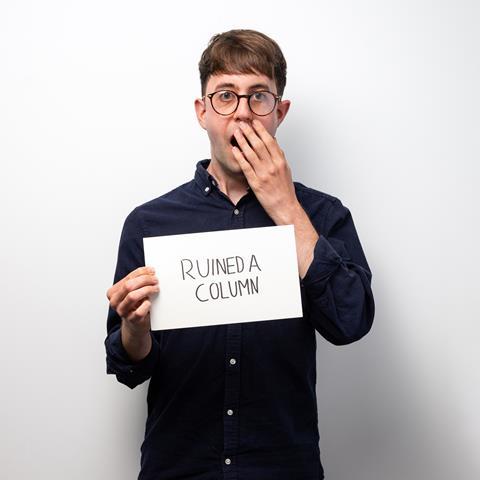
I once dropped an entire pipette and pipette tip into a column after carefully adding my sample during an undergraduate practical. I was already pressed for time so I had no choice but to keep calm and carry on. My solvent – which I think was a mixture of dichloromethane and methanol – slowly dissolved some of the pipette tip, meaning that some of the dye ended up in the same fractions as my product. I was ultimately left with extra peaks in my NMR spectra and a pale pink product (which should have been white). Lesson learned: it’s okay to restart experiments. Oh, and that having a steady hand is helpful.
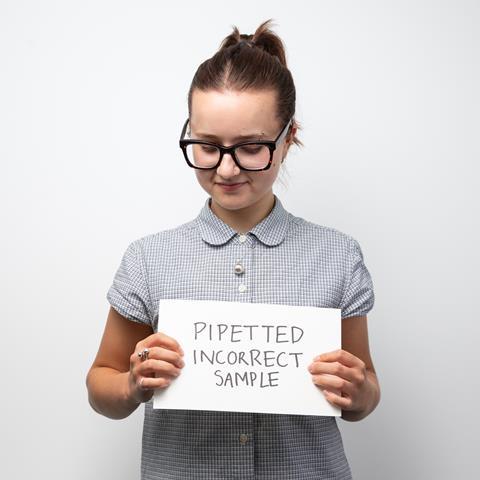
Pipetted the wrong sample
Frances Briggs, science writer intern
My master’s project explored the effect of fluorinating cellulose, which could be an environmentally friendly ‘bio-Teflon’. Studying this material involved degrading the functionalised cellulose and analysing its end products. MALDI–ToF – matrix-assisted laser desorption/ionisation time-of-flight analysis – was one of the many analytical methods I used. Here, a laser vaporises a sample, with matrix molecules transferring their charge to the analyte. This allows you to then measure the mass-to-charge ratio of your molecules without fragmenting the sample itself.
If you’ve ever used MALDI, you’ll know that setting up your sample is time-consuming: carefully pipetting microlitre drops of sample onto a MALDI plate followed by adding microlitre drops of a matrix solution, which helps crystallise your sample for analysis. So, when my samples hadn’t crystallised after 30 minutes, I thought ‘that’s odd’, and set the timer for another half an hour. After several trips up and down the stairs to and from the lab, I checked the matrix. Except, the matrix was in the left corner of my shelf of the freezer and not where I’d put it. And where I thought I’d put the matrix was something suspiciously resembling my bulk sample. In my rush to get the MALDI process started, I’d pipetted more sample onto my sample, not the matrix. What a waste of time!
Released ants into the lab
Mariana Kneppers, science media producer

I was running an experiment involving ants, and I thought I had taken every precaution to avoid their escape from the enclosure. But lo and behold, I got an email from an irate professor saying that there were ants currently roaming free in the lab in the middle of his lecture. I then had to run across campus to collect the escapees. We had this special device that consisted of a small chamber at the end of a large tube so you could literally suck the ants into the chamber. So there I was, crawling on my hands and knees, under desks and lab benches in the middle of an active lecture, dodging students’ legs in my recovery mission. Needless to say, that enclosure ended up with some reinforced security after that day!
Broke a Schlenk line
Jamie Durrani, senior science correspondent

It was the first day of my industrial placement. I’d been shown to the fumehood where I would work for the next two months and was busy setting up the equipment I’d need. Central to this was the Schlenk line: a fancy, and – I feel the need to stress this – expensive piece of glassware that keeps air and moisture away from sensitive reactions. As I worked away – crack! – part of the line suddenly came off in my hand.
I was still early in my PhD studies, wracked with imposter syndrome, and terrified about first impressions.
Luckily it was a clean break. I re-assembled the Schlenk line, with the crack craftily hidden behind a clamp. I then spent the next week-and-a-half busying myself with anything other than the actual chemistry I’d been sent to do: ‘reading the literature’, ‘planning my synthesis’, going on tours of the different analytical labs. I did all the e-learning modules HR provide for new staff: fire safety, ergonomics training, how to use the intranet. All to the bafflement of my supervisors.
Finally, I was ready to fess up. ‘I’m really sorry, but I think I’ve broken this Schlenk line.’
No-one cared. A new Schlenk was found, and – at long last – I could start my project. It taught me an important lesson about owning your mistakes. Instead of coming clean straight away, all I’d done was waste several days of my placement. And if anything, I made a worse first impression on my colleagues by coming across as a weird and incredibly slow worker.
Years later, none of this matters. I doubt any of the co-workers I’d tried to hide my mistake from remembers anything about it – although it still makes me shudder!