



When asked about the greatest innovation of humans, people will often say language or fire. A new paper suggests that these innovations may be more interlinked than we previously assumed.
Understanding how human language evolved is one of the hardest problems in science to unpick, since writing is a relatively recent innovation. Also, the vocal tracts and brains of our ancestors did not fossilise as they were made of soft tissue. We are left, then, with indirect evidence about how humans and other apes communicate today.
One of the most prominent theories about the origins of human language is that our ancestors started to communicate using gestural language. This theory is based on our understanding of the abilities of apes, as evidence suggest both chimpanzees and gorillas have gestural communication systems.
We also know that one of the best strategies for communicating when you don’t have a shared language is gesture. We often do this when communicating on holiday with someone who doesn’t speak our language; we point, mime and emote to get our message across.
Some of my previous research has shown that we do this because gestures or sign languages are often more iconic than words in spoken languages. This means their meaning is easier to guess for someone without any previous knowledge of the gesture or language being spoken; perfect for creating a new language from scratch.
Did fireside storytelling aid the evolution of human language?
If human language started with gestures, then why are the vast majority of languages today spoken? One reason for this shift might lie in the limits of gestural language. You need a light source to see a gesture, and communication would have been necessary for our ancestors after dark.
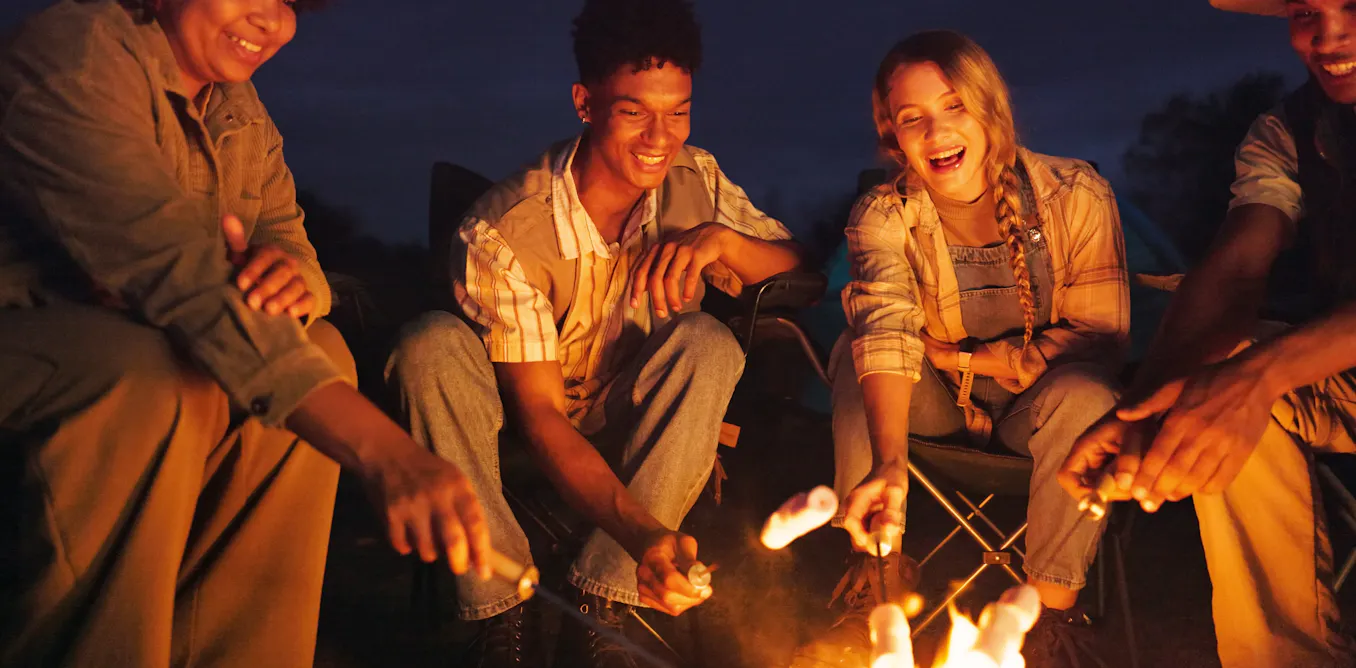
A article by researchers at the University of St Andrews argues that by the dim light of a campfire, we might find an explanation for why we moved from gesture to spoken language. While a light source, firelight is potentially too dim for us to rely on it for the meaningful bits of early gestural language. For fully expressive stories in the dark, we would need spoken language but still keep gestural elements to emphasise and emote our speech.
The study highlights how storytelling links to some of the features of human language that make it unique. Stories have complex structures and are often displaced in time and space, meaning they talk about things not immediately present, in the past, or sometimes not even real.
Gorgev/Shutterstock
The article suggests that social storytelling is what enabled us to surpass the communicative abilities of other living apes, into the rich, expressive tapestry of human language. Storytelling aids our social bonds and helps us understand the world and how to behave. It can help us develop our imagination, identities and cultural belief systems.
The idea that language emerged for social bonding is not new; however, the authors of the new article highlight that fireside context might have been crucial. They argue that the colour spectrum of fire is well suited for human vision without suppressing the melatonin that helps us sleep, like modern screen light can.
The study also highlights that human neurons synchronise to the frequency of flickering firelight, which the authors argue can improve shared social experience and bonding through connected rhythmic activities that can promote empathy.
How about storytelling today?
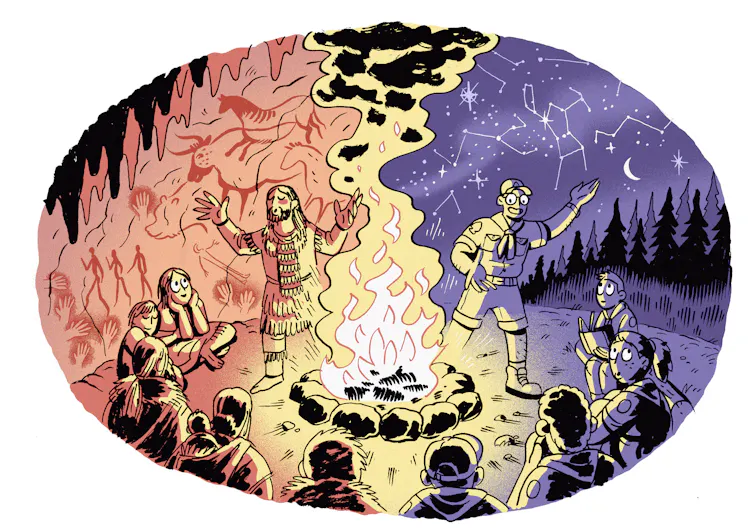
Other research, reviewed in my own work, has shown that stories from our early oral traditions share similar traits to one another. This is thought to happen because the social transmission of stories acts like evolution. Instead of survival of the fittest, we get survival of the most memorable aspects of stories as they are shared. Stories survive when they have more social, human-oriented content, counterintuitive elements, create negative emotions and have elements of survival.
Jordan Collver, Author provided (no reuse)
Researchers think this happens because swapping stories about social bonds, unexpected dangers and survival are advantageous for our evolution.
Storytelling is still one of the primary ways we understand the world even now, through the news and social media. This content is full of human interest, negative emotions and surprise.
Storytelling in the modern world is now often about getting the most clicks and attention. It is often about keeping people up past their bedtime looking at the melatonin suppressing blue light of our screens.
I’m left wondering, after reading about the potential fireside origins of our language, that we might feel more connection and trust by going back to sharing stories around a fire.