.gif "Here’s the iFixit Repairability Rating for the iPhone 18 Pro")
Commercially available polymers have been used to create a foaming material that is bright white with no pigments and yet is still rigid. The photopolymer also has lotus-leaf like super-hydrophobicity, which could find application in replacing harmful fluorinated compounds in waterproof clothing and other products.
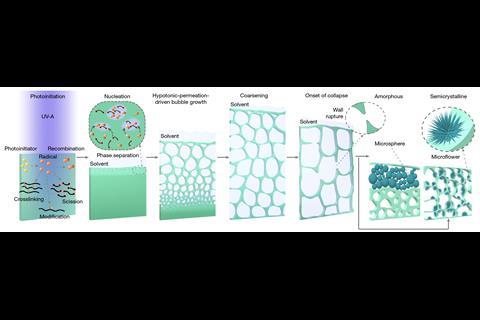
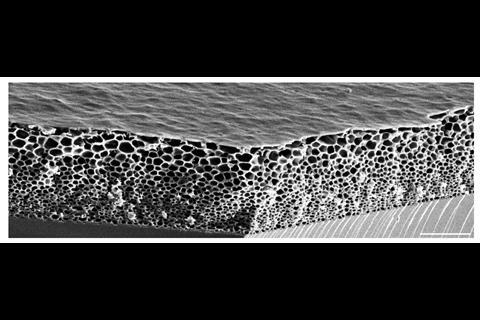
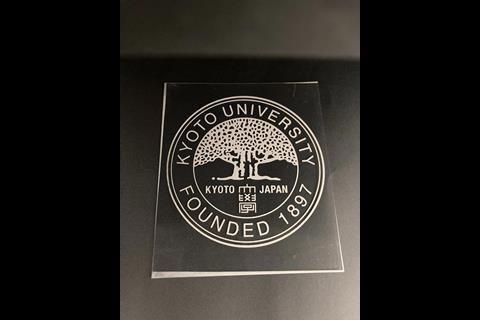

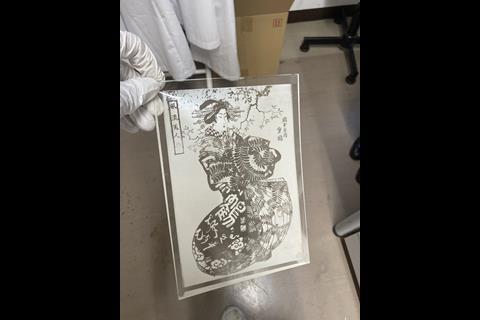
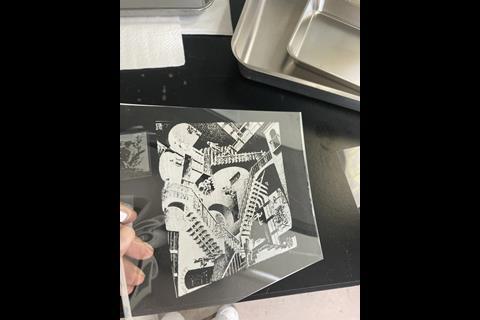


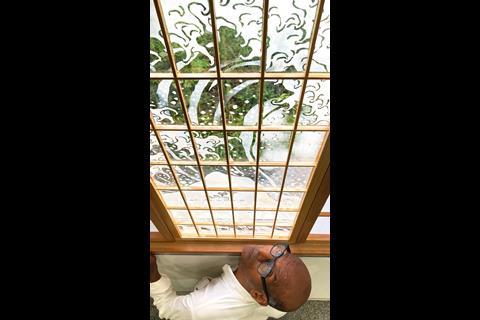
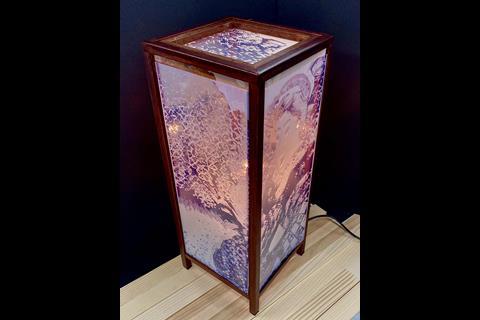
Drawing inspiration from nature and its range of structural colours that reflect light owing to their nanostructure, the team from Kyoto University’s iCeMS in Japan induced foaming of polymer films via UV-generated free radicals combined with a weak solvent. With light helping break the polymer into smaller molecular fragments, the solvent triggers pore nucleation and expansion. In what the researchers describe as a ‘controllable viscoelastic collapse’, the material is engineered to reveal ‘microflowers’, which provide a rough water-repellent outer surface around an internal network of pores that scatter light like snow, sea spray or clouds.
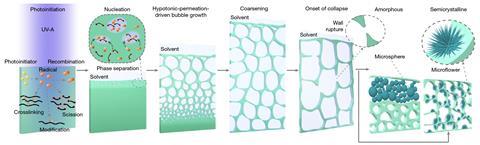
Easan Sivaniah at Kyoto University, who led the work, says this development is ‘attacking three issues at once’. Alongside the opportunity to reduce reliance on titanium dioxide for whiteness and per- and polyfluoroalkyl substances for water-repellence, the light reflective properties also keep the material cool.
‘What is so good about this technology is that it does work for practically every polymer we’ve tested,’ Sivaniah says. ‘Researchers working in lots of different areas could take advantage of this. I really love this technology, I just don’t know where next really. You could imagine a bulletproof foam since it can compress and absorb that energy or sound insulation.’
Sivaniah joined forces with Taiki Yanagishima of Tokyo Metropolitan University after they fortuitously bumped into each other on a train platform. ‘For eons, in art or industry, colour has been about pigmentation – finding the right chemical with the right absorption properties to create a certain colour profile,’ Yanagishima says. ‘More recently, we’re trying to shift away from sometimes harmful chemicals to something that produces similar colours using physical structure.’
The team had previously been working on creating structural colour using periodic structures that reflected light in different ways. However, the foaming polymer structures were a different class of structural colour, one that presented an irresistible opportunity to Yanagashima to understand exactly what was going on.
‘So, through this we found instead of these periodic structures, large thickness sections of foam,’ he explains. ‘You’re seeing wide-scale porosity, very expanded foam structures but they’re mechanically rigid.’ He says that their process both takes apart the polymer and rebuilds it. ‘There’s a mixture of a controlled demolition in a building and at the same time, there’s like a building elf trying to repair the thing as it’s exploding. There’s sort of a creation and destruction happening within the film.’
Niamh Fox, a lecturer in polymer science and expert in materials engineering at the University of Manchester, UK, who wasn’t involved in this research says she’s interested to see how the process will scale beyond the lab. ‘The exciting advantage of this method is the ability to pattern materials to such a high resolution opening further potential applications such as microfluidics, controlled wettability and security applications. I think the method will need further development depending on what application is chosen.’
‘I’d love to understand how this method copes with the inclusion of further materials in the initial films in an attempt to create reactive pore surfaces.’
For both, ensuring the structures are biodegradable and don’t cause environmental harm is a priority in scaling up. Sivaniah says the team plan to spin-out a company to expand their work into inks. ‘Now it’s a question of scaling up and engineering for biodegradability while balancing situations where you don’t want it to degrade, you want it to last.’