
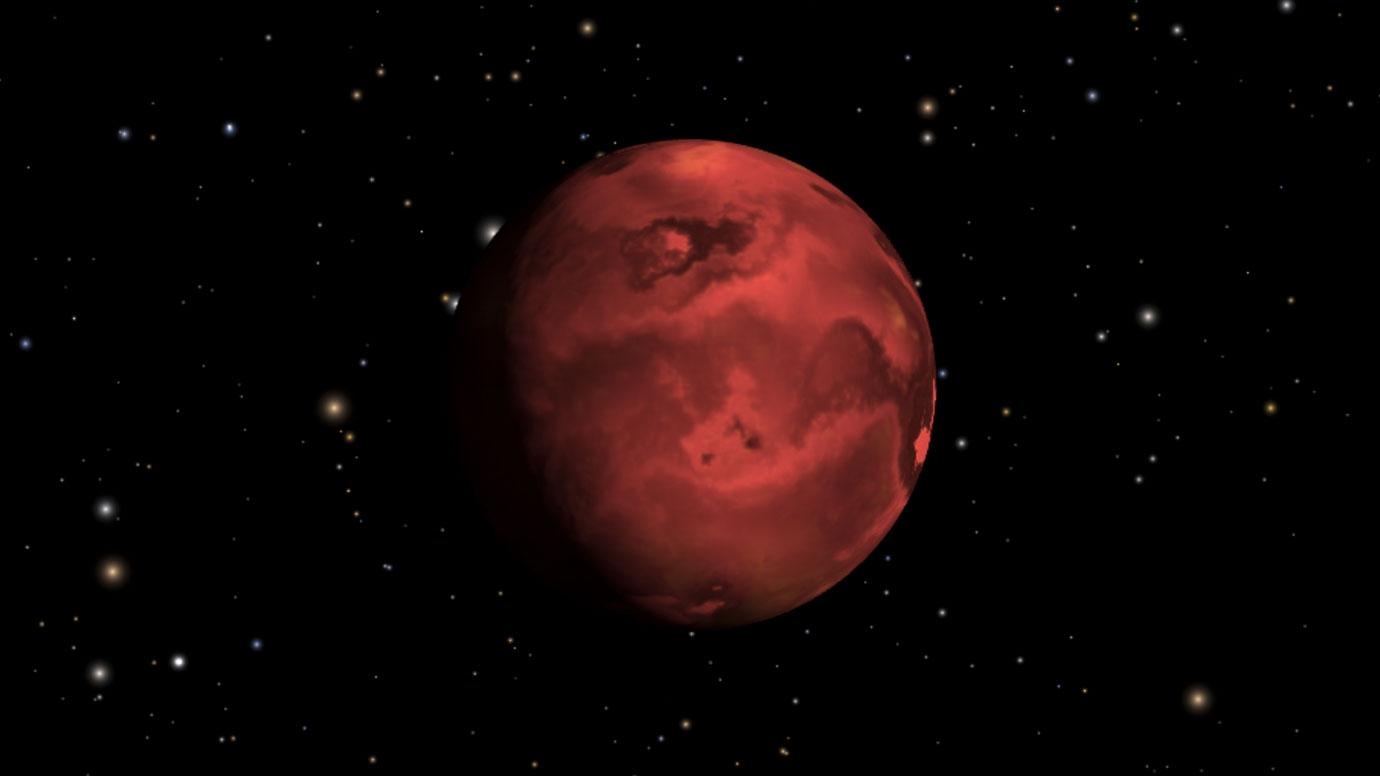



As the only place we know of capable of supporting life, ours is a pretty lonely planet. But there are other celestial bodies out there that at least resemble what ours may have looked like in baby photos. One of them is HD 3167 b. Called a “super-Earth” because its mass is roughly four times greater than our planet’s, this rocky lava world zips around a star slightly smaller than our sun at a speedy rate. In fact, a year on HD 3167 b is only as long as one of our days. Surprisingly, according to a new study published in The Astrophysical Journal Letters, it also has an atmosphere.
Atmospheres are fairly high on the checklist of what makes a habitable planet, because without them it’s unlikely to find water on the surface. While most rocky Earth-like planets don’t have atmospheres, lava planets like HD 3167 b have a better track record. So far, scientists have found four with atmospheres, and HD 3167 b makes five.
Read more: “What It Would Be Like to Surf Five Distant Planets”
“What’s so surprising is that the closer a rocky planet orbits its star, the harder it should be to have an atmosphere, because it’s bombarded by stellar wind and gets more high-energy photons from the star. But it seems that many of these lava worlds do,” explained study author Edwin Kite of the University of Chicago in a statement. “These planets are too hot for life, but by studying them, we can say something about the processes that matter for other rocky worlds.”
How can they tell HD 3167 b has an atmosphere?
They used the James Webb Space Telescope to collect infrared data as the planet passed behind its star. A planet with no atmosphere would be expected to be as hot as theoretically possible (taking into account other factors like its reflectivity based on its composition and more). But when HD 3167 b took a trip behind its host star, it was a lot cooler than expected. That’s likely because heat from the hotter star-facing side was dissipated to its cooler night side by a blanket of atmospheric gases. Additionally, cloud cover could be reflecting light and heat, another clear sign of an atmosphere.
So what’s it made out of?
“We think that HD 3167 b might have a silicate-rich composition, with a similar mixture of minerals that make up Earth’s mantle,” Kite said. “Before this study, we expected that any atmosphere on these ultra-hot planets would be composed of vaporized rock, but we’re starting to see evidence that some might have heavier gases like carbon dioxide, carbon monoxide, or water in their atmospheres.”
According to the researchers, studying the relatively cooler HD 3167 b can offer crucial insights into whether there’s a critical transition temperature that allows silicate planets to form thick atmospheres.
As far as we know Earth is still alone in its life-supporting abilities, but the club of rocky planets with atmospheres keeps getting bigger.
Enjoying Nautilus? Subscribe to our free newsletter.
Lead Image: NASA