
Dark Mode Light Mode
How Crocodiles Survived the Asteroid That Killed the Dinosaurs
One-Quarter of Data Centers Are Located in Water-Stressed Areas, Study Shows
The Surprising Origins of Native Hawaiians
Chemistry, medicine, materials and the technology shaping tomorrow — the best science stories from trusted sources, every day.

One-Quarter of Data Centers Are Located in Water-Stressed Areas, Study Shows

One-Quarter of Data Centers Are Located in Water-Stressed Areas, Study Shows One-Quarter of Data Centers Are Located in Water-Stressed Areas, Study Shows


Data centers need water to stay cool and functional, and lots of it: The larger facilities can consume as much water a day as a town of 50,000 people, and because much of the cooling involves evaporation, freshwater is often preferred.

That raises serious questions about the environmental impact of the cloud compute we use to run AI queries, host photos and videos, stream music, and all the rest. Researchers are trying to get a handle on what the impacts on water usage actually are.

In a new study published in Environmental Science & Technology, researchers led by a team from the Carnegie Institution for Science in the US mapped the location of the 9,347 currently identified data centers worldwide.

When the local water conditions of all these sites were analyzed, the team found that around 25 percent of data centers are in areas where there’s a water gap during at least one month of the year – that’s when water demand outstrips supply.
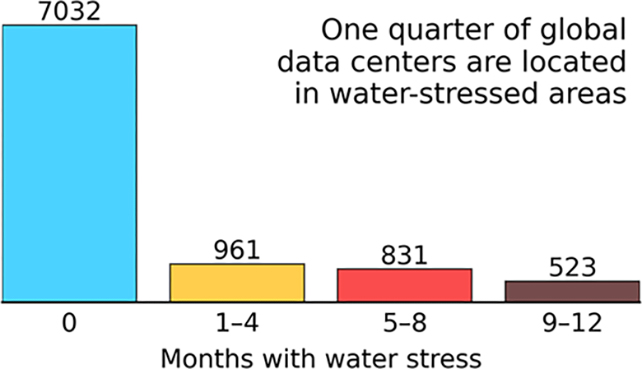
Data center water usage
2,315 of 9,347 data centers are in water-stressed areas. (Rosa et al., Environ. Sci. Technol., 2026)

Based on climate models and 3 °C (5.4 °F) of average global temperature rise from 1900 levels, the number of water-stressed data center locations would rise to 33 percent within as little as 10 years, the researchers found.

“These facilities are not landing in empty landscapes,” says environmental scientist Lorenzo Rosa, from the Carnegie Institution for Science. “They are landing on top of the water supply of cities and farms.”

While electricity can be spread across long distances through a power grid, the same can’t be said for water. It typically needs to be sourced locally, which means the local conditions at sites chosen for data centers really do matter.

Water typically gets pulled from lakes, rivers, and aquifers – which can all vary seasonally in terms of the water they supply.

“The energy footprint of data centers has been quantified in detail because electricity is metered and reported,” says Rosa. “Water scarcity is measured locally, inconsistently, and often not at all.”

“So, we built the map because it did not exist.”
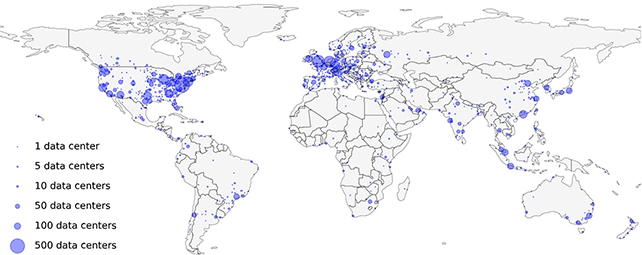
Data center map
The researchers plotted all of the world’s data centers on a map. (Rosa et al., Environ. Sci. Technol., 2026)

The map showed that 41 percent of global data centers are competing directly with cities and municipalities for their water, while for another 28 percent of sites the primary water use is for agriculture.

For 523 facilities – that’s a little over 5 percent of the total – there are already water gaps for at least 9 months of the year.

There were differences in terms of climate change impact too. Most data centers pushed beyond the water gap threshold by temperature rises would be in the US, the modeling showed, while in countries such as the UK and Germany there wouldn’t be much change.

“Data centers typically have the financial capacity and institutional priority to secure water supplies whenever water is available,” write the researchers in their published paper.

“As a result, the primary risk may not be to data center operations themselves but to other water users within the same basins.”

The researchers note that information on data center water usage remains limited – the giant tech companies involved are reticent to share the exact level of demand these facilities are putting on our natural resources.

More accountable reporting would definitely help, which might require intervention from regulators and governments.

There is some positivity from the researchers at the end of their paper, though, pointing to efforts to use wastewater and treated seawater in place of freshwater, as well as improvements in data center heat management. What’s clear is that changes are needed before the data center water drain gets worse.

“The extent to which water-stress exposure translates into operational impacts for data centers themselves or into measurable consequences for other water users remains an open question to address,” write the researchers.

“Ensuring data center long-term viability will require siting and governance choices that account for local hydrological limits.”

The research has been published in Environmental Science & Technology.

This article was fact-checked by Rachel Garner and edited by Fiona MacDonald. While we pride ourselves on our process, we are only human. If you spot a mistake, please let us know.


Source link

Previous Post
How Crocodiles Survived the Asteroid That Killed the Dinosaurs

How Crocodiles Survived the Asteroid That Killed the Dinosaurs

Next Post
The Surprising Origins of Native Hawaiians

The Surprising Origins of Native Hawaiians