Dark Mode Light Mode
Nephrologist shortages linked to higher kidney disease mortality along US-Mexico borde
Miniature Ball Lightning Created in a Lab Could Help Solve a Centuries-Old Mystery
Chemistry, medicine, materials and the technology shaping tomorrow — the best science stories from trusted sources, every day.

Miniature Ball Lightning Created in a Lab Could Help Solve a Centuries-Old Mystery

Miniature Ball Lightning Created in a Lab Could Help Solve a Centuries-Old Mystery Miniature Ball Lightning Created in a Lab Could Help Solve a Centuries-Old Mystery


When you picture lightning, it tends to be fairly straightforward – a jagged gash of light that splits the sky, disappearing in less time than it takes to blink.

But for centuries, a strange picture of a more eerie form has emerged.

Thousands of records and eyewitness accounts have told of balls of lightning hovering above the ground before disappearing in a pop like soap bubbles.

This fleeting phenomenon is all but impossible to study – and reports vary wildly in descriptions of its size, its hue, and even its behavior, making it one of the most peculiar mysteries in atmospheric science.

But if you can’t catch ball lightning in a field, physicist Chuliang Zhou and colleagues at the Chinese Academy of Sciences have reasoned, maybe we can learn more by reproducing something like it in a lab.

“Here we report the first controlled generation of a macroscopic, long-lived soliton driven by relativistic terahertz electromagnetic fields,” the researchers write in a paper published in Nature Photonics.

“This work establishes a laboratory-accessible platform for investigating optical soliton physics, advanced energy storage mechanisms, and the long-standing scientific puzzle of ball lightning.”

YouTube Thumbnail

frameborder=”0″ allow=”accelerometer; autoplay; clipboard-write; encrypted-media; gyroscope; picture-in-picture; web-share” referrerpolicy=”strict-origin-when-cross-origin” allowfullscreen>

A soliton is essentially a single, self-contained wave that keeps its shape and structural integrity through a delicate balance of physical forces.

They can form in plasma, water, light, potentially even some biological membranes – basically any medium where competing physical effects can balance to sustain a stable wave.

Some theories suggest that ball lightning is a kind of electromagnetic soliton, trapping energy in a shell of plasma.

To find out whether they could make this kind of soliton, the researchers turned to a very, very pointy piece of tungsten.

OK, it was a little more complicated than that – but the tungsten needle, with a tip just 100 nanometers across, was instrumental. A human hair, for context, measures between 80,000 and 100,000 nanometers across.

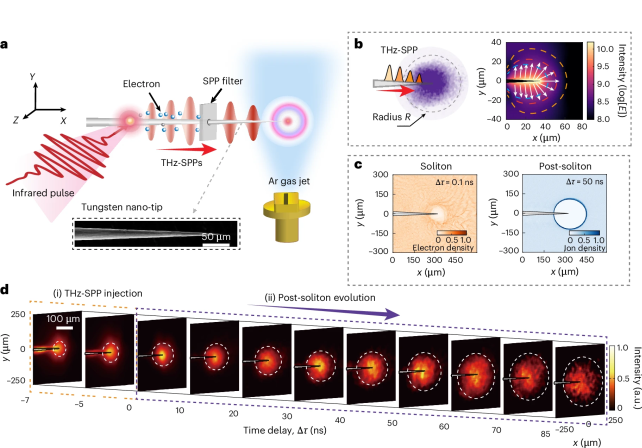
The researchers fired an ultrashort laser pulse at the needle, generating a powerful electromagnetic wave that traveled along its length.

When the wave reached the tip, its energy became concentrated into an extraordinarily intense electric field that stripped electrons from atoms in a waiting cloud of argon gas, creating a superheated bubble of ionized argon – plasma.

It flickered into existence as a tiny ball of light.
Miniature Ball Lightning Created in a Lab Could Help Solve a Centuries-Old Mystery
A schematic of the experimental setup, field map, and simulations (top) and images showing the formation and expansion of the tiny plasma ball (bottom). (Zhou et al., Nat. Photon., 2026)

The fragile, luminous sphere started as a pinprick around 80 micrometers across, then expanded to a larger pinprick several hundred micrometers over the next 100 nanoseconds.

That might not sound like a long time, but it’s vastly longer than the electromagnetic pulse from which it was born. And rather than simply dissipating like an ordinary cloud of hot plasma, the sphere maintained its structure as it expanded.

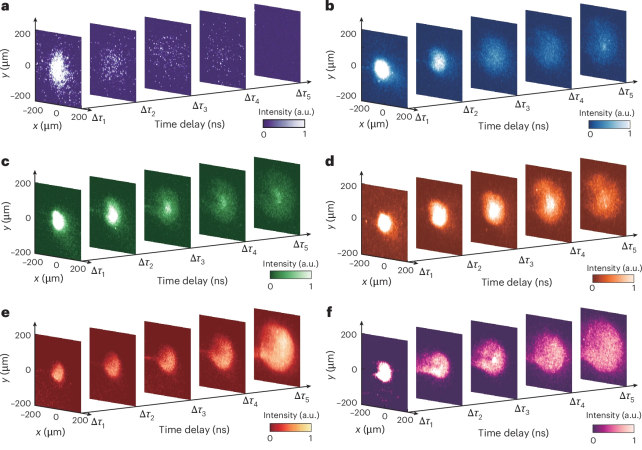
The researchers tracked this expansion and analyzed the wavelengths of light the sphere emitted as it cooled, comparing their observations with theoretical models and computer simulations.

This expansion, the researchers found, matched the theoretical predictions for an electromagnetic soliton.

This suggests that electromagnetic energy remained trapped within the plasma, helping sustain the glowing orb even as it expanded.

By contrast, their simulations of the thermal expansion in ordinary plasma produced a much faster, more diffuse process.

But a tiny dot of light in a carefully controlled laboratory experiment is far from the wild atmospheric conditions where ball lightning is typically reported.
Miniature Ball Lightning Created in a Lab Could Help Solve a Centuries-Old Mystery
The tiny plasma ball photographed through six different wavelength filters, revealing how its light changed as it expanded and cooled. (Zhou et al., Nat. Photon., 2026)

So, the researchers used their theoretical models to see how the phenomenon might behave at larger scales, driven by lower-frequency electromagnetic radiation.

Their calculations suggested that electromagnetic solitons driven by microwaves, rather than terahertz radiation, could theoretically grow to meters across and persist for seconds.

That’s much closer to some of the eyewitness reports of how mysterious balls of lightning behave.

It’s far from a definitive explanation for ball lightning – but solving meteorological mysteries isn’t the only potential application for these tiny fireballs.

The ability to trap electromagnetic energy in a stable, localized structure could also open new avenues for energy-storage technologies and studying how light interacts with matter under extreme conditions.

“Our controlled laboratory approach to spatiotemporal characterization under tunable conditions provides a systematic pathway to decode the century-old enigma of ball lightning formation,” the researchers write.

“By unifying extreme field photonics, plasma science, and atmospheric geophysics, our findings redefine terahertz-driven platforms as discovery engines for both applied technologies and unresolved natural phenomena.”

The research has been published in Nature Photonics.

This article was fact-checked by Rebecca Dyer and edited by Rebecca Dyer. While we pride ourselves on our process, we are only human. If you spot a mistake, please let us know.


Source link

Previous Post
Nephrologist shortages linked to higher kidney disease mortality along US-Mexico borde

Nephrologist shortages linked to higher kidney disease mortality along US-Mexico borde