




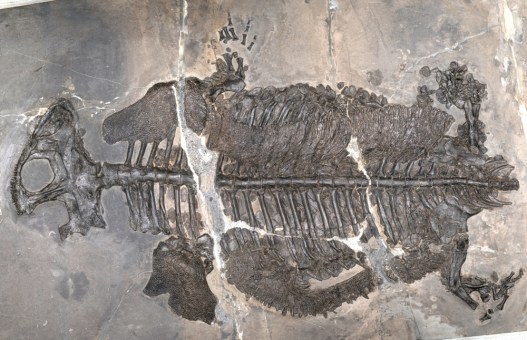


Every year, hundreds of meters below the waves in the cold, dark waters off southeast Australia, a wondrous gathering takes place.
Around a lonely mountain south of Tasmania called Patience Seamount, millions of eels converge, transforming a normally quiet patch of the deep sea into a seething morass of writhing, sinuous bodies.
These deep-sea creatures are basketwork eels (Diastobranchus capensis), and scientists believe they’re gathering for one of the most important events of their lives – reproduction.
Now, a study led by marine scientist Ben Scoulding of Australia’s CSIRO has quantified the astonishing scale of this mysterious congregation for the first time.
At its peak, Scoulding and his colleagues have determined, the gathering could contain as many as 2.8 million eels, collectively weighing more than 3,500 metric tons (3,860 US tons).
Yet one enormous question lingers: Why, of all the relatively similar nearby mountains under the ocean, do the eels choose this one?
“That’s one of the biggest unanswered questions,” Scoulding told ScienceAlert.
“Patience is one of around 120 seamounts in the Huon and Tasman Fracture marine parks south of Tasmania, and although nearby seamounts have similar depths and broad environmental characteristics, they don’t support the same aggregation of eels.
“At this stage, we have some good hypotheses, but we don’t yet have a definitive answer.”
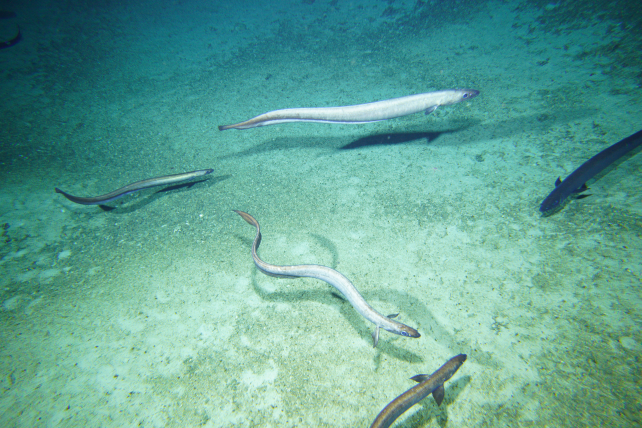
Teasing apart the true scale of the annual basketwork eel aggregation at Patience Seamount is the work of decades.
Unusual numbers of the eels in the area had been reported by commercial fisheries since at least the 1980s and 1990s, but it wasn’t until 2007 that a deep-sea camera survey finally captured the extraordinary gathering on film.
The seamount lies within the Huon Marine Park, established in 2007 as an expansion of an earlier marine reserve created in 1999 to protect the region’s fragile deep-sea ecosystems.
As part of a 2007 expedition to survey the seabed and marine life in and around the marine park, CSIRO scientists towed a camera behind a research vessel – like the bear going over the mountain – to see what they could see.
In contrast to the bear, however, they saw much more than the other side of the mountain.
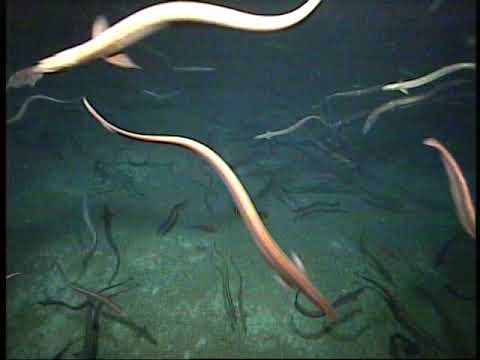
frameborder=”0″ allow=”accelerometer; autoplay; clipboard-write; encrypted-media; gyroscope; picture-in-picture; web-share” referrerpolicy=”strict-origin-when-cross-origin” allowfullscreen>
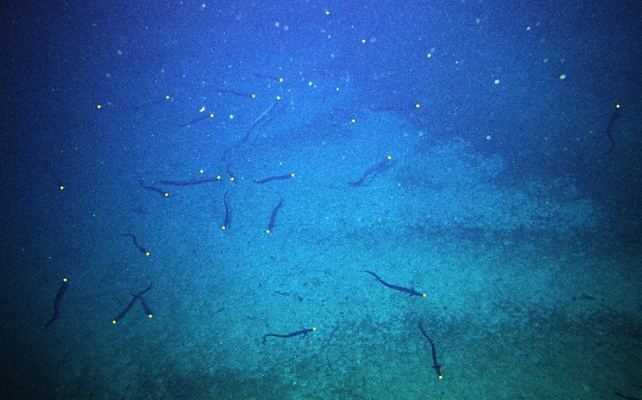
In the permanent darkness deep beneath the waves, the water column roiled with eels.
Subsequent surveys shed further light. The eels inhabit the seamount year-round, but their numbers peak in the southern autumn months, from March to May. Eels caught during this peak have been found in advanced spawning condition – both male and female – strongly indicating a reproductive reason for the eel jamboree.
It is, by all accounts, spectacular.
“Although seamounts are well known as hotspots where fish can aggregate, it’s unusual to find millions of fish concentrated around a single feature. Patience Seamount itself is relatively small, covering only about 2 square kilometers [0.8 square miles], yet it consistently supports an enormous seasonal aggregation over many months,” Scoulding said.
“Seeing so much biomass concentrated on such a small deep-sea feature is rare, and the scale, persistence, and likely reproductive nature of the aggregation make it one of the most remarkable fish aggregations documented in the deep ocean.”
But observing an extraordinary eel swarm is one thing. Working out just how many are there is not as simple.
A 2021 paper on the aggregation used hydroacoustic measurements and on-camera eel counts to estimate that tens of thousands of eels may have been present during an April 2015 aggregation.
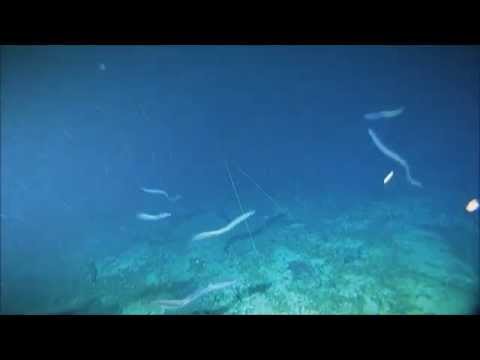
frameborder=”0″ allow=”accelerometer; autoplay; clipboard-write; encrypted-media; gyroscope; picture-in-picture; web-share” referrerpolicy=”strict-origin-when-cross-origin” allowfullscreen>
Scoulding and his colleagues wanted to address the question with intent and precision.
“What nobody knew was how large the aggregation was, how long it persisted, or how many eels were actually involved,” he said. “One of the main aims of our study was to answer those questions.”
Between 2023 and 2025, the researchers conducted a series of surveys around Patience Seamount, using sonar to map the enormous concentrations of fish in the water.
But there was a complication. Basketwork eels aren’t the only fish that gather around Patience Seamount. Orange roughy (Hoplostethus atlanticus) also congregate there, and sonar alone can’t distinguish between the two.
So the team combined their acoustic measurements with underwater camera footage, which allowed them to work out how much each species was contributing to the sonar signal.
Their findings revealed an aggregation of jaw-dropping proportions. At its largest, the swarm extended roughly 3 kilometers long, 2 kilometers wide, and 150 meters above the seafloor (1.9 miles long by 1.2 miles wide, and 492 feet high).
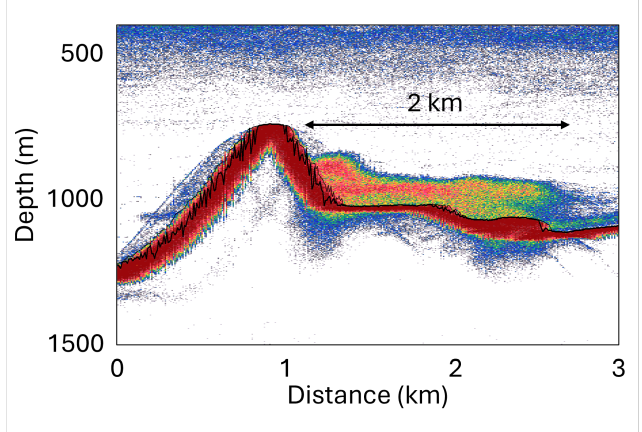
The researchers estimated that the biomass of basketwork eels increased from around 750 metric tons in March to more than 3,500 metric tons in May.
“The sheer size of it was remarkable. Estimating that there could be up to 2.8 million eels and more than 3,500 tons of biomass concentrated around a single seamount really highlights just how extraordinary Patience Seamount is,” Scoulding said.
And, he noted, by combining their new data with previous surveys, the researchers were able to document the aggregation’s presence from December to August.
“The thing that surprised me most was the persistence of the aggregation. We knew it existed, but we didn’t expect it to be present for so much of the year.”
The composition of the gathering also changes throughout the year. At some times, orange roughy make up a substantial proportion of the fish; at others, basketwork eels overwhelmingly dominate.
The two species even seem to prefer different parts of the mountain. Orange roughy tend to gather around the steeper upper slopes, while basketwork eels prefer the deeper, flatter terrain around its base.
What makes Patience Seamount so attractive to the eels, however, remains unclear. One possibility, the researchers noted, is its proximity to the continental shelf, which may influence fish movement or the currents flowing around the mountain.
Whatever the reason, the gathering underscores the importance of protecting these remote deep-sea habitats.
Patience Seamount was once subjected to bottom trawling, but scientists are now seeing encouraging signs of recovery, including rebuilding orange roughy populations and the return of living corals to previously trawled areas.
And there is still much to learn about the eels themselves. Scoulding and his team found further evidence that they’re gathering to reproduce, including females carrying advanced eggs and sporting empty bellies.
This introduced an unexpected wrinkle to the research. The eels may stop feeding as they prepare to spawn – and an eel that isn’t hungry is unlikely to take the bait. From among the writhing mass of eels deep below their boat, the researchers only managed to catch seven.
And they have yet to establish exactly when and where spawning takes place.
Understanding that process – and how the aggregation changes from year to year – could help scientists determine what these fascinating animals need to thrive.
“Because the aggregation occurs within a protected marine park, it provides a rare opportunity to revisit the site every few years and see how the population changes through time,” Scoulding said.
“If the ecosystem continues to recover from historical fishing impacts, we may see further increases in the size of the aggregation.”
The research has been published in Royal Society Open Science.
This article was fact-checked by Rebecca Dyer and edited by Rebecca Dyer. While we pride ourselves on our process, we are only human. If you spot a mistake, please let us know.


