
Dark Mode Light Mode
Chemistry, medicine, materials and the technology shaping tomorrow — the best science stories from trusted sources, every day.

LA’s Eaton Fire Exposed 7 Million Residents to Lead 80 Times Above Normal Levels

LA’s Eaton Fire Exposed 7 Million Residents to Lead 80 Times Above Normal Levels LA’s Eaton Fire Exposed 7 Million Residents to Lead 80 Times Above Normal Levels


When the Santa Ana wind pushed flames from Eaton Canyon into Altadena on 7 January 2025, it quickly escalated into one of the most destructive fires in California’s history.

By January 9, plumes of smoke blanketed around 7 million Los Angeles residents in air laden with lead roughly 80 times above normal atmospheric levels for 24 hours.

That’s one of the major findings from a new study published in Science Advances, led by atmospheric chemists Haroula Baliaka and Nga Ng at the California Institute of Technology (Caltech).

Their research reveals just how laden with toxic metals those urban fire smoke plumes were. As well as lead, the smoke contained high concentrations of chlorine, bromine, zinc, copper, and arsenic.
LA Eaton Fire Plumes Exposed Millions of Residents To Lead 80 Times Greater Than Background Levels, Scientists Find
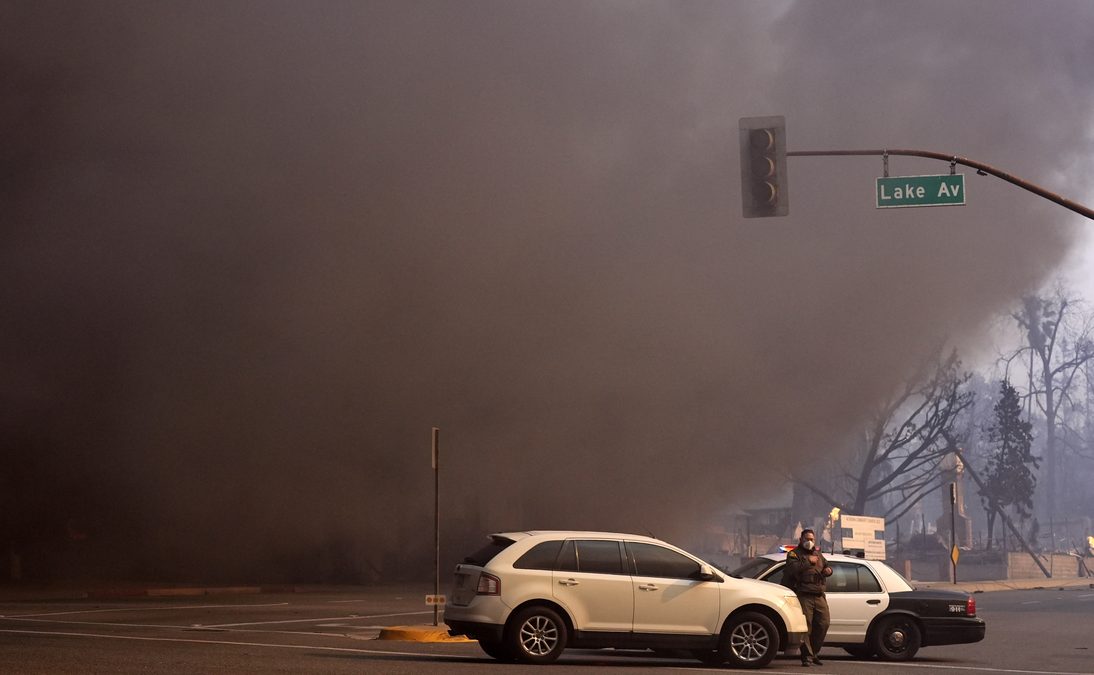
An officer is dwarfed by smoke at Lake Avenue and Altadena Drive from the Eaton Fire, Wednesday 8 January 2025. (AP Photo/Chris Pizzello)

The study also highlights potentially distinct health risks from fires that enter urban landscapes compared to those that burn in wildlands like forests and grasslands.

“Unlike the wildfire smoke that has been the focus of decades of air quality research, this plume originated primarily from burning homes, vehicles, and infrastructure, a fundamentally different fuel with a distinct chemical signature,” writes the team.

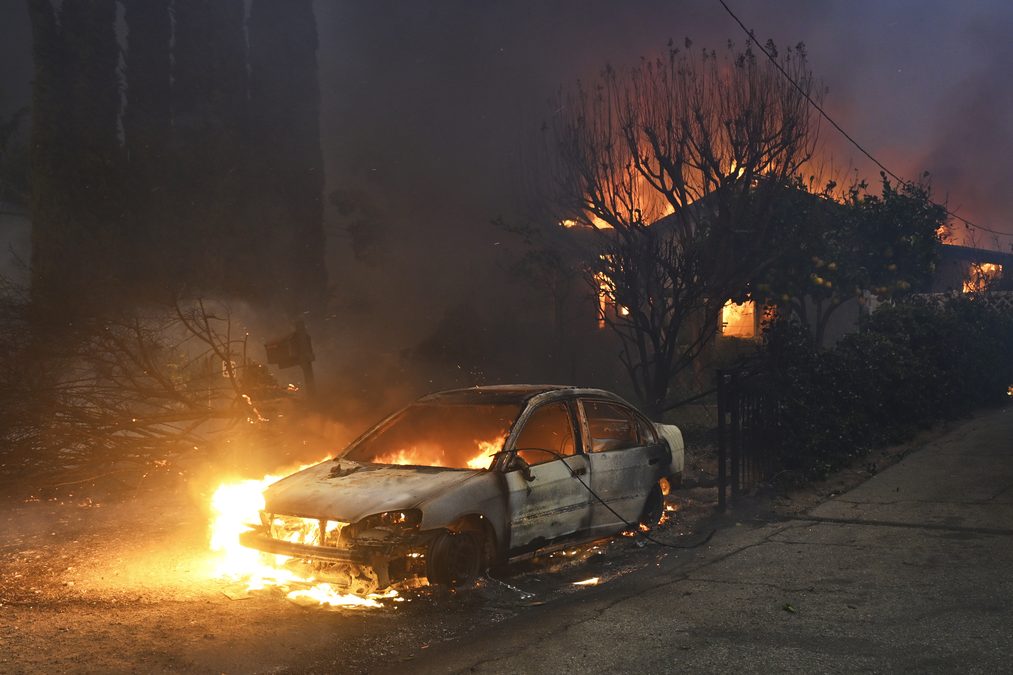
More than 9,000 structures in the area burned, along with electronics and vehicles. Together, these fuel sources contributed airborne chemicals to the smoke plume that coated the Los Angeles basin for days.
LA Eaton Fire Plumes Exposed Millions of Residents To Lead 80 Times Greater Than Background Levels, Scientists Find
The Eaton Fire burnt vehicles and structures, releasing far more heavy metals and other chemicals into the air than your typical wildfire. (AP Photo/Nic Coury)

Directly south of the fire, a Caltech air composition monitoring facility in Pico Rivera detected real-time details of the air pollution as the situation unfolded.

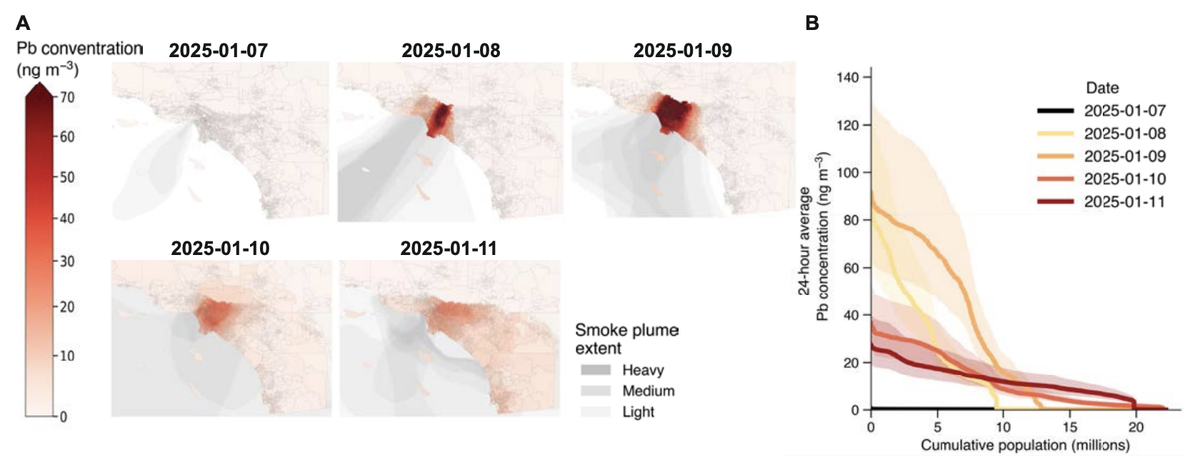
Air quality was at its worst in the first two days of the fire, with people in eastern LA and the San Gabriel Valley affected by the highest 24-hour average lead concentrations.

“Under typical conditions, daily lead at Pico Rivera averages just 0.6 nanograms per cubic meter. Overlaying daily lead maps with census data reveals the scale of exposure: On 9 January, approximately 7 million residents experienced concentrations exceeding 50 nanograms per cubic meter,” Baliaka and team report.

“Notably, as peak concentrations declined with the transition from structural to wildland burning, total population exposed continued to rise as the plume dispersed across the basin.”

Similar results were recently reported by a team from the University of California, Los Angeles (UCLA), whose data came from monitoring stations on the UCLA campus in Westwood, and in Huntington Park.
LA Eaton Fire Plumes Exposed Millions of Residents To Lead 80 Times Greater Than Background Levels, Scientists Find
(A) Daily 24-hour average Pb concentrations mapped at 1-km spatial resolution over Los Angeles and surrounding regions from 7 to 11 January 2025. Darker colors indicate higher concentrations. (B) Cumulative population exposed to 24-hour average Pb concentrations for each day. (Baliaka et al., Science Advances, 2026)

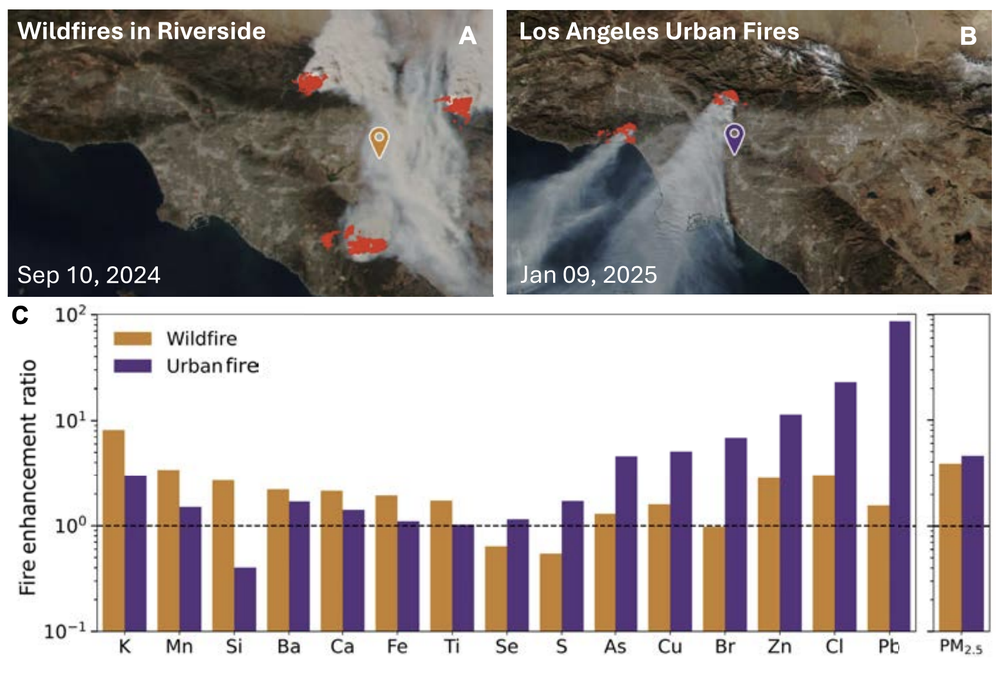
The Caltech researchers also compared their results with data from a wildfire that occurred almost exclusively in vegetated wildlands in Riverside in 2024, about four months prior.

Compared to the Riverside fire, the Los Angeles Eaton plume contained 50 times the concentration of lead, along with 7 times the concentration of the halogens chlorine and bromine, 4 times the levels of zinc, and 3 times the levels of copper and arsenic.
LA Eaton Fire Plumes Exposed Millions of Residents To Lead 80 Times Greater Than Background Levels, Scientists Find
Urban fire plumes exhibit distinct chemical signatures compared to wildfire smoke. The orange and purple pins denote the location of air composition monitoring sites. (Baliaka et al., Science Advances, 2026)

Many of the houses in Altadena are early-to-mid 20th century builds, dating from a time when lead paints and brominated flame retardants were commonly used. That could explain why the Eaton fire plumes were so particularly toxic.

The health consequences for people who were exposed to this smoke remain unknown.

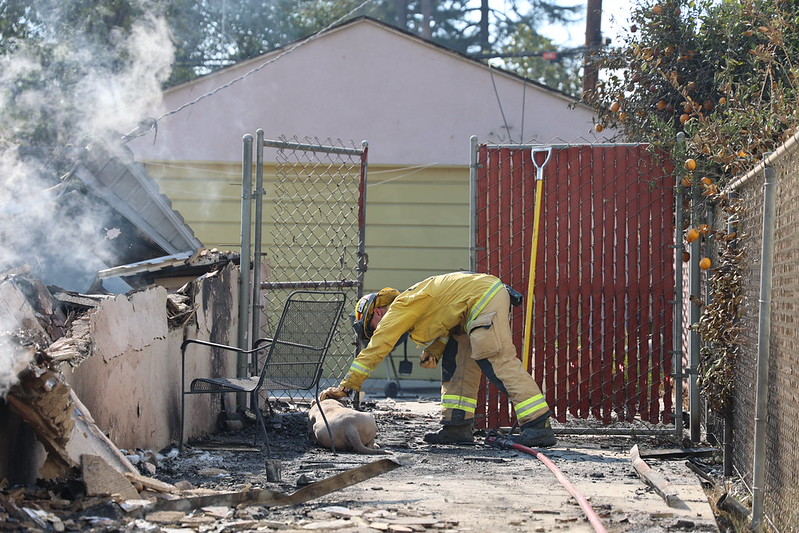
The researchers are also concerned about the ongoing effects these contaminants have in the long term, after settling across playgrounds, watersheds, and farmlands.
LA Eaton Fire Plumes Exposed Millions of Residents To Lead 80 Times Greater Than Background Levels, Scientists Find
Long after the fires are gone, the contaminants may remain in soil and waterways. (CAL FIRE/Flickr/CC BY-NC 2.0)

“There is an urgent call for epidemiological studies to explore the health outcomes associated with these exposures, particularly in children and other vulnerable populations,” Baliaka and team write.

“While the toxicity of chronic exposure to individual elements (e.g., neurotoxicity of lead or carcinogenicity of arsenic) is well established, far less is known about
the consequences of these short-duration but high-intensity exposures, as well as the cumulative effects of simultaneous exposure to complex mixtures.”

Very few studies have documented the effects of urban fires like this one, yet the evidence suggests disasters like this are only going to become more frequent and severe.

We need to know more, and fast.

“As climate change and urban expansion drive more fires into cities, the question is not whether another urban firestorm will occur,” Baliaka and team warn.

“What remains to be seen is what we will have learned from the previous ones and whether monitoring and emergency response systems can adapt fast enough to characterize these emissions and their exposure risk.”

The research has been published in Science Advances.


Source link

Previous Post
Brain development eliminates flawed neurons to ensure genomic integrity

Brain development eliminates flawed neurons to ensure genomic integrity

Next Post
Hunting is for Girls—at Least Among Bonobos

Hunting is for Girls—at Least Among Bonobos