






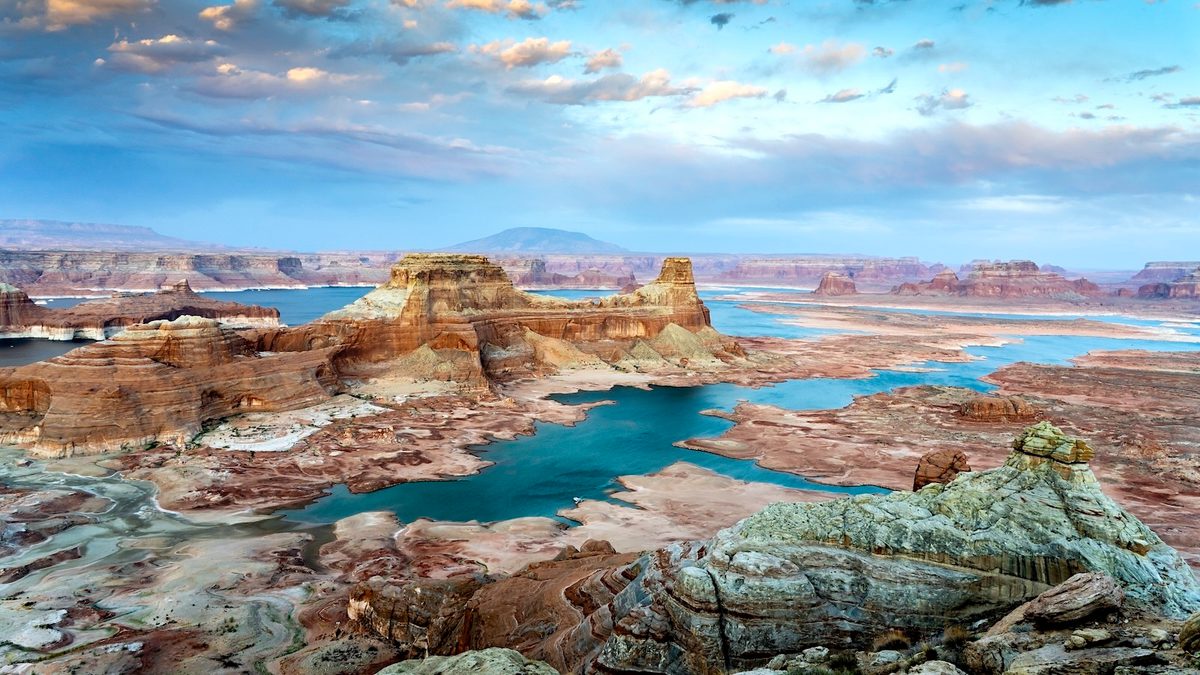
The 27-year-long drought in the Southwestern U.S. — the longest dry period in the last 1,200 years — is taking a serious toll on the flow of the Colorado River. Climate change is shrinking the snowpack in Colorado’s Rocky Mountains, the source of roughly 80 percent of the river’s annual flow, and higher temperatures are melting the snowpack earlier in the year, which saps runoff in late summer and fall. Warmer weather is also increasing evaporation from the river’s 40 reservoirs, including its two largest — Lakes Powell and Mead.
Last month, Lake Powell, on the Utah-Arizona border, reached a record low, at less than 150 feet above dead pool, the point at which water can no longer flow through the Glen Canyon Dam’s bypass tubes to reach Lake Mead, behind Hoover Dam, 300 miles downstream. The low water levels reduced the generation of hydropower from both reservoirs, complicated how riverine ecosystems are managed, and slashed deliveries of water to the Lower Basin states of Arizona, California, and Nevada.
Farmers are fallowing fields. Developers in some areas have paused housing construction for lack of guaranteed water supplies. And the Bureau of Reclamation has curtailed its “environmental flows” — releases of cold water from Powell — which is threatening protected fish and preventing the buildup of sandbars that provide habitat for wildlife in the Grand Canyon. No matter how the river is managed going forward, observers say, ecosystems both downstream and up will see significant changes.
Faced with the prospect of even lower Colorado River levels, the federal and state governments have been scrambling to come up with ways to meet the competing demands of disparate interests that rely on its flow, from topping off Lake Powell with water diverted from upstream reservoirs, to slashing downstream water deliveries by 40 percent, to paying farmers to keep their allocations of water in the river. The crisis is even causing some to consider a fix once deemed unthinkable: draining Lake Powell entirely.
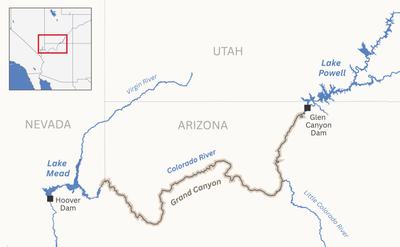
A map of Lake Mead and Lake Powell on the Colorado River.
Yale Environment 360 / Created with Datawrapper
When the Glen Canyon Dam was built in the 1960s, proponents hyped its benefits: cheap hydropower, subsidized water for cotton and alfalfa growers, real estate on the new lakeshore, and a playground for boaters. But detractors bemoaned the drowning of Glen Canyon itself, a red rock labyrinth of gorges, spires, cliffs, and grottoes that conservationists described as even more beautiful than the Grand Canyon.
Over the decades, some environmental advocates have argued for removing the Glen Canyon Dam and restoring the canyon, but the idea was always dismissed as too expensive and, because it would wipe out power generation, wildly impractical.
Now, a more tempered approach is gaining support, with groups like the Glen Canyon Institute arguing not to remove the dam but to drain Lake Powell through new diversion tunnels that would be drilled below the existing bypass tubes, close to the riverbed. The upsides, say advocates, would be manifold. The water would boost hydropower production in Lake Mead. The stunning formations of Glen Canyon and sites sacred to Indigenous people would reemerge. Wildlife would return, and riparian habitat above and below the dam site would eventually be restored. The plan is called Fill Mead First.
For more than four decades, the Glen Canyon Dam was considered a huge asset to the river basin, said Eric Balken, executive director of the Glen Canyon Institute. But it’s now “becoming a liability because it might actually prevent water from flowing downstream. All of the core assumptions around the dam have been turned on their head.”
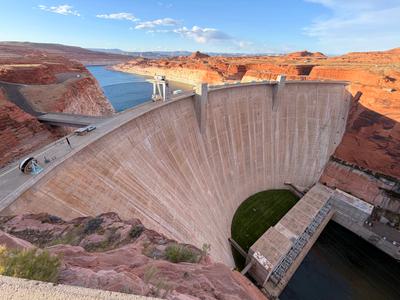
That’s because of the dam’s structural limitations. If the lake drops below minimum power pool, its penstocks — the large pipes that send water to the dam’s eight turbines — will be left stranded, high and dry. Lake water will instead be released through bypass tubes, which sit below the penstocks but have less than half their capacity to discharge water.
These tubes were not built for sustained long-term use, and sending high volumes of water through them could cause vibrations, scouring, and other effects that could cause irreparable damage to the dam. While the Bureau of Reclamation has long warned about relying solely on the bypass tubes to release water, after inspecting and relining them in 2025 it said they might work if needed. But another challenge will remain: Relying on the narrow tubes will make it harder for Upper Basin states (Colorado, New Mexico, Utah, and Wyoming) to meet their delivery obligations to Lower Basin states and, by international agreement, Mexico.
Allowing more water to flow through the Glen Canyon Dam — by draining the lake through the existing bypass tubes and newly drilled diversion tunnels near the riverbed — is no longer dismissed out of hand. “That conversation has evolved,” said Kathryn Sorensen, director of research at the Kyl Center for Water Policy at Arizona State University.
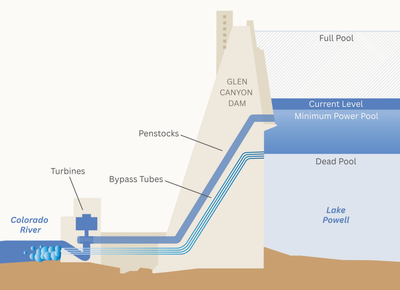
A diagram of the Glen Canyon Dam. The minimum power pool is the lowest level at which it is possible to generate power. Dead pool is the point at which water stops flowing through the dam.
Yale Environment 360
Lower release structures, said Jack Schmidt, director of the Center for Colorado River Studies at Utah State University, are “an utterly reasonable idea” and should be part of the discussion. As for Powell’s potential loss of hydropower, proponents of dam removal say those megawatts could be replaced with solar power. The new Gemini solar plant near Las Vegas has a capacity of 690 megawatts; the Glen Canyon Dam currently has a capacity of around 730 megawatts.
The Lower Basin states, which primarily take their water from Lake Mead and are seeing their allotments held back to prop up Lake Powell, have urged the federal government to consider modifying the dam with lower outlets rather than cutting back on deliveries, as the Biden administration ordered in 2024.
“Addressing the infrastructure limitations may be the one long-term measure that would best achieve operation and management improvements to the Glen Canyon Dam,” representatives of the Lower Basin states wrote to Interior Secretary Doug Burgum last year.
Draining Lake Powell completely “could [annually] reduce evaporative losses by a couple hundred thousand acre-feet,” said Sorensen: Experts say 11 percent of the water in the reservoir is lost to evaporation each year. “On a river that is much smaller than anyone expected, that water really matters,” she said. But while the Glen Canyon Institute plan is gaining some traction, she added, “it faces a lot of obstacles.”
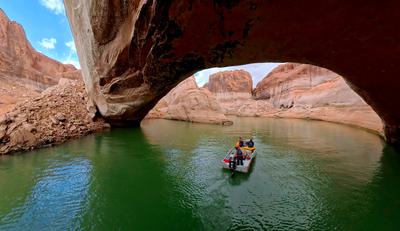
Boaters travel under Gregory Natural Bridge, in Lake Powell, which was under water until 2021.
Francisco Kjolseth / The Salt Lake Tribune
One of those obstacles is the federal government, which did not even consider the possibility of draining Lake Powell as an option in its recent environmental impact statement — finalized in August — which addressed ways to manage the Colorado over the next 10 years.
Officials in Page, Arizona, which has a thriving water-based recreation industry, have also opposed draining the lake. The BlueRibbon Coalition, which represents off-road and motorized outdoor recreation, leads the opposition. It has put forward a model bill called the Colorado River Abundance Act, which would supply treated water to Lower Basin states, allowing more water to be retained in Lake Powell. The treated water would come from nuclear-powered desalination of seawater and briny water and through “advanced water reuse,” in which wastewater is cleaned with filter technologies, at an estimated cost of $40 billion.
Another obstacle is time: New diversion tunnels would likely take a decade to study, design, and build. And the price tag could be in the billions.
The Colorado’s reduced flows are, meanwhile, taking a toll on riverine ecosystems, which scientists call “novel” because they have been radically altered by 70 years of human activity — most significantly by the elimination of seasonal flooding. For a number of reasons, including low lake levels, the Bureau of Reclamation has canceled many environmental flows from the Glen Canyon Dam in recent years, depriving the Colorado of a large pulse of sediment, which is a part of the river’s natural ecology. The flows rebuild sandbars and beaches used by boaters in the Grand Canyon, and they create shallow-water habitat for threatened and endangered native fish.
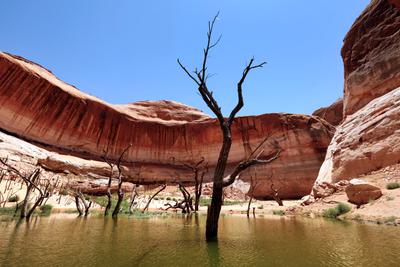
Long-drowned cottonwood trees in Lake Powell have resurfaced as water levels have dropped.
Carolyn Cole / Los Angeles Times via Getty Images
The Bureau also occasionally releases cold water from the dam to lower the river’s temperature and keep invasive, warm-water-loving bass from taking up residence in the Grand Canyon stretch and displacing native fish. But because of the drought, which is already reducing hydroelectric production, those releases have also been curtailed.
Draining the lake completely would allow Glen Canyon to recover as the river flushes out built-up sediment, experts say. Native cottonwoods and willows would take root and help push out invasives, like tamarisk. River otters, beavers, birds, and amphibians would return to the canyon. And the drowned red rock arches, natural bridges, amphitheaters, and waterfalls would gradually emerge from the muck, along with thousands of sites sacred to Native Americans.
A shift in the hydrological regime would also have profound effects on hundreds of miles of river ecosystems below Glen Canyon Dam, including in the Grand Canyon. “It would change in ways that are only partially predictable,” said Schmidt. “Suddenly the river would have great fluctuations. The river would have much more sediment. The river would be much more turbid.” A refugium of native fish, the Grand Canyon would suddenly be swamped with non-native fish, many of which were introduced into Lake Powell for sport fishing. “It just keeps getting more complicated,” Schmidt acknowledges. “It’s all a trade-off in this screwy manmade world.”
For now, Fill Mead First remains a pipe dream, one that’s getting a lot more attention as river levels continue to drop and global temperatures rise. The federal government will ultimately decide the Glen Canyon Dam’s future, but Eric Balken, for one, thinks a new regime is long overdue. Propping up Lake Powell is “kicking the can down the road,” he said. “But they are running out of road.”


