


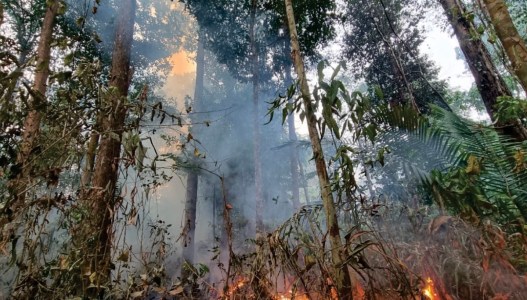




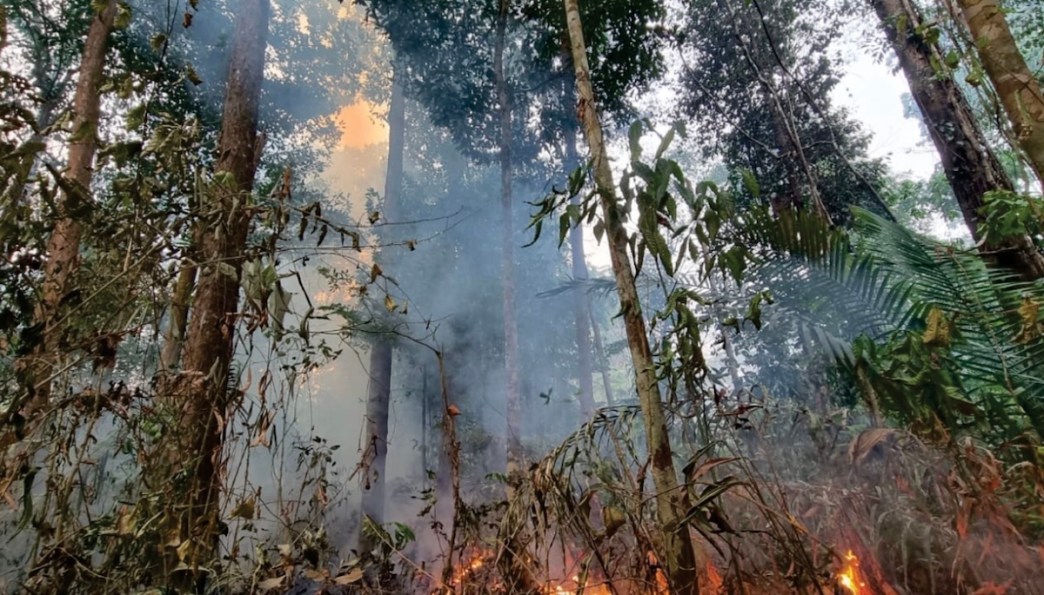
The Amazon Rainforest is often referred to as the “lungs of the planet” because its lush canopy “inhales” carbon dioxide and “exhales” oxygen. This breathing pattern is part of an important natural defense against climate change, pulling carbon from the atmosphere and sequestering it, but that might be changing. According to a new study published in Nature, the Amazon may shift from a net sink to a net source of atmospheric carbon.
A team of climate scientists arrived at that conclusion after analyzing atmospheric samples taken by planes criss-crossing the skies over the Amazon for 15 years. Satellite-based monitoring is difficult because of the dense blanket of cloud cover generated by evaporating moisture and ground-based systems are few and far between. So the team went straight to the source.
Read more: “The Rainforest Is Teeming with Consciousness”
“In this context, airborne vertical profiling fills a critical gap, providing the most direct way to quantify the movement of carbon between tropical land ecosystems and the atmosphere at the regional scale,” study author Jen Johnson of the University of Kansas explained in a statement.
The team divided the15 years studied into three different groups: wet periods with little human interference, periods of heavy deforestation but minimal climate stressors, and periods marked by acute climate stress (droughts, wildfires, and El Niños).
“We wanted to know, ‘Is the effect of global climate on the Amazon the most important factor determining its carbon balance, or are regional human-driven activities—like deforestation and clearing through wildfires—equally or more important?’” Johnson said.
The team found that during wet years, when the forests were left relatively unperturbed, the Amazon was a net source of carbon, but just a small one. Things got much worse in other years. Carbon emissions spiked during years when the climate was mild but deforestation increased. Years where high levels of human activity and climate stressors coincided were the worst of all.
In other words, whether it’s from wildfires or deforestation, human activity is transforming the Amazon from a net carbon sink into a net carbon source with potentially disastrous consequences for climate change.
“For many decades, there has been concern about the idea of a tipping point, where gradual drying and gradual loss of the forest could feed back on itself in a self-reinforcing way,” Johnson said. “That could create a transition from an ecosystem type that has stored huge amounts of carbon in living vegetation to drier forests or other ecosystem types that do not store nearly as much carbon.”
The solution, per Johnson, is relatively simple: stop destroying the trees. “Measures to bring deforestation down to zero are required to manage net carbon emissions from the Amazon,” she said.
The alternative is finding out how to live on a planet suffering from chronic lung disease.
Enjoying Nautilus? Subscribe to our free newsletter.
Lead Image: Gatti et al.


