Dark Mode Light Mode
Type 2 diabetes breakthrough as 54% achieve remission in just 6 months
Two Different Kinds of Gamma-Ray Bursts Erupted 4 Minutes Apart. Astronomers Have Never Seen This Before.
Start up to reduce PFAS in data centres
Chemistry, medicine, materials and the technology shaping tomorrow — the best science stories from trusted sources, every day.

Two Different Kinds of Gamma-Ray Bursts Erupted 4 Minutes Apart. Astronomers Have Never Seen This Before.

Two Different Kinds of Gamma-Ray Bursts Erupted 4 Minutes Apart. Astronomers Have Never Seen This Before. Two Different Kinds of Gamma-Ray Bursts Erupted 4 Minutes Apart. Astronomers Have Never Seen This Before.


Gamma-ray bursts (GRBs) are among the most energetic cosmic events since the Big Bang, releasing the most energetic type of radiation, gamma rays – the stuff that turned unassuming Bruce Banner into the rampaging Hulk, but on an astronomical, potentially planet-sterilizing level.

GRBs are classed by transience, including short-duration ones that last less than two seconds and long-duration ones that last over two seconds (possibly much longer).

The former are thought to originate from the various collisions and resultant mergers of compact celestial objects, such as neutron stars and black holes. 

The latter are typically associated with core-collapse supernovae, the outbursts of dying stars that may be tens of times more massive than the Sun.

Now, astronomers have reported an event unlike any other yet observed or predicted: a short and a long-burst GRB, spaced only four minutes apart – a happening so unprecedentedly odd it may require a rethink of GRB classifications and origin scenarios. 

This singularly spectacular specimen, named GRB 160425A, is described in a paper published in Nature Astronomy.

“This is so far the only event with such a strange property,” corresponding author Bing Zhang, an astrophysicist at the University of Hong Kong, told ScienceAlert.

“I’d think that these are two independent GRBs, but the chance of having them happen together (in the same direction and around the same time) is so low [that] we have to admit that the pair has the same origin.”
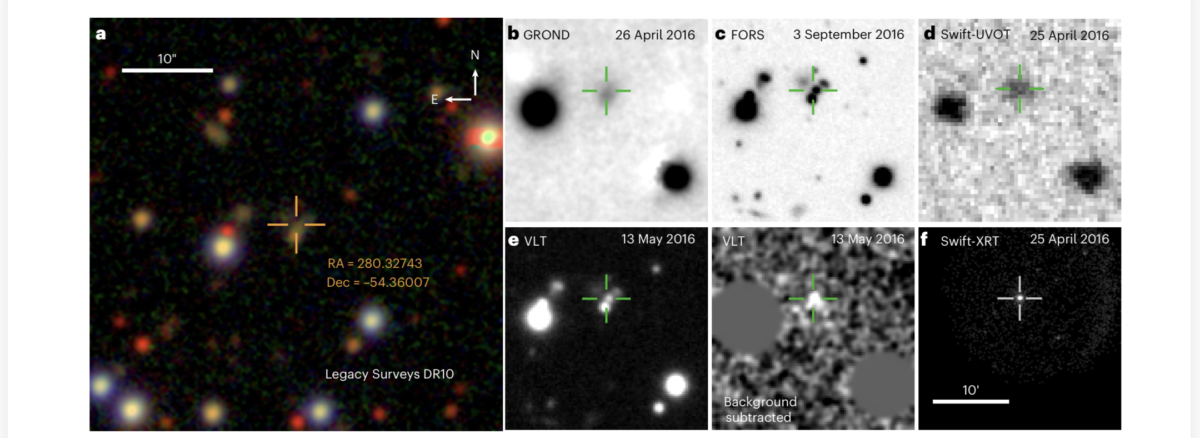
Panel a shows the GRBs’ host galaxy, while the others show the same patch of sky as observed by various telescopes, with crosshairs marking the bursts’ afterglow. (Li et al., Nat Astron, 2026)

The blasts were detected on April 25, 2016, by the Neil Gehrels Swift Observatory in space, a necessity since Earth’s atmosphere is opaque to gamma rays, and ground-based telescopes then followed the fading afterglow.

Its host galaxy, possibly a pair of merging galaxies, is so far away that the bursts’ light took roughly 5.5 billion years to reach us.

So this event occurred nearly a billion years before our Solar System formed, and its high-energy light traveled across more than one-third of cosmic history to reach us. 

The first GRB, called G1, lasted a scant 1.7 seconds and is associated with a merger origin, while the second burst, called G2, lasted 51.2 seconds and is associated with a collapsing star origin. 

GRBs are thought to release their energy in focused beams. Momentarily ignoring this fact for relatability, the first burst released billions of years’ worth of solar energy, and the second roughly three times more:

“The total energy emitted by the Sun throughout the entire lifetime is not enough to account for the second component,” Zhang explains, and notes that accounting for a beam-like release substantially changes the mathematics.

Altogether, this discovery is unlike any previous GRB because it combines three features: two separate bursts, the quiet gap between them, and the fact that they’re different types of GRBs.

The researchers describe five possible explanations, each of which they note is “challenging,” elucidating the previously mentioned astronomical odds.

The first is happenstance. Maybe the bursts came from separate host galaxies that are coincident in space and time, within about four minutes of each other and both pointing their jets toward Earth.

The odds of this happening in any one moment and patch of sky are about 2 in a trillion; even across all the years Swift has been watching, they’re only around 1 in 100,000 to 1 in 10 million.

The second explanation is that the two bursts originated in the same galaxy but in different locations. The odds may be between about 8 in 10 trillion and 8 in a trillion, and once all of Swift’s years of observations are factored in, it becomes even less likely than the first scenario.

For perspective, 10 trillion days would be equivalent to more than 27 billion years, almost twice the age of the Universe.

Imagine you and a friend each randomly picking a dinner date from a calendar of 10 trillion days, and the odds of you both landing on the same one. (Also pretend you’re both very long-lived with very few outstanding engagements.)

Explanation three is that we’re seeing a rare version of a type I GRB (short duration), produced by colliding bodies like neutron stars, which give off a big bang (not the Big Bang) followed by a weaker tail-like emission.

Yet the long quiet gap between them, and the fact that the second burst is far too energetic to be a mere tail, make this unlikely.

Enter interpretation four: could this event be a single type II GRB (long duration), from the collapse of a dying massive star, with the main explosion (G2) being prefaced by a smaller, death-bed emission (G1)?

In other words, a stellar belch before the doomed star fatally upchucks its radioactive guts? Perhaps not, as such a process would likely produce a weaker initial emission.

Finally, explanation five may be the most intriguing and non-standard. This double-GRB may originate within a single system that includes an undetermined type and number of celestial bodies, generating an intertwined blast that connects two of the Universe’s most intensely energetic events via some mechanism that cannot yet be specified; a mystery for the ages. 

“That’s the difficult part. We ran out the possibilities,” Zhang said.

“All the scenarios have severe difficulties,” he concluded. “As a theorist working on GRBs for more than two decades, this one really challenged me.”

The research has been published in Nature Astronomy.

This article was fact-checked by Rebecca Dyer and edited by Rebecca Dyer. While we pride ourselves on our process, we are only human. If you spot a mistake, please let us know.


Source link

Previous Post
Type 2 diabetes breakthrough as 54% achieve remission in just 6 months

Type 2 diabetes breakthrough as 54% achieve remission in just 6 months

Next Post
Start up to reduce PFAS in data centres

Start up to reduce PFAS in data centres