Dark Mode Light Mode
Less Than 42 Minutes of Bright Light Daily Is a Stronger Predictor of Dementia Than Obesity, Study Finds
A Mysterious Asteroid Is Accelerating in Space, And We’re Running Out of Explanations
Chemistry, medicine, materials and the technology shaping tomorrow — the best science stories from trusted sources, every day.

A Mysterious Asteroid Is Accelerating in Space, And We’re Running Out of Explanations

A Mysterious Asteroid Is Accelerating in Space, And We’re Running Out of Explanations A Mysterious Asteroid Is Accelerating in Space, And We’re Running Out of Explanations


Most asteroids are pretty predictable.

They just do what they’re told, pushed and tugged by external forces such as gravity or radiation pressure from the Sun.

Not 1998 KY26.

KY26 is hooning about like a ne’er-do-well – that is, accelerating in a way that defies expectations for how a well-brought-up asteroid ought to behave.

One proposed explanation for these cosmic monkeyshines is that KY26 is only masquerading as an asteroid – that, in its deep heart of hearts, it’s really a ‘dark’ comet, whose undetectable outgassing is steering it along a different path.

But there’s now a problem with that explanation.

According to aerospace engineers Korbin Hansen and Masatoshi Hirabayashi of the Georgia Institute of Technology, the 11-meter (36-foot) space rock is too warm to retain the ice needed to power propulsion.

“Our temperature model results indicate that the water outgassing rate on 1998 KY26 would be too high to maintain buried ice, refining the understanding of the asteroid’s composition,” they write in a paper published in Icarus.
A Mysterious Asteroid Is Accelerating Through Space. A Leading Explanation Is Now in Doubt.
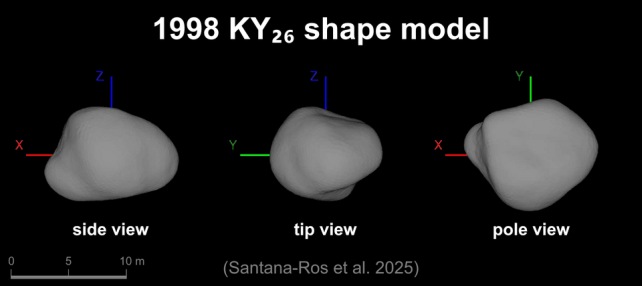
A model of what KY26 may look like. (Original model by Toni Santana-Ros et al. (2025); edited by Nrco0e/Wikimedia Commons, CC BY 4.0)

The rocks that populate interplanetary space generally fall into two broad categories – asteroids and comets.

Asteroids are mostly lumps of rock, whereas comets contain ice that, as it sublimates into gas and escapes into space, can give the comet a bit of a shove beyond the forces applied by gravity as it orbits the Sun.

The image that likely comes to mind when you think of a comet is a shimmering, hazy orb trailed by luminous streamers. But not all comets are built alike.

What we call dark comets are so named because their cometary activity is effectively invisible. They’re thought to spew out gases just like an ordinary comet, without producing the spectacular visible tails normally associated with them.

They look just like ordinary asteroids, with a little added acceleration.

This is what KY26 may look like. The small asteroid rotates once every 5.35 minutes, and its trajectory shows unusual acceleration perpendicular to the plane of its orbit. So naturally, scientists have considered whether it could be one of these dark comets.

One of the defining characteristics of comets is their icy composition, which gives scientists an easy way to check their cometary ID.

All you have to do is take their temperature.

This is what Hansen and Hirabayashi did. Or rather, they combined what is known about KY26 – its size, its orbit, its reflectivity, and its likely composition – to model temperatures across its surface and deep inside.
A Mysterious Asteroid Is Accelerating Through Space. A Leading Explanation Is Now in Doubt.
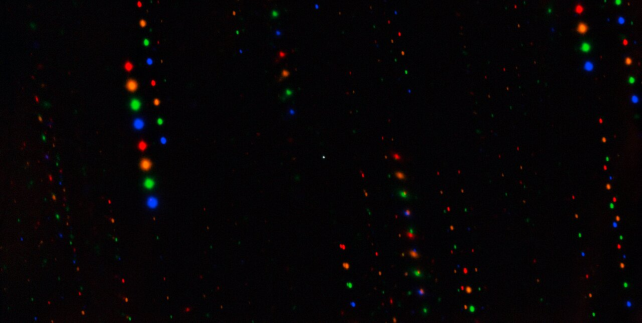
Actual photo of KY26 released in 2025 using Gemini South. The asteroid is the tiny white dot in the center. (International Gemini Observatory/NOIRLab/NSF/AURA/T. Santana-Ros)

For buried water ice to survive over long periods, temperatures need to remain below around 145 Kelvin (-128 degrees Celsius).

But even the coldest regions of KY26, the researchers found, have an average temperature of at least 212 Kelvin (-61 degrees Celsius) over the course of its orbit around the Sun. That’s deathly cold for a human, sure – but far too warm for cometary ice to hang around.

At these temperatures, the researchers calculated that even if water ice made up 1 percent of KY26’s mass, it would all disappear in just over 2,000 years. And if that ice were responsible for the asteroid’s unusual acceleration, it would be gone in just 62 years.

KY26 may be billions of years old – but even so, there is an important caveat. It’s not clear how long it has occupied its current orbit. So it’s still possible that it has ice – but between this result and an earlier paper tracing KY26 to a potential asteroid belt origin, that possibility is shrinking.

So what could be shoving KY26 off the straight-and-narrow? Well, we can still look at good old peer pressure – if peer pressure means radiation pressure from the Sun. Sunlight exerts a small but potentially powerful enough force that it could be responsible for the asteroid’s apparent delinquency.

The great news is that we may find out for certain very soon. The Japanese space agency’s Hayabusa2 spacecraft is making its way toward KY26 even as you read these words, with a rendezvous slated for July 2031.

Accelerate all you want, KY26. You can’t hide forever.

The research has been published in Icarus.

This article was fact-checked by Peter Dockrill and edited by Peter Dockrill. While we pride ourselves on our process, we are only human. If you spot a mistake, please let us know.


Source link

Previous Post
Less Than 42 Minutes of Bright Light Daily Is a Stronger Predictor of Dementia Than Obesity, Study Finds

Less Than 42 Minutes of Bright Light Daily Is a Stronger Predictor of Dementia Than Obesity, Study Finds