


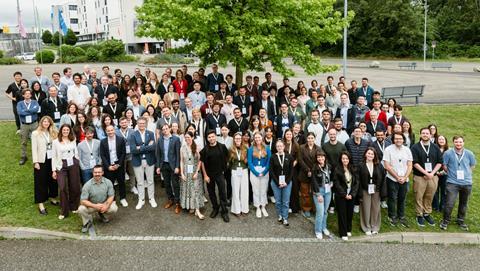
At the June 2025 annual meeting of NCCR Catalysis in Zurich, we asked everyone in the room to scan a QR code and spend 45 minutes answering questions about sustainability practices in the field of chemistry. Not about developing better catalysts, reactions or processes, but about how researchers incorporate different dimensions of sustainability into their everyday work, and what would help them do more.
Eighty-eight participants, spanning different disciplines and career stages within the consortium, contributed around 900 free-text answers. The exercise generated a paper in Green Chemistry, highlighting barriers to sustainability beyond the lab. Here, we offer a complementary perspective: how the exercise came about, what it took to run it from inside a consortium dedicated to sustainable chemistry, and what it can – and cannot – tell us.
NCCR Catalysis was set up in 2020 as Switzerland’s National Centre of Competence in Research for sustainable chemistry. To better connect the broader dimensions of sustainability with the development of chemical innovations, the NCCR Catalysis leadership consulted the community on how to integrate social sciences into the consortium’s research activities. In 2024, an open call brought social scientists into the consortium, creating new opportunities for collaboration with its established chemical sciences community. Among the co-authors of this article are social scientists who joined the consortium through this initiative, for whom chemistry was (more or less) new territory, and established members of NCCR Catalysis, including some who helped initiate the call.
We will not pretend that bringing these social sciences perspectives into a chemistry consortium was frictionless
The social scientists started their work with exploratory interviews: one scientist at a time, then transcribing and analysing. Those interviews, whose full analyses are on the way, revealed a panoply of views on what sustainability means – but, more importantly, a disconnect between established sustainability frameworks and everyday research practices. Many researchers were unfamiliar with these frameworks or had never explicitly considered how their broader objectives related to their own work.
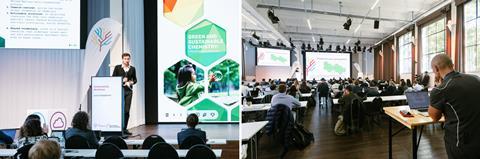
As interviews were focusing on the senior level of the consortium, discussions with the NCCR Catalysis management team led to the idea of complementing them with a consortium-wide survey at the annual meeting. While the interviews provided individual perspectives in depth, the survey offered a broader picture of how sustainability is understood and integrated into research. So, we rebuilt part of our interview questions around the 10 objectives of the UN Environment Programme’s Green and Sustainable Chemistry framework, asking of each: how, if at all, does your work already address this, and what would help you do more? This helped us understand how researchers connect broader sustainability objectives with their scientific activities, and what makes these connections difficult.
We will not pretend that bringing these social sciences perspectives into a chemistry consortium was frictionless. But such challenges are hardly unique to this collaboration: differences in vocabulary, methods and priorities are familiar even between chemists and chemical engineers. What mattered to us is how the specific differences in this collaboration could stimulate reflection, challenge assumptions and converge into a collective research dynamic.
What made such a study possible is indeed a combination of several factors: an interdisciplinary research environment that encouraged the exchange of perspectives (and especially the visibility of minoritarian perspectives from the social sciences); the opportunity to engage the wider consortium through a short and accessible survey; a format in which every participant could speak openly; and a rigorous process of coding, analysing, and interpreting the survey results through discussion among the authors. In a few words, the study required a collegial spirit, with approaches and conclusions argued out together and shared across disciplinary boundaries.
What can we learn from this experience?
Our survey reflects self-reported perspectives from one research consortium; other stakeholders, or even the same research community at another point in time, might offer different views. It captures only part of the complex challenge of sustainability transitions. Its findings should therefore be taken less as a universally applicable diagnosis of the chemistry community, and more as valuable insights into the practices and challenges of a specific research environment. At the same time, the study offers a unique methodology to document these matters that other research organisations could adapt to their own contexts.
The value of these findings becomes clear when considering their implications. Our respondents did not ask for new or more refined sustainability frameworks but the conditions under which existing ones can be put into practice: evaluation and publication criteria that make sustainability claims legible, time to meet them, working interfaces with industry and regulators, and the staged phasing out of research lines that persist out of inertia.
For NCCR Catalysis, the survey offers more than a snapshot of researchers’ perceptions. It has helped us identify where sustainability objectives are already integrated into our research and where further efforts are needed, providing insights that can inform discussions on research priorities, training, and the conditions needed to translate scientific advances into sustainable solutions. For educators, it is a reminder that much work is still needed to embed sustainability in chemistry education.
If the next generation of chemists and chemical engineers learns to master concepts such as life-cycle assessment or planetary boundaries and learns to work with social scientists as a matter of basic curriculum, exercises like ours will stop being isolated experiments. Finally, for the field of sustainable chemical sciences, we hope our survey can make complex knowledge about sustainability actionable without losing nuance. Beyond the technical questions, we need to understand the organisational, cultural and economic conditions that shape what researchers can achieve – and how these can evolve through collaboration with others. If such reflection becomes routine across the sciences concerned with sustainable chemical innovations and beyond, our research will have done its job.


